
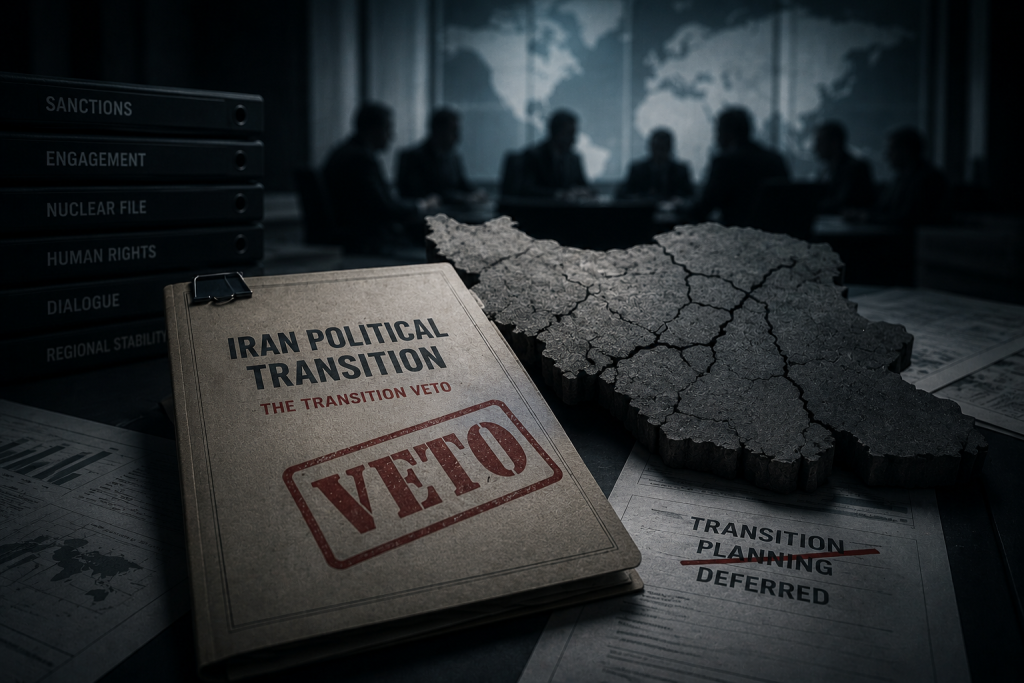
How Foreign Governments Keep Iran’s Political Future in Permanent Suspension
Introduction
The Transition Veto describes a recurring pattern in international policy towards Iran. If January 2026 did not fundamentally change the way foreign governments approached the Islamic Republic, it is reasonable to ask what possibly could. That question lies at the heart of this article. The debate over Iran’s political transition has long been framed around familiar arguments: uncertainty, regional instability, a fragmented opposition and the absence of a viable alternative. Those arguments have shaped international policy for years. After decades of documented repression, repeated nationwide uprisings and one of the most consequential episodes of mass political violence in the history of the Islamic Republic, they deserve to be examined again.
Foreign governments have never lacked policies towards the Islamic Republic. They have developed sanctions regimes, negotiated over the nuclear programme, coordinated regional security, protected maritime routes, responded to hostage diplomacy and invested considerable diplomatic resources in managing successive crises. What has received far less attention is a different question altogether: how should governments prepare for Iran after the Islamic Republic? Compared with the effort devoted to managing the existing regime, remarkably little institutional attention has been directed towards the political, constitutional and administrative realities that would inevitably accompany its eventual collapse.
That imbalance matters because a political transition cannot be improvised. Restoring state institutions, rebuilding the economy, maintaining public order, re-establishing the rule of law and recognising legitimate political authority all require preparation long before a transition begins. Waiting until the existing system fails is not a transition strategy. It is an admission that no transition strategy exists.
January 2026 exposed that weakness more clearly than any previous event. The killings did not reveal anything fundamentally new about the Islamic Republic. Its record of repression, transnational violence and systematic human rights abuses had already been documented for decades. What January exposed was something else. It tested the assumptions that had shaped international policy towards Iran for years. Governments condemned the killings, expanded sanctions and adopted stronger political language. Even so, the underlying structure of policy changed very little. The Islamic Republic continued to be treated as the essential interlocutor for almost every major issue concerning Iran, from regional security to nuclear diplomacy.
This article argues that the absence of meaningful transition planning should not be dismissed as simple caution or diplomatic pragmatism. Repeated over many years, reinforced through institutional habits and reproduced across different policy communities, it has become a pattern in its own right. Governments do not need to coordinate their policies or openly support the Islamic Republic to produce the same practical outcome. When the existing regime is consistently treated as the only realistic framework for engagement, preparation for Iran beyond it is repeatedly postponed. The result is not an official policy of regime preservation. It is a policy environment in which the future is continuously deferred while the present remains the only subject of serious planning.
The arguments developed in this article build upon earlier IranSTO research into post-Islamic Republic transition planning and the international assessment of Reza Pahlavi’s political legitimacy. They also draw on previous investigations into the institutional incentives that sustain unresolved crisis and the gatekeeping structures that shape which Iranian voices acquire international recognition.
Taken together, those studies point towards a broader conclusion. The central problem is not that governments have failed to understand the Islamic Republic. Nor is it that they all pursue identical objectives. The problem is that different governments, institutions and policy communities have repeatedly arrived at remarkably similar outcomes. They have become substantially better prepared to manage the continuation of the Islamic Republic than to prepare for Iran beyond it. This article argues that this recurring pattern has become one of the defining characteristics of contemporary international policy towards Iran. It is this pattern that we describe as The Transition Veto.
Chapter One
A Foreign Policy Built to Manage, Not to Transition
Foreign policy rarely reveals its priorities through official statements alone. It reveals them through the problems governments choose to prepare for and, just as importantly, the questions they leave unanswered. For more than four decades, international policy towards the Islamic Republic has generated extensive planning around sanctions, nuclear negotiations, regional security, maritime security, counter-proliferation and crisis management. One question, however, has remained largely absent from mainstream policy planning. What happens when the Islamic Republic no longer governs Iran?
That omission is difficult to explain away. Political transition is not an unusual event in international affairs. Governments routinely prepare for constitutional change, leadership succession, post-conflict reconstruction and institutional continuity in countries facing prolonged instability. Foreign ministries, defence departments and international organisations regularly produce contingency plans for political scenarios that may never materialise. Iran has largely been treated differently. Instead of preparing for the possibility that the current political order may eventually come to an end, policy has overwhelmingly assumed that the Islamic Republic will remain the framework through which every major international issue concerning Iran must continue to be managed.
The consequences of that assumption extend well beyond diplomacy. Once negotiations, sanctions and security policy are built around the expectation that the existing regime will endure, transition gradually moves from the centre of strategic thinking to its margins. Questions about constitutional continuity, public administration, judicial reform, economic stabilisation and the restoration of normal state institutions receive comparatively little sustained attention. They are rarely dismissed outright. More often, they are simply postponed. Over time, postponement develops its own institutional momentum. Diplomatic expertise, financial resources and political attention continue to accumulate around managing the Islamic Republic, while transition planning for Iran beyond the regime remains fragmented, intermittent and, in many areas, largely absent.
Supporters of this approach usually describe it as pragmatism. Governments, they argue, must engage with the authorities that exercise power today rather than speculate about uncertain political futures. As a principle of day-to-day diplomacy, that argument is entirely understandable. States negotiate with governments, not with possibilities. The difficulty begins when a practical necessity evolves into a long-term strategic assumption. A foreign policy designed to manage today’s realities can gradually lose the ability to prepare for tomorrow’s. In Iran, that distinction has become increasingly important. The longer political transition is treated as a distant contingency rather than a foreseeable policy challenge, the more international strategy becomes invested in the continuity of the very system whose instability it repeatedly seeks to contain.
The language of official policy reflects the same pattern. Stability, de-escalation, dialogue, regional security and non-proliferation dominate diplomatic discussions about Iran. Each objective is understandable on its own. Taken together, however, they reveal a policy framework primarily organised around limiting the consequences of the Islamic Republic rather than preparing for what comes after it. Managing an existing regime and preparing for its eventual replacement are not competing responsibilities. A comprehensive foreign policy should be capable of doing both. In practice, the second has remained consistently underdeveloped.
This article does not argue that governments secretly coordinated to preserve the Islamic Republic. The available evidence does not support such a conclusion, nor does the argument depend upon it. The more significant finding is the existence of a persistent policy asymmetry. Governments have invested substantial diplomatic, political and institutional resources in negotiating with, sanctioning, deterring and containing the Islamic Republic. Comparable effort has rarely been devoted to examining how political authority after the Islamic Republic might be recognised, stabilised and supported. That imbalance forms the foundation of the argument developed throughout this article.
The events of January 2026 did not create this problem. They exposed it. By the time the killings forced governments to confront the consequences of decades of policy, the underlying assumptions had already become deeply embedded. International policy was considerably better prepared to manage the continuation of the Islamic Republic than to prepare for the possibility that Iran would one day have to move beyond it.
Chapter Two
The Logic of the Transition Veto
Political transitions are not delayed only by military force, emergency legislation or direct repression. They can also be delayed by policy assumptions that become so deeply embedded they are no longer recognised as political choices. This article argues that this is how the Transition Veto operates. It is not a formal doctrine, a written policy or a coordinated international strategy. It is the cumulative effect of decisions that repeatedly postpone preparation for political change while treating the continuation of the existing governing system as the default framework for international engagement.
Unlike a formal veto exercised through law or diplomacy, the Transition Veto works through repetition. Each individual decision can appear entirely reasonable when viewed on its own. Preventing regional escalation, reducing nuclear risk, protecting international shipping, securing the release of detained foreign nationals or preserving diplomatic channels are all legitimate foreign-policy objectives. The difficulty arises when those priorities consistently displace serious preparation for political transition. What begins as tactical pragmatism gradually hardens into a strategic habit. Iran beyond the Islamic Republic remains theoretically possible, but institutionally absent.
This process does not require governments to support the Islamic Republic. Many openly condemn its conduct, sanction its officials and document its human rights record. The contradiction lies elsewhere. Diplomatic practice continues to treat the regime as the indispensable political authority through which almost every major issue concerning Iran must eventually be addressed. As long as that assumption remains intact, the political space for preparing alternatives inevitably narrows.
Uncertainty is often presented as the strongest justification for this approach. Policymakers warn of state collapse, regional conflict, institutional fragmentation, and an unpredictable succession. Those concerns are real and should not be dismissed. Every political transition carries risk, particularly in highly centralised systems of power. Yet uncertainty cannot justify postponing preparation indefinitely. In every other area of international policy, uncertainty is precisely why governments prepare. They develop contingency plans for financial crises, armed conflict, humanitarian emergencies and leadership succession because uncertainty is expected, not because certainty already exists. Treating Iran differently reflects a policy choice rather than an unavoidable feature of political transition.
The same pattern appears in discussions about political alternatives. The claim that no viable alternative exists has become a familiar feature of diplomatic debate, yet it often functions as an assumption rather than the conclusion of sustained analysis. Comparatively little institutional effort has been devoted to evaluating competing sources of political legitimacy, constitutional continuity or transitional governance. Instead, the perceived absence of an alternative repeatedly serves as the justification for the lack of preparation. The argument gradually turns in on itself. Transition is deferred because no recognised alternative exists, while no alternative receives sustained institutional attention because transition itself continues to be deferred. Questions surrounding political legitimacy and alternative leadership illustrate how this circular reasoning has shaped wider discussions about Iran’s future.
Over time, this logic becomes self-reinforcing. Governments invest resources where policy already exists. Expertise grows around sanctions, negotiations, nuclear monitoring and regional deterrence because those are the areas receiving sustained political attention. Far less institutional knowledge develops around constitutional transition, administrative continuity or post-authoritarian reconstruction. The imbalance is therefore not simply intellectual. It becomes bureaucratic. The longer the policy concentrates on managing the existing regime, the more difficult it becomes to build the expertise required for managing what comes after it.
The Transition Veto should therefore be understood as a pattern rather than a policy. It does not depend upon explicit support for the Islamic Republic, nor does it require coordination between governments pursuing identical objectives. It functions because immediate crises consistently receive detailed policy attention while preparation for Iran beyond the Islamic Republic remains secondary. Over time, that repeated imbalance becomes part of the architecture of international policy itself.
Chapter Three
January 2026: The Policy Stress Test
Foreign policy is not ultimately judged by the principles it declares. It is judged by the decisions governments make when those principles are tested. Extraordinary events force policymakers to confront assumptions that ordinary diplomacy can postpone for years. January 2026 was one of those moments. The mass killings across Iran did not simply expose another cycle of repression. They confronted foreign governments with a question they had consistently avoided. Could the existing approach to the Islamic Republic still be defended after violence on such a scale?
By the beginning of 2026, governments could no longer claim that they lacked information about the nature of the regime. Decades of documented human rights abuses, nationwide protests, transnational repression, hostage diplomacy, regional proxy warfare and nuclear confrontation had already established an extensive public record. January did not reveal a new reality. It removed the last credible argument that the international community still needed more evidence before taking the political future of Iran seriously.
The immediate response was both visible and forceful. Governments condemned the killings. New sanctions were announced. Senior officials adopted stronger language, and calls for accountability became more prominent than in previous rounds of repression. European debates over the designation of the Islamic Revolutionary Guard Corps gained renewed momentum, while discussions about crimes against humanity and international accountability moved closer to the centre of diplomatic debate. These developments mattered. They reflected a genuine recognition that the scale of the violence demanded a stronger response than routine expressions of concern.
The more important question, however, is not whether governments condemned the killings. It is whether those condemnations changed the underlying assumptions of international policy.
The evidence suggests they did not.
The language became stronger. The policy remained remarkably familiar.
Governments continued to approach the Islamic Republic as the principal political authority through which almost every major issue concerning Iran would have to be managed. Nuclear diplomacy continued to revolve around the existing regime. Regional security calculations still assumed its continued existence. Diplomatic engagement, sanctions policy and crisis management all remained organised around the expectation that the Islamic Republic would continue to function as the central actor in Iran.
This distinction is fundamental because recognising atrocities and preparing for political transition are not the same policy. A government can condemn systematic repression while still organising its long-term strategy around the expectation that the same political system will remain in power. January demonstrated exactly that contradiction. International policy became more willing to acknowledge the brutality of the regime, but it did not become equally willing to prepare for the possibility that the regime itself might eventually disappear.
That continuity deserves closer attention. Diplomacy often requires governments to engage with authorities whose conduct they oppose. No serious foreign policy can operate on the assumption that dialogue should end whenever grave abuses occur. That is not the argument made here. The question is different. Why did an event of this magnitude fail to trigger equally serious preparation for Iran after the Islamic Republic? If the largest episode of political violence in the history of the regime did not prompt sustained planning for constitutional transition, administrative continuity, economic recovery and the recognition of legitimate political authority, what event realistically would?
The months that followed January provide a revealing answer. International attention remained focused on familiar priorities: containing regional escalation, preventing nuclear proliferation, maintaining diplomatic channels, expanding sanctions and managing immediate security risks. Each objective could be defended on its own. Together, however, they reveal a broader pattern. Governments became increasingly prepared to respond to the consequences of the Islamic Republic while remaining comparatively unprepared for the possibility that the Islamic Republic itself might cease to govern Iran.
The difference between reactive policy and strategic preparation is often overlooked. Reactive policy addresses the behaviour of an existing government. Strategic preparation asks what follows if that government no longer exists. Throughout the period following January 2026, the first question dominated international debate. The second remained largely absent. Public discussion concentrated on sanctions, accountability mechanisms, legal designations and diplomatic pressure. Comparatively little attention was devoted to constitutional continuity, institutional reconstruction or the practical requirements of democratic transition. Even discussions about post-Islamic Republic governance remained largely outside mainstream foreign-policy planning.
This imbalance shaped more than diplomacy. It also shaped expectations. When governments devote years to planning for negotiations, deterrence and crisis management while investing relatively little in transition planning, the existing governing system gradually comes to appear as the only realistic framework through which policy can operate. In this way, the response to January unintentionally reinforced the same assumption that the crisis should have compelled governments to re-examine.
January 2026 should therefore be remembered as more than a humanitarian catastrophe. It was the most significant test of international policy towards Iran in decades. The question was never whether governments recognised the brutality of the Islamic Republic. They did. The question was whether that recognition fundamentally altered the way they prepared for Iran’s political future. The available evidence suggests that while the rhetoric of international policy changed, its underlying structure remained largely intact.
This conclusion also reflects a broader pattern documented throughout earlier IranSTO investigations into international accountability for mass killings, the role of international actors that enabled repression, and the wider architecture of impunity. Those investigations examined the response to the crimes themselves. This article examines what that response reveals about the assumptions guiding international policy towards Iran.
Chapter Four
Condemnation Without Consequence
January 2026 changed the language of international diplomacy. It did not fundamentally change the structure of international policy.
Governments responded with stronger public statements, additional sanctions and increasingly severe descriptions of the Islamic Republic’s conduct. Expressions such as accountability, impunity and crimes against humanity became more prominent than they had been during previous waves of repression. In political terms, the response was visibly stronger. Few governments attempted to minimise what had happened, and many openly acknowledged that the violence represented a profound escalation.
That shift should not be dismissed. Public condemnation matters. Diplomatic language shapes international expectations, influences legal processes and signals political priorities. The question, however, is whether a stronger condemnation was accompanied by an equally significant change in long-term strategy.
The available evidence suggests that it was not.
The central assumptions guiding policy remained largely intact. Governments became more willing to condemn the behaviour of the Islamic Republic, yet they continued to organise their long-term approach around the expectation that the same governing structure would remain the essential political interlocutor. The language became more severe. The strategic framework remained remarkably familiar.
This distinction matters because condemning atrocities and preparing for political transition are fundamentally different responsibilities. Governments can acknowledge systematic repression while continuing to build their policies around the expectation that the same regime will remain in power. January 2026 demonstrated exactly that contradiction. The international response evolved in tone without undergoing a comparable transformation in direction.
The pattern became increasingly clear as the immediate political shock faded. International attention returned to familiar priorities: sanctions, regional security, nuclear diplomacy, maritime stability and crisis management. None of these objectives was unreasonable. Each addressed genuine foreign-policy concerns. Collectively, however, they reflected continuity rather than strategic reassessment. The focus remained on managing the consequences of the Islamic Republic rather than preparing for the political future of Iran.
That imbalance deserves careful attention. Governments recognised that January represented far more than another episode of domestic unrest. Official statements described widespread repression, systematic violence and serious violations of fundamental rights. Those descriptions inevitably raise broader policy questions. If a government is publicly recognised as responsible for crimes on this scale, should long-term policy continue to assume its indefinite continuity? At what point does diplomatic condemnation require governments to prepare for a different political future rather than simply react to the existing one?
These questions rarely became part of mainstream policy planning. Considerable institutional effort was devoted to documenting abuses, expanding sanctions and strengthening accountability mechanisms. Far less attention was directed towards constitutional continuity, administrative reconstruction, legitimate political authority or democratic transition. The same imbalance identified in The Architecture of Impunity also became visible here. International institutions increasingly developed mechanisms for responding to abuses after they occurred, while comparatively little effort was devoted to preparing for the political conditions that might prevent similar abuses in the future.
This is where the gap between condemnation and consequence becomes most visible. Foreign policy reveals its priorities not only through what it denounces, but through what it prepares for. Governments routinely develop detailed contingency plans for military conflict, economic instability, migration crises and humanitarian emergencies because they recognise those possibilities as sufficiently serious to justify preparation. The relative absence of comparable planning for Iran after the Islamic Republic suggests that political transition has continued to occupy a secondary place within the hierarchy of international priorities.
None of this demonstrates that governments consciously sought to preserve the Islamic Republic. The argument developed in this article is narrower and, in many respects, more significant. Public condemnation became stronger. Legal measures expanded. Diplomatic pressure increased. Yet the broader architecture of policy continued to revolve around managing the existing regime rather than preparing for Iran beyond it. That gap between recognition and preparation became one of the clearest expressions of the Transition Veto.
Chapter Five
The Negotiating Partner Paradox
Diplomacy requires negotiation. No serious foreign policy can function without engaging governments whose behaviour it opposes. States have negotiated with rivals, adversaries and even active military opponents throughout modern history. The existence of negotiations with the Islamic Republic is therefore not, by itself, evidence of strategic failure. The more important question is whether negotiation remained one foreign-policy instrument among many, or whether it gradually became the framework through which almost every major issue concerning Iran came to be understood.
Over time, the second pattern became increasingly visible.
The Islamic Republic was repeatedly described as a source of regional instability, nuclear risk, transnational repression and systematic human rights abuses. At the same time, it continued to be treated as the principal political authority through which those very problems would ultimately have to be managed. The contradiction is difficult to ignore. The same governing structure identified as the source of successive crises also remained the central partner expected to resolve them.
That contradiction became even clearer after January 2026. Governments expanded sanctions, adopted stronger political language and intensified diplomatic pressure. Yet their broader strategic assumptions changed very little. Progress on nuclear negotiations, regional security, sanctions implementation and wider regional stability continued to depend upon engagement with the same political system. The practical consequence was unmistakable. Confidence in the legitimacy of the regime declined, but its position at the centre of international policy remained largely intact.
The problem is not that governments kept diplomatic channels open. Responsible foreign policy often requires communication during periods of profound political conflict. The problem emerges when diplomacy with the existing authorities is not matched by equally serious preparation for the possibility that those authorities may no longer govern. Negotiation without transition planning gradually creates institutional dependency. Policy becomes increasingly organised around preserving the conditions necessary for continued dialogue instead of preparing for political change should that dialogue eventually fail.
That dependency shapes institutions as much as it shapes diplomacy. As governments devote greater political and bureaucratic resources to negotiations with the Islamic Republic, expertise naturally accumulates around understanding the existing regime. Intelligence assessments, diplomatic reporting and strategic planning all become centred on the current political system. Comparatively little institutional capacity develops around constitutional continuity, post-authoritarian governance or the emergence of legitimate political authority after the regime. Over time, negotiations appear indispensable partly because policy has invested so little in developing credible alternatives.
The same logic extends beyond foreign ministries. Policy institutes, international organisations, security forums and diplomatic conferences frequently organise discussions around influencing the behaviour of the Islamic Republic rather than preparing for its eventual replacement. Political transition is acknowledged as a theoretical possibility, yet it rarely becomes an operational priority. As a result, the existing regime continues to dominate institutional thinking even when many policymakers openly recognise that it remains a long-term source of regional instability.
This helps explain why the international response to January 2026 produced stronger condemnation without producing a comparable shift in strategic direction. The negotiating partner remained unchanged because international policy had gradually become organised around the assumption that no other governing framework was sufficiently prepared to take its place. That assumption was reinforced by years of limited institutional assessment of alternative political and by the continued preference for managing immediate crises rather than preparing for political transition.
Negotiations, therefore, became more than a diplomatic instrument. They evolved into one of the mechanisms through which the Transition Veto continued to operate. The longer the policy remained centred on engagement with the existing regime, the more difficult it became for governments to imagine, evaluate and prepare for Iran beyond it.
Chapter Six
The Alternative They Never Seriously Evaluated
Few assumptions have shaped international policy towards Iran more profoundly than the claim that no viable political alternative exists. The phrase appears regularly in diplomatic discussions, policy papers and media commentary. It is often presented as a self-evident conclusion that justifies continued engagement with the Islamic Republic despite growing recognition of the regime’s systemic failures. Yet far less attention has been devoted to a more fundamental question. How was that conclusion reached?
Determining whether a political alternative is viable requires evidence, not assumptions. Questions of legitimacy, public recognition, institutional capacity, constitutional continuity, organisational networks and transitional leadership all demand systematic assessment. Governments routinely carry out similar evaluations when analysing emerging political actors or potential successor authorities elsewhere in the world. In the case of Iran, however, comparable institutional effort has often been far more limited. The absence of a recognised alternative has frequently been treated as an established fact rather than the outcome of a sustained analytical process.
That distinction matters because assumptions shape institutions. If policymakers begin from the premise that no viable alternative exists, research, diplomatic attention and strategic planning naturally become concentrated on understanding the existing regime. Institutional resources follow the same direction. Over time, this reinforces the original assumption. The less seriously, alternative sources of political authority are examined, the easier it becomes to conclude that no credible alternative has emerged.
The same dynamic extends well beyond government. Universities, policy institutes, international organisations, media outlets and diplomatic forums all influence how political legitimacy is perceived. The voices most frequently invited into these spaces are often those regarded as institutionally familiar, professionally accessible and diplomatically manageable. That process does not necessarily reflect deliberate political preference, but it does shape which actors receive sustained international attention and which remain comparatively underexamined. As a result, institutional recognition and political legitimacy can gradually become confused, even though they are not the same thing. Earlier IranSTO research into diaspora gatekeeping and institutional recognition examined this dynamic in greater detail.
This distinction is particularly important when assessing Iran’s political future. Public legitimacy cannot be measured solely through institutional access, international visibility or professional networks. Nor can the absence of institutional recognition be taken as evidence that political legitimacy does not exist. A serious assessment requires governments to examine where authority may emerge within Iranian society itself rather than relying exclusively on those actors already embedded in international policy discussions.
It is within that broader framework that debates surrounding Reza Pahlavi’s political legitimacy should be understood. The central issue is not whether foreign governments should endorse a particular constitutional model or political figure. The more fundamental question is whether competing sources of national legitimacy have been assessed according to consistent standards. Historical continuity, public recognition, organisational capacity and evidence of popular support deserve the same level of scrutiny regardless of whether they align with existing institutional preferences. Selective evaluation weakens policy because it replaces empirical assessment with institutional convenience.
The same asymmetry appears in wider discussions of the Iranian opposition. Fragmentation is frequently presented as evidence that transition lacks credible leadership. Fragmentation undoubtedly creates serious challenges, but it also requires explanation. International policy cannot simultaneously devote limited effort to evaluating potential sources of political authority while treating the absence of internationally recognised leadership as proof that no viable alternative exists. Under those conditions, the diagnosis begins to reinforce the outcome it claims merely to describe.
The central question is therefore not whether one political actor should automatically replace another. The question is whether international policy has invested sufficient effort in evaluating the range of political possibilities that may shape Iran after the Islamic Republic. As long as the assumption of “no viable alternative” continues to precede systematic analysis instead of emerging from it, that assumption will remain one of the most durable mechanisms through which the Transition Veto continues to reproduce itself. The broader relationship between international legitimacy and political representation demonstrates why this distinction extends beyond individual political figures and reaches the wider architecture of international engagement with Iran.
Chapter Seven
Stability for Whom?
Stability has become one of the most frequently repeated objectives in international policy towards Iran. It appears in government statements, diplomatic initiatives and security assessments almost as a self-evident goal. Preventing regional escalation, protecting international shipping, reducing nuclear risk, avoiding refugee flows and limiting military confrontation are all presented as efforts to preserve stability. Individually, these objectives are understandable. Collectively, however, they raise a more fundamental question.
Stability for whom?
For decades, many governments have identified the Islamic Republic as a principal source of instability in the Middle East. Official statements have linked the regime to regional proxy warfare, missile proliferation, transnational repression, hostage diplomacy, cyber operations and repeated violations of international obligations. At the same time, many of those same governments have continued to organise their long-term strategy around the assumption that regional stability ultimately depends upon engagement with that very system. This contradiction sits at the heart of contemporary Iran policy.
The consequences become clearer when viewed over a longer period. Nuclear negotiations repeatedly return. Regional crises recur. Maritime confrontations continue. Sanctions are expanded, adjusted and expanded again. New rounds of human rights abuses produce new rounds of diplomatic condemnation. Yet the underlying structure of policy changes remarkably little. Governments respond to successive crises, but the same strategic assumptions continue to shape their response. Stability becomes an objective that is continually pursued without resolving the conditions that repeatedly undermine it.
That does not mean governments are acting irrationally. States are expected to protect their own security interests. Preventing immediate conflict, limiting nuclear proliferation and safeguarding international trade are legitimate responsibilities. The difficulty begins when those priorities become the dominant framework through which Iran itself is understood. At that point, Iran risks being treated primarily as a regional security challenge rather than as a nation whose political future also demands preparation.
This distinction matters because the interests of governments are not always identical to the long-term interests of nations. A strategy that successfully reduces immediate regional risks may still postpone the political conditions necessary for lasting stability inside Iran. Managing today’s crisis and preparing for tomorrow’s political transition are not mutually exclusive responsibilities. A comprehensive foreign policy should be capable of pursuing both.
Instead, the language of stability has often encouraged a different habit. Every delay in preparing for a political transition can be justified by the possibility that change may generate greater instability. Every postponement appears prudent because uncertainty always exists. Yet postponement carries its own risks. Institutions continue to weaken. Political conflicts become more deeply entrenched. Opportunities for an orderly transition become progressively more difficult to achieve. In attempting to avoid the uncertainty associated with political change, governments may unintentionally increase the long-term cost of that change when it eventually occurs.
The events of January 2026 brought this dilemma into sharp focus. Governments recognised the scale of the killings, condemned the repression and strengthened political pressure against the Islamic Republic. Even so, the dominant strategic objective remained the management of immediate risks rather than preparation for Iran beyond the regime. Stability continued to be measured primarily in terms of regional containment, while comparatively little attention was devoted to the institutional requirements of Iran’s political transition.
This illustrates the central dilemma of the Transition Veto. Political transition is often portrayed as a threat to stability. Yet the continued absence of transition planning may itself become a source of future instability. A policy that repeatedly postpones preparation does not eliminate political risk. It simply transfers that risk into the future, where it is likely to become more complex and more costly.
The issue, therefore, is not whether governments should pursue stability. They should. The real question is what kind of stability international policy has sought to preserve. Stability built upon the indefinite continuation of a governing system that repeatedly generates repression at home and instability abroad cannot easily be described as durable. It represents the management of recurring crises rather than a strategy capable of resolving them.
Chapter Eight
The Cost of Permanent Suspension
By this stage, a broader pattern begins to emerge.
The questions examined throughout this series were never separate problems. They were different expressions of the same policy framework. What initially appeared to be independent debates about succession, political legitimacy, donor incentives, media representation and diplomatic practice increasingly point towards a single conclusion. Each describes a different mechanism through which preparation for Iran beyond the Islamic Republic has been repeatedly delayed, while the existing governing system has remained the principal reference point for international policy.
The absence of transition planning did not develop in isolation. It reflected an international environment in which political continuity was consistently treated as more practical than political transformation. The debate surrounding Reza Pahlavi’s political legitimacy was never simply about one political figure or one constitutional model. It exposed a broader institutional reluctance to evaluate competing sources of national legitimacy according to consistent standards. At the same time, the permanent crisis industry demonstrated how donor structures, professional networks and institutional incentives can gradually become more sustainable when crises remain unresolved than when political transitions succeed. Finally, diaspora gatekeeping and international representation showed how institutional familiarity increasingly came to shape which Iranian voices foreign governments and policy institutions repeatedly encountered.
Viewed independently, each of these developments can be explained through its own institutional logic. Together, however, they reveal something much more significant.
Transition planning remains limited because political continuity is assumed.
Political legitimacy remains contested because institutional recognition is uneven.
Permanent crisis becomes professionally sustainable because meaningful transition remains politically deferred.
Representation becomes selective because institutional familiarity is repeatedly mistaken for political authority.
None of these mechanisms, on their own, is capable of preventing political change. Together, however, they reinforce one another. Each strengthens the assumptions upon which the others depend. The result is an international policy environment that becomes progressively better prepared to manage the Islamic Republic than to prepare for Iran beyond it.
This is the broader significance of the Transition Veto.
It is not a diplomatic doctrine.
It is not a formal strategy.
It is not a policy adopted by a single government.
It is the cumulative outcome of many institutions pursuing different objectives through different policy frameworks while repeatedly producing the same practical result.
Foreign ministries seek stability.
Security institutions seek containment.
International organisations pursue accountability.
Policy institutes produce analysis.
Universities generate expertise.
Media organisations look for accessible and familiar sources.
Each activity appears rational when viewed independently. The cumulative effect is something else entirely. The international system steadily expands its capacity to understand, negotiate with and manage the Islamic Republic while investing comparatively little in understanding what follows after it.
The consequences extend well beyond diplomacy. Political transitions cannot be organised after they begin. Constitutional continuity, public administration, judicial reform, economic stabilisation, security-sector transformation and the recognition of legitimate political authority all require preparation before a governing system collapses. Every year in which that preparation is postponed makes a future transition more uncertain, more expensive and more difficult to manage.
January 2026 exposed the practical consequences of this imbalance. Even the largest episode of political violence in the history of the Islamic Republic failed to produce a comparable transformation in strategic planning. Governments adjusted their rhetoric. They expanded sanctions. They strengthened legal measures and accountability efforts. What remained largely absent was systematic preparation for Iran after the Islamic Republic. The obstacle was no longer a lack of information. It was the continued preference for managing the political present rather than preparing for the political future.
This is why the Transition Veto should be understood as the central argument of this series rather than simply the title of its final article. It describes a policy pattern in which different governments, institutions and policy communities repeatedly arrive at the same practical destination. They become increasingly prepared to manage the continuity of the Islamic Republic while remaining comparatively unprepared for the political transition that will eventually follow its end. The cost of that imbalance is not measured only in diplomatic inefficiency. It is measured in the continued suspension of meaningful preparation for Iran’s future.
Conclusion
The central argument of this article is not that foreign governments deliberately chose to preserve the Islamic Republic. Nor is it that diplomacy, sanctions or negotiations were inherently misguided. States inevitably pursue their own security interests, and governments will continue to engage with regimes whose conduct they oppose whenever they judge that engagement to be necessary. The argument developed here is narrower, but ultimately more consequential. International policy has repeatedly prioritised managing the realities of the Islamic Republic while devoting comparatively little institutional attention to preparing for the political future of Iran beyond it.
That imbalance has not been created by a single government, a single institution or a single policy decision. It has emerged gradually through the interaction of diplomatic practice, security priorities, institutional incentives and analytical assumptions that have reinforced one another over time. Each decision may appear rational when considered in isolation. Taken together, however, they have produced an international policy environment in which preparation for political transition remains consistently less developed than preparation for managing the existing regime.
January 2026 represented the most significant test of those assumptions in decades. The scale of the killings removed any credible claim that the nature of the Islamic Republic remained insufficiently understood. Governments recognised the brutality of the violence, strengthened sanctions, expanded accountability measures and adopted increasingly uncompromising language. Yet the underlying structure of policy changed far less than the rhetoric surrounding it. The principal diplomatic question remained how to manage the Islamic Republic rather than how to prepare for Iran after it.
This is the broader significance of what this article has described as the Transition Veto. It is not exercised through a formal declaration, a diplomatic resolution or an explicit commitment to preserve the existing regime. It emerges when preparation for political transition is repeatedly deferred, when recognised political authority is assessed unevenly, when unresolved crisis becomes institutionally sustainable and when representation is shaped more by institutional familiarity than by systematic evaluation of national legitimacy. None of these mechanisms alone determines the future of Iran. Together, they help explain why the international community has become considerably better prepared for the continuation of the Islamic Republic than for the political realities that will eventually follow its end.
No governing system is permanent. The relevant policy question has never been whether political change will eventually come to Iran, but whether governments, international organisations and policy institutions will be prepared when it does. A strategy that repeatedly postpones that preparation does not eliminate uncertainty. It merely transfers the costs of uncertainty into the future, where they are likely to become more difficult, more expensive and more dangerous to manage.
The most important challenge facing international policy is therefore no longer understanding the Islamic Republic. Decades of evidence have already established its character, its methods and its regional consequences. The challenge is to begin treating Iran as more than the government that currently rules it. Preparing for Iran beyond the Islamic Republic is not a speculative political exercise. It is a necessary component of responsible foreign policy. The longer that preparation is delayed, the more difficult a future transition is likely to become, not only for the Iranian people but also for the international community that will inevitably have to respond to it.
The Transition Veto is therefore not simply a description of how international policy has operated. It is a framework for examining how policy assumptions shape political outcomes, often without being recognised as assumptions at all. If this article contributes anything to the wider debate, it is the argument that the most consequential question facing international policy is no longer how to manage the Islamic Republic. It is whether the international community is finally prepared to begin preparing for Iran itself.
References & Resources
Official Government and International Sources
Foreign, Commonwealth & Development Office (United Kingdom)
Foreign Secretary Statement on Iran (13 January 2026)
https://www.gov.uk/government/speeches/foreign-secretary-statement-on-iran-13-january-2026
UK Government
UK Announces Sanctions Against Perpetrators of Human Rights Violations in Iran (2 February 2026)
Council of the European Union
Iran: Council Adopts New Sanctions over Serious Human Rights Violations and Iran’s Continued Support to Russia’s War of Aggression Against Ukraine (29 January 2026)
Council of the European Union
EU Terrorist List: Council Designates the Islamic Revolutionary Guard Corps (IRGC) as a Terrorist Organisation (19 February 2026)
Office of the United Nations High Commissioner for Human Rights (OHCHR)
Iran: Türk Says Reports of Violent Protests Are Deeply Disturbing (9 January 2026)
Office of the United Nations High Commissioner for Human Rights (OHCHR)
Iran: After Unprecedented Violence, Priority Must Be Gathering Evidence and Holding Perpetrators Accountable (23 January 2026)
International Atomic Energy Agency (IAEA)
IAEA and Iran: Board Reports
https://www.iaea.org/newscenter/focus/iran/iaea-and-iran-iaea-board-reports
The White House
Fact Sheet: President Donald J. Trump Addresses Threats to the United States by the Government of Iran (6 February 2026)
Academic Literature
Beetham, David. The Legitimation of Power. Palgrave Macmillan, 1991.
Fukuyama, Francis. State-Building: Governance and World Order in the 21st Century. Cornell University Press, 2004.
Huntington, Samuel P. The Third Wave: Democratization in the Late Twentieth Century. University of Oklahoma Press, 1991.
Linz, Juan J., & Stepan, Alfred. Problems of Democratic Transition and Consolidation. Johns Hopkins University Press, 1996.
Mahoney, James. “Path Dependence in Historical Sociology.” Theory and Society, 2000.
O’Donnell, Guillermo, & Schmitter, Philippe C. Transitions from Authoritarian Rule: Tentative Conclusions About Uncertain Democracies. Johns Hopkins University Press, 1986.
Pierson, Paul. “Increasing Returns, Path Dependence, and the Study of Politics.” American Political Science Review, 2000.
Thelen, Kathleen. How Institutions Evolve. Cambridge University Press, 2004.
Tilly, Charles. Coercion, Capital, and European States, AD 990–1992. Blackwell, 1992.
Weber, Max. Economy and Society. University of California Press, 1978.
Previous IranSTO Research
Iran Mass Killings 2026 Report
https://iransto.com/iran-mass-killings-2026-report/
Iran Mass Killings 2026 Report II
https://iransto.com/iran-mass-killings-2026-report-2/
Global Enablers of Iran Repression
https://iransto.com/global-enablers-iran-repression/
IRGC Terror Infrastructure in Europe
https://iransto.com/irgc-terror-infrastructure-europe-designation/
The Architecture of Impunity: How UN Human Rights Procedure and Criminal Inaction Shield Atrocity in Iran
https://iransto.com/architecture-of-impunity-in-iran/
The Reformist Illusion: How the Myth of Moderation Enabled Mass Killing in Iran
https://iransto.com/reformist-illusion-iran-moderation-mass-killing/
Transnational Legitimacy: Diaspora Mediation and Western Institutional Enablement of the Islamic Republic
https://iransto.com/transnational-legitimacy-islamic-republic-diaspora-mediation/
Washington’s Iran Deal Panic: When Domestic Politics Replaces Strategy
https://iransto.com/washington-iran-deal-panic/
Who Benefits From Keeping the Islamic Republic Alive?
https://iransto.com/who-benefits-from-keeping-the-islamic-republic-alive/
Donald Trump, Iran, and the Outcome Test: Why the Islamic Republic Still Survives
https://iransto.com/trump-iran-outcome-test/
The Successor Problem: Why Nobody Is Preparing for a Post-Islamic Republic Iran
https://iransto.com/post-islamic-republic-iran-successor-problem/
The Prince Problem: Why Reza Pahlavi Legitimacy Remains Contested
https://iransto.com/reza-pahlavi-legitimacy/
The Permanent Crisis Industry: How Iran’s Unresolved Transition Became a Political Economy
https://iransto.com/irans-unresolved-transition-permanent-crisis-industry/
The Exile Gatekeepers: Who Decides Which Iranian Voices Reach the World?
https://iransto.com/iranian-diaspora-gatekeepers/