
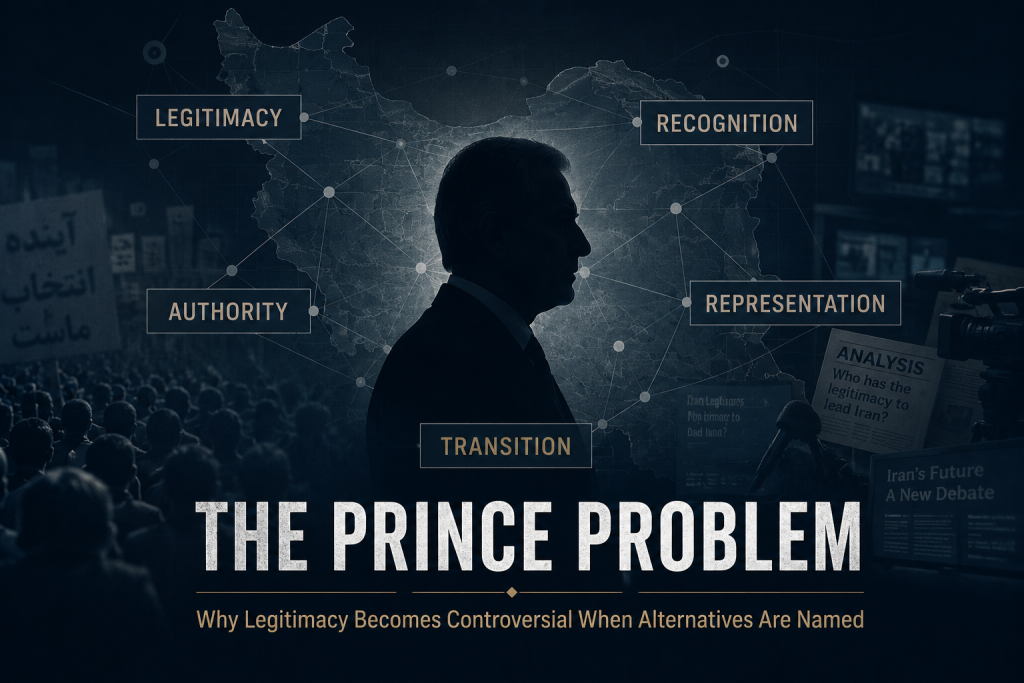
Why Legitimacy Becomes Controversial When Alternatives Are Named
Introduction
The Moment Transition Becomes Personal
Reza Pahlavi legitimacy has become one of the most disputed subjects in discussions about Iran’s future.
This is not because Iranians agree on him.
It is because they do not.
Few political figures generate comparable levels of support, opposition, scrutiny and political anxiety at the same time. Few names repeatedly return to the centre of debates that ostensibly began somewhere else. Whether the subject is political transition, opposition unity, regime change, constitutional design, international engagement or leadership, discussions often find their way back to the same question: what role, if any, should Reza Pahlavi play in Iran’s future?
The persistence of that question is itself noteworthy.
Political systems produce many critics, activists, commentators and opposition figures. Most attract limited attention beyond their immediate supporters. Some disappear from public discussion entirely. Others remain visible but politically peripheral. Yet a small number of individuals become something different. They become reference points. Supporters organise around them. Opponents organise against them. Alliances form around them and fracture around them. Their significance becomes a subject of dispute in its own right.
The debate surrounding Reza Pahlavi increasingly displays these characteristics.
This article is not an attempt to determine whether he should lead a future Iranian government. Nor is it an argument for the restoration of monarchy. Those questions, while politically significant, are ultimately secondary to the issue examined here.
The central question is different.
Why has the issue of Reza Pahlavi’s legitimacy become so controversial?
More specifically, why do discussions of legitimacy appear to intensify once they become attached to a recognisable individual?
For years, conversations about Iran’s future have often remained at the level of abstraction. Political transition, democratic governance, civil society, constitutional reform and institutional reconstruction are frequently discussed across a wide range of political and ideological perspectives. Participants may disagree on methods, priorities and outcomes, but the discussion remains manageable because it concerns concepts rather than people.
The atmosphere changes when a different question is introduced.
Not whether change is necessary.
Not whether the Islamic Republic has failed.
Not whether Iran requires political reconstruction.
But who.
Who would represent an alternative?
Who would speak during a transition?
Who would possess sufficient authority to negotiate, organise, mobilise or claim public trust?
Who would be recognised as a legitimate political actor beyond a narrow factional audience?
At that point, debates often become considerably more contentious.
The shift reveals an underlying problem that extends far beyond any individual figure. Discussions of political transition are often comfortable while legitimacy remains abstract. The moment legitimacy acquires a face, however, the conversation changes. Questions that previously appeared procedural become political. Discussions that appeared theoretical become personal. Broad agreement fragments into disputes over authority, representation and recognition.
The Iranian case provides an unusually revealing example of this phenomenon.
Following years of unrest, repeated waves of protest, escalating state repression and growing uncertainty surrounding the future of the Islamic Republic, discussions about alternatives have become increasingly prominent. Yet while many participants are willing to discuss transition in principle, far fewer agree on how legitimacy should be evaluated in practice.
This disagreement is particularly visible in debates surrounding Reza Pahlavi.
Supporters frequently point to his public recognition, historical association, international visibility and continued presence within opposition discourse. Critics challenge the relevance of those factors, question the legitimacy of hereditary association, reject the political implications of public visibility or argue that no individual should occupy such a central position within discussions of Iran’s future.
Yet beneath these disagreements lies a deeper question.
How is political legitimacy actually measured?
The term is used constantly throughout discussions of Iran, yet rarely defined with precision. Is legitimacy derived from public support? Historical continuity? Organisational capacity? Political credibility? Popular recognition? Electoral validation? International acceptance? Some combination of these factors? The absence of consensus regarding these questions has produced an environment in which legitimacy is simultaneously invoked, challenged and redefined depending on the political context.
As a result, the debate surrounding Reza Pahlavi often reveals broader tensions within the Iranian political ecosystem. Arguments that appear to concern one individual frequently expose disagreements about authority itself. Standards that appear decisive in one context become negotiable in another. Principles presented as universal are sometimes applied selectively. The controversy surrounding one figure begins to illuminate a larger uncertainty regarding how political legitimacy is recognised, contested and distributed.
The Prince Problem, therefore, is not fundamentally a question about monarchy.
Nor is it ultimately a question about one individual.
It is a question about legitimacy.
More specifically, it is an investigation into why legitimacy becomes increasingly controversial when attached to a specific person rather than an abstract political idea.
Because the moment transition becomes personal, debates about the future cease to be discussions about systems alone.
They become discussions about who has the authority to represent that future.
Chapter 1
The Safety of Abstract Transition
Political transitions are frequently discussed through the language of institutions rather than the language of authority. Academic literature, policy analysis, international organisations and opposition movements often focus on constitutional design, democratic governance, judicial reform, civil society development and electoral frameworks. These discussions are important because political systems ultimately require institutions to function. Yet institutional discussions possess a characteristic advantage: they allow broad political coalitions to emerge without requiring agreement on who should exercise power. Participants may support democratic transition while holding fundamentally different assumptions about leadership, representation and political authority. As long as those assumptions remain implicit, consensus appears easier to sustain.
This tendency is not unique to Iran. Throughout modern political transitions, procedural questions have often proven easier to discuss than questions of authority. Electoral systems can be debated without identifying future office holders. Constitutional arrangements can be examined without determining who will negotiate their implementation. Institutional models can be evaluated without resolving competing claims to representation. The result is a political environment in which discussions of process frequently advance further than discussions of legitimacy.
Part of this dynamic stems from the nature of political language itself. Concepts such as democracy, freedom, accountability and transition possess a degree of flexibility that allows different actors to project their own expectations onto the same terminology. Two individuals may both support democratic transition while imagining entirely different political outcomes. One may envision a parliamentary republic, another a constitutional monarchy. One may prioritise decentralisation, another strong national institutions. One may emphasise civil society, another executive leadership. Despite these differences, both can comfortably endorse the language of democratic transition because the practical implications remain undefined.
This flexibility often creates the appearance of consensus where genuine consensus does not yet exist. Agreement becomes easier when political questions remain sufficiently abstract. The closer discussions move toward implementation, however, the more difficult that consensus becomes to maintain. Principles that appear universally acceptable begin to encounter practical realities. Questions emerge regarding responsibility, decision-making, representation and authority. Political actors who previously appeared aligned discover that they may hold profoundly different assumptions regarding who should exercise power and under what conditions.
For this reason, discussions of transition and discussions of authority should not be treated as interchangeable. Political transition describes a process. Authority describes the ability to influence, organise, represent and shape that process. The two are related, but they are not identical. A political movement may agree that change is necessary while remaining deeply divided regarding who should participate in leading that change. Similarly, broad agreement regarding democratic principles does not automatically produce agreement regarding political leadership.
This distinction becomes particularly significant during periods of instability. Criticism of an existing government does not automatically generate a viable alternative. Nor does opposition activity necessarily produce recognised leadership. In many political environments, a large number of individuals and organisations may oppose the governing system while very few possess sufficient recognition, credibility or organisational capacity to be viewed as plausible alternatives. The gap between opposition and alternative is often one of the least examined aspects of political transition.
The distinction matters because opposing power and replacing power are fundamentally different political functions. Opposition can be decentralised. Criticism can emerge from countless sources simultaneously. Political dissatisfaction does not require central coordination. Alternatives, however, operate under different constraints. A credible alternative must eventually address questions of representation, decision-making and responsibility. It must demonstrate an ability not merely to oppose existing institutions but to engage with the realities that emerge when those institutions weaken, collapse or lose legitimacy.
Many political discussions avoid this distinction by remaining focused on criticism rather than succession. The failures of an existing system are often easier to analyse than the challenges of constructing a new one. In the Iranian context, extensive attention has been devoted to the shortcomings of the Islamic Republic, the consequences of state repression, the limitations of reformist narratives and the broader failures of governance. Far less agreement exists regarding who possesses sufficient legitimacy to participate in shaping a future alternative. As a result, discussions frequently remain concentrated on what should end rather than what should emerge.
This reluctance is understandable. Questions of authority are inherently more divisive than questions of opposition. Criticising a government does not require agreement regarding leadership. Supporting transition does not require representation agreement. Once authority enters the discussion, however, disagreements become unavoidable. Political actors must begin evaluating competing claims to legitimacy. They must consider whether recognition, visibility, public support, historical continuity, organisational capacity or political credibility should influence assessments of leadership. At that stage, debates become considerably more difficult because they require choices rather than aspirations.
The problem is further complicated by the absence of universally accepted standards for measuring legitimacy. Unlike constitutional procedures or electoral frameworks, legitimacy cannot be reduced to a single institutional mechanism. It is shaped by public perception, political recognition, historical context and social acceptance. Different actors often prioritise different criteria. Some emphasise popular support. Others prioritise organisational structures. Some focus on democratic procedures. Others emphasise political experience, symbolic significance or historical continuity. The absence of consensus regarding these standards ensures that legitimacy debates remain highly contested, particularly during periods of uncertainty.
This produces what may be described as an authority gap. Discussions of political transition often advance significantly further than discussions of political legitimacy. Detailed proposals emerge regarding constitutional reform, governance models and institutional reconstruction, yet considerably less attention is devoted to the question of who possesses sufficient authority to participate in implementing those proposals. The result is an environment in which political transition is frequently discussed as a theoretical possibility while questions of representation remain unresolved.
The authority gap is not simply a theoretical problem. It has practical consequences. Political transitions rarely occur through institutions alone. Negotiations require participants. Coalitions require organisers. Public movements require recognised figures, organisations or networks capable of mobilising support. International actors, whether governments, media organisations or policy institutions, also tend to engage with identifiable political actors rather than abstract concepts. Consequently, questions of legitimacy become increasingly important as political uncertainty intensifies.
Contemporary discussions regarding Iran provide a particularly revealing example of this dynamic. There is no shortage of debate regarding democratic transition, constitutional reform or the future structure of the Iranian state. Numerous visions of a post-Islamic Republic order have been proposed across ideological and political divides. Yet substantially less agreement exists regarding who possesses the legitimacy to represent those visions. The closer discussions move toward identifiable individuals, organisations or leadership structures, the more contentious they tend to become.
This pattern suggests that the central challenge may not be transition itself. The concept of transition enjoys broad support across a wide range of political perspectives. The greater difficulty emerges when transition ceases to be theoretical and becomes associated with questions of authority, representation and legitimacy. At that point, disagreements that remained hidden within procedural discussions become visible. Consensus fragments. Political fault lines emerge. Debates shift from institutions to individuals.
Understanding this distinction is essential because it forms the foundation of the investigation that follows. Before examining why particular figures generate unusually intense legitimacy debates, it is necessary to understand why legitimacy itself remains one of the most contested concepts in discussions of political change. If discussions of transition remain incomplete without discussions of authority, a more fundamental question follows: why do legitimacy debates often appear considerably more uncomfortable than transition debates themselves?
Chapter 2
The Legitimacy Question
Few concepts appear more frequently in political debates than legitimacy. Governments invoke it to justify authority. Opposition movements invoke it to challenge authority. International institutions refer to it when recognising political actors, while critics appeal to it when questioning existing political arrangements. Despite its constant presence in political discourse, legitimacy remains one of the least consistently defined concepts in contemporary politics. Participants often speak about legitimacy as though its meaning were obvious, yet disagreements concerning legitimacy frequently reveal deeper disagreements about the standards through which political authority should be evaluated.
The problem becomes particularly visible during periods of political uncertainty. In stable political systems, legitimacy is often assumed rather than examined. Existing institutions provide established mechanisms through which authority is exercised, contested and renewed. Elections, constitutions, political parties and legal frameworks create reference points that allow disagreements to occur within recognised structures. Questions concerning legitimacy do not disappear, but they remain embedded within institutions that provide at least some degree of procedural clarity.
Periods of transition are fundamentally different. Existing structures may lose credibility while future structures remain undefined. Political actors who previously occupied peripheral positions may suddenly acquire greater relevance. Questions that once appeared theoretical become immediate and practical. Under such conditions, legitimacy moves from the background of political life to the centre of political debate.
The contemporary Iranian case illustrates this dynamic with unusual clarity. Discussions concerning the future of Iran frequently involve competing claims regarding legitimacy, representation and authority. Yet participants often employ these concepts without agreeing on what they mean. Supporters and critics of particular political actors routinely invoke legitimacy while relying upon entirely different criteria. Some emphasise public support. Others emphasise democratic procedure. Some prioritise organisational capacity, while others focus on visibility, political experience, historical continuity or symbolic significance. The result is not simply disagreement regarding legitimacy. It is disagreement regarding how legitimacy should be recognised in the first place.
Part of the difficulty stems from the tendency to reduce legitimacy to a single factor. Political debates frequently search for a decisive indicator capable of settling disputes regarding authority. Public support is often presented as such an indicator. The argument possesses obvious appeal. Political authority ultimately depends upon some degree of public recognition. A political actor entirely disconnected from public sentiment is unlikely to exercise lasting influence. Yet public support alone rarely resolves legitimacy debates, particularly in environments where reliable measurement is difficult.
This challenge is especially relevant in authoritarian political systems. Free political competition may not exist. Independent polling may be limited. Public political expression may involve significant personal risk. Under such conditions, determining the precise extent of support for any political actor becomes difficult. Observers are therefore forced to rely upon indirect indicators rather than conventional democratic measurements. The absence of clear mechanisms does not eliminate legitimacy debates. It complicates them.
A similar problem emerges when legitimacy is equated with visibility. Political attention matters. Individuals who remain visible over extended periods are more likely to shape public conversations, attract supporters and influence political discourse. Yet visibility alone cannot establish authority. Public recognition may reflect admiration, criticism, controversy or symbolic importance. Political actors can become highly visible without acquiring broad legitimacy. Visibility contributes evidence, but it does not independently settle the legitimacy question.
The same distinction applies to political recognition. Participation within political discourse differs from acceptance as a legitimate representative. Many individuals become prominent participants in political debates without emerging as focal points of wider legitimacy discussions. Recognition may create opportunities for legitimacy to develop, but recognition and legitimacy remain distinct concepts. One concerns presence within the conversation. The other concerns authority within it.
Historical continuity introduces another layer of complexity. Throughout modern political history, movements and institutions have frequently drawn legitimacy from historical experience. Political actors often seek to connect themselves to earlier national traditions, institutions or periods of governance. Critics, however, frequently reject the notion that legitimacy can be inherited or transferred through historical association alone. The resulting disagreement reveals an important reality. Historical continuity may influence perceptions of legitimacy, but it neither guarantees legitimacy nor automatically invalidates it.
These competing interpretations become particularly significant during political transitions because transitional environments rarely provide universally accepted methods for evaluating authority. Elections may be unavailable. Institutional frameworks may be weak or contested. Political organisations may be fragmented. Public political activity may be constrained by repression. Under such circumstances, legitimacy cannot easily be reduced to a single measurable variable. The conventional tools used to assess political authority often become incomplete or unavailable.
It is therefore more useful to think of legitimacy as an accumulation of factors rather than a single political characteristic. Public support may matter. Recognition may matter. Visibility may matter. Historical continuity may matter. Organisational capacity may matter. Credibility may matter. Different observers may assign different weight to each factor, but legitimacy rarely emerges from any one of them in isolation. Political authority is usually assessed through combinations of evidence rather than through a single decisive test.
This observation helps explain why legitimacy debates often become so contentious. Participants are rarely arguing only about political actors. They are also arguing about standards. Disagreements concerning legitimacy frequently conceal deeper disagreements concerning which forms of evidence should be considered meaningful. One observer may regard public visibility as politically significant. Another may regard institutional organisation as more important. A third may prioritise democratic procedures above all else. The debate therefore concerns not only whether legitimacy exists but also how legitimacy should be measured.
The Iranian opposition environment demonstrates this problem repeatedly. Political actors often agree that the Islamic Republic lacks legitimacy while simultaneously disagreeing about what legitimate political authority should look like in its place. Competing visions of legitimacy coexist within the same political space. Some emphasise democratic validation. Some emphasise public mobilisation. Others emphasise continuity, representation, experience or political organisation. The result is a fragmented debate in which legitimacy functions simultaneously as a political claim, a political criticism and a contested analytical category.
This creates a further difficulty. If legitimacy cannot be reduced to popularity, visibility, historical continuity or any other single factor, how should competing legitimacy claims be evaluated? Which forms of evidence deserve greater weight? How should observers interpret situations in which different indicators point in different directions? These questions become increasingly important in environments where political uncertainty is high and institutional mechanisms remain weak.
The challenge becomes even more interesting when attention shifts from legitimacy itself to the distribution of legitimacy debates. Political actors exist throughout every opposition environment, yet only a small number become recurring subjects of intense dispute. Some figures attract sustained arguments concerning representation, authority and political relevance. Others do not. If legitimacy is genuinely multidimensional, and if no single indicator can resolve the question, then the concentration of legitimacy debates around particular individuals becomes worthy of investigation in its own right.
Why do some political actors become enduring subjects of legitimacy disputes while others remain comparatively peripheral?
Why do questions of authority, representation and recognition repeatedly return to the same individuals?
Before examining any specific case, it is necessary to understand a broader political phenomenon. Legitimacy becomes politically consequential not when it exists as an abstract concept, but when it becomes attached to identifiable actors operating within real political environments.
It is at that point that legitimacy acquires a face.
Chapter 3
When Legitimacy Acquires a Face
Much of modern political discourse is remarkably comfortable discussing legitimacy in the abstract. Governments seek legitimacy. Opposition movements claim legitimacy. International institutions invoke legitimacy when recognising elections, political processes or transitional arrangements. Analysts frequently debate legitimacy as a characteristic of systems, institutions and political frameworks. At this level, disagreements often remain manageable. Participants may disagree about definitions, but they can still operate within a shared conceptual space.
The situation changes when legitimacy becomes attached to an identifiable individual.
This shift may appear minor, but its political consequences are significant. Discussions that seem relatively stable when focused on institutions often become considerably more contentious when focused on people. Political actors who broadly agree on democratic principles may disagree sharply regarding who should represent those principles. Coalitions that appear united in opposition to an existing system may discover profound disagreements once questions of authority and representation become unavoidable.
The distinction is particularly relevant in transitional political environments. During periods of political uncertainty, discussions concerning the future frequently begin with broad objectives. Participants speak about democracy, accountability, constitutional reform, human rights or political pluralism. Such conversations often create space for cooperation because they allow different actors to project different assumptions onto the same political language. Agreement remains possible because many of the most difficult questions have not yet been addressed.
The challenge emerges when political discussions move beyond aspirations and toward authority.
At that point, legitimacy ceases to be a theoretical concept and becomes a practical question. Political actors are no longer debating whether change should occur. They are debating who should be recognised within a future political order. Questions concerning representation become more immediate. Questions concerning authority become more controversial. Political disagreements that previously remained hidden begin to surface.
The Iranian opposition environment illustrates this dynamic repeatedly. Across different ideological traditions, political organisations and activist networks, there is widespread criticism of the Islamic Republic. Significant disagreements remain regarding Iran’s future political structure, but criticism of the existing system is not generally the source of the most persistent disputes. The intensity of disagreement often increases when conversations move from criticism of the present toward questions concerning future authority.
This pattern can be observed both inside Iran and throughout the Iranian diaspora. Discussions concerning transition frequently attract broad participation. Discussions concerning representation often produce considerably greater friction. Activists, organisations and commentators may agree that change is necessary while disagreeing fundamentally regarding who should play a meaningful role in shaping that change. The closer the conversation moves toward identifiable individuals, the more difficult consensus tends to become.
The reason is not difficult to understand. Institutions do not possess personal histories. Constitutional principles do not have biographies. Democratic frameworks do not accumulate supporters, critics or political symbolism. Individuals do. Once legitimacy becomes associated with a specific person, the debate expands beyond questions of political principle. Personal history, political associations, public statements, symbolic significance and historical context all become part of the discussion.
As a result, legitimacy debates often begin to absorb other political disputes.
Questions concerning authority become intertwined with questions concerning identity. Discussions concerning representation become intertwined with questions concerning history. Arguments about political relevance become intertwined with arguments about visibility, symbolism and public recognition. What initially appears to be a debate about legitimacy gradually becomes a debate about the broader meaning of political authority itself.
This process helps explain why legitimacy disputes rarely remain confined to a single issue. Supporters may interpret public recognition as evidence of political relevance. Critics may interpret the same phenomenon as evidence of excessive concentration of attention. Historical continuity may be viewed by some as politically meaningful and by others as politically irrelevant. Visibility may be treated as evidence of significance or dismissed as a poor substitute for democratic validation. The disagreement frequently extends beyond the evidence itself and into disputes regarding how evidence should be interpreted.
The challenge becomes even more pronounced because legitimacy lacks a universally accepted measurement system. Political observers often seek objective criteria capable of resolving legitimacy disputes, yet transitional environments rarely provide such certainty. Elections may not be available. Reliable polling may be limited. Political competition may be constrained. Organisational structures may remain fragmented. Under such conditions, different actors inevitably rely upon different indicators when assessing political authority.
This reality helps explain why legitimacy debates often become more intense than debates concerning political programmes. Policy disagreements can sometimes be negotiated. Legitimacy disputes are more difficult because they concern the standing of political actors themselves. Participants are not merely debating ideas. They are debating who possesses the authority to advance those ideas. Questions of recognition therefore become inseparable from questions of legitimacy.
Recognition occupies a particularly important position within this process. To recognise a political actor is not necessarily to endorse them, but it is to acknowledge their relevance. Recognition establishes that an individual occupies sufficient political space to require engagement. Once this threshold has been crossed, political actors are compelled to respond. They may support, oppose, criticise or ignore particular proposals, but they can no longer easily ignore the existence of the individual themselves.
This distinction becomes increasingly important when visibility enters the equation. Visibility does not establish legitimacy, yet visibility often influences which legitimacy debates occur in the first place. Political actors who remain visible over extended periods become reference points within broader political conversations. Journalists ask about them. Activists position themselves in relation to them. Organisations cooperate with them, criticise them or attempt to distinguish themselves from them. Their significance becomes a recurring subject of discussion independent of any single political proposal.
Over time, this process produces an important political effect. The individual becomes embedded within the wider discourse. Supporters may regard this as evidence of political significance. Critics may regard it as evidence of disproportionate attention. Yet both responses reveal the same underlying reality. The individual has become difficult to ignore.
Political relevance should not be confused with legitimacy. The distinction remains essential. Relevance does not automatically establish authority, representation or public support. Nevertheless, legitimacy debates rarely become concentrated around individuals who possess no relevance whatsoever. Before political actors can challenge a person’s legitimacy, they must first acknowledge that the individual occupies sufficient political space to warrant attention.
The Iranian case demonstrates this phenomenon with unusual clarity. Numerous political actors participate in discussions concerning Iran’s future. Many possess dedicated constituencies. Some maintain organisational structures. Others attract media attention or activist support. Yet only a relatively small number become recurring focal points across multiple political conversations. Fewer still generate sustained disputes concerning legitimacy, representation and authority over long periods of time.
This observation raises an important analytical question.
Why do certain individuals repeatedly become the subject of legitimacy debates while others do not?
Why do discussions concerning authority, representation and political relevance continue to return to the same figures despite changing political circumstances?
Answering that question requires moving beyond general theories of legitimacy and examining a specific case study. Within contemporary Iranian politics, no figure has generated a more persistent debate concerning legitimacy, recognition and political relevance than Reza Pahlavi.
Understanding why that exception exists is the next stage of this investigation.
Chapter 4
The Reza Pahlavi Exception
The preceding chapters examined legitimacy as a political concept. They explored why discussions of transition are often easier than discussions of authority, why legitimacy remains difficult to define and measure, and why political disputes frequently intensify once legitimacy becomes attached to identifiable individuals. The next step is to examine a specific case in which these dynamics are particularly visible.
Few contemporary Iranian political figures illustrate these tensions more clearly than Reza Pahlavi.
This observation is not dependent upon support for his political role, agreement with his views or endorsement of any particular constitutional model. It reflects a simpler and more measurable reality: discussions concerning Iran’s political future repeatedly return to him. Whether the subject is opposition unity, regime change, democratic transition, constitutional design, international engagement or political representation, his name continues to occupy a position that few other opposition figures have managed to sustain.
The persistence of that position is itself politically significant.
Iranian opposition politics has undergone repeated transformations over the past four decades. Political organisations have emerged and disappeared. Coalitions have formed and collapsed. Public figures who once dominated political conversations have gradually faded from broader relevance. New movements have appeared, attracted attention and then fragmented. Yet despite these changes, Reza Pahlavi has remained a recurring reference point within discussions concerning Iran’s future.
This persistence alone does not establish legitimacy. Political relevance and political legitimacy are not identical concepts. However, it does raise a question that deserves examination. Why has one individual continued to occupy such a prominent place within debates regarding representation and political alternatives while many others have not?
Part of the answer lies in the unusual nature of the reactions he generates.
Most political figures attract either support or opposition. Some enjoy loyal constituencies while remaining largely ignored by their critics. Others generate criticism without attracting substantial public support. Reza Pahlavi occupies a different position. He simultaneously attracts support, opposition, scrutiny, expectation and political anxiety. Supporters frequently present him as a unifying national figure capable of contributing to a transition beyond the Islamic Republic. Critics challenge his political relevance, question the sources of his legitimacy, reject historical association as a basis for authority or oppose any role connected to the monarchy. Yet despite these disagreements, both sides continue to treat him as politically significant.
This dynamic is unusual because it produces a recurring paradox. Many critics argue that Reza Pahlavi lacks meaningful political standing. Yet substantial time, energy and organisational effort continue to be devoted to challenging his legitimacy. Political organisations frequently define themselves in relation to him. Public debates repeatedly return to him. Media coverage often positions him as a central reference point within broader discussions regarding opposition politics. Even arguments intended to minimise his significance often contribute to sustaining his visibility within political discourse.
The point is not that criticism validates legitimacy.
It does not.
The point is that sustained political attention is itself a form of evidence. Political ecosystems do not allocate unlimited attention to unlimited actors. Time, organisational resources and public focus are finite. When a particular individual remains at the centre of political disputes over extended periods, the persistence of that attention becomes a phenomenon worthy of explanation.
The Iranian case becomes particularly revealing when viewed through this lens.
Over the past decade, and especially during successive waves of unrest and political crisis, debates concerning alternatives to the Islamic Republic have become increasingly prominent. Protest movements, state repression, economic deterioration and growing uncertainty regarding the future of the existing system have intensified public interest in questions of political transition. Within this environment, Reza Pahlavi has consistently remained one of the most visible and widely discussed opposition figures.
Supporters often point to this visibility as evidence of legitimacy. Critics frequently respond that visibility alone proves nothing. Both positions contain an element of truth. Visibility is not equivalent to legitimacy. Yet the debate often becomes trapped within this binary framework, obscuring a more important observation. Regardless of how visibility is interpreted, it continues to place Reza Pahlavi at the centre of discussions concerning representation and political alternatives.
This pattern is visible not only among supporters but also among opponents. Political actors who reject his role frequently devote significant attention to explaining why he should not be regarded as a legitimate representative. Others seek to challenge the relevance of his public recognition, question the political significance of support expressed on social media or dismiss public gatherings associated with him as politically inconclusive. These arguments vary considerably in substance, yet they share a common feature: they accept that Reza Pahlavi remains a figure requiring response.
That acceptance is politically significant.
Legitimacy debates rarely become this intense around individuals considered genuinely irrelevant. Political disagreement is common. Sustained contestation is more revealing. The continued effort to affirm, deny, challenge, defend or reinterpret Reza Pahlavi’s political standing suggests that the dispute concerns more than one individual alone. It reflects a broader struggle over how legitimacy should be recognised within a fragmented political environment.
The issue becomes even more complex when examining the absence of comparable debates surrounding many other opposition figures. Iran’s opposition landscape includes activists, political organisations, former officials, civil society actors, intellectuals and advocacy groups representing a wide range of ideological positions. Yet few generate the same level of persistent disagreement regarding legitimacy. Few attract comparable levels of simultaneous support and opposition. Few occupy a similarly central position within debates concerning representation.
This asymmetry raises an important question.
If legitimacy is the issue, why does the debate repeatedly concentrate on the same individual?
The answer cannot be reduced solely to popularity, visibility or historical association. Each of these factors may contribute to the explanation, but none fully accounts for the persistence of the phenomenon. A more plausible interpretation is that Reza Pahlavi occupies a position in which multiple competing understandings of legitimacy intersect. For some observers, he represents continuity with a historical period that preceded the Islamic Republic. For others, he represents a recognisable national figure capable of attracting public attention. For his critics, he represents a challenge to competing visions of political authority or a symbol of constitutional arrangements they reject. The result is that debates concerning legitimacy become concentrated around him because different political actors are often arguing about different things simultaneously.
In this sense, the Reza Pahlavi debate may reveal as much about the Iranian political ecosystem as it does about Reza Pahlavi himself.
Supporters and critics frequently approach the question of legitimacy using different standards. Public recognition, historical continuity, democratic validation, organisational capacity, symbolic significance and political visibility are weighted differently depending on the perspective being advanced. The disagreement therefore extends beyond one individual. It reflects a deeper uncertainty regarding how legitimacy should be evaluated in the absence of a universally accepted framework.
This uncertainty helps explain why discussions surrounding Reza Pahlavi often become unusually intense. The debate is not merely about one political figure. It is also about competing definitions of legitimacy itself. Arguments concerning his role frequently function as arguments about representation, authority and political recognition more broadly.
For this reason, describing Reza Pahlavi simply as a supporter of monarchy, an opposition activist or a public figure risks missing the larger phenomenon. Whether viewed positively or negatively, he occupies a position within contemporary Iranian politics that few other opposition figures can claim. His significance remains contested. His legitimacy remains contested. His political role remains contested. Yet the persistence of those disputes has itself become one of the defining features of the conversation.
The question, therefore, is no longer why Reza Pahlavi exists within the debate.
The more revealing question is why the debate repeatedly returns to him.
Answering that question requires examining one of the most common explanations offered by both supporters and critics alike: the monarchy question.
It is to that argument that the investigation now turns.
Chapter 5
The Monarchy Distraction
One of the most common explanations offered for the controversy surrounding Reza Pahlavi is that the debate has little to do with legitimacy and everything to do with monarchy. According to this interpretation, the intensity of the reactions he generates is neither surprising nor analytically significant. Reza Pahlavi is controversial because he is associated with a former monarchy, and the controversy surrounding him is therefore understood as a continuation of a long-standing disagreement regarding Iran’s constitutional future.
At first glance, this explanation appears convincing. The Pahlavi era remains one of the most heavily debated periods in modern Iranian history. Discussions concerning state-building, economic development, political repression, modernisation, national sovereignty and the circumstances that led to the 1979 revolution continue to generate strong and often contradictory interpretations. It would therefore be unrealistic to suggest that contemporary debates surrounding Reza Pahlavi exist independently of these historical disputes. His public identity is inseparable from a political legacy that continues to shape Iranian political memory.
The existence of a connection, however, does not necessarily establish a complete explanation.
The central question is not whether monarchy influences perceptions of Reza Pahlavi. It clearly does. The more important question is whether monarchy alone adequately explains the scale, persistence and structure of the legitimacy debate that surrounds him. The answer is less obvious than either supporters or critics often assume.
If the controversy were solely a constitutional disagreement, one would expect the debate to remain primarily focused on constitutional questions. Discussions would centre on whether a future Iranian state should be organised as a republic or a constitutional monarchy. Arguments would focus on institutional design, legal authority, democratic accountability and the distribution of political power. While such discussions certainly occur, they account for only part of the broader debate.
In practice, discussions surrounding Reza Pahlavi frequently move beyond constitutional questions and enter a different political territory. Arguments concerning monarchy often become arguments concerning representation. Constitutional preferences become intertwined with questions of authority. Historical debates evolve into disputes regarding legitimacy, relevance and political recognition. The controversy ceases to concern only the structure of a future state and begins to concern the standing of a specific individual within contemporary political discourse.
This distinction is important because constitutional disagreements are not unusual. Political communities routinely disagree about institutional arrangements without producing the same degree of sustained political friction. Competing visions of governance exist in almost every political environment. The existence of disagreement alone cannot explain why one individual continues to occupy such a prominent position within broader debates regarding Iran’s future.
The persistence of the controversy suggests that monarchy may function less as a complete explanation and more as a framework through which deeper disagreements are expressed.
This becomes particularly apparent when examining the diversity of political actors involved in the debate. The common assumption that support for Reza Pahlavi is synonymous with support for monarchical restoration, and that opposition to him is synonymous with republicanism, does not withstand sustained scrutiny. Contemporary Iranian political discourse is considerably more complex. Individuals who support a republican political system may nevertheless regard Reza Pahlavi as a relevant political actor. Others who reject any future role for him may do so for reasons unrelated to constitutional design. Similarly, some supporters view him primarily as a transitional figure rather than a future monarch, while others see him as a symbol of national continuity rather than a constitutional solution.
The result is a political landscape that cannot be adequately explained through a simple monarchist-versus-republican framework.
This complexity becomes even more significant when examining one of the most common criticisms directed at Reza Pahlavi: the argument that his political relevance derives primarily from hereditary association. Critics frequently contend that legitimacy cannot be inherited and that no democratic political order should assign authority on the basis of family lineage. As a general principle, this position is both understandable and consistent with modern democratic norms. Political legitimacy is generally expected to derive from public recognition, political participation and institutional processes rather than biological inheritance.
The analytical challenge does not arise from the principle itself. It arises from the manner in which the principle is applied.
Political legitimacy debates are rarely determined by the existence of a standard alone. They are shaped by the consistency with which that standard is enforced. Any principle that is presented as universal must ultimately be evaluated according to whether it is applied universally. If hereditary association is regarded as politically disqualifying, the question becomes whether that judgement operates consistently across political contexts. If inherited political standing is treated as fundamentally incompatible with legitimacy, the same logic would presumably apply regardless of ideology, political system or historical circumstance.
The significance of this observation lies not in defending hereditary association but in examining analytical consistency. Political arguments derive much of their credibility from the perception that standards are being applied evenly. When identical principles appear to operate differently depending on the political actor involved, questions inevitably emerge regarding whether the dispute concerns the principle itself or the specific individual under discussion.
This issue becomes particularly relevant because legitimacy, as demonstrated in previous chapters, is rarely reducible to a single variable. Public recognition, political credibility, organisational capacity, symbolic significance, historical continuity and contemporary relevance all influence how legitimacy is perceived. The attempt to reduce legitimacy exclusively to questions of family lineage risks oversimplifying a considerably more complex political phenomenon.
Historical association undoubtedly influences public perceptions. Political actors do not emerge in a vacuum. Individuals inherit political advantages, disadvantages, expectations and liabilities from the environments in which they operate. Historical lineage may increase visibility. It may generate support. It may generate opposition. It may shape public expectations in profound ways. Yet none of these outcomes automatically resolves the legitimacy question. Political legitimacy cannot be mechanically inherited, but neither can it be mechanically invalidated through inheritance alone.
The distinction is crucial because the controversy surrounding Reza Pahlavi frequently becomes trapped within debates about historical identity while avoiding more difficult questions concerning contemporary political relevance. Discussions repeatedly return to what the Pahlavi name represents rather than examining why that representation continues to occupy such a central position within discussions of Iran’s future. The historical debate remains important, but it does not fully explain the contemporary political phenomenon.
This tendency can produce a form of analytical displacement. Rather than examining how legitimacy operates within present political conditions, attention becomes concentrated on symbolic arguments about the past. Historical disputes absorb political energy that might otherwise be directed toward evaluating contemporary indicators of relevance, influence and public recognition. The result is a debate that often appears to concern legitimacy while functioning primarily as a debate about historical memory.
The persistence of this pattern suggests that monarchy may operate as a distraction in a specific analytical sense. The term does not imply that constitutional questions are unimportant. On the contrary, constitutional design remains a significant component of any future political transition. The problem is that constitutional disagreement often obscures the underlying issue being examined. Participants become preoccupied with competing interpretations of monarchy while leaving broader questions of legitimacy unresolved.
This helps explain why debates surrounding Reza Pahlavi frequently fail to reach stable conclusions. Different participants are often engaged in different arguments simultaneously. Some are debating constitutional systems. Others are debating historical narratives. Others are evaluating political legitimacy. Still others are responding to questions of representation, authority or political influence. Because these discussions overlap, they are frequently mistaken for a single debate when they are in fact multiple debates occurring at the same time.
The consequence is a recurring cycle in which monarchy appears to explain the controversy without ever fully resolving it. Constitutional disagreement remains present, yet the controversy persists even when discussions move beyond constitutional issues. Historical arguments remain influential, yet they do not eliminate questions concerning contemporary political relevance. Criticism continues, support continues, and debates regarding legitimacy continue. The persistence of the phenomenon suggests that the monarchy question, while important, is insufficient on its own.
The deeper issue concerns the relationship between visibility, recognition and legitimacy. Reza Pahlavi’s position within contemporary Iranian political discourse cannot be understood solely through the lens of constitutional preference. The intensity of the reactions he generates points toward a broader political dynamic involving representation, authority and public relevance. The monarchy debate may shape the form of the controversy, but it does not fully explain why the controversy continues to occupy such a prominent place within discussions of Iran’s future.
Understanding that distinction requires moving beyond constitutional labels altogether. Before legitimacy can be assessed, it is necessary to separate two concepts that are frequently treated as interchangeable but are not: visibility and legitimacy. The failure to distinguish between them has contributed significantly to the confusion surrounding political authority in contemporary Iranian opposition politics.
It is to that distinction that the next chapter now turns.
Chapter 6
Visibility Versus Legitimacy
Few aspects of contemporary Iranian opposition politics generate more disagreement than the relationship between visibility and legitimacy. The debate appears repeatedly in discussions surrounding Reza Pahlavi. Supporters frequently point to public recognition, protest slogans, diaspora mobilisation and sustained media attention as evidence that he occupies a significant position within the broader debate concerning Iran’s future. Critics often respond that visibility should not be confused with legitimacy and that public attention alone cannot establish political authority. At first glance, the disagreement appears straightforward. Upon closer examination, however, it reveals a deeper problem concerning how legitimacy is evaluated in environments where conventional mechanisms of political validation are either absent or contested.
The distinction matters because visibility and legitimacy are not identical concepts. Visibility refers to public presence. It can be observed through media coverage, political discussion, public mobilisation or sustained recognition across different audiences. Legitimacy concerns authority, representation and the extent to which political actors are regarded as possessing a justified role within a political process. The two concepts often overlap, but they are not interchangeable. A highly visible figure may possess contested legitimacy. Equally, a politically legitimate figure may experience fluctuations in visibility over time. Confusing the two concepts frequently produces more heat than clarity.
The challenge becomes particularly pronounced in transitional political environments. In established democratic systems, elections, political parties, public office and institutional authority provide at least some framework through which legitimacy claims can be evaluated. Such mechanisms are often imperfect and disputed, but they offer identifiable reference points. The Iranian case is different. Political competition remains constrained, independent political organisation faces significant obstacles, and many of the conventional tools used to assess political authority are either unavailable or contested. Under such conditions, political observers inevitably begin searching for alternative indicators.
Visibility becomes one of the most accessible.
Political actors who repeatedly attract public attention appear significant. Their statements generate responses. Their activities attract coverage. Their supporters mobilise. Their critics respond. Their presence becomes embedded within wider political conversations. For many observers, these developments appear to offer indirect evidence regarding political standing. The attraction of this logic is understandable. Political influence rarely exists in complete obscurity. Governments invest enormous resources in communication because visibility matters. Opposition movements compete for audiences because visibility matters. Activists seek public attention because visibility matters. Political life is saturated with efforts to attract, maintain and shape recognition.
Yet visibility does not resolve the legitimacy question.
Political history contains numerous examples of individuals who attracted extraordinary levels of public attention while exercising limited political authority. Public recognition may emerge from admiration, controversy, hostility, symbolism or curiosity. Attention alone does not establish representation. Visibility provides evidence that something is happening. It does not automatically explain what that evidence means.
The analytical difficulty emerges when political actors attempt to transform visibility into proof. Supporters sometimes treat public attention as evidence that legitimacy has already been established. Critics often move toward the opposite conclusion, arguing that visibility proves nothing at all. Both positions simplify a more complicated reality. The first assumes that attention can independently generate authority. The second assumes that attention can be dismissed as politically insignificant. Neither position adequately explains how political relevance functions within fragmented political environments.
The distinction between relevance and legitimacy is therefore essential. Relevance concerns the extent to which an actor occupies meaningful political space. Legitimacy concerns the extent to which authority is recognised or accepted. The concepts intersect, but they perform different functions. A politically relevant actor may possess disputed legitimacy. A politically legitimate actor may experience changing levels of visibility. The analytical challenge lies not in choosing one concept over the other but in understanding how they interact.
This distinction becomes particularly revealing within opposition politics. Fragmented political environments generate competition for attention. Organisations compete for influence. Activists compete for audiences. Coalitions compete for recognition. Public attention becomes a limited political resource, and relatively few actors succeed in sustaining it over extended periods. Most political figures experience brief moments of prominence before gradually disappearing from wider public discussion. Sustained visibility is different. It persists across changing political circumstances, survives shifting news cycles and remains present despite the emergence of competing events and competing actors.
It is this distinction that makes the Iranian case particularly interesting.
Over the past several decades, Iranian opposition politics has witnessed the emergence of numerous organisations, coalitions and public figures. Some generated substantial attention before fading from wider political relevance. Others maintained influence within specific constituencies while remaining largely absent from broader public debate. A much smaller number became recurring points of reference across different political communities, ideological traditions and periods of political activity.
Reza Pahlavi belongs to this latter category.
Regardless of how one evaluates his political role, discussions concerning Iran’s future repeatedly return to him. This pattern can be observed across opposition media, activist networks, political organisations, diaspora communities and international discussions concerning political transition. Supporters cite him as evidence of political continuity, representation or leadership. Critics challenge his relevance, his legitimacy or his political vision. Yet both responses reveal the same underlying reality: he remains sufficiently significant to require engagement.
This observation is narrower than many supporters claim and more significant than many critics acknowledge.
It does not establish legitimacy. It does not determine political authority. It does not resolve questions concerning leadership or representation. What it demonstrates is that Reza Pahlavi occupies a position within contemporary Iranian political discourse that competing actors continue to regard as politically relevant. The persistence of this pattern becomes difficult to ignore precisely because it has survived dramatic changes within the Iranian political landscape.
The years following the Woman, Life, Freedom movement and the political upheavals that culminated in the January 2026 mass killings provide a particularly revealing example. During periods of heightened political tension, discussions concerning alternatives to the Islamic Republic intensified both inside Iran and throughout the diaspora. Protest slogans, public statements, political campaigns and large-scale diaspora gatherings increasingly focused attention on questions of transition, representation and future governance. In such moments, visibility becomes politically significant not because it answers legitimacy questions but because it shapes which actors remain present within the conversation.
The diaspora mobilisations that followed these events illustrate the point. Large gatherings in cities such as Munich and Toronto generated extensive debate regarding participation, representation and political significance. Supporters frequently interpreted attendance as evidence of public support. Critics challenged whether such gatherings accurately reflected broader political sentiment. Neither position fully resolved the underlying issue. Public mobilisation cannot independently establish legitimacy. At the same time, sustained mobilisation cannot simply be dismissed as politically meaningless. It provides evidence that political energy exists. The analytical challenge lies in determining what conclusions should reasonably be drawn from that evidence.
A similar pattern appears in debates surrounding protest slogans inside Iran. Different observers often assign different meanings to the same events. Some interpret recurring references to particular figures as evidence of political support. Others argue that slogans represent only fragments of public opinion and cannot be treated as comprehensive measures of legitimacy. Both observations contain elements of truth. Protest slogans are imperfect indicators. They rarely provide definitive answers. Nevertheless, their repeated appearance remains politically relevant because it demonstrates which actors continue to occupy space within the political imagination of at least some segments of society.
The significance of these observations becomes clearer when viewed collectively rather than individually. No single rally establishes legitimacy. No single slogan establishes legitimacy. No single media appearance establishes legitimacy. Political authority is too complex to be reduced to isolated events. Yet political analysis rarely depends upon individual observations in isolation. Meaning often emerges through accumulation. When visibility persists across different audiences, different contexts and different political moments, it contributes to a broader picture of political relevance that deserves examination.
The question, therefore, is not whether visibility exists.
The question is why it persists.
And it is that question that brings the investigation into the politics of recognition itself.
The politics of recognition begins where the politics of visibility becomes insufficient. Visibility can demonstrate that an actor occupies political space. It cannot, by itself, determine how that space should be interpreted. This distinction explains why debates surrounding visibility often become more contentious than they initially appear. The disagreement is rarely about whether public attention exists. The disagreement concerns what political significance should be attached to that attention once it has become impossible to ignore.
This tension becomes easier to observe when attention shifts from theory to behaviour. Across contemporary political movements, visibility is frequently described as an unreliable indicator of legitimacy. Yet the same actors who make this argument often devote considerable resources to expanding their own public presence, strengthening media exposure and increasing recognition among relevant audiences. The behaviour is entirely rational. Political actors seek visibility because visibility influences relevance, and relevance influences whether an individual, organisation or movement is included within wider political conversations.
This observation does not invalidate criticism of visibility-based arguments. It does, however, reveal an important contradiction. Political actors may reject the proposition that visibility establishes legitimacy, but they rarely behave as though visibility is politically irrelevant. The disagreement therefore concerns interpretation rather than existence. The debate is not about whether visibility matters. The debate concerns what visibility should mean once it has been established.
The Iranian opposition environment provides a particularly revealing example of this dynamic. Over the past several decades, numerous organisations, coalitions, advocacy networks and political figures have attempted to establish themselves as meaningful participants within discussions concerning Iran’s future. Some achieved temporary prominence before gradually disappearing from wider political discourse. Others maintained influence within specific ideological constituencies without achieving broader recognition. Only a relatively small number remained recurring reference points across multiple political conversations and multiple generations of political activism.
The significance of this observation lies not in the existence of support for any particular actor but in the persistence of attention itself. Political actors who possess no meaningful relevance rarely become enduring subjects of dispute. They may be ignored, marginalised or forgotten, but they do not typically generate sustained controversy across decades of changing political circumstances. The continued presence of Reza Pahlavi within debates concerning political transition, representation and opposition politics therefore raises a question that cannot be answered through visibility alone. If visibility were the complete explanation, the same pattern would be expected to emerge around a much larger number of political actors.
This is where the relationship between visibility and legitimacy becomes more complex. Public attention does not merely reveal support. It also reveals contestation. Political actors become visible not only because they are embraced but because they are challenged. Criticism, opposition and attempts at political delegitimisation are themselves forms of engagement. In some circumstances, they may reveal as much about political relevance as expressions of support.
This distinction is particularly important in the Iranian case because discussions surrounding Reza Pahlavi frequently generate an unusual combination of reactions. Supporters often point to sustained public visibility, recurring protest slogans, diaspora mobilisation and continued public recognition as evidence that he occupies a significant position within contemporary Iranian politics. Critics challenge the representativeness of those indicators and argue that public attention cannot be equated with legitimacy. These disagreements are legitimate and, in many respects, unavoidable. Yet the analytical value of the debate lies elsewhere. The persistence of the dispute itself demonstrates that competing political actors continue to regard the question as important enough to contest.
Political attention is not distributed randomly. Time, organisational resources and public focus are finite. Political movements make choices regarding where to direct them. Journalists decide which actors deserve coverage. Activists decide which actors deserve criticism. Organisations decide which actors deserve engagement. These decisions do not necessarily reveal legitimacy, but they do reveal perceived relevance. The allocation of attention is itself a form of political information.
For this reason, the persistence of legitimacy debates often reveals more than their immediate content. Political actors may disagree sharply regarding representation, authority or leadership, but the very act of repeatedly returning to the same individual provides insight into how political space is being organised. Certain figures become unavoidable reference points regardless of whether observers support or oppose them. Their significance becomes part of the political environment itself.
The challenge, however, is that contemporary political debates often seek definitive answers where only probabilistic conclusions are available. Participants frequently look for evidence capable of conclusively proving or disproving legitimacy. Such evidence rarely exists, particularly within fragmented opposition environments. Legitimacy is not a binary condition that can be established through a single event, a single rally or a single slogan. It is better understood as an ongoing process through which political standing is recognised, challenged, reinforced and contested over time.
Visibility contributes to this process without determining its outcome.
This distinction becomes particularly important when evaluating alternatives to the Islamic Republic. Political actors frequently agree that transition is necessary while disagreeing sharply regarding who should participate in shaping that transition. Under such conditions, visibility acquires practical significance because it influences which actors remain present within the conversation. Individuals who maintain public relevance continue to attract support, criticism and scrutiny. Individuals who lose relevance gradually disappear from wider political discussions regardless of the merits of their political positions.
The resulting tension helps explain why visibility often becomes a source of political discomfort. For supporters, visibility appears to validate significance. For critics, the same visibility often appears insufficient to justify claims regarding authority. Both interpretations contain elements of truth because they are attempting to answer different questions. One asks whether visibility demonstrates relevance. The other asks whether relevance establishes legitimacy. The questions are related, but they are not identical.
The distinction becomes even more significant when examining the role of institutions, commentators and organisations that seek to position themselves as neutral observers. Many acknowledge visibility while avoiding conclusions regarding legitimacy. In principle, such caution appears reasonable. Political transitions are uncertain by nature, and analytical restraint often serves an important purpose. Yet neutrality itself can become politically consequential when it obscures rather than clarifies the standards being applied.
The issue is not whether observers should support or oppose particular political figures. The issue is whether the criteria used to evaluate political relevance are applied consistently. If visibility is regarded as insufficient evidence in one context, what forms of evidence are considered sufficient? If public mobilisation is dismissed as analytically weak, what indicators should replace it? If sustained recognition is considered inadequate, how should political standing be assessed in environments where conventional democratic mechanisms remain unavailable?
These questions become increasingly difficult to avoid as political uncertainty intensifies. Abstract discussions concerning democracy, institutional reform and political transition are often easier to sustain than discussions concerning authority and representation. As previous chapters have demonstrated, the closer political conversations move toward identifiable actors, the more uncomfortable they tend to become. Visibility contributes to this discomfort because it transforms theoretical debates into practical ones. Once an individual becomes sufficiently visible, political actors are forced to decide how they will respond. Ignoring the individual becomes more difficult. Engaging with the individual becomes more consequential.
This dynamic helps explain why debates surrounding Reza Pahlavi frequently appear trapped between acknowledgement and reluctance. His visibility is widely recognised. The implications of that visibility remain contested. Supporters regard it as evidence of significance. Critics challenge the conclusions drawn from it. Many observers attempt to avoid the dispute altogether. Yet the persistence of the debate suggests that avoidance is becoming increasingly difficult. Visibility may not resolve legitimacy questions, but it continually forces those questions back into public view.
The broader significance of this phenomenon extends beyond any individual political actor. It reflects a deeper uncertainty regarding how legitimacy should be evaluated within fragmented opposition environments. When conventional mechanisms of validation are absent, political communities are forced to rely upon indirect indicators, contested interpretations and competing standards of evidence. Visibility becomes one component of that process because it remains one of the few political variables that can be observed directly even when legitimacy itself remains disputed.
The resulting disputes reveal a larger problem. Political actors frequently claim to support open political competition while simultaneously resisting discussions concerning how political relevance should be recognised and evaluated. The controversy therefore extends beyond visibility itself. It concerns the standards through which political actors are acknowledged, included or excluded from broader discussions regarding the future.
It is this tension that leads directly to the next stage of the investigation. The central question is no longer whether visibility matters or whether visibility establishes legitimacy. The more revealing question concerns how institutions, commentators and political actors respond when confronted with visible figures whose legitimacy remains contested.
The challenge lies not in visibility itself.
The challenge lies in the politics of neutrality that emerge around it.
Chapter 7
The Neutrality Problem
Throughout modern political discourse, neutrality is often presented as a virtue. Journalists emphasise it. Researchers invoke it. Policy institutions frequently describe it as an essential component of credible analysis. In principle, the argument is straightforward. Political observers should evaluate developments according to evidence rather than preference. Analysis should not be confused with advocacy. Description should not be mistaken for endorsement. These principles are both reasonable and necessary. Without them, serious political analysis quickly deteriorates into partisanship.
The difficulty emerges when neutrality moves from being a methodological principle to becoming a political practice.
In theory, neutrality concerns how conclusions are reached. In practice, neutrality often influences which questions are asked, which observations are emphasised and which subjects become politically uncomfortable to discuss. As a result, debates concerning neutrality are rarely confined to questions of objectivity. They frequently become debates concerning recognition. Political actors may be visible, relevant and widely discussed while simultaneously remaining difficult to acknowledge within formal political discourse.
This distinction is particularly significant in transitional political environments. During periods of political stability, institutions can often rely upon established frameworks when evaluating political actors. Governments exist. Political parties operate. Elections provide at least some mechanism through which legitimacy claims can be tested. Transitional environments are fundamentally different. Existing structures may be losing authority while future structures remain undefined. Political observers are therefore confronted with a more complicated challenge. They must evaluate political actors in the absence of universally accepted standards.
Under such circumstances, neutrality often becomes attractive because it appears to offer a way of avoiding premature conclusions. Analysts can discuss democratic principles without identifying potential leaders. Institutions can examine political transition without evaluating specific actors. Commentators can describe political developments while avoiding questions of representation. This approach may reduce immediate controversy, but it also creates limitations. Political transitions are ultimately shaped by people as well as principles. Discussions that remain permanently detached from political actors eventually encounter difficulties when confronted with practical questions regarding authority, representation and leadership.
The resulting tension is visible across a wide range of political environments, but it becomes particularly pronounced in discussions concerning Iran. Over the past several years, political conversations surrounding Iran have increasingly focused on transition. Analysts debate possible futures. Researchers examine institutional reform. Advocacy organisations discuss accountability, human rights and democratic governance. Policy communities evaluate regional consequences and international implications. Yet discussions often become noticeably more cautious when attention shifts from abstract transition to identifiable political actors.
The distinction is not always explicit. Few institutions openly argue that political actors should be ignored. Instead, hesitation frequently appears in subtler forms. Discussions become more general. Conclusions become more cautious. Evaluation criteria become less clear. Observers who are comfortable discussing democratic futures often become considerably more reluctant when asked how specific political actors should be assessed within those futures.
This hesitation is understandable. Political recognition carries consequences. To evaluate a political actor is not necessarily to endorse that actor, but it is to acknowledge that the actor warrants evaluation. Recognition introduces political risk. Analysts may worry that discussion will be interpreted as advocacy. Institutions may fear accusations of bias. Journalists may seek to avoid becoming participants in the political debates they are attempting to describe. Neutrality therefore becomes a form of protection against political controversy.
The problem is that protection can sometimes generate ambiguity.
When political observers decline to explain how political actors are being evaluated, neutrality risks becoming difficult to distinguish from avoidance. The issue is not that analysts should support particular individuals. The issue is that political relevance still requires explanation. If a visible political figure is repeatedly discussed, repeatedly criticised, repeatedly defended and repeatedly referenced within broader political discourse, observers eventually confront a simple question: how should this phenomenon be interpreted?
Neutrality does not eliminate the need for an answer.
It merely postpones the process through which an answer is developed.
This observation becomes particularly relevant when examining the debate surrounding Reza Pahlavi. Few contemporary Iranian opposition figures have generated comparable levels of sustained visibility, support, criticism and political attention. As previous chapters have demonstrated, the persistence of this attention does not independently establish legitimacy. At the same time, it cannot reasonably be dismissed as politically meaningless. The challenge therefore lies in determining how such visibility should be evaluated.
It is at this point that neutrality frequently becomes complicated.
Many observers are comfortable acknowledging that Reza Pahlavi occupies a significant position within contemporary Iranian political discourse. They recognise his visibility. They recognise his name recognition. They recognise his presence within discussions concerning opposition politics and political transition. Yet considerably less agreement exists regarding what conclusions should be drawn from these observations. Rather than articulating explicit standards, political actors often retreat into general statements regarding neutrality itself.
The resulting ambiguity creates a second problem.
If visibility does not establish legitimacy, what does?
This question appears deceptively simple. In practice, it exposes one of the most significant weaknesses within contemporary discussions concerning political legitimacy. Many participants are willing to reject proposed indicators while offering little clarity regarding what alternative indicators should replace them. Public recognition may be regarded as insufficient. Diaspora mobilisation may be regarded as insufficient. Media attention may be regarded as insufficient. Historical continuity may be regarded as insufficient. Yet the standards capable of establishing legitimacy often remain undefined.
The consequence is a political environment in which legitimacy becomes increasingly difficult to evaluate because the criteria themselves remain uncertain.
This uncertainty is particularly significant because political actors are rarely assessed in a vacuum. Every evaluation framework privileges certain forms of evidence while discounting others. Electoral outcomes privilege votes. Organisational models privilege institutional structures. Revolutionary movements may privilege participation or sacrifice. Transitional environments often rely upon more fragmented indicators, including recognition, mobilisation, visibility, credibility and public engagement. The choice of criteria therefore shapes the conclusions that follow.
Neutrality cannot eliminate this reality.
Every assessment framework contains assumptions regarding what constitutes meaningful evidence.
The important question is whether those assumptions remain visible.
This is where the neutrality problem becomes most apparent. Political observers often seek to avoid bias by refraining from explicit judgements regarding political actors. Yet the absence of explicit judgement does not eliminate the existence of implicit standards. Decisions are still being made regarding which evidence deserves attention, which indicators should be discounted and which forms of political relevance are regarded as significant. Neutrality may reduce overt political commitments, but it does not remove the need for analytical frameworks.
The Iranian case illustrates this difficulty with unusual clarity. Discussions concerning alternatives to the Islamic Republic frequently reveal disagreement not only regarding political actors but also regarding the standards through which those actors should be evaluated. Some observers emphasise democratic validation. Others emphasise public recognition. Some focus on organisational structures. Others prioritise coalition-building, visibility or symbolic significance. The debate therefore concerns more than competing political figures. It also concerns competing theories of legitimacy.
This broader context helps explain why discussions surrounding Reza Pahlavi often appear trapped between acknowledgement and reluctance. Political observers recognise that he occupies a significant position within contemporary Iranian political discourse. Simultaneously, many remain hesitant to articulate how that significance should be interpreted. The result is a recurring pattern in which visibility is acknowledged, relevance is recognised, and public attention is documented, yet conclusions regarding legitimacy remain suspended.
Such caution may be understandable, but it is not politically neutral in its effects.
The refusal to define evaluation criteria does not eliminate legitimacy debates. Instead, it transfers those debates into a less transparent space where assumptions remain implicit rather than explicit. Political actors continue to be evaluated, but the standards governing those evaluations become increasingly difficult to identify. As a result, disagreement persists without producing greater analytical clarity.
This problem extends beyond any individual political figure. It reflects a broader challenge confronting institutions, commentators and researchers attempting to analyse political transitions. Political systems do not change through abstractions alone. They change through interactions between institutions, movements, organisations and individuals. Discussions that focus exclusively on principles eventually encounter practical questions concerning authority and representation. At that point, neutrality alone becomes insufficient. Analytical frameworks must also explain how political actors are being assessed.
The significance of this observation becomes increasingly apparent as political uncertainty grows. The closer discussions move toward questions of transition, the more important political evaluation becomes. Observers may disagree regarding outcomes, but they cannot indefinitely avoid questions concerning relevance, representation and legitimacy. Political actors continue to emerge. Public attention continues to accumulate around some figures more than others. Recognition continues to shape political discourse. The challenge is not whether these developments should be analysed. The challenge is determining how they should be analysed consistently.
It is here that the neutrality problem begins to merge with a different phenomenon. The reluctance to articulate standards often coexists with intense competition among political actors themselves. Visibility, recognition and legitimacy are not contested solely by institutions or analysts. They are also contested within the opposition environment. Political organisations compete for influence. Activists compete for attention. Coalitions compete for recognition. Competing visions of political authority struggle to establish themselves within the same political space.
The result is an ecosystem in which legitimacy debates are shaped not only by questions of principle but also by political incentives.
Understanding those incentives requires moving beyond neutrality and examining the broader environment in which opposition politics operates. The next stage of the investigation therefore shifts attention away from institutions and toward the ecosystem itself. If neutrality alone cannot explain the persistent contestation surrounding legitimacy, then the focus must turn to the political structures, rivalries and incentives that help sustain that contestation.
It is within that environment that the legitimacy debate acquires its most persistent form.
Chapter 8
The Opposition Ecosystem
Political legitimacy is often discussed as though it exists independently of the environment in which it is evaluated. Public figures are described as legitimate or illegitimate, representative or unrepresentative, influential or irrelevant. Such language can create the impression that legitimacy is a fixed political attribute that can be objectively measured and universally recognised. In reality, legitimacy is rarely assessed in isolation. It is evaluated within political ecosystems composed of organisations, activists, media platforms, coalitions, institutions and competing centres of influence. These ecosystems do not merely observe legitimacy debates. They actively participate in them.
This observation is particularly important within fragmented opposition environments. In political systems where formal mechanisms for determining legitimacy are weak, absent or contested, competing actors frequently seek to influence how legitimacy itself is understood. Political disagreements therefore extend beyond programmes, policies or constitutional preferences. They also involve struggles over recognition. Different actors seek to shape perceptions regarding who should be regarded as relevant, who should be taken seriously and whose claims to representation deserve attention.
The resulting competition is neither unusual nor uniquely Iranian. Political ecosystems routinely generate contests over authority. Organisations seek influence. Coalitions seek visibility. Activists seek audiences. Public figures seek recognition. The existence of such competition is a normal feature of political life. The analytical challenge lies in understanding how these dynamics influence debates that are often presented as purely principled disagreements.
This distinction becomes particularly relevant when examining contemporary Iranian opposition politics. Discussions concerning the future of Iran frequently emphasise broad objectives. Democracy, accountability, political pluralism, human rights and constitutional reform are all recurring themes. Yet agreement regarding objectives does not automatically produce representation agreement. Political actors who share criticism of the Islamic Republic often possess very different views regarding who should occupy prominent positions within a future political landscape.
The consequence is that legitimacy becomes both an analytical question and a political resource.
Political actors do not simply evaluate legitimacy. They frequently compete over it.
This competition can take many forms. Organisations may seek to establish themselves as credible representatives of particular constituencies. Activists may attempt to increase their visibility within public discourse. Coalitions may present themselves as vehicles for political coordination. Media platforms may amplify some voices while paying less attention to others. None of these activities necessarily involve bad faith. They reflect the reality that political influence is finite and that recognition is unevenly distributed.
The significance of this dynamic becomes clearer when examining how opposition environments respond to individuals who accumulate disproportionate levels of attention. Political ecosystems rarely distribute visibility equally. Some figures attract broader recognition than others. Some become recurring reference points across multiple political conversations. Their names appear repeatedly in debates concerning transition, representation and political authority. Once this occurs, other actors are forced to position themselves in relation to that visibility.
This process often produces an important shift.
Disagreements that initially appear to concern legitimacy may also reflect competition over political space.
The distinction matters because political relevance creates incentives. When one actor becomes highly visible, other actors must determine how they will respond. Some may seek cooperation. Others may seek differentiation. Some may challenge the significance of that visibility. Others may attempt to redirect attention toward alternative figures, organisations or frameworks. These responses do not necessarily reveal whether the visible actor is legitimate. They reveal that legitimacy is being debated within an environment characterised by competition rather than neutrality.
The Iranian case provides a particularly useful illustration of this phenomenon. Over recent years, discussions concerning political transition have frequently returned to the same small group of highly visible actors despite the existence of a much larger opposition landscape. Among these figures, Reza Pahlavi occupies a distinctive position. Regardless of whether observers support or oppose his political role, his visibility has generated a level of sustained attention that extends across ideological, organisational and geographic boundaries.
This observation is important because it creates pressures within the opposition ecosystem itself.
Political actors who seek influence must decide how to engage with a figure whose visibility they cannot easily ignore. Some respond by embracing cooperation. Others emphasise differences. Some seek to minimise his significance. Others challenge the criteria through which significance is being assessed. The resulting disputes often appear to concern the individual at the centre of the debate. In many cases, however, they also reflect broader struggles concerning representation, influence and political positioning.
This helps explain why discussions surrounding Reza Pahlavi frequently generate reactions that appear disproportionate to the immediate issue under consideration. Debates that begin with specific political proposals often evolve into arguments concerning legitimacy itself. Questions regarding visibility become questions regarding authority. Questions regarding representation become questions regarding political recognition. The conversation expands because multiple actors are simultaneously attempting to shape the broader framework through which legitimacy is evaluated.
The role of media within this process deserves particular attention. Political ecosystems are influenced not only by political organisations but also by the mechanisms through which attention is distributed. Media platforms act as intermediaries between political actors and public audiences. Decisions regarding coverage, visibility and framing influence how political relevance is perceived. Some voices receive extensive attention. Others remain confined to narrower audiences. These patterns do not automatically determine legitimacy, but they help shape the environment within which legitimacy debates occur.
This dynamic often produces what might be described as political gatekeeping. The term should not be understood as evidence of coordinated behaviour or hidden control. Rather, it reflects the reality that all political ecosystems contain mechanisms through which attention is filtered and distributed. Editors decide which stories receive coverage. Organisations determine which speakers appear at events. Coalitions decide which actors are invited into discussions. Researchers determine which voices are included within analysis. Such decisions are unavoidable. Yet they also influence how political relevance is perceived.
The significance of gatekeeping becomes particularly apparent when examining disputes concerning representation. Political actors frequently disagree not only about who should lead but also about who should be recognised as a meaningful participant within political discussions. Recognition itself becomes contested. The debate therefore shifts from political authority to political inclusion. Before legitimacy can be accepted or rejected, actors often compete over whether legitimacy claims should even be considered.
This pattern is visible across much of the contemporary Iranian opposition landscape. Discussions concerning representation frequently reveal disagreements regarding which actors deserve serious consideration. Some organisations prioritise institutional structures. Others emphasise grassroots mobilisation. Some focus on ideological coherence. Others prioritise public visibility. The result is a fragmented environment in which competing standards coexist without a universally accepted mechanism for resolving disagreements.
Under such conditions, legitimacy debates become self-reinforcing.
Political actors challenge one another’s claims to representation. Competing organisations dispute each other’s significance. Public figures become symbols through which broader conflicts are expressed. Visibility generates scrutiny. Scrutiny generates contestation. Contestation generates additional visibility. The cycle continues because the underlying dispute concerns not only individual actors but also the criteria through which political standing is evaluated.
This observation is particularly relevant when examining persistent controversies surrounding Reza Pahlavi. It is possible to interpret these controversies as evidence that legitimacy remains unresolved. Such an interpretation would not be unreasonable. Yet it is also possible to observe that sustained controversy itself reflects the existence of a broader political struggle. The debate persists not simply because legitimacy is uncertain, but because legitimacy has become a contested political resource within the opposition ecosystem.
The distinction is important.
If a political actor possessed no relevance whatsoever, there would be little incentive to devote substantial political energy toward challenging, defending or redefining that actor’s legitimacy. The intensity of the dispute therefore reveals something about the environment in which the dispute occurs. Competing actors are not merely evaluating legitimacy. They are participating in a broader contest over who gets to define legitimacy.
This conclusion does not establish that any particular actor possesses legitimate authority. Nor does it determine who should play a future role within Iran’s political development. Such questions remain contested and fall beyond the scope of this investigation. What can be observed, however, is that legitimacy debates do not occur in a political vacuum. They emerge within ecosystems characterised by competition, incentives and struggles over recognition.
The Iranian opposition environment illustrates this reality with unusual clarity. Discussions concerning political futures are frequently accompanied by disputes concerning political representation. Competing actors seek influence while simultaneously contesting the influence of others. Recognition becomes a source of political value. Visibility becomes a source of political leverage. Legitimacy becomes a subject of competition as well as evaluation.
Understanding this environment helps explain why debates surrounding Reza Pahlavi often prove so persistent. The controversy is not solely a dispute about one individual. It also reflects broader disagreements concerning representation, recognition and authority within the opposition ecosystem itself. Political actors are not merely debating legitimacy. They are debating who has the authority to define it.
This observation raises a further question.
If legitimacy is shaped not only by domestic political actors but also by the broader structures through which recognition is distributed, what role do international institutions, media organisations, policy communities and foreign governments play in this process? To what extent are legitimacy debates influenced by actors operating beyond the Iranian opposition ecosystem itself?
It is to that international dimension that the investigation now turns.
Chapter 9
The International Dimension
Legitimacy is often discussed as though it emerges exclusively from domestic political conditions. Public support, political participation, historical experience and national institutions are commonly treated as the primary factors through which political authority is established and evaluated. In principle, this approach appears reasonable. Political legitimacy ultimately derives from the relationship between political actors and the societies they seek to represent. Yet in an interconnected political environment, legitimacy is rarely evaluated solely within national boundaries. International institutions, foreign governments, policy communities, media organisations and research networks frequently participate in shaping how political actors are perceived, recognised and discussed.
The significance of this international dimension becomes particularly apparent during periods of political uncertainty. When political systems appear stable, external actors often rely upon existing institutions to determine which individuals and organisations should be treated as legitimate participants in political life. During transitional periods, however, those reference points become less reliable. Questions emerge regarding succession, representation, authority and future governance. Political actors who previously occupied marginal positions may acquire greater relevance. Existing structures may lose credibility. New forms of political recognition begin to compete with established frameworks.
Under such conditions, international actors face a challenge similar to the one confronting domestic observers. They must determine how political relevance should be evaluated in an environment where outcomes remain uncertain.
This challenge is frequently underestimated because international legitimacy is often discussed in overly simplistic terms. Political debates frequently assume that foreign governments and institutions either support particular actors or oppose them. Such interpretations may occasionally contain elements of truth, but they rarely capture the complexity of how international systems actually operate. Governments, policy institutions and international organisations do not evaluate political actors solely according to ideological preference. They also evaluate predictability, risk, institutional familiarity and the potential consequences of political change.
This distinction is particularly important when examining discussions concerning Iran.
Over the past several decades, much of the international conversation surrounding Iran has been conducted through established frameworks. Diplomatic engagement, sanctions policy, nuclear negotiations, regional security concerns, human rights mechanisms and economic restrictions have all developed within institutional structures that assume the continued existence of the Islamic Republic as the primary political actor. Whether these frameworks have succeeded or failed is a separate question. What matters for the purposes of this investigation is that they created systems of engagement built around an existing political reality.
The existence of such systems does not necessarily imply support for that reality.
It does, however, create familiarity.
Political institutions generally operate more comfortably within frameworks they understand than within outcomes they cannot easily predict. Bureaucracies are designed to manage recognised actors. Diplomatic systems are designed to engage identifiable governments. Policy communities often develop expertise around existing structures. As a result, periods of political uncertainty frequently generate institutional caution even among actors who acknowledge the shortcomings of the status quo.
This tendency has appeared repeatedly throughout the broader Iran policy debate.
As previous IranSTO investigations have demonstrated, discussions concerning Iran are often shaped by preferences for stability, predictability and institutional continuity. These preferences do not necessarily indicate approval of the Islamic Republic. Nor do they require support for its conduct. Rather, they reflect a recurring tendency within international systems to prioritise known structures over uncertain alternatives. Existing arrangements may be criticised, sanctioned or challenged while simultaneously remaining more familiar than potential successors.
The relevance of this observation extends beyond state actors. Similar dynamics frequently appear within policy institutions, academic environments and media ecosystems. Analysts become accustomed to particular frameworks. Research communities develop expertise around specific political structures. Journalists cultivate networks of sources within existing systems. Institutional knowledge accumulates around recognised actors and recognised processes. Consequently, discussions concerning political alternatives often encounter a different set of analytical challenges than discussions concerning existing realities.
This broader context helps explain why international conversations about political transition frequently appear more comfortable discussing process than discussing authority.
Concepts such as democratic transition, pluralism, accountability and institutional reform are generally easier to discuss than questions concerning specific political actors. Process-oriented discussions allow observers to emphasise principles without becoming entangled in debates concerning representation. Political actors can endorse democratic outcomes without expressing views regarding who might ultimately benefit from those outcomes. The language of process therefore provides a degree of analytical safety.
The difficulty emerges when political transitions become personalised.
At that point, abstract discussions concerning democratic futures begin to intersect with questions of recognition. Observers are no longer discussing theoretical possibilities. They are confronted with identifiable actors, competing claims to representation and competing visions of political authority. Questions that once appeared procedural become political. Recognition acquires consequences.
This distinction is particularly relevant when examining debates surrounding Reza Pahlavi.
Throughout much of the contemporary discussion concerning Iran’s future, international observers have often appeared more comfortable discussing transition as a concept than discussing the political implications of specific actors. This pattern should not be interpreted as evidence of opposition to any particular individual. A more plausible interpretation is that recognition itself introduces a different category of political risk.
To recognise a political actor as politically significant is not necessarily to endorse that actor. Yet recognition carries implications that purely procedural discussions do not. Once an individual is treated as a meaningful participant within a future political landscape, questions inevitably arise regarding representation, influence and authority. Political observers who are comfortable discussing democratic principles may become more cautious when confronted with the practical consequences of applying those principles to specific political actors.
The resulting caution often produces ambiguity.
International institutions may acknowledge visibility without discussing legitimacy. Policy analysts may recognise relevance without discussing representation. Media organisations may report political prominence without evaluating political authority. Such approaches are understandable. They reduce the risk of appearing partisan. They preserve institutional distance from contested political debates. At the same time, they can contribute to a situation in which recognition remains incomplete even when political relevance is widely acknowledged.
This pattern becomes increasingly visible when domestic and international evaluations begin to diverge.
Political legitimacy is not always assessed according to identical standards inside and outside a country. Domestic political audiences may place greater emphasis on public recognition, historical memory, protest activity or symbolic significance. International observers may prioritise institutional structures, coalition-building, organisational capacity or diplomatic implications. Neither approach is inherently illegitimate. The existence of different evaluative frameworks, however, can produce substantial disagreement regarding the significance of particular political actors.
The Iranian case illustrates this tension with unusual clarity.
Inside Iran, debates concerning political legitimacy are often shaped by lived experience, historical memory and direct engagement with political realities. Outside Iran, legitimacy discussions frequently occur within institutional environments influenced by policy considerations, diplomatic frameworks and international risk assessments. The resulting differences do not necessarily produce opposing conclusions, but they can generate different forms of political caution.
This caution becomes particularly significant when legitimacy begins to concentrate around actors operating outside established political frameworks.
Political systems possess mechanisms for engaging recognised governments. They possess procedures for interacting with opposition organisations. They possess established methods for managing political disputes between institutional actors. They are often less comfortable when confronted with figures whose significance derives from a combination of visibility, symbolism, public recognition and political relevance rather than from formal institutional authority.
The challenge is not simply one of evaluation.
It is also one of adaptation.
When legitimacy debates emerge around actors who do not fit neatly within existing frameworks, international institutions must decide whether existing standards remain adequate. Questions arise concerning representation, recognition and political relevance. Observers may hesitate not because they have reached a negative conclusion but because the criteria themselves remain uncertain. Political caution becomes a substitute for political clarity.
This observation helps explain why international responses to legitimacy debates often appear hesitant, inconsistent or incomplete. The issue is not necessarily support or opposition. The issue may instead concern uncertainty regarding how legitimacy should be interpreted when it emerges outside familiar institutional channels. International systems generally perform most effectively when political actors fit recognisable categories. Transitional environments frequently produce actors who do not.
The resulting ambiguity forms an important part of the broader legitimacy debate surrounding Reza Pahlavi. Supporters often interpret international caution as evidence of political bias. Critics may interpret the same caution as evidence that legitimacy remains unproven. Both interpretations risk overlooking a more significant possibility. International hesitation may reflect uncertainty regarding the consequences of recognition itself.
Recognition matters because it changes the political environment.
It influences perceptions of relevance. It shapes discussions concerning representation. It affects how other political actors position themselves. Once legitimacy begins to concentrate around specific individuals, international observers are no longer evaluating abstract political principles. They are evaluating the potential implications of political recognition.
This dynamic connects the present investigation to a broader theme running throughout the IranSTO research programme. Previous investigations have demonstrated that political systems often display preferences for predictability, familiarity and manageable forms of uncertainty. These preferences do not determine outcomes, but they influence how institutions respond to emerging political realities. The legitimacy debate surrounding Reza Pahlavi cannot be understood independently of this broader context.
The question, therefore, is not whether international actors support or oppose a particular individual.
The more revealing question is how international systems respond when legitimacy begins to accumulate around actors operating beyond established political frameworks.
The answer to that question brings this investigation to its central issue.
If legitimacy remains contested domestically, contested internationally and contested within the opposition ecosystem itself, what exactly is the problem being debated?
What, precisely, is the Prince Problem?
Chapter 10
The Prince Problem
The preceding chapters have examined the controversy surrounding Reza Pahlavi from multiple perspectives. They have explored the relationship between transition and authority, the difficulties inherent in evaluating legitimacy, the role of visibility, the limitations of neutrality, the dynamics of opposition politics and the influence of international frameworks. Each of these factors contributes to understanding why debates concerning Reza Pahlavi remain unusually persistent. Yet none of them, on its own, fully explains the phenomenon.
The monarchy debate explains part of the controversy but not all of it. Visibility explains part of the controversy but not all of it. Opposition rivalries explain part of the controversy but not all of it. International caution explains part of the controversy but not all of it. Throughout the investigation, a recurring pattern has emerged. The intensity of the debate consistently increases when discussions move away from abstract principles and toward identifiable political authority.
This pattern is not unique to Iran, but it is particularly visible in the Iranian case.
Political actors often find it easier to discuss transition than authority. They are frequently comfortable discussing democracy, accountability, constitutional reform and political pluralism in general terms. Such discussions allow broad coalitions to form around shared aspirations without requiring agreement regarding who should ultimately exercise influence within a future political order. Abstract principles create political space. They permit disagreement to be postponed.
The situation changes when political discussions become personalised.
At that point, questions that previously appeared theoretical acquire practical consequences. Debates concerning democracy become debates concerning representation. Discussions concerning transition become discussions concerning authority. Political actors are no longer evaluating ideas alone. They are evaluating people. The standards through which legitimacy is assessed become more visible because those standards now produce implications for identifiable individuals rather than hypothetical futures.
The significance of this shift cannot be overstated. Much of the controversy examined throughout this investigation appears to originate from this transition between abstraction and recognition. The closer discussions move toward concrete political actors, the more difficult consensus becomes. Actors who broadly agree on the need for change frequently disagree on questions of authority. Political coalitions that appear coherent at the level of principle often become fragmented at the level of representation.
It is within this context that Reza Pahlavi occupies an unusual position.
The central argument of this investigation is not that Reza Pahlavi possesses legitimacy beyond dispute. Such a claim would be impossible to sustain given the very controversies explored throughout these chapters. Nor is the argument that legitimacy questions surrounding him have been conclusively resolved. The persistence of disagreement demonstrates the opposite.
The more significant observation is that Reza Pahlavi has become a focal point through which broader legitimacy disputes are expressed.
This distinction is essential because it shifts attention away from the individual alone and toward the political phenomenon surrounding him. Throughout contemporary Iranian political discourse, numerous actors have participated in debates concerning the country’s future. Many have attracted support. Many have attracted criticism. Yet relatively few have generated the same degree of sustained attention across such a wide range of political environments. The controversy surrounding Reza Pahlavi persists not simply because opinions about him differ, but because debates concerning him repeatedly become debates concerning legitimacy itself.
In this sense, the case study reveals a broader problem that extends beyond any one political figure.
Political transitions require mechanisms through which legitimacy can be recognised, evaluated and contested. Stable political systems often rely upon institutional frameworks to perform this function. Elections, parties, legislatures and constitutional processes provide reference points through which authority claims can be assessed. Transitional environments are different. Existing institutions may have lost credibility while future institutions have yet to emerge. As a result, legitimacy debates frequently unfold in the absence of agreed mechanisms for resolving them.
Under such conditions, political actors are forced to rely upon indirect indicators. Visibility becomes important. Public mobilisation becomes important. Recognition becomes important. Historical memory becomes important. Organisational capacity becomes important. None of these factors independently establishes legitimacy, yet all of them become part of the broader process through which legitimacy is interpreted.
The consequence is that legitimacy begins to concentrate.
Certain figures acquire greater visibility than others. Certain actors attract greater recognition than others. Certain individuals become recurring points of reference within political discourse. Whether this concentration reflects support, symbolism, familiarity, relevance, or some combination of factors remains open to debate. What is more difficult to dispute is that concentration itself changes the political conversation.
This observation points toward what may be described as the central dynamic underlying the Prince Problem.
The controversy is not primarily generated by the existence of disagreement. Political disagreement is a normal feature of public life. The controversy emerges because legitimacy appears to be accumulating around a figure whose role remains contested. As legitimacy, or perceptions of legitimacy, begin to concentrate, political actors are forced to confront questions they may prefer to postpone. Questions concerning representation become unavoidable. Questions concerning authority become unavoidable. Questions concerning recognition become unavoidable.
The resulting tension can be observed throughout the debates examined in previous chapters. Supporters frequently interpret visibility as evidence of legitimacy. Critics challenge that interpretation. Neutral observers seek standards capable of evaluating both claims. Opposition organisations compete over representation. International actors hesitate to recognise outcomes whose implications remain uncertain. Each of these responses reflects a different dimension of the same underlying issue.
The issue is not simply whether Reza Pahlavi should or should not play a role in Iran’s future.
The issue is that his continued presence within the debate forces political actors to engage with unresolved questions regarding legitimacy.
This helps explain why the controversy often appears disproportionate to the immediate subject under discussion. Arguments that begin with constitutional preferences frequently evolve into arguments concerning representation. Debates that begin with visibility frequently evolve into debates concerning authority. Discussions that begin with political strategy frequently evolve into disputes concerning recognition. The recurring pattern suggests that the individual at the centre of the debate has become inseparable from the broader legitimacy question itself.
The significance of this observation extends beyond contemporary opposition politics. It speaks to a wider challenge confronting any political transition. Societies can often agree that change is necessary long before they agree on who should help lead it. Broad coalitions can emerge around shared dissatisfaction while remaining deeply divided regarding authority. The transition from opposition to governance requires legitimacy questions to be addressed rather than deferred.
This is where the Prince Problem acquires its broader analytical relevance.
The problem is not that Reza Pahlavi exists within the political landscape. Nor is it that opinions concerning him differ. The problem is that his prominence exposes unresolved questions that many political actors would prefer to leave unanswered. As long as discussions remain abstract, broad agreement remains possible. Once discussions become attached to identifiable actors, the underlying disagreements become visible.
Seen from this perspective, the Prince Problem is not fundamentally a debate about monarchy. It is not fundamentally a debate about dynastic history. It is not even fundamentally a debate about one individual.
It is a debate about what happens when legitimacy acquires a face.
The controversy surrounding Reza Pahlavi therefore reveals something larger than support for or opposition to a particular political figure. It reveals the difficulty of evaluating legitimacy in the absence of agreed institutions, agreed standards and agreed mechanisms of political recognition. The debate persists because the underlying questions remain unresolved.
Whether one ultimately supports or opposes Reza Pahlavi is a political judgement.
The more significant analytical observation is that discussions concerning Iran’s future repeatedly return to him. The persistence of that pattern suggests that the central issue is not merely the individual himself. The central issue is what his presence reveals about legitimacy, recognition and authority within the broader debate concerning Iran’s future.
It is this observation that leads to the final conclusions of the investigation.
Conclusion
This investigation began with a seemingly simple question: why does legitimacy become controversial when attached to Reza Pahlavi?
At first glance, the answer appeared obvious. Some observers attributed the controversy to monarchy. Others pointed to political ideology, opposition rivalries or disagreements regarding Iran’s future constitutional structure. Still others argued that the debate reflected broader disagreements concerning representation, leadership and democratic procedure. Each of these explanations captures part of the picture. None of them, however, fully explains why discussions concerning Iran’s future repeatedly return to the same individual.
The central finding of this investigation is that the controversy surrounding Reza Pahlavi reveals a broader problem than support for or opposition to any particular political actor.
Throughout the preceding chapters, a recurring pattern emerged. Discussions concerning democratic transition, political reform and future governance often remain relatively manageable while they are conducted at the level of principles. Broad coalitions can form around concepts such as democracy, accountability, political pluralism and constitutional change. The intensity of disagreement frequently increases, however, when those same discussions become attached to identifiable individuals.
The transition from abstract politics to identifiable authority changes the nature of the debate.
Questions concerning democratic principles become questions concerning representation. Discussions concerning political transition become discussions concerning leadership. Debates concerning legitimacy become debates concerning specific actors. At that point, disagreements that previously remained latent become visible.
The significance of this shift extends beyond the Iranian case. Political transitions rarely involve disagreement regarding change alone. They also involve disagreement regarding who should be recognised within a future political order. The challenge becomes particularly acute in environments where accepted mechanisms for evaluating legitimacy remain weak, contested or absent altogether.
This condition describes much of the contemporary Iranian opposition landscape.
The Islamic Republic continues to deny the Iranian people meaningful mechanisms through which political authority can be openly contested, measured or renewed. As a result, legitimacy debates frequently unfold in the absence of institutions capable of resolving them. Elections cannot perform this role. Political competition cannot perform this role. Independent mechanisms for measuring public support remain limited. Competing political actors therefore rely upon indirect indicators including visibility, recognition, historical continuity, organisational capacity, public mobilisation and symbolic significance.
None of these indicators independently establishes legitimacy.
Yet none of them can be dismissed entirely.
The resulting debates often appear irresolvable because the disagreement extends beyond political actors themselves. Participants frequently disagree about the standards through which legitimacy should be assessed. Competing actors are not merely contesting authority. They are contesting the criteria used to evaluate authority.
This dynamic helps explain why the debate surrounding Reza Pahlavi has proven so persistent. The controversy is not fundamentally a debate about monarchy. Nor is it fundamentally a debate about dynastic history. It is not even fundamentally a debate about one individual. Rather, it reflects a wider struggle over political recognition within a fragmented opposition environment that lacks universally accepted mechanisms for allocating legitimacy.
Seen in this context, the Prince Problem is not the existence of a prince.
The Prince Problem is the absence of an agreed method for determining who matters politically.
This distinction helps explain several of the patterns examined throughout the investigation. Visibility becomes controversial because visibility influences recognition. Recognition becomes controversial because recognition influences perceptions of legitimacy. Opposition rivalries intensify because competing actors seek influence over how legitimacy is interpreted. International caution emerges because recognition carries political consequences. What often appears to be a debate about one individual is frequently a debate about the broader allocation of political relevance.
The persistence of the controversy therefore reveals something important. Political actors continue to disagree about legitimacy because legitimacy itself remains unresolved. The debate survives not because the question has been answered, but because no mechanism exists that is widely accepted as capable of answering it conclusively.
This observation carries implications that extend beyond the subject of this article.
If legitimacy remains contested, who benefits from that contestation?
If recognition remains unresolved, who benefits from the absence of resolution?
If political authority remains permanently suspended between competing claims, who benefits from a political environment in which legitimacy can never be conclusively allocated?
These questions point toward a broader phenomenon that extends well beyond any individual political actor. Political uncertainty is not merely a condition. In some environments, it can become an ecosystem. Organisations adapt to it. Institutions adapt to it. Political actors adapt to it. Entire networks of influence may emerge around the management of unresolved crises rather than their resolution.
The Prince Problem therefore leads directly to a larger question.
Perhaps the most important issue is not why legitimacy remains contested.
Perhaps the more revealing question is why so many political, institutional and organisational actors appear comfortable with legitimacy remaining contested indefinitely.
It is to that wider ecosystem of managed uncertainty, perpetual transition and unresolved political crisis that the next stage of this investigation turns.
The story, in other words, does not end with the allocation of legitimacy.
It begins with the interests that emerge when legitimacy is never allocated at all.
References
Political Legitimacy, Authority and Representation
Beetham, D. (1991). The Legitimation of Power. London: Macmillan.
https://www.macmillanihe.com/page/detail/The-Legitimation-of-Power-David-Beetham/?K=9780333379115
Bourdieu, P. (1991). Language and Symbolic Power. Cambridge, MA: Harvard University Press.
https://www.hup.harvard.edu/books/9780674534266
Dahl, R. A. (1971). Polyarchy: Participation and Opposition. New Haven: Yale University Press.
https://yalebooks.yale.edu/book/9780300015657/polyarchy/
Lipset, S. M. (1960). Political Man: The Social Bases of Politics.
https://archive.org/details/politicalmansoci00lips
Pitkin, H. F. (1967). The Concept of Representation. Berkeley: University of California Press.
https://www.ucpress.edu/book/9780520021568/the-concept-of-representation
Taylor, C. (1994). The Politics of Recognition. In Multiculturalism: Examining the Politics of Recognition. Princeton University Press.
https://press.princeton.edu/books/paperback/9780691037795/multiculturalism
Weber, M. (1978). Economy and Society. Berkeley: University of California Press.
https://archive.org/details/economyandsociet0002webe
Democratic Transition and Political Change
Huntington, S. P. (1991). The Third Wave: Democratization in the Late Twentieth Century. Norman: University of Oklahoma Press.
https://www.oupress.com/9780806125164/the-third-wave/
Linz, J. J., & Stepan, A. (1996). Problems of Democratic Transition and Consolidation. Baltimore: Johns Hopkins University Press.
https://jhupbooks.press.jhu.edu/title/problems-democratic-transition-and-consolidation
O’Donnell, G., Schmitter, P. C., & Whitehead, L. (1986). Transitions from Authoritarian Rule. Baltimore: Johns Hopkins University Press.
https://jhupbooks.press.jhu.edu/title/transitions-authoritarian-rule
International IDEA. Democracy, Representation and Political Transitions Research Archive.
https://www.idea.int
Varieties of Democracy (V-Dem Institute). Democracy Reports and Dataset.
https://www.v-dem.net
Freedom House. Freedom in the World Reports: Iran.
https://freedomhouse.org/country/iran
Iran: Human Rights, Repression and Political Developments
Amnesty International. Iran Country Reports and Human Rights Documentation.
https://www.amnesty.org/en/location/middle-east-and-north-africa/iran/
Human Rights Watch. Iran: Country Reports and Analysis.
https://www.hrw.org/middle-east/n-africa/iran
United Nations Human Rights Council. Independent International Fact-Finding Mission on Iran.
https://www.ohchr.org/en/hr-bodies/hrc/ffm-iran/index
United Nations Special Rapporteur on the Situation of Human Rights in Iran.
https://www.ohchr.org/en/special-procedures/sr-iran
Center for Human Rights in Iran (CHRI).
https://iranhumanrights.org
Abdorrahman Boroumand Center.
https://www.iranrights.org
Iranian Opposition, Political Transition and Diaspora Politics
Carnegie Endowment for International Peace. Iran Research and Analysis Archive.
https://carnegieendowment.org
The Washington Institute. Iran Policy and Opposition Analysis Archive.
https://www.washingtoninstitute.org
Chatham House. Iran Research and Policy Analysis.
https://www.chathamhouse.org
Atlantic Council. IranSource Research Archive.
https://www.atlanticcouncil.org/programs/middle-east-program/iransource/
German Institute for International and Security Affairs (SWP). Iran and Political Transition Research.
https://www.swp-berlin.org
Primary Sources
Reza Pahlavi. Official Website and Public Statements.
https://rezapahlavi.org
Reza Pahlavi. Official X Account.
https://x.com/PahlaviReza
Official speeches, interviews, public statements and published policy proposals by Reza Pahlavi (2022–2026).
Media Archives and Contemporary Documentation
BBC Persian.
https://www.bbc.com/persian
Iran International.
https://www.iranintl.com
Manoto.
https://www.manototv.com
Radio Farda.
https://www.radiofarda.com
Voice of America Persian.
https://ir.voanews.com
Reuters Middle East Coverage.
https://www.reuters.com/world/middle-east/
Associated Press Middle East Coverage.
https://apnews.com/hub/middle-east
Research Resources
Burns, J. M. (1978). Leadership.
https://archive.org/details/leadership0000burn
Buchanan, A. (2002). Political Legitimacy and Democracy.
https://academic.oup.com/book/25678
Kotter, J. P. (1990). A Force for Change: How Leadership Differs from Management.
https://www.hup.harvard.edu/books/9780029184658
Fukuyama, F. (2014). Political Order and Political Decay.
https://www.farrarstraus.com/books/political-order-and-political-decay
Levitsky, S., & Way, L. (2010). Competitive Authoritarianism: Hybrid Regimes After the Cold War.
https://www.cambridge.org/core/books/competitive-authoritarianism
Acemoglu, D., & Robinson, J. A. (2012). Why Nations Fail.
https://whynationsfail.com