
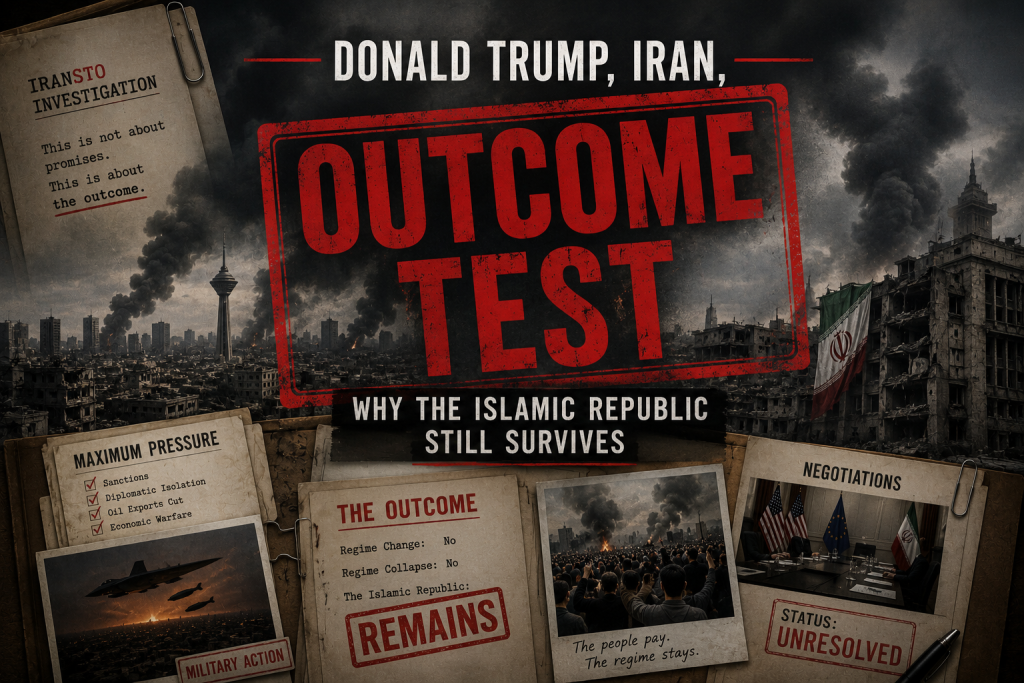
Introduction
Trump’s Iran Policy.
Donald Trump built his political case on a simple accusation: America’s Iran policy had failed.
Barack Obama had failed.
Joe Biden had failed.
Diplomacy had failed.
Negotiations had failed.
Accommodation had failed.
Again and again, Trump presented himself as the alternative.
He promised strength where others had shown weakness.
Pressure where others had offered concessions.
Results where others had produced failure.
Most importantly, he promised a different outcome.
That promise mattered.
It mattered because the Islamic Republic had already survived decades of American policy experimentation.
It survived engagement.
It survived isolation.
It survived sanctions.
It survived negotiations.
It survived diplomatic pressure.
It survived military pressure.
Every administration arrived claiming it had discovered the correct approach.
Every administration promised a better result.
The regime remained.
Trump insisted he would be different.
For many Iranians, particularly those who had long viewed Washington’s Iran policy as an endless cycle of management disguised as strategy, that promise carried enormous weight.
Trump did not merely criticise previous presidents.
He mocked them.
He portrayed them as weak.
Naive.
Incompetent.
Unwilling to confront the reality of the Islamic Republic.
The message was unmistakable.
Others had accepted the regime.
Trump would challenge it.
Others had managed the problem.
Trump would solve it.
Others had failed the Iranian people.
Trump would stand with them.
This theme became one of the defining features of his public messaging.
When protests erupted inside Iran, he expressed support.
When repression intensified, he issued condemnations.
When critics questioned his policies, he pointed towards pressure, confrontation, and resolve.
The administration repeatedly portrayed itself as an ally of the Iranian people and an opponent of the regime that governed them.
Then came Maximum Pressure.
The United States withdrew from the nuclear agreement.
Sanctions expanded.
Economic restrictions intensified.
Oil revenues declined.
The killing of Qasem Soleimani became one of the most significant confrontations between Washington and the Islamic Republic in decades.
Supporters celebrated the campaign as proof that the era of accommodation was over.
Critics warned that pressure alone was not a strategy.
The debate continued.
Then history moved forward.
Trump returned to office.
The confrontation deepened.
The promises continued.
Then January 2026 happened.
The deadliest crackdown in modern Iranian history unfolded.
Hundreds were killed.
Thousands disappeared into detention systems.
Families searched for information.
The world watched.
Trump responded with a promise.
“Help is on the way.”
The statement carried enormous implications.
It suggested that the United States was prepared to do more than issue statements.
It suggested that events were moving towards a different outcome.
Weeks later, war followed.
The conflict escalated.
Ali Khamenei was killed.
Military operations expanded.
Ceasefires were announced.
Negotiations emerged.
The language of victory competed with the language of diplomacy.
The language of confrontation increasingly coexisted with the language of agreement.
Yet amid the noise, one fact remained remarkably difficult to ignore.
The Islamic Republic did not disappear.
Its governing structures remained.
Its institutions remained.
Its security apparatus remained.
Its capacity to exercise power remained.
That reality sits at the centre of this investigation.
Because this article is not about intentions.
It is not an attempt to uncover hidden motives.
It does not assume that Donald Trump supports the Islamic Republic.
The evidence does not require such a claim.
This investigation is concerned with something far simpler.
Outcome.
Trump established a standard for judging American policy towards Iran.
He repeatedly argued that Obama and Biden should not be judged by speeches, intentions, or promises.
They should be judged by results.
This article applies the same standard to Trump himself.
Not because he is unique.
Not because he deserves special scrutiny.
But because he personally established the metric.
If Obama failed because the Islamic Republic survived, what should be concluded when the regime survives Trump?
If Biden failed because negotiations preserved the regime, what should be concluded when negotiations continue under Trump?
If previous administrations failed because they could not deliver meaningful change for the Iranian people, what standard should be applied when the same question remains unresolved in 2026?
These are not partisan questions.
They are not ideological questions.
They are outcome-based questions.
And they become unavoidable once rhetoric is separated from reality.
Throughout this investigation, one principle remains constant.
Pressure is not an outcome.
Sanctions are not an outcome.
War is not an outcome.
Speeches are not an outcome.
The outcome is what remains after all of them.
The central question is therefore not whether Donald Trump confronted the Islamic Republic.
He did.
The central question is whether that confrontation produced a materially different result from the policies he spent years condemning.
Because after sanctions, military escalation, war, ceasefires, negotiations, and years of promises, one fact continues to dominate the landscape.
The Islamic Republic remains.
The burden of proof therefore belongs not to Trump’s critics.
It belongs to those claiming that the outcome is different.
Because after everything that happened in 2026, the question Trump spent years asking everyone else has returned to him.
If the regime remains, what exactly changed?
Chapter 1
The Man Who Promised Results
The Standard Trump Created
Long before war.
Long before sanctions.
Long before military escalation.
And long before promises that help was on the way.
Donald Trump built his political case on a simple accusation.
America’s Iran policy had failed.
Not partially failed.
Not temporarily failed.
Failed.
This was not a secondary theme of Trump’s political message.
It was one of its foundations.
Again and again, he argued that Washington had spent decades confusing activity with achievement.
Administrations talked.
The regime survived.
Administrations negotiated.
The regime survived.
Administrations issued statements.
The regime survived.
From Trump’s perspective, that fact alone was enough to expose the failure.
The argument resonated because it targeted a reality that was difficult to deny.
The Islamic Republic remained in power.
Whatever tactical victories previous administrations claimed, the regime itself endured.
Trump understood the political power of that observation.
And he used it relentlessly.
The Obama Failure
No president occupied a larger place in Trump’s criticism of Iran policy than Barack Obama.
The nuclear agreement became the centrepiece of the case.
Trump repeatedly described it as a disastrous bargain.
Washington had surrendered leverage.
The regime had gained relief.
The regime had gained time.
The regime had gained resources.
Again and again, the same accusation appeared.
Obama had strengthened the Islamic Republic while presenting the result as diplomacy.
The details varied.
The conclusion did not.
The regime survived.
For Trump, that fact was sufficient.
The argument was never simply that Obama negotiated.
It was that negotiation failed to alter the fundamental reality of the regime.
The Islamic Republic remained.
Therefore the policy failed.
This logic would become central to Trump’s broader political identity.
The Biden Failure
Joe Biden received much the same treatment.
The policies differed.
The criticism did not.
Biden was portrayed as weak.
Indecisive.
Committed to managing the Islamic Republic rather than confronting it.
Diplomatic engagement became evidence of failure.
Negotiation became evidence of failure.
Attempts to reduce tensions became evidence of failure.
Once again, the regime’s survival sat at the centre of the argument.
Trump rarely asked whether a policy reduced risk.
He rarely asked whether it delayed conflict.
He rarely asked whether it created tactical advantages.
His preferred question was far simpler.
Did it solve the problem?
And by Trump’s own definition, the answer was no.
Because the Islamic Republic remained.
Rhetoric Versus Outcome
This distinction matters because it reveals how Trump chose to measure success.
Intentions were not enough.
Good faith was not enough.
Effort was not enough.
Diplomatic activity was not enough.
Rhetoric was not enough.
Outcomes mattered.
That was the standard.
Obama could point towards diplomacy.
Trump pointed towards the regime.
Biden could point towards stability.
Trump pointed towards the regime.
Others could point towards process.
Trump pointed towards the regime.
As long as the Islamic Republic remained in power, he argued, claims of success were fundamentally hollow.
The framework was not complicated.
That was precisely why it worked.
It reduced a complex geopolitical debate to a single outcome.
The regime survived.
Therefore, the policy failed.
The Promise of Difference
Having established failure, Trump offered an alternative.
Pressure instead of accommodation.
Strength instead of weakness.
Confrontation instead of management.
The promise was not merely that his methods would be different.
The promise was that his outcome would be different.
That distinction is essential.
Every administration claims to possess different tactics.
Trump promised something larger.
He promised results.
For many Iranians, this was the most important part of the message.
The question was never whether another American president would criticise the Islamic Republic.
Most presidents already did.
The question was whether criticism would finally be connected to meaningful change.
Trump repeatedly suggested that it would.
The implication was clear.
Previous presidents had accepted outcomes that should never have been accepted.
Trump would not.
The Standard That Matters
This chapter is not an attempt to determine whether Trump’s criticism of Obama and Biden was fair.
Nor is it an attempt to defend their records.
That is not the purpose of this investigation.
What matters is something much simpler.
Donald Trump established a standard.
He argued that American policy towards Iran should be judged by results rather than intentions.
By outcomes rather than rhetoric.
By realities rather than promises.
Most importantly, he argued that the continued survival of the Islamic Republic represented evidence of failure.
That standard sits at the centre of everything that follows.
Because before examining sanctions, war, negotiations, January 2026, and the events that followed, one fact must first be understood.
The metric used throughout this investigation was not created by Trump’s critics.
It was created by Trump himself.
And once a politician establishes a standard for judging others, it becomes impossible to avoid a final question.
Should that same standard now be applied to him?
Chapter 2
The Failure of Obama
The Case Trump Built
Long before Donald Trump had an Iran policy of his own, he had already built a case against somebody else’s.
Barack Obama became the primary target.
Again and again, Trump returned to the same accusation.
The Islamic Republic survived.
Everything else was secondary.
The negotiations.
The diplomacy.
The speeches.
The agreements.
The promises.
None of them mattered if the regime remained in power.
This was the foundation of Trump’s criticism.
It was also the standard he demanded others accept.
Obama’s defenders pointed towards diplomacy.
Trump pointed towards the regime.
Obama’s defenders pointed towards reduced tensions.
Trump pointed towards the regime.
Obama’s defenders pointed towards the nuclear agreement.
Trump pointed towards the regime.
The message was brutally simple.
If the Islamic Republic remained intact, the policy had failed.
The Nuclear Agreement
No issue occupied a larger place in Trump’s indictment than the Joint Comprehensive Plan of Action.
The Obama administration presented the agreement as a diplomatic achievement.
Supporters argued that it restricted Iran’s nuclear programme, expanded monitoring, and reduced the likelihood of military confrontation.
Trump viewed the agreement through a different lens.
The nuclear file was not the central issue.
The regime was.
Again and again, he returned to the same argument.
The administration negotiated with the regime.
The regime remained.
Sanctions were lifted.
The regime remained.
Economic relief arrived.
The regime remained.
For Trump, these were not separate observations.
They were evidence.
Evidence that Washington had mistaken process for success.
The agreement may have altered aspects of the nuclear dispute.
It had not altered the survival of the Islamic Republic.
And in Trump’s view, that was the only outcome that mattered.
The Legitimacy Argument
Trump’s criticism extended beyond sanctions and nuclear policy.
It touched a broader issue.
Legitimacy.
A recurring argument among critics of Obama’s approach was that engagement inevitably strengthened the regime’s international standing.
Negotiation created recognition.
Recognition created legitimacy.
Legitimacy created stability.
Trump embraced this argument completely.
The accusation was straightforward.
Washington had reduced pressure on the regime while claiming progress.
The regime received diplomatic engagement.
The regime received economic relief.
The regime received international recognition.
And at the end of the process, the regime remained.
Once again, the criticism returned to the same destination.
Outcome.
The Islamic Republic survived.
Therefore, the policy failed.
The Iranian People
Trump’s criticism was not confined to the regime itself.
It repeatedly invoked the Iranian people.
The argument was politically powerful because it drew a clear distinction.
Iran was not the Islamic Republic.
The Iranian people were not the Islamic Republic.
According to Trump’s critique, Washington had spent years engaging with the rulers of Iran while paying insufficient attention to the people living under them.
Diplomacy had become a conversation with power.
Not a strategy for change.
Whether that characterisation was entirely fair is not the issue.
What matters is that Trump used it relentlessly.
Obama had negotiated with the regime.
Trump would stand with the people.
Obama had pursued accommodation.
Trump would pursue pressure.
Obama had accepted outcomes that should never have been accepted.
Trump would not.
These claims became central to his political identity.
They also created expectations that would later become impossible to escape.
The Outcome Test
At its core, Trump’s criticism of Obama rested on a single assumption.
Results matter more than intentions.
The Obama administration could point towards negotiations.
Trump pointed towards the regime.
The Obama administration could point towards agreements.
Trump pointed towards the regime.
The Obama administration could point towards reduced tensions.
Trump pointed towards the regime.
Again and again, the same logic appeared.
If the Islamic Republic remained in power, the policy had failed.
The theory was not complicated.
That was its strength.
It reduced a complex geopolitical debate to a simple outcome-based standard.
The regime survives.
Therefore, success has not occurred.
The argument proved politically effective because it was easy to understand.
It was also difficult to rebut.
The Islamic Republic remained.
That fact gave Trump’s criticism its force.
The Standard Established
This chapter is not an attempt to determine whether Trump’s criticism of Obama was entirely justified.
Reasonable people can disagree on that question.
The purpose of this investigation is different.
The purpose is to establish the standard Trump created.
Because before examining Trump’s own record, one reality must be understood.
Donald Trump did not ask the public to judge Iran policy by effort.
He did not ask them to judge it by intentions.
He did not ask them to judge it by diplomatic activity.
He asked them to judge it by outcome.
More specifically, he asked them to judge it by whether the Islamic Republic remained in power.
That standard became one of the most effective political weapons of his career.
It would eventually become one of the greatest challenges facing his own presidency.
Because once a politician builds his argument around outcome, he creates a question for himself.
If the survival of the Islamic Republic proved that Obama failed, what should be concluded when the same regime survives Trump?
Chapter 3
The Failure of Biden
The Target Before the Return
If Barack Obama represented Trump’s case against engagement, Joe Biden became the symbol of everything Trump claimed was wrong with contemporary American policy towards Iran.
The criticism was relentless.
The language was familiar.
Weakness.
Appeasement.
Accommodation.
Failed leadership.
The circumstances had changed.
The accusation had not.
According to Trump, Washington had once again fallen into the trap of managing the Islamic Republic rather than confronting it.
The administration spoke about stability.
The regime remained.
The administration pursued diplomacy.
The regime remained.
The administration attempted to reduce tensions.
The regime remained.
For Trump, the conclusion was obvious.
Nothing fundamental had changed.
The Biden Approach
Unlike Obama, Biden inherited a landscape already shaped by Maximum Pressure.
The nuclear agreement was effectively broken.
Relations between Washington and Tehran were strained.
Regional tensions remained high.
The administration’s response focused largely on management.
Reducing escalation.
Containing risk.
Preserving stability.
Keeping confrontation within predictable limits.
Supporters described this approach as pragmatic.
Critics described it as drift.
Trump described it as failure.
Once again, the disagreement centred on method.
Trump focused on outcome.
And in his view, one outcome overshadowed everything else.
The Islamic Republic remained in power.
The Politics of Stability
One of Trump’s most effective political attacks concerned the idea of stability itself.
For supporters of the administration, stability represented risk reduction.
For Trump, stability represented surrender disguised as strategy.
The distinction mattered.
Because once stability became synonymous with acceptance, every attempt to avoid escalation could be portrayed as weakness.
Every diplomatic initiative became accommodation.
Every effort to reduce risk became hesitation.
Every attempt to manage reality became evidence that Washington had stopped trying to change it.
Whether those accusations were fair is not the point.
The point is that Trump repeated them constantly.
He presented stability not as an achievement, but as proof that American policy had abandoned meaningful change.
The Negotiation Argument
Negotiations occupied a central place in Trump’s criticism of both Obama and Biden.
The argument remained remarkably consistent.
Talks continued.
The regime remained.
Discussions continued.
The regime remained.
Diplomatic initiatives came and went.
The regime remained.
For Trump, this pattern revealed a deeper problem.
Washington was managing crises.
The Islamic Republic was surviving them.
And survival, in Trump’s framework, represented victory for the regime.
The implication was clear.
If negotiations repeatedly ended with the continued existence of the Islamic Republic, negotiations could not be described as success.
At least not according to the standard Trump established.
The Iranian People Again
Just as he had done when criticising Obama, Trump frequently framed his criticism of Biden around the Iranian people.
The accusation was familiar.
Washington spent too much time engaging with the regime and too little time supporting those living under it.
Diplomats talked.
Ordinary Iranians suffered.
Officials negotiated.
Ordinary Iranians remained trapped under the same political system.
The argument resonated because it shifted the debate away from policy mechanics and towards outcome.
The question was no longer whether negotiations occurred.
The question was whether those negotiations changed the reality experienced by the Iranian people.
Trump’s answer was unambiguous.
They had not.
That conclusion became a central part of his campaign to return to office.
The Promise
By the time Trump sought a return to the White House, he had spent years constructing a remarkably simple political narrative.
Obama failed.
Biden failed.
The Islamic Republic remained.
The criticism did not depend upon ideology.
It depended upon outcome.
The regime survived.
Therefore, the policy failed.
This argument created a powerful expectation.
If Obama failed because the regime survived, Trump would have to produce something different.
If Biden failed because negotiations preserved the regime, Trump would have to demonstrate another path.
If previous administrations failed the Iranian people, Trump would eventually have to show what success looked like.
The standard was now fully established.
Trump was no longer merely criticising policy.
He was making a promise.
A promise that his presidency would produce an outcome fundamentally different from the outcomes he had spent years condemning.
The Trap He Created
Political standards are powerful weapons.
They are also dangerous.
A politician who judges others by outcome eventually invites the same judgement upon himself.
That reality now becomes unavoidable.
By the time Trump returned to office, the benchmark had already been set.
The Islamic Republic remained.
Therefore Obama failed.
The Islamic Republic remained.
Therefore Biden failed.
The logic was simple.
The consequences were unavoidable.
Because once Trump returned to power, the debate could no longer focus on the failures of others.
The focus would shift to his own record.
And for the first time, the standard he had spent years applying to Obama and Biden would begin to move in the opposite direction.
Back towards him.
That is where this investigation now turns.
From criticism.
To accountability.
Chapter 4
Trump’s First Test
Maximum Pressure
For years, Donald Trump argued that previous administrations had accepted outcomes that should never have been accepted.
The Islamic Republic remained in power.
That fact sat at the centre of his criticism of both Obama and Biden.
Now, for the first time, Trump had an opportunity to prove his own theory.
No more criticism.
No more campaign speeches.
No more attacks on previous presidents.
The responsibility now belonged to him.
If engagement had failed, what would replace it?
If negotiations had failed, what would replace them?
If accommodation had failed, what would replace it?
Trump’s answer was clear.
Maximum Pressure.
It became the defining feature of his first presidency and the foundation of his claim that he was pursuing a fundamentally different approach towards the Islamic Republic.
The administration did not promise adjustment.
It promised reversal.
Ending the Obama Era
The defining moment arrived on 8 May 2018.
The United States withdrew from the Joint Comprehensive Plan of Action.
The decision represented far more than a disagreement over nuclear policy.
It was a direct rejection of the assumptions that had guided Obama’s approach.
Trump argued that the agreement had strengthened the regime while producing little meaningful change.
Supporters of withdrawal viewed the move as a long overdue correction.
Critics warned that Washington was abandoning an imperfect but functioning framework without a credible replacement.
The debate was intense.
The political message was simple.
Obama negotiated.
Trump confronted.
Obama reduced pressure.
Trump increased it.
Obama accepted the survival of the regime.
Trump promised to challenge it.
Whether that promise could be fulfilled remained to be seen.
Economic Warfare
Following withdrawal from the nuclear agreement, the administration rebuilt and expanded one of the most comprehensive sanctions regimes imposed against any state in recent history.
Energy exports were targeted.
Financial institutions were targeted.
Shipping networks were targeted.
Industrial sectors were targeted.
Foreign companies faced increasing pressure to disengage from Iran.
The objective was unmistakable.
Reduce the regime’s access to revenue.
Increase economic pain.
Restrict financial flexibility.
Force difficult choices upon the leadership.
In economic terms, the campaign produced measurable consequences.
Oil exports declined sharply.
Inflation accelerated.
Foreign investment contracted.
The national currency experienced severe instability.
Economic pressure became impossible to ignore.
Even many critics acknowledged that Maximum Pressure imposed genuine costs on the Iranian economy.
The pressure was real.
The damage was real.
The question was whether pressure and success were the same thing.
Soleimani
In January 2020, the administration escalated even further.
A United States drone strike killed Qasem Soleimani, one of the most influential figures within the Islamic Republic’s regional security architecture.
The significance extended far beyond the individual target.
For supporters of the administration, the strike demonstrated something they believed previous presidents lacked.
Willingness.
Trump had spent years accusing earlier administrations of caution.
Now he was presenting himself as a president prepared to act.
A president willing to challenge the regime directly rather than merely criticise it.
A president willing to impose consequences rather than issue statements.
A president willing to break assumptions that previous administrations treated as untouchable.
The symbolism was enormous.
The political message was unmistakable.
Trump was doing what he had promised to do.
The Difference Was Real
One of the weakest arguments in contemporary debates about Iran is the claim that nothing changed under Trump.
That argument does not survive serious examination.
Things changed.
The level of economic pressure changed.
The level of confrontation changed.
The level of risk changed.
The willingness to escalate changed.
Trump’s first-term policy was not a continuation of Obama’s approach.
Nor was it a continuation of the approach that followed.
The differences were substantial.
The methods were different.
The rhetoric was different.
The tools were different.
This investigation does not require pretending otherwise.
In fact, recognising those differences is essential.
Because the stronger Trump’s actions appear, the more important the next question becomes.
What did those actions ultimately produce?
The Missing Destination
This is where the first major weakness emerged.
The administration frequently explained what it was doing.
It explained far less clearly what success would look like.
Was the objective a new nuclear agreement?
Behavioural change?
Strategic surrender?
Regime transformation?
Regime collapse?
The answers often appeared uncertain.
Different officials offered different explanations.
The administration clearly possessed instruments.
Sanctions.
Military leverage.
Diplomatic pressure.
What remained far less visible was a coherent theory connecting those instruments to a final political destination.
Pressure was visible.
The destination was not.
The First Outcome Test
By the conclusion of Trump’s first presidency, the administration could point towards an impressive list of actions.
It withdrew from the nuclear agreement.
It imposed unprecedented sanctions.
It inflicted high economic costs.
It killed Qasem Soleimani.
It fundamentally altered the relationship between Washington and Tehran.
No serious observer can deny any of these facts.
The administration acted.
Aggressively.
Repeatedly.
Publicly.
The question is what those actions achieved.
Because Donald Trump did not build his political case against Obama and Biden by measuring activity.
He measured outcome.
That was the standard.
And when Trump’s first presidency came to an end, one fact remained stubbornly unchanged.
The Islamic Republic remained.
Its institutions remained.
Its security apparatus remained.
Its mechanisms of repression remained.
Its ability to govern remained.
This reality did not end the debate.
It transformed it.
Because after years spent judging others, Trump now possessed a record of his own.
And for the first time, the standard he created could begin to move in the opposite direction.
Back towards him.
Chapter 5
January 2026
Help Is On The Way
On 13 January 2026, as reports emerged of mass killings inside Iran, Donald Trump delivered a message that immediately spread across social media, news platforms, and Iranian communities around the world.
“Help is on the way.”
The statement was short.
Its consequences were not.
For many Iranians, the words carried an obvious implication.
The President of the United States was not merely expressing concern.
He was signalling action.
The message arrived during one of the darkest moments in modern Iranian history.
Images of violence spread across the world.
Reports of mass casualties multiplied.
Families searched desperately for information.
Fear spread.
Anger spread.
Grief spread.
And in the middle of that atmosphere, the most powerful political figure in the world delivered a promise.
Help is on the way.
The statement immediately created a question.
What kind of help?
The Weight of a Promise
Political leaders make promises every day.
Most disappear almost immediately.
This one did not.
Because it was delivered under extraordinary circumstances.
The statement was not made during a campaign rally.
It was not made during a policy debate.
It was made while people were being killed.
The timing transformed its meaning.
Many interpreted the message as an indication that the United States intended to move beyond statements and condemnations.
The expectation was understandable.
Trump had spent years criticising previous presidents for weakness.
Years criticising diplomacy.
Years criticising accommodation.
Years promising a different approach.
Now a historic crisis was unfolding.
And the President of the United States was telling Iranians that help was coming.
The expectation did not emerge from wishful thinking.
It emerged from Trump’s own rhetoric.
The Moment Of Accountability
For years, Trump had argued that previous administrations tolerated realities that should never have been accepted.
The survival of the Islamic Republic.
The repression of Iranian citizens.
The absence of meaningful political change.
Again and again, he portrayed himself as the alternative.
The president willing to act.
The president willing to confront.
The president willing to achieve what others would not.
January 2026 transformed those claims into a test.
No administration before him had faced this exact moment.
No administration before him had made this exact promise.
The debate was no longer theoretical.
The debate was no longer historical.
The debate was no longer about Obama.
Or Biden.
Or the JCPOA.
The debate was now about Trump.
His promises.
His decisions.
His outcome.
Expectation And Reality
The difficulty begins here.
Because nothing happened.
Because a great deal happened.
The United States did not remain passive.
Events moved rapidly.
Escalation followed.
Military action followed.
Regional confrontation followed.
The situation evolved far beyond the limits of ordinary diplomacy.
Yet as events accelerated, another question emerged.
What exactly was the political objective?
The promise had been clear.
The destination was not.
Was the objective protection?
Regime change?
Deterrence?
Punishment?
Transition?
Different observers offered different answers.
The administration spoke frequently about action.
It spoke far less clearly about outcome.
That gap would become one of the defining features of everything that followed.
The Iranian People’s Test
For many observers outside Iran, January 2026 became another geopolitical crisis.
For many Iranians, it became something else.
A test.
A test of whether years of rhetoric would finally be connected to meaningful change.
Trump had repeatedly distinguished himself from Obama and Biden.
He had repeatedly argued that previous administrations failed because they accepted outcomes that should never have been accepted.
Now history had presented him with an opportunity unlike any faced by his predecessors.
The question was no longer whether Trump opposed the Islamic Republic.
The question was what opposition would actually produce.
Because promises create expectations.
And expectations create standards.
The phrase “help is on the way” did not simply express sympathy.
It created a benchmark.
A benchmark against which everything that followed would inevitably be judged.
The Standard Arrives
This investigation does not attempt to determine what Donald Trump intended when he made that statement.
Intentions are rarely measurable.
Outcomes are.
What matters is that a promise was made.
Publicly.
Clearly.
At one of the most consequential moments in modern Iranian history.
From that point forward, the debate changed.
The question was no longer whether Trump criticised Obama.
The question was no longer whether Trump criticised Biden.
The question was no longer whether Maximum Pressure differed from engagement.
The question became far simpler.
Help was on the way.
What arrived?
The answer to that question would shape everything that followed.
Including the war itself.
Chapter 6
The War
The Ultimate Escalation
For years, Donald Trump argued that previous administrations lacked the willingness to confront the Islamic Republic.
Obama negotiated.
Biden managed.
Trump promised action.
January 2026 appeared to present the moment that would define whether those promises meant anything.
Then the situation escalated beyond sanctions.
Beyond statements.
Beyond diplomacy.
War arrived.
For supporters of the administration, the conflict represented proof that Trump was fundamentally different from his predecessors.
No president had gone this far.
No president had applied this level of pressure.
No president had accepted this degree of risk.
The argument seemed straightforward.
Obama negotiated.
Trump fought.
Obama accommodated.
Trump confronted.
Obama managed.
Trump acted.
At first glance, the contrast appeared undeniable.
The question is whether contrast and success are the same thing.
The Death of Khamenei
One event quickly dominated international attention.
Ali Khamenei was dead.
For decades, Khamenei had occupied the centre of the Islamic Republic’s political structure.
He was not simply a senior official.
He was the regime’s supreme authority.
Its ultimate decision-maker.
Its most powerful symbol.
His death immediately generated speculation across the world.
Some observers described it as a historic turning point.
Others described it as the beginning of a transition.
Many assumed that the removal of such a central figure would fundamentally alter the future of the regime.
The expectation was understandable.
If the Supreme Leader was gone, surely the system itself had been fatally weakened.
Yet history repeatedly demonstrates that political systems and political individuals are not always the same thing.
Removing a leader and removing a regime are different achievements.
One can happen without the other.
That distinction would become increasingly important as events unfolded.
Action Is Not Outcome
There is little value in pretending the war was insignificant.
It was not.
The scale of escalation exceeded anything witnessed during Trump’s first presidency.
Military action occurred.
Regional dynamics shifted.
Political assumptions collapsed.
Events that had once seemed improbable became reality.
The administration could legitimately point towards these developments as evidence that it had abandoned the caution of previous governments.
The problem appears when escalation itself becomes the measurement of success.
War is an instrument.
Not an outcome.
Military action is an instrument.
Not an outcome.
Escalation is an instrument.
Not an outcome.
The question therefore remains unchanged.
What political reality was the war supposed to create?
The Missing Political Destination
This question became increasingly difficult to answer as the conflict expanded.
The administration spoke frequently about strength.
Resolve.
Deterrence.
Pressure.
Victory.
Yet the final political destination often remained unclear.
What would success actually look like?
The destruction of nuclear infrastructure?
The elimination of senior figures?
The collapse of the regime?
A negotiated settlement?
A political transition?
Different observers offered different answers.
The administration itself often appeared more comfortable discussing action than discussing destination.
This uncertainty matters because wars are not self-justifying.
Their significance depends on the political outcomes they produce.
Without a clearly defined destination, even dramatic events become difficult to evaluate.
The question is not whether the war happened.
The question is what it was intended to achieve.
The Promise Revisited
This uncertainty becomes even more significant when viewed through the lens of January 2026.
The promise that help was on the way created expectations.
The war appeared to be part of the response.
Many supporters of the administration presented it that way.
The United States was finally doing something.
Finally imposing consequences.
Finally confronting the regime directly.
Yet confrontation alone does not answer the question raised by the promise.
Help for whom?
And towards what end?
The administration demonstrated willingness to escalate.
It remained less clear how escalation connected to a defined political future for Iran itself.
This distinction would become increasingly difficult to ignore as the conflict continued.
The Difference Trump Wanted
There is no question that Trump succeeded in distinguishing himself from Obama and Biden in one important respect.
The level of confrontation was different.
The willingness to use force was different.
The willingness to escalate was different.
The differences were real.
This investigation does not require denying them.
The issue is whether difference alone constitutes success.
Because Trump never merely promised a different method.
He promised a different outcome.
That is the standard he established.
That is the standard he repeatedly applied to others.
And that is the standard that must now be applied to him.
The Outcome Question
By this stage, one reality had become impossible to avoid.
The war demonstrated capability.
It demonstrated willingness.
It demonstrated escalation.
It demonstrated that Trump was prepared to go further than previous administrations.
What it did not automatically demonstrate was political success.
A government can win battles and still fail to achieve its objectives.
It can escalate conflict and still leave the underlying political reality unchanged.
It can remove individuals and still leave systems intact.
The crucial question therefore remained unresolved.
What political outcome was the war supposed to produce?
Because once military action begins, intentions matter less than results.
And once results become the standard, a new contradiction begins to emerge.
The war changed many things.
But did it change the one thing Trump spent years arguing mattered most?
That question leads directly to the next stage of the investigation.
Because after war came something many observers did not expect.
Negotiation.
Chapter 7
The Ceasefire Contradiction
From War To Negotiation
For years, Donald Trump built his political identity around a simple accusation.
Obama negotiated.
Biden negotiated.
The Islamic Republic survived.
Therefore, the policy failed.
The argument followed him into office.
It followed him through Maximum Pressure.
It followed him into war.
And eventually, it followed him into one of the most uncomfortable moments of his presidency.
Because after escalation came something familiar.
Negotiation.
After military action came diplomacy.
After declarations of strength came discussions of agreement.
After promises of decisive action came conversations about settlement.
The contradiction was impossible to miss.
The same president who spent years attacking negotiations now found himself defending them.
The same president who mocked diplomacy now found himself relying on it.
The same president who portrayed accommodation as weakness now found himself discussing arrangements with the surviving structures of the very regime he claimed he would fundamentally change.
The language changed.
The slogans changed.
The justification changed.
The underlying reality did not.
The Islamic Republic remained part of the conversation.
The Ceasefire Problem
The problem was never the existence of a ceasefire.
Wars often end through negotiation.
Military conflicts frequently transition into diplomacy.
No serious observer disputes that reality.
The problem lies elsewhere.
The war had been presented as a break from the past.
A rejection of the assumptions that guided previous administrations.
A rejection of endless management.
A rejection of cyclical diplomacy.
A rejection of policies that left the regime intact.
Yet as the months passed, the public increasingly encountered a familiar pattern.
Announcements of progress.
Announcements of negotiations.
Announcements of agreements.
Announcements of ceasefires.
Then renewed exchanges.
Renewed tensions.
Renewed military activity.
Then more negotiations.
More agreements.
More promises.
The cycle began to look increasingly familiar.
Not identical.
But familiar.
And familiarity was precisely what Trump had promised to destroy.
The System Survived
Much of the public discussion focused on individuals.
Particularly the death of Ali Khamenei.
Far less attention focused on a more important question.
What happened to the system?
Political systems do not disappear automatically when leaders disappear.
Institutions survive.
Security structures survive.
Bureaucracies survive.
Networks survive.
Power adapts.
That reality sits at the heart of the Islamic Republic’s history.
And it increasingly sat at the heart of the post-war debate.
The Supreme Leader was gone.
The war had happened.
The escalation had happened.
The promises had happened.
Yet the conversation increasingly revolved around arrangements involving surviving components of the same political structure.
The question became more difficult with each passing month.
Not because explanations were unavailable.
Because the outcome increasingly resembled something Trump had spent years condemning.
Management.
Trump’s Question Returns
Throughout his political career, Trump repeatedly asked a devastatingly simple question.
What did your policy achieve?
It was effective because it cut through complexity.
Diplomatic achievements became secondary.
Procedural victories became secondary.
Intentions became secondary.
Only outcome mattered.
Now the same question was returning.
Not from Trump’s critics.
From reality itself.
What had the war achieved politically?
Had it produced transformation?
Had it produced transition?
Had it produced a fundamentally different future?
Or had it produced a new version of a familiar situation?
These questions became increasingly difficult to dismiss.
Because they emerged directly from the standard Trump himself created.
The Iranian People’s Verdict
For policymakers in Washington, the debate often revolved around strategy.
For many Iranians, it revolved around outcome.
The distinction matters.
Ordinary people do not live inside policy papers.
They live inside consequences.
They do not experience strategic frameworks.
They experience reality.
And the reality confronting many Iranians after months of war, ceasefires, negotiations, uncertainty, and competing political narratives was deeply unsettling.
They remembered the promises.
They remembered the speeches.
They remembered the rhetoric.
Most of all, they remembered the statement.
“Help is on the way.”
The question many increasingly began asking was brutally straightforward.
Was this the help?
Was this the destination?
Was this what years of criticism of Obama and Biden had been leading towards?
The question did not emerge from ideology.
It emerged from comparison.
Trump spent years defining success through outcome.
Many Iranians were beginning to do the same thing.
Negotiating With What Remains
Perhaps the most uncomfortable question raised by the conflict concerns the nature of negotiation itself.
Negotiation is not automatically surrender.
It is not automatically weakness.
It is not automatically failure.
But neither is it automatically success.
Its significance depends entirely upon what remains afterwards.
And that creates a serious problem for the administration.
For years, Trump portrayed negotiation as evidence that previous presidents lacked the courage to pursue real solutions.
Yet after war, negotiations returned.
After escalation, negotiations returned.
After promises of a different outcome, negotiations returned.
The issue is not that negotiations existed.
The issue is that they returned after being presented for years as evidence of failure.
That contradiction is impossible to ignore.
The Outcome That Matters
By this stage, one reality had become increasingly difficult to avoid.
The administration demonstrated strength.
It demonstrated willingness.
It demonstrated escalation.
It demonstrated military capability.
No serious observer can deny any of these facts.
The question is whether strength, willingness, escalation, and capability were the outcome.
Or whether they were merely instruments used in pursuit of one.
Because if outcome remains the standard, then a more uncomfortable question emerges.
The war happened.
The ceasefires happened.
The negotiations happened.
The promises happened.
What changed?
That question sits at the centre of everything that follows.
Because before determining whether Trump succeeded or failed, another issue must first be understood.
Why does the Islamic Republic continue to survive pressures that many believed would be decisive?
To answer that question, the focus must now shift away from Washington and towards the regime itself.
Because this story is not only about what Trump did.
It is also about what the Islamic Republic was built to survive.
Chapter 8
The Survival Machine
How the Islamic Republic Absorbs Pressure
By this stage of the investigation, an uncomfortable reality begins to emerge.
The survival of the Islamic Republic cannot be explained solely through the actions of American presidents.
Obama matters.
Biden matters.
Trump matters.
But none of them provides a complete explanation.
Because the same regime survived all of them.
Different rhetoric.
Different strategies.
Different levels of confrontation.
The outcome remained remarkably consistent.
This raises a question that is frequently ignored in Washington.
What if the problem is not only the policies being applied?
What if the problem is also the system receiving them?
To understand why sanctions, diplomatic engagement, military escalation, and even war repeatedly fail to produce the outcomes many expect, it is necessary to understand the political architecture of the Islamic Republic itself.
Because the regime was never designed to prosper.
It was designed to survive.
A System Built For Crisis
Many governments are built around stability.
The Islamic Republic was built around crisis.
The distinction matters.
From its earliest years, the regime developed under conditions of war, sanctions, isolation, confrontation, internal unrest, and international pressure.
Pressure was never an unexpected challenge.
Pressure became part of the operating environment.
Over time, institutions evolved accordingly.
The system learned how to function under sanctions.
How to operate under restriction.
How to govern during instability.
How to convert external threats into internal narratives.
How to transform crisis into justification.
This does not mean the regime became stronger because of pressure.
It means the regime became accustomed to it.
And systems accustomed to pressure behave differently from systems encountering it for the first time.
The Transfer Of Pain
One of the regime’s most effective survival mechanisms is brutally simple.
It transfers costs.
When sanctions increase, ordinary citizens absorb the consequences.
When inflation accelerates, ordinary citizens absorb the consequences.
When the currency collapses, ordinary citizens absorb the consequences.
The people suffer.
The system adjusts.
This reality exposes a weakness that repeatedly appears in Western policy debates.
Economic damage and political transformation are not the same thing.
Many policymakers speak as if one automatically produces the other.
History repeatedly demonstrates otherwise.
A regime capable of shifting pain onto the population can remain politically intact long after economic conditions deteriorate.
The Islamic Republic has spent decades refining that capability.
The result is a political system that often treats public hardship not as an existential threat, but as a manageable cost of survival.
Repression Is Infrastructure
Outside observers frequently describe repression as a reaction.
The Islamic Republic treats repression as infrastructure.
The distinction is critical.
The regime does not improvise repression.
It prepares for it.
Budgets for it.
Institutionalises it.
The security apparatus is not an emergency measure.
It is a permanent feature of governance.
The intelligence apparatus is not an emergency measure.
It is a permanent feature of governance.
The judicial system is not merely a legal institution.
It is also a political weapon.
These structures exist for one overriding purpose.
Regime continuity.
This helps explain a reality that repeatedly frustrates foreign policymakers.
Economic pressure may weaken the economy.
It does not automatically weaken the institutions responsible for maintaining political control.
In some cases, those institutions become even more important as pressure increases.
Adaptation As Strategy
For decades, sanctions have been presented as a mechanism capable of forcing change.
The Islamic Republic responded by building mechanisms capable of absorbing them.
Alternative trade routes emerged.
Informal financial networks emerged.
Intermediaries emerged.
Smuggling networks expanded.
Sanctions evasion became an industry.
An entire ecosystem developed around survival under restriction.
None of this eliminated the economic damage.
The costs remained severe.
The inefficiencies remained severe.
The corruption remained severe.
But survival is not the same thing as prosperity.
The regime never needed to thrive.
It only needed to endure.
That distinction repeatedly escaped policymakers who confused economic suffering with political collapse.
The Leadership Illusion
Western analysis often becomes obsessed with individuals.
Presidents.
Foreign ministers.
Military commanders.
Supreme leaders.
These figures matter.
But they can also become distractions.
The death of Ali Khamenei generated enormous attention.
Understandably so.
Yet the survival question did not begin or end with one individual.
Political systems capable of surviving for decades rarely depend entirely on a single person.
They depend on institutions.
Networks.
Patronage structures.
Security structures.
Bureaucratic continuity.
The removal of a leader can create disruption.
It does not automatically create transformation.
This distinction became increasingly important after the war.
Many observers focused on who disappeared.
The more important question concerned what remained.
The Real Opponent
This is where many external strategies encounter the same obstacle.
They assume the primary challenge is applying enough pressure.
The Islamic Republic presents a different challenge.
The challenge is overcoming a system specifically designed to survive pressure.
The regime expects sanctions.
It expects isolation.
It expects confrontation.
It expects hostility.
Pressure is not an unexpected event.
It is part of the political environment.
This does not make the regime invulnerable.
Far from it.
It remains dependent on coercion.
Dependent on fear.
Dependent on control.
Dependent on institutions that require constant maintenance.
But it does explain why policies that appear devastating from the outside repeatedly fail to produce decisive political outcomes.
The system was designed with survival in mind.
And survival remains its most consistent achievement.
Why This Matters
This chapter is not an argument against pressure.
Nor is it an argument against confrontation.
It is an argument against simplistic assumptions.
The assumption that economic damage automatically becomes political change.
The assumption that military escalation automatically becomes transformation.
The assumption that removing leaders automatically becomes regime collapse.
The history of the Islamic Republic repeatedly challenges these assumptions.
And that challenge becomes particularly relevant when evaluating Donald Trump’s record.
Because the central question is no longer whether pressure was applied.
It clearly was.
The question is whether pressure was connected to a strategy capable of overcoming a political system built to survive it.
That distinction sits at the centre of this investigation.
And it leads directly to the final contradiction.
If the Islamic Republic was built to survive pressure, what happens when opposition becomes almost entirely defined by pressure itself?
That question sits at the heart of Trump’s Iran policy.
And it is where this investigation now turns.
Chapter 9
The Iranian People’s Test
The Question Nobody Answered
Throughout this investigation, one question has appeared repeatedly.
What was the strategy for the Iranian people?
Not the strategy for sanctions.
Not the strategy for negotiations.
Not the strategy for military pressure.
The strategy for the Iranian people themselves.
This question matters because a distinction that is routinely blurred in international policy debates is impossible to ignore.
Iran is not the Islamic Republic.
The Iranian people are not the Islamic Republic.
The interests of the regime are not the interests of the nation.
Yet for decades, American policy has often behaved as though pressure on one automatically benefits the other.
The evidence is far less clear.
Weakening a regime and empowering a population are not the same thing.
And nowhere does that distinction become more important than in the case of Iran.
A Promise Repeated
Donald Trump understood the political power of this distinction.
Throughout his political career, he repeatedly separated the Iranian people from the regime that governed them.
His administration condemned repression.
It expressed support for protesters.
It criticised corruption.
It criticised the ruling elite.
It portrayed the Iranian people as victims of a political system that had failed them.
The rhetoric was often direct.
The message was often welcomed.
Many Iranians wanted to believe that Washington finally understood a reality that had long been ignored.
Iran and the Islamic Republic were not the same thing.
The problem emerged when rhetoric gave way to policy.
Because recognising a distinction and building a strategy around that distinction are very different things.
One requires language.
The other requires architecture.
Pressure Against Whom?
One of the central assumptions behind Maximum Pressure was that pressure imposed on the regime would eventually create political consequences for the regime.
Sometimes that happened.
Often it did not.
What repeatedly occurred instead was something more complicated.
The regime transferred costs.
The population absorbed them.
Economic pressure intensified.
Ordinary people paid.
Inflation intensified.
Ordinary people paid.
Currency collapse intensified.
Ordinary people paid.
The regime suffered.
The people suffered more.
This does not mean pressure was unjustified.
It means pressure alone could not answer the most important question.
How does pressure imposed on the regime become empowerment for the people?
The administration spoke extensively about the first half of that equation.
The second half remained remarkably underdeveloped.
The Missing Architecture
This is where the central weakness becomes visible.
A strategy against a regime is not automatically a strategy for a people.
The difference is enormous.
A strategy against a regime focuses on punishment.
A strategy for a people focuses on capability.
Organisation.
Communication.
Institution-building.
Political alternatives.
Leadership development.
Networks.
Transition planning.
Washington knew how to sanction.
It knew how to pressure.
It knew how to escalate.
The evidence is far less clear that it knew how to build.
The historical record reveals extensive evidence of coercion.
Far less evidence of political infrastructure.
The administration developed sanctions.
It developed restrictions.
It developed mechanisms of pressure.
What remains difficult to identify is a comparable effort to develop the foundations of an alternative political future.
This distinction matters because regimes rarely disappear into space.
If a political system collapses, something replaces it.
The question is what.
And throughout much of the period examined in this investigation, that question remained largely unanswered.
The January Test
January 2026 exposed this problem more clearly than any previous event.
The question was no longer theoretical.
People were dead.
Families were searching for relatives.
The country was in shock.
Mass killing created outrage.
Outrage created expectation.
Expectation created urgency.
Then came the promise.
Help is on the way.
The statement resonated because it appeared to acknowledge a simple reality.
The Iranian people needed more than sympathy.
They needed something tangible.
Something capable of altering political reality itself.
The question is whether such a strategy existed.
The evidence remains difficult to identify.
The administration clearly possessed a strategy for confrontation.
It clearly possessed a strategy for pressure.
It clearly possessed a strategy for escalation.
Whether it possessed a strategy for the Iranian people themselves remains far less obvious.
The Difference Between Opposition And Transition
This distinction sits at the centre of the entire debate.
Opposing the Islamic Republic is not the same thing as creating a pathway beyond it.
One is criticism.
The other is construction.
One is confrontation.
The other is transformation.
For years, Trump criticised Obama and Biden for accepting outcomes that should never have been accepted.
The criticism carried force because millions of Iranians shared the frustration.
The regime remained.
The repression remained.
The corruption remained.
The question was always what came next.
A successful policy requires more than identifying a problem.
It requires a theory of change.
A mechanism connecting today’s reality to tomorrow’s reality.
That mechanism remained difficult to identify.
The Outcome That Matters Most
This is why the Iranian people ultimately became the most important measure of success.
Not because governments exist to satisfy public opinion.
But because Trump’s own promises repeatedly centred on them.
The administration did not merely promise pressure.
It promised support.
It promised solidarity.
It promised a different future.
That creates a standard.
And standards create accountability.
The question therefore becomes unavoidable.
After the sanctions.
After the war.
After the ceasefires.
After the negotiations.
What materially changed for the Iranian people?
Not for diplomats.
Not for policymakers.
Not for political narratives.
For the people in whose name these policies were repeatedly justified.
This is the test that matters most.
Because if the Iranian people were the stated beneficiaries of the policy, then their reality becomes the ultimate measure of its success.
The administration demonstrated how it would confront the regime.
It never demonstrated with equal clarity how confrontation would become transformation.
And once that standard is applied, the investigation arrives at its final stage.
Not what Trump did.
But what Trump achieved.
Chapter 10
Trump’s Outcome
The Standard Applied
Every investigation eventually reaches the same moment.
The moment where claims collide with outcomes.
This is that moment.
For nearly a decade, Donald Trump built his political argument around a simple proposition.
Obama failed.
Biden failed.
The Islamic Republic survived.
That was the standard.
Not intentions.
Not effort.
Not rhetoric.
Not diplomatic activity.
Outcome.
The regime remained.
Therefore, the policy failed.
It was a powerful argument.
It helped define Trump’s political identity.
It helped justify Maximum Pressure.
It helped justify confrontation.
It helped justify war.
Most importantly, it helped justify the claim that a fundamentally different approach was required.
The question now is whether that same standard produces a different verdict when applied to Trump himself.
The Record
The record is not difficult to establish.
Trump withdrew from the nuclear agreement.
He launched one of the most extensive sanctions campaigns in modern history.
He authorised the killing of Qasem Soleimani.
He returned to office promising a different future.
Following the mass killing of January 2026, he publicly declared that help was on the way.
War followed.
Ali Khamenei was killed.
Military escalation followed.
Ceasefires followed.
Negotiations followed.
No serious observer can claim that Trump lacked willingness to act.
No serious observer can claim that he simply repeated Obama’s approach.
No serious observer can claim that he merely extended Biden’s approach.
The differences were real.
The escalation was real.
The confrontation was real.
The war was real.
The question is whether those differences produced a fundamentally different outcome.
The Contradiction
This is where the investigation arrives at its central contradiction.
For years, Trump argued that previous presidents should be judged by outcome rather than activity.
Now the same standard returns.
Not from political opponents.
From Trump’s own framework.
The administration can point towards sanctions.
It can point towards military action.
It can point towards escalation.
It can point towards confrontation.
The question remains the same question Trump asked of Obama and Biden.
What was achieved?
Because activity was never the benchmark.
Outcome was.
And once outcome becomes the benchmark, uncomfortable questions become unavoidable.
The Negotiation Problem Returns
Perhaps the most striking aspect of the current situation is how familiar parts of it have become.
For years, Trump portrayed negotiations as evidence of failure.
Diplomacy was weakness.
Accommodation was surrender.
Management was the problem.
Yet after war came negotiations.
After escalation came negotiations.
After promises of decisive action came negotiations.
The issue is not that negotiations occurred.
Most conflicts eventually involve negotiations.
The issue is that Trump spent years presenting the continued existence of negotiations as evidence that previous presidents had failed.
That standard did not disappear when he returned to office.
It survived his return.
And it now applies to him.
Iran Is Not The Regime
Throughout this investigation, one distinction has remained essential.
Iran is not the Islamic Republic.
The Iranian people are not the Islamic Republic.
The interests of the regime are not the interests of the nation.
Trump repeatedly acknowledged this reality.
His administration repeatedly claimed that its policies were designed to benefit the Iranian people while confronting the regime.
That promise created an obligation.
Not an obligation to achieve perfection.
Not an obligation to control every event.
But an obligation to demonstrate how pressure, confrontation, military escalation, and war would produce a materially different future for the people in whose name those actions were repeatedly justified.
That pathway remains difficult to identify.
The administration demonstrated how it would confront the regime.
It never demonstrated with equal clarity how confrontation would become transformation.
Action Versus Achievement
This may be the most important distinction in the entire investigation.
Action is not achievement.
Pressure is not achievement.
Escalation is not achievement.
War is not achievement.
These are instruments.
Their value depends entirely on what they produce.
For years, Trump accused previous administrations of confusing activity with success.
The accusation carried force because governments often celebrate process while avoiding outcome.
The difficulty is that the same trap now threatens Trump’s own record.
The administration can point towards what it did.
The question remains what it achieved.
The Outcome Test
Measured against Trump’s own standard, the outcome remains unresolved.
The political crisis that has defined relations between Washington and Tehran for decades remains unresolved.
Negotiations remain.
Instability remains.
The struggle between the regime and the Iranian people remains.
This does not automatically mean Trump failed.
It does mean that claims of success require far more explanation than slogans.
Because the central promise was never pressure.
The central promise was never escalation.
The central promise was never war.
The central promise was outcome.
A different outcome.
That promise remains the benchmark against which Trump’s Iran policy must ultimately be judged.
The Question That Remains
This investigation has never been about intentions.
Intentions are ultimately unknowable.
Outcomes are visible.
The outcome visible in June 2026 is not the outcome promised by Obama.
It is not the outcome promised by Biden.
But neither is it obviously the outcome promised by Trump.
That reality leaves behind a question that no serious assessment of American Iran policy can avoid.
Donald Trump spent years asking whether the survival of the Islamic Republic proved the failure of previous presidents.
After Maximum Pressure.
After sanctions.
After war.
After the death of Ali Khamenei.
After ceasefires.
After negotiations.
The same question returns.
Not from critics.
Not from opponents.
From the standard Trump created himself.
If the regime remains, what exactly changed?
That is the question that leads directly to the conclusion of this investigation.
Conclusion
The Burden of Proof
Donald Trump spent years telling the world that America’s Iran policy had failed.
Barack Obama failed.
Joe Biden failed.
The Islamic Republic survived.
That was the argument.
Repeatedly.
Relentlessly.
Publicly.
The regime remained in power.
Therefore, the policy had failed.
It was a simple standard.
A brutal standard.
And it was politically effective because it focused on the one thing that could not easily be disputed.
Outcome.
Not intention.
Not effort.
Not rhetoric.
Outcome.
For nearly a decade, Trump demanded that others be judged according to that principle.
This investigation has done nothing more than apply the same principle to him.
The Problem Is Not Action
The result is deeply uncomfortable.
Not because Trump failed to act.
He acted.
Not because Trump avoided confrontation.
He confronted.
Not because Trump lacked willingness.
Few American presidents demonstrated a greater willingness to escalate pressure against the Islamic Republic.
Maximum Pressure happened.
The killing of Qasem Soleimani happened.
War happened.
The death of Ali Khamenei happened.
Military escalation happened.
Ceasefires happened.
Negotiations happened.
No serious observer can deny any of these realities.
The problem is not the absence of action.
The problem is the gap between action and outcome.
Throughout this investigation, the same distinction has repeatedly appeared.
Pressure is not an outcome.
Escalation is not an outcome.
War is not an outcome.
These are instruments.
Their value depends entirely upon what they produce.
And that is where the central question emerges.
The Outcome Question
For years, Trump mocked previous presidents for celebrating process while avoiding result.
He accused them of confusing activity with success.
He accused them of treating negotiations as achievement.
He accused them of treating management as strategy.
He accused them of accepting outcomes that should have been unacceptable.
The question now is whether the same criticism applies to him.
Because if sanctions are not outcomes, what is the outcome?
If military escalation is not the outcome, what is the outcome?
If war is not the outcome, what is the outcome?
If the removal of individual leaders is not the outcome, what is the outcome?
The answer cannot be pressure.
The answer cannot be confrontation.
The answer cannot be activity.
Those were the instruments.
The outcome is what remains afterwards.
And what remains in June 2026 is a reality that millions of Iranians find increasingly difficult to reconcile with the promises they were given.
Political uncertainty remains.
Negotiations remain.
The future remains unresolved.
Most importantly, the central question that defined Trump’s criticism of Obama and Biden remains unresolved.
The Iranian People’s Question
This investigation has not argued that Trump supports the Islamic Republic.
The evidence does not require that conclusion.
It has not argued that Trump secretly desired this outcome.
The evidence does not support that claim.
The problem is simpler.
And perhaps more damaging.
A policy can genuinely oppose a regime and still fail to produce the outcome it promised.
A president can genuinely confront a regime and still fail to alter the underlying political reality.
A war can occur.
Pressure can occur.
Escalation can occur.
And yet the political structure at the centre of the conflict can remain remarkably intact.
That possibility sits at the heart of Trump’s Iran record.
Throughout his political career, Trump repeatedly separated Iran from the Islamic Republic.
He repeatedly claimed that his policies would benefit the Iranian people while confronting the regime.
That promise matters.
Because if the Iranian people were the stated beneficiaries of the policy, then their reality becomes the ultimate measure of its success.
And that reality raises difficult questions.
Where is the political transformation that was promised?
Where is the pathway that connected confrontation to change?
Where is the outcome that justified years of criticism directed at previous administrations?
The Standard Returns Home
For years, Trump promised that Obama had failed because the regime survived.
He promised that Biden had failed because the regime survived.
He promised that he would produce a different result.
The burden of proof therefore belongs to those claiming that he did.
Not because criticism is fashionable.
Not because opposition is ideological.
Not because Trump deserves a different standard.
But because Trump personally established the standard himself.
If the survival of the Islamic Republic was sufficient evidence of failure under Obama, why is it not sufficient evidence of failure under Trump?
If negotiations proved weakness under Biden, why do negotiations not raise the same question today?
If “help is on the way” was more than a slogan, where is the political outcome that transformed the lives of the people to whom that promise was directed?
These questions are not partisan.
They are not academic.
They are not rhetorical.
They emerge directly from the reality left behind by events.
And reality is stubborn.
It survives speeches.
It survives narratives.
It survives political branding.
It survives campaign promises.
Donald Trump built his political case against previous presidents on a single idea.
Judge them by outcome.
In June 2026, that standard returns to its creator.
And once it does, a final question remains impossible to avoid.
After Maximum Pressure.
After sanctions.
After war.
After the death of Ali Khamenei.
After ceasefires.
After negotiations.
After years of promises.
If the outcome was supposed to be different, where is the difference?
References
Official U.S. Government Documents
Trump, Donald J. (2018)
Remarks by President Trump on the Joint Comprehensive Plan of Action (JCPOA)
The White House, 8 May 2018.
https://trumpwhitehouse.archives.gov/briefings-statements/remarks-president-trump-joint-comprehensive-plan-action/
The White House (2018)
President Donald J. Trump Is Ending United States Participation in an Unacceptable Iran Deal
8 May 2018.
https://trumpwhitehouse.archives.gov/briefings-statements/president-donald-j-trump-ending-united-states-participation-unacceptable-iran-deal/
The White House (2018)
Ceasing U.S. Participation in the JCPOA and Taking Additional Action to Counter Iran’s Malign Influence
8 May 2018.
https://trumpwhitehouse.archives.gov/presidential-actions/ceasing-u-s-participation-jcpoa-taking-additional-action-counter-irans-malign-influence-deny-iran-paths-nuclear-weapon/
Pompeo, Michael R. (2018)
After the Deal: A New Iran Strategy
The Heritage Foundation, Washington DC, 21 May 2018.
https://2017-2021.state.gov/after-the-deal-a-new-iran-strategy/
U.S. Department of State (2018)
Iran Strategy
https://2017-2021.state.gov/iran-strategy/
Congressional Research Service (CRS)
U.S. Sanctions on Iran
https://crsreports.congress.gov
Congressional Research Service (CRS)
Iran: Internal Politics and U.S. Policy and Options
https://crsreports.congress.gov
Sanctions, Nuclear Policy and Economic Data
International Atomic Energy Agency (IAEA)
Verification and Monitoring in the Islamic Republic of Iran
https://www.iaea.org/topics/iran
U.S. Energy Information Administration (EIA)
Iran Country Analysis Brief
https://www.eia.gov/international/analysis/country/IRN
International Monetary Fund (IMF)
Islamic Republic of Iran Country Data
https://www.imf.org/en/Countries/IRN
World Bank
Iran Economic Indicators
https://data.worldbank.org/country/iran-islamic-rep
International Energy Agency (IEA)
Iran Energy Profile
https://www.iea.org
Human Rights and Repression Documentation
United Nations Human Rights Council
Situation of Human Rights in the Islamic Republic of Iran
https://www.ohchr.org/en/countries/iran
United Nations Independent International Fact-Finding Mission on Iran
https://www.ohchr.org/en/hr-bodies/hrc/ffm-iran
Amnesty International
Iran: Human Rights Reports and Investigations
https://www.amnesty.org/en/location/middle-east-and-north-africa/iran/
Human Rights Watch
Iran Country Reports
https://www.hrw.org/middle-east/n-africa/iran
Center for Human Rights in Iran
https://iranhumanrights.org
Contemporary Reporting and Event Documentation
Reuters
Coverage of U.S.–Iran Relations, Sanctions, Escalation and 2026 Conflict Developments
https://www.reuters.com/world/middle-east/
Associated Press (AP)
Iran Coverage Archive
https://apnews.com/hub/iran
BBC News
Iran Special Coverage
https://www.bbc.com/news/topics/c8nq32jw5r5t/iran
The Guardian
Iran and U.S.–Iran Relations Coverage
https://www.theguardian.com/world/iran
France 24
Iran Coverage
https://www.france24.com/en/tag/iran/
Iran International
Special Coverage of January 2026 Events and Subsequent Conflict
https://www.iranintl.com
Strategic and Policy Analysis
Council on Foreign Relations (CFR)
Iran Program and Policy Analysis
https://www.cfr.org
Atlantic Council
IranSource
https://www.atlanticcouncil.org/programs/middle-east-program/iransource/
Brookings Institution
Iran and U.S. Policy Analysis
https://www.brookings.edu
Carnegie Endowment for International Peace
Middle East Program
https://carnegieendowment.org
Foundation for Defence of Democracies (FDD)
Iran Program
https://www.fdd.org
Institute for the Study of War (ISW)
Iran Assessments and Regional Conflict Monitoring
https://www.understandingwar.org
Methodological Note
This article relies on official U.S. government statements, sanctions documentation, Congressional research, international human rights reporting, economic and energy datasets, and contemporaneous reporting from major international news organisations.
The analytical framework evaluates policy through an outcome-based standard repeatedly articulated by Donald Trump himself: that American Iran policy should be judged not by intentions, rhetoric, or activity, but by political outcomes.