
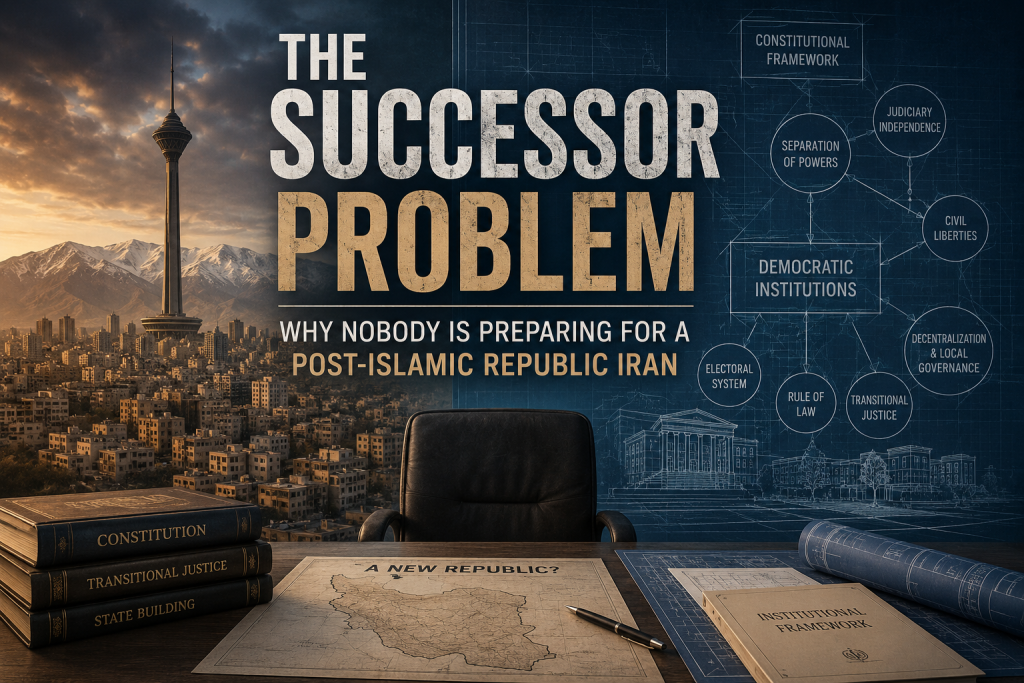
Introduction:
For more than four decades, the Islamic Republic has occupied a central position in international policy discussions. Governments negotiate with it. Intelligence agencies monitor it. Sanctions target it. Human rights organisations document its abuses. Think tanks analyse its behaviour. Universities study its political structure. Journalists report on its crises. Entire professional ecosystems have emerged around understanding, containing, influencing or engaging the Islamic Republic. Yet comparatively little attention has been devoted to a post-Islamic Republic Iran and the practical realities of political transition beyond the current regime.
Yet amid this vast infrastructure of analysis and policy, a remarkably simple question remains largely unanswered.
What comes after it?
The question itself is neither radical nor hypothetical. Every political system is finite. Every regime eventually confronts succession, transformation or collapse. The Soviet Union disappeared. Yugoslavia disappeared. Ba’athist Iraq disappeared. Monarchies, republics, military governments and revolutionary states have all faced moments when the political order that once appeared permanent suddenly ceased to exist.
The Islamic Republic is no exception.
Its leadership has aged. Its legitimacy has eroded. Its economic foundations remain fragile. Its relations with significant parts of Iranian society have deteriorated over decades of repression, corruption and political exclusion. Periodic waves of protest have repeatedly exposed the gap between the governing structure and large segments of the population it claims to represent. The events of January 2026 further intensified questions about the regime’s long-term sustainability, both inside and outside Iran.
The developments that followed only reinforced the significance of those questions. The war of 2026, the death of Ali Khamenei, subsequent ceasefire arrangements and renewed diplomatic efforts demonstrated the extent to which international attention remained focused on stabilisation, negotiation and crisis management. Even during one of the most consequential periods in the history of the Islamic Republic, relatively little public discussion emerged regarding the practical requirements of a post-Islamic Republic transition. The dominant framework remained management rather than succession.
Despite this, serious discussion of a post-Islamic Republic future remains strikingly limited.
No widely recognised transition framework commands broad international attention or institutional adoption. No visible international roadmap for political succession. No serious public debate regarding governance after the regime. No established mechanism for addressing the transfer of power. No coherent discussion of how state institutions would be stabilised during a transition period. No comparable level of preparation for political change to match the immense resources invested in sanctions, negotiations, monitoring and crisis management.
This absence is often treated as a secondary issue. It should not be.
The purpose of policy is not merely to understand the present. It is to prepare for the future. Where future planning is absent, strategic blind spots emerge. Where strategic blind spots persist for decades, they begin to shape outcomes.
The central argument of this article is straightforward.
The Islamic Republic survives not only because it possesses instruments of repression, coercion and state power. It also benefits from the absence of a serious successor strategy among many of the institutions that claim to oppose its behaviour. A system without a transition framework frequently defaults to continuity. A policy environment focused overwhelmingly on managing a regime often struggles to imagine its replacement.
This does not imply the existence of a conspiracy. Nor does it suggest that governments, think tanks, human rights organisations or academic institutions consciously support the Islamic Republic. Such claims would oversimplify a far more complex reality.
The problem is structural rather than conspiratorial.
Over time, much of the international approach toward Iran has become organised around management rather than transition. The primary questions have concerned sanctions, negotiations, nuclear activities, regional escalation, human rights violations and crisis containment. These are all important subjects. Yet they share a common characteristic: they largely assume the continued existence of the Islamic Republic as the framework within which future policy must operate.
The result is a paradox.
The regime is frequently described as destabilising, dangerous, repressive and illegitimate. At the same time, relatively little attention is devoted to the practical realities of a future in which it no longer governs Iran.
This contradiction extends beyond governments.
Large sections of the Iran policy ecosystem focus on explaining the Islamic Republic. Universities produce scholarship examining its institutions. Analysts interpret its internal factions. Diplomats seek channels of communication. Human rights organisations document abuses committed by its officials. Journalists follow the actions of its leadership. Even critics of the regime often dedicate most of their attention to understanding how the Islamic Republic functions rather than how a post-Islamic Republic Iran might emerge.
The imbalance is significant.
Understanding a regime and preparing for a future beyond it are not the same activity. One examines the present. The other addresses political succession. One analyses continuity. The other confronts change. One asks how a system operates. The other asks what happens when it no longer does.
The distinction matters because the absence of preparation does not eliminate the possibility of transition. It merely increases the likelihood that transition, when it arrives, will occur under conditions of uncertainty.
History offers numerous examples. Political systems rarely collapse according to convenient timetables. They rarely wait for governments, institutions or analysts to feel fully prepared. The question is therefore not whether change will eventually occur. The question is whether serious planning exists for the moment when it does.
For Iran, that question remains largely unresolved.
The issue is further complicated by a persistent conceptual error that often goes unchallenged in international discussions. Iran and the Islamic Republic are frequently treated as though they are synonymous. They are not. Iran is a nation, a society and a civilisation with a history measured in millennia. The Islamic Republic is a political system established in 1979. The future of one should not be confused with the future of the other. Yet discussions concerning political change in Iran often proceed as though uncertainty regarding the regime automatically implies uncertainty regarding the country itself. This assumption encourages policymakers to view transition primarily through the lens of risk rather than possibility, and political succession primarily through the lens of instability rather than governance.
This conflation has consequences. It encourages the perception that questioning the future of the Islamic Republic is equivalent to questioning the future of Iran. It transforms debates about political transition into debates about national stability. It elevates fears of uncertainty while discouraging serious consideration of alternative outcomes.
The result is a policy environment in which the future remains undefined.
That uncertainty benefits the status quo.
The purpose of this article is not to advocate a specific political movement, party or individual. Nor is it to predict the exact circumstances under which the Islamic Republic may eventually lose power. Rather, it seeks to examine a simpler but more important question.
Why has so little attention been devoted to preparing for what comes next?
To answer that question, this investigation will examine how regime management gradually became a strategic objective, how fears of instability displaced discussions of transition, why successor planning remains underdeveloped, and which institutional incentives encourage the continuation of this pattern.
The successor problem is not merely a question about the future.
It is a question about the present.
Because a political system does not survive only through the strength of its institutions.
Sometimes it survives because its alternatives remain undefined.
Chapter 1
Managing the Islamic Republic Became the Strategy
The central question of contemporary Iran policy is rarely stated directly.
Governments speak of security. Diplomats speak of stability. Analysts speak of escalation risks. Human rights organisations speak of accountability. Sanctions architects speak of pressure. Military planners speak of deterrence.
Yet beneath these different vocabularies lies a more fundamental question.
What is the desired political outcome?
The answer matters because policies cannot be evaluated solely by their intentions. They must be evaluated by the outcomes they are designed to achieve. A strategy that seeks regime transformation should be judged differently from a strategy that seeks behavioural modification. A policy intended to produce political change should not be assessed according to the same criteria as one intended merely to reduce immediate risks.
For much of the past four decades, discussions surrounding Iran have often blurred these distinctions.
The Islamic Republic has been subjected to sanctions, diplomatic isolation, military pressure, intelligence operations, cyber campaigns, human rights scrutiny and repeated international condemnation. Yet despite the diversity of these tools, a striking pattern has emerged. Most have been designed to influence the behaviour of the regime rather than address the question of its replacement.
This distinction is frequently overlooked.
Pressure and transition are not the same thing.
A government may impose sanctions without seeking regime change. It may engage in negotiations without recognising the legitimacy of the opposing system. It may condemn human rights violations while avoiding any position regarding political succession. Each of these actions can be pursued within a framework that ultimately assumes the continued existence of the regime being targeted.
Over time, this assumption became increasingly visible in international approaches toward Iran.
The objective was rarely articulated as the preservation of the Islamic Republic. On the contrary, Western governments frequently criticised its conduct, sanctioned its officials and condemned its actions. However, criticism of behaviour did not necessarily translate into preparation for a post-regime future.
Instead, policy increasingly focused on managing risks generated by the regime itself.
Nuclear escalation became a management problem.
Regional proxy warfare became a management problem.
Missile programmes became a management problem.
Hostage diplomacy became a management problem.
Human rights abuses became a management problem.
Economic sanctions became a management problem.
At each stage, the emphasis remained centred on reducing threats, containing crises and preventing escalation.
Far less attention was directed toward the political question underlying all of them: what future should emerge if the Islamic Republic ultimately ceases to govern Iran?
The absence of a clear answer shaped the entire policy environment.
This pattern was particularly visible in the evolution of sanctions policy.
Sanctions are often presented as evidence of a confrontational approach toward the Islamic Republic. In practical terms, however, sanctions have served multiple purposes over the years. They have been used to signal disapproval, impose economic costs, limit access to technology, deter specific activities and create leverage for negotiations.
What sanctions have rarely been accompanied by is a clearly articulated transition framework.
Successive sanctions regimes identified prohibited conduct, designated entities and established conditions for relief. They outlined what the Islamic Republic should stop doing. They rarely explained what political future international actors hoped to see if maximum pressure achieved its most ambitious objectives.
The result was a policy instrument with considerable coercive power but limited connection to questions of succession.
Pressure existed.
End-state planning often did not.
The same pattern appeared in diplomatic engagement.
Whether negotiations focused on nuclear activities, regional security concerns or prisoner exchanges, diplomatic frameworks generally operated on a common assumption: representatives of the Islamic Republic would remain the relevant interlocutors.
Negotiations sought changes in conduct rather than changes in political authority.
The objective was to secure agreements, reduce tensions or alter specific behaviours. The broader issue of political transition remained largely outside the scope of discussion.
This approach was often justified on practical grounds. Diplomacy requires negotiating partners. Governments engage with existing authorities rather than hypothetical future ones. From a narrow operational perspective, the logic is understandable.
The cumulative effect, however, was significant.
Decades of diplomacy reinforced the perception that the Islamic Republic constituted the permanent framework through which Iran-related issues would continue to be addressed.
The regime became the default reference point.
Even discussions regarding instability frequently assumed its continuation.
Policy debates increasingly revolved around questions such as how to constrain the Islamic Republic, how to influence it, how to negotiate with it, how to deter it or how to pressure it.
Far fewer discussions addressed how to prepare for a future beyond it.
This imbalance extended well beyond government policy.
Academic research frequently examined factional dynamics within the regime. Analysts devoted substantial attention to electoral processes, elite rivalries and internal decision-making structures. Conferences explored pathways to negotiation, de-escalation and conflict management. Publications assessed the implications of leadership changes, economic pressures and foreign policy shifts.
These efforts generated valuable knowledge.
Yet they also reflected a broader tendency.
The Islamic Republic was studied primarily as a continuing political system.
Its future replacement often remained a peripheral subject.
The distinction may appear subtle, but its implications are substantial.
A policy ecosystem that concentrates overwhelmingly on understanding how a regime functions inevitably allocates fewer resources to understanding how a transition might occur.
Research priorities shape policy priorities.
Policy priorities shape institutional preparation.
Institutional preparation shapes strategic readiness.
Where preparation is absent, continuity acquires an advantage.
This dynamic does not require conscious intent.
No coordinated decision is necessary for a management framework to emerge. Such frameworks often develop gradually through bureaucratic incentives, professional specialisation and institutional habits. Organisations tend to focus on problems they are structured to address. Governments build departments around existing challenges. Think tanks develop expertise in ongoing crises. International organisations establish mandates focused on current realities.
Over time, entire systems become oriented toward managing what exists.
Preparing for what may replace it becomes a secondary concern.
The Islamic Republic benefited from this tendency.
Not because governments supported it.
Not because policy institutions endorsed its conduct.
But because a system focused primarily on managing the regime’s behaviour inevitably devoted less attention to the question of political succession.
This distinction is essential.
The argument is not that Western governments sought to preserve the Islamic Republic.
The argument is that many of their policies became compatible with its continuation.
Those are not identical propositions.
A strategy can fail to challenge continuity without actively seeking it.
A policy can reinforce the status quo without intending to do so.
A framework can become dependent on management even while expressing dissatisfaction with the system being managed.
That is precisely what makes the successor problem significant.
The issue is not whether international actors criticised the Islamic Republic.
They did.
The issue is whether criticism was accompanied by meaningful preparation for a future beyond it.
After four decades of sanctions, negotiations, pressure campaigns, diplomatic initiatives and crisis management, the answer remains remarkably unclear.
The architecture of management is extensive.
The architecture of succession is far harder to identify.
That imbalance lies at the centre of the successor problem.
And it raises a question that becomes increasingly difficult to avoid.
If the international community invested enormous resources in managing the Islamic Republic, who invested comparable resources in preparing for the day after it?
Chapter 2
The Regime as Permanent Infrastructure
Political systems are often discussed as though they were permanent until the moment they are not.
History is filled with governments, ruling parties and state structures that appeared durable shortly before they disappeared. The Soviet Union survived until it did not. Communist governments across Eastern Europe appeared entrenched until they collapsed with remarkable speed. Numerous authoritarian systems spent years projecting permanence only to discover that permanence had been largely an illusion.
The Islamic Republic has frequently been analysed through a different lens.
Rather than being treated as a political system whose future remains uncertain, it is increasingly approached as a permanent feature of the international landscape. This assumption is rarely stated openly. It does not appear in official declarations or diplomatic communiqués. Yet it is visible in the way institutions organise themselves, allocate resources and frame policy discussions.
The distinction matters.
A political system viewed as temporary invites questions about succession.
A political system viewed as permanent encourages adaptation.
Over time, much of the international approach toward Iran has gravitated toward the second category.
The evidence is not found primarily in rhetoric. It is found in assumptions.
Consider how most policy discussions concerning Iran are structured.
The debate typically focuses on how governments should engage with the Islamic Republic, pressure the Islamic Republic, deter the Islamic Republic, negotiate with the Islamic Republic or respond to the Islamic Republic. The regime serves as the central reference point around which policy analysis is organised.
This may appear logical. After all, the Islamic Republic remains the governing authority inside Iran.
The deeper issue is not that policymakers deal with the existing regime.
The deeper issue is that discussions frequently stop there.
The possibility of a post-Islamic Republic political order is often treated as speculative, unrealistic or beyond the practical scope of policy planning. As a result, the existing regime becomes the default framework through which the future is imagined.
The consequences are subtle but significant.
When a political system remains the central organising principle of policy discussions for decades, institutional habits begin to form around its continued existence.
Diplomatic channels are built around communication with its officials.
Intelligence assessments are structured around its decision-making processes.
Negotiation frameworks assume the presence of its representatives.
Sanctions regimes are designed to influence its behaviour.
Academic expertise becomes organised around interpreting its internal dynamics.
Media coverage focuses on its leaders, factions and policy debates.
Over time, an extensive infrastructure emerges.
The purpose of this infrastructure is not necessarily to preserve the regime.
Its purpose is to understand and manage it.
Yet the longer such systems operate, the more continuity becomes embedded within the institutions themselves.
The regime becomes the operating assumption.
This phenomenon is not unique to Iran.
Large bureaucratic systems generally orient themselves toward existing realities rather than hypothetical alternatives. Governments build expertise around known actors. International organisations create mechanisms to address current conditions. Research institutions specialise in ongoing political structures. Entire professional communities emerge around analysing the systems that already exist.
The challenge arises when those systems are treated as the only plausible framework for the future.
At that point, a distinction begins to disappear.
The distinction between the state and the regime.
This confusion has played a particularly important role in discussions about Iran.
Iran is one of the world’s oldest continuous civilisations. Its history extends thousands of years beyond the creation of the Islamic Republic. Its national identity, institutions, culture and society cannot be reduced to a political system established in 1979.
Yet international discussions frequently blur this distinction.
Concerns about the future of the regime are often presented as concerns about the future of Iran itself.
Questions regarding political transition become questions about state collapse.
Debates regarding leadership succession become debates regarding national fragmentation.
Discussions about regime legitimacy become discussions about regional stability.
The result is a conceptual fusion between Iran and the Islamic Republic.
This fusion benefits the status quo.
If the regime is perceived as synonymous with the state, then uncertainty regarding the regime automatically appears dangerous. Any discussion of political transition becomes associated with fears of institutional breakdown, territorial fragmentation or regional instability.
The regime becomes more than a government.
It becomes a perceived pillar of order.
Such perceptions can persist even among individuals and institutions that strongly oppose the regime’s conduct.
One does not need to support the Islamic Republic to assume that it is permanent.
One does not need to endorse its ideology to organise policy around its continued existence.
One does not need to defend its behaviour to conclude that dealing with it is more realistic than preparing for alternatives.
These assumptions accumulate over time.
They shape research agendas.
They influence funding priorities.
They affect policy recommendations.
They determine which questions are considered practical and which are considered speculative.
The effect is visible across much of the Iran policy ecosystem.
Discussions concerning sanctions are generally detailed and highly developed.
Discussions concerning negotiations are extensive.
Discussions concerning nuclear activities are exhaustive.
Discussions concerning political succession are comparatively limited.
The imbalance is striking.
One can find thousands of pages examining how the Islamic Republic governs.
Far fewer examining how a transition beyond it might be managed.
This disparity is not merely academic.
It has strategic implications.
A political system treated as permanent receives continuous analytical investment.
A political future treated as hypothetical receives comparatively little preparation.
The result is a self-reinforcing cycle.
Because transition planning is limited, policymakers perceive transition as uncertain.
Because transition appears uncertain, they devote more attention to managing the existing regime.
Because management receives greater institutional investment, the regime remains the central reference point.
The cycle then repeats itself.
This dynamic became particularly visible during moments of crisis.
Major protests, violent crackdowns, economic disruptions and periods of heightened instability repeatedly generated international debate regarding the future of the Islamic Republic. Yet even during these moments, discussions frequently returned to familiar questions.
How should sanctions be adjusted?
Should negotiations continue?
How can escalation be avoided?
How should regional stability be preserved?
These are legitimate concerns.
What is notable is the question that often remained secondary.
If the regime were weakened significantly, what comes next?
The absence of a developed answer encouraged caution.
Caution encouraged continuity.
Continuity reinforced the assumption that the regime would remain the primary framework for future policy.
This is not evidence of a coordinated effort to preserve the Islamic Republic.
It is evidence of a system that became increasingly adapted to its existence.
That distinction is crucial.
The argument of this chapter is not that governments, think tanks or international organisations consciously chose permanence.
The argument is that institutional behaviour frequently produced the same practical outcome.
A political order repeatedly treated as the default framework for the future gradually acquires a form of permanence, even if that permanence is never formally declared.
The Islamic Republic benefited from this phenomenon.
Not because it convinced the world that it was legitimate.
But because much of the world increasingly behaved as though it was inevitable.
The difference between legitimacy and inevitability is important.
A regime does not need to be admired to survive.
It merely needs enough influential actors to conclude that its continuation is the safest assumption.
For decades, that assumption has shaped much of the discussion surrounding Iran.
The question is whether it continues to do so because the Islamic Republic is genuinely permanent, or because too few institutions have invested seriously in imagining the alternative.
That question leads directly to the next stage of this investigation.
If the future beyond the Islamic Republic remains underdeveloped, what explains that reluctance?
The most common answer is also the most familiar.
Fear.
Chapter 3
The Fear Industry
How Iraq, Syria and Libya Became Arguments for Inaction
Few arguments appear more frequently in discussions about Iran’s future than a simple warning.
Look at Iraq.
Look at Libya.
Look at Syria.
Look at Afghanistan.
The message is familiar. The collapse of an existing political order can produce instability, violence, institutional breakdown and prolonged uncertainty. Any discussion of political transition in Iran is therefore met with an immediate question: what if the alternative is worse?
At first glance, the concern appears entirely reasonable.
History offers numerous examples of states that experienced severe disruption following the collapse of governments, ruling parties or political systems. The risks associated with transition are real. Security institutions can fragment. Armed groups can emerge. Economic systems can deteriorate. Regional actors can exploit uncertainty. Political vacuums can create opportunities for violence.
These dangers should not be dismissed.
The problem lies elsewhere.
The problem is that discussions about risk frequently become substitutes for discussions about preparation.
The result is a policy environment in which fear is treated as a strategy.
The pattern is remarkably consistent.
Whenever questions arise regarding the future of the Islamic Republic, the conversation often shifts away from transition itself and toward historical examples of disorder. The debate ceases to focus on what a successful transition might require and instead concentrates on what could go wrong.
The distinction is important.
Every major political transition contains risks.
The relevant question is not whether risks exist.
The relevant question is whether those risks justify the absence of planning.
In practice, the answer often appears to be yes.
For decades, scenarios involving instability have occupied a prominent place in discussions concerning Iran’s future. Policymakers have warned about regional conflict. Analysts have highlighted the possibility of fragmentation. Commentators have raised concerns regarding ethnic tensions, refugee flows, economic disruption and competition among political factions.
Many of these concerns are legitimate.
What is striking is the imbalance.
The dangers of transition are discussed extensively.
The dangers of failing to prepare for transition receive far less attention.
This imbalance has consequences.
Fear influences policy priorities.
Institutions devote resources toward avoiding perceived threats. Governments focus on immediate risks. Organisations build expertise around crisis prevention. Over time, these priorities shape the broader policy environment.
In the case of Iran, this process contributed to a subtle but significant shift.
Transition increasingly became associated with danger.
Continuity increasingly became associated with stability.
The assumption was rarely stated openly.
Yet it influenced the structure of the debate.
The Islamic Republic might be criticised.
Its conduct might be condemned.
Its officials might be sanctioned.
But the prospect of political succession often remained overshadowed by warnings regarding what might follow.
The effect was to transform uncertainty into a powerful political argument.
Uncertainty became evidence against preparation rather than evidence for it.
This dynamic can be observed in the way historical examples are frequently deployed.
Iraq is often cited as proof that regime change can produce chaos.
Libya is frequently presented as evidence that removing a dictatorship does not guarantee stability.
Syria is invoked as a warning about state collapse and civil war.
Afghanistan is used to illustrate the fragility of externally supported political transitions.
Each example contains lessons.
None provides a universal model.
More importantly, none eliminates the need for planning.
The historical lesson of difficult transitions is not that transitions should never be considered.
The historical lesson is that transitions require preparation.
Yet discussions concerning Iran often arrive at a different conclusion.
The failures of previous transitions become arguments against developing future transition frameworks.
The result is a paradox.
The very cases that should encourage more planning are frequently used to justify less planning.
This paradox becomes clearer when viewed from an institutional perspective.
Governments routinely prepare for crises they hope never occur.
Military organisations plan for conflicts they seek to avoid.
Emergency services prepare for disasters they do not expect.
Financial regulators conduct stress tests against scenarios they hope never materialise.
Preparation does not imply desire.
Planning for an event is not the same as advocating for it.
Yet this distinction often disappears in discussions regarding political transition.
Developing contingency plans for a post-Islamic Republic Iran is frequently treated as politically sensitive because it appears to imply support for regime change.
The assumption is flawed.
Preparing for a possible future is not the same as attempting to create it.
A government may prepare for a natural disaster without wishing for one.
A state may prepare for war without seeking war.
Likewise, institutions may prepare for political transition without actively pursuing it.
The reluctance to recognise this distinction has contributed to a significant strategic gap.
Fear of instability has often reduced incentives to examine what stability after transition might actually require.
The conversation remains trapped within a binary framework.
On one side stands the existing regime.
On the other stands an undefined future filled with uncertainty.
This comparison naturally favours continuity.
Any known system appears less risky than an undefined alternative.
The problem is that the comparison itself is incomplete.
It compares an existing reality with an imagined worst-case scenario.
It rarely compares existing realities with potential alternative outcomes.
This matters because continuity also carries costs.
The assumption that avoiding transition reduces risk depends upon the belief that the current system remains stable.
The Islamic Republic’s own history complicates that assumption.
Repeated cycles of protest, repression, economic crisis, international confrontation and political unrest suggest that continuity does not necessarily eliminate instability.
In many cases, it merely postpones unresolved tensions.
The costs of postponement are rarely distributed equally.
They are often borne by the population living under the existing system.
This dimension frequently receives less attention than fears regarding hypothetical future instability.
Policy discussions become focused on managing potential risks associated with change while paying comparatively less attention to the risks associated with preserving the status quo.
The result is a form of strategic asymmetry.
Future dangers are examined in detail.
Present dangers become normalised.
Over time, this dynamic produces what might be described as a fear industry.
Not an organised institution.
Not a coordinated network.
Rather, a broader ecosystem of assumptions, incentives and analytical habits that repeatedly emphasise the dangers of transition while investing comparatively little effort in understanding how successful transitions might occur.
Within such an environment, caution acquires institutional value.
Risk avoidance becomes a policy objective in itself.
The safest recommendation is often to avoid discussing politically sensitive alternatives.
The safest assumption is often that the existing framework will continue.
The safest course is often management rather than preparation.
Yet safety can be deceptive.
History demonstrates that political systems rarely become more predictable simply because institutions refuse to prepare for their possible disappearance.
Ignoring a scenario does not reduce its likelihood.
It merely reduces readiness.
This is the central weakness in the fear-based approach to Iran’s future.
The problem is not that risks are identified.
The problem is that risk identification frequently substitutes for strategic planning.
Fear answers one question.
What could go wrong?
It does not answer another.
What should be done if change occurs anyway?
For decades, the first question has dominated discussions about Iran.
The second remains remarkably underdeveloped.
That imbalance has helped create one of the most significant gaps in contemporary Iran policy.
The absence of a serious transition architecture.
And it is that absence which forms the centrepiece of the successor problem.
Chapter 4
The Missing Transition Architecture
Political systems rarely disappear according to schedule. Governments seldom announce their own end in advance, and major political transitions rarely occur only after policymakers, international organisations and analysts have completed their preparations. History offers numerous examples of political orders that appeared durable until the moment they ceased to be. The relevant policy question is therefore not whether a transition can be predicted with precision, but whether meaningful preparations exist should a transition occur.
For a policy community that has devoted decades to analysing the Islamic Republic, this question produces an uncomfortable observation. The institutional architecture devoted to understanding, managing and influencing the regime is extensive. Governments maintain specialised Iran units, intelligence services dedicate significant resources to monitoring developments, international organisations produce regular assessments, and research institutions publish a continuous stream of analysis concerning sanctions, diplomacy, security and regional affairs. By contrast, the architecture devoted to a post-Islamic Republic transition is far less visible, less developed and considerably more fragmented.
The issue is not the complete absence of discussion. Various opposition organisations have proposed roadmaps for political change, individual analysts have examined transition scenarios, and academic literature addressing democratic transitions, state reconstruction and post-authoritarian governance is extensive. Some initiatives have attempted to address practical questions concerning governance, institutional continuity, legal frameworks and transitional administration in a post-Islamic Republic environment. The problem is not that transition planning does not exist. The problem is that such efforts have not developed into a widely recognised, internationally discussed or institutionally mature policy architecture comparable to the infrastructure devoted to managing the Islamic Republic itself.
This imbalance becomes particularly evident when examining the practical requirements of political succession. Any serious political transition generates a series of immediate governance challenges. Questions of authority, institutional continuity, public order, economic stabilisation, international obligations, security-sector restructuring, accountability for major crimes, political legitimacy, electoral administration and constitutional design must all be addressed within a relatively compressed timeframe. These are not abstract academic concerns. They are practical requirements that every successful transition must confront. The remarkable feature of contemporary Iran policy is not that these questions are difficult, but that they so rarely occupy a central position within public discussions about Iran’s future.
Governance provides the clearest example. Every transition requires an answer to a fundamental question: who exercises authority during the period between the collapse of one political order and the establishment of another? Administrative institutions require direction, public services require continuity, financial systems require oversight and legal structures require recognised authority. While various proposals have emerged from opposition circles and independent policy initiatives, there remains no broadly recognised international framework addressing how authority might be transferred following the end of the Islamic Republic. No internationally accepted model exists outlining the structure of an interim administration, the allocation of transitional powers, the sequencing of institutional reforms or the process through which political legitimacy would be established. The issue is therefore not the absence of ideas but the absence of a recognised framework around which serious policy discussion has coalesced.
The same pattern is visible in the security sphere. Political transitions are not solely political events; they are also security events. The future of intelligence agencies, military organisations, law-enforcement bodies and armed networks frequently determines whether transitions remain orderly or descend into instability. In the Iranian context, these questions are particularly significant given the role of the Islamic Revolutionary Guard Corps and the broader security apparatus within the state’s political and economic structure. Any serious transition would inevitably raise questions concerning institutional reform, command structures, demobilisation, accountability and continuity of essential security functions. Despite the importance of these issues, discussions concerning Iran frequently focus on the current behaviour of these institutions rather than the practical realities of managing their future transformation.
Economic planning reveals a similar gap. International debate regarding Iran’s economy has largely concentrated on sanctions, inflation, trade restrictions, currency instability and energy exports. These topics are important and deserve serious attention. However, considerably less attention has been devoted to the requirements of post-transition economic stabilisation. A future Iranian government would immediately confront challenges involving investor confidence, banking reform, international financial integration, energy-sector management, regulatory reconstruction and economic recovery. These issues cannot be addressed spontaneously after a transition occurs. They require preparation, scenario planning and institutional coordination well in advance. Yet the available policy discussion remains heavily weighted toward economic pressure on the regime rather than economic recovery after it.
The imbalance is equally visible within discussions of accountability and human rights. Over the past four decades, extensive efforts have been devoted to documenting repression, political imprisonment, torture, executions and other abuses committed by the Islamic Republic. Such documentation is essential. Without evidence, accountability becomes impossible. However, documentation alone does not constitute a justice strategy. Transitional justice requires courts, legal mechanisms, investigative authorities, evidentiary procedures and institutional capacity. Victims require recognition, perpetrators require legal scrutiny and evidence must ultimately be connected to a system capable of acting upon it. The challenge is therefore not merely collecting information about crimes but preparing for the political circumstances in which accountability becomes possible.
Questions of international recognition present an additional challenge. Political transitions require both domestic legitimacy and external recognition. Governments, international organisations and multilateral institutions must decide whom they recognise, whom they engage and under what conditions diplomatic relations are restructured. These questions become urgent during periods of political change, yet they remain comparatively underdeveloped within contemporary discussions regarding Iran. The reluctance is understandable, as recognition decisions carry significant political implications. Nevertheless, the absence of visible planning contributes to continued uncertainty regarding how international actors might respond to a rapid change in political authority.
Across each of these areas, a consistent pattern emerges. Extensive frameworks exist for analysing, sanctioning, monitoring and negotiating with the Islamic Republic. Comparable frameworks addressing governance transition, security reform, economic stabilisation, accountability mechanisms and international recognition are far less developed. The architecture of management is visible. The architecture of succession is considerably harder to identify.
This observation should not be interpreted as evidence that governments have entirely ignored the possibility of change. States routinely conduct internal assessments and contingency planning that never enter the public domain. Intelligence services examine scenarios that remain classified, and policymakers often prepare for developments they never discuss publicly. Nor should it be interpreted as evidence that no transition planning exists within Iranian opposition, civil society or policy circles. The issue is not whether isolated planning exists. The issue is whether a visible and mature policy ecosystem devoted to post-Islamic Republic transition exists on a scale comparable to the ecosystem devoted to managing the regime itself.
The answer appears to be no.
That conclusion matters because policy ecosystems shape priorities, priorities shape preparation and preparation shapes outcomes. A system that spends decades refining its understanding of how a regime functions while investing comparatively little effort in understanding what follows it develops a predictable bias. It becomes highly capable of managing continuity and considerably less prepared to manage change.
This is the central finding of the successor problem. The challenge is not simply that transition remains uncertain. All political transitions are uncertain. The challenge is that uncertainty itself has often become a justification for avoiding the very preparation that uncertainty requires. The result is a policy landscape rich in analysis but comparatively poor in succession planning, equipped with extensive tools for managing the present but lacking a comparable framework for addressing the future.
The unavoidable question is therefore no longer whether transition planning is necessary. The more important question is why so little of it has achieved meaningful institutional attention.
Chapter 5
Sanctions Without an Endgame
Few policy instruments have shaped international approaches toward the Islamic Republic more than sanctions. For decades, sanctions have occupied a central position within the efforts of the United States, the European Union and other governments to influence Iranian behaviour. They have targeted financial institutions, energy exports, military procurement networks, shipping operations, government officials and entities associated with the regime’s security apparatus. Entire compliance industries, regulatory frameworks and enforcement mechanisms have emerged around their implementation.
The effectiveness of sanctions remains a subject of ongoing debate. Analysts continue to disagree regarding their economic impact, their influence on decision-making within the Islamic Republic and their broader consequences for Iranian society. These debates are important. However, they often obscure a more fundamental question.
What political outcome are sanctions ultimately designed to produce?
The question appears deceptively simple. In practice, the answer is often unclear. Sanctions are commonly justified as instruments of pressure intended to alter behaviour. Governments impose costs in order to discourage specific activities, restrict access to resources or create incentives for policy change. In the Iranian context, sanctions have been linked to concerns regarding nuclear activities, ballistic missile programmes, regional interventions, human rights violations and support for armed proxy organisations.
Yet behavioural pressure and political transition are not the same objective.
A sanctions regime can be highly detailed regarding prohibited conduct while remaining remarkably vague regarding the desired political end-state. It can specify which activities should cease, which entities should be designated and which conditions must be met for sanctions relief, while providing little clarity regarding what political future is expected if maximum pressure succeeds.
This ambiguity has characterised much of the sanctions debate surrounding Iran.
Successive sanctions frameworks have generally focused on constraining behaviour rather than defining a post-regime future. Their architecture is designed to apply pressure, create leverage and influence decision-making within the existing political system. Considerably less attention has been devoted to the question of what should occur if that system becomes unsustainable, loses legitimacy or experiences significant political transformation.
The distinction is important because sanctions are often presented as evidence of a confrontational policy. In reality, sanctions are tools. Their significance depends upon the strategic objective they serve. The same instrument can support fundamentally different goals. It can be used to encourage negotiation, secure concessions, alter specific behaviours, contain threats or contribute to broader political change. Understanding sanctions therefore requires understanding the end-state toward which they are directed.
In the case of Iran, that end-state has frequently remained undefined.
The events of 2026 illustrate this dynamic particularly clearly. Following the January 2026 mass killings, the subsequent war, the death of Ali Khamenei and renewed diplomatic engagement, international discussions once again became heavily focused on sanctions, negotiations, verification mechanisms, escalation management and the conditions under which economic restrictions might be adjusted or removed. These debates addressed important policy questions. They did not substantially alter the underlying framework.
The central discussion remained how the international community should manage its relationship with the Islamic Republic and its successor institutions, not how it should prepare for a post-Islamic Republic transition. Even during one of the most consequential crises in the history of the regime, questions concerning succession architecture, transitional governance, institutional continuity and post-transition recovery remained largely peripheral to mainstream policy discussions.
This pattern is significant because it demonstrates that the successor problem is not a historical artefact of earlier diplomatic eras. It continues to shape contemporary policy. The framework may shift between pressure and engagement, sanctions and negotiations, confrontation and stabilisation, but the underlying assumption often remains the same: the primary task is managing the existing political order rather than preparing for its possible replacement.
This does not mean sanctions lack purpose. Governments typically articulate clear operational goals when introducing new measures. The issue is that these goals often concern immediate conduct rather than long-term political outcomes. The result is a framework that explains what the Islamic Republic should stop doing but provides comparatively little insight into what should happen if the regime’s existing model becomes untenable.
The absence of a visible successor framework creates a strategic gap.
Pressure campaigns are generally evaluated according to indicators such as economic impact, compliance rates, diplomatic leverage or behavioural change. These measurements are useful, but they address only part of the policy equation. They reveal whether pressure is being applied effectively. They do not necessarily reveal whether policymakers have prepared for the consequences of success.
This issue becomes particularly relevant when sanctions are described using transformative language. Advocates of maximum pressure frequently argue that sustained economic restrictions can weaken the regime, reduce its resources and increase political pressure. Critics often respond by questioning whether such strategies can realistically achieve those objectives. Both sides tend to focus on whether sanctions work.
Far fewer ask what happens if they do.
If economic pressure significantly weakens the governing system, what transition mechanisms are expected to manage the consequences? Which institutions would assume responsibility for maintaining continuity in essential services? What economic stabilisation measures would be required during a period of political uncertainty? How would international financial institutions engage with a post-transition government? Which sanctions would be removed immediately, and which would remain in place pending legal or political reforms?
These questions are not secondary details. They are central components of any serious transition strategy.
Yet they rarely occupy a comparable position within public sanctions debates.
The imbalance reflects a broader pattern visible throughout contemporary Iran policy. Considerable intellectual and institutional energy has been devoted to designing mechanisms of pressure. Comparatively less attention has been devoted to designing mechanisms of succession. The architecture of coercion is detailed. The architecture of transition remains considerably less developed.
This disparity becomes even more significant when viewed through the lens of institutional incentives. Sanctions generate extensive bureaucratic activity. Governments establish specialised offices to administer them. Regulatory agencies monitor compliance. Financial institutions develop sanctions-screening procedures. Legal professionals advise clients regarding restrictions. Researchers analyse their effectiveness. Think tanks publish assessments of their impact. A substantial ecosystem has emerged around the management, interpretation and enforcement of sanctions regimes.
None of this implies that sanctions exist to sustain the Islamic Republic. Such a conclusion would be unsupported by evidence. However, it does highlight an important structural reality. Extensive resources have been invested in managing the relationship between the international system and the Islamic Republic under conditions of continued regime existence. Significantly fewer resources appear to have been invested in preparing for a future in which that relationship must be fundamentally restructured.
The distinction is subtle but consequential.
A policy ecosystem can become highly sophisticated in administering pressure while remaining underprepared for political change. It can refine its understanding of sanctions enforcement, compliance mechanisms and negotiation leverage without developing a comparable understanding of transition management. In such circumstances, continuity becomes the default assumption not because it is actively desired, but because it is the scenario for which institutions are most thoroughly prepared.
This dynamic helps explain a recurring feature of sanctions discourse. Discussions frequently revolve around the intensity of pressure, the scope of enforcement or the likelihood of behavioural change. They rarely devote equal attention to the practical realities of post-regime recovery. Economic reconstruction, reintegration into global markets, restoration of investor confidence, financial normalisation and long-term development planning often remain peripheral subjects despite their obvious relevance to any future transition.
The result is a policy framework that appears stronger when viewed from the perspective of pressure than when viewed from the perspective of outcome.
This observation does not invalidate sanctions as a policy tool. States will continue to employ sanctions because they provide an alternative to military force and allow governments to impose costs without direct confrontation. The issue is not whether sanctions should exist. The issue is whether sanctions have been integrated into a broader strategic vision for Iran’s future.
At present, the evidence suggests a persistent imbalance. The mechanisms designed to influence the Islamic Republic are considerably more developed than the mechanisms designed to address a post-Islamic Republic political environment. Pressure has been institutionalised. Succession planning remains comparatively fragmented, uneven and underdeveloped.
This imbalance reflects the broader argument of this investigation. A system that devotes decades to managing the behaviour of a regime without devoting comparable attention to preparing for its possible replacement gradually becomes oriented toward continuity. The objective may be pressure. The practical outcome is often management.
The successor problem is therefore not merely a question of political imagination. It is also a question of strategic design. Sanctions can create pressure, impose costs and alter incentives. What they cannot do on their own is answer the question that becomes increasingly important as pressure accumulates:
What comes next?
The absence of a clear answer has shaped sanctions policy for decades. It has also helped reinforce a wider pattern throughout the international approach to Iran. The Islamic Republic has been subjected to extensive scrutiny, pressure and criticism. Much less effort has been devoted to preparing for the moment when the conversation must move beyond the regime itself.
That pattern extends beyond sanctions. It is equally visible in another major pillar of international engagement with Iran: the human rights architecture.
Chapter 6
Human Rights Without Power Transfer
For more than four decades, the Islamic Republic has been the subject of extensive human rights scrutiny. International organisations, United Nations mechanisms, independent investigators, non-governmental organisations and advocacy groups have documented a wide range of abuses, including arbitrary detention, torture, executions, restrictions on freedom of expression, persecution of political opponents, discrimination against minorities and the use of lethal force against protesters. The volume of documentation is substantial. Reports, resolutions, investigations and evidentiary archives now constitute one of the most comprehensive records of state repression in the contemporary Middle East.
This documentation performs an essential function. Without evidence, abuses can be denied, minimised or forgotten. Human rights reporting preserves facts, establishes historical records and creates the evidentiary foundations upon which future accountability efforts may depend. In many cases, documentation is the only barrier preventing crimes from disappearing into political amnesia.
The value of such work should not be underestimated.
At the same time, documentation and accountability are not synonymous.
The existence of evidence does not automatically produce consequences. Reports do not prosecute perpetrators. Fact-finding missions do not exercise judicial authority. Resolutions do not remove governments from power. Documentation may establish what happened, identify responsible actors and preserve evidence for future use, but it does not itself determine whether political or legal accountability will occur.
This distinction is particularly important in the Iranian context.
Over time, the international human rights architecture concerning Iran has become increasingly sophisticated. Investigative mechanisms have expanded. Reporting standards have improved. Evidence collection methodologies have become more rigorous. The international community possesses far more information regarding the conduct of the Islamic Republic than it did in previous decades.
Yet a fundamental question remains unresolved.
How does documentation translate into accountability?
The question is not rhetorical. It is practical.
Accountability requires institutions capable of acting upon evidence. It requires legal mechanisms, recognised authorities, investigative powers, judicial structures and political conditions under which perpetrators can be held responsible for their actions. In the absence of such mechanisms, documentation remains indispensable but incomplete. It records abuses without necessarily altering the political structures that enable them.
The challenge is not unique to Iran. Human rights organisations generally operate within constraints. Most do not possess prosecutorial authority, military capabilities or executive power. Their primary role is to document, investigate, monitor and advocate. Responsibility for enforcement typically rests elsewhere.
The issue is that the “elsewhere” often remains undefined.
As a result, a growing gap emerges between the production of evidence and the exercise of accountability. The international system becomes increasingly effective at documenting violations while remaining considerably less effective at determining how documented crimes will ultimately be addressed.
This gap is visible throughout discussions concerning Iran. Reports identify abuses, investigations identify perpetrators, resolutions condemn conduct, and fact-finding mechanisms preserve evidence. Yet the pathway connecting these activities to meaningful political consequences frequently remains unclear. The result is a form of institutional asymmetry in which the mechanisms for recording crimes become increasingly sophisticated while the mechanisms for addressing the political conditions that enable those crimes remain comparatively weak.
The events of 2026 provide a particularly revealing example. The January 2026 mass killings generated renewed international attention, extensive documentation efforts and widespread reporting by human rights organisations and investigative bodies. Evidence collection expanded, testimony was gathered, and additional scrutiny was directed toward the conduct of the regime. Yet the subsequent months demonstrated the limitations of documentation alone. The Islamic Republic remained in power, repression continued, and new executions were carried out even as evidence concerning earlier abuses accumulated. The problem was not a lack of information. The problem was the absence of a clear pathway through which information could be converted into meaningful accountability.
This imbalance becomes particularly significant when examining large-scale episodes of repression. Events such as mass arrests, widespread crackdowns on protests and allegations of crimes against humanity generate extensive documentation efforts. International attention increases. Investigators gather testimony. Advocacy organisations publish findings. Governments issue statements of concern. In some cases, sanctions are imposed on individual officials.
These responses are important.
However, they often leave a broader question unresolved.
What happens if the political system responsible for those crimes remains in place?
The answer cannot simply be more documentation.
Additional evidence may strengthen the historical record, but it does not necessarily change the underlying political reality. A regime can absorb condemnation. It can survive critical reports. It can continue operating despite repeated exposure of abuses. History contains numerous examples of governments that accumulated extensive human rights records while remaining politically durable.
The Islamic Republic has demonstrated a significant capacity for absorbing reputational costs.
This observation is not intended to diminish the value of documentation. Rather, it highlights the limitations of treating documentation as an end-state. Evidence collection is a component of accountability. It is not accountability itself.
The distinction becomes particularly relevant when considering the relationship between human rights and political transition.
Many discussions concerning Iran deliberately separate these subjects. Human rights reporting focuses on violations. Political analysis focuses on governance. Transitional questions are often treated as belonging to a different category of debate.
In practice, however, the issues are closely connected.
The possibility of accountability depends in part upon the political environment in which accountability is pursued. Major transitional justice processes, whether in Latin America, Eastern Europe, Africa or elsewhere, have generally emerged in conjunction with broader political change. Courts, truth commissions, investigative bodies and legal reforms rarely operate independently of shifts in political authority. They are often products of transition rather than substitutes for it.
This historical pattern raises an important question.
If accountability ultimately depends upon political conditions, why do discussions of accountability and discussions of transition remain so disconnected in contemporary Iran policy?
The separation may reflect institutional boundaries. Human rights organisations focus on documenting abuses because that is their mandate. Governments focus on diplomacy because that is their responsibility. Researchers focus on analysis because that is their area of expertise.
Yet from a strategic perspective, the fragmentation creates a problem.
Each institution addresses part of the equation.
Few address the entire equation.
The result is a policy landscape in which extensive effort is devoted to documenting crimes while considerably less attention is devoted to understanding how accountability might function in a post-Islamic Republic environment.
This gap becomes visible in discussions concerning transitional justice. Questions regarding prosecutions, truth commissions, lustration policies, institutional reform, victim compensation and evidentiary standards are fundamental components of post-authoritarian accountability. Yet they rarely occupy a central position in mainstream discussions regarding Iran’s future. The international community has generated substantial evidence regarding violations committed under the Islamic Republic. Comparatively less attention has been devoted to examining how that evidence might be utilised within a future transitional framework.
The consequences are significant.
Without preparation, accountability risks becoming reactive rather than strategic. Institutions may find themselves possessing extensive evidence but lacking established mechanisms through which that evidence can be translated into action. The challenge is not merely legal. It is political, administrative and institutional.
This brings the discussion back to the broader successor problem.
The issue is not that human rights organisations have failed. Their role is indispensable. The issue is that the wider policy ecosystem has often treated documentation as though it were sufficient on its own. Over time, the collection of evidence has become increasingly sophisticated while the architecture required to transform evidence into accountability has remained comparatively fragmented and underdeveloped.
The result is a familiar pattern. The international community becomes highly capable of identifying abuses, preserving records and condemning violations. It becomes considerably less prepared to address the political and institutional questions that arise when an opportunity for accountability finally emerges.
This imbalance mirrors the pattern already identified in sanctions policy. Extensive effort has been invested in documenting the behaviour of the Islamic Republic. Far less effort has been invested in preparing for the consequences of meaningful political change. The architecture of observation is visible. The architecture of transition remains considerably less developed.
The implications extend beyond governments and international organisations. They reach into the broader ecosystem of researchers, analysts and institutions that shape discussions concerning Iran. Understanding why this imbalance persists requires examining not only policies, but also the professional structures that have developed around the Islamic Republic itself.
It is to those structures that the investigation now turns.
Chapter 7
The Professional Ecosystem of Continuity
The Islamic Republic is not only a political system.
It is also a subject of professional specialisation.
For more than four decades, governments, universities, think tanks, international organisations, media institutions, advocacy groups and consulting firms have devoted substantial resources to understanding, monitoring, negotiating with and analysing the Islamic Republic. An extensive body of expertise has emerged around virtually every aspect of the regime’s behaviour, including its political institutions, security structures, economic networks, foreign policy, nuclear programme, sanctions exposure and regional activities.
This expertise serves important functions. Policymakers require analysis. Journalists require informed sources. Governments require regional knowledge. Researchers require access to historical and contemporary information. The existence of a professional community focused on Iran is neither unusual nor problematic in itself.
The question is not whether expertise should exist.
The question is what happens when an entire ecosystem becomes organised around the continued existence of the subject it studies.
This is not a uniquely Iranian phenomenon. Long-running conflicts, authoritarian systems and geopolitical disputes frequently generate professional communities dedicated to understanding them. Over time, institutions develop specialised knowledge, funding structures emerge, research agendas become established and career paths are created around particular policy areas. The longer a political problem persists, the larger the ecosystem surrounding it often becomes.
The Islamic Republic has existed long enough for precisely such an ecosystem to emerge.
Universities maintain programmes devoted to Iranian politics and society. Research centres publish regular analyses of developments inside Iran. Think tanks organise conferences, panels and policy discussions. Journalists cultivate networks of specialists and commentators. Governments employ experts responsible for monitoring Iranian affairs. Sanctions professionals analyse enforcement mechanisms and compliance requirements. Human rights organisations maintain teams dedicated to documenting abuses and monitoring developments inside the country.
None of these activities implies support for the regime.
Yet they do create a particular institutional environment.
Most professional activity within this ecosystem is organised around understanding the Islamic Republic as an existing political system. Researchers analyse how it functions. Diplomats examine how it negotiates. Journalists report on its decisions. Policy experts assess its behaviour. Academic literature explores its internal dynamics. The regime becomes the central object of analysis.
This focus is entirely understandable.
The Islamic Republic governs Iran.
Any serious attempt to understand contemporary Iranian politics must engage with that reality.
The question is whether an ecosystem structured around explaining the regime inevitably devotes less attention to examining what might replace it.
The imbalance becomes visible when comparing the volume of work dedicated to understanding the Islamic Republic with the volume of work dedicated to preparing for a post-Islamic Republic future.
Research concerning the regime’s internal factions is extensive.
Research concerning transition architecture is comparatively limited.
Analysis of nuclear negotiations is extensive.
Analysis of post-transition governance is comparatively limited.
Discussion of sanctions enforcement is extensive.
Discussion of post-transition economic recovery is comparatively limited.
Coverage of current political actors is extensive.
Discussion of future institutional arrangements is comparatively limited.
The pattern is difficult to ignore.
The issue is not the absence of transition-related work. Such work exists. Individual researchers, opposition figures and policy analysts have explored questions of succession, democratic transition and institutional reform. The problem is one of proportionality. The intellectual infrastructure devoted to continuity remains considerably larger than the infrastructure devoted to transition.
This disparity shapes the policy environment.
Research influences debate.
Debate influences priorities.
Priorities influence preparation.
The subjects that receive the greatest institutional attention often become the subjects most likely to shape policy discussions.
Over time, this process can create a subtle but significant effect.
The regime becomes easier to imagine than the alternative.
Experts can explain how the Islamic Republic functions in considerable detail. They can identify key institutions, influential actors, competing factions and policy trends. The future beyond the regime often appears less developed by comparison, not necessarily because it is impossible, but because far fewer resources have been devoted to examining it.
The result is a form of intellectual asymmetry.
Knowledge of the present becomes highly sophisticated.
Preparation for the future remains comparatively limited.
This asymmetry carries practical consequences. Policymakers generally rely on existing expertise when assessing risk. Governments consult specialists. Journalists seek recognised authorities. International organisations depend upon established networks of knowledge. When expertise is concentrated primarily on the management of an existing system, policy discussions naturally gravitate toward questions associated with that system.
The regime therefore remains the centre of gravity.
This dynamic does not require conscious intent.
No individual analyst needs to oppose political change.
No academic institution needs to favour continuity.
No think tank needs to advocate regime survival.
Institutional effects frequently emerge without deliberate coordination.
The cumulative outcome may nevertheless be significant.
A professional environment structured around explaining an existing political order can become more effective at analysing continuity than at preparing for transformation.
The challenge becomes even more complex when professional incentives are considered. Research funding, conference agendas, publication opportunities, consultancy work and policy relevance often depend upon current realities. Institutions generally allocate resources toward subjects that policymakers consider important. As long as the Islamic Republic remains a central geopolitical issue, substantial attention will continue to be devoted to understanding its behaviour.
Again, this is neither unusual nor inherently problematic.
The issue arises when current realities consume so much analytical attention that future possibilities remain underdeveloped.
The successor problem is partly a consequence of this imbalance.
The international community possesses extensive expertise regarding the Islamic Republic. It possesses considerably less expertise regarding the practical requirements of a post-Islamic Republic transition. The difference is not absolute, but it is substantial enough to influence policy discussions and shape institutional readiness.
This observation becomes particularly relevant when examining the language frequently used in discussions concerning Iran. Analysts often debate the intentions of regime officials, the balance of power within governing institutions, the prospects for negotiations or the effectiveness of sanctions. Far less attention is devoted to questions concerning interim authority, institutional continuity, constitutional reform or long-term reconstruction. The subjects that dominate discussion are often those associated with managing the regime rather than preparing for its eventual replacement.
The consequence is not merely intellectual.
It is strategic.
A policy ecosystem that devotes most of its attention to understanding the Islamic Republic inevitably strengthens society’s ability to interpret the regime. It does not necessarily strengthen its ability to prepare for what follows it. The result is a growing imbalance between knowledge of the present and preparation for the future.
This imbalance helps explain why discussions concerning political succession often appear vague, fragmented or underdeveloped despite decades of intensive engagement with Iranian affairs. The issue is not a lack of expertise. The issue is where expertise has been concentrated.
For four decades, the overwhelming focus has been the regime itself.
The successor problem asks a different question.
What happens when the subject that everyone studies is no longer the subject that matters most?
That question cannot be answered solely through analysis of the Islamic Republic. It requires examination of the political alternatives that may emerge beyond it.
And that inevitably brings the investigation to one of the most sensitive issues in contemporary discussions about Iran’s future:
the question of leadership.
Chapter 8
The Leadership Vacuum Debate
Every discussion of political transition eventually encounters the same question.
Who governs?
The question is unavoidable. Governments can be criticised, sanctioned, pressured or isolated, but any serious conversation about political succession ultimately requires consideration of authority. Political systems do not transition into abstractions. They transition into alternative structures of governance, and those structures inevitably depend upon questions of leadership, legitimacy and public acceptance.
Despite this reality, discussions concerning Iran’s future frequently display a noticeable reluctance to engage directly with the issue.
The hesitation is understandable. Questions of political leadership are often controversial. They involve competing visions of the future, disagreements regarding representation and uncertainty regarding public support. Governments generally prefer to avoid appearing interventionist. International organisations tend to remain cautious when addressing domestic political alternatives. Research institutions frequently focus on describing political realities rather than endorsing particular outcomes.
These considerations are legitimate.
They do not, however, eliminate the underlying problem.
A transition framework that avoids the question of authority remains incomplete.
This is one of the most significant weaknesses in contemporary discussions concerning a post-Islamic Republic Iran. Considerable attention is devoted to civil society, democratic values, human rights, constitutional reform and political participation. Far less attention is devoted to the practical issue of who would exercise authority during a transitional period and how that authority would acquire legitimacy.
The distinction matters because governance is not self-executing.
Administrative institutions require direction. Security structures require command. International actors require interlocutors. Economic systems require recognised authority. Elections require organisers. Constitutions require implementation. Political transitions require individuals and institutions capable of exercising responsibility during periods of uncertainty.
The absence of such structures does not create neutrality.
It creates a vacuum.
This reality is widely recognised in other contexts. Discussions concerning political transitions in Eastern Europe, Latin America, Africa and parts of Asia routinely address questions of transitional leadership. Analysts examine opposition movements, interim authorities, coalition structures and legitimacy mechanisms. Leadership is treated as a practical component of political change rather than an inappropriate subject for discussion.
Iran often represents an exception.
The leadership question is frequently acknowledged only indirectly. Discussions focus on civil society, grassroots activism, democratic participation or broad opposition coalitions. While each of these elements is important, they do not entirely resolve the issue of authority. Civil society can contribute to political change. It does not automatically govern a country. Social movements can mobilise populations. They do not necessarily provide administrative continuity. Political participation is essential to democratic legitimacy. It does not eliminate the need for recognised leadership during transitional periods.
The result is a recurring ambiguity.
Many discussions concerning Iran’s future emphasise processes while avoiding the issue of political authority. Elections, constitutional conventions, democratic institutions and public participation are all discussed extensively. The question of who is expected to guide these processes often remains comparatively unclear.
This ambiguity has consequences.
Without a discussion of legitimacy, discussions of transition become increasingly abstract. Political change is presented as a desirable outcome, but the mechanisms through which authority would be exercised remain underdeveloped. The future is described in procedural terms while the practical realities of governance receive comparatively little attention.
The reluctance to address legitimacy also reflects deeper concerns.
Many policymakers remain wary of appearing to endorse particular opposition figures. Governments generally avoid formal recognition of alternative leadership structures unless political circumstances compel them to do so. Academic institutions often regard questions of legitimacy as matters for citizens rather than researchers. International organisations frequently prioritise neutrality. These positions are understandable from an institutional perspective.
However, they also create a predictable outcome.
The leadership question remains unresolved until circumstances force it into the centre of political debate.
History suggests that such delays can create difficulties. Political transitions rarely provide unlimited time for legitimacy disputes to be resolved. Moments of significant political change often generate immediate demands for leadership, coordination and decision-making. Where competing claims exist, uncertainty can become a source of instability. Where no recognised authority exists, institutional fragmentation becomes more likely.
Preparation therefore requires more than discussing democratic principles.
It requires examining how legitimacy may emerge in practice.
This issue is particularly relevant in the Iranian context because discussions concerning legitimacy often become politically uncomfortable. The moment the conversation shifts from abstract transition to concrete leadership, disagreements become sharper. Questions of public support, historical continuity, national symbolism and political representation move to the forefront. What appears to be a discussion about governance quickly becomes a discussion about competing visions of Iran’s future.
Yet the discomfort often extends beyond disagreement itself.
Legitimacy requires evaluation. Evaluating legitimacy requires comparison. Comparison inevitably raises difficult questions regarding public recognition, organisational capacity, national visibility, political influence and the ability to exercise authority under transitional conditions. These are precisely the types of questions that many institutions prefer to avoid because they move the discussion from abstract principles to practical judgments.
The result is that many institutions remain more comfortable discussing participation than legitimacy, more comfortable discussing process than authority and more comfortable discussing political diversity than evaluating competing claims to leadership.
The consequences of that caution are significant.
A transition framework cannot remain permanently detached from questions of leadership. Eventually, every political transition requires recognised authority. The relevant debate is therefore not whether legitimacy matters, but how legitimacy should be understood, evaluated and prepared for before a transition occurs.
This is where the successor problem becomes particularly visible.
The absence of planning does not eliminate the need for leadership. It merely postpones the discussion until circumstances become more urgent. The same pattern identified in previous chapters appears once again. Considerable effort is devoted to analysing the existing regime. Considerably less effort is devoted to examining the practical realities of what follows it.
The issue becomes even more apparent when examining opposition politics. Iran’s opposition landscape is diverse, fragmented and often characterised by competing ideological visions. Some groups advocate republican models. Others support a constitutional monarchy. Some prioritise decentralisation. Others emphasise national unity. Various organisations, activists and public figures claim different forms of legitimacy.
These debates are unavoidable.
The question is whether institutions should ignore them.
In practice, many appear to do precisely that. Rather than examining legitimacy directly, discussions often retreat toward general concepts such as inclusivity, dialogue and coalition-building. These concepts have value, but they do not answer the central question.
Who possesses sufficient legitimacy to help guide a transition?
The reluctance to engage with that issue has produced a curious situation. A substantial amount of analysis exists regarding the weaknesses of the Islamic Republic. Far less analysis exists regarding the sources of legitimacy that may emerge beyond it. The result is a policy environment in which the problem is discussed in detail while the potential alternatives remain comparatively underexamined.
This observation does not point toward a predetermined conclusion.
It does, however, lead toward an unavoidable reality.
Any serious discussion of a post-Islamic Republic future must eventually confront questions of leadership, legitimacy and representation. These issues cannot be postponed indefinitely, nor can they be resolved solely through procedural language.
The successor problem therefore evolves into a second problem.
Not whether alternatives exist.
But whether institutions are willing to examine them seriously.
That reluctance has shaped discussions concerning Iran for many years. It has also contributed to a broader tendency within the international policy environment: a preference for fragmentation over consolidation, ambiguity over legitimacy and process over authority.
Understanding why requires examining the role that fragmentation itself has come to play within contemporary approaches to Iranian opposition politics.
Chapter 9
Fragmentation as a Policy Outcome
Political diversity is not a weakness.
Every democratic society contains competing interests, ideological disagreements, regional perspectives and alternative visions of governance. Pluralism is a normal feature of political life and, in many respects, one of the defining characteristics of a free society. No serious transition strategy should seek to eliminate political competition or impose artificial uniformity upon a complex nation.
The challenge arises when diversity evolves into fragmentation.
While political competition can strengthen democratic systems, excessive fragmentation can complicate political transitions by making it difficult to establish legitimacy, coordinate decision-making and maintain institutional continuity during periods of uncertainty. The distinction is particularly important in discussions concerning a post-Islamic Republic Iran, where fragmentation is often treated as an unavoidable reality rather than a strategic problem requiring examination.
The issue extends beyond opposition politics.
Fragmentation also appears as a recurring feature of the broader policy environment surrounding Iran. Governments, research institutions, advocacy organisations and international actors frequently emphasise inclusivity, dialogue and broad participation when discussing political alternatives. These principles have obvious value. Political transitions that exclude major segments of society often generate their own forms of instability.
However, inclusivity and functionality are not identical concepts.
A political system ultimately requires decision-making structures. Authority must be exercised. Institutions must operate. Policies must be implemented. At certain moments, governance requires not merely participation but coordination. A transition framework that successfully incorporates a wide range of voices must still address the practical question of how collective decisions are made and who possesses the authority to implement them.
This issue receives comparatively limited attention in discussions concerning Iran’s future.
Many policy conversations focus on coalition-building, dialogue processes and representative participation. Considerably less attention is devoted to the mechanisms through which political legitimacy might be consolidated during a transition. The result is a recurring tendency to describe desirable political outcomes without fully addressing the institutional requirements necessary to achieve them.
The imbalance becomes particularly evident when examining the language frequently used in discussions of opposition politics. Broad coalitions are often celebrated as evidence of inclusivity. Diverse participation is interpreted as a sign of democratic health. Consensus-building is presented as an inherently positive objective. Each of these assumptions contains an element of truth.
Yet consensus and effectiveness are not always synonymous.
Large political coalitions can generate legitimacy, but they can also generate paralysis. Broad representation can strengthen democratic credibility, but it can also complicate decision-making when no recognised mechanism exists for resolving disagreements. Inclusive political structures can increase participation, but they do not automatically produce coherent governance.
Historical transitions illustrate this tension repeatedly. Successful democratic transitions often involve both pluralism and consolidation. Political diversity remains present, but some degree of recognised authority emerges during critical periods of change. Transitional governments, constitutional assemblies, interim administrations and reform coalitions typically require structures capable of making decisions, implementing policies and maintaining continuity. Without such mechanisms, fragmentation can become a source of instability rather than a safeguard against it.
The Iranian case raises a particularly important question.
Why is fragmentation so often accepted as a permanent condition?
Part of the answer lies in the understandable reluctance of many institutions to favour particular political actors. Governments generally avoid endorsing opposition movements. Research organisations often seek analytical neutrality. International organisations frequently emphasise broad participation rather than leadership selection. These approaches reduce the risk of appearing interventionist, but they can also produce an unintended consequence.
The question of legitimacy remains unresolved.
When no effort is made to distinguish between varying levels of public support, organisational capacity, national recognition or political influence, all actors tend to be discussed within the same analytical framework. The result is a political landscape in which differentiation becomes difficult. Numerous voices are recognised. Few are evaluated in terms of their ability to exercise authority during a transition.
One consequence of this approach is that political alternatives gradually become treated as analytically equivalent. Differences in visibility, organisational reach, mobilisation capacity, institutional experience and public recognition receive comparatively less attention than the principle of inclusivity itself. Over time, the discussion shifts away from evaluating competing claims to legitimacy and toward managing political diversity. The result is not necessarily greater clarity. It is often greater ambiguity regarding who could realistically exercise authority during a transition.
This dynamic influences how alternatives to the Islamic Republic are perceived.
A fragmented opposition often appears safer than a consolidated one. Fragmentation distributes influence across multiple actors, reducing concerns regarding the concentration of power. It minimises the likelihood that any single individual or organisation will dominate the political landscape. From the perspective of risk management, such fragmentation may appear desirable.
From the perspective of transition planning, the calculation is more complicated.
Political transitions do not occur within abstract theoretical environments. They occur under conditions that frequently demand rapid decision-making, institutional continuity and recognised authority. A fragmented political environment may provide broad representation, but it may also struggle to respond effectively to the practical demands of governance.
This tension rarely receives the attention it deserves.
Discussions concerning Iran often emphasise the importance of avoiding authoritarian alternatives, preventing exclusion and maintaining broad participation. These concerns are legitimate. However, considerably less attention is devoted to the opposite risk: the possibility that excessive fragmentation may impede the formation of effective transitional institutions.
The result is a persistent asymmetry.
The dangers of consolidation are discussed extensively.
The dangers of fragmentation are discussed far less frequently.
This imbalance affects not only opposition politics but also the broader policy ecosystem. International actors often find it easier to engage with abstract concepts such as civil society, democratic participation and inclusive dialogue than with more difficult questions concerning legitimacy and authority. The former involve principles. The latter involve choices. Principles are generally less controversial than choices.
Yet transitions ultimately require choices.
Someone must organise elections. Someone must oversee institutional continuity. Someone must negotiate international recognition. Someone must manage economic stabilisation. Someone must address security-sector reform. These responsibilities cannot be permanently distributed across an undefined collection of actors.
The successor problem therefore intersects directly with the problem of fragmentation.
A policy environment that avoids discussions of legitimacy frequently produces fragmented alternatives. Fragmented alternatives, in turn, reinforce perceptions that no viable successor framework exists. The cycle becomes self-sustaining. The absence of recognised authority is cited as evidence that transition is risky, while the reluctance to discuss authority contributes to the very fragmentation that generates those concerns.
The outcome is not necessarily intentional.
No coordinated effort is required to produce such a result. Institutional caution, professional incentives and risk-averse policymaking can generate similar outcomes without any central direction. Nevertheless, the practical consequences remain significant.
A fragmented opposition is easier to describe than a consolidated alternative. It is easier to observe than to recognise. It is easier to discuss than to evaluate. Most importantly, it is easier to accommodate within a policy framework oriented toward management rather than transition.
This observation brings the investigation to a broader question. If successor planning remains underdeveloped, if legitimacy is frequently avoided and if fragmentation is often treated as preferable to consolidation, what explains these recurring patterns?
Part of the answer may lie beyond Iran itself.
A post-Islamic Republic Iran would not merely transform Iranian politics. It would also alter regional relationships, strategic calculations, economic interests and institutional arrangements that have developed over decades. The consequences would extend far beyond the borders of Iran.
Understanding those consequences requires examining a possibility that many policy discussions prefer to leave unexplored:
What would happen if Iran were no longer defined by the Islamic Republic?
And who might find that prospect uncomfortable?
Chapter 10
The Cost of a Free Iran
Much of the discussion surrounding Iran is framed in negative terms. Analysts examine the risks posed by the Islamic Republic, the challenges created by regional tensions, the consequences of sanctions, the dangers of nuclear escalation and the implications of domestic repression. Considerably less attention is devoted to a different question.
What would happen if Iran were no longer governed by the Islamic Republic?
The question matters because political transitions do not occur in isolation. They alter existing relationships, redistribute influence, create new opportunities and disrupt established patterns of behaviour. A post-Islamic Republic Iran would not simply represent the removal of one political system and its replacement with another. It would introduce a new strategic reality for governments, institutions, businesses and regional actors that have spent decades adapting to the existing environment.
This observation should not be interpreted as evidence that external actors support the Islamic Republic. The argument is more structural than intentional. Long-standing political realities generate institutional adaptation. Organisations develop procedures, governments establish policies, industries emerge and professional ecosystems evolve in response to existing conditions. When those conditions change, adaptation becomes necessary.
Iran is no exception.
For more than four decades, regional and international actors have operated within a geopolitical environment shaped by the existence of the Islamic Republic. Security planning, sanctions enforcement, diplomatic engagement, energy calculations and regional alliances have all evolved within that context. The result is a complex network of assumptions and arrangements that often take the continued existence of the regime as a starting point.
A post-Islamic Republic Iran would challenge many of those assumptions.
The economic implications alone would be substantial. Iran possesses significant energy resources, a large domestic market, a highly educated population, extensive industrial capacity and a strategic geographic position linking multiple regions. While the country’s economic potential has often been discussed in abstract terms, a genuinely reintegrated Iran would represent a major economic actor in the Middle East and beyond.
Such a transformation would create opportunities.
It would also require adjustment.
Energy markets would need to adapt to a different Iranian role within global supply chains. Regional competitors would face new commercial dynamics. International investors would reassess opportunities that have remained constrained for decades. Trade patterns would evolve. Infrastructure development would accelerate. Financial institutions would confront new realities. Economic integration on such a scale would produce winners and losers, as major structural changes typically do.
The same principle applies to regional politics.
For decades, the Islamic Republic has occupied a central position within the security calculations of governments across the Middle East. Military planning, intelligence priorities, diplomatic initiatives and regional alliances have all been influenced by the behaviour of the regime. Entire security architectures have evolved in response to Iranian policies, regional interventions and strategic competition.
A different Iran would require different assumptions.
Governments accustomed to viewing Iran primarily through a security lens would need to reassess long-established policies. Regional relationships would be recalibrated. Diplomatic priorities would shift. Existing strategic frameworks would require revision. Such changes would not necessarily be negative, but they would be disruptive. Institutions generally prefer predictability, and major political transitions reduce predictability, at least in the short term.
The implications extend beyond governments.
Over time, the Iranian question has generated substantial institutional activity within the international policy community. Think tanks publish reports, research centres organise conferences, media organisations maintain specialist coverage and consulting firms provide analysis related to sanctions, compliance, political risk and regional affairs. A considerable volume of professional activity now exists because Iran remains a persistent international issue.
This reality does not imply bad faith.
Nor does it suggest that individuals or institutions wish to preserve the current situation.
It does, however, highlight an often-overlooked fact. Long-term crises create ecosystems. They generate expertise, funding streams, professional networks and institutional priorities. The longer a geopolitical issue persists, the more extensive those ecosystems often become.
A fundamentally different Iran would inevitably alter that environment.
The issue is not that analysis would disappear. Iran would remain an important country. The issue is that the nature of the discussion would change. Subjects that have dominated international attention for decades—including sanctions, nuclear negotiations, regional confrontation and crisis management—would no longer occupy the same position within policy debates. New priorities would emerge, while old frameworks would lose relevance.
The transition would therefore involve not only political adaptation inside Iran but institutional adaptation outside it.
This dimension is rarely discussed.
Public debates often focus on whether political change would benefit Iran itself. Considerably less attention is devoted to how such change might affect the organisations, industries and policy communities that have developed around the existing reality. Yet these effects are important because institutions, like individuals, frequently prefer environments they understand to environments that require substantial adjustment.
The same pattern can be observed in diplomacy.
For decades, negotiations concerning Iran have revolved around a relatively familiar set of issues. Nuclear activities, sanctions relief, regional security concerns and prisoner exchanges have dominated the agenda. Diplomatic institutions have accumulated experience managing these subjects. Negotiation frameworks have evolved around them. International actors understand the procedures, expectations and limitations associated with these interactions.
A post-Islamic Republic Iran would alter the agenda significantly.
Questions concerning reconstruction, institutional reform, economic integration, constitutional development and long-term partnership would become increasingly important. The diplomatic challenge would shift from managing a persistent crisis to engaging with a major transitional state. Such a shift would require new forms of expertise and different policy priorities.
Again, the issue is not preference.
The issue is adaptation.
Throughout history, institutions have often demonstrated greater comfort with familiar problems than with unfamiliar opportunities. Existing challenges may be difficult, but they are understood. New realities require adjustment, experimentation and strategic reconsideration. The prospect of change therefore introduces uncertainty even when the long-term outcome may ultimately prove beneficial.
This dynamic helps explain a broader feature of the successor problem.
The future beyond the Islamic Republic is not merely a question about Iran. It is also a question about how numerous external actors would respond to a transformed political environment. A free Iran would not operate within the assumptions that have governed regional and international discussions for decades. It would introduce new variables, new opportunities and new challenges.
The result would be a redistribution of strategic attention.
Some existing institutions would gain relevance.
Others would lose it.
Some policy frameworks would expand.
Others would become obsolete.
Certain assumptions that currently shape international engagement with Iran would no longer apply.
The prospect of such changes does not explain every aspect of the successor problem. However, it helps illuminate why discussions of political transition often generate hesitation. Preparing for a post-Islamic Republic future requires more than evaluating the future of Iran itself. It requires reconsidering a wide range of political, economic and institutional arrangements that have evolved around the current reality.
This is where the successor problem becomes larger than a single regime.
The question is no longer simply whether the Islamic Republic may eventually lose power.
The question is whether governments, institutions and policy communities are prepared for the consequences of a fundamentally different Iran.
The evidence examined throughout this investigation suggests that many are not.
That lack of preparation carries risks of its own.
Indeed, one of the most significant dangers may not be transition itself, but the continued absence of serious planning for the day when transition arrives.
It is to that final question that this investigation now turns.
Chapter 11
The Cost of Not Preparing
Throughout this investigation, a recurring pattern has emerged. Considerable resources have been devoted to understanding, managing, sanctioning, negotiating with and documenting the Islamic Republic. Far less attention has been devoted to preparing for a future beyond it. The resulting imbalance has shaped discussions concerning Iran for decades, influencing how policymakers define risks, allocate resources and evaluate political alternatives.
The consequences of that imbalance become most visible when examined from a simple perspective.
What happens if change arrives before preparation does?
The question is not hypothetical. Political transitions rarely occur according to institutional schedules. Governments, research organisations and international bodies generally prefer predictability. History rarely provides it. Significant political change often emerges under conditions of uncertainty, accelerated timelines and incomplete information. In such circumstances, the quality of preparation frequently determines whether transitions remain manageable or become significantly more difficult.
The importance of preparation is widely recognised in other policy domains. Governments develop contingency plans for economic crises, natural disasters, military conflicts and public health emergencies. Financial institutions conduct stress tests against adverse scenarios. Security organisations routinely prepare for events they hope never occur. The underlying logic is straightforward. Uncertainty increases the need for preparation rather than reducing it.
Yet discussions concerning Iran often follow a different pattern.
The uncertainty associated with political transition has frequently been treated as a reason to avoid planning rather than a reason to strengthen it. As a result, the successor problem has persisted despite repeated reminders that political systems are neither permanent nor immune to change.
The events of 2026 further exposed the limitations of this approach. The January mass killings, the subsequent war, the death of Ali Khamenei and the diplomatic efforts that followed demonstrated how rapidly long-standing assumptions can be challenged. For a period, questions regarding the future of the regime moved from theoretical debate to practical policy concern. Yet even during this period of heightened uncertainty, discussions remained overwhelmingly focused on stabilisation, negotiations, sanctions, ceasefire arrangements and crisis management. The possibility of transition received increased attention, but the architecture required to manage such a transition remained comparatively underdeveloped.
This gap carries practical implications.
The first concerns governance. Political transitions create immediate demands for authority, coordination and decision-making. Public institutions continue to operate. Essential services continue to function. Citizens continue to require security, healthcare, transportation, financial stability and legal certainty. The question is not whether governance will be necessary after a transition. The question is whether credible mechanisms exist to ensure continuity during the period in which new political structures are being established.
The absence of preparation increases uncertainty at precisely the moment when uncertainty is already elevated.
The same principle applies to economic management. Transitions often generate volatility. Investors seek clarity. Markets react to political developments. Financial institutions assess risk. Governments confront urgent fiscal challenges. Economic recovery is generally easier when planning exists before a transition occurs rather than after it has already begun. Where preparation is limited, uncertainty becomes more expensive, and recovery becomes more difficult.
Security presents an equally significant challenge. Every major political transition raises questions concerning institutional continuity, command structures, law enforcement, intelligence functions and the management of armed organisations. The objective is not merely to prevent instability but to ensure that essential security functions continue operating while political authority evolves. Such outcomes are more likely when planning precedes transition rather than follows it.
Questions of accountability create additional complexities. Over the past four decades, extensive evidence has been collected concerning human rights violations, political repression and other abuses committed under the Islamic Republic. Documentation efforts have generated substantial records that may one day support legal or transitional justice processes. However, evidence alone does not create accountability. Institutions, procedures, legal authorities and administrative capacity must also exist. The absence of preparation risks transforming accountability from a structured process into an improvised response.
International recognition introduces another layer of uncertainty. Political transitions require governments and international organisations to determine whom they recognise, whom they engage and how diplomatic relationships should be restructured. These decisions often emerge rapidly during periods of political change. The absence of prior consideration can complicate responses at moments when clarity is most valuable.
None of these challenges is unique to Iran.
The significance of the successor problem lies precisely in the fact that such issues are well understood in other contexts. Policymakers, researchers and international organisations recognise the importance of transition planning in principle. The unusual feature of the Iranian case is the degree to which discussions concerning succession remain underdeveloped despite decades of intensive engagement with the regime itself.
This observation returns the investigation to its central finding.
The successor problem is not primarily a consequence of insufficient information. The international community possesses extensive knowledge regarding the Islamic Republic. Its institutions, leadership structures, security apparatus, economic challenges and regional activities have been examined in extraordinary detail. The issue is not a lack of analysis. The issue is the allocation of analytical attention.
Understanding a regime and preparing for its replacement are related but distinct activities. The former has received sustained institutional investment. The latter has received considerably less. The consequences of that imbalance are cumulative. Each year devoted primarily to managing the existing system increases expertise regarding continuity while doing comparatively little to improve readiness for change. Over time, the policy environment becomes progressively more sophisticated in analysing the present and comparatively less developed in preparing for the future.
This dynamic affects how risks are perceived. Discussions often focus on the dangers associated with political transition while paying less attention to the dangers associated with entering a transition unprepared. Yet the distinction is important. A poorly planned transition and a transition itself are not the same phenomenon. Many of the risks commonly associated with political change are magnified by the absence of preparation rather than caused by change alone.
This may be the most important finding of the entire investigation. The choice is not between stability and transition. The choice is between preparing for transition and refusing to prepare for it.
Political change may occur quickly, gradually or not at all in the near term. Reasonable observers can disagree regarding timing. They can disagree regarding probability. They can disagree regarding specific scenarios.
What is more difficult to dispute is the broader principle.
If a political system has governed for decades, if questions regarding its long-term future continue to arise and if major institutions repeatedly describe it as a source of instability, repression and regional tension, then preparing for a future beyond that system is not a radical proposition. It is a basic exercise in strategic planning.
The absence of such planning does not eliminate uncertainty.
It increases dependence upon improvisation.
That reality represents the ultimate cost of the successor problem.
A policy environment that invests heavily in understanding the Islamic Republic while investing comparatively little in understanding what follows it may discover, when change eventually arrives, that expertise concerning the regime is not the same thing as preparedness for its replacement.
The distinction has been visible throughout this investigation. Management has been developed. Transition has received far less attention. Documentation has expanded. Succession planning remains fragmented and underdeveloped. The present has been studied extensively. The future has received considerably less attention.
For decades, these imbalances remained largely hidden behind discussions of diplomacy, sanctions, security and crisis management. The events of 2026 have made them more difficult to ignore. The successor problem brings them fully into view.
And once visible, the central question becomes increasingly difficult to avoid.
If so much attention has been devoted to the Islamic Republic itself, why has so little attention been devoted to the possibility that one day it may no longer define Iran’s future?
Conclusion
For more than four decades, the Islamic Republic has occupied a unique position within the international policy landscape. It has been analysed, sanctioned, negotiated with, monitored, criticised and documented in extraordinary detail. Governments have developed specialised expertise. Research institutions have produced extensive scholarship. Human rights organisations have built substantial evidentiary records. Diplomats have invested decades in managing recurring crises. Entire professional ecosystems have emerged around understanding the regime and responding to its behaviour.
Yet throughout this process, a striking imbalance has persisted.
Considerably more effort has been devoted to managing the Islamic Republic than to preparing for a future beyond it.
This investigation began with a simple question: why is there so little discussion of what comes next?
The answer is not the absence of information. The answer is not the absence of expertise. Nor is it the absence of concern regarding the behaviour of the regime. The international community possesses extensive knowledge regarding the Islamic Republic and has repeatedly expressed concern regarding its conduct.
The problem is structural.
Over time, the dominant frameworks through which Iran has been approached have become oriented toward management rather than succession. Sanctions seek to influence behaviour. Diplomacy seeks to manage escalation. Human rights mechanisms document abuses. Analysts explain political developments. Researchers study institutions. Each of these activities serves a legitimate purpose. Collectively, however, they have often reinforced a policy environment in which the continued existence of the Islamic Republic remains the assumed context within which future decisions are made.
The result is a paradox.
The regime is frequently described as repressive, destabilising and responsible for significant human rights violations. At the same time, relatively little attention has been devoted to the practical requirements of a future in which it no longer governs Iran.
This imbalance has consequences.
Transition planning remains fragmented. Questions of governance remain underdeveloped. Discussions of legitimacy are often avoided. Leadership debates are frequently postponed. Accountability mechanisms are discussed separately from the political conditions required to make accountability possible. Fragmentation is often treated as preferable to consolidation, while the risks associated with fragmentation receive comparatively little scrutiny.
None of these realities proves that governments, institutions or policy communities support the Islamic Republic. Such conclusions would oversimplify a far more complex picture.
The successor problem does not arise from conspiracy.
It arises from incentives.
Institutions generally become proficient at addressing the problems they are organised to manage. The longer a political system survives, the more extensive the structures dedicated to understanding and engaging with it become. Over time, continuity becomes familiar. Transition remains uncertain. Expertise accumulates around the existing reality while comparatively less attention is devoted to preparing for an alternative one.
The events of 2026 exposed the limitations of this approach. The January mass killings, the subsequent war, the death of Ali Khamenei and the diplomatic efforts that followed demonstrated how rapidly assumptions regarding political stability can be challenged. Yet even during one of the most consequential periods in the history of the Islamic Republic, the dominant international conversation remained centred on management, stabilisation, negotiations and crisis response. The successor question briefly became more visible, but it did not become central.
That fact may be the clearest illustration of the argument advanced throughout this investigation.
The successor problem is not merely a question about the future.
It is a question about present priorities.
A policy environment that spends decades preparing for negotiations while devoting comparatively little effort to preparing for transition should not be surprised when transition planning remains weak. A system that invests heavily in documenting abuses while investing comparatively little effort in examining how accountability might function after political change should not be surprised when accountability remains difficult to imagine. A framework that avoids discussions of legitimacy should not be surprised when questions of authority remain unresolved.
The issue is not whether transition will occur tomorrow, next year or decades from now.
Reasonable observers can disagree about timing.
They can disagree about probability.
They can disagree about scenarios.
What is far more difficult to dispute is a simpler proposition.
If the possibility of political change is considered significant enough to influence sanctions policy, diplomatic engagement, human rights advocacy and regional security planning, then it is significant enough to justify serious preparation.
That preparation does not require endorsing a particular ideology, political movement or individual. It does not require predicting the exact circumstances under which change may occur. It requires recognising a basic strategic principle: uncertainty is not an argument against planning. It is an argument for it.
Throughout this investigation, one conclusion has emerged repeatedly.
The Islamic Republic has been studied extensively.
Its possible successors have not.
The regime has been analysed in remarkable detail.
The requirements of transition have received considerably less attention.
The present has been institutionalised.
The future remains comparatively undefined.
This is the successor problem.
And until it is addressed, discussions concerning Iran will continue to focus disproportionately on managing the Islamic Republic rather than preparing for the possibility that one day it may no longer define the country’s political future.
Once that possibility is taken seriously, however, another question immediately emerges.
If leadership, legitimacy and political authority are essential components of any successful transition, why do discussions of those subjects so often become uncomfortable?
Why are some alternatives examined extensively while others remain politically sensitive?
Why is fragmentation frequently encouraged while legitimacy remains difficult to evaluate?
Those questions lead directly to the next stage of this investigation.
Not the successor problem.
But the prince problem.
References and Resources
Democratic Transition and Political Change
- Guillermo O’Donnell, Philippe C. Schmitter & Laurence Whitehead, Transitions from Authoritarian Rule: Prospects for Democracy
https://press.jhu.edu/books/title/2678/transitions-authoritarian-rule - Juan J. Linz & Alfred Stepan, Problems of Democratic Transition and Consolidation
https://jhupbooks.press.jhu.edu/title/problems-democratic-transition-and-consolidation - Samuel P. Huntington, The Third Wave: Democratization in the Late Twentieth Century
https://www.oupress.com/9780806125169/the-third-wave/ - Gene Sharp, From Dictatorship to Democracy
https://www.aeinstein.org/nonviolentaction/from-dictatorship-to-democracy
Governance, State Capacity and Institutional Continuity
- Francis Fukuyama, The Origins of Political Order
https://www.farrarstraus.com/books/the-origins-of-political-order-by-francis-fukuyama - Francis Fukuyama, Political Order and Political Decay
https://www.farrarstraus.com/books/political-order-and-political-decay-by-francis-fukuyama - Daron Acemoglu & James A. Robinson, Why Nations Fail
https://whynationsfail.com - Daron Acemoglu & James A. Robinson, The Narrow Corridor
https://www.penguinrandomhouse.com/books/546640/the-narrow-corridor-by-daron-acemoglu-and-james-a-robinson - World Bank, World Development Report 2011: Conflict, Security and Development
https://www.worldbank.org/en/publication/wdr/wdr-archive/world-development-report-2011 - OECD, States of Fragility Reports
https://www.oecd.org/en/topics/sub-issues/states-of-fragility.html - United Nations Development Programme (UNDP), Governance and Peacebuilding Resources
https://www.undp.org/governance
Transitional Justice and Accountability
- United Nations, Guidance Note of the Secretary-General: United Nations Approach to Transitional Justice
https://www.un.org/ruleoflaw/files/TJ_Guidance_Note_March_2010FINAL.pdf - International Center for Transitional Justice (ICTJ)
https://www.ictj.org - Office of the United Nations High Commissioner for Human Rights (OHCHR)
https://www.ohchr.org - International Criminal Court (ICC)
https://www.icc-cpi.int
Human Rights Documentation on Iran
- UN Special Rapporteur on the Situation of Human Rights in Iran
https://www.ohchr.org/en/special-procedures/sr-iran - UN Independent International Fact-Finding Mission on Iran
https://www.ohchr.org/en/hr-bodies/hrc/ffm-iran - Amnesty International – Iran Research Archive
https://www.amnesty.org/en/location/middle-east-and-north-africa/iran - Human Rights Watch – Iran Research Archive
https://www.hrw.org/middle-east/north-africa/iran - Center for Human Rights in Iran (CHRI)
https://iranhumanrights.org
Sanctions, Economic Statecraft and International Pressure Mechanisms
- U.S. Department of the Treasury – Office of Foreign Assets Control (OFAC)
https://ofac.treasury.gov - European Union Sanctions Map
https://www.sanctionsmap.eu - Congressional Research Service (CRS) – Iran Reports
https://crsreports.congress.gov - Atlantic Council – Economic Statecraft Research
https://www.atlanticcouncil.org/programs/geoeconomics-center - Peterson Institute for International Economics – Sanctions Research
https://www.piie.com
Iran Policy, Governance and Transition Discussions
- Iran Prosperity Project – Emergency Phase Framework
https://iranopasmigirim.com/EmergPhase_EN.pdf - National Endowment for Democracy (NED) – Iran Publications
https://www.ned.org/region/middle-east-and-north-africa/iran - Georgetown Institute for Women, Peace and Security
https://giwps.georgetown.edu - Carnegie Endowment for International Peace – Iran Programme
https://carnegieendowment.org/middle-east - Chatham House – Middle East and North Africa Programme
https://www.chathamhouse.org/about-us/our-departments/middle-east-and-north-africa-programme - Brookings Institution – Iran and Regional Security Research
https://www.brookings.edu/topic/middle-east
Contemporary Context
The article was written in the context of:
- January 2026 mass killings in Iran.
- The 2026 war and its aftermath.
- The death of Ali Khamenei.
- Ongoing sanctions, ceasefire and diplomatic negotiations as of June 2026.
These events provide contemporary context for the investigation. The article’s primary focus remains the structural absence of successor planning within international approaches to Iran.