
Introduction
Power is commonly understood through those who exercise it in public. Presidents deliver speeches, ministers announce policy, military commanders appear before the media and heads of state dominate political headlines. They become the recognised face of government, shaping both domestic narratives and international perceptions. Yet the visible exercise of authority should not be confused with the mechanisms through which authority is organised, preserved and reproduced. The career of Mohammad Mohammadi Golpayegani, spanning decades inside the Office of the Supreme Leader, illustrates a broader characteristic of authoritarian governance: those most essential to the operation of political power are often those least visible to the public. Governments do not endure through speeches alone. They endure because institutions continue to function, trusted administrators preserve continuity, and bureaucratic systems outlive the individuals who temporarily occupy positions of leadership.
The Islamic Republic offers one of the clearest contemporary examples of this dynamic. More than four decades of scholarship have examined the constitutional authority of the Supreme Leader, the ideological foundations of Velayat-e Faqih and the political evolution of the regime. Comparatively little attention, however, has been devoted to the institution that enables those constitutional powers to operate in practice. Over time, the Office of the Supreme Leader has evolved into one of the Islamic Republic’s most influential centres of unelected authority, maintaining relationships with the political leadership, the judiciary, the Islamic Revolutionary Guard Corps (IRGC), intelligence organisations, religious institutions, economic foundations and an extensive network of provincial representatives. Despite its central role, its internal organisation remains remarkably opaque. Public knowledge of its administrative hierarchy, decision-making procedures and operational structure remains fragmented, leaving one of the state’s most consequential institutions only partially understood.
That opacity should not be dismissed simply as an absence of information. It is itself an institutional characteristic worthy of investigation. Organisations become substantially more difficult to scrutinise when formal organisational charts reveal only a fraction of how authority actually functions. Public attention naturally gravitates towards presidents, ministers and military commanders, while those responsible for regulating access, coordinating institutions and preserving administrative continuity remain largely outside public view. The result is an enduring analytical imbalance. Much of the existing literature explains who governs the Islamic Republic, yet comparatively little explains how the machinery of governance continues to operate behind its most visible offices.
Approaching the problem from a different perspective leads to a different set of questions. Rather than asking only who possesses constitutional authority, it becomes equally important to ask who controls access to that authority, who manages the flow of information, who coordinates communication between institutions and who preserves administrative continuity during periods of political uncertainty. These functions rarely attract sustained public attention, yet they frequently determine whether a political system can maintain coherence during crisis, succession or prolonged instability. In highly centralised authoritarian systems, administrative proximity often proves more consequential than public prominence.
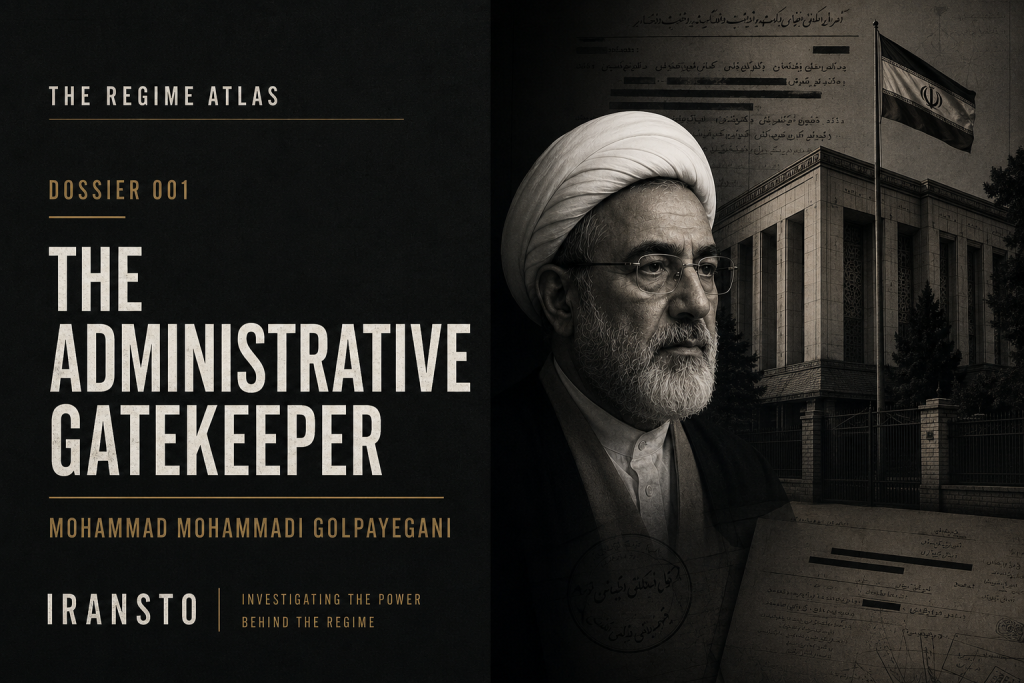
Few officials illustrate this reality more clearly than Mohammad Mohammadi Golpayegani. Outside specialist circles, his name remains relatively unfamiliar despite spending decades at the centre of the Islamic Republic’s most powerful institution. Public reporting generally identifies him simply as the Chief of Staff of the Office of the Supreme Leader, offering little explanation of the significance of that position or of the institutional authority accumulated through decades of uninterrupted service. His longevity, documented proximity to the Supreme Leader, role in the administration of the Office, representation of the institution during official events, family connection to the Khamenei household and designation under international sanctions together reveal something considerably more significant than the career of one senior official. They provide an opportunity to examine the administrative logic through which one of the Islamic Republic’s most influential institutions preserves authority over time.
The importance of that inquiry has grown considerably following the political developments of 2026. The death of Ali Khamenei fundamentally altered the leadership structure that had shaped the Islamic Republic for more than three decades and renewed questions concerning succession, institutional continuity and the resilience of the Office itself. Leadership transitions inevitably dominate public debate, but institutions frequently survive long after individual leaders disappear. Understanding that continuity requires examining the administrators responsible for preserving the organisational machinery that allows political authority to endure beyond any single officeholder.
This study forms the opening investigation in IranSTO’s Regime Atlas project. Its purpose is neither to compile biographical profiles nor to personalise complex political institutions by reducing them to the individuals who serve within them. Instead, it adopts an institutional methodology in which individuals function as gateways into broader systems of power. Each investigation begins with a person but ultimately seeks to reconstruct the institution, the network and the administrative architecture that person helps sustain. The individual is therefore the gateway; the institution remains the subject.
Accordingly, this article does not attempt to answer the relatively narrow question of who Mohammad Mohammadi Golpayegani is. It addresses a more fundamental one: how does the Office of the Supreme Leader preserve and exercise power through trusted administrators who remain largely invisible to the public? Answering that question requires moving beyond biography and treating administrative authority as a political instrument in its own right. Through that approach, Golpayegani becomes more than the subject of a profile. He becomes the point of entry into one of the least transparent, yet most consequential, institutions of the Islamic Republic.
Chapter 1
The Office of the Supreme Leader: A State Within a State
Political systems are commonly understood through their constitutional institutions. Constitutions identify heads of state, define executive authority and establish formal chains of command. They explain where authority is expected to reside, but they rarely explain how authority is translated into the daily operation of government. Every political system depends upon an institutional infrastructure that converts legal authority into practical governance. In democratic systems, that infrastructure is generally visible, regulated and subject to public oversight. In authoritarian systems, however, administrative institutions frequently evolve beyond their formal mandates, accumulating influence through restricted access, institutional trust and organisational opacity rather than through transparent accountability. The Office of the Supreme Leader represents one of the clearest examples of this evolution within the Islamic Republic.
Despite its importance, the Office has received remarkably limited analytical attention. Much of the existing scholarship has focused on the constitutional authority of the Supreme Leader and the ideological foundations of Velayat-e Faqih. Far less attention has been paid to the institution through which those constitutional powers are exercised in practice. Public discussion often portrays the Office of the Supreme Leader as little more than the personal secretariat of one political leader. That characterisation is fundamentally misleading. The Office is not simply where the Supreme Leader works. It is one of the Islamic Republic’s principal centres of institutional coordination, connecting multiple organs of political, judicial, military, religious and economic authority.
Constitutions do not implement themselves. Political authority requires an organisational structure capable of regulating access to decision-makers, transmitting instructions, coordinating communication between institutions and preserving continuity during periods of uncertainty. Although these functions appear administrative, their consequences are unmistakably political. Whoever controls the administrative environment surrounding the highest office of the state inevitably shapes the flow of information, the interaction of institutions and, ultimately, the practical exercise of authority itself.
Unlike executive offices in most democratic systems, the Office of the Supreme Leader operates with remarkably limited transparency. No comprehensive organisational chart has been made public. Internal reporting structures remain largely undisclosed, formal decision-making procedures are seldom explained and official communications reveal comparatively little about how the institution actually functions. This lack of transparency should not be viewed simply as an informational deficiency. It is itself a feature of institutional design. Opacity limits external scrutiny, complicates accountability and makes it considerably more difficult to distinguish formal authority from the informal relationships through which power is often exercised.
Over more than four decades, the Office has developed into something far more complex than a clerical bureaucracy. It functions as an institutional junction linking the political leadership, the judiciary, the Islamic Revolutionary Guard Corps (IRGC), intelligence organisations, religious representatives, provincial offices and influential economic structures associated with the Supreme Leader. Each of these institutions possesses its own formal responsibilities, yet many of their interactions with the Supreme Leader are channelled through the Office. Its primary function is therefore not administrative support in the conventional sense, but institutional coordination across multiple centres of unelected power.
The Office’s hybrid character helps explain both its resilience and its influence. Historically, it inherited important features of the traditional beyt maintained by senior Shi’a religious authorities, where trusted aides managed correspondence, visitors and religious affairs on behalf of the marja’. Over time, however, that traditional model expanded into a modern administrative organisation serving the leadership of an ideological state. The result is neither a purely religious institution nor a conventional government department. It is a hybrid structure in which religious authority, political administration and state power operate through the same organisational framework.
Understanding this institutional evolution requires looking beyond formal titles. Within the Office, influence is not determined solely by constitutional authority or bureaucratic rank. It is shaped by proximity to the centre of power, accumulated institutional trust, longevity in office and privileged access to confidential decision-making processes. Senior administrators become indispensable not because they dominate public debate, but because they preserve the machinery through which political decisions are communicated, coordinated and implemented. Administrative continuity, in this environment, becomes inseparable from regime continuity.
This institutional logic also explains why many of the Office’s most influential officials remain largely absent from international analysis. Public visibility and operational importance frequently move in opposite directions. Political leaders, ministers and military commanders dominate headlines, while those responsible for managing access to the centre of power operate quietly beyond sustained public scrutiny. Their influence is exercised through procedures rather than speeches, through trusted networks rather than media exposure and through decades of institutional continuity rather than electoral legitimacy.
Recognising the Office of the Supreme Leader as a central institution of governance rather than the personal office of one political leader fundamentally changes how the Islamic Republic should be analysed. The central question is no longer simply who occupies the position of Supreme Leader, but how the institution surrounding that office preserves authority through political crises, leadership transitions and changing domestic circumstances. Shifting the focus from personalities to institutions reveals mechanisms of power that are often overlooked precisely because they rarely appear in public view.
It is within that institutional framework that Mohammad Mohammadi Golpayegani becomes analytically significant. His importance does not arise from exceptional public prominence but from the position he occupied within one of the Islamic Republic’s least transparent institutions. Before examining how he accumulated influence over decades, it is first necessary to understand the organisation he served. Only then can the career of one administrator be understood as a window into the broader administrative architecture that has helped sustain the Office of the Supreme Leader throughout the history of the Islamic Republic.
Chapter 2
Mohammad Mohammadi Golpayegani: Building Trust Before Building Power
Political systems centred upon personal authority cannot function through formal institutions alone. Constitutions may define offices, laws may allocate responsibilities and bureaucracies may establish administrative procedures, but none of these mechanisms resolves a fundamental political question: who can be trusted with proximity to power? The closer an institution operates to the centre of political authority, the less influence depends upon formal qualifications and the more it depends upon confidence, discretion and long-established personal reliability. In highly centralised authoritarian systems, trust becomes a form of political capital. It determines who gains access to sensitive information, who participates in confidential decision-making and who remains inside the inner administrative circle as political circumstances change.
The Office of the Supreme Leader demonstrates this principle with unusual clarity. Although its senior officials occupy formally defined administrative positions, their practical authority cannot be understood through organisational charts alone. The institution operates through relationships that have often been cultivated over decades, combining administrative experience with personal confidence earned inside one of the state’s most closely protected environments. Institutional authority and institutional trust therefore become inseparable.
Mohammad Mohammadi Golpayegani exemplifies this process. Public accounts usually begin and end with a brief biographical summary before noting that he served for decades as Chief of Staff of the Office of the Supreme Leader. Such descriptions reveal remarkably little. They identify his position but do not explain the political significance of his longevity. In authoritarian systems characterised by intense competition for influence, remaining within the innermost administrative circle for decades is rarely accidental. Longevity at the centre of power is seldom explained by bureaucratic competence alone. It normally reflects a sustained relationship of confidence that survives political change, institutional restructuring and shifting balances of power.
The transition from Ruhollah Khomeini to Ali Khamenei illustrates this dynamic. Leadership succession often produces extensive administrative change as incoming leaders replace inherited officials with trusted associates. The Islamic Republic experienced one of the most consequential political transitions in its history, yet Golpayegani not only remained inside the Office but consolidated his position under the new Supreme Leader. Rather than treating this continuity as an individual success story, it should be understood as evidence of a broader institutional process. It raises a more significant question than biography alone can answer: what qualities enable certain officials to retain the confidence of successive centres of power while others disappear from the political landscape?
The available evidence suggests that confidence inside the Office is accumulated gradually rather than conferred solely through formal appointment. Longevity, discretion, ideological reliability, familiarity with the institution’s internal culture and the capacity to manage highly sensitive administrative responsibilities all appear to contribute to continued access. Unlike elected politicians or senior ministers, whose authority is reinforced through public visibility, senior administrators within the Office derive influence from precisely the opposite condition. Their effectiveness depends upon remaining indispensable while attracting as little public attention as possible.
Golpayegani’s documented family connection to the household of the Supreme Leader provides a further illustration of how institutional and personal confidence can become mutually reinforcing. The marriage between his son and the daughter of Ali Khamenei should not be understood simply as a private family relationship. Within the political environment surrounding the Office, it demonstrates how administrative proximity, personal confidence and family networks may intersect inside the regime’s most restricted circles of authority. This observation does not suggest that family relationships alone determine political advancement. Rather, it illustrates how personal and institutional confidence can reinforce one another within a system where access itself constitutes one of the most valuable forms of political capital.
Equally revealing is what remains absent from the public record. Despite occupying one of the Islamic Republic’s most influential administrative positions, Golpayegani has maintained an exceptionally limited public profile. He has given few substantial interviews, published little that sheds light on the internal operation of the Office and received relatively limited attention within international scholarship. The result is a significant analytical blind spot. Researchers have understandably concentrated on the Supreme Leader while devoting comparatively little attention to the officials responsible for sustaining the institution surrounding him.
Limited visibility should not be mistaken for limited influence. Within the Office of the Supreme Leader, public prominence and institutional authority frequently move in opposite directions. Political leaders carry the burden of representation, while trusted administrators preserve continuity behind the scenes. Their influence is exercised not through speeches or electoral mandates, but through the management of procedures, access, communication and institutional memory. In highly centralised systems, the most durable power often belongs not to those who speak on behalf of the state, but to those who ensure that the machinery of government continues to function regardless of political transition or institutional disruption.
Understanding Mohammad Mohammadi Golpayegani therefore requires abandoning the assumptions of conventional political biography. His significance lies not in the chronology of his personal life, but in what his career reveals about the production of institutional confidence within the Islamic Republic. Before authority can be exercised, confidence must first be established. Before power becomes visible, it must already have been entrusted. The career of Golpayegani demonstrates that inside the Office of the Supreme Leader, institutional trust is not merely a personal attribute. It is one of the administrative foundations upon which political authority itself is built.
Chapter 3
Administrative Power Is Political Power
The concentration of political authority around a single leader inevitably transforms administration into an instrument of power. In highly centralised political systems, authority depends not only upon those who make decisions but also upon those who organise the conditions under which decisions are made. Meetings must be arranged, reports prioritised, visitors screened, correspondence managed, institutions coordinated and channels of communication maintained. These responsibilities appear administrative in form, yet their political consequences are substantial. The organisation of decision-making is itself an exercise of power.
This distinction is particularly important within the Office of the Supreme Leader. Public discussion often assumes that administrative officials merely implement decisions taken elsewhere. Such an assumption overlooks one of the defining characteristics of modern political institutions: the capacity to shape the decision-making environment without formally participating in the final decision itself. Political authority is exercised not only when a decision is announced, but also through the management of information, the coordination of institutional relationships and the regulation of access to those who ultimately possess constitutional authority.
For that reason, administrative authority cannot be regarded as politically neutral. Every political system requires mechanisms that determine how information reaches senior decision-makers. Reports compete for attention, institutions seek direct access to leadership and requests for meetings invariably exceed the time available. Administrative structures therefore perform an unavoidable filtering function. They establish priorities, organise communication and shape the flow of information long before formal political decisions become visible. While such processes do not necessarily determine outcomes, they define the institutional environment in which those outcomes are produced.
Within the Office of the Supreme Leader, this filtering function assumes exceptional significance. Access to the Supreme Leader represents one of the most tightly controlled forms of political access within the Islamic Republic. Very few individuals or institutions communicate directly with the highest office without passing through procedures administered inside the Office itself. Managing those procedures is therefore far more than a logistical responsibility. It constitutes one of the principal mechanisms through which institutional order is maintained across a highly centralised political system.
This investigation proposes the concept of the Administrative Gatekeeper to describe that role. An Administrative Gatekeeper is not necessarily the individual who formulates state policy or publicly defines ideological doctrine. Rather, the gatekeeper preserves the institutional environment within which political authority operates. By regulating access, supervising administrative procedures, coordinating communication and safeguarding institutional continuity, such officials become indispensable to the functioning of the political system despite remaining largely absent from public attention. Their influence derives less from formal constitutional authority than from sustained proximity, accumulated institutional confidence and long-term control over administrative processes.
Mohammad Mohammadi Golpayegani exemplifies this form of authority. His significance does not rest upon evidence that he personally directed national policy or publicly shaped ideological doctrine. Instead, his decades of service illustrate the political importance of administrative continuity itself. Remaining at the centre of the Office of the Supreme Leader for such an extended period suggests a role sustained by exceptional institutional confidence. In systems where access to the highest political authority is tightly controlled, preserving that confidence over decades becomes politically significant in its own right.
Administrative power also depends upon institutional memory. Political leaders, ministers and military commanders may change over time, but administrative institutions often preserve their operational knowledge through long-serving officials. Such individuals accumulate familiarity with internal procedures, trusted communication channels, previous crises, established working relationships and organisational routines that cannot easily be replicated through formal appointment alone. Institutional memory therefore becomes a strategic resource. It preserves continuity during periods of uncertainty while reducing the disruption that would otherwise accompany political transition.
This helps explain why administrative influence is frequently underestimated by external observers. Public analysis naturally concentrates on visible political actors because their speeches, appointments and public decisions generate accessible evidence. Administrative officials, by contrast, perform much of their work beyond public observation. Their influence is embedded in procedures rather than public statements, in trusted relationships rather than media appearances and in institutional continuity rather than electoral legitimacy. The quieter an institution becomes, the more difficult its political significance can be to recognise.
Understanding the Office of the Supreme Leader through the concept of administrative gatekeeping fundamentally changes how the institution should be analysed. Rather than viewing the Office as a passive bureaucracy supporting the Supreme Leader, it becomes more accurate to understand it as the organisational mechanism through which political authority is coordinated daily. Administrative processes do not replace political decision-making, but they make that decision-making possible by structuring the movement of information, regulating institutional access and preserving organisational continuity.
Viewed from this perspective, Mohammad Mohammadi Golpayegani represents something considerably more significant than a senior administrator. His career demonstrates how unelected administrative authority can become one of the least visible yet most durable components of political power. The importance of his position lies not simply in his proximity to the Supreme Leader, but in illustrating how control over access, communication, institutional memory and organisational continuity can itself become a form of political authority. That institutional logic also provides the foundation for understanding how a relatively small circle of trusted officials has preserved its influence within the Office of the Supreme Leader across decades of political change.
Chapter 4
The Closed Circle
Political systems built around highly personalised authority inevitably develop mechanisms for distinguishing between ordinary officials and trusted insiders. Formal appointments determine who occupies public office, but they do not necessarily determine who gains access to the innermost circle surrounding the centre of power. In highly centralised authoritarian systems, some of the most consequential appointments are those that receive the least public attention. They concern access rather than office, confidence rather than rank and long-established reliability rather than public legitimacy. The Office of the Supreme Leader represents one of the clearest examples of this dynamic within the Islamic Republic.
Viewed from the outside, the Office appears to function through a conventional administrative hierarchy. Closer examination suggests a considerably more complex reality. Its most influential officials have not simply occupied senior positions for extended periods; many have remained within a remarkably stable circle of confidence that has survived leadership transitions, political crises and broader institutional change. Such continuity cannot be explained by bureaucratic procedure alone. It points instead to a political environment in which confidence is accumulated gradually, tested continuously and rewarded with long-term access to the highest levels of authority.
The careers of senior officials associated with the Office reveal several recurring characteristics. Many emerged from overlapping religious, revolutionary or security environments before assuming responsibilities inside the institution. They established reputations for discretion rather than publicity, administrative reliability rather than political ambition and institutional loyalty rather than independent public influence. Unlike elected politicians, whose authority depends upon public recognition, trusted administrators within the Office derive much of their influence from remaining outside the political spotlight. Their function is not to represent the institution publicly but to preserve its internal cohesion.
This pattern also helps explain why turnover within the Office’s inner administrative circle has historically been far lower than in many other parts of the Iranian state. Governments have changed, presidents have come and gone, parliamentary majorities have shifted and senior military commanders have been replaced. Yet several of the Office’s principal administrators remained in positions of exceptional confidence for decades. Such continuity should not be dismissed as routine bureaucratic stability. In a political system where proximity to the Supreme Leader constitutes one of the most valuable forms of political capital, remaining within that circle represents the preservation of institutional confidence at the highest level.
Mohammad Mohammadi Golpayegani illustrates this mechanism particularly well. His longevity cannot be explained simply by administrative competence. Many officials possess technical expertise; comparatively few remain entrusted with the daily operation of the Islamic Republic’s most powerful institution across successive political eras. His career instead suggests that the Office rewards a combination of qualities extending well beyond bureaucratic ability: absolute discretion, demonstrated ideological reliability, deep institutional memory, sustained personal confidence and the capacity to exercise influence without cultivating an independent political profile.
Family relationships provide another dimension of this architecture of confidence. The documented marriage between Golpayegani’s son and Ali Khamenei’s daughter should not be viewed merely as a private family connection. It illustrates how institutional proximity and family relationships may reinforce one another within the regime’s most restricted circles of authority. This observation does not imply that kinship alone determines political advancement. Rather, it demonstrates how personal relationships can strengthen networks that have already been established through years of institutional cooperation and accumulated confidence.
The importance of these relationships extends well beyond individual careers. They indicate that the Office of the Supreme Leader should be understood not simply as an administrative bureaucracy but as a protected political environment in which access itself becomes a strategic resource. Entry into that environment appears to depend less upon transparent institutional procedures than upon prolonged demonstrations of reliability, discretion and ideological commitment. Once established, these networks acquire a degree of resilience that makes them remarkably resistant to external political change. In that sense, the Office reproduces itself not merely by appointing officials, but by reproducing trusted elite networks across successive generations.
This raises a broader analytical question extending beyond the case of Golpayegani. How does an authoritarian political system preserve elite cohesion over decades without relying exclusively upon formal institutions? The evidence examined throughout this investigation suggests that one important answer lies in the construction of tightly controlled circles of confidence whose members combine administrative responsibility with privileged access to the highest political authority. Such circles reduce uncertainty, centralise communication, preserve organisational continuity and minimise the risks associated with internal fragmentation. At the same time, they complicate meaningful external oversight because the relationships that matter most operate within protected networks rather than transparent institutional structures.
Understanding the Office of the Supreme Leader therefore requires analysing not only its formal organisation but also its internal sociology of power. Organisational charts explain only part of the institution. Networks explain considerably more. The durability of the Islamic Republic has depended not solely upon constitutional offices or ideological doctrine, but upon the careful cultivation of trusted administrative elites whose authority rests upon proximity rather than publicity. Mohammad Mohammadi Golpayegani occupies an important place within that system not because his career is unique, but because it provides a rare window into the mechanisms through which the Islamic Republic protects, reproduces and preserves its innermost circle of power. The following chapter examines how those institutional relationships extend beyond administrative confidence and become reinforced through family networks at the very centre of the regime.
Chapter 5
Power Through Invisibility
Modern political analysis often assumes that influence can be measured by visibility. Presidents dominate headlines because they deliver speeches. Ministers are judged through legislation, interviews and public appearances. Military commanders become recognised through official appointments and operational announcements. Visibility therefore creates the impression that political authority belongs primarily to those who appear most frequently before the public. That assumption becomes increasingly unreliable, however, when examining highly centralised authoritarian systems. Within such systems, visibility is rarely distributed naturally. It is managed. Those who appear least in public are not necessarily those who exercise the least influence.
The Office of the Supreme Leader illustrates this dynamic with particular clarity. While the Supreme Leader has understandably remained the principal focus of international attention, the administrative institution surrounding that office has attracted far less scrutiny. Public information concerning many of its most influential officials remains remarkably limited despite decades of service at the centre of political authority. This absence should not be dismissed simply as a failure of journalism or academic research. It reflects the institutional logic of an organisation whose effectiveness depends, in part, upon limiting external visibility into the individuals responsible for its daily operation.
Mohammad Mohammadi Golpayegani exemplifies this pattern. For decades he occupied one of the most strategically important administrative positions within the Islamic Republic while remaining largely absent from international political analysis. His public appearances were generally confined to official ceremonies or formal statements issued on behalf of the Office of the Supreme Leader. He gave few substantive interviews, published little that illuminated the institution’s internal operation and attracted relatively limited academic attention despite serving at the administrative centre of Iran’s highest political office. Rather than diminishing his significance, this limited visibility raises a more important analytical question: why do some of the most influential officials within the Islamic Republic remain among its least publicly examined?
Part of the answer lies in the distinction between representative authority and operational authority. Public political figures perform representative functions. They communicate policy, defend government decisions and engage with domestic or international audiences. Senior administrators fulfil a different role. Their responsibility is to preserve the institutional conditions under which political authority can be exercised. Their effectiveness therefore depends less upon public recognition than upon uninterrupted access, organisational continuity and the sustained confidence of those they serve. Indeed, excessive public prominence may itself become a liability if it allows an administrator to develop an independent political profile capable of competing with the authority of the institution.
This pattern extends well beyond one individual. Several long-serving officials associated with the Office of the Supreme Leader accumulated considerable institutional influence while maintaining exceptionally limited public profiles. Although their responsibilities differed, they shared several common characteristics: prolonged service, restricted media exposure, direct proximity to the centre of power and continued institutional relevance across successive political crises. Considered individually, such careers may appear unremarkable. Considered collectively, they reveal a consistent organisational principle. The Office appears to reward discretion as much as competence, continuity as much as experience and invisibility as much as loyalty.
The implications extend beyond the Office itself. Limited visibility complicates external scrutiny by journalists, researchers and policymakers seeking to understand how political authority actually functions inside the Islamic Republic. Public debate naturally concentrates upon elected officials, military commanders and highly visible political figures because their activities generate accessible evidence. Administrative actors operating behind the institutional curtain receive comparatively little systematic attention despite occupying positions that may substantially influence communication, coordination and institutional continuity. The result is a persistent analytical imbalance. Public authority becomes extensively documented while operational authority often remains insufficiently understood.
That imbalance carries broader consequences for research. Analysing authoritarian systems primarily through their public representatives risks reproducing the image those systems project rather than exposing the institutional mechanisms through which power is organised. Understanding the Islamic Republic therefore requires shifting analytical attention away from visible personalities and towards the administrative structures that connect, preserve and coordinate them. Such an approach replaces the study of political rhetoric with the study of institutional practice, revealing forms of authority that rarely appear in official narratives yet remain indispensable to the operation of the state.
Mohammad Mohammadi Golpayegani is significant precisely because his career illustrates this hidden dimension of political power. His importance derives not from an unusually visible public role but from the opposite. His decades of limited public exposure, combined with sustained proximity to the Office of the Supreme Leader, demonstrate that within the Islamic Republic influence is not necessarily exercised in proportion to public recognition. In some cases, the durability of authority depends upon remaining largely unseen while occupying one of the system’s most strategically important administrative positions.
Understanding this relationship between invisibility and influence fundamentally changes how the Office of the Supreme Leader should be analysed. Rather than treating the absence of public information as an obstacle to investigation, it becomes evidence worthy of investigation in its own right. The limited visibility of trusted administrators is not merely a gap in the historical record. It forms part of the institutional logic through which the Office protects internal cohesion, preserves administrative continuity and limits external scrutiny. Within the Office of the Supreme Leader, invisibility should therefore not be understood as the absence of power. It has often been one of the conditions through which power is organised, protected and preserved.
Chapter 6
When the System Is Tested
The true character of political institutions rarely reveals itself during periods of stability. Established procedures, administrative routines and long-serving officials often pass unnoticed while government functions without major disruption. It is during moments of profound political crisis that institutions expose whether they are resilient, fragmented or dependent upon individual personalities. Crises reveal organisational strengths that routine governance conceals. More importantly, they demonstrate whether political continuity rests primarily upon constitutional arrangements or upon administrative structures operating behind the visible institutions of the state.
The Office of the Supreme Leader should be understood within that context. Its importance cannot be measured solely by its role during ordinary government administration. Its institutional value becomes most apparent when the political system comes under exceptional pressure. During periods of domestic unrest, external conflict or leadership transition, the Office is expected to preserve communication, maintain institutional coordination and ensure that the administrative machinery surrounding the highest political authority continues to function. At such moments, continuity rather than visibility becomes its defining purpose.
Recent developments inside the Islamic Republic illustrate the importance of this distinction. Public attention understandably focused on the January 2026 mass killings and, subsequently, the death of Ali Khamenei. Both events fundamentally altered the political environment surrounding the Office of the Supreme Leader. Yet while the political consequences of those events have been widely discussed, considerably less attention has been devoted to examining how the institution itself responded to one of the most consequential periods in the history of the Islamic Republic.
Publicly available evidence concerning the internal operation of the Office during these crises remains extremely limited. No comprehensive public record explains how responsibilities were allocated, how internal coordination was maintained or what specific responsibilities senior administrators assumed during the management of these events. That absence of documentation should not be interpreted as evidence supporting conclusions that cannot presently be substantiated. It nevertheless reveals an important institutional characteristic. Even during moments of national significance, the Office continued to operate with an exceptional degree of administrative opacity.
For researchers, that opacity presents both a limitation and a finding. It limits the ability to reconstruct internal decision-making with confidence. At the same time, it demonstrates the extent to which one of the Islamic Republic’s most important institutions continues to function beyond meaningful public scrutiny. Understanding that absence of transparency therefore becomes part of understanding the institution itself. In this respect, the lack of evidence regarding internal administrative processes is not merely a research obstacle; it is itself evidence of how the Office has historically been organised.
The available evidence nevertheless supports several broader observations. Despite successive national crises, the Office continued operating as the administrative centre surrounding the Supreme Leader. Official communications continued to be issued, institutional relationships remained operational, and the organisational framework surrounding the Office did not visibly collapse following the death of Ali Khamenei. This continuity suggests that the institution had developed an administrative resilience extending beyond the authority of any single individual. Organisations built exclusively around personal leadership often weaken when that leadership disappears. The continued operation of the Office points instead towards a more durable institutional architecture.
This observation reinforces one of the central arguments advanced throughout this investigation. The Office of the Supreme Leader should not be understood simply as the personal office of one political leader. It has evolved into an institutional mechanism capable of preserving continuity during periods that test the stability of the wider political system. Senior administrators therefore derive their significance not only from proximity to political authority, but from their responsibility for ensuring that the machinery of authority continues to function under exceptional circumstances.
Mohammad Mohammadi Golpayegani should be understood within that institutional framework. The publicly available evidence does not permit definitive conclusions regarding his precise administrative responsibilities during every stage of the January 2026 mass killings or the subsequent transition following the death of Ali Khamenei. Responsible analysis requires acknowledging those evidentiary limits rather than replacing them with speculation. At the same time, his decades at the administrative centre of the Office make it impossible to examine the institution’s response to these crises without considering the role of its senior leadership. The absence of transparent documentation therefore identifies an important area for continued investigation rather than bringing the inquiry to a close.
Ultimately, crises do more than test governments; they expose the institutional foundations upon which governments depend. In the case of the Islamic Republic, those foundations extend well beyond constitutional offices into an administrative structure that has received remarkably limited public scrutiny. The Office of the Supreme Leader emerges from these moments not merely as a supporting bureaucracy but as one of the principal mechanisms through which political continuity is organised and preserved. Understanding how that continuity is maintained remains essential to understanding how the Islamic Republic itself functions under conditions of extraordinary political stress. The following chapter examines how the international community has recognised the importance of this institution through targeted sanctions while still failing to understand much of the administrative architecture those sanctions implicitly acknowledge.
Chapter 7
Sanctioned but Still Unseen
International sanctions are often interpreted as evidence that governments have identified an individual as politically significant. While that assumption is generally correct, it explains only part of the picture. Sanctions identify targets; they do not explain why those targets matter, how they exercise influence or where they fit within the institutional architecture of political power. A sanctions designation may therefore acknowledge the importance of an individual while leaving the organisational system that gives that individual influence almost entirely unexplored. The case of Mohammad Mohammadi Golpayegani illustrates this distinction with particular clarity.
Despite maintaining an exceptionally limited public profile throughout his career, Golpayegani became the subject of international sanctions. Unlike many designated officials whose prominence derives from public leadership, military command or overt political activity, his international significance stems primarily from the institution he served. His designation reflects the assessment that senior officials responsible for sustaining the Office of the Supreme Leader form part of the administrative machinery through which the Islamic Republic preserves and exercises political authority. In that respect, the sanctions recognise institutional significance rather than public visibility.
This distinction deserves careful attention. Public discussion often treats sanctions as though they constitute comprehensive judgements about an individual’s legal or political responsibility. In practice, sanctions are instruments of foreign policy. They are designed to impose political and economic costs, restrict international engagement and signal governmental concern regarding particular individuals or institutions. They are not judicial findings, nor do they establish criminal liability. Confusing these functions risks attributing to sanctions conclusions they were never intended to provide.
Even so, sanctions remain valuable analytical evidence. They reveal how external governments perceive the structure of political power inside the Islamic Republic. The decision to sanction a senior administrative official whose public profile remained exceptionally limited suggests that at least part of the international community recognised the strategic importance of the Office of the Supreme Leader beyond the figure of the Supreme Leader himself. Implicitly, such measures acknowledge that administrative institutions—not only highly visible political leaders—play an essential role in sustaining the regime.
Yet that recognition remains incomplete. Although senior administrators have been designated under international sanctions, comparatively little public analysis has examined the institutional mechanisms that made those designations necessary in the first place. Media reporting has generally focused on the announcement of sanctions rather than the administrative structures underlying them. Academic research has similarly devoted far greater attention to constitutional authority, electoral politics and the security apparatus than to the internal operation of the Office itself. The result is a persistent gap between political action and institutional understanding.
That gap carries important practical consequences. Effective policy depends upon accurate institutional analysis. Sanctioning an individual acknowledges that his position matters; it does not explain why that position matters, how authority flows through the institution or how comparable administrative networks continue operating regardless of action taken against a single official. Without a clearer understanding of institutional architecture, external responses risk concentrating upon individual names while overlooking the organisational systems that outlast individual officeholders.
Golpayegani’s case illustrates this broader challenge. His designation drew international attention to his position, but it did relatively little to improve public understanding of the institution he helped administer. The Office of the Supreme Leader remains one of the least transparent centres of political authority within the Islamic Republic. Consequently, one of the most important questions raised by international sanctions remains insufficiently answered: what does the Office actually do daily, and through what administrative mechanisms does it translate constitutional authority into operational power?
This question extends well beyond sanctions policy. It concerns accountability itself. Institutions that remain poorly understood are inherently more difficult to scrutinise. Their internal relationships, administrative procedures and decision-making processes become resistant to independent examination, limiting the ability of researchers, journalists and policymakers to attribute responsibility with precision. Transparency is therefore more than a democratic principle; it is a prerequisite for meaningful institutional accountability.
This investigation does not seek to replace evidentiary gaps with speculation. Instead, it argues that the combination of international sanctions, restricted public visibility and sustained institutional influence identifies the Office of the Supreme Leader as an institution requiring far deeper investigation than it has so far received. The paradox surrounding Mohammad Mohammadi Golpayegani is therefore not simply that he became internationally sanctioned despite remaining largely unknown. The greater paradox is that one of the Islamic Republic’s most influential administrative institutions continues to receive far less systematic scrutiny than its strategic importance would appear to justify.
For IranSTO, that distinction is fundamental. The objective is not merely to catalogue sanctioned individuals but to reconstruct the institutional architecture within which they operate. Sanctions identify important nodes within a political system; investigative research must explain the system itself. Only by moving beyond individual designations and examining the administrative structures that sustain political authority can meaningful institutional understanding, and ultimately meaningful accountability, begin to emerge.
Chapter 8
Beyond One Man: Rethinking How the Islamic Republic Is Studied
The purpose of this investigation has never been to elevate Mohammad Mohammadi Golpayegani into a figure of greater public prominence. Quite the opposite. His limited visibility is precisely what makes his position analytically valuable. Throughout this article, Golpayegani has served not as the principal subject of investigation, but as the point of entry into a far larger institutional structure. The central argument developed here is therefore methodological as much as political: understanding the Islamic Republic requires a fundamental shift in analytical perspective. Political systems cannot be understood solely through the individuals who publicly represent them. They must also be examined through the institutions, administrative networks and organisational relationships that enable authority to function over time.
The Office of the Supreme Leader illustrates this principle with particular clarity. Golpayegani’s career demonstrates that administrative continuity, institutional confidence, restricted access and organisational memory are not peripheral characteristics of the Office; they are among its defining features. These elements help explain how authority is preserved beyond electoral cycles, beyond cabinet reshuffles and, ultimately, beyond individual political leaders. They reveal an institution designed not simply to support political authority, but to preserve it across changing political circumstances.
Adopting this perspective also helps explain why conventional approaches to studying the Islamic Republic frequently leave important questions unanswered. Political reporting understandably concentrates on elections, public speeches, military operations and diplomatic developments because these provide the most visible evidence of state activity. Yet visible politics represents only one layer of the system. Beneath it exists an administrative architecture responsible for coordinating institutions, preserving continuity and protecting the mechanisms through which authority is exercised. Without examining that deeper structure, analyses risk describing political events without fully explaining how the system repeatedly reproduces itself.
The implications extend well beyond the Office of the Supreme Leader. The analytical framework developed in this investigation provides a methodology for examining other institutions across the Islamic Republic. Individuals matter because they reveal institutions. Institutions matter because they reveal networks. Networks matter because they reveal the mechanisms through which political authority is organised, protected and reproduced. This progression—from individual, to institution, to network, to political architecture—forms the methodological foundation of The Regime Atlas.
This framework also carries practical implications for accountability. Public debate often seeks responsibility primarily in the actions of individual leaders while leaving institutional structures comparatively underexamined. Yet authoritarian systems are rarely sustained by one individual alone. They endure because administrative, political, security and economic institutions continue functioning together even during periods of crisis, succession or leadership transition. Understanding those institutions is therefore essential not only for historical analysis but also for any serious effort to understand responsibility, resilience and the long-term operation of political power.
The investigation of Mohammad Mohammadi Golpayegani should therefore be understood as the opening chapter of a much broader research programme rather than the conclusion of a single case study. Many questions remain unresolved. The wider administrative leadership of the Office of the Supreme Leader, its financial structures, provincial representatives, relationships with security organisations, channels of institutional coordination and internal mechanisms of authority all require substantially deeper investigation. The absence of comprehensive public knowledge in these areas should not discourage further research. It should define its priorities.
Ultimately, the most important conclusion of this article concerns neither Golpayegani nor any other individual official. It concerns the way the Islamic Republic itself should be studied. Focusing exclusively on public personalities risks overlooking the administrative structures that make those personalities effective. Reconstructing those hidden structures requires patience, evidence and sustained institutional analysis rather than speculation. Only by examining the architecture beneath the visible state can researchers begin to understand how political authority is organised, protected and reproduced within one of the world’s most opaque governing systems.
This is the objective of The Regime Atlas. Each investigation begins with one individual, but no investigation ends there. Every profile is intended to expose a wider institution. Every institution leads to a broader network. Every network reveals another layer of the Islamic Republic’s administrative architecture. The ultimate objective is not to document individual officials in isolation, but to produce a comprehensive institutional map of the political system they sustain.
Chapter 9
Networks Beyond the Office
No institution of strategic importance operates through a single individual. The Office of the Supreme Leader is no exception. While Mohammad Mohammadi Golpayegani provides an important point of entry into the institution, understanding the Office ultimately requires looking beyond any one administrator and reconstructing the wider network through which authority is organised, transmitted and preserved. Administrative continuity is never sustained by isolated careers. It depends upon interconnected individuals performing complementary functions within a protected institutional environment built on long-established confidence, restricted access and organisational continuity.
Throughout the history of the Islamic Republic, a relatively small group of senior officials has occupied influential positions in and around the Office for extended periods. Although their formal responsibilities have differed, their careers reveal striking institutional similarities. Many remained in office for decades rather than years. Most maintained exceptionally limited public profiles despite exercising considerable influence. Their authority rested neither on electoral legitimacy nor public visibility. Instead, it was built upon sustained institutional confidence earned inside the Office itself. Collectively, these officials formed an administrative ecosystem in which continuity depended on trusted relationships rather than continual personnel changes.
Viewed from this perspective, Golpayegani is not an exceptional case but one element within a broader institutional structure. Other senior officials associated with the Office have exercised influence over security coordination, political affairs, executive administration, communications and relations with other state institutions. Their individual responsibilities have varied, yet their collective function has remained remarkably consistent. They preserve the operational capacity of the Office regardless of political circumstances. Examining only one of these officials would therefore provide an incomplete understanding of how the institution actually functions.
This wider network also helps explain the resilience of the Office during periods of political transition. Administrative authority has not been concentrated in a single official. Instead, it has been distributed across specialised roles connected through long-standing working relationships, institutional memory and trusted channels of communication. Such resilience is a defining characteristic of mature political institutions. Continuity is preserved because institutional knowledge survives individual officeholders and remains embedded within an enduring administrative network.
Understanding that network requires looking beyond formal organisational charts. Authoritarian institutions frequently combine official responsibilities with informal influence, personal confidence and long-established working relationships that remain only partially visible in public documentation. Titles therefore explain only part of institutional authority. Equally important are the informal patterns of cooperation, access and confidence that develop over time among senior officials operating inside the same administrative environment. Reconstructing those relationships is essential if the internal operation of the Office of the Supreme Leader is to be understood with greater precision.
This observation reinforces one of the central methodological arguments advanced throughout this investigation. The Office of the Supreme Leader should be examined as a network rather than as a collection of isolated officeholders. Individual biographies remain valuable because they provide documentary evidence, but their significance increases substantially when they are placed within their institutional context. The interaction between administrators, advisers, security officials and trusted intermediaries reveals far more about the operation of the Office than the study of any single career in isolation.
For that reason, the investigation of Mohammad Mohammadi Golpayegani should be understood as the opening stage of a broader institutional research programme rather than as a self-contained case study. Reconstructing the Office requires further investigation into other senior administrators, its relationship with security organisations, its provincial representative network, its financial structures and the mechanisms through which information, authority and institutional confidence circulate throughout the institution. Each of these subjects provides another route into the wider administrative architecture surrounding the Supreme Leader.
The importance of those future investigations extends well beyond historical documentation. Mapping institutional networks makes it possible to understand how political authority is preserved, adapted and reproduced over time. It also provides a framework for analysing the Islamic Republic as an interconnected system rather than as a collection of individual personalities. The enduring strength of the Office lies in the interaction of trusted officials working within a stable institutional framework. That institutional framework remains one of the Islamic Republic’s most significant centres of unelected power, yet it also remains one of its least systematically examined.
This is where The Regime Atlas moves next. Golpayegani is only the first institutional dossier. The same investigative methodology will now be applied to other senior officials, affiliated organisations, financial structures, security networks and centres of administrative authority surrounding the Office of the Supreme Leader. The objective is not to assemble a series of biographies. It is to reconstruct the institutional architecture through which political power is organised, protected and reproduced inside the Islamic Republic.
Chapter 10
Why the Administrative Gatekeeper Matters
The significance of Mohammad Mohammadi Golpayegani does not lie primarily in the details of his individual career. If this investigation demonstrates anything, it is that his value as a subject of research extends well beyond the chronology of one administrator’s professional life. His importance is methodological rather than biographical. Through his position inside the Office of the Supreme Leader, it becomes possible to examine the administrative structures, institutional relationships and networks of confidence that preserve political authority inside the Islamic Republic while remaining largely outside public attention.
Much of the existing literature on the Islamic Republic has understandably focused on its most visible centres of power. Researchers have examined the constitutional authority of the Supreme Leader, the role of the Islamic Revolutionary Guard Corps, presidential administrations, electoral politics, foreign policy and ideological development. These fields remain indispensable. Yet they also reveal an important analytical imbalance. Far less attention has been devoted to the administrative structures that connect these institutions, preserve continuity between them and coordinate their daily interaction. As a result, some of the officials most central to the operation of the political system remain among its least systematically examined.
The Office of the Supreme Leader illustrates why that imbalance matters. Political authority inside the Islamic Republic is exercised not only through constitutional provisions or public institutions, but also through administrative mechanisms that regulate access, preserve institutional memory, coordinate communication and maintain continuity during periods of political uncertainty. These mechanisms rarely receive sustained public attention, yet they shape the practical operation of the political system every day. Focusing exclusively on visible authority risks overlooking the institutional machinery that enables authority to function.
Golpayegani provides an unusually valuable case study because he spent decades at the centre of that machinery. His career demonstrates that influence inside the Islamic Republic cannot always be measured by ministerial office, public prominence or media visibility. In many cases, the opposite appears to be true. The individuals who exercise the greatest operational influence are often those who avoid independent political profiles, rarely engage in public debate and dedicate their careers to preserving institutional continuity rather than cultivating personal prominence. Understanding these officials provides a clearer picture of how political authority is organised in practice rather than how it appears in public.
The implications extend beyond one institution and beyond one individual. Administrative gatekeepers exist because highly centralised political systems require trusted intermediaries capable of connecting formal authority with practical governance. They coordinate communication between institutions, preserve organisational continuity during periods of political disruption and ensure that administrative routines survive changes in political leadership. Their influence derives from accumulated institutional confidence, operational experience and long-term proximity to the centre of power. Studying these actors therefore provides insight into the resilience of the political system itself.
This perspective also carries practical importance for policymakers, investigative journalists and accountability mechanisms. Effective policy depends upon understanding where authority is exercised in practice rather than merely where it appears to reside in constitutional theory. Investigative reporting benefits from reconstructing institutional networks instead of focusing exclusively on public personalities. Likewise, meaningful accountability requires understanding the administrative structures through which communication, coordination and decision-making occur. Without that institutional perspective, analysis risks concentrating on visible political figures while overlooking the organisational systems that sustain political authority behind them.
This investigation therefore argues for a broader shift in the way the Islamic Republic is studied. Senior administrators should not be regarded as peripheral actors operating behind the scenes. They should be recognised as essential components of institutional power. Their careers provide access to structures that are otherwise difficult to observe, allowing researchers to reconstruct relationships that remain largely hidden from conventional political analysis. Studying those structures does not diminish the importance of political leaders or constitutional institutions. It complements existing scholarship by revealing the administrative foundations upon which visible authority depends.
For IranSTO, this principle forms the methodological foundation of The Regime Atlas. Individuals are investigated because they reveal institutions. Institutions are examined because they reveal networks. Networks are reconstructed because they expose the mechanisms through which political authority is organised, preserved and reproduced. Mohammad Mohammadi Golpayegani is therefore not presented as an isolated official deserving attention in his own right. He serves as the first institutional gateway in a wider programme of investigation. Understanding the Office of the Supreme Leader remains the central objective of this article, and understanding that Office provides a foundation for examining the broader administrative architecture through which the Islamic Republic continues to exercise and preserve power.
Chapter 11
Outstanding Research Questions
One of the defining characteristics of serious institutional research is the willingness to distinguish clearly between what the available evidence supports and what remains unresolved. The objective of this investigation has never been to eliminate uncertainty, but to reduce it through the careful examination of publicly available evidence. Where the evidentiary record permits well-supported conclusions, those conclusions have been presented. Where substantial gaps remain, they have been acknowledged rather than concealed or filled with speculation. Those unanswered questions should not be regarded as weaknesses of the investigation. They define the research agenda that follows.
The Office of the Supreme Leader remains one of the least transparent institutions within the Islamic Republic. Although this article has examined important aspects of its administrative structure through the case of Mohammad Mohammadi Golpayegani, much of the institution continues to resist independent scrutiny. This limitation does not arise from the methodology of the present investigation. It reflects the longstanding opacity of the Office itself and the continuing difficulty of reconstructing its internal organisation using publicly available evidence.
One important area requiring further investigation concerns the Office’s internal administrative structure. Public sources do not permit a comprehensive reconstruction of its organisational hierarchy or a precise understanding of how responsibilities are distributed among its senior officials. Likewise, the relationships linking the Office to the Islamic Revolutionary Guard Corps, intelligence organisations, the judiciary, major economic foundations and the Supreme Leader’s provincial representative network remain only partially documented. These institutional connections are frequently acknowledged in general terms but rarely described with sufficient precision to support detailed structural analysis.
The role of the Office during periods of national crisis also requires considerably deeper investigation. Publicly available evidence remains insufficient to reconstruct the institution’s internal administrative response to the January 2026 mass killings or to determine with confidence how responsibilities were allocated during that period. Similar questions remain regarding the transition that followed the death of Ali Khamenei. The available evidence confirms that the Office continued operating throughout both events, yet the internal mechanisms through which continuity was maintained remain largely undocumented. Understanding those mechanisms represents an important priority for future institutional research.
The Office’s financial and organisational ecosystem presents another significant area for investigation. Existing reporting identifies relationships between the Office and a range of political, religious and economic institutions, but many of those relationships remain only partially understood. Greater attention should be devoted to the interaction between administrative authority, economic foundations, provincial structures, financial networks and other institutional mechanisms that may contribute to the long-term resilience of the Islamic Republic. Advancing this area of research will require documentary evidence, financial analysis and systematic institutional mapping.
Another unresolved question concerns the relationship between institutional confidence and family networks. The documented family connection between the Golpayegani and Khamenei families demonstrates that administrative authority and personal relationships can intersect within the highest levels of the political system. Whether comparable patterns exist elsewhere within the Office, and to what extent such relationships reinforce institutional continuity, remains insufficiently examined. Addressing these questions will require comparative analysis across a broader group of senior officials rather than reliance upon a single case study.
The international dimension of the Office also deserves substantially greater attention. Targeted sanctions have acknowledged the strategic importance of several senior administrators, yet relatively little research has examined what those designations reveal about external assessments of the Office itself. Future investigations should explore how international accountability mechanisms, diplomatic engagement and sanctions policy intersect with the administrative structures examined throughout this article. Understanding where international assessments are well supported, and where they remain incomplete, represents another important research priority.
Taken together, these unresolved questions illustrate the scale of the work that remains to be done. They should not be interpreted as shortcomings of the present investigation, but as evidence that the Office of the Supreme Leader remains substantially underexamined despite its central role within the Islamic Republic. Each question identified here provides a foundation for future institutional investigation.
For IranSTO, these questions define the next stage of The Regime Atlas. The objective is not to produce isolated profiles of individual officials, but to build a cumulative body of institutional research that reconstructs the administrative architecture of the Islamic Republic. Each investigation will address one part of that larger structure. Over time, those investigations will contribute to a more comprehensive understanding of how political authority is organised, coordinated and preserved within one of the world’s least transparent governing systems.
Conclusion
Throughout this investigation, Mohammad Mohammadi Golpayegani has served not as the ultimate subject of analysis but as the point through which a much larger institution becomes visible. Examining his career demonstrates that the operation of political authority inside the Islamic Republic cannot be understood solely through constitutional offices, public speeches or the actions of its most recognisable leaders. It also depends upon administrative institutions that preserve continuity, regulate access, coordinate relationships and sustain the practical operation of power beyond the public eye.
The Office of the Supreme Leader illustrates this reality with particular clarity. Its influence extends beyond the constitutional authority formally vested in the Supreme Leader himself. It functions through an administrative structure designed to preserve organisational continuity, maintain institutional confidence and coordinate relationships across multiple centres of political, security, religious and economic authority. Understanding that structure is essential to understanding how the Islamic Republic continues to function through periods of political stability, national crisis and leadership transition.
Viewed in isolation, Golpayegani’s biography contributes only a limited understanding of one senior administrator. Examined within its institutional context, however, his career reveals something considerably more significant. It exposes the importance of administrative authority, institutional memory, trusted networks and long-term organisational continuity as enduring components of political power. The value of this investigation therefore lies not in documenting one individual, but in demonstrating a method for reconstructing the institutions that individual helps sustain.
This methodological shift carries implications extending far beyond the Office of the Supreme Leader. Authoritarian systems rarely survive through charismatic leadership alone. They endure because administrative organisations preserve routines, trusted officials maintain institutional coordination, and established networks continue functioning despite political disruption, succession or changes in public leadership. Political authority may appear personal, but its durability is institutional.
At the same time, this investigation also demonstrates the limits of current public knowledge. Important aspects of the Office remain resistant to independent examination, and significant evidentiary gaps continue to restrict detailed analysis of its internal operation. Those limitations should not be regarded as weaknesses of this study. They identify the boundaries of what can presently be established through publicly available evidence and define the priorities for future research. Serious institutional investigation does not end where documentation becomes limited. It begins by identifying precisely what remains unknown.
That principle defines the purpose of The Regime Atlas. The project does not seek to assemble a catalogue of prominent personalities within the Islamic Republic. Nor is it intended to produce a series of conventional biographies. Each investigation begins with an individual because individuals provide documentary entry points into institutions. Those institutions reveal networks, and those networks expose the administrative architecture through which political authority is organised, protected and reproduced. The objective is to move systematically from people, to institutions, to systems of power.
The Office of the Supreme Leader remains one of the least transparent and most consequential institutions within the Islamic Republic. For that reason, it requires considerably greater scholarly, investigative and policy attention than it has received to date. Mohammad Mohammadi Golpayegani is therefore presented here not as the conclusion of that inquiry, but as its beginning. This article represents the first institutional dossier within The Regime Atlas. The wider task is considerably more ambitious: to reconstruct, piece by piece, the administrative architecture through which the Islamic Republic has organised, preserved and exercised political authority for more than four decades. This dossier is therefore not an endpoint, but the opening map in a much larger effort to reconstruct the institutional architecture of the Islamic Republic.
References
- Constitution of the Islamic Republic of Iran (1989). English translation. Available at: https://www.servat.unibe.ch/icl/ir00000_.html
- Office of the Supreme Leader of the Islamic Republic of Iran. Official website. Available at: https://www.leader.ir/en
- U.S. Department of the Treasury. (2019). Treasury Designates Supreme Leader of Iran’s Inner Circle Responsible for Advancing Regime’s Domestic and Foreign Oppression. 4 November 2019. Available at: https://home.treasury.gov/news/press-releases/sm824
- Office of Foreign Assets Control (OFAC). Iran Sanctions Program. U.S. Department of the Treasury. Available at: https://ofac.treasury.gov/sanctions-programs-and-country-information/iran-sanctions
- Office of Foreign Assets Control (OFAC). Specially Designated Nationals and Blocked Persons List (SDN List). Available at: https://sanctionssearch.ofac.treas.gov/
- Federal Register. (2019). Notice of OFAC Sanctions Actions. Available at: https://www.federalregister.gov/documents/2019/11/12/2019-24613/notice-of-ofac-sanctions-actions
- United Nations Human Rights Council. Independent International Fact-Finding Mission on the Islamic Republic of Iran. Available at: https://www.ohchr.org/en/hr-bodies/hrc/ffm-iran
- United Nations Special Rapporteur on the Situation of Human Rights in the Islamic Republic of Iran. Available at: https://www.ohchr.org/en/special-procedures/sr-iran
- Amnesty International. Iran. Available at: https://www.amnesty.org/en/location/middle-east-and-north-africa/iran/
- Human Rights Watch. Iran. Available at: https://www.hrw.org/middle-east/north-africa/iran
- Chatham House. Research on Iran. Available at: https://www.chathamhouse.org/
- Carnegie Endowment for International Peace. Middle East Program – Iran. Available at: https://carnegieendowment.org/
- RAND Corporation. Research on Iran. Available at: https://www.rand.org/topics/iran.html
- The Washington Institute for Near East Policy. Iran Program. Available at: https://www.washingtoninstitute.org/
Research Resources
The following resources provide additional institutional, legal and analytical material for researchers seeking to further investigate the Office of the Supreme Leader, Mohammad Mohammadi Golpayegani and the administrative architecture of the Islamic Republic.
Official Institutions
- Office of the Supreme Leader of the Islamic Republic of Iran
https://www.leader.ir/en - The Constitution of the Islamic Republic of Iran
https://www.servat.unibe.ch/icl/ir00000_.html
Sanctions Databases
- U.S. Department of the Treasury – Office of Foreign Assets Control (OFAC)
https://ofac.treasury.gov/ - OFAC Sanctions Search (SDN List)
https://sanctionssearch.ofac.treas.gov/ - UK Office of Financial Sanctions Implementation (OFSI)
https://www.gov.uk/government/organisations/office-of-financial-sanctions-implementation - European Union Sanctions Map
https://www.sanctionsmap.eu/
United Nations
- UN Human Rights Council – Independent International Fact-Finding Mission on Iran
https://www.ohchr.org/en/hr-bodies/hrc/ffm-iran - UN Special Rapporteur on the Situation of Human Rights in Iran
https://www.ohchr.org/en/special-procedures/sr-iran
Human Rights Documentation
- Amnesty International – Iran Research
https://www.amnesty.org/en/location/middle-east-and-north-africa/iran/ - Human Rights Watch – Iran
https://www.hrw.org/middle-east/north-africa/iran
Policy and Institutional Research
- Chatham House – Middle East and North Africa Programme
https://www.chathamhouse.org/ - Carnegie Endowment for International Peace – Iran
https://carnegieendowment.org/ - RAND Corporation – Iran Research
https://www.rand.org/topics/iran.html - The Washington Institute for Near East Policy – Iran Program
https://www.washingtoninstitute.org/ - Brookings Institution – Middle East Program
https://www.brookings.edu/
Legal and Government Documents
- Federal Register (United States)
https://www.federalregister.gov/ - U.S. Department of State – Iran
https://www.state.gov/countries-areas/iran/ - Council of the European Union
https://www.consilium.europa.eu/
IranSTO Related Investigations
Readers interested in the institutional architecture of the Islamic Republic may also wish to consult the following IranSTO investigations:
- The Successor Problem
- The Prince Problem
- The Permanent Crisis Industry
- The Exile Gatekeepers
- The Transition Veto
- The Administrative Gatekeeper: Mohammad Mohammadi Golpayegani and the Administrative Architecture of the Office of the Supreme Leader
All online resources were last accessed in July 2026.