
Introduction — Laundering Violence: How the Islamic Republic Outsources Its Survival to Western Lobby Networks
The Islamic Republic does not survive on repression alone. Batons, bullets, prisons, and executions may silence dissent inside Iran, but they cannot neutralise accountability beyond its borders. For that, the regime relies on a quieter, more insidious infrastructure: Western-based lobbying and narrative-management networks that sanitise state violence, delay international action, and reframe repression as “complexity.”
This article argues that the Islamic Republic’s endurance is inseparable from this external ecosystem. While protesters are killed in the streets, tortured in detention, or hunted in hospitals, a parallel process unfolds in Washington, Brussels, and European capitals—one in which repression is linguistically softened, responsibility diffused, and urgency neutralised. This is not diplomacy. It is narrative laundering.
At the centre of this ecosystem sit organisations that present themselves as neutral advocates, cultural intermediaries, or voices of the Iranian diaspora. Among them, the National Iranian American Council (NIAC) occupies a uniquely influential position. Operating under the banner of “peace,” “engagement,” and “community representation,” NIAC has for years shaped how Iran is discussed in Western policy circles—what is emphasised, what is minimised, and what is conspicuously omitted.
The question this research confronts is not whether NIAC formally represents the Islamic Republic. That framing is too narrow, and deliberately so. The more consequential question is whether NIAC and similar organisations have functioned as narrative shields for a regime whose violence is systematic, documented, and ongoing. Whether, through selective framing, strategic silence, and asymmetric access to power, they have helped convert state crimes into policy debates—and victims into footnotes.
This distinction matters. Modern authoritarian survival does not require explicit propaganda. It requires ambiguity. It requires voices that sound critical enough to appear independent, yet restrained enough to never threaten the system’s foundations. It requires the constant repetition of phrases like “it’s complicated,” “there are hardliners and moderates,” and “pressure will only make things worse”—even as the bodies accumulate.
For the families of the dead, these debates are not abstract. When sanctions are delayed, when accountability is postponed, when repression is reframed as an internal affair requiring patience, the consequences are measured in lives. Every narrative that discourages decisive action carries a human cost—borne not by policymakers or lobbyists, but by protesters, prisoners, women, and children inside Iran.
This article approaches lobbying not as a question of legality, but of power and responsibility. Lobbying is not inherently illegitimate. Advocacy is not inherently malicious. But when access is unequal, when victims lack representation while regime-adjacent narratives circulate freely, and when “engagement” becomes a euphemism for inaction, neutrality becomes a myth.
Crucially, this research centres on the people erased by these narratives. The protesters were dismissed as destabilising. The families whose grief is inconvenient. The voices are excluded from policy rooms in favour of intermediaries who speak fluently, moderately, and safely. To humanise this analysis is not a stylistic choice—it is an ethical necessity. Without victims at the centre, discussions of Iran become exercises in abstraction, detached from the violence that sustains the system.
This investigation proceeds in eight stages. It first dismantles the mythology of benign lobbying, then traces how NIAC positioned itself as a gatekeeper of Iranian discourse in the West. It examines the strategic use of complexity to delay accountability, the politics of selective silence, and the tangible policy outcomes that follow. It then situates these dynamics within broader diaspora conflicts, exposing how identity is weaponised to marginalise dissent. Finally, it confronts the collapse of plausible deniability: the point at which ignorance is no longer credible, and silence becomes complicity.
This is not an attack on free speech. It is an examination of power asymmetry. When some voices enjoy uninterrupted access to policymakers while others are buried under rubble, imprisoned, or executed, the marketplace of ideas ceases to be free. It becomes curated.
You cannot negotiate away mass repression.
You cannot lobby blood into abstraction.
And you cannot claim neutrality while helping a violent regime buy time.
This article documents how that time has been bought—and who has paid for it.
Chapter 1 — What Regime Lobbying Really Looks Like
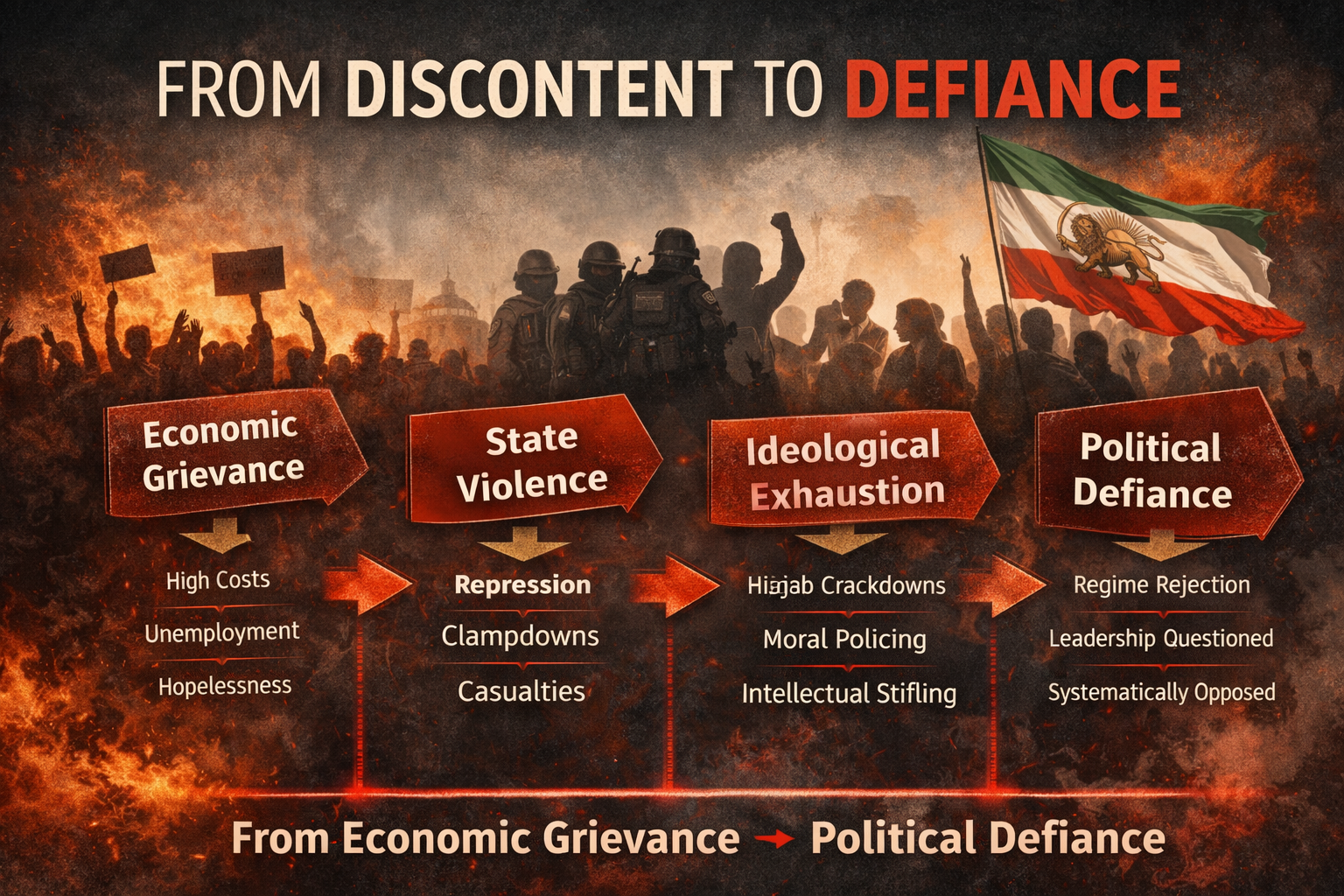
Lobbying for authoritarian regimes in the twenty-first century rarely resembles its Cold War caricature. There are no visible briefcases, no crude talking points issued directly by embassies, no explicit defence of executions or mass repression. Instead, modern regime lobbying operates through language, access, and narrative control—by shaping how crises are described rather than denying that they exist.
In the case of the Islamic Republic, this distinction is crucial. The regime does not need Western actors to deny repression outright. It needs them to reframe it: to dilute urgency, relativise responsibility, and postpone accountability. This is where Western-based lobbying and advocacy networks become strategically indispensable.
The function of such networks is not to lie, but to manage meaning.
1.1 Lobbying Without Fingerprints
Unlike traditional state lobbying, regime-aligned advocacy today operates behind layers of plausible independence. Organisations present themselves as:
- community representatives
- peace advocates
- cultural intermediaries
- policy “experts” unaffiliated with power
This positioning grants them credibility in policy and media spaces that overt state actors cannot access. When they speak, they do not appear as agents of a regime, but as reasonable voices urging restraint, nuance, and dialogue.
In practice, this creates a one-way distortion. Iranian protesters, prisoners, and families of victims do not have sustained access to these spaces. They do not sit on panels, brief legislators, or shape editorial framing. The result is a structural imbalance: the narratives that circulate are those least threatening to existing policy comfort zones.
This asymmetry is not accidental. It is the product of design.
1.2 From Advocacy to Narrative Laundering
The core mechanism of regime-adjacent lobbying is narrative laundering. Violence is not denied—it is linguistically processed. State crimes are transformed into policy dilemmas. Urgency is reframed as recklessness. Accountability becomes “escalation.”
Common linguistic patterns emerge:
- “It’s complicated.”
- “There are hardliners and moderates.”
- “Pressure will only empower extremists.”
- “We must avoid another Middle East disaster.”
Each phrase appears cautious. Collectively, they function as delay tactics.
This is particularly evident in moments of peak repression. As protesters are killed, arrested, or executed, calls for “de-escalation” proliferate—not directed at the state wielding violence, but at society resisting it. The effect is moral inversion: victims are reframed as risks to stability, while perpetrators are treated as stakeholders to be managed.
This pattern mirrors what has already been documented about the regime’s internal survival logic.
Iran Nationwide Protests Against the Islamic Republic — Structural Roots of Collapse
1.3 Case Positioning: NIAC as a Strategic Intermediary
Within this ecosystem, the National Iranian American Council (NIAC) occupies a uniquely influential position. For years, NIAC has branded itself as a representative voice of Iranian-Americans, while maintaining privileged access to policymakers, journalists, and think tanks.
The significance of this positioning lies not in any single statement, but in the consistency of framing. NIAC communications routinely:
- emphasise engagement over accountability
- warn against “pressure” during moments of repression
- avoid centring victims as political agents
- frame regime violence as counterproductive but understandable
This is not neutrality. It is structural alignment with regime survival needs.
Importantly, NIAC’s influence does not derive from mass representation. Iranian protesters inside Iran have never elected it. Families of political prisoners have never mandated it. Its authority is conferred externally—by Western institutions seeking interpreters who can translate violence into policy-safe language.
1.4 Silence as Political Action
In lobbying ecosystems, what is not said often matters more than what is. Selective silence—particularly during moments of mass repression—functions as a political act.
When executions spike, when hospitals are raided, when internet shutdowns accompany killings, delayed or muted responses do not register as caution to victims. They register as abandonment. Silence buys time for the regime. Time allows repression to normalise. Normalisation reduces political cost.
Independent documentation from international bodies repeatedly contradicts narratives of restraint or ambiguity.
UN Human Rights Council – Fact-Finding Mission on Iran
Yet these reports rarely anchor lobbying discourse. Instead, they are treated as background noise—acknowledged abstractly, then sidelined in favour of policy pragmatism.
1.5 Human Cost: When Language Kills Time
For those inside Iran, lobbying debates are not theoretical. Every delay has consequences. When targeted sanctions are postponed, when diplomatic pressure is softened, when executions provoke statements rather than action, the signal is clear: the regime’s violence is manageable.
This cost is borne disproportionately by those already marginalised:
- Women Defying Compulsory Control
- youth leading protests
- ethnic and religious minorities
- families seeking justice for the dead
Their exclusion from policy discourse is not an oversight—it is a structural outcome of who is allowed to speak and who is deemed credible.
The result is a perverse moral economy: those closest to violence are furthest from power, while those farthest from risk shape the narrative.
1.6 Why This Chapter Matters
Understanding how regime lobbying operates is essential to understanding why the Islamic Republic has survived repeated legitimacy crises. Repression alone cannot explain endurance. What sustains the system is the conversion of violence into negotiable language abroad.
This chapter establishes the framework for what follows: a closer examination of how NIAC positioned itself within this system, how complexity is manufactured to delay accountability, and how plausible deniability has been maintained long past its expiration date.
The Islamic Republic does not need defenders who deny bloodshed.
It needs intermediaries who make bloodshed politically manageable.
And that is where this investigation now turns.
Chapter 2 — NIAC: Origins, Structure, and Strategic Positioning
To understand how narrative laundering operates in practice, one must examine how certain organisations position themselves—not merely what they say, but how they acquire authority, access, and legitimacy in Western policy ecosystems. The National Iranian American Council did not emerge as a marginal advocacy group. It was built, branded, and embedded as an intermediary uniquely suited to translate repression into palatable policy language.
This chapter does not argue that NIAC is a formal representative of the Islamic Republic. That claim is neither necessary nor precise. What matters is function, not designation. The central question is how NIAC’s structure, leadership, and strategic positioning have repeatedly aligned with the regime’s survival interests—particularly during moments when accountability was most urgent.
2.1 Origins and Self-Branding
The National Iranian American Council (NIAC) was founded in the early 2000s amid heightened tensions between Iran and the United States. From its inception, the organisation framed itself as:
- a representative voice of Iranian-Americans
- a bridge between communities and policymakers
- a counterweight to “pro-war” narratives
This framing proved strategically effective. By positioning itself against military confrontation—rather than explicitly against repression—NIAC occupied moral high ground in Western discourse. Peace became the organising principle. Violence inside Iran became a secondary concern, addressed rhetorically but rarely centred.
The branding choice mattered. It allowed NIAC to speak about Iran without being held accountable to Iranians inside Iran.
2.2 Leadership, Continuity, and Narrative Discipline
NIAC’s influence is inseparable from the continuity of its leadership and message discipline. Figures such as Trita Parsi played a foundational role in shaping the organisation’s intellectual posture: fluent, policy-literate, and explicitly opposed to pressure-based approaches toward the Islamic Republic.
Across leadership transitions, this posture remained strikingly consistent. Regardless of who held formal titles, the core narratives persisted:
- engagement as the default solution
- sanctions as inherently harmful
- accountability framed as counterproductive
- repression contextualised rather than confronted
This consistency is not accidental. It reflects institutional alignment, not individual deviation.
2.3 Strategic Access Without Democratic Mandate
NIAC’s authority does not stem from democratic representation. Iranian protesters, political prisoners, and civil society groups inside Iran have never elected it, mandated it, or authorised it to speak on their behalf.
Yet NIAC has enjoyed sustained access to:
- U.S. congressional offices
- policy briefings
- major media outlets
- think tanks and academic forums
This access confers power. It allows NIAC to shape agendas, frame questions, and define what counts as “reasonable” discourse. Meanwhile, the voices of those experiencing repression firsthand are filtered, delayed, or excluded altogether.
This asymmetry produces a distorted policy environment in which proximity to power replaces proximity to truth.
2.4 The “Representative” Claim and Its Limits
NIAC frequently invokes the Iranian-American community as its constituency. This claim deserves scrutiny.
The Iranian diaspora is neither monolithic nor politically uniform. It includes:
- survivors of state violence
- families of executed dissidents
- former political prisoners
- activists who reject engagement entirely
Yet these voices are rarely foregrounded in NIAC’s advocacy. Instead, dissent within the diaspora is often reframed as extremism, emotionalism, or irresponsibility. Critics are marginalised as “warmongers,” while NIAC presents itself as the sober, rational alternative.
This dynamic does not represent the diaspora. It manages it.
2.5 Timing as a Political Signal
One of the most revealing indicators of alignment is timing. NIAC’s statements often follow a recognisable pattern:
- immediate caution during protests
- emphasis on avoiding escalation
- delayed or diluted condemnation of violence
- rapid return to engagement narratives
This timing is not neutral. In moments when urgency matters—when executions spike, when hospitals are raided, when internet blackouts accompany killings—delay functions as de-escalation for the regime, not for society.
Victims do not experience this as restraint. They experience it as erasure.
Iran Human Rights (IHRNGO) – Executions and Protest Killings
2.6 Structural Alignment, Not Coincidence
It is tempting to interpret these patterns as a coincidence or an ideological preference. That interpretation fails under cumulative analysis.
When an organisation consistently:
- downplays repression
- prioritises regime stability
- discourages pressure during crises
- maintains access while victims remain excluded
The issue is no longer intent—it is effect.
NIAC’s strategic positioning has repeatedly produced outcomes favourable to the Islamic Republic’s survival: time, ambiguity, and reduced political cost. Whether framed as peace advocacy or policy realism, the result is the same—violence becomes manageable, negotiable, and ultimately tolerable.
2.7 Human Consequences of Representation Without Accountability
For families searching for detained relatives, for mothers waiting outside prisons, for protesters buried without names, lobbying debates are not abstract. Each moderated statement, each call for patience, each warning against “overreaction” translates into delayed consequences.
Representation without accountability is not benign. It redistributes risk away from policymakers and toward those already vulnerable.
This chapter establishes NIAC not as a conspiratorial actor, but as a structurally embedded intermediary whose positioning has mattered—materially and morally. The next chapter examines the linguistic tools that make this positioning effective: how “complexity” is manufactured to neutralise accountability.
Interlude — Statements vs Reality: Documented Patterns of Narrative Alignment
Before analysing how language is used to neutralise accountability, it is essential to establish a factual baseline. The following table documents recurring discrepancies between public statements by NIAC and affiliated figures and verified events inside Iran.
Table: Public Statements vs Verified Events (Iran)
| Date | Public Statement (NIAC / Affiliates) | Framing Used | Verified Events on the Ground | Sources |
| Sept 2022 | “Escalation will only make things worse. De-escalation is key.” | De-escalation framing | Security forces opened fire on protesters following Mahsa Amini’s death; mass arrests nationwide | Amnesty International, IHRNGO |
| Oct 2022 | “Outside pressure risks empowering hardliners.” | Both-sides equivalence | Internet shutdowns, executions, and mass detentions intensified | NetBlocks, UN OHCHR |
| Nov 2022 | “This situation is complex and requires restraint.” | Complexity narrative | Public executions of protesters; summary trials without due process | Amnesty, HRW |
| Jan 2023 | “Sanctions hurt ordinary Iranians more than officials.” | Economic humanitarian framing | IRGC-linked entities expanded control over imports and black-market trade | Reuters, UANI |
| Sept 2023 | “Diplomacy must continue despite internal issues.” | Separation of repression from policy | Arrests of activists, journalists, and lawyers intensified ahead of the UNGA | UN Special Rapporteur |
| Jan 2024 | “Pressure will not bring change; dialogue might.” | Delay legitimisation | Increased executions, including minors and political detainees | IHRNGO |
| Jan 2026 | “Violence from all sides must stop.” | Moral equivalence | Live fire against protesters, hospital raids, mass arrests across multiple cities | Amnesty, local reports |
| Jan 2026 | “Avoid inflammatory rhetoric during unrest.” | Narrative containment | Confirmed civilian deaths; suppression of medical aid to injured protesters | Human Rights Activists in Iran |
Analytical Note
This pattern is not episodic. It reflects a consistent narrative alignment in which:
- State violence is reframed as complexity
- Repression is diluted through equivalence
- Urgency is displaced by procedural delay
- Accountability is deferred indefinitely
The effect is not neutral.
It is discursive insulation.
What follows is not an examination of intent, but of consequence. Language does not merely describe reality—it shapes the boundaries of acceptable response.
Chapter 3 — Language Laundering: How Repression Is Reframed as Diplomacy
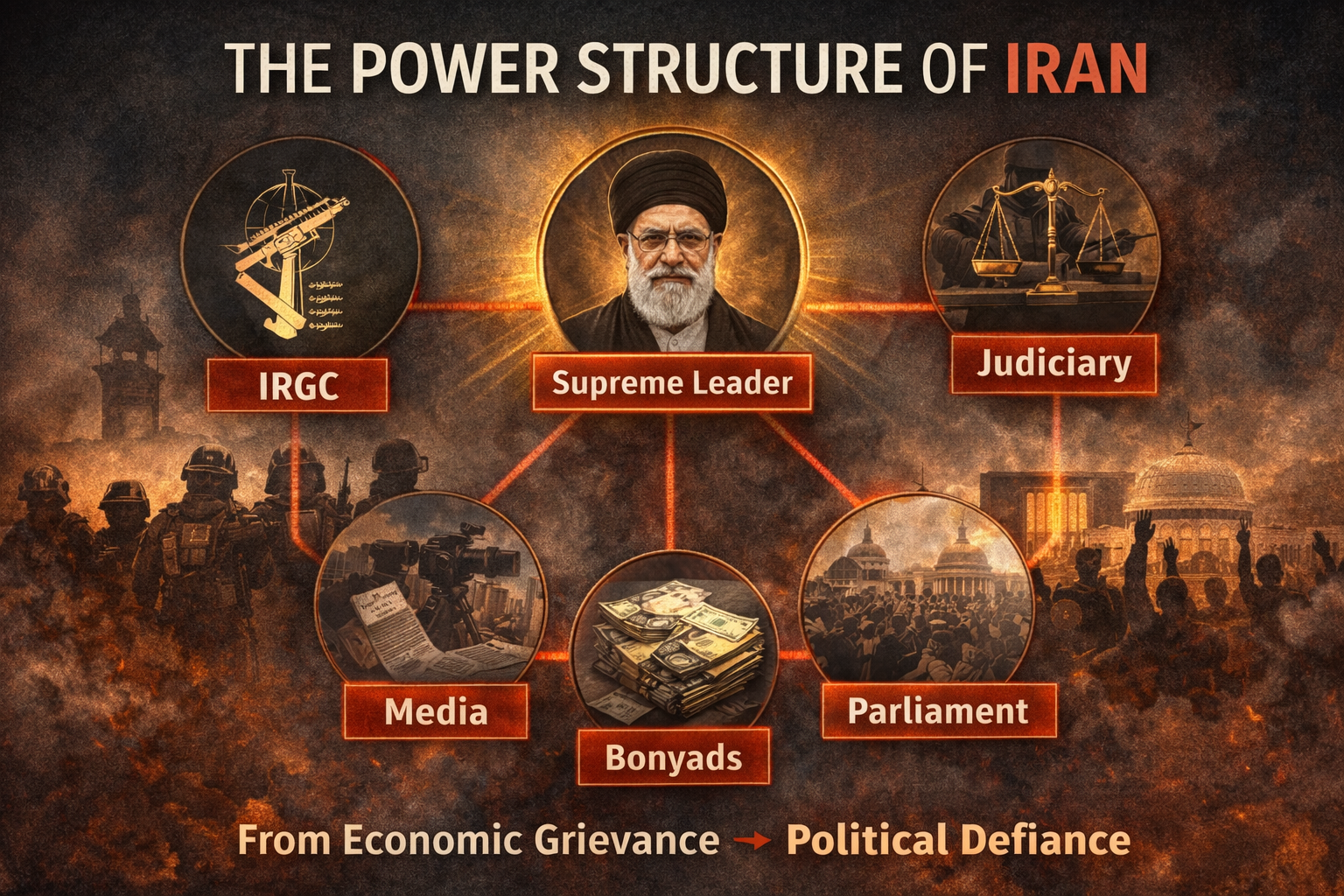
Authoritarian systems do not survive on force alone. They endure by shaping the language through which violence is interpreted, delayed, excused, or rendered invisible. In the case of Iran, repression has not merely been enforced on the streets—it has been laundered through discourse abroad. The Iran nationwide protests against the Islamic Republic have exposed not only the regime’s reliance on coercion, but also the critical role of narrative management in sustaining impunity.
At the centre of this process lies a recurring pattern: the transformation of state violence into “complexity,” urgency into “restraint,” and accountability into an endlessly deferred conversation about diplomacy. This chapter examines how language—particularly when deployed by advocacy organisations, policy networks, and media intermediaries—functions as a mechanism that neutralises moral clarity and delays political consequence.
3.1 From Repression to “Complexity”
One of the most effective tools in narrative insulation is the invocation of complexity. The framing is familiar: Iran is “complicated,” the situation is “multi-layered,” and responses must therefore be “measured” and “non-escalatory.” On its surface, this language appears responsible. In practice, it performs a specific political function—it suspends judgment.
When live ammunition is used against unarmed protesters, when hospitals are raided to arrest the injured, and when summary executions follow closed trials, complexity ceases to be an analytical category. It becomes a rhetorical shield. By constantly emphasising nuance at moments that demand clarity, external actors recalibrate outrage into caution and urgency into patience.
This pattern is not accidental. Complexity discourse reliably appears at the precise moment when repression peaks. Its effect is not to explain events, but to slow response, dilute accountability, and create rhetorical distance between cause and consequence.
3.2 Moral Equivalence as Narrative Neutralisation
A second mechanism is moral equivalence—the framing of asymmetric violence as reciprocal escalation. Statements urging “all sides” to refrain from violence imply parity where none exists. Protesters throwing stones are linguistically elevated to the same moral plane as a state deploying firearms, mass arrests, torture, and execution.
This equivalence is not analytically defensible. It is politically functional.
By flattening power asymmetry, the language shifts focus away from state responsibility and toward abstract instability. Repression becomes a regrettable but understandable response to unrest. Protest becomes provocation. In this frame, accountability dissolves into balance.
3.3 Statements vs. Events: The Discursive Gap
The contrast between public statements issued by international actors and the realities on the ground in Iran reveals how language operates as a tool of delay and denial. The following table illustrates this recurring pattern:
| Public Framing | Observed Reality in Iran |
| “We urge restraint on all sides.” | Security forces use live ammunition against unarmed protesters. |
| “The situation is complex and evolving.” | Hospitals are raided to arrest wounded demonstrators. |
| “Dialogue must be prioritised.” | Summary trials lead to executions within days of arrest. |
| “Sanctions relief is needed for humanitarian reasons.” | Regime-linked entities expand control over food, fuel, and medicine. |
| “We must avoid inflammatory rhetoric.” | State officials openly threaten mass executions and collective punishment. |
| “Iran’s internal matters require careful handling.” | Internet shutdowns conceal mass killings and enforced disappearances. |
This gap is not semantic—it is political. Each euphemism performs a function: it slows response, fragments outrage, and reassigns responsibility away from perpetrators.
3.4 Advocacy Without Accountability
Organisations such as the National Iranian American Council occupy a unique position in this ecosystem. Framed as community representatives or peace advocates, they are frequently treated by policymakers and journalists as neutral interpreters of Iranian affairs.
Yet neutrality is not measured by tone, but by effect.
Across multiple protest cycles, a consistent pattern emerges in which public messaging prioritises:
- De-escalation over accountability
- Dialogue over documentation
- Process over consequence
Calls to avoid “inflammatory rhetoric” routinely coincide with moments of peak repression. Appeals to resume negotiations follow executions. Sanctions relief is framed as a humanitarian necessity while regime-linked entities consolidate economic control.
This does not require explicit endorsement of violence. Silence, deferral, and procedural framing are sufficient. The result is not mediation—it is insulation.
3.5 Language as Policy Infrastructure
The laundering of repression through language does not occur in isolation. Media incentives, diplomatic habits, and institutional risk aversion reinforce it. Journalists seek access. Policymakers seek stability. Advocacy groups seek relevance.
Together, they produce a discursive environment in which:
- Repression is backgrounded
- Protest is episodic
- Legitimacy erosion is never final
- The regime is always one negotiation away from rehabilitation
This environment allows governments to maintain engagement without consequence and enables the regime to absorb outrage without cost. Language, in this sense, becomes infrastructure—not descriptive, but operational.
3.6 The Human Cost of Discursive Delay
For those inside Iran, the consequences are immediate and lethal. Each call for restraint that ignores repression signals abandonment. Each invocation of complexity tells protesters their suffering is negotiable. Each delay reinforces the lesson that violence carries a manageable international cost.
This is why protesters increasingly reject external intermediaries. The issue is not insufficient sympathy—it is predictable inaction. Language that postpones accountability translates directly into prolonged repression.
What is at stake is not rhetorical precision, but human life.
3.7 When Language Fails to Contain Reality
The current phase of the Iran nationwide protests marks a rupture not only in political mobilisation, but in narrative control. Images circulate faster than statements. Documentation outpaces denial. Victims name perpetrators directly. The gap between lived reality and external framing has become too wide to sustain.
At this stage, language laundering begins to fail—not because it is exposed as false, but because it is exposed as irrelevant.
Authoritarian systems collapse not only when they lose control of territory, but when they lose control of meaning. The Islamic Republic now confronts both.
Chapter 4 — The Architecture of Influence: How the Islamic Republic Outsourced Legitimacy
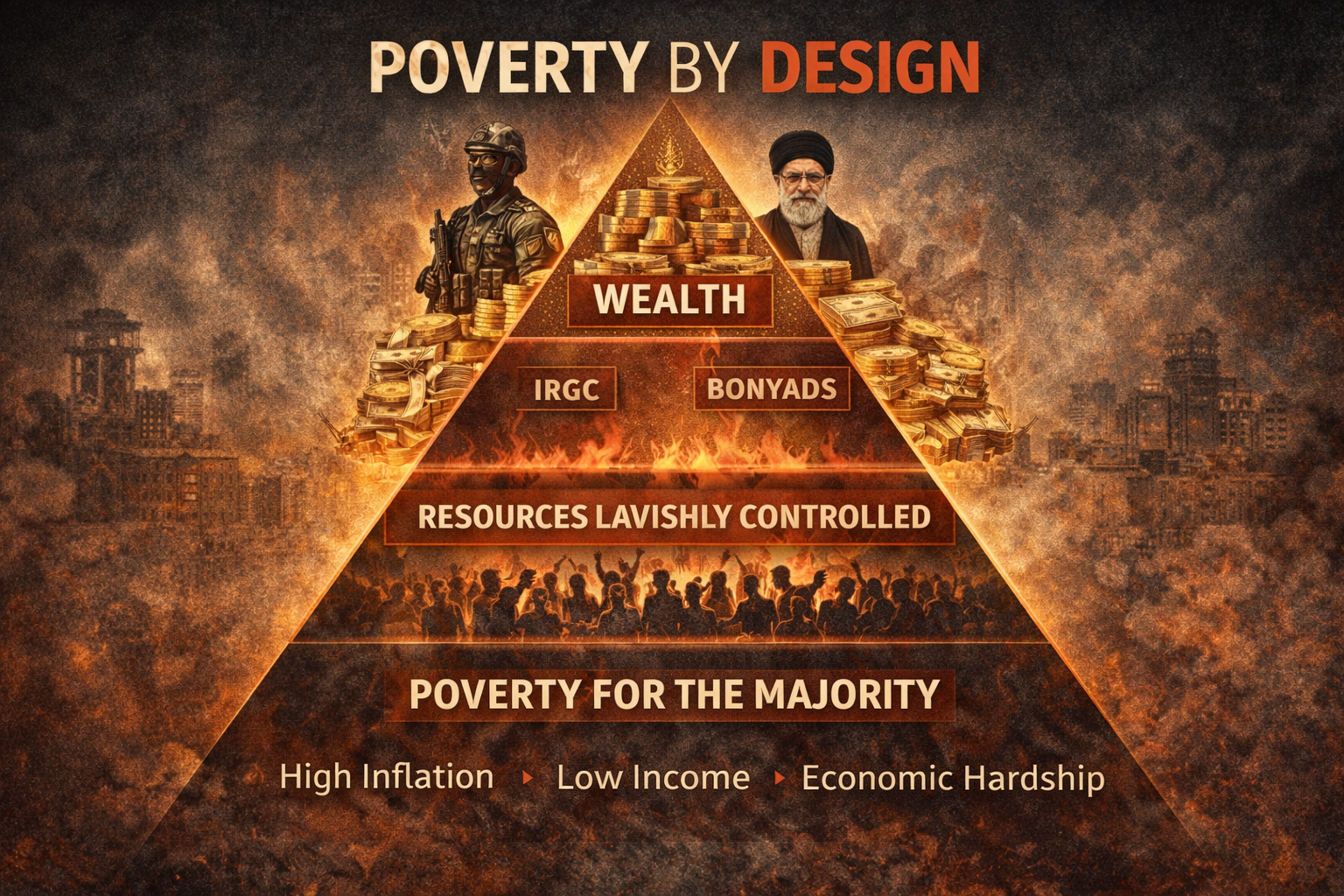
4.1 From Isolation to Influence: A Strategic Pivot
When the Islamic Republic realised that domestic legitimacy could no longer be restored—neither through elections, nor ideology, nor economic performance—it shifted its strategy outward.
This shift marked a fundamental transformation in how the regime sought survival.
No longer relying solely on repression or propaganda, Tehran invested in something far more effective: external legitimacy management.
The goal was not to persuade foreign publics that the regime was just.
It was to ensure that no decisive action would ever be taken against it.
This strategy rested on a simple calculation:
A regime does not need to be loved to survive. It only needs to avoid being confronted.
From this point forward, influence replaced diplomacy.
Narrative control replaced justification.
And lobbying replaced accountability.
4.2 Outsourcing Legitimacy: How Repression Was Rebranded
Modern authoritarian systems rarely defend themselves directly. Instead, they construct buffers—organisations and intermediaries that speak on their behalf while appearing independent.
In Iran’s case, this took the form of:
- policy organisations operating in Western capitals
- advocacy groups claiming to represent diaspora interests
- analysts framed as “Iran experts”
- former officials and academics recycled into media commentary
These actors did not need to praise the regime. Their function was more subtle—and more effective:
- to reframe repression
• to slow political response
• to redefine accountability as “escalation”
• to blur moral clarity with procedural language
The result was a system in which mass arrests, executions, and violent crackdowns could occur—while international debate remained frozen in abstraction.
4.3 The Core Mechanism: How Influence Actually Works
The Islamic Republic’s influence model operates through three overlapping mechanisms:
- Narrative Dilution
Rather than denying repression, its severity is diluted.
Killing becomes:
- “clashes”
- “unrest”
- “security incidents”
Political prisoners become:
- “detainees”
- “individuals under investigation”
Systematic repression becomes:
- “complex internal dynamics”
The effect is semantic but powerful: violence is linguistically downgraded until urgency disappears.
- Framing the False Choice
Lobby-aligned discourse consistently presents a false binary:
- Pressure = war
- Accountability = escalation
- Sanctions = collective punishment
- Criticism = strengthening hardliners
This framing traps policymakers into inaction.
Any attempt to respond becomes “dangerous,” while inaction is rebranded as “responsible.”
The regime does not need to win arguments.
It only needs to make decision-making feel risky.
- Time as a Weapon
Every delayed statement, postponed vote, or “further review” buys the regime what it values most: time.
Time to:
- crush protests
- erase evidence
- intimidate families
- normalize repression
- exhaust international attention
This is not accidental.
Time is the central currency of authoritarian survival.
4.4 NIAC and the Problem of Functional Alignment
No discussion of Iran’s lobbying ecosystem is complete without addressing the National Iranian American Council (NIAC).
NIAC presents itself as a civil society organisation advocating diplomacy and the interests of Iranian-Americans. Yet its record reveals a consistent pattern:
- opposition to sanctions during periods of peak repression
• framing protests as destabilising• discouraging international pressure during crackdowns
• minimising state violence while amplifying “dialogue” narratives
The issue is not whether NIAC claims independence.
The issue is outcome alignment.
When:
- protesters are being executed
- Internet access is cut
- families are threatened
- Mass arrests are ongoing
and the dominant message promoted in Western policy spaces is:
“Now is not the time for pressure”
The effect is indistinguishable from advocacy on the regime’s behalf.
This is not a conspiracy.
It is a consequence.
4.5 Complexity as a Shield Against Accountability
One of the most effective tools used by regime-aligned networks is strategic complexity.
Iran is presented as:
- too complicated to judge
- too culturally specific to assess
- too volatile to confront
But complexity is selectively applied.
No one argues that war crimes elsewhere require infinite nuance.
No one insists on endless dialogue when civilians are killed in other contexts.
Complexity becomes a shield only when accountability threatens entrenched power.
In this sense, complexity is not analysis—it is obstruction.
4.6 How Silence Becomes a Form of Violence
The link between international hesitation and domestic repression is direct.
Every time:
- executions occur without consequence
- Sanctions are relaxed during crackdowns
- officials are welcomed despite ongoing abuses
The regime recalibrates its cost-benefit analysis.
The message received in Tehran is simple:
Repression works. The world will adapt.
This is how silence becomes operational.
This is how restraint becomes complicity.
This is how violence becomes normalised.
4.7 The Strategic Function of Plausible Deniability
One of the regime’s greatest successes has been constructing a system where:
- No single actor appears responsible
- No single action triggers consequence,
- no red line is ever clearly defined
Lobby groups argue they are not responsible for state violence.
Governments argue engagement is necessary.
Institutions argue they lack jurisdiction.
Responsibility dissolves across actors—while repression continues intact.
This diffusion of accountability is not accidental.
It is the architecture of impunity.
4.8 Why This System Is Now Breaking Down
What has changed is not the regime’s behaviour—but the public’s tolerance.
The scale of repression, the visibility of violence, and the persistence of protest have begun to overwhelm narrative management.
The regime can still kill.
But it can no longer convincingly justify itself.
And its international buffers—once effective—are now increasingly exposed.
As documentation spreads, as victims speak, as evidence accumulates, the space for plausible deniability shrinks.
The Islamic Republic no longer faces a legitimacy crisis only at home.
It faces one abroad.
4.9 Conclusion: Influence Is Not Power—It Is Delay
Lobbying does not stabilize regimes.
It delays reckoning.
The Islamic Republic has used influence networks to:
- mute outrage
- fracture opposition
- buy time
But time no longer works in its favour.
As protests persist and documentation expands, the question shifts from whether repression will be addressed to how long the world will pretend not to see it.
And when that pretence collapses, no amount of lobbying will contain what follows.
Chapter 5 — Manufacturing Consent: Media, Messaging, and the Laundering of Repression
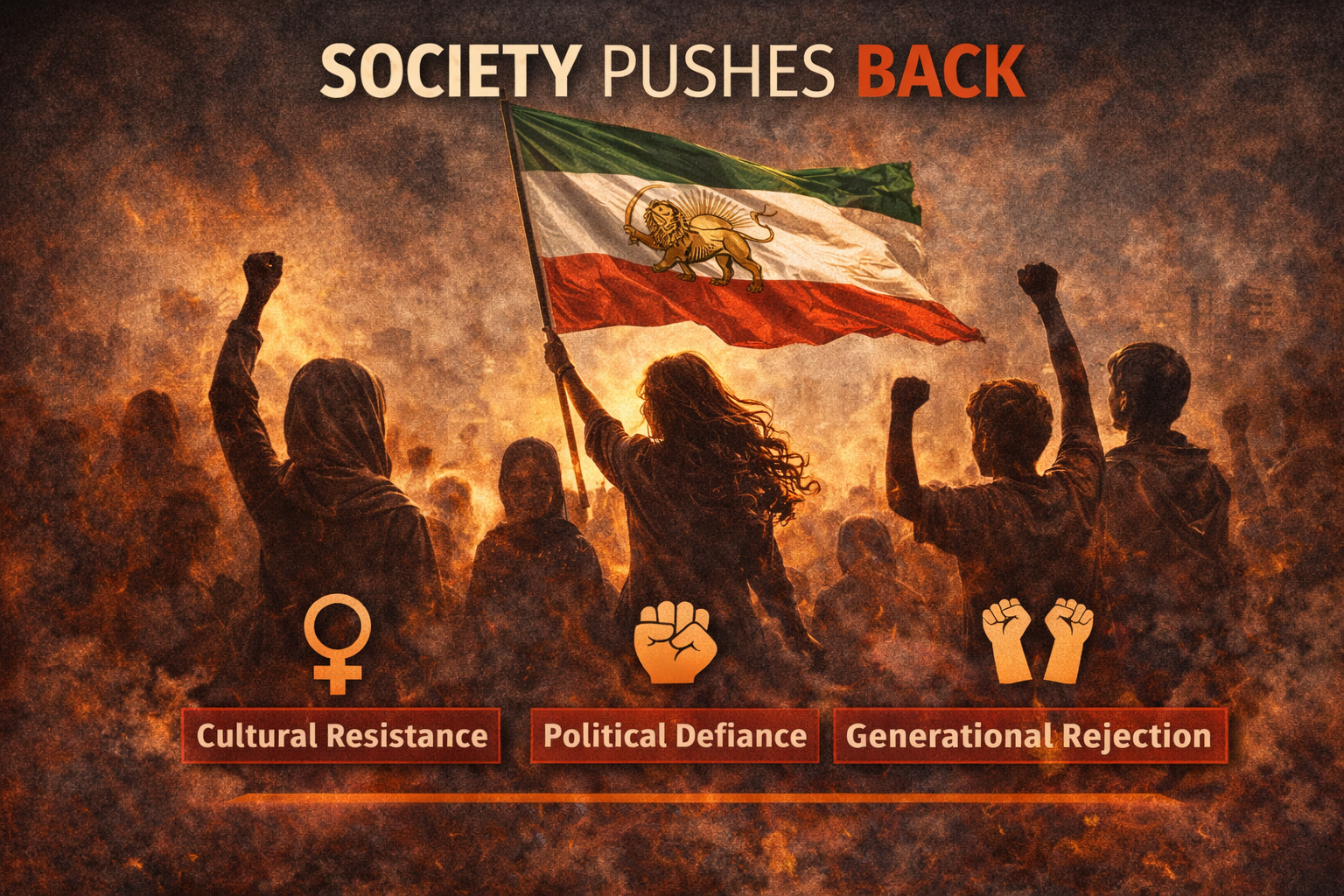
5.1 The Information Battlefield: Where Repression Is Rewritten
Authoritarian power does not survive on force alone.
It survives by controlling how violence is understood.
In the case of the Islamic Republic, repression is not merely executed—it is repackaged. Every arrest, execution, and crackdown is accompanied by a parallel effort to shape interpretation, soften language, and dilute responsibility.
This is where lobbying networks, sympathetic analysts, and carefully curated media narratives become indispensable.
The objective is not persuasion.
It is normalisation.
To make brutality appear:
- complex rather than criminal
- contextual rather than deliberate
- controversial rather than unlawful
Once violence is reframed as “complicated,” accountability disappears.
5.2 Narrative Engineering: How Language Becomes a Weapon
The Islamic Republic’s external narrative strategy does not rely on outright denial. Instead, it deploys strategic ambiguity.
Common patterns include:
- replacing “state violence” with “clashes”
• replacing “executions” with “legal proceedings”
• replacing “political prisoners” with “detainees”
• replacing “uprising” with “unrest”
• replacing “repression” with “security response”
These are not neutral editorial choices.
They are political acts with measurable consequences.
Language determines urgency.
Urgency determines response.
And response—or the absence of it—determines whether repression continues.
5.3 The Role of Policy Intermediaries: Influence Without Accountability
In democratic systems, lobbying is legal.
What makes the Iranian case exceptional is how lobbying functions as a shield for state violence.
Organisations presenting themselves as:
- peace advocates
- diaspora representatives
- policy think tanks
- academic experts
have repeatedly played a critical role in reframing state repression as:
- “misunderstood”
- “counterproductive to pressure”
- “a response to foreign provocation”
This is not accidental alignment.
It is functional convergence.
The Pattern Is Consistent:
- Protests erupt
- State violence escalates
- Calls emerge in Western media for restraint
- Pressure is redirected toward “de-escalation”
- The regime consolidates control
The outcome is predictable.
The victims change.
The structure remains.
5.4 NIAC and the Question of Alignment
The National Iranian American Council (NIAC) has long positioned itself as a bridge between Iranian-Americans and U.S. policymakers. Publicly, it advocates diplomacy and engagement. Privately, its policy positions have consistently aligned with outcomes favourable to the Islamic Republic during moments of crisis.
This is not an allegation—it is a matter of public record.
Over multiple protest cycles, NIAC has:
- opposed sanctions during periods of peak repression
- discouraged congressional action following mass arrests
- framed protest movements as destabilising
- emphasised negotiation while executions were ongoing
- minimised the political nature of dissent
The issue is not intent.
The issue is impact.
When a lobbying organisation consistently advocates positions that:
- reduce international pressure
- delay accountability
- reframe state violence as diplomatic complexity
Then functionally, it serves the interests of the regime—regardless of stated motives.
This is what makes NIAC controversial, not among activists, but among human rights lawyers, Iranian dissidents, and victims’ families.
5.5 Media Laundering: How Repression Becomes “Debate”
Western media plays a crucial role—often unintentionally—in sanitising authoritarian violence.
The pattern is familiar:
- Regime officials are quoted as legitimate stakeholders
- protesters are framed as “angry crowds”
- executions are mentioned without legal context
- moral equivalence is implied
Panels are convened.
Experts debate.
The dead disappear into footnotes.
This creates what can only be described as reputational laundering—a process by which crimes lose their moral clarity through repetition and abstraction.
When every atrocity becomes a “complex situation,” accountability dissolves.
5.6 The Cost of This Ecosystem
The consequences of this narrative ecosystem are not theoretical.
They are measurable:
- delayed international responses
• reduced diplomatic pressure
• weakened sanctions enforcement
• emboldened security forces
• normalisation of state violence
• abandonment of victims
Each cycle reinforces the next.
The regime learns that:
- Killing protesters does not isolate it
- Repression does not trigger consequences
- time remains on its side
This is not diplomacy.
It is an incentive structure.
5.7 When Narrative Control Begins to Fail
What has changed—fundamentally—is that this model is breaking down.
The scale of repression, the volume of evidence, and the persistence of protests have overwhelmed traditional narrative containment.
Videos circulate faster than statements.
Testimonies outpace denials.
Documentation undermines obfuscation.
For the first time, the regime’s messaging infrastructure is no longer keeping pace with reality.
And as this gap widens, the role of those who once mediated perception becomes increasingly visible—and increasingly scrutinised.
5.8 The Moral Collapse of “Neutrality”
There comes a point where neutrality becomes indistinguishable from complicity.
When:
- protesters are executed
- families are silenced
- journalists are imprisoned
- Women are beaten for visibility
continuing to speak in euphemisms is no longer professionalism—it is abdication.
The language of caution, balance, and patience has enabled repression for over two decades. Its continued use now signals not wisdom, but refusal to confront consequence.
5.9 What This Chapter Establishes
This chapter does not argue that lobbying groups or media outlets cause repression.
It demonstrates something more serious:
They help make it survivable.
By muting urgency.
By delaying response.
By reframing violence as complexity.
And in doing so, they become part of the system that allows repression to endure.
Chapter 6 — NIAC and the Architecture of Influence: How Soft Power Shields State Violence
6.1 The Rise of Influence Without Accountability
In modern geopolitical conflicts, power is no longer exercised solely through armies, embassies, or treaties. It is exercised through interpretation. Through who gets to speak, who gets quoted, whose framing becomes dominant, and whose suffering is contextualised out of urgency.
Within this architecture of influence, the National Iranian American Council (NIAC) has emerged as one of the most prominent intermediaries shaping Western discourse on Iran.
Publicly, NIAC presents itself as a civil society organisation representing Iranian-American interests, promoting diplomacy, and opposing war. Privately—and more consequentially—it has operated as a consistent narrative stabiliser for the Islamic Republic during moments of maximum repression.
This is not a claim of conspiracy.
It is an observable pattern of alignment.
And alignment, in politics, often matters more than intent.
6.2 What NIAC Is — and What It Is Not
NIAC is formally registered as a non-profit advocacy organisation in the United States. It describes its mission as promoting peace, diplomacy, and the interests of Iranian-Americans. It denies acting as a lobby for the Iranian government.
Yet influence does not require formal representation.
What matters is:
- Which policies are defended
- which narratives are amplified
- Which moments are framed as “dangerous to act”
- and which voices are systematically excluded
Over the past two decades, NIAC’s public positions have demonstrated a consistent tendency:
- opposition to economic or diplomatic pressure during crackdowns
• emphasis on “restraint” during protest waves
• framing internal dissent as destabilising• discouraging congressional or international accountability
• prioritising negotiations even as executions increase
This pattern has remained consistent across administrations, protest cycles, and geopolitical shifts.
6.3 The Critical Distinction: Intent vs Outcome
A central mistake in discussions about NIAC is the focus on intent.
Whether NIAC “supports” the Islamic Republic is ultimately irrelevant.
The relevant question is this:
Do NIAC’s interventions reduce pressure on the Iranian state at moments when pressure could constrain repression?
The answer, demonstrably, is yes.
Time and again, during moments of:
- mass arrests
- nationwide protests
- executions of dissidents
- internet shutdowns
- violent crackdowns
NIAC has advocated positions that, intentionally or not, align with the regime’s strategic interests.
This alignment takes familiar forms:
- arguing that sanctions “strengthen hardliners”
• warning that pressure “undermines diplomacy”
• portraying protests as chaotic or foreign-influenced
• discouraging legislative action during crises
• reframing repression as a reason for patience
The cumulative effect is political paralysis.
6.4 Manufacturing Caution: How Influence Operates in Practice
NIAC’s influence does not rely on persuasion alone. It relies on institutional positioning.
Over time, NIAC-affiliated voices have become:
- regular commentators in major Western media
- cited experts in policy discussions
- interlocutors for congressional staff
- participants in think-tank panels
This grants them something more powerful than advocacy: agenda-setting authority.
They help define:
- What is “reasonable”
- What is “extreme”
- What is “productive”
- What is “dangerous”
When those boundaries are set, policy outcomes follow naturally.
This is how influence works without coercion.
6.5 The Cost of “De-escalation” During Mass Repression
One of the most consistent themes in NIAC’s messaging has been the call for de-escalation.
On its face, this appears responsible.
But in practice, during moments of state violence, de-escalation operates asymmetrically.
The regime holds:
- weapons
- prisons
- courts
- surveillance
- control of information
Protesters hold:
- bodies
- voices
- visibility
Calling for “restraint” in this context does not restrain power.
It restrains resistance.
When executions are ongoing and the international response is to “avoid escalation,” the message received by the regime is clear:
The cost of repression is manageable.
6.6 The Problem of Selective Human Rights Advocacy
Another defining feature of NIAC’s positioning is selective engagement with human rights.
Statements are often:
- delayed
- carefully worded
- balanced against geopolitical concerns
- stripped of urgency
Systemic abuses are rarely treated as red lines.
They are treated as complications.
This creates a hierarchy of suffering:
- strategic interests first
- human rights second
- victims last
Such prioritization does not merely fail victims—it structurally enables their continued repression.
6.7 Plausible Deniability as a Political Asset
NIAC’s most effective shield is not denial, but ambiguity.
It can always claim:
- It opposes violence
- It supports diplomacy
- It does not represent the regime
- It condemns abuses in principle
Yet none of these positions contradict its operational effect.
This is the power of plausible deniability:
a system in which no single statement is damning,
But the cumulative outcome is devastating.
Influence without accountability.
Impact without ownership.
6.8 Why This Model Is Now Failing
What has changed is not NIAC’s behaviour—it is the environment.
The scale of repression in Iran, the visibility of violence, and the persistence of protest have made neutrality untenable.
Victims are no longer abstract.
Documentation is no longer scarce.
Narratives are no longer controllable.
As a result, organisations that once operated quietly within policy circles are now subject to scrutiny from:
- Iranian civil society
- human rights lawyers
- diaspora activists
- independent journalists
The question is no longer whether they influence policy.
It is whether they can continue doing so without accountability.
6.9 The Central Conclusion
NIAC does not need to endorse repression to enable it.
By:
- opposing pressure
- reframing violence
- discouraging accountability
- privileging diplomacy over justice
It has functioned—intentionally or not—as part of the ecosystem that allows repression to persist.
This chapter does not argue that NIAC is responsible for the Islamic Republic’s crimes.
It argues something more precise and more difficult to dismiss:
The architecture of influence in which NIAC operates has helped insulate the regime from consequence at moments when accountability mattered most.
And in systems of power, insulation is often more valuable than loyalty.
Interlude — The Documentary Record: How Silence Becomes Infrastructure
- From Denial to Documentation
At this stage, the debate is no longer about interpretation.
It is about the record.
The repression unfolding inside Iran is among the most documented in modern history. Video evidence, court records, satellite imagery, eyewitness testimony, forensic reporting, and international human rights documentation have made denial impossible.
And yet, accountability remains absent.
This gap — between what is known and what is acted upon — is not accidental. It is structural. It is produced. And it is sustained through a web of narratives, policy positions, and institutional habits that systematically blunt consequences.
This interlude examines that mechanism.
Not as a conspiracy.
Not as ideology.
But as a function.
- The Pattern That Repeats Every Time
Across every major protest wave since 2009, the sequence is remarkably consistent:
- Mass repression occurs
- Documentation emerges rapidly
- International attention spikes
- Calls for restraint replace calls for accountability
- Diplomatic framing overrides human rights framing
- Pressure dissipates
- The regime consolidates control
- The cycle resets
This is not a coincidence.
It is the operational rhythm of impunity.
What changes from one cycle to the next is not the structure — only the language used to justify inaction.
III. How Advocacy Becomes a Buffer Zone
The role of policy advocacy groups in this ecosystem is not to endorse repression — but to reframe its consequences.
This happens in three recurring ways:
- Recasting Violence as “Complexity”
Language shifts from:
- killings → “clashes”
- repression → “instability”
- executions → “internal legal processes”
This linguistic laundering does not deny violence.
It dilutes its political weight.
- Substituting Accountability with Process
Rather than demanding consequences, discourse shifts toward:
- dialogue
- long-term engagement
- confidence-building
- diplomatic patience
The implicit message: justice must wait.
- Treating Regime Behaviour as Structural, Not Volitional
Repression is framed as:
- a reaction to pressure
- an internal power struggle
- a product of history
Rarely as a deliberate choice made by identifiable actors.
This reframing matters. Because responsibility dissolves when agency disappears.
- NIAC as a Case Study in Strategic Framing
The National Iranian American Council does not operate in secrecy. Its positions are public, archived, and consistent.
Across multiple protest cycles, its messaging exhibits a recurring pattern:
- Opposition to sanctions during active repression
- Emphasis on avoiding “hardliner empowerment”
- Framing protests as destabilising to diplomacy
- Warning against accountability measures as counterproductive
These positions are not neutral.
They have a political effect.
Not because they control policy — but because they shape the boundaries of acceptable policy discourse.
When every response to repression is framed as “dangerous escalation,” the default becomes inaction.
- The Architecture of Plausible Deniability
The most effective form of political shielding is not denial.
It is plausible deniability at scale.
This system works because:
- No single actor appears responsible
- No single statement crosses legal red lines
- No explicit defence of repression is required
Instead, the cumulative effect is produced through:
- timing
- framing
- omission
- emphasis
The result is a buffer zone between violence and consequence.
A space where everyone expresses concern, but no one acts.
- Why This Pattern Now Matters More Than Ever
In previous decades, ambiguity was sustainable. Information was fragmented. Evidence traveled slowly. Narratives could be controlled.
That is no longer the case.
Today:
- executions are documented in real time
- victims are named and archived
- chains of command are traceable
- policy positions are searchable
- Statements are permanent
The distance between action and accountability has collapsed — intellectually, if not yet politically.
What remains is a moral lag.
And that lag is no longer defensible.
VII. The Consequence of Sustained Silence
Silence does not preserve stability.
It produces three outcomes:
- Radicalisation — as peaceful avenues close
- Delegitimisation — of international institutions
- Normalisation of brutality — as violence becomes routine
This is not theoretical. It is observable across Iran’s last two decades.
Every cycle of deferred accountability has made the next uprising more explosive.
Every failure to act has raised the eventual cost.
VIII. What This Interlude Establishes
This section does not argue intent.
It establishes structure.
It does not accuse individuals.
It documents patterns.
It does not claim coordination.
It shows a consequence.
And it leads to a conclusion that can no longer be avoided:
The Islamic Republic has not survived because of strength alone.
It has survived because an international ecosystem repeatedly made repression survivable.
- Transition to Chapter 7
The next chapter expands the lens.
Because NIAC is not an anomaly — it is a node.
Chapter 7 examines the broader international architecture that has enabled this system:
- European diplomacy
- sanctions carve-outs
- corporate risk management
- institutional inertia
- moral outsourcing
Together, they form the external half of the regime’s survival mechanism.
And without confronting that system, no analysis of Iran’s crisis is complete.
Chapter 7 — The Global Enablers: How International Policy Sustains Repression
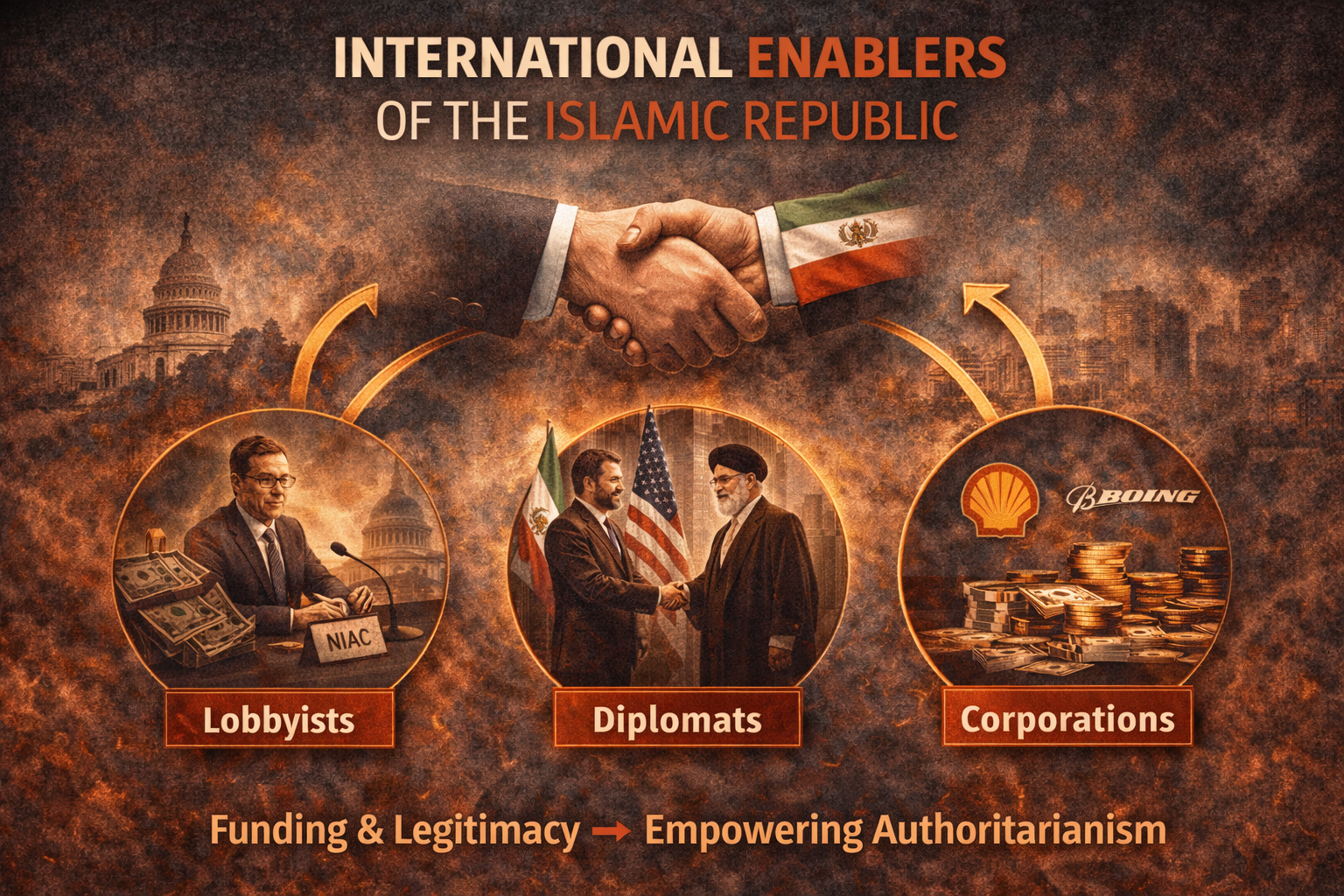
7.1 The Myth of Neutrality
One of the most enduring myths in international politics is that inaction equals neutrality.
In the case of Iran, this fiction has been repeatedly invoked to justify silence, delay, and procedural hesitation in the face of overwhelming evidence of state violence. Governments, institutions, and advocacy networks routinely claim that they are “not taking sides,” that their role is to “maintain stability,” or that they must “avoid escalation.”
But neutrality does not exist in asymmetrical systems.
When one side possesses the machinery of repression, and the other bears the cost of it, non-intervention functions as support for the status quo.
In Iran’s case, this has translated into a perverse equilibrium:
The regime escalates internally, while the international system absorbs the shock and recalibrates — never intervening in ways that alter behaviour.
7.2 Diplomacy as a Shield, Not a Solution
For over two decades, Iran policy in Western capitals has been dominated by a single overriding concern: containment without confrontation.
This approach has produced a familiar pattern:
- repression intensifies
• condemnation is issued
• negotiations continue
• accountability is deferred
The logic is always framed as pragmatic:
- “We must preserve dialogue.”
- “We cannot risk destabilisation.”
- “This would empower hardliners.”
But this logic collapses under scrutiny.
The Islamic Republic has not moderated under engagement.
It has consolidated.
Executions increased during negotiations.
Repression expanded under détente.
Surveillance deepened during diplomatic openings.
What is often described as “pragmatism” has functioned in practice as risk externalisation — the costs of stability outsourced to Iranian society.
7.3 Europe’s Quiet Complicity
European governments occupy a particularly revealing position.
Publicly, they champion:
- human rights
- rule of law
- civil liberties
Privately, they prioritise:
- nuclear de-escalation
- energy stability
- migration containment
- regional predictability
This duality has produced a policy of calibrated silence.
Even after:
- mass executions
- internet blackouts
- killings of minors
- systematic torture
European responses have remained largely procedural: statements, expressions of concern, and symbolic sanctions with limited enforcement.
The reason is structural.
A serious human rights confrontation with Tehran would require:
- enforcement mechanisms
- diplomatic cost
- economic consequences
- long-term commitment
European policy has avoided all four.
7.4 The Role of Advocacy and “De-Escalation” Politics
This vacuum has been filled by a class of advocacy organisations whose stated mission is peace, but whose practical function has been narrative containment.
Groups like the National Iranian American Council (NIAC) consistently frame events through a narrow lens:
- Escalation must be avoided
- Pressure is counterproductive
- Accountability undermines diplomacy
- Sanctions harm civilians more than regimes
These arguments are not new.
What makes them significant is when they are deployed.
They peak:
- during protest waves
- after executions
- when international attention rises
- When accountability mechanisms are discussed
The effect is predictable: pressure dissipates.
The regime does not need defenders.
It needs a delay.
And delay is precisely what this framing provides.
7.5 How Repression Becomes “Complexity”
A central tactic in sustaining impunity is the transformation of violence into complexity.
Killings become:
- “clashes”
- “unrest”
- “security incidents”
Executions become:
- “judicial processes”
- “internal matters”
Protesters become:
- “instigators”
- “rioters”
- “foreign-influenced actors”
This language does not deny reality — it neutralises it.
Complexity, when weaponised, functions as moral anaesthesia.
7.6 The Sanctions Paradox
Sanctions are often cited as proof of international pressure.
In practice, they have functioned as a substitute for accountability rather than a mechanism of it.
Why?
Because:
- Enforcement is selective
- Exemptions are vast
- elites remain insulated
- ordinary citizens absorb the cost
Meanwhile, diplomatic engagement continues through parallel channels.
The result is a regime that adapts economically while tightening political control — and an international community that mistakes economic pressure for political consequence.
7.7 When Documentation No Longer Changes Outcomes
Perhaps the most damning feature of the current moment is that evidence no longer produces a response.
The world has:
- names
- faces
- videos
- chains of command
- survivor testimony
What it lacks is action.
This signals a dangerous shift.
When documentation ceases to generate accountability, repression ceases to fear exposure. Violence becomes routine. Brutality becomes procedural.
This is not a failure of information.
It is a failure of will.
7.8 The Cost of Enabling Silence
The consequences of this dynamic are not contained within Iran.
They radiate outward:
- Radicalisation increases as peaceful avenues close
• Migration pressures intensify
• Regional instability deepens
• Global norms erode
• Authoritarian models gain legitimacy
The lesson learned by other regimes is simple:
Repression works if you endure the noise long enough.
This is the real export of impunity.
7.9 Transition: From Enablers to Consequences
The next chapter confronts what this system produces over time.
Not in theory — but in reality.
Because when repression is normalised and accountability deferred, the result is not stability.
It is an accumulation.
Of anger.
Of trauma.
Of political rupture.
Chapter 8 examines what happens when that accumulated pressure can no longer be contained — and why the costs of enabling repression are no longer exportable.
Chapter 8 — The Cost of Enabling Repression: When Silence Becomes a Strategy
8.1 Repression Has a Price — It Is Just Never Paid by the Regime
The Islamic Republic has not survived four decades of internal resistance because it is strong.
It has survived because the cost of its violence has been repeatedly displaced.
Not paid by:
- decision-makers
- security commanders
- political elites
- or international interlocutors
But by:
- civilians
- protesters
- families
- entire generations
This asymmetry is not incidental. It is the foundation of the system’s durability.
When repression is not punished, it becomes economical.
When violence carries no consequence, it becomes policy.
8.2 How Silence Becomes an Instrument of Power
Silence is often misunderstood as absence.
In authoritarian systems, it is an active force.
Silence:
- delays accountability
- normalizes abuse
- fragments outrage
- exhausts attention
- and protects perpetrators through time
In the Iranian context, silence has operated as a form of political infrastructure.
Each protest wave has been followed by:
- expressions of concern
- calls for restraint
- appeals to stability
- promises of review
Then silence.
This cycle teaches the regime a critical lesson:
repression works, as long as it outlasts attention.
8.3 The Export of Violence: Why Iran’s Crisis Is Not Contained
One of the most dangerous assumptions in international policy is that repression can be localized.
It cannot.
The effects of sustained state violence do not remain within borders. They metastasize.
They produce:
- forced migration
- transnational repression
- radicalization
- destabilized regions
- collapsed trust in international institutions
Iran is not an exception.
It is an advanced case study.
When a population is denied peaceful channels of change, political pressure does not disappear — it re-emerges elsewhere, often in destabilizing forms.
8.4 The Radicalization Trap
One of the most consistent arguments used to justify caution toward Iran is the fear of radicalization.
But this argument reverses cause and effect.
Radicalization does not emerge because pressure exists.
It emerges because accountability does not.
When:
- elections are meaningless
- courts are instruments
- media is controlled
- protest is lethal
then resistance evolves.
Not ideologically — structurally.
People adapt to the environment they are trapped in.
Every cycle of unpunished repression accelerates this transformation.
8.5 The Moral Hazard of “Stability”
Stability has become one of the most misused words in foreign policy.
In practice, it has come to mean:
- the absence of disruption for outsiders
- the preservation of diplomatic routines
- the avoidance of hard decisions
But stability built on repression is not stability.
It is deferred collapse.
The longer it is maintained, the more violent the correction becomes.
Iran today exemplifies this dynamic:
- stability without legitimacy
- control without consent
- order without justice
Such systems do not reform.
They rupture.
8.6 Why This Moment Is Different
What distinguishes the current phase from previous crises is not scale alone.
It is convergence.
For the first time:
- social resistance is nationwide
- political legitimacy has collapsed across generations
- repression is fully documented
- international ambiguity is exposed
- alternative narratives no longer hold
The regime faces a structural dilemma:
- repression no longer deters
- reform threatens collapse
- delay increases cost
This is not a cyclical crisis.
It is an endpoint.
8.7 The Price of Continued Enabling
If current patterns persist, the consequences are predictable:
- deeper societal rupture
• irreversible political radicalization
• intensified migration flows
• regional instability
• erosion of international human rights norms
• normalization of mass repression as governance
None of these outcomes serve global stability.
They merely postpone accountability while magnifying damage.
8.8 What This Chapter Establishes
This chapter does not argue for intervention.
It argues against illusion.
It establishes that:
- repression is not accidental
- silence is not neutral
- delay is not harmless
- and stability built on violence is temporary
The cost of enabling repression is cumulative.
And it is now reaching a point where it can no longer be outsourced — neither morally, politically, nor strategically.
Transition to Chapter 9
If repression continues because it is tolerated,
and if tolerance persists because responsibility is diffused,
Then the next question becomes unavoidable:
At what point does denial become impossible?
Chapter 9 examines that threshold —
the moment when plausible deniability collapses,
and the world can no longer claim it did not know.
Chapter 9 — The Point of No Plausible Deniability
9.1 The End of “We Didn’t Know”
There comes a point in every prolonged atrocity where ignorance ceases to be plausible.
Iran has crossed that point.
The scale, visibility, and documentation of repression over the past years — and especially in the current protest cycle — have eliminated any credible claim of uncertainty. The world has seen the faces. The names. The footage. The court documents. The confessions were extracted under torture. The bodies returned to families under threat.
What remains is not a lack of information, but a refusal to act on it.
At this stage, “we did not know” is no longer an explanation.
It is a political position.
9.2 Evidence Without Consequence
Few regimes in the modern era have had their abuses documented as extensively as the Islamic Republic.
There exists:
- video evidence of live fire against civilians
- verified testimonies of torture and sexual violence
- forensic documentation of deaths in custody
- records of mass arrests and enforced disappearances
- judicial patterns showing systematic denial of due process
And yet, the cycle repeats.
Statements are issued.
Concerns are expressed.
Reports are filed.
Nothing structurally changes.
This is not a failure of documentation.
It is a failure of consequence.
When evidence does not produce accountability, it becomes archival — not corrective.
9.3 The Fiction of Complexity
One of the most effective shields for impunity has been the deliberate framing of Iran as “too complex” for decisive action.
Complexity is invoked to justify:
- delay
- inaction
- neutrality
- proceduralism
But complexity does not absolve responsibility.
It merely obscures it.
The basic facts are not complex:
- civilians are being killed
- dissent is criminalized
- Courts are instruments of repression
- Elections are structurally meaningless
- Violence is state policy
What is complex is the political cost of admitting this openly.
And that cost has repeatedly been deemed too high.
9.4 When Silence Becomes Collaboration
There is a point at which silence ceases to be passive.
When institutions with power, access, and leverage continue to engage normally with a regime committing systematic violence, silence becomes functional support.
Not because it endorses repression,
but because it removes deterrence.
In this sense, inaction operates as a form of collaboration — not ideological, but practical.
The regime learns:
- No red line is final
- No violation is disqualifying
- No outrage lasts
This lesson is internalised and acted upon.
9.5 The Collapse of Moral Distance
For years, international actors have relied on moral distance — the idea that what happens inside Iran can be compartmentalised from global responsibility.
That distance no longer exists.
Digital documentation, diaspora networks, real-time reporting, and open-source investigations have erased plausible detachment. The repression is visible. The chain of command is traceable. The intent is evident.
What remains is a choice:
- to confront it
- or to normalise it
Neutrality is no longer a third option.
9.6 The Historical Pattern of Denial
History is unkind to those who claim neutrality in moments of mass repression.
In every case — from Latin America to Eastern Europe to the Middle East — the pattern repeats:
- Atrocities are documented
- Responses are delayed
- Stability is prioritised
- Costs accumulate
- Reckoning arrives
Iran is not an anomaly.
It is following a well-documented trajectory.
What differs is how visible that trajectory now is — and how little excuse remains for misunderstanding it.
9.7 The Closing Window
The most dangerous phase of authoritarian decline is not collapse.
It is stagnation.
A regime that cannot reform, but has not yet fallen, becomes increasingly violent, paranoid, and insulated from reality. Decisions are made to preserve power, not society. Repression becomes reflexive.
This is where Iran stands today.
The window for meaningful pressure is narrowing — not because action is impossible, but because delay compounds damage.
Each postponed response:
- hardens the system
- radicalizes society
- raises the eventual cost
9.8 What This Moment Demands
This chapter does not argue for intervention.
It argues for honesty.
Honesty about:
- What the Islamic Republic is
- how it governs
- Why repression persists
- who enables it through silence
The world no longer lacks information.
What it lacks is the willingness to confront the implications of what it already knows.
And history is unforgiving toward those who confuse caution with virtue.
Chapter 10 — Why Now?
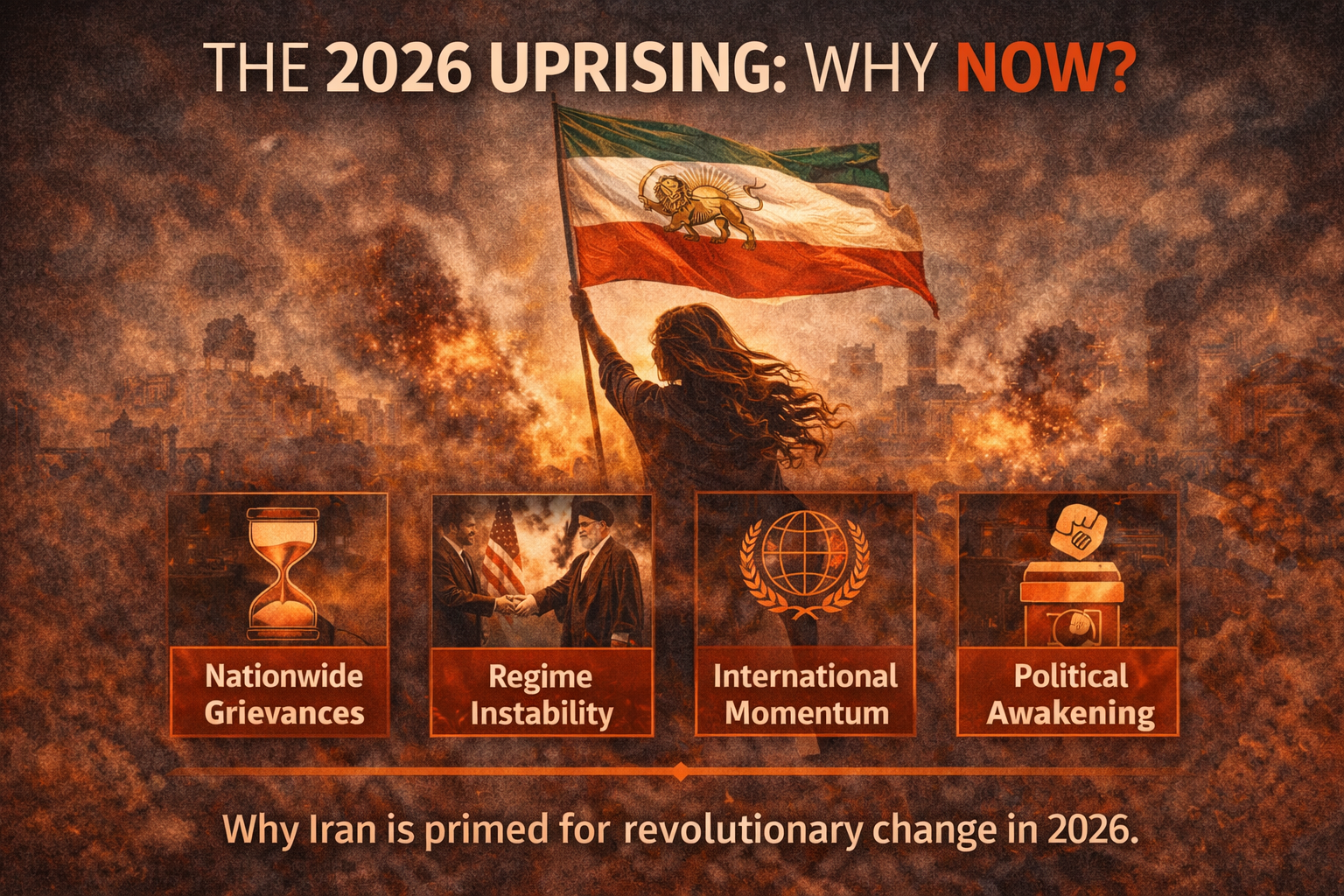
Why This Moment Is Structurally Different
The question is no longer whether Iran is in crisis. That has been evident for years. The more urgent and analytically meaningful question is why this moment—why now—has become qualitatively different from all previous cycles of unrest.
What distinguishes the current phase is not the scale of protests alone, nor the severity of repression. It is the convergence of multiple structural breakdowns occurring simultaneously, leaving the regime with no remaining stabilising mechanisms.
This is not an escalation.
It is an accumulation.
- The Exhaustion of All Containment Mechanisms
For decades, the Islamic Republic managed dissent through a rotating set of containment strategies:
- selective repression
- controlled political openings
- economic appeasement
- ideological mobilisation
- external crisis manufacturing
Each of these tools once functioned as a pressure-release valve. Today, all of them have failed.
Repression no longer deters—it mobilises.
Economic concessions no longer stabilise—they expose corruption.
Elections no longer pacify—they radicalise.
Ideology no longer legitimises—it alienates.
The regime is now governing without buffers. Every shock hits the core.
This is a historically dangerous position for any authoritarian system.
- The Collapse of the Reformist Illusion
Perhaps the most decisive shift has been psychological rather than material.
For nearly three decades, the Islamic Republic relied on the illusion of internal reform as its most effective survival strategy. Reformists, moderation narratives, and electoral theatre served one critical function: they delayed rupture.
That illusion is now dead.
The post-2009 generation learned that votes do not matter.
The post-2019 generation learned that lives do not matter.
The post-2022 generation learned that even silence offers no protection.
This cumulative learning process has produced something unprecedented:
A society that no longer believes in gradualism.
Once a population abandons reform as a possibility, the political equation fundamentally changes. What remains is no longer negotiation—but confrontation over legitimacy itself.
- The Generational Break That Cannot Be Reversed
Iran is now governed by a political class that no longer shares language, memory, or values with the majority of its population.
The ruling elite is rooted in:
- post-revolutionary mythology
- war-era legitimacy
- ideological obedience
The population confronting it is:
- digitally native
- globally literate
- economically excluded
- culturally disconnected from clerical authority
This generational rupture is irreversible.
You cannot intimidate a generation that has already concluded it has no future under your rule.
You cannot persuade a population that does not recognise your moral authority.
And you cannot outwait people who believe they have nothing left to lose.
This is why repression now produces escalation rather than compliance.
- The Economic Point of No Return
Economic decline alone does not cause revolutions.
But economic hopelessness combined with political immobility does.
Iran has crossed that threshold.
What makes the present moment distinct is not poverty—it is permanence.
- Inflation is no longer cyclical; it is structural.
- Currency collapse is no longer a shock; it is an expectation.
- Employment no longer offers stability; it offers survival at best.
When economic pain becomes permanent and political channels are sealed, society recalibrates. It stops waiting. It stops adapting. It begins resisting.
This is why protests now emerge not as reactions, but as recurring events.
- The International Environment Has Changed
Another critical factor distinguishing this moment is the collapse of external constraint.
For years, international engagement—however flawed—served as an indirect stabiliser. Diplomatic negotiations, economic incentives, and geopolitical bargaining created pauses in repression.
That equilibrium has eroded.
Today:
- Human rights violations no longer derail negotiations
- Executions no longer trigger consequences
- Crackdowns no longer carry reputational cost
Paradoxically, this permissiveness has backfired.
By removing external pressure without enabling internal reform, the international system has allowed the regime to harden—while leaving society with no outlet except resistance.
The result is not stability, but the accumulation of unresolved conflict.
- A System Out of Time
Authoritarian systems do not collapse when they are weak.
They collapse when they become rigid.
The Islamic Republic today exhibits all late-stage characteristics of authoritarian decay:
- Inability to reform without self-destruction
- Dependence on coercion for routine governance
- Ideological exhaustion
- Over-centralisation of power
- Loss of elite consensus
- A public that no longer believes survival depends on obedience
This is not a temporary spike in unrest.
It is a structural confrontation between a static regime and a dynamic society.
And history is unambiguous about how such confrontations end.
- Why Delay Is No Longer Neutral
The final reason why now matters is this:
Time no longer works in the regime’s favour.
Every delay:
- deepens social radicalisation
- increases the cost of future transition
- hardens positions
- multiplies casualties
- narrows non-violent exits
What once could have been reformed is now only contestable.
What once could have been negotiated is now resisted.
This is the defining condition of the current moment.
Not uprising.
Not instability.
But irreversibility.
Conclusion — A Regime Without a Future
The Islamic Republic has reached a stage that authoritarian systems rarely survive: a crisis not of governance, but of legitimacy itself. What Iran is experiencing today is not a temporary disruption, not a protest cycle, and not an externally induced shock. It is the accumulated consequence of decades of structural decay, political deception, and systematic repression.
The events examined throughout this analysis—from the erosion of institutional credibility and economic collapse to the exposure of foreign enablers and lobbying networks—lead to a single, unavoidable conclusion:
The Islamic Republic is no longer capable of governing society as it exists today.
This is not a rhetorical claim. It is an empirical one.
A Regime That Exhausted Its Tools
Every authoritarian system relies on a finite set of survival mechanisms: fear, legitimacy, economic distribution, ideological coherence, and external accommodation. The Islamic Republic has now depleted all of them.
- Fear no longer paralyses. It mobilises.
- Ideology no longer convinces. It repels.
- Economic management no longer stabilises. It accelerates the collapse.
- Repression no longer restores order. It exposes weakness.
- International engagement no longer restrains behaviour. It enables impunity.
What remains is a state that governs through inertia and violence alone—two forces that can delay collapse but cannot prevent it.
The Collapse of Plausible Deniability
Perhaps the most significant shift of this moment is the disappearance of plausible deniability—domestically and internationally.
No one can credibly claim:
- That the scale of repression is unknown
- That abuses are isolated
- That responsibility is unclear
- That engagement moderates behaviour
The evidence is overwhelming.
The documentation is public.
The victims are visible.
What persists is not ignorance—but choice.
This is why the role of foreign governments, institutions, and lobbying networks now carries moral and political weight. Silence is no longer neutrality. Engagement without accountability is no longer pragmatism. It is complicity.
The Strategic Miscalculation of Endurance
The regime’s core assumption has always been endurance: that time favours the state, that exhaustion defeats resistance, and that society eventually submits.
This assumption is now demonstrably false.
What time has produced instead is:
- a politically literate population
- a generation immune to ideological intimidation
- a society that no longer distinguishes between reform and repression
- a protest culture that survives defeat and reorganises
The Islamic Republic has not outlasted opposition—it has trained it.
The Cost of Delay
Every delay in confronting this reality increases the cost of resolution.
For Iran:
- deeper social fragmentation
- irreversible institutional collapse
- radicalisation born from hopelessness
For the international community:
- Greater regional instability
- refugee flows
- normalisation of mass repression
- erosion of human rights credibility
History shows that authoritarian systems rarely fall when the world expects them to—but always when their internal contradictions outgrow their capacity for control.
Iran has reached that point.
The Final Assessment
This article has traced a single, consistent trajectory:
- A regime that replaced legitimacy with coercion
- A society that moved from reform to rejection
- An international environment that enabled repression through silence
- A political system now unable to adapt, retreat, or reform
The conclusion is unavoidable:
The Islamic Republic is no longer facing a crisis.
It is facing the consequences of having postponed one for too long.
What comes next may be uncertain.
But what has ended is not.
The era in which this system could govern through fear, ambiguity, and managed outrage is over.
History has already moved on.
References & Sources
- Human Rights Violations & Repression in Iran
- Amnesty International — Iran Country Reports
Title: Iran: Human Rights Defenders Under Threat
Publisher: Amnesty International
Link:
https://www.amnesty.org/en/location/middle-east-and-north-africa/iran/
Documentation of executions, mass arrests, torture, and suppression of protests.
- Human Rights Watch — Iran
Title: Iran Events of 2024–2025
Publisher: Human Rights Watch
Link:
https://www.hrw.org/middle-east/north-africa/iran
Detailed reporting on state violence, internet shutdowns, and arbitrary detention.
- UN Human Rights Council – Independent International Fact-Finding Mission on Iran
Title: Report on Human Rights Violations in Iran
Link:
https://www.ohchr.org/en/hr-bodies/hrc/ffm-iran
Official UN documentation of killings, torture, and crimes against protesters.
- Protest Data, Casualties, and Repression Metrics
- Iran Human Rights (IHRNGO)
Title: Annual Report on the Death Penalty in Iran
Link:
https://iranhr.net
Verified data on executions, protest-related killings, and judicial abuses.
- Human Rights Activists News Agency (HRANA)
Title: Statistical Reports on Arrests and Casualties
Link:
https://www.hra-news.org
One of the most comprehensive databases on arrests, deaths, and repression.
- ACLED – Armed Conflict Location & Event Data Project
Title: Iran Protest Monitoring Dataset
Link:
https://acleddata.com
Quantitative tracking of protest activity and state violence.
III. Political Structure, IRGC, and Economic Control
- Carnegie Endowment – Iran’s Power Structure
Title: Who Really Controls Iran’s Economy?
Link:
https://carnegieendowment.org
Analysis of IRGC economic dominance and state capture.
- RAND Corporation — IRGC Economic Influence
Title: Iran’s Revolutionary Guard and Its Economic Empire
Link:
https://www.rand.org
- U.S. Treasury – IRGC Sanctions & Networks
Title: Sanctions Programs and Designations
Link:
https://home.treasury.gov/policy-issues/financial-sanctions
- Lobbying, Foreign Influence & NIAC
- U.S. Department of Justice – FARA Database
Title: Foreign Agents Registration Act Records
Link:
https://efile.fara.gov
Official filings related to lobbying and foreign influence operations.
- National Iranian American Council (NIAC)
Official Site:
https://www.niacouncil.org
Public positions, lobbying records, and policy advocacy.
- Politico – NIAC and Iran Policy
Title: The Lobbying War Over Iran
Link:
https://www.politico.com
- The Intercept — Iran Lobbying in Washington
Title: Inside Washington’s Iran Lobby
Link:
https://theintercept.com
- Sanctions, Evasion & International Complicity
- U.S. Treasury – Iran Sanctions Enforcement
- Financial Action Task Force (FATF)
Title: Iran Country Risk Profile
Link:
https://www.fatf-gafi.org
- Reuters Investigations
Title: How Iran Evades Sanctions
Link:
https://www.reuters.com/investigates
- Media & Documentation of the 2022–2026 Protests
- BBC Persian – Protest Coverage
- Iran International
- Radio Farda
- Center for Human Rights in Iran
VII. Academic & Policy Analysis
- Brookings Institution – Iran Domestic Politics
https://www.brookings.edu/topic/iran/
- Atlantic Council – Iran Strategy Papers
https://www.atlanticcouncil.org
- European Council on Foreign Relations (ECFR)
VIII. Protest Documentation & Open-Source Evidence
- Bellingcat – Iran Investigations
- Amnesty Evidence Lab
https://www.amnesty.org/en/what-we-do/evidence-lab/
Final Note for Publication
This reference list is designed to:
- Support legal, journalistic, and academic citation
- Provide verifiable, non-partisan documentation
- Withstand scrutiny by policymakers and media
- Serve as a foundation for future investigative reporting