
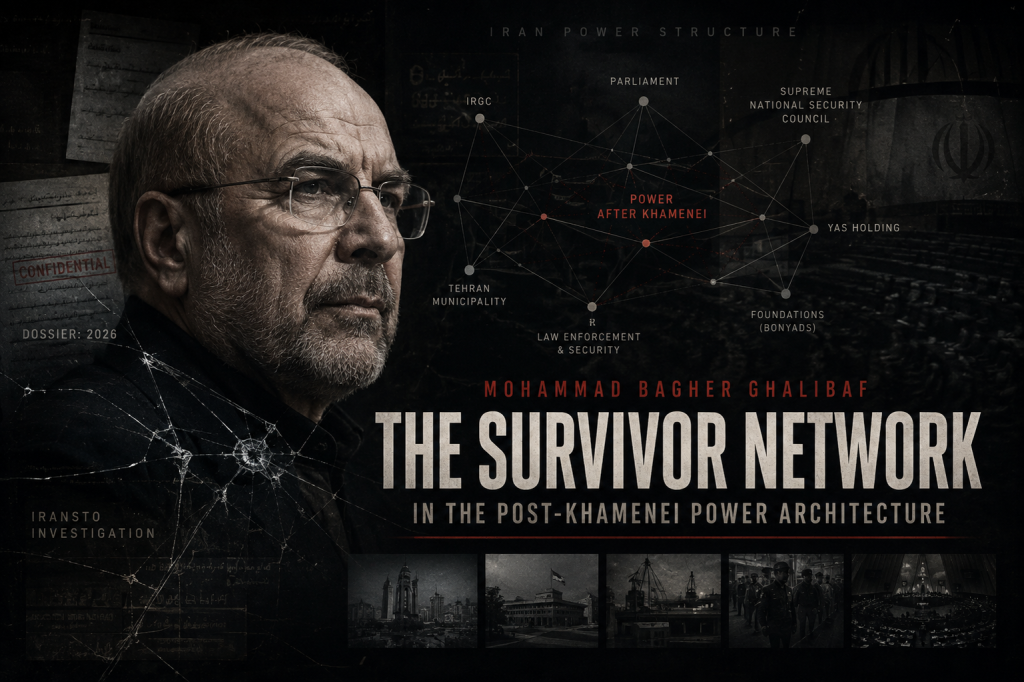
Introduction: The Man Who Survived the System
Any serious attempt to map the Mohammad Bagher Ghalibaf power network has to begin with a problem that conventional factional analysis cannot explain. There is no formal organisation carrying his name, no stable military bloc publicly answerable to him and no evidence that the senior commanders, security officials and political operators who repeatedly appear around him take instructions from the Speaker of Parliament. Yet when the 28 February 2026 leadership strikes tore through the upper ranks of the Islamic regime, killing or removing figures across its political and military hierarchy, Ghalibaf emerged in a stronger relative position. The constitutional powers of the Speaker do not explain why.
His survival immediately raised the harder question. The strikes exposed intelligence penetration at a level that should have been extraordinarily difficult inside a system built around concealed movements, protected communications, compartmentalised schedules and overlapping security controls. Senior figures were eliminated in circumstances that inevitably placed scrutiny on those who survived and then benefited from the collapse. IranSTO therefore examined whether Ghalibaf had received advance warning, deliberately avoided a gathering he knew would be attacked or maintained some connection to the penetration that made the operation possible. The available public evidence establishes none of those claims. No reliable record reviewed for this investigation places him on a confirmed attendance list for a targeted meeting, documents an unexplained last-minute cancellation or connects him to the intelligence channels behind the strikes. If new evidence emerges, those possibilities should be reopened without hesitation. Until then, survival and political benefit cannot be manufactured into proof of foreknowledge.
The more defensible explanation for Ghalibaf’s survival as a power centre was built over roughly four decades. His earliest durable relationships emerged inside the Islamic Revolutionary Guard Corps (IRGC) and the Iran-Iraq War, where he belonged to a generation of commanders from Khorasan who later dispersed through the armed forces and security establishment. Command of the national police gave him something different: direct authority over careers inside one of the regime’s principal coercive institutions. Tehran Municipality then placed resources on a scale unavailable in either environment under his political administration, including land, municipal companies, infrastructure contracts, development rights, public finance and a patronage system centred on the capital. Each stage added a different layer of access, and each allowed relationships to survive after the formal office itself was gone.
The Yas Holding affair, centred on financial arrangements linking Tehran Municipality to the IRGC Cooperative Foundation and associated economic structures, exposed how those separate worlds could converge. Senior municipal officials, managers inside the Guard’s economic apparatus, financial operators, security figures and military commanders became entangled in a scandal involving public assets and major financial transactions. Criminal convictions later established serious financial wrongdoing inside the system. The leaked internal material surrounding Yas was politically even more revealing because it showed senior security and military figures becoming involved once the conflict moved beyond the defendants who eventually went to prison. A financial scandal originating around municipal and IRGC economic structures had reached actors close enough to the leadership to affect how far the investigation could travel, who would be protected and how much institutional damage the regime was prepared to absorb.
That episode is central to understanding Ghalibaf because his durability was never produced solely through elections, parliamentary manoeuvring or ideological alignment. It developed inside a state in which military, economic, security and political institutions routinely overlap while retaining separate legal identities and chains of authority. IranSTO’s previous investigation into the security architecture surrounding the Office of the Supreme Leader documented how Ali Khamenei’s system relied on precisely this mixture of formal institutions and personal channels. Ghalibaf was never a permanent operator inside the Office and did not possess the privileged bureaucratic position of its senior intermediaries. His route to power was more dispersed. He moved through separate institutions, exploited the authority available in each one and preserved relationships after his formal control had ended.
The destruction of the old leadership on 28 February made that accumulated access considerably more valuable. The strikes did not simply create vacancies at the top of the regime. They killed people who had spent years carrying decisions, instructions and political bargains between the Supreme Leader, military commands, security organisations and the formal machinery of government. The problem confronting Mojtaba Khamenei’s post-succession command structure was therefore much larger than replacing one Supreme Leader with another. A damaged authoritarian state had to reconnect institutions whose established intermediaries had been killed, displaced or weakened while simultaneously maintaining military cohesion, internal security and political continuity.
Ghalibaf entered that crisis with relationships accumulated long before anyone could have anticipated the circumstances in which they would become useful. Ali Abdollahi had served for years as his deputy in Law Enforcement before building an independent career deep inside the Armed Forces General Staff. Jamaleddin Aberoumand moved from the IRGC financial environment exposed through Yas into Ghalibaf’s parliamentary structure and later into national development coordination. Esmail Qaani belonged to the Khorasan military environment in which Ghalibaf’s wartime relationships were formed and retained his own authority through the Quds Force. Hossein Taeb, whose power came from the security apparatus surrounding the Khamenei leadership rather than from Ghalibaf, nevertheless appears in the Yas record as an interventionist during one of the most dangerous internal crises of Ghalibaf’s municipal career.
Treating these men as members of a personal Ghalibaf faction would make the story simpler and the investigation weaker. Their political importance lies precisely in the fact that their careers developed beyond his control. A conventional patronage machine is vulnerable when its members depend on one patron for office, money and protection. Ghalibaf’s network became harder to dismantle because many of its most important relationships were embedded inside institutions with independent command structures. The individuals involved could disagree with him, pursue their own ambitions and remain loyal to other centres of power while still preserving channels created through wartime service, professional command, institutional cooperation or political bargaining.
Parliament added another layer to that architecture. As Speaker, Ghalibaf acquired a central position in legislation, national budgeting, ministerial bargaining and the constant competition among MPs for provincial resources. Development mechanisms involving ministries, governors, parliamentary representatives and IRGC-linked implementing bodies created a political marketplace in which access could be converted into leverage without requiring personal ownership of the money or operational command of the organisation carrying out the work. This distinction runs through the entire investigation. Ghalibaf’s reach is substantial, but access is not ownership, influence is not command and a usable relationship is not proof of personal loyalty.
This first part of IranSTO’s investigation reconstructs those overlapping networks as a political file rather than a conventional biography. It follows Ghalibaf from the wartime IRGC into the national police, Tehran Municipality, the Yas financial scandal, security protection channels, Parliament, provincial resource structures and the surviving military establishment. It also examines the intelligence questions surrounding 28 February and the rapid expansion of his political role after the strikes. The purpose is neither to inflate every historical acquaintance into a conspiracy nor to sanitise connections simply because their full legal significance remains unresolved. The task is to establish what can be documented, identify where relationships carried political value, distinguish protection from command and leave the gaps open where the public record still cannot support a definitive finding.
What emerges is not an all-powerful hidden ruler and not an ordinary parliamentary politician. Ghalibaf does not control every institution he can reach, and several of the most powerful figures around him possess enough independent authority to resist, bypass or outmanoeuvre him. That limitation has not made the network insignificant. After the regime lost a large number of established intermediaries on 28 February, the ability to reach several surviving centres of power became more valuable precisely because those centres no longer fitted together as smoothly as they had before. Ghalibaf entered the resulting disorder with Parliament intact, old military relationships still usable, security connections accumulated over decades and a long record of operating where state resources, coercive institutions and political bargaining intersected. This investigation asks how those connections were built, what they actually allow him to do and why so much of that architecture remained standing when the hierarchy around it was torn apart.
Chapter 1: The Network Was Built Before Politics
Mohammad Bagher Ghalibaf entered national politics with relationships that were already decades old. Their origins lay inside the Islamic Revolutionary Guard Corps during the Iran-Iraq War, long before Parliament, Tehran Municipality or any recognisable electoral faction became relevant to his career. Ghalibaf rose through the wartime command structure and eventually commanded the 5th Nasr Division, a formation rooted in Khorasan and associated with officers who would later occupy senior positions across the military and security establishment. The significance of that period is not simply biographical. It placed him inside a generation whose members would spend the following decades carrying wartime relationships into institutions that increasingly dominated the Islamic regime.
Qasem Soleimani and Esmail Qaani belonged to that wider environment, although neither can credibly be described as a subordinate who later rose because of Ghalibaf. Their careers developed on independent tracks and ultimately carried both men into the Quds Force, one of the most powerful components of the IRGC. Soleimani accumulated direct access to Ali Khamenei and became a military and political operator whose influence extended far beyond the formal boundaries of his command. Qaani remained within the armed establishment and eventually succeeded him. By the time Ghalibaf was competing for national political office, neither man needed his patronage, protection or approval. That independence is central to understanding why the wartime network later mattered.
The Iran-Iraq War produced a cohort of officers who had known one another before the institutions, titles and political alignments that later defined them existed. Over subsequent decades they dispersed through the IRGC, intelligence bodies, security organisations, ministries, economic foundations and other parts of the state. Their interests frequently diverged. Some competed for influence, some attached themselves more closely to the Supreme Leader’s Office, and others developed institutional loyalties that placed them in conflict with former comrades. None of this erased the personal history accumulated in war. The result was a web of relationships that survived changes of office and political alignment because it had been formed before many of those later divisions existed.
Ghalibaf’s connection with Soleimani provides an early example of how such relationships could retain political value without creating a formal chain of command. By the 2010s, Soleimani’s institutional weight was considerably greater than anything Ghalibaf possessed through electoral politics or Tehran Municipality. He commanded the Quds Force, dealt directly with Khamenei and operated across foreign, military and security theatres in which the mayor of Tehran had no authority. Yet the relationship between the two remained active. Soleimani publicly supported Ghalibaf at politically important moments and later became involved in the internal bargaining surrounding the Yas affair, when a financial conflict involving Tehran Municipality and the IRGC’s economic structures escalated far beyond an ordinary dispute over contracts or municipal assets.
That intervention matters because it demonstrates how an old military relationship could become operationally relevant inside an entirely different institutional conflict. Soleimani did not intervene because Ghalibaf commanded him or because the Quds Force sat inside a Ghalibaf faction. He entered a crisis involving a former wartime associate whose municipal administration had become entangled with powerful IRGC economic interests. By that stage, the two men occupied separate centres of authority, and precisely because Soleimani possessed his own access to the leadership and senior commanders, his involvement could alter the balance inside a dispute Ghalibaf could not resolve through City Hall. The later Yas record would expose this pattern in far greater detail, showing how personal familiarity, institutional access and political protection could intersect without becoming a single organisation.
Qaani represents a different form of continuity. His relationship with Ghalibaf originated in the same Khorasan military environment and the network surrounding the 5th Nasr Division, but his subsequent career remained overwhelmingly military. He did not follow Ghalibaf into municipal administration or parliamentary politics, and the public record does not support portraying him as part of a personal political machine. Decades later, however, the old connection still had political relevance. After the 28 February 2026 strikes destroyed much of the existing leadership hierarchy, Qaani publicly supported the political and negotiating role Ghalibaf had begun to assume during the regime’s emergency response. The significance of that intervention lies in what Qaani represented at the time: a senior surviving military figure signalling that Ghalibaf’s political role could operate alongside, rather than in defiance of, the armed establishment.
The political capital created by these relationships differs fundamentally from conventional patronage. A politician who fills an institution with dependent clients can exercise substantial control while he remains in office, but the same network can collapse when appointments are reversed, funding disappears, or the patron loses power. Ghalibaf’s wartime relationships were less controllable and, in some respects, more durable. Soleimani became powerful through the Quds Force, not through Ghalibaf. Qaani’s authority followed the same independent military route. Other officers from the wartime generation moved into institutions Ghalibaf never commanded. Their independence prevented him from treating them as political assets in the ordinary sense, but it also meant that their positions did not rise and fall with his own career.
This distinction becomes more important once the full trajectory of Ghalibaf’s career is considered. After the war he moved through the IRGC Air Force, national police, Tehran Municipality and eventually Parliament, crossing institutions with radically different sources of authority. Military command gave him one type of relationship; policing gave him access to careers inside a nationwide coercive institution; Tehran added land, contracts, companies, municipal finance and administrative patronage; Parliament later added legislation, national budgets and provincial bargaining. At each stage he entered a new institutional environment without fully severing the relationships accumulated in the previous one. That mobility separated him from many former commanders whose careers remained concentrated inside the armed forces and gradually gave him access to several parts of the state at once.
The wartime network should therefore not be romanticised as a fraternity of loyal comrades or inflated into a secret faction that moved collectively through the regime. Later conflicts make such an interpretation untenable. Ghalibaf’s municipal interests would eventually collide with powerful actors inside the IRGC economic establishment, and Yas exposed an elite environment in which old relationships, financial competition, security protection and institutional hostility could operate simultaneously. Individuals who had known one another for decades could cooperate in one dispute and oppose one another in another. That instability did not make the relationships politically meaningless; it made factional labels inadequate for describing them.
By the time Ghalibaf became a national political actor, he could reach people whose authority came from institutions entirely outside his control. Some had known him since the war, some had served beside him, and others belonged to military networks with which he had shared an institutional history. The value of those connections remained limited while Ali Khamenei’s system contained numerous senior commanders, Office intermediaries and political actors with their own direct routes into the leadership. The 28 February 2026 strikes changed that balance by destroying many of those alternative channels while leaving several of Ghalibaf’s older relationships intact. What had once been useful background access became more consequential in a damaged system where surviving connections carried greater political weight.
Ghalibaf did not enter politics and then construct this first layer of his network. He entered politics carrying it with him. The next stage was considerably more deliberate. When he took command of the national police in 2000, he acquired authority over a large coercive institution in which appointments, promotions and professional advancement could be shaped directly from the top. The wartime network had connected him to men whose careers developed independently; Law Enforcement allowed him to influence careers himself, creating a cadre whose later movement through the security state would become another component of his political architecture.
Chapter 2: The Police Years and the Construction of a State Cadre
When Mohammad Bagher Ghalibaf took command of the national police in 2000, the character of his network changed materially. The wartime relationships examined in the previous chapter had connected him to officers whose careers developed alongside his own and eventually carried them into independent centres of military power. Law Enforcement gave him something more direct. For five years, Ghalibaf controlled a nationwide coercive institution with provincial commands, specialised units, a large administrative bureaucracy and its own system of appointments, promotions and professional advancement. He was no longer simply preserving relationships with former comrades. He was now in a position to shape careers inside one of the principal instruments through which the Islamic regime policed society and suppressed political disorder.
The public image constructed around his tenure emphasised modernisation, efficiency and managerial competence. Police 110 expanded, communications and emergency response were systematised, management procedures were tightened and the force was presented as more professional and responsive. That narrative cannot be separated from what the institution actually existed to do. The same administrative reforms that improved response times and coordination also strengthened an organisation responsible for political control, enforcement of compulsory social rules and the suppression of unrest. Modernisation did not make the police less coercive. It made the coercive apparatus more organised, faster and easier to deploy.
Eskandar Momeni is one of the clearest examples of how careers advanced inside that environment could later acquire national political significance. His rise through senior police positions accelerated during Ghalibaf’s command, including responsibilities in Khorasan and a prominent role in the development of Police 110. He continued advancing after Ghalibaf left Law Enforcement in 2005, later serving as deputy police commander and moving through the Drug Control Headquarters before eventually reaching the Interior Ministry. By January 2026, Momeni occupied one of the most important civilian positions in the regime’s domestic-security structure during the nationwide repression of that period.
The available record does not establish that Momeni remained under Ghalibaf’s personal direction decades after their service together, and there is no reason to manufacture such a claim. The documented trajectory is serious enough. An officer whose national career developed substantially during Ghalibaf’s police command eventually reached a ministry sitting at the centre of internal administration, provincial governance and domestic-security coordination. The original chain of command had disappeared; the professional relationship and shared institutional history had not.
Ali Abdollahi presents an even more consequential case because the original relationship was much closer. Abdollahi served for roughly five years as Ghalibaf’s deputy in Law Enforcement before moving into the Armed Forces General Staff, where his later responsibilities included logistics, supply and industrial support. He subsequently rose into the Khatam al-Anbiya Central Headquarters, the military command and coordination structure that must be distinguished from the IRGC construction conglomerate carrying the same name. His later authority was built inside institutions entirely outside Parliament and no longer depended on the man under whom he had served in the police.
That independence is exactly what makes the relationship important. A former subordinate who remains permanently dependent on a political patron can offer access only as long as the patron retains the power to sustain him. Abdollahi followed another path. He moved into the military establishment, accumulated institutional authority of his own and eventually reached the machinery responsible for military coordination and continuity. When the senior command structure was shattered after the 28 February 2026 strikes, Ghalibaf did not need to install an ally inside the reconstructed military hierarchy. A man who had once served directly beneath him was already there.
Not every officer who passed through the police during Ghalibaf’s tenure belongs inside the same network, and treating institutional overlap as proof of personal patronage would turn an investigation into propaganda. Ahmadreza Radan later became one of the most hard-line figures in the policing establishment and eventually returned to the top of the Law Enforcement Command of the Islamic Republic of Iran (FARAJA), but the public evidence reviewed here does not establish him as a durable Ghalibaf protégé. Esmail Ahmadi-Moghaddam, who succeeded Ghalibaf as police commander and later played a central role in the security apparatus during the 2009 Green Movement, likewise developed his authority through institutions and leadership relationships independent of Ghalibaf. Both men belonged to the coercive system in which he had operated. Neither should be retroactively converted into a personal lieutenant simply because their careers crossed his.
The cases of Morteza Talaei and Azizollah Rajabzadeh show a different and more direct form of continuity because both men subsequently crossed from the security apparatus into the political and municipal environment surrounding Ghalibaf. Talaei served as Tehran police commander during the Ghalibaf period before entering Tehran politics and joining the City Council, where he became a visible political ally of the future mayor. Rajabzadeh’s trajectory is more disturbing. He commanded Tehran police during the 2009 crackdown and later became a senior defendant in the Kahrizak case, although he was ultimately acquitted. After leaving Law Enforcement, he entered Tehran Municipality and later said publicly that he had accepted Ghalibaf’s invitation to join the administration.
The available record does not establish that Rajabzadeh’s municipal appointment was compensation for his role in the coercive apparatus or for events surrounding Kahrizak, and this investigation does not make that allegation. It does not need to. The documented sequence already exposes the institutional permeability of the regime. A senior police commander associated with one of the most notorious episodes of post-election repression was able to move from Tehran’s coercive establishment into the civilian administration controlled by Ghalibaf. The uniform disappeared; the political system that had produced and protected the career remained open to him.
Placed together, these careers show why Ghalibaf’s police years cannot be treated as a closed biographical episode. Officers who served inside his command environment later dispersed through the Interior Ministry, senior military structures, national policing and Tehran politics. Some became independent power holders whose careers no longer relied on him. Others crossed more directly into political structures close to his own orbit. The formal chain of command ended when Ghalibaf left the police, but the relationships, professional familiarity and shared institutional experience accumulated during those five years did not disappear with his resignation.
This circulation reflects a broader characteristic of the Islamic regime: personnel implicated in coercion, political repression or institutional controversy are repeatedly recycled across military, police, intelligence, economic and civilian structures rather than removed from the governing system. IranSTO’s investigation into the regime’s architecture of impunity documented how accountability can be neutralised through transfers, new appointments and movement between institutions. A career does not necessarily end when an institution becomes politically toxic or when an official becomes associated with abuse. It can simply continue somewhere else.
Ghalibaf operated inside that system and benefited from the same institutional permeability. His police command gave him more than the managerial reputation later deployed in presidential campaigns. It was the first position in which he could shape a national cadre inside a coercive institution and then watch parts of that cadre migrate into other centres of state power. By 2005, he no longer commanded the national police, but he left with relationships to officers whose subsequent careers would extend into the Interior Ministry, the Armed Forces General Staff, municipal politics and the wider security establishment.
Tehran Municipality would enlarge that architecture dramatically. The police years had given Ghalibaf personnel, professional relationships and experience inside the machinery of domestic coercion. City Hall would add land, contracts, companies, finance and political patronage on a scale no previous stage of his career had provided.
Chapter 3: Tehran Municipality as a Parallel Power Base
When Mohammad Bagher Ghalibaf became mayor of Tehran in 2005, he acquired something neither the IRGC nor the national police had previously given him on the same scale: control over a civilian institution with enormous economic reach. For the next twelve years, he sat at the centre of an administration controlling land, development rights, municipal companies, public contracts, infrastructure budgets and the political machinery of the capital. City Hall became the first major power base that was recognisably his own rather than inherited from a military chain of command or shared with officers whose authority had developed independently.
Tehran Municipality was never an ordinary local authority. Control over land use, construction permits, transport, redevelopment and urban infrastructure placed the mayor’s office in permanent negotiation with banks, property developers, contractors, ministries, the City Council and state-linked companies. In a city the size and economic importance of Tehran, those powers were political assets in their own right. Major infrastructure decisions could create fortunes, determine access to contracts, alter property values and decide which companies or individuals gained proximity to public resources. For a politician with national ambitions, the municipality offered far more than administrative prestige. It provided an economic and political ecosystem capable of producing patronage, dependence and influence on a scale unavailable through ordinary electoral politics.
Ghalibaf built much of his public image around execution. Metro expansion, highways, tunnels, bridges and other large urban projects became part of the managerial brand he later carried into presidential campaigns: the former commander who could force cumbersome institutions to deliver. That image captured only the visible half of the system. Every major project also created a chain of political and economic dependence. Contractors needed work. Developers required permits and favourable land decisions. Municipal companies depended on financing. Councillors negotiated with the executive. Senior managers depended on appointment structures, while ministries and state-linked organisations had to cooperate whenever projects crossed institutional boundaries. The public saw infrastructure; behind it sat a machinery for distributing access.
That distinction matters because the political value of Tehran Municipality was not limited to the number of roads built or kilometres of metro opened. Control over a capital-city administration allowed Ghalibaf to determine who entered important parts of the municipal system, which organisations negotiated directly with City Hall and which networks accumulated experience dealing with public assets. The municipality became a place where political loyalty, administrative authority and economic opportunity could meet without ever appearing as a formal political faction.
It also allowed Ghalibaf to carry personnel from his earlier security environment into a civilian administration with vastly greater economic reach. Morteza Talaei moved from senior policing into Tehran politics and became a visible ally on the City Council. Azizollah Rajabzadeh, whose movement from the Tehran police into Ghalibaf’s municipal administration was examined in the previous chapter, created an even more direct bridge between coercive institutions and City Hall. These cases do not prove that Tehran Municipality simply became an extension of the police. They demonstrate something more important: the supposed institutional boundary between Ghalibaf’s security career and his civilian power base was porous from the beginning.
That boundary narrowed further during political crisis. Ghalibaf later described Tehran Municipality as having operated at the level of security bodies during the unrest following the disputed 2009 presidential election. The detailed operational role of municipal institutions in repression belongs to the second part of this investigation, but the admission is already difficult to dismiss as administrative rhetoric. Under Ghalibaf, City Hall was capable of functioning as more than a provider of transport, construction and urban services. When the regime considered political order threatened, municipal capacity could be drawn into the wider security response.
That matters because the same institution possessed extraordinary civilian resources. A municipality able to mobilise administrative personnel, vehicles, property, contractors, communications, public-space management and local infrastructure also possessed assets that could become relevant to political control when the distinction between municipal administration and regime security began to collapse. Tehran City Hall therefore sat at an uncomfortable intersection: formally civilian, economically powerful and, by Ghalibaf’s own account, capable of operating alongside security bodies when the regime faced internal unrest.
At the same time, the financial infrastructure surrounding the municipality was expanding. Bank Shahr developed from Tehran’s municipal banking environment during Ghalibaf’s mayoralty and grew into an increasingly important vehicle for urban and municipal finance. Tehran Municipality and related municipal institutions formed part of the base from which the bank developed, giving an already powerful city administration access to a financial platform capable of supporting borrowing, development and large-scale transactions.
There is no public evidence establishing Ghalibaf as the personal owner of Bank Shahr, and nothing that happened at the bank after his departure can automatically be attributed to him. That distinction is essential. The significance of Bank Shahr lies elsewhere: a municipal administration already controlling land, construction, contracts and development had acquired access to an increasingly important financial institution of its own ecosystem. The boundary between city administration and financial power had widened considerably beyond what the ordinary language of local government suggests.
The bank’s later trajectory makes that history even harder to dismiss. IranSTO has documented how actors connected to Bank Shahr subsequently appeared inside the Islamic regime’s shadow-banking and non-SWIFT settlement architecture. That later activity does not establish continued personal control by Ghalibaf. It does demonstrate that financial structures developed during his mayoralty remained relevant to the regime’s wider economic architecture long after he had left City Hall.
The relationship between Tehran Municipality and the IRGC’s expanding economic establishment was more consequential still. Tehran needed contractors capable of delivering enormous infrastructure projects, while IRGC-linked engineering and commercial organisations were moving aggressively into civilian construction, procurement and development. Ghalibaf entered those negotiations with relationships inside the Guard that predated his mayoralty by decades. City Hall converted that history into a much more concrete form of interaction: contracts, land, infrastructure and other municipal assets now sat directly across the table from organisations linked to the military establishment.
The relationship could be mutually profitable without being politically harmonious. City Hall controlled projects, permissions, land and public resources. IRGC-linked organisations brought construction capacity, political protection and commercial networks of their own. Neither institution needed to become subordinate to the other. They could cooperate over one project, compete over another and still remain economically entangled. That mixture of cooperation and rivalry would later become crucial once the financial arrangements connecting the two systems began to collapse under the weight of their own opacity.
Opacity was not a side effect of the structure. It was one of its defining features. Municipal companies could create additional layers between political decisions and individual transactions. Land and development rights could move through arrangements difficult for outside investigators to reconstruct. Contractors linked to powerful state institutions operated where procurement, political access and economic privilege overlapped. Once public resources began moving between City Hall, banks, companies and military-linked organisations, responsibility became increasingly fragmented. A system can become almost impossible to audit without having a single secret owner; it only needs enough institutional layers that no one body appears to hold the complete chain.
This is why treating every company or transaction connected to Tehran Municipality as Ghalibaf’s personal property would actually obscure the structure he controlled. The City Council retained formal powers. National institutions could intervene. IRGC organisations answered to chains of authority outside City Hall. Banks and contractors had their own management structures and interests. Those limits are real, but they do not erase the extraordinary concentration of political and economic power available to a mayor who sat for twelve years at the centre of the country’s largest municipal administration.
Personal ownership of every company was unnecessary for Ghalibaf to benefit politically from deciding who could reach the system. Nor did every payment have to pass through him for relationships to accumulate around public spending. The IRGC’s economic organisations remained outside his command, but he negotiated repeatedly with them from a position backed by Tehran’s land, contracts and development budget. The political asset was prolonged control over one of the largest civilian gateways through which state resources and private opportunity met.
By the time Ghalibaf left Tehran Municipality in 2017, he had acquired an administrative and economic network independent of military office. Some of its participants had followed him from the security environment. Others entered through construction, finance, municipal management, banking or political bargaining. What connected them was not membership in a formal Ghalibaf organisation but access to a city government wealthy enough to generate national consequences and deeply entangled with institutions whose authority extended far beyond Tehran.
The vulnerabilities were embedded in exactly the same system. Large pools of public money, opaque contracting, land transfers and sustained interaction with the IRGC’s economic organisations created opportunities for abuse that eventually became impossible to contain inside normal municipal politics. The Yas affair was the point at which the machinery behind Tehran’s parallel power base stopped appearing only through construction projects and political patronage and became visible through criminal convictions, leaked internal material and an elite conflict reaching into the senior military and security establishment.
Yas would expose some of Ghalibaf’s closest municipal officials, managers inside the IRGC’s financial structure, security figures and senior commanders inside the same political record. The significance was larger than another corruption scandal. It revealed what twelve years of municipal power had actually created: a system in which public assets, military-linked economic organisations, political protection and personal relationships had become sufficiently intertwined that when one part began to collapse, the conflict travelled directly towards the regime’s coercive core.
Chapter 4: Yas, Money, Protection and Internal War
The Yas affair was not merely another corruption scandal from Mohammad Bagher Ghalibaf’s twelve years at Tehran Municipality. It was one of the rare moments when the machinery surrounding his municipal power became visible from inside the regime itself. Tehran City Hall, the IRGC Cooperative Foundation, senior financial managers, military-linked companies, security officials and some of the Islamic regime’s most powerful commanders all appeared within the same conflict. What began around municipal assets, debts and large financial transactions eventually developed into an internal struggle over exposure, protection and institutional responsibility.
The criminal proceedings that followed removed any serious basis for dismissing Yas as an opposition narrative or a purely political allegation. Issa Sharifi, one of Ghalibaf’s closest deputies at Tehran Municipality, was sentenced to 20 years in prison. Mahmoud Seif received a 30-year sentence, Masoud Mehrdadi was sentenced to two years, and Mahmoud Khakpour received five and a half years. Those convictions established serious financial crimes inside a system operating across the boundary between Tehran Municipality and the IRGC’s economic apparatus. They did not, however, establish that Ghalibaf personally owned the companies involved, directly received the funds at issue or exercised operational control over every transaction prosecuted in the case. No court convicted him in Yas, and this investigation does not claim otherwise.
That legal distinction should not be used to sanitise the political structure around the scandal. Sharifi was not an incidental contractor who happened to deal with City Hall. He was one of Ghalibaf’s closest municipal deputies. The transactions at the centre of the affair involved public resources and institutions embedded in an administration Ghalibaf had controlled for more than a decade. Once the dispute escalated, the question was no longer confined to individual defendants or accounting irregularities. Senior security and military figures became involved because the scandal had begun to threaten relationships and institutions whose political importance extended far beyond Tehran Municipality.
Jamaleddin Aberoumand occupied an important position inside that environment. As a senior figure in the IRGC Cooperative Foundation, he operated within the financial structure that became entangled with Tehran Municipality during Yas. His significance cannot be reduced to the scandal itself because his relationship with Ghalibaf outlived it. Years later, after Ghalibaf became Speaker of Parliament, Aberoumand returned to his political orbit and appeared inside a national development and resource-coordination structure. That later continuity makes Yas relevant not only as a corruption case but as evidence of how personnel and relationships could survive the collapse of the specific financial arrangements in which they first became visible.
The most revealing evidence about the internal struggle surrounding Yas did not come from formal government statements. It came from leaked recordings attributed to senior IRGC discussions about the case. Those materials require a different evidentiary category from court judgments and should not be treated as equivalent to authenticated judicial records. Their political importance lies in the picture they provide of how senior regime actors discussed the crisis internally and how far efforts to manage it appear to have reached.
Hossein Taeb appears in those discussions as an actor prepared to intervene in a way that benefited Ghalibaf. By that stage, Taeb’s authority did not derive from Tehran Municipality and had no institutional dependence on the mayor. His career had passed through the Basij, the IRGC intelligence apparatus and the security architecture surrounding Ali Khamenei and Mojtaba Khamenei. His reported intervention therefore matters because protection was coming from outside Ghalibaf’s own formal sphere. A security figure close to the leadership was entering a conflict between Ghalibaf’s municipal administration and parts of the IRGC’s own economic establishment.
Qasem Soleimani also appears in the chain of intervention. As commander of the Quds Force, he occupied a position dramatically more powerful than anything available through Tehran City Hall and enjoyed direct access to Ali Khamenei. Reporting based on the leaked material indicates that Soleimani became involved as the dispute escalated and communicated upward as attempts were made to contain or resolve the confrontation. The importance of his role is not that it turned Yas into a Ghalibaf-controlled operation. It demonstrates that a financial conflict originating around municipal transactions had become serious enough to require mediation by one of the most powerful military figures in the Islamic regime.
At that point, Yas had ceased to be a conventional corruption case. The dispute had moved into the space where financial exposure threatened political networks, security relationships and the internal balance of the IRGC itself. Mohammad Ali Jafari, then commander-in-chief of the IRGC, represented an institution with its own interests in the Cooperative Foundation and its own reasons to resist or investigate arrangements associated with Yas. The leaked material points to substantial internal conflict over responsibility, protection and the handling of the case. Taeb could intervene in support of Ghalibaf. Soleimani could mediate. Jafari could oppose parts of the arrangement. Financial managers pursued their own interests, while municipal officials ultimately faced prosecution.
The significance of this confrontation lies precisely in the absence of a single unified regime position. Parts of the state were investigating financial misconduct while other parts of the same state were trying to contain the consequences. The scandal cannot credibly be reduced to a simple confrontation between a corrupt municipal network and an uncorrupted military institution, because the evidence points to competing interests inside both sides of the relationship. Nor does the record support a single criminal organisation operating under one commander. What emerges instead is an elite system in which public money, political patronage, military-economic power and security protection had become sufficiently entangled that exposing one layer threatened several others.
IranSTO’s investigation into the regime’s IRGC front-company network documented the wider architecture through which formally separate companies and institutions can operate inside overlapping systems of state access, commercial privilege and political protection. Yas revealed a particularly concentrated version of that architecture in Tehran. Municipal resources intersected with the IRGC’s financial establishment, and when the arrangement became unstable, the dispute moved upward into the security and command structures capable of deciding how much of the underlying network would be exposed.
The prosecutions punished individuals, but they did not dismantle the political ecosystem that had produced them. Ghalibaf continued his national career. Taeb remained embedded in the security establishment. Aberoumand later returned to Ghalibaf’s immediate political orbit. Other actors continued through military, financial and political institutions. Specific corporate arrangements became unusable and several defendants went to prison, yet the personnel and relationships surrounding the system proved considerably more durable than the entities through which the transactions had been conducted.
Aberoumand’s reappearance is particularly important because it undermines any claim that Yas produced a clean institutional break. A senior figure from the IRGC financial environment exposed through the scandal did not become permanently excluded from sensitive political work. He later entered the parliamentary structure of the same politician whose municipal administration had stood on the opposite side of the Yas transactions. That return does not establish that Yas was recreated under a different name, and the evidence examined here does not support such a claim. What it does establish is that association with a compromised financial structure did not render the people, expertise and relationships built around it politically unusable.
This is one of the central mechanisms through which elite networks survive accountability inside the Islamic regime. A company can be dissolved, a manager imprisoned and a transaction prosecuted without destroying the personal and institutional connections that allowed the system to function. The regime can discipline particular actors while preserving the broader architecture, especially when those actors retain knowledge, access or relationships that remain useful elsewhere.
Yas therefore exposed both the reach and the limits of Ghalibaf’s power. The crisis showed that he could draw intervention from figures far outside his formal chain of authority, including actors embedded in the security and military establishment. It also showed that he could not impose a single outcome on competing centres inside the IRGC. The same system that generated protection around parts of his network also investigated it, prosecuted its managers and exposed deep fractures among senior commanders.
The scandal did not reveal a disciplined Ghalibaf faction governing the system from behind the scenes. It revealed something more politically durable and more difficult to dismantle: a network capable of surviving criminal convictions, internal warfare and the destruction of the financial structure through which some of its most important relationships had first become visible.
Chapter 5: The Protection Channel, Taeb, Soleimani and the Office
Mohammad Bagher Ghalibaf never held a permanent position inside the Supreme Leader’s Office, and there is no evidence that he controlled its bureaucracy, security apparatus or access to Ali Khamenei. His municipal authority stopped well before the inner machinery through which intelligence chiefs, military commanders and trusted political intermediaries reached the Supreme Leader. Yet the Yas affair demonstrates that exclusion from the Office did not leave Ghalibaf without routes into it. By the time his municipal network faced its most dangerous internal crisis, he had relationships with men who possessed precisely the access that his own formal position lacked.
Hossein Taeb and Qasem Soleimani are the clearest examples. They entered the Yas conflict from different parts of the regime and carried very different forms of power, but neither depended on Ghalibaf for office or authority. Taeb had built his career through the Basij, the IRGC intelligence apparatus and the security establishment surrounding the Khamenei leadership. Soleimani commanded the Quds Force and enjoyed direct access to Ali Khamenei at a level available to very few officials in the Islamic regime. Their involvement pushed Ghalibaf’s municipal crisis into an entirely different political category. Once figures of that rank were intervening, the dispute was no longer confined to Tehran Municipality or the IRGC Cooperative Foundation. It had entered the leadership’s security environment.
Taeb’s role is particularly important because his institutional home lay close to a political centre usually portrayed as Ghalibaf’s natural rival. His career became deeply associated with the security network around Mojtaba Khamenei, one of the principal unelected channels through which the younger Khamenei accumulated influence before succeeding his father. IranSTO’s investigation into Mojtaba Khamenei’s authority inside the leadership system documented the importance of that security architecture and its connections to the IRGC, intelligence bodies and coercive institutions. Taeb belonged to that environment while simultaneously appearing in the Yas material as an actor prepared to intervene during a crisis threatening Ghalibaf.
The leaked IRGC discussions do not resolve Taeb’s motive, and inventing one would weaken the investigation. He may have been protecting Ghalibaf personally, defending other interests exposed by the investigation, shielding individuals whose prosecution threatened a wider network or attempting to contain institutional damage that might have spread beyond Tehran Municipality. The available public record does not allow those possibilities to be separated confidently. What it does establish is already politically significant: when Ghalibaf encountered a conflict he could no longer manage through City Hall, a senior security figure from the leadership’s coercive core appears to have been available as an intervention channel.
Soleimani provided a second route with even more direct access to Ali Khamenei. By the time Yas became an internal regime crisis, the relationship between Ghalibaf and Soleimani was no longer simply the residue of wartime service. Soleimani had become one of the most powerful military figures in the state, operating across the Quds Force, regional military policy and the Supreme Leader’s strategic environment. Reporting based on the leaked material places him inside efforts to contain or resolve the Yas dispute as it moved through senior levels of the regime. His involvement gave the conflict a route into the leadership that Ghalibaf could never have created through his authority as mayor.
This is where the architecture of protection becomes visible. Ghalibaf could not order Soleimani to intervene, and Tehran Municipality could not compel the Quds Force commander to negotiate with senior IRGC figures or carry a politically dangerous dispute towards the Supreme Leader. Soleimani’s usefulness came precisely from his independence. He possessed authority and access Ghalibaf lacked, while their relationship gave the mayor a potential route towards those assets once his own institutional power had reached its limit. The same principle applied to Taeb on the intelligence and security side. Ghalibaf’s protection did not require formal command over either man. It required relationships strong enough to become politically usable when the stakes were high enough.
The conflict with Mohammad Ali Jafari exposed why access to several centres of power mattered. As IRGC commander-in-chief, Jafari possessed his own institutional authority and his own interests surrounding the Guard’s economic structures. Ghalibaf could not dictate the outcome of a conflict involving Jafari simply because other senior security figures were prepared to intervene in a way that benefited him. Yas instead revealed a regime in which rival centres of power could pull in different directions at the same time. One part of the IRGC could pursue an investigation or resist an arrangement while another security figure sought to protect people caught inside it and a third senior commander attempted mediation. Political survival inside that system depended less on controlling a single institution than on being able to navigate several competing ones.
That pattern also complicates the long-standing portrayal of Ghalibaf and Mojtaba Khamenei as leaders of two neatly separated camps. There were genuine reasons for rivalry. Ghalibaf possessed presidential ambitions, an electoral presence, control of a major municipal machine and relationships with his own generation of IRGC commanders. Mojtaba accumulated influence much closer to his father and through security officials whose authority rested outside elections, Parliament and municipal politics. A simple factional model therefore places the two men on opposite sides of the regime’s internal competition. The Yas evidence makes that boundary much harder to sustain.
Taeb is central to that contradiction. A security figure strongly associated with Mojtaba’s environment also appears in a crisis in which his intervention benefited Ghalibaf. That does not prove a secret alliance between Mojtaba and Ghalibaf, and the evidence does not justify describing it as one. It does demonstrate that networks routinely presented as opposing camps were already capable of sharing intermediaries and cooperating when particular interests converged. Rivalry over succession, elections or institutional influence did not prevent temporary cooperation when financial exposure, security interests or regime stability gave powerful actors a reason to work across supposedly hostile camps.
The history became considerably more important after the 28 February 2026 strikes. Mojtaba Khamenei’s elevation transformed him from a powerful figure operating behind the formal leadership into the centre around which the damaged regime had to reconstruct authority. Ghalibaf was not eliminated as that new order emerged. His political role expanded while several military figures with longstanding relationships to him remained relevant inside the surviving command structure. The new leadership needed to restore connections between the Supreme Leader, the armed establishment and functioning political institutions, and Ghalibaf entered that crisis with decades of experience dealing with a leadership centre he had never formally controlled.
His years under Ali Khamenei had taught him how power could be reached indirectly. Ghalibaf did not need an office inside the Supreme Leader’s compound when relationships with military commanders, security officials and trusted intermediaries could carry an issue into the same environment. Such access was never guaranteed. Taeb, Soleimani or any other intermediary retained interests and loyalties of his own, and no relationship ensured protection in every conflict. The important finding is that Ghalibaf repeatedly possessed more than one route towards institutions beyond his formal command, making complete political isolation considerably more difficult than his constitutional position would suggest.
The Yas affair provides the clearest documented case of how that protection architecture worked under pressure. A municipal scandal escalated into a confrontation involving the IRGC’s financial establishment, senior security figures and one of the most powerful commanders in the regime. Ghalibaf did not control those institutions, yet people inside them became involved in a struggle whose outcome directly affected his political environment. That capacity to activate relationships outside his own bureaucracy is more revealing than any unsupported claim that he secretly commanded the Office or the security apparatus. Influence moved through people, access and intervention rather than through an organisational chart bearing his name.
One figure from the financial side of the same ecosystem would later show how durable these connections could become. Jamaleddin Aberoumand survived the political destruction surrounding Yas as a usable operator and eventually resurfaced beside Ghalibaf after he became Speaker of Parliament. His return connected the compromised financial environment of Tehran Municipality to a new political structure involving national budgets, provincial development and IRGC-linked implementation. The institutions had changed. The political usefulness of the personnel moving between them had not.
Chapter 6: Jamaleddin Aberoumand and the Survival of the Network
Jamaleddin Aberoumand is one of the clearest personnel bridges in the Mohammad Bagher Ghalibaf power network because his career connects two institutional environments that, after the Yas scandal, should have been politically difficult to reconnect. During the Yas period, Aberoumand occupied a senior position inside the IRGC Cooperative Foundation and operated within the financial machinery that became entangled with Tehran Municipality. Years later, after Ghalibaf had left City Hall and become Speaker of Parliament, the same figure reappeared beside him inside a national structure concerned with development and resource coordination. The institutions had changed. The relationship had survived.
That continuity matters because Yas was not a minor administrative controversy that disappeared once several defendants were convicted. The scandal exposed serious financial wrongdoing, produced prison sentences and revealed a conflict involving senior figures inside the IRGC and security establishment. Aberoumand belonged to the economic environment in which those transactions and disputes developed. In a functioning accountability system, association with a financial structure damaged at that level would normally make subsequent access to sensitive public-resource coordination politically difficult. The Islamic regime operates differently. Structures can become toxic, individuals can be prosecuted and specific arrangements can be dismantled while personnel carrying valuable contacts and institutional knowledge remain available for reuse elsewhere.
Aberoumand’s return to Ghalibaf’s political orbit after 2020 is therefore difficult to dismiss as an incidental bureaucratic appointment. Once Ghalibaf became Speaker, Aberoumand entered the Speaker’s structure in a role connected to service and development. That placed a former senior operator from the IRGC Cooperative Foundation inside an institution sitting close to national legislation, public budgeting and the political competition through which MPs seek resources for their constituencies. A figure whose earlier career had already operated at the junction of military economic organisations, public assets and political authority had found a new institutional setting in which those same skills remained useful.
His background inside the IRGC’s economic bureaucracy is important in its own right. IranSTO’s investigation into the regime’s IRGC front-company network documented how formally separate companies, foundations and economic entities can operate inside overlapping systems of state privilege, military access and political protection. Aberoumand had spent years navigating precisely this kind of environment. He understood how public institutions dealt with military foundations, how economic organisations moved through state structures and how negotiations could cross legal boundaries without collapsing into a single formal chain of command.
His subsequent involvement with the Imam Hassan Majtaba deprivation-removal mechanism made that continuity more visible. Public reporting does not describe Imam Hassan as a conventional company with one corporate hierarchy or a permanent national contractor exercising exclusive control over its projects. It operates through a distributed structure involving combinations of the IRGC, Basij construction bodies, provincial commands, ministries, governorates and local authorities. Projects range across rural water, roads, housing, employment and other forms of deprivation removal, while implementation can pass through military- and Basij-linked organisations and political or financial coordination remains distributed across civilian institutions.
Aberoumand emerged as one of the more visible national coordinators inside that system. The significance is not simply that a former IRGC economic official later worked on development programmes. It is where he was positioned. During Yas, he had operated inside an IRGC financial structure negotiating and competing with Ghalibaf’s powerful municipal administration. After returning to Ghalibaf’s orbit in Parliament, he was again working at a point where civilian budgets, provincial political demands and IRGC-linked implementation had to be brought into the same operating framework.
There is no public evidence that Imam Hassan was a renamed continuation of Yas, that the same companies were simply transferred into a replacement structure or that the criminal transactions exposed in the earlier scandal were reproduced under another institutional label. Making that claim would go beyond the evidence. The continuity is more concrete and more difficult to dismiss: the same personnel and institutional expertise survived the destruction of the earlier structure and resurfaced inside another system where public resources and military-linked implementation again had to be coordinated.
For Ghalibaf, Aberoumand therefore offered considerably more than the services of an ordinary parliamentary adviser. He had spent years inside the IRGC’s economic bureaucracy and understood the internal relationships through which military foundations, state resources, companies and political authority interacted. That experience included first-hand proximity to a scandal serious enough to expose the consequences of opaque financial arrangements and contested control over public assets. Inside Parliament, the same operator now had access to an environment where MPs were seeking resources, provincial authorities were competing for development funding and civilian bodies had to authorise or finance projects implemented partly through military-linked organisations.
Kermanshah provides one of the clearest public examples of how that later role functioned. Reporting on agreements associated with Imam Hassan placed Aberoumand inside a framework that also included provincial authorities, parliamentary representation and IRGC-linked organisations. The significance is not the existence of a development project by itself. The politically important fact is who was sitting inside the same coordinating structure: provincial government, Parliament, national development coordination and military-linked implementation, with Aberoumand positioned at the point where those institutions met.
This is where his return becomes an accountability issue rather than a biographical curiosity. Yas punished identifiable defendants and made parts of the old financial machinery politically dangerous, but it did not produce a clean rupture between Ghalibaf and every senior operator associated with the compromised economic environment. Aberoumand retained enough institutional value to re-enter a politically sensitive structure under the same politician whose municipal administration had previously stood inside the Yas conflict. The regime prosecuted financial crimes without necessarily dismantling the networks of expertise and access surrounding them.
That pattern is central to understanding how elite networks survive scandals that, from outside the system, appear capable of destroying them. Institutional continuity does not require the survival of the same company, account, contract or legal entity. People can move between military foundations, municipalities, Parliament, ministries and development mechanisms while carrying contacts, negotiating knowledge and administrative experience acquired in earlier positions. A structure can formally disappear while the officials who understood how to operate it remain available for deployment somewhere else.
Aberoumand’s trajectory is unusually revealing because both ends of that movement are visible. Before Yas became politically toxic, he was embedded inside the IRGC economic environment interacting with Ghalibaf’s Tehran administration. After the scandal, he resurfaced beside Ghalibaf in Parliament and became associated with a nationwide development mechanism linking civilian resources to IRGC and Basij implementation across the provinces. The corporate and institutional forms were different, but the same individual remained useful at the point where political access, state resources and military-linked execution converged.
One part of that trajectory remains unresolved. Aberoumand was publicly associated with the Imam Hassan mechanism before the 28 February 2026 leadership strikes, but the available public record does not establish with sufficient confidence whether he retained exactly the same coordinating position afterwards, moved into another role or lost the post entirely. IranSTO therefore treats his post-strike status as an intelligence gap rather than filling it with assumption. The uncertainty surrounding his personal position does not erase the wider mechanism, which continued through ministries, provincial authorities, MPs and IRGC-linked implementing bodies.
The political significance of Aberoumand consequently does not depend on proving that he personally controlled Imam Hassan after February 2026. His career already demonstrates something more important: a personnel route from the compromised financial environment of Yas into Ghalibaf’s parliamentary structure and from there into a nationwide system coordinating development resources across civilian and military institutions. That sequence does not prove that the later structure was criminal; it exposes how limited the institutional cleansing after Yas actually was.
The prosecutions broke particular transactions and punished particular individuals. They did not erase the knowledge, access and relationships developed inside the system. Aberoumand remained politically usable because the Islamic regime changed structures without necessarily discarding the people capable of navigating them. In the architecture surrounding Ghalibaf, that continuity matters more than the survival of any single company. The old financial machinery did not need to remain intact for one of its senior operators to reappear inside another network where public money, political access and military-linked implementation once again met.
Chapter 7: Parliament, Provincial Resources and the Imam Hassan Machine
The Imam Hassan Majtaba mechanism gave Mohammad Bagher Ghalibaf access to a form of political power very different from the concentrated executive authority he had exercised in Tehran. Parliament did not place individual development projects under his personal command, but it positioned him close to the institutional gateways through which legislation, national budgets, ministerial decisions, provincial demands and military-linked implementation structures could be brought into the same negotiation. For a politician whose power had increasingly depended on connecting institutions rather than formally owning them, this was a particularly valuable position.
Development spending inside the Islamic regime carries political consequences well beyond the infrastructure being built. A rural water network, housing programme or road project may address a genuine local need, but it also creates political credit and institutional dependence. MPs can present completed projects as evidence that they can deliver resources to their constituencies. Governors demonstrate their ability to obtain support from Tehran. Ministries acquire leverage over provincial authorities, while IRGC and Basij organisations deepen their presence in civilian administration by becoming implementing bodies for programmes formally presented as deprivation removal. The result is a system in which development resources can simultaneously serve administrative, political and institutional interests.
The Imam Hassan Majtaba structure sits inside that political economy. Public reporting does not describe a single company, ministry or permanent national contractor exercising exclusive control over its programmes. Implementation instead passes through changing combinations of the IRGC, Basij construction organisations, provincial military commands, ministries, governorates, parliamentary representatives and local authorities. Projects involving water, roads, housing, employment and other forms of deprivation removal can therefore move through several separate institutions between approval and execution. This fragmentation makes it difficult to identify a single controlling actor, but it also creates multiple points at which political access can influence whether a project receives funding, administrative support or implementation capacity.
For Ghalibaf, the significance of this structure lies in the position Parliament occupies above many of those transactions. A provincial MP may have substantial political pressure to secure infrastructure but no authority over the ministry holding the relevant budget. A governor can control parts of the local administration while remaining dependent on central financing. An IRGC or Basij organisation may possess engineering capacity but still require legal authority, funding or agreements with civilian bodies before a project can proceed. Parliament sits close to the point where many of these competing requirements are translated into legislation, budgetary provisions and political bargaining. As Speaker, Ghalibaf does not need to select a contractor or approve an individual payment to acquire leverage from a system in which MPs, ministers and provincial officials repeatedly need access to the institution he leads.
Kermanshah provides one of the clearest public illustrations of the architecture. Reporting on an Imam Hassan Majtaba agreement placed Governor Mohammad Tayyeb Sahraei, Jamaleddin Aberoumand, a representative of the province in Parliament and senior figures from regional IRGC structures inside the same development framework, including the Najaf Ashraf West Headquarters and the Nabi Akram Corps. The arrangement covered multiple areas of civilian development rather than a narrowly defined military project. Its importance for this investigation lies in the composition of the coordinating structure: provincial government, parliamentary representation and military-linked implementation were brought together while Aberoumand, a figure operating from Ghalibaf’s political environment, occupied a national coordinating role.
Comparable arrangements appeared elsewhere. In Khuzestan, large rural water programmes associated with Imam Hassan involved provincial authorities, parliamentary representatives and IRGC- or Basij-linked organisations, including structures connected to the Vali-Asr Corps and Basij Sazandegi. These relationships matter politically even where there is no evidence that an MP handles the money directly. A representative who can associate himself with new water infrastructure or other visible development can convert access into electoral or factional credit, while military organisations gain an expanded civilian role and provincial officials demonstrate that they can secure resources from the centre. None of those actors needs to share a permanent political loyalty for the system to generate mutual dependence.
This transactional structure helps explain why Ghalibaf does not require a disciplined parliamentary faction to benefit from the resource machinery. MPs can oppose him over legislation, elections or internal parliamentary disputes while still having reasons to preserve access to the Speaker’s office when a provincial project, ministerial negotiation or budgetary priority is at stake. His leverage comes from occupying a position through which many competing actors must repeatedly pass, not from converting every participant into a loyal client. The relationship is therefore more flexible than conventional factional discipline and can survive political disagreement as long as the demand for resources remains.
Sistan and Baluchestan illustrates both the scale of the programmes and the difficulty of reconstructing their finances. Public reporting on an Imam Hassan-linked rural water programme described work covering approximately 1,751 villages, with an announced value of roughly 4.83 trillion tomans. A separate figure of approximately 1.1 trillion tomans appears in reporting connected to a smaller tranche involving around 401 villages, but the material reviewed by IranSTO does not establish that this amount formed an oil-financed component of the wider 1,751-village programme. The available evidence is therefore insufficient to present the 1.1 trillion figure as proof that the larger Sistan project was financed through an oil allocation, and this investigation does not do so.
The absence of a proven project-level oil link does not eliminate the wider transparency problem. National budget legislation has permitted commodity-based and other unconventional financing mechanisms in parts of the Islamic regime’s public and military-linked economy, while IranSTO has separately documented how oil and commodity channels operate inside the regime’s sanctions-evasion architecture. What cannot be established from the current public record is a complete financial chain connecting a specific oil allocation to the 1,751-village Sistan programme. Without evidence identifying the receiving entity, method of monetisation, intermediaries and transfer of proceeds into project expenditure, describing that particular programme as oil financed or as part of a sanctions-evasion operation would go beyond what the evidence supports.
The larger accountability problem remains substantial even without that allegation. Deprivation-removal programmes can draw resources from ministries, provincial budgets, parliamentary appropriations, banks and other public financing mechanisms before implementation passes through IRGC, Basij or local bodies. Different institutions can announce different values at different stages, and there is no comprehensive public system allowing an outside investigator to trace every allocation from its original legal authority through implementing organisations to the final contractor and expenditure. Official assessments of deprivation-removal programmes have themselves identified fragmented reporting, overlapping responsibilities and inadequate coordination of data, creating an environment in which large amounts of public money can pass through several institutional layers while responsibility becomes progressively harder to assign.
Such opacity should not be confused with proof that every Imam Hassan project is corrupt. The more defensible criticism is structural and, in many respects, more serious. Political credit can be concentrated while administrative responsibility remains dispersed. An MP may claim responsibility for securing a project, a governor for obtaining funding, a ministry for financing it and an IRGC-linked organisation for implementation. If the programme succeeds, several institutions can claim the result. If resources are wasted, diverted or badly managed, the fragmentation of authority makes it considerably harder to determine where responsibility lies and which institution should answer for the failure.
East Azerbaijan demonstrates the same decentralised architecture from another direction. Water and housing programmes involved provincial Basij and IRGC-linked organisations rather than a single permanent national contractor, with local structures participating in implementation and, in some cases, tendering. Khorasan Razavi provides an equally important limitation on the argument. Major development programmes there involved regional military and development bodies, including structures connected to the Thamen al-Aemmeh Ground Force command, but IranSTO found no public evidence establishing direct intervention by Ghalibaf’s office in those projects. The absence of such evidence prevents the entire Imam Hassan mechanism from being treated as a private machine controlled by the Speaker.
Ghalibaf’s influence sits higher in the structure and is politically more useful for being less exposed. Parliament is positioned where legislation, ministries, budgets and provincial demands intersect. Aberoumand provided Ghalibaf’s parliamentary environment with a direct connection to national development coordination. MPs continued to need access to resources, governors depended on central financing and military-linked organisations retained substantial implementation capacity. Ghalibaf did not need to control the final contractor or individual payment when his institutional value lay closer to the gateways through which the participating actors negotiated what would be funded and how political support would be assembled.
Tehran Municipality had once given him concentrated authority over a single enormous administrative system. Parliament gave him less direct control but a much wider geographic and political reach. The distinction became especially important after the 28 February 2026 strikes, when senior coordinators could disappear, and military command structures could be reorganised without eliminating the underlying demand for development spending. Ministries still held budgets, governors still sought projects, MPs still needed visible results and IRGC and Basij structures still possessed implementation capacity. The resource system did not depend on one individual strongly enough to collapse when the hierarchy above it was damaged.
By February 2026, Ghalibaf had spent years operating close to this national marketplace of legislation, budgets, provincial bargaining and development access. The evidence does not support describing him as the owner of the Imam Hassan machinery or the controller of every transaction associated with it. His position is more consequential than that caricature suggests. He occupied a political junction through which actors seeking public resources repeatedly had reasons to negotiate, while a former senior operator from the IRGC economic establishment had become part of the coordination system around him. When much of the old leadership was destroyed, those provincial and budgetary dependencies remained intact, preserving another layer of the network that made Ghalibaf increasingly difficult to bypass.
The next layer was closer to the coercive centre of the regime. Several military and security figures who remained important after 28 February were men Ghalibaf had known long before entering Parliament, and the destruction of competing command channels sharply increased the political value of those surviving relationships.
Chapter 8: The Old Commanders Who Still Matter
Parliament explains only one part of Mohammad Bagher Ghalibaf’s position after the 28 February 2026 strikes. The other lies inside a military and security establishment that lost senior commanders but did not lose every relationship connecting its surviving institutions to the political state. Several men who remained important during the reconstruction had known Ghalibaf for years or decades. Their connections to him were formed through different stages of his career and carried different political weight, but none can credibly be described as belonging to a private military faction controlled by the Speaker. Their authority came from institutions with their own chains of command, and that independence is precisely what made Ghalibaf’s access to them politically valuable.
Ali Abdollahi is the strongest case because the original relationship was unusually direct. He served for roughly five years as Ghalibaf’s deputy in Law Enforcement before leaving the police environment and building a long career inside the Armed Forces General Staff. His later responsibilities included logistics, supply, industrial support and senior military coordination, followed by command of the Khatam al-Anbiya Central Headquarters, the unified wartime command that coordinates the armed forces and must be distinguished from the IRGC construction conglomerate carrying the same name. By the time the February strikes destroyed much of the senior hierarchy, Abdollahi’s authority had long since ceased to depend on his former police chief.
His rise after the strikes transformed an old professional relationship into one of the most consequential connections in Ghalibaf’s network. Abdollahi emerged near the centre of the reconstructed command structure and increasingly appeared in roles associated with coordination across the armed forces and communication with Mojtaba Khamenei’s leadership. On 10 August 2026, Mojtaba formally appointed him Chief of Staff of the Armed Forces, elevating a former direct deputy of Ghalibaf to the highest staff position in the military establishment. The same decrees appointed Kioumars Heydari as his deputy and formalised a wider restructuring of the command system.
That appointment significantly increases the political value of the historical Ghalibaf-Abdollahi relationship, but it does not convert it into command. There is no evidence that Abdollahi takes military instructions from Ghalibaf, allocates armed-forces resources at his request or treats Parliament as a superior authority. His position rests on decades of advancement through institutions Ghalibaf never controlled. The importance of the connection lies elsewhere: one of the men now sitting at the apex of the military hierarchy once worked directly beneath Ghalibaf for years, giving the Speaker a depth of personal familiarity inside the command system that most civilian politicians simply do not possess.
Esmail Qaani represents a different category. His connection to Ghalibaf reaches back to the Khorasan military environment and the networks around the 5th Nasr Division during the Iran-Iraq War. Qaani’s subsequent career remained overwhelmingly military and eventually carried him to command of the Quds Force. He never required Ghalibaf’s patronage and has his own institutional relationships with the leadership and the wider IRGC establishment. After the February strikes, however, Qaani publicly supported the political and negotiating role Ghalibaf was beginning to perform, providing visible military legitimacy at a moment when the regime was attempting to combine continued coercive pressure with negotiations and external political signalling.
The value of Qaani’s support should not be overstated, but neither should it be dismissed as ceremonial endorsement. A Speaker attempting to conduct negotiations while appearing detached from the surviving military command would have been politically vulnerable inside a regime whose coercive institutions had acquired greater influence after decapitation. Qaani’s intervention indicated that at least one of the regime’s most senior surviving commanders regarded Ghalibaf’s political role as compatible with the military strategy rather than as a civilian challenge to it. That gave Ghalibaf political room to operate without transferring a single unit of military authority into his hands.
Hossein Taeb occupies a third and considerably darker part of the network. His connection to Ghalibaf became visible during the Yas affair, when leaked internal material placed him inside efforts that benefited Ghalibaf as the municipal scandal escalated into a conflict involving senior IRGC figures. Taeb’s authority, however, was built through the Basij, the IRGC Intelligence Organisation and his longstanding relationship with the security environment surrounding the Khamenei family. His importance to Ghalibaf has always come from his proximity to a coercive structure that Ghalibaf himself did not control.
That relationship became more significant after Mojtaba Khamenei’s succession. Taeb remained one of the security figures most closely associated with the new leadership, and on 10 August 2026 Mojtaba placed him back at the head of the Basij Resistance Force, an organisation deeply embedded in domestic mobilisation and repression. The appointment does not establish Taeb as a Ghalibaf operative; it establishes almost the opposite. A man whose institutional loyalties sit close to the Supreme Leader now controls a major coercive organisation while retaining a documented history of intervention in a crisis involving Ghalibaf. For an investigation concerned with access rather than invented chains of command, that distinction is crucial.
Ahmad Vahidi marks another hard boundary around Ghalibaf’s actual power. His long career spans the IRGC, Quds Force, Defence Ministry, Interior Ministry and the senior military establishment, giving him an independent base that cannot be folded into a Ghalibaf faction. After the February decapitation, Vahidi assumed command of the IRGC, and the August restructuring formally confirmed him as Commander-in-Chief of the Islamic Revolutionary Guard Corps, with promotion to major general. The significance for Ghalibaf is therefore not that Vahidi belongs to his network in the narrow sense, but that any serious political strategy pursued by the Speaker has to coexist with a commander who controls an institution capable of overriding civilian preferences across military, security and political affairs.
Vahidi is useful to the map precisely because he prevents it from turning into propaganda about Ghalibaf’s omnipotence. Cooperation between the two may become necessary when negotiations, military signalling, parliamentary action or internal security intersect, but there is no evidence that Ghalibaf can compel Vahidi to follow his political preferences. The IRGC commander possesses his own direct relationship with Mojtaba Khamenei and his own institutional constituency. Any arrangement involving Ghalibaf therefore remains a negotiation among centres of power rather than an extension of parliamentary authority into the military.
Mohammad Bagher Zolghadr belongs in the same analytical category of independent security power, although his institutional trajectory has been different. His career has crossed the IRGC, national-security structures, the judiciary and senior state institutions, giving him channels unavailable to ordinary political figures. Where his interests and Ghalibaf’s coincide, those connections can facilitate movement between political and security structures; where they diverge, the same independence can provide an alternative route around the Speaker. His presence on the map is therefore evidence of constraint as much as access, reinforcing the point that Ghalibaf’s network includes actors capable of cooperating with him without becoming subordinate to him.
Majid Mousavi provides a narrower but politically relevant example of how the military environment helped legitimise Ghalibaf’s expanding post-strike role. As a senior Aerospace Force figure, Mousavi publicly defended the compatibility of military strength and diplomatic activity. Taken alone, such statements would reveal little about Ghalibaf personally. Alongside Qaani’s support and the broader effort to reconstruct the regime’s command system, however, they helped establish a political division of labour in which a former IRGC commander serving as Speaker could participate in negotiations while the armed establishment retained control over coercive strategy.
The resulting network is deliberately untidy because the underlying power structure is untidy. Abdollahi began as a direct subordinate and eventually became Chief of Staff of the Armed Forces through a career independent of Ghalibaf. Qaani is an old wartime connection whose authority comes from the Quds Force. Taeb provides a documented historical channel into the security system around the leadership and now once again commands the Basij. Vahidi controls the IRGC from a position entirely outside Ghalibaf’s authority. Zolghadr has his own cross-institutional security history, while figures such as Mousavi indicate where parts of the military establishment have accepted the political role Ghalibaf assumed after the strikes.
Before 28 February, these relationships existed inside a much more crowded hierarchy. Ali Khamenei possessed experienced Office intermediaries, senior commanders had direct routes to the leadership, and several political actors could connect the civilian state to the coercive apparatus without going through Ghalibaf. The strikes destroyed many of those people and severed some of the routes they maintained. The consequences did not appear as a formal transfer of military authority to Parliament. They appeared as a reduction in the number of alternatives available around Ghalibaf.
The August appointments have made that structure even harder to ignore. Abdollahi now heads the Armed Forces General Staff, Vahidi formally commands the IRGC, and Taeb has returned to command of the Basij. Three figures already relevant to the network reconstructed in this investigation have therefore moved into even more consequential positions inside the military and security establishment. Their elevation does not prove the existence of a Ghalibaf faction, and presenting it that way would turn evidence into speculation. What it proves is that Ghalibaf’s political environment now intersects directly with men occupying some of the most powerful coercive posts in the Islamic regime.
That is the military dimension of his post-February advantage. Ghalibaf did not seize the armed forces, and the evidence does not show generals taking orders from Parliament. He entered a decapitated regime carrying long-established relationships with several men who survived, rose or were subsequently placed at the top of the reconstructed coercive structure. As the number of competing routes between politics and military power contracted, the value of those relationships increased. The relevant finding is therefore not that Ghalibaf commands the generals around him, but that the regime rebuilt part of its military hierarchy around figures he could already reach.
Chapter 9: 28 February 2026 and the Foreknowledge Question
The 28 February 2026 strikes created the most serious unresolved question surrounding Mohammad Bagher Ghalibaf’s post-attack rise: whether his survival was simply the product of circumstance or whether it reflected prior knowledge of an operation that penetrated the highest levels of the Islamic regime. The scale of the attack makes that question unavoidable. Senior political and military figures were killed in locations and meetings protected by a security architecture designed precisely to conceal movements, restrict access and compartmentalise decision-making. The strikes demonstrated that those protections had been penetrated at a level far beyond an ordinary security failure.
IranSTO’s investigation into Vahid Haghanian and the operational machinery surrounding the Office of the Supreme Leader documented how heavily the leadership system depended on trusted intermediaries, controlled access, protected communications and tightly managed movements. Reaching senior officials through that structure required intelligence capable of identifying not only who mattered, but where they would be, when they would be there and which protective procedures could be bypassed. Some form of high-level penetration is therefore difficult to avoid as an analytical conclusion. What remains unresolved is the source of that penetration.
Ghalibaf became an obvious subject of suspicion because he survived while figures above and around him were eliminated and because his political importance increased almost immediately afterwards. That sequence justifies scrutiny, but it cannot substitute for an evidentiary chain. The strongest allegation against him has been that he was expected to attend a leadership meeting that was subsequently struck, failed to appear and therefore survived because he had received advance warning. IranSTO found no reliable public evidence establishing the first and most important part of that claim.
No authenticated attendee list reviewed for this investigation places Ghalibaf at the targeted meeting. No verified invitation establishes that he had been ordered or expected to attend. No contemporaneous record shows that he cancelled his attendance, changed his plans at the last moment or informed other officials that he would not be present. Nor has IranSTO identified a credible witness who was present or involved in organising the meeting and later stated that Ghalibaf had been expected but failed to appear. Without evidence establishing that he was actually supposed to be there, the claim that he deliberately avoided the meeting rests on an assumption rather than a documented anomaly.
Public accounts of Ghalibaf’s movements point in another direction. Ali Nikzad later described himself as being at Parliament when the attacks began and said he knew Ghalibaf was also at his workplace that day. As explosions were reported and officials began trying to establish who had been hit, Nikzad asked where the Speaker was and was told that Ghalibaf had been in his office before being moved elsewhere for security reasons. That account does not provide a minute-by-minute reconstruction of Ghalibaf’s movements and cannot prove that every part of his schedule is known. It does, however, undermine the more dramatic version of the allegation in which he is presented as having inexplicably withdrawn from a confirmed leadership meeting shortly before it was attacked.
Much of the accusation has instead been built retrospectively from the outcome. Ghalibaf survived, several competing figures did not, and his political value increased after the regime’s upper hierarchy was torn apart. Those facts are real. The conclusion that he must therefore have known about the attack is not. A forensic investigation has to distinguish between a political beneficiary and an operational participant, particularly in a case where dozens of other actors also survived for reasons that may have had nothing to do with foreknowledge.
The intelligence penetration revealed by the strikes cannot close that gap. Targeting information could have reached the attackers through human sources inside the regime, compromised communications, signals intelligence, technical surveillance, physical observation or several methods working in combination. The sophistication of the operation makes internal compromise highly plausible, but the existence of compromise does not identify the compromised individual. Turning the success of the strikes into evidence against whichever survivor later gained political influence would produce a theory that cannot be falsified and therefore cannot meet an investigative standard.
A credible foreknowledge finding against Ghalibaf would require evidence capable of connecting him to the operation itself. That could include authenticated communications showing advance warning, documented changes to his movements after receiving information unavailable to other officials, evidence that he had access to targeting information, contact with individuals involved in the penetration or credible testimony linking him to the intelligence chain used to identify the targets. IranSTO found no such material in the public record examined for this article.
Ahmadreza Radan presents a materially different case because there is a documented anomaly rather than an allegation built solely around survival. Radan later said that a last-minute incident prevented him from attending a meeting that was subsequently struck. Unlike the claim surrounding Ghalibaf, the crucial premise here comes from Radan himself: he had expected to attend, something changed at the last moment, and he was absent when the meeting was struck.
That sequence warrants closer scrutiny. The publicly accessible account does not explain the nature of the last-minute incident in sufficient detail to resolve why Radan did not attend. The timing of the change remains unclear, as does the question of who knew that his plans had changed and when. Without a fuller contemporaneous account of his movements, communications and the organisation of the meeting, the circumstances surrounding his absence remain an unresolved intelligence question.
Those gaps are serious because the absence itself is documented. They still do not amount to proof that Radan had advance warning. IranSTO found no public evidence showing that he knew the meeting would be attacked, altered his schedule because of intelligence about the strike or communicated with actors involved in the operation. His case should therefore remain open as a genuine intelligence gap rather than converted prematurely into an accusation of betrayal.
The distinction between the Radan and Ghalibaf cases is important because it illustrates the evidentiary discipline required when investigating an operation of this scale. In Radan’s case, a last-minute absence from a meeting that was later struck comes from his own account, while the circumstances behind that absence remain incomplete. In Ghalibaf’s case, the underlying premise that he was expected at a targeted meeting has not been established. Treating both cases as equivalent would flatten a significant difference in the available evidence.
The same caution applies to claims that Ghalibaf maintained a covert relationship with Israeli or American intelligence. The depth of foreign penetration revealed by the February operation makes high-level human access a legitimate subject of investigation. The attackers possessed information that should have been among the most tightly protected in the state, and the possibility that individuals inside the regime contributed to that intelligence cannot be dismissed. IranSTO nevertheless found no credible public evidence identifying Ghalibaf as an Israeli or American intelligence asset. His survival, subsequent political rise and long history inside the regime’s security institutions do not establish such a relationship.
There is no investigative value in attaching an unsupported espionage allegation to a record that already contains far more substantial and documentable material. Ghalibaf spent decades inside the coercive state, built personnel relationships through the national police, controlled Tehran Municipality for twelve years, presided over an administration later exposed through the Yas scandal, maintained access to senior military and security figures and eventually occupied a parliamentary position giving him leverage over national budgets and provincial resource networks. After the February decapitation, his role expanded further. That record requires scrutiny on its own terms and does not need an unproven intelligence relationship to make it politically serious.
The evidence assembled in this investigation supports a structural explanation for Ghalibaf’s post-strike rise more strongly than a conspiracy explanation. Before 28 February, he operated inside a crowded hierarchy containing senior commanders, Office intermediaries, security officials and political figures with their own routes into Ali Khamenei’s leadership. Many possessed access that was superior to his, and several could bypass Parliament entirely. The strikes removed a significant number of those competing nodes while leaving Ghalibaf’s principal institutional base intact and preserving many of the military, security and political relationships he had accumulated over decades.
Parliament survived as a functioning institution. His relationships with several senior commanders survived. The budgetary and provincial structures examined in the previous chapters continued to operate. His older security contacts did not disappear simply because the leadership architecture above them had been torn apart. None of those facts gave Ghalibaf new constitutional powers on the morning of 28 February, but they changed the environment in which his existing powers operated. The regime lost alternative routes around him faster than it lost the infrastructure he could still reach.
For that reason, the foreknowledge hypothesis should remain open only as an intelligence gap requiring new evidence. If authenticated material later establishes that Ghalibaf was expected at a targeted meeting, documents an unexplained alteration to his movements, reveals communications indicating prior warning or connects him directly to the penetration used to identify senior targets, the assessment should be reopened immediately. Until such evidence emerges, presenting him as a participant in the operation would go beyond what the public record can support.
The more defensible finding is also more revealing about the structure of power that survived the attack. Ghalibaf did not need advance knowledge of the strikes to benefit from their consequences. He entered 28 February with a political network distributed across institutions that proved more resilient than much of the hierarchy surrounding it. When competing intermediaries disappeared, and established channels collapsed, the relative value of the relationships he still possessed increased. His survival matters because of what remained available to him afterwards, not because the evidence currently proves that he knew what was coming.
Chapter 10: The Immediate Reordering After 28 February
The 28 February 2026 strikes did more than kill senior officials and leave vacancies at the top of the Islamic regime. They ripped through part of the informal machinery that had allowed the system to function behind its constitutional façade. Ali Khamenei’s state depended heavily on personal channels linking the Supreme Leader to military commanders, security officials and senior political institutions, many of them accumulated over decades and operating alongside the formal bureaucracy. Positions could be refilled, and new commanders could be announced within days. The relationships through which orders were trusted, disputes settled, and institutions connected could not be replaced so easily, particularly while the regime was simultaneously fighting, protecting what remained of its leadership and managing succession.
Parliament entered that crisis in a radically different condition from much of the military and leadership apparatus. Ali Nikzad’s account places Ghalibaf inside the Majles when the attacks began, as reports of explosions and senior deaths turned ordinary parliamentary activity into emergency political management. Nothing in the available evidence shows that Ghalibaf seized control of the state during those hours, and presenting the aftermath as a parliamentary coup would replace investigation with theatre. His advantage was less dramatic and more consequential: the institution he headed was still functioning while parts of the machinery capable of bypassing it were being destroyed.
The Majles could still convene, legislate, approve measures, negotiate with the government and participate in the budgetary decisions required during military confrontation and political disruption. Ghalibaf also carried an institutional biography that almost no ordinary parliamentarian could match. He had commanded inside the IRGC, run the national police, governed Tehran for twelve years and then reached the speakership. Before the strikes, that record made him an unusually experienced regime operator. Once much of the leadership architecture had been torn apart, experience accumulated across several separate centres of state power became something more valuable: a ready-made capacity to operate between institutions that were suddenly struggling to reconnect.
A conventional MP could bargain with ministers while remaining largely external to military command. A serving general could exercise coercive authority without possessing the political machinery required to manage Parliament, budgets or civilian representation. Ghalibaf had spent decades crossing those boundaries. The destruction of established intermediaries therefore increased the value of a career that had already moved through the Guard, policing, municipal administration and national politics. Relationships with military figures that had previously functioned as background political capital now led towards institutions undergoing emergency reconstruction, while Parliament remained one of the major national bodies whose leadership did not need to be recreated after the attack.
This changed the value of the Mohammad Bagher Ghalibaf power network without giving the Speaker a single new constitutional power. His military history, police relationships, municipal network and parliamentary position all predated 28 February. What changed was the surrounding regime. Senior figures capable of going around him disappeared. Personal channels that had carried political and security decisions for years were severed. The pool of experienced operators who could move credibly between military, political and administrative environments contracted within hours. Ghalibaf did not become more powerful because the constitution suddenly empowered Parliament. He became more difficult to avoid because the state lost too many alternative intermediaries at once.
He was not the only survivor with cross-institutional reach. During the first weeks after the strikes, Ali Larijani remained an important counterweight, carrying an independent history through Parliament, national-security institutions and the senior political establishment. His death on 17 March removed another experienced broker from an already depleted system. The Supreme National Security Council remained formally central to strategic decision-making and retained its own connections to the leadership, military and intelligence structures. Surviving commanders and security organisations also continued to operate through chains of authority that did not originate in Parliament. The post-strike order was therefore never a Ghalibaf-controlled hierarchy. It was an improvised arrangement among damaged institutions whose ability to coordinate with one another had been badly degraded.
Military commanders concentrated on rebuilding operational command. Security organisations dealt with continuity, internal control and protection of the surviving leadership. During the short period before his death, Larijani remained relevant to strategic coordination. Parliament continued functioning as a legislative and budgetary centre, with Ghalibaf at its head and carrying personal and professional access into parts of the coercive establishment that most MPs could approach only through formal channels. His visibility consequently increased much faster than his legal powers. From outside, that could resemble a transfer of authority. Inside the system, the more important change was a redistribution of political usefulness.
The hierarchy around Ghalibaf had become thinner without becoming subordinate to him. His growing involvement in high-level political activity, external messaging and the regime’s negotiating track did not require the armed establishment to surrender authority to Parliament. It required military and political institutions, suddenly deprived of some of their established intermediaries, to find surviving figures capable of operating across the gap. Ghalibaf was unusually well suited to that role because he could appear publicly as Speaker while still carrying the institutional language, relationships and reflexes of a former IRGC commander and senior security official.
Mojtaba Khamenei’s succession intensified the same problem. Formal elevation to the office previously occupied by his father could determine who held the title of Supreme Leader. It could not instantly reproduce the network Ali Khamenei had accumulated over decades. As IranSTO documented in its investigation into Mojtaba Khamenei’s post-succession command structure, the new leadership had to reconnect military commanders, security organisations and political institutions to a new centre of authority while the previous channels were still damaged. Orders required recognised routes of transmission. Commanders needed certainty about where authority now rested. Civilian institutions had to renegotiate their relationship with a leader whose formal supremacy was new even if his influence inside the old system was not.
Ghalibaf entered that disorder with assets that could not have been manufactured after the strikes. He already knew senior commanders, headed a functioning Parliament, understood the internal culture of the coercive state and had spent years negotiating with a Supreme Leader’s Office that he could influence only indirectly. His experience in Law Enforcement and Tehran Municipality had also taught him how large institutions behave under political pressure and how conflicts involving military, security, economic and civilian actors are actually resolved inside the regime. In an emergency, that background reduced the amount of institutional translation required before he could become useful.
This was not abstract political capital. It meant that Ghalibaf could walk into negotiations with the biography of a civilian Speaker and the history of a former commander. He could deal with MPs seeking resources, officials managing legislation and military figures with whom his relationship predated Parliament by decades. That combination did not make him sovereign. It made him one of the few surviving senior politicians capable of moving between institutions that no longer possessed the same number of trusted bridges between them.
The regime’s external response exposed the same advantage. Military confrontation increasingly had to coexist with negotiation, deterrent signalling and attempts to control the political terms of the crisis. Ghalibaf could participate in that process without appearing wholly detached from the coercive establishment. Esmail Qaani’s public support for his political and negotiating role reinforced the impression that Ghalibaf was operating inside a division of labour accepted by at least part of the surviving military hierarchy. The endorsement did not place Qaani under Ghalibaf’s authority and did not transfer military policy to Parliament. It did something more immediately useful: it reduced the ability of opponents to portray Ghalibaf’s political activity as a civilian challenge to the armed establishment.
For Mojtaba’s emerging leadership, Ghalibaf therefore offered a bridge at precisely the moment when direct channels were still being reconstructed. His usefulness did not arise from an ability to replace generals, command intelligence bodies or dictate military policy. It came from his capacity to connect a functioning Parliament to political, security and military environments whose relationships with the new leadership were still being renegotiated. The arrangement was born from institutional damage rather than mutual trust. Centres of power that had spent years competing under Ali Khamenei suddenly had to cooperate inside a state that could no longer rely on many of the people who had previously managed their conflicts.
That same fragmentation placed a limit on the durability of Ghalibaf’s advantage. Brokerage is most valuable when direct channels are broken. A Supreme Leader’s Office capable of rebuilding reliable relationships into the military, intelligence services and formal state would have less need for politicians who carry access between them. The armed establishment could also develop other political representatives, reducing Ghalibaf’s value as a bridge between civilian institutions and coercive power. His post-strike rise therefore depended partly on a crisis he did not create and on institutional weaknesses he could not guarantee would persist.
This is why the immediate post-February period should not be read as the birth of a Ghalibaf regime. What emerged was more conditional and, in some respects, more revealing. The strikes destroyed enough of the old hierarchy that relationships previously treated as secondary became operationally important. Ghalibaf did not inherit the authority of those who were killed. He inherited a political environment in which fewer people could do what he had spent decades learning to do: move between institutions that remained formally separate but could no longer function without repeated coordination.
Ali Abdollahi demonstrates the consequences more clearly than almost any other surviving figure. He had served directly beneath Ghalibaf in Law Enforcement before spending the following decades moving through the Armed Forces General Staff and towards the centre of military coordination. By the time the February strikes shattered the senior hierarchy, Abdollahi’s career was entirely independent of his former police chief. That independence made the old relationship more consequential, not less. Ghalibaf was no longer dealing with a subordinate from his past. He had a longstanding personal and professional connection to a man positioned inside the reconstruction of military power.
The destruction of the old order therefore did not hand Ghalibaf a command structure. It changed the price of access. When the regime lost senior intermediaries, experienced commanders and established routes between the political state and its coercive core, the surviving relationships around Ghalibaf suddenly mattered more than they had the day before. Chapter 11 examines the strongest of those surviving bridges: the rise of Ali Abdollahi from Ghalibaf’s former police deputy to the centre of the reconstructed armed hierarchy.
Chapter 11: Ali Abdollahi and the New Military Bridge
Among the military figures connected to Mohammad Bagher Ghalibaf, Ali Abdollahi is the most consequential because the relationship began inside an actual chain of command. He was not merely another officer from the wartime generation or a senior commander whom Ghalibaf later came to know through politics. Abdollahi served for roughly five years as Ghalibaf’s deputy in Law Enforcement before leaving the police environment and building a separate career inside the Armed Forces General Staff. By the time the Islamic regime entered its 2026 succession crisis, that career had carried him into some of the least visible and most important machinery of the military state.
Abdollahi’s trajectory through the General Staff is critical to understanding what kind of power he accumulated. His responsibilities included logistics, supply, industrial support and coordination, areas that receive far less public attention than battlefield command but determine whether military power can actually be sustained. Weapons have to be produced or procured, units supplied, transport maintained, industrial capacity protected and budgets converted into usable military resources. Abdollahi spent years inside this infrastructure before moving into command of the Khatam al-Anbiya Central Headquarters, the unified military command responsible for coordinating the armed forces in major operations and a structure entirely separate from the IRGC construction conglomerate bearing the same name.
His position became markedly more important after the 28 February strikes destroyed much of the senior military hierarchy. The surviving command system had to restore operational coordination while simultaneously reconnecting itself to a new Supreme Leader, and Abdollahi emerged inside that reconstruction with responsibilities spanning more than a single service. By May, state reporting placed him directly before Mojtaba Khamenei, briefing the new leader on the readiness of the Army, IRGC, police, border forces, Defence Ministry and Basij. Khamenei reportedly issued new military directives through that encounter, placing Abdollahi visibly inside the channel through which the reconstructed leadership communicated with the armed establishment.
The importance of that meeting went beyond ceremony. Abdollahi was appearing before Mojtaba as the commander of a structure capable of coordinating several coercive institutions simultaneously, exactly when the leadership needed a functioning mechanism for translating formal authority into military action. For Ghalibaf, this meant that a man who had once served directly beneath him had reached a position close to the point where the new Supreme Leader and the surviving armed forces met. No evidence shows that Ghalibaf controlled that channel or transmitted military instructions through Abdollahi, but the existence of a decades-old professional relationship at such a junction is politically significant on its own.
The August 2026 military reshuffle moved Abdollahi even further upward. Mojtaba Khamenei appointed him Chief of Staff of the Armed Forces, placing Ghalibaf’s former police deputy at the apex of the formal military staff system. This does not turn Abdollahi into a Ghalibaf loyalist, nor does it place the armed forces under parliamentary influence. It does, however, materially strengthen the network identified in this investigation. A connection that began inside Law Enforcement more than two decades earlier now reaches directly into the senior command structure of the post-Khamenei military state.
That distinction is essential because Abdollahi’s value to Ghalibaf comes from the authority he acquired independently. Had he remained a minor former subordinate whose career depended on political patronage from the Speaker, the connection would reveal little beyond conventional clientelism. Instead, Abdollahi spent decades accumulating his own institutional weight through military logistics, industrial support, General Staff coordination and unified command. The result is a relationship in which Ghalibaf possesses historical access to a figure whose present authority comes from institutions outside Ghalibaf’s control.
For most civilian politicians, access to the Chief of Staff would be heavily mediated by formal protocol, military bureaucracy and the Supreme Leader’s chain of command. Ghalibaf approaches that institution with a personal history that predates Abdollahi’s rise through it. There is no evidence that this allows him to direct operations or obtain privileged control over military decisions, but influence inside authoritarian systems is rarely limited to the power to issue orders. Familiarity, private access and the ability to communicate across institutions can matter most when the formal chain is damaged, contested or being rebuilt.
The deeper issue raised by Abdollahi’s rise lies beneath the visible command structure. The 2026 strikes did not remove only operational commanders. Officials responsible for finance, planning, logistics, procurement and the military’s resource infrastructure were also killed, leaving major questions about where control over the material foundations of the armed state subsequently moved. These are not secondary bureaucratic issues. The organisation controlling weapons procurement, industrial support, military budgets and supply chains possesses power that remains largely invisible until war exposes how indispensable it is.
Jamsheed Eshaghi is one of the unresolved figures in that layer. He was associated with senior General Staff responsibilities involving financial and planning functions, including areas connected to the military’s resource and commercial infrastructure, before being killed in March 2026. The public record examined by IranSTO does not establish who inherited the complete range of responsibilities that had accumulated around his position. Individual functions may have been redistributed, but no sufficiently transparent record allows the post-strike chain of control to be reconstructed with confidence.
Mohsen Darrehbaghi leaves a similar gap on the logistical side. He held the General Staff portfolio covering logistics and industrial support, precisely the institutional territory through which Abdollahi himself had previously moved. Darrehbaghi was also killed after the February strikes, yet IranSTO has not identified a reliable public record showing how his full portfolio was divided or who ultimately acquired authority over every component. The absence of that information matters because military logistics is not administrative housekeeping; it is the machinery that converts political decisions and budgetary resources into sustained coercive capacity.
Abdollahi’s background makes these vacancies especially important to investigate. He entered the reconstruction with direct experience in the same systems whose senior personnel had been removed, and his subsequent rise to Chief of Staff places him above much of the structure in which those responsibilities now operate. That does not establish that he personally inherited Eshaghi’s financial authorities, Darrehbaghi’s complete logistics portfolio or control of every military procurement mechanism. The evidence cannot support such a conclusion, and the distinction must remain explicit. What the evidence does show is that one of the most senior survivors possessed unusually relevant experience across several of the institutional areas that had suddenly lost their previous managers.
The same evidentiary limit applies to Ghalibaf. Nothing examined for this investigation demonstrates that his relationship with Abdollahi gives him access to military budgets, procurement decisions, classified industrial programmes or the commercial mechanisms used to sustain the armed forces. Such a claim would require evidence of transactions, communications, appointments or decision-making that has not entered the public record. There is enough documented material to establish a major political relationship without manufacturing a financial command structure for which evidence does not yet exist.
That restraint makes the relationship more important rather than less. Ghalibaf does not need to control the military budget for the Chief of Staff to matter inside his political network. The relevant fact is that a former direct deputy has independently reached the highest level of a military establishment that now sits at the centre of regime survival. When Parliament, the leadership and the armed forces need to negotiate around war, budgets, mobilisation or political strategy, Ghalibaf is no longer approaching that military hierarchy as a civilian politician with no history inside it.
Abdollahi also illustrates why the search for a disciplined “Ghalibaf faction” repeatedly produces the wrong map. His career did not remain attached to Ghalibaf after the police years. He disappeared into the military bureaucracy and accumulated power through institutions whose internal promotion systems, commanders and political loyalties developed independently. Qaani followed an equally independent path through the Quds Force, while Taeb built authority through the security apparatus surrounding the Khamenei leadership. Their relationships with Ghalibaf survived because their careers did not require his political success.
The destruction of the old hierarchy therefore produced an unusual outcome. Ghalibaf did not emerge surrounded by clients waiting for him to distribute offices; several men he already knew had survived or risen inside institutions carrying their own coercive power. In Abdollahi’s case, the relationship is stronger than ordinary historical familiarity because the two men spent years inside the same operational command structure before their careers diverged. Decades later, one heads Parliament while the other has reached the top of the Armed Forces General Staff.
This makes Abdollahi the clearest military bridge in the network reconstructed so far. The bridge does not give Ghalibaf ownership of the military, and treating it that way would obscure the more disturbing reality. The Islamic regime’s damaged post-strike architecture has placed two men with a long direct professional history at the head of major political and military institutions at precisely the moment when those institutions need repeated coordination. Ghalibaf’s power is strengthened by that proximity even when he cannot dictate what happens on the other side of it.
The unresolved financial and logistical succession beneath Abdollahi remains a significant intelligence gap. IranSTO can identify senior officials who disappeared from crucial parts of the resource system, document Abdollahi’s previous experience inside the same machinery and now place him at the apex of the reconstructed General Staff. What the public record still does not reveal is how the complete chain of military finance, industrial support, procurement and resource coordination was redistributed after the killings. Until that chain can be reconstructed, any claim about who controls the material economy beneath the armed forces remains incomplete.
That missing layer may ultimately matter as much as the published command appointments. Formal titles identify who signs orders and represents institutions; they do not necessarily reveal who controls the budgets, procurement channels, industrial capacity and commercial relationships required to execute those orders. Abdollahi’s rise provides one of the strongest leads into that hidden structure and simultaneously deepens the significance of Ghalibaf’s access to it. The next question is how this military bridge fits into the new political bargain above it, where Mojtaba Khamenei is attempting to consolidate a damaged leadership while keeping powerful surviving networks close enough to use and constrained enough not to become rivals.
Chapter 12: Mojtaba, the Office and the New Bargain
For years, Mohammad Bagher Ghalibaf and Mojtaba Khamenei were presented as rival claimants to the future of the Islamic regime. The theory was not invented out of thin air. Ghalibaf had presidential ambitions, a political base built outside the Supreme Leader’s Office and relationships with commanders from his own IRGC generation. Mojtaba accumulated influence much closer to Ali Khamenei, relying on family access, trusted security officials and unelected institutions that did not depend on parliamentary or electoral politics. Their interests were capable of colliding over succession, control of the coercive state and the distribution of power after Ali Khamenei.
What the evidence never established was the cleaner version of that story in which two sealed camps had formed and were waiting for succession to trigger an inevitable confrontation. Elite politics inside the Islamic regime has never respected boundaries that neat, and Ghalibaf’s own history makes the model particularly difficult to sustain. Hossein Taeb, one of the security figures most closely associated with Mojtaba’s rise, also appears in the Yas material as an interventionist during a crisis threatening Ghalibaf’s municipal network. Whatever Taeb’s motive, the episode demonstrated years before succession that a figure embedded in Mojtaba’s security environment could simultaneously maintain a politically useful channel to Ghalibaf.
The destruction of the old leadership on 28 February turned that overlap from an interesting historical contradiction into a problem of regime survival. Mojtaba inherited the office his father had occupied, but he inherited it after the machinery supporting that office had been violently damaged. Formal succession could determine who carried the title of Supreme Leader. It could not resurrect the intermediaries who had spent years carrying instructions between Ali Khamenei, senior commanders, intelligence organisations and the political state. As IranSTO documented in its investigation into Mojtaba Khamenei’s post-succession command structure, the new leadership had to reconstruct authority while war, succession and institutional damage were unfolding at the same time.
Ghalibaf entered that crisis with assets accumulated largely outside Mojtaba’s own apparatus. Parliament remained intact under his leadership. The speakership placed him close to legislation, national budgeting and provincial bargaining. His relationships extended into sections of the military and security establishment whose senior figures had built careers independent of both men. Mojtaba could not manufacture those relationships in the weeks after the strikes. But neither could a new Supreme Leader rebuilding a damaged command system comfortably allow an experienced politician carrying that combination of institutional assets to evolve unchecked into an alternative centre of power.
Ghalibaf faced the inverse problem. The speakership preserved a substantial formal platform, but Parliament alone could never protect him inside a regime where decisive coercive authority remained concentrated around the leadership and armed establishment. His military history gave him access to commanders and security actors; it did not exempt him from the Supreme Leader’s chain of authority. His post-strike position therefore depended on remaining politically useful to Mojtaba while avoiding the appearance that usefulness had become autonomy. The arrangement was inherently unstable because each man possessed something the other needed and something the other had reason to fear.
The clearest evidence for what developed between them is behavioural rather than contractual. IranSTO found no authenticated agreement dividing the post-Khamenei state between Ghalibaf and Mojtaba, no reliable account of a negotiated distribution of offices and no evidence that Ghalibaf was guaranteed a permanent share of power in exchange for supporting succession. What is visible is that Mojtaba’s consolidation did not initially produce Ghalibaf’s removal. Ghalibaf remained Speaker, became increasingly central to political coordination and moved into the regime’s negotiating track with the United States. In May, a message attributed to Mojtaba specifically praised Ghalibaf’s efforts while urging Parliament to preserve unity. The intervention placed the Speaker inside the leadership’s political strategy at a moment when his expanding negotiating role was already generating suspicion among rival hard-line factions.
That accommodation did not produce elite unity. It exposed how divided the regime had become over the direction of the post-war state. Ghalibaf’s negotiations with the United States triggered attacks from ultra-hard-line factions that accused him and President Masoud Pezeshkian of overriding the leadership, conceding too much and engineering what some openly described as a political surrender or even a coup. The accusations were not marginal noise from outside the system. They came from figures embedded inside the regime’s own parliamentary and ideological machinery and revealed that Ghalibaf’s growing role was creating enemies precisely because it was becoming consequential.
By July, that struggle had moved directly into Parliament. Mahmoud Nabavian and Ebrahim Rezaei, two of the most vocal parliamentary critics of negotiations with Washington and frequent critics of Ghalibaf, lost senior positions on the National Security and Foreign Policy Committee. Their removal does not prove that Ghalibaf personally dictated the committee vote or purged his enemies by order. It does demonstrate a shift in the internal parliamentary balance at a moment when the negotiating strategy associated with Ghalibaf was under organised attack. The factional fight was no longer rhetorical. Positions inside one of Parliament’s most sensitive committees were changing hands while the struggle over negotiations was still active.
Mojtaba’s own interventions exposed the limits of the accommodation. In June, he approved the US-Iran memorandum while simultaneously signalling that he had reservations about its substance. Ghalibaf then publicly framed implementation as obedience to the Supreme Leader’s conditions. That sequence matters because it shows the political space in which Ghalibaf was allowed to operate. He had room to negotiate and sign, but the legitimacy of the process still had to be anchored in the Supreme Leader’s approval. His authority over the negotiating track did not become an independent foreign-policy mandate. It remained politically usable only while the leadership accepted the arrangement.
That dependence cuts both ways. Mojtaba could withhold political cover and expose Ghalibaf to attacks from factions already accusing him of surrender. Ghalibaf, meanwhile, occupied a functioning national institution, led a negotiating process the regime had chosen to pursue and retained personal routes into parts of the military and security establishment that the new leadership was still reconnecting to itself. Neither side needed to trust the other for cooperation to become necessary. The bargain worked because the damaged state temporarily made exclusion more expensive than accommodation.
The Supreme Leader’s Office remains the institutional centre of that relationship. Ghalibaf never built his career inside its permanent bureaucracy. IranSTO’s investigation into Mohammad Mohammadi Golpayegani and the administrative machinery of the Supreme Leader’s Office documented how a relatively small group of trusted officials around Ali Khamenei controlled political access, correspondence and administrative coordination on a scale far greater than the formal size of the Office suggested. Ghalibaf spent decades approaching that centre from outside. He relied on people who already possessed routes into the leadership rather than securing a permanent bureaucratic position inside it himself.
The individuals changed as the leadership changed, but the method remained recognisable. During Yas, Soleimani could carry a conflict towards Ali Khamenei while Taeb could intervene through the security establishment. After 28 February, Ali Abdollahi emerged inside the military structure, being reconnected directly to Mojtaba. Ghalibaf therefore did not need to penetrate the Office institutionally. His network travelled around its perimeter through people positioned inside the military, security and political institutions the Office had to coordinate.
That is precisely why Mojtaba has spent the months since succession reducing his dependence on this kind of external brokerage. The August appointment of Mohsen Rezaei as Secretary of the Supreme National Security Council, together with Rezaei’s appointment as the Supreme Leader’s representative on the Council, brought another veteran military-political operator directly into Mojtaba’s security architecture. Mohammad Bagher Zolghadr, whom Rezaei replaced, was not expelled from the system; he moved into a political advisory role under the Supreme Leader. The reshuffle is revealing because it shows consolidation occurring through absorption and reassignment rather than simple purge. Mojtaba is building direct channels into national-security decision-making instead of leaving those routes dependent indefinitely on politicians such as Ghalibaf.
This is the central tension in the post-February arrangement. Mojtaba occupies the leadership apex and is progressively reconstructing direct command relationships beneath it. Ghalibaf holds the speakership and carries an unusually dense set of relationships into institutions the Office still needs to coordinate with. The military retains corporate authority of its own. None of these centres has been absorbed completely by another. Cooperation is therefore possible without removing competition, and temporary alignment should not be mistaken for a settled division of power.
The Narmak Circle Claim
The alleged “Narmak Circle” deserves separate treatment because it demonstrates how easily genuine relationships can be turned into an organisation the evidence does not establish. For years, opposition reporting and political commentary used the label to describe an informal network linking Ghalibaf, Qasem Soleimani and other figures from overlapping military, revolutionary or Tehran backgrounds. More expansive versions went much further, portraying the circle as a coherent faction preparing to block Mojtaba Khamenei from controlling the state after his father’s death.
IranSTO found substantial evidence for some of the personal relationships incorporated into that narrative. Ghalibaf’s relationship with Soleimani was real, extended from wartime familiarity into later political interaction and became operationally relevant during the Yas conflict. Other individuals attached to the supposed circle also passed through overlapping IRGC, security and political environments. Those facts justify network analysis. They do not establish the existence of a functioning organisation called the Narmak Circle.
The organisational evidence is conspicuously absent. No reliable membership list has emerged. No authenticated internal document identifies such a body. No documented command structure, common financial machinery or consistent record of collective action demonstrates that the individuals attached to the label operated as a stable faction under a common leadership. Treating the Narmak Circle as an established organisation would therefore turn political folklore into institutional fact and impose a hierarchy on relationships that the available evidence shows were substantially more fluid.
The post-February order makes the stronger versions of the theory even harder to defend. Figures supposedly belonging to an anti-Mojtaba environment were not purged together or reorganised into an opposition bloc after succession. Ghalibaf remained politically useful to the new leadership. Qaani publicly supported his political role. Taeb remained embedded in the security architecture associated with Mojtaba while carrying a documented history of intervention during a crisis affecting Ghalibaf. The pattern is inconsistent with two disciplined armies waiting on opposite sides of succession. It is entirely consistent with overlapping networks whose members cooperate, compete and realign depending on the issue at stake.
Discarding the Narmak label does not weaken the investigation into Ghalibaf. It removes an easy target for dismissal. A supposed secret faction can be attacked simply by showing that its alleged members behave independently. A distributed network requires a more difficult inquiry: which relationships remain usable, through which institutions, under what conditions and to whose advantage? That is the pattern repeatedly visible around Ghalibaf.
Competition between Ghalibaf and Mojtaba has therefore not disappeared simply because open confrontation failed to materialise. Ghalibaf retains national ambitions, Parliament and an institutional history independent of the Office. Mojtaba has every reason to prevent any political intermediary from becoming indispensable and is already strengthening direct security and national-security channels around the leadership. If that consolidation succeeds, the brokerage value Ghalibaf acquired from institutional fragmentation can decline. A regime that needed him because its connective tissue had been destroyed may eventually rebuild enough of that tissue to bypass him.
For the moment, it has not. Ghalibaf remains embedded deeply enough in Parliament, resource politics and military relationships to make exclusion costly, while Mojtaba possesses enough formal and coercive authority to ensure that Ghalibaf cannot dictate the architecture being reconstructed around him. Their present relationship is best understood as a contingent accommodation produced by institutional need inside a damaged regime. Neither side has surrendered its capacity to compete. The question is what happens when the emergency that made cooperation necessary begins to recede.
Chapter 13 therefore turns from the existence of the network to its limits: which institutions Ghalibaf actually commands, where he possesses leverage, where he merely has access, and where his reach stops altogether.
Chapter 13: What Ghalibaf Controls, and What He Does Not
By this point, the Mohammad Bagher Ghalibaf power network reaches across enough institutions to produce a dangerous analytical illusion. His career intersects with the IRGC, Law Enforcement, Tehran Municipality, Parliament, provincial development structures, senior military commanders, the Supreme National Security Council and the security environment surrounding Mojtaba Khamenei. Placed together on a network diagram, those connections can resemble a single command system radiating outward from Ghalibaf. The evidence does not support that interpretation.
His power has to be divided into several different categories. In some institutions he has exercised direct executive authority. In others he possesses political leverage because of the office he holds. Elsewhere, his advantage consists primarily of privileged access to independently powerful actors. A final category contains institutions that remain outside his command altogether even when his political interests overlap with theirs. Failing to separate those categories produces two equally misleading versions of Ghalibaf: either an ordinary parliamentary politician whose influence has been exaggerated, or a hidden sovereign secretly commanding military, security and financial structures across the state.
Parliament is the clearest area of present formal power. As Speaker, Ghalibaf controls an important political platform and can influence parliamentary procedure, legislative timing, negotiations with other branches of government and bargaining over committees, ministers, budgets and provincial priorities. The speakership also gives him institutional visibility that extends far beyond the chamber itself, particularly during periods of political crisis when Parliament becomes one of the surviving national centres through which the regime can legislate, allocate resources and present political decisions as part of a functioning state.
Even here, however, his authority is incomplete. The Majles is not a personal command structure. Senior deputies and parliamentary figures retain their own constituencies, ambitions and relationships, while MPs who cooperate with Ghalibaf on one issue may oppose him on another. He has repeatedly demonstrated an ability to construct working coalitions and maintain the speakership, but that is different from controlling a permanent bloc capable of enforcing his preferences automatically. Much of his parliamentary power depends on remaining useful to representatives who need access to legislation, ministries, budgets and provincial resources.
The national budget extends that leverage without turning public finance into a personal treasury. Parliament participates in constructing the legal framework through which development spending, provincial allocations and other state resources are authorised. The Imam Hassan Majtaba programmes examined earlier demonstrate how much political value can accumulate around these gateways. Ghalibaf operates close to the point where MPs demand projects, ministers defend allocations and legislative decisions determine which forms of expenditure become possible. That position gives him bargaining power before resources move into the executive and implementation stages.
His authority weakens considerably once the money leaves that political gateway. Ministries retain executive control over their own budgets, parliamentary committees contain independent members and interests, governors negotiate for provincial priorities, and military or Basij-linked organisations may control implementation. Local authorities and contractors enter further downstream. Nothing uncovered in this investigation demonstrates that Ghalibaf personally selects every contractor associated with Imam Hassan, directs provincial IRGC commands or determines the final recipient of every allocation. His influence is strongest around access, authorisation and political coordination rather than across the complete expenditure chain.
Tehran Municipality represents a different category because there Ghalibaf once possessed genuine executive control. For twelve years, he sat at the centre of an administration managing land, procurement, municipal companies, construction, infrastructure and finance on a scale unmatched by any other city in the country. Bank Shahr developed inside that municipal environment, while Yas exposed how relationships around City Hall could reach into the IRGC’s financial and security establishment. The political capital created during those years was substantial because Ghalibaf controlled appointments and public resources directly rather than merely negotiating around them.
That period should not be converted into a claim of permanent ownership. Ghalibaf left Tehran Municipality in 2017. Nothing assembled for this investigation demonstrates that the current municipality answers to him, that Bank Shahr remains under his personal control or that every company whose history intersects with his mayoralty forms part of a hidden corporate empire that he continues to command. What survived was more diffuse: personnel relationships, institutional familiarity, knowledge of the municipal economic system and political connections created during twelve years of direct executive authority.
The distinction becomes even sharper as the network approaches the armed establishment. Ghalibaf does not command the IRGC, and Parliament does not command the Armed Forces General Staff. Esmail Qaani’s authority comes from his military career and the Quds Force rather than from a parliamentary patron. Ahmad Vahidi controls the IRGC through an institutional position independent of the Speaker. Ali Abdollahi’s rise through the General Staff occurred over decades after his period as Ghalibaf’s deputy in Law Enforcement. These relationships increase Ghalibaf’s access to military power without transferring that power into his hands.
Abdollahi demonstrates the boundary particularly well. Their earlier relationship was direct and unusually close: he served beneath Ghalibaf for years before moving into the military establishment and building an independent career. That history gives the current connection greater political weight than ordinary contact between a parliamentary leader and a senior commander. It does not establish that Abdollahi takes military instructions from Ghalibaf, moves forces at his request or gives Parliament access to classified General Staff resources. The value lies in the existence of a longstanding route into an institution whose authority Ghalibaf cannot himself exercise.
Hossein Taeb illustrates the same distinction on the security side. The Yas material provides evidence that Taeb became involved during a major internal conflict in a manner that benefited Ghalibaf, creating a documented example of politically useful intervention from outside Ghalibaf’s own bureaucracy. Taeb’s authority, however, was built through the Basij, the IRGC intelligence structure and his relationship with the Khamenei leadership environment. Ghalibaf could benefit from access to such a figure without controlling the institution from which that figure derived his power.
This is also the correct framework for understanding the relationship with Mojtaba Khamenei. The accommodation examined in the previous chapter gives Ghalibaf meaningful access to the post-28 February leadership order because Mojtaba has reasons to use Parliament, Ghalibaf’s political brokerage and his relationships with senior surviving officials. Ghalibaf has equally strong reasons to preserve access to the new Supreme Leader. The exchange can generate substantial influence without placing the Supreme Leader’s Office beneath Ghalibaf’s authority.
Nothing uncovered in this investigation establishes that Ghalibaf can dictate appointments inside the Office, command its security channels or override Mojtaba’s direct relationships with the armed forces and intelligence establishment. The opposite dynamic may become increasingly important as the new leadership reconstructs its own channels. Every direct route Mojtaba builds into the military, intelligence services or national-security bureaucracy reduces the need to rely on outside intermediaries. Ghalibaf’s current usefulness therefore exists alongside a leadership strategy that may eventually make some of that brokerage less valuable.
His position inside the national-security system requires the same discipline. The speakership gives Ghalibaf a formal role in high-level strategic deliberation, but the Supreme National Security Council is not an extension of Parliament. It possesses its own leadership relationships, secretariat and institutional membership. Military commanders and intelligence organisations enter national-security decision-making with authority that does not originate with the Speaker. Ghalibaf can participate in constructing strategic policy without controlling every institution responsible for implementing it.
This distinction becomes particularly important when responsibility for repression is examined. A senior political actor does not need personal operational command over police units, intelligence officers or prosecutors to bear responsibility for policies that enable coercion. Ghalibaf can support legislation that expands security powers, use Parliament to legitimise repression, publicly demand punitive action and participate in national-security decision-making that produces coercive outcomes. Those forms of political responsibility must be investigated separately from the operational question of which commander ordered a particular unit into the street or which prosecutor authorised an individual case.
His own police history makes that separation especially necessary. Eskandar Momeni eventually reached the Interior Ministry through a career that continued independently after his years in the police structure associated with Ghalibaf. Ahmadreza Radan is not established by the evidence as a current subordinate of the Speaker. FARAJA has its own chain of command and does not answer institutionally to Parliament. The judiciary is even further removed. Ghalibaf can help construct the political and legal environment in which these institutions operate, but the office of Speaker does not allow him to issue prosecutorial orders or direct individual police operations.
Financial power presents perhaps the greatest temptation to overstate the network. Ghalibaf’s career repeatedly intersects with money: Tehran Municipality, Bank Shahr, Yas, IRGC economic structures, parliamentary budgeting, provincial development programmes and other state resource mechanisms. The recurrence is too substantial to dismiss and warrants a separate financial investigation. It does not, on the evidence assembled here, establish a single concealed corporate empire personally owned and centrally directed by Ghalibaf across every institution that has appeared in this dossier.
The pattern is more complex and more defensible. Ghalibaf has repeatedly occupied positions from which public resources, political access and financial institutions could be brought into the same operating environment. During the Tehran years, a significant part of that authority was executive and direct. In Parliament, financial influence is mediated through legislation, budgets, bargaining and political access. Around the military and security establishments, the relationship becomes more indirect again. The money may pass through systems in which Ghalibaf influences without ever passing through an account or company he personally controls.
This hierarchy of power is what makes the network difficult to describe through ordinary factional language. Ghalibaf is far more than a parliamentary politician whose reach ends with the Majles, but the evidence does not support treating him as the hidden commander of every military, security and economic institution that appears around him. His strongest formal base remains Parliament. Beyond it, his power becomes progressively more dependent on bargaining, relationships and access to actors who possess independent authority of their own.
The independence of those actors should not be mistaken for a weakness in the network. It is one of the reasons the architecture proved so durable. Abdollahi did not need Ghalibaf to build his military career. Qaani did not require a Ghalibaf faction to reach the Quds Force command. Taeb’s power derived from the security establishment around the Khamenei leadership. Because their institutional authority was independent, their careers could survive periods in which Ghalibaf lost elections, left Tehran Municipality or faced political damage from scandals around his administration.
The 28 February strikes did not transfer the offices of the dead to Ghalibaf. They changed the balance by removing competing intermediaries while leaving many of his existing routes into the surviving state intact. That is a narrower claim than saying he inherited the regime, but it explains his rise more convincingly. A politician who had once been one of many possible channels between institutions became more valuable when the number of alternative channels suddenly contracted.
There are hard limits to that advantage. A more centralised Mojtaba leadership could reconstruct direct routes around him. Military institutions can develop political channels that bypass Parliament. Losing the speakership would strip Ghalibaf of his strongest current formal base and substantially weaken the bargaining infrastructure built around it. Senior commanders with whom he has longstanding relationships can be removed, killed or replaced by figures who owe him nothing and have no reason to preserve the same access. Nothing in the architecture guarantees permanent supremacy.
The opposite conclusion is equally unsustainable. Measuring Ghalibaf only by what he formally commands misses much of the power accumulated around his career. He directly controls less than the full map suggests, but he can reach considerably further than the constitutional powers of the Speaker would imply. Understanding that difference is essential to the final stage of this investigation, because the most important feature of the network after 28 February was never that Ghalibaf suddenly owned the surviving state. It was that so much of the surviving state remained within reach.
Chapter 14: The Survivor Network
Mohammad Bagher Ghalibaf did not emerge from the 28 February 2026 strikes with a new constitutional office, a private military command or a disciplined faction waiting to inherit the Islamic regime. His position changed because much of the political architecture accumulated around him was still standing when large parts of the hierarchy surrounding it were destroyed. The strikes did not create the Mohammad Bagher Ghalibaf power network. They changed the value of relationships built over four decades.
Those relationships had never depended on a single institution. The oldest were military, formed through wartime service and the early IRGC command environment. Law Enforcement added another layer by placing officers directly beneath Ghalibaf, whose subsequent careers carried them into other parts of the coercive state. Tehran Municipality gave him authority over appointments, land, procurement, infrastructure, municipal finance and an enormous contracting economy. Yas exposed the point at which that municipal system collided with the IRGC’s economic establishment and dragged senior security and military figures into the resulting struggle. Parliament later extended his reach into legislation, national budgeting and provincial resource politics. Each stage produced a different kind of connection, and none required the others to operate as part of a single formal organisation.
That architecture differs sharply from a conventional political machine. A faction whose members derive their positions from one patron is vulnerable to the patron’s fall. Remove the leader, dismantle the party, cut off its funding or purge its senior organisers and the structure can collapse because authority flows from the same source. Ghalibaf’s network developed through repeated movement between institutions whose personnel had careers and power bases of their own. It was less disciplined than a faction and much harder to decapitate.
Ali Abdollahi illustrates the mechanism. His direct professional relationship with Ghalibaf was established during the police years, but his later military authority was accumulated independently through the Armed Forces General Staff and central military coordination. Esmail Qaani did not require Ghalibaf’s patronage to rise through the Quds Force. Hossein Taeb built his position through the Basij, intelligence structures and the security environment surrounding the Khamenei leadership. Jamaleddin Aberoumand remained politically usable after the IRGC economic environment in which his connection to Ghalibaf had become publicly visible was exposed by prosecution, scandal and internal conflict. Their independence restricted Ghalibaf’s ability to command them. It also meant that their careers did not collapse when his own political fortunes did.
This helps explain why Yas, despite the seriousness of the criminal cases and the internal warfare surrounding it, failed to destroy the broader architecture. The scandal produced convictions, established major financial wrongdoing and exposed a confrontation involving municipal officials, the IRGC Cooperative Foundation and some of the most powerful figures in the military-security establishment. Specific arrangements became politically toxic. Individuals were imprisoned. Parts of the financial machinery could no longer continue in the same form. What survived were relationships, institutional knowledge and channels of access that the prosecutions did not erase.
Aberoumand’s later return beside Ghalibaf is one of the clearest examples. There is no need to claim that Yas was secretly reconstructed under another name, and the available evidence does not support doing so. The documented continuity is damaging enough. A senior figure from the IRGC economic environment exposed through one of the most serious scandals connected to Ghalibaf’s mayoralty later became politically useful to him again inside Parliament and national development coordination. The compromised structure could die while part of the personnel network survived and was redeployed elsewhere.
The same process runs through the rest of Ghalibaf’s career. Officials move between institutions, commanders receive promotions unrelated to him, companies disappear, bureaucracies are reorganised, and political coalitions collapse. Relationships formed while people worked together can survive every one of those changes. So can knowledge of how a particular part of the state functions, who controls access to it and which intermediary can make a transaction, appointment or political negotiation possible. In a regime where formal bureaucracy repeatedly overlaps with personal authority, that accumulated knowledge can remain politically valuable long after the office that originally produced it has been lost.
There is no evidence that Ghalibaf planned this architecture as a forty-year succession project. Treating every wartime relationship, police appointment, municipal decision and parliamentary connection as part of a single design would impose a coherence on his career that the evidence does not support. His trajectory was repeatedly disrupted. He lost presidential elections, left institutions he had once controlled and survived scandals capable of destroying politicians with weaker networks. The architecture accumulated because each stage of his career placed him inside a different concentration of state power, and he repeatedly left those institutions without losing every relationship formed inside them.
By February 2026, the cumulative effect mattered more than the original reason any particular relationship had been created. Under Ali Khamenei, Ghalibaf existed inside a regime with numerous ways to bypass him. The Supreme Leader’s Office had its own intermediaries. Senior commanders could reach the leadership directly. Intelligence and security organisations possessed independent channels. Other senior politicians carried their own routes into national-security decision-making, budgets and the leadership environment. Ghalibaf was important, but he remained one node inside an extremely crowded elite system.
The 28 February strikes destroyed many of those competing nodes within hours. Senior commanders were killed, leadership intermediaries disappeared, and long-established channels between the apex, military command and political state were severed. None of their formal authority passed automatically to Ghalibaf. He did not inherit their offices, command structures or institutional resources. What disappeared were alternatives. The regime lost people who had previously allowed institutions to communicate, negotiate and bypass one another without needing him.
That distinction is central to understanding his post-strike rise. Abdollahi did not have to become more loyal to Ghalibaf for their historical relationship to become more valuable. Qaani did not have to join a political faction. Parliament did not need additional constitutional powers. Ghalibaf did not require operational command of the IRGC. The surrounding system became more difficult to coordinate at exactly the moment when he retained access to several surviving parts of it.
A dispersed political network becomes especially valuable under those conditions. Stable authoritarian systems can rely heavily on formal chains because the leadership possesses established routes into ministries, military commands, intelligence services and political institutions. A damaged authoritarian state faces the opposite problem. Titles can be replaced quickly; trust, institutional memory and cross-system familiarity cannot. Officials capable of speaking credibly to several parts of the state acquire brokerage power even when none of those institutions formally answers to them.
That was the system Mojtaba Khamenei inherited. Central authority had to be reconstructed while the armed establishment was rebuilding command, Parliament remained necessary for legislation and budgets, provincial politicians continued competing for resources, and security institutions retained substantial independent authority. IranSTO’s investigation into Mojtaba Khamenei’s post-succession command structure documented how the new leadership began rebuilding direct routes into these institutions. But that reconstruction did not happen instantly. In the meantime, figures already capable of moving between damaged parts of the state became more valuable.
Ghalibaf occupied contact points across much of that landscape. He headed Parliament, retained relationships with men inside the armed establishment, possessed decades of experience dealing with security institutions and had already demonstrated through his municipal years that he could operate where civilian administration, public finance and military-linked organisations overlapped. His importance after February came from the simultaneous survival of those separate access points.
The network was resilient precisely because its nodes did not depend on uniform loyalty. An official could cooperate with Ghalibaf in one context and resist him in another. A military commander could maintain a longstanding relationship with him while remaining fully subordinate to the Supreme Leader’s military chain. A parliamentary ally could oppose him on legislation but still need his office when dealing with ministries or provincial resources. Taeb could be embedded in Mojtaba’s security environment while carrying a documented history of intervention in a crisis affecting Ghalibaf. None of this resembles a disciplined faction. It is a network whose political usefulness survives disagreement because ideological and organisational obedience are not required for every relationship to remain usable.
That is also why labels such as the “Narmak Circle” ultimately obscure more than they explain. A named faction implies boundaries, membership, internal discipline and some form of collective decision-making. What emerged from this investigation is far messier: relationships activated under different circumstances among people whose interests sometimes overlap and sometimes collide. The absence of a central command does not make those relationships politically meaningless. It means their value has to be measured by when they can be activated, what institutional doors they open and what happens when formal channels fail.
The same architecture contains Ghalibaf’s principal vulnerability. Brokerage becomes valuable when the system is fragmented. It becomes less valuable when central authority rebuilds direct channels of its own. If Mojtaba succeeds in reconnecting the Supreme Leader’s Office reliably to the armed forces, intelligence establishment and political state, some of the access currently carried through figures such as Ghalibaf becomes easier to bypass. A reconstructed leadership does not need to destroy an intermediary if it can simply reduce the number of decisions for which that intermediary is necessary.
The speakership is another obvious vulnerability. Parliament is the strongest formal platform Ghalibaf currently possesses and the institutional centre around which much of his present political leverage operates. Losing it would not erase his military history, police relationships or older security contacts, but it would remove the principal functioning base from which those connections can be converted into current political power. Individual relationships are equally fragile. Senior commanders can be killed, dismissed or transferred. Security officials can lose access. Men who have known Ghalibaf for decades can be replaced by officials with no reason to preserve the same channels.
The network should therefore not be mistaken for permanent power. Its resilience comes from dispersion, not invulnerability. Some routes can disappear without destroying the whole structure, but enough losses would eventually reduce the advantage. Ghalibaf remains dependent on institutions and individuals whose authority he does not own. The same independence that allowed those relationships to survive his earlier defeats also means he cannot guarantee their future usefulness.
For the moment, however, the post-February state rewards exactly the quality that once made Ghalibaf’s position difficult to classify. His power is spread across relationships rather than concentrated inside one personal organisation. He does not need every node to obey him. He needs enough of them to remain reachable when political, military, financial or institutional coordination becomes necessary. The destruction of the old centre increased the value of that reach.
What survived 28 February was therefore neither a secret faction waiting to seize the state nor a meaningless collection of personal acquaintances. It was a political network embedded widely enough across the Islamic regime that the destruction of senior leadership reduced the number of viable alternatives around it. Ghalibaf did not emerge because the state suddenly became his. He became harder to bypass because too many surviving institutions still contained people, relationships or political dependencies through which he could operate.
Conclusion: Power Without a Faction
Mohammad Bagher Ghalibaf emerged from the destruction of 28 February 2026 with considerably more political weight than the constitutional powers of the Speaker of Parliament can explain. This investigation found no hidden command structure placing the IRGC, Armed Forces General Staff, Law Enforcement or Supreme Leader’s Office beneath his authority. It found no credible basis for treating the senior commanders and security officials around him as a disciplined bloc of personal loyalists, and no reliable public evidence demonstrating that Ghalibaf knew the February strikes were coming or deliberately avoided a gathering he knew would be attacked. None of those theories is necessary to explain what happened to his position after the old leadership was decapitated.
The Mohammad Bagher Ghalibaf power network matters because it was built across institutions that were never part of a single faction. Four decades of movement through the IRGC, Law Enforcement, Tehran Municipality and Parliament left him with different kinds of political capital in different parts of the state. Some relationships originated in direct command. Others came from wartime service, police appointments, municipal patronage, financial negotiations, security intervention or repeated cooperation among institutions whose interests overlapped only temporarily. The result was never a conventional organisation with a membership list and a headquarters. It was a dispersed set of relationships embedded across the regime.
The police years show how early that architecture began to spread beyond Ghalibaf himself. Officers who served in structures he commanded later moved into national security, the Interior Ministry, military coordination and other senior institutions. Their subsequent authority was not granted by Ghalibaf and did not remain dependent on him. That independence limited his control but preserved relationships across periods when his own political fortunes changed. A former subordinate who eventually became powerful in his own right was far more useful to the network than a client who disappeared when his patron lost office.
Tehran Municipality added an entirely different form of power. For twelve years, Ghalibaf controlled an administration capable of distributing contracts, appointments, land access, development rights and financial opportunity across the country’s largest city. The municipality connected his security-era relationships to contractors, banks, IRGC economic organisations, municipal companies and political actors seeking access to Tehran’s resources. It also produced the most damaging evidence against the environment he had built.
Yas exposed that system at its most compromised. Criminal convictions established serious financial wrongdoing inside arrangements connecting senior municipal officials with the IRGC’s economic establishment. Leaked internal material then revealed something the criminal judgments alone could not show: once the scandal threatened powerful interests, security officials and senior commanders became involved in the fight over protection, exposure and accountability. Ghalibaf was never convicted in the case, and the public record does not establish that he personally received the funds prosecuted through Yas. The scandal nevertheless demonstrated how far the relationships surrounding his municipal administration had penetrated institutions beyond City Hall.
The survival of those relationships after Yas is as important as the scandal itself. Jamaleddin Aberoumand later resurfaced beside Ghalibaf after he became Speaker, eventually appearing within national development coordination involving Parliament, provincial authorities and military-linked implementing organisations. There is no evidence that the Yas financial structure was simply recreated under another name. The continuity is more revealing at the personnel level. A compromised structure could be dismantled while individuals carrying institutional knowledge, contacts and negotiating experience remained politically useful.
Parliament gave Ghalibaf a new platform for the same kind of cross-institutional politics. His authority as Speaker does not give him ownership of national budgets or control over provincial contractors, but it places him near the gateways through which legislation, ministries, allocations and local political demands are negotiated. Programmes such as Imam Hassan Majtaba illustrate how civilian budgets, provincial authorities, MPs and IRGC- or Basij-linked implementation can converge inside the same development machinery. Ghalibaf does not need to control every downstream transaction to acquire leverage from a system in which numerous actors have reasons to negotiate through Parliament.
The military relationships examined in this investigation operate differently again. Ali Abdollahi, Esmail Qaani, Hossein Taeb and other senior figures do not derive their present authority from Ghalibaf. Abdollahi built an independent career through the Armed Forces General Staff after serving as Ghalibaf’s deputy in Law Enforcement. Qaani accumulated power through the Quds Force. Taeb’s position came through the Basij, intelligence institutions and the security architecture surrounding the Khamenei leadership. Their independence is the reason those connections have political value. Ghalibaf possesses access to men with power of their own rather than command over officers whose careers depend on him.
The 28 February strikes radically changed the value of that access. Ali Khamenei’s system had contained numerous routes around Ghalibaf. The Supreme Leader had trusted Office intermediaries, senior commanders possessed their own direct channels to the leadership, security organisations maintained independent connections and other senior political figures could negotiate across the same institutional landscape. The strikes destroyed many of those people and relationships simultaneously. New appointments could replace titles, but the informal connective tissue through which the regime had operated for years could not be reconstructed at the same speed.
Ghalibaf did not inherit the authority of those who were killed. He did not become commander of the armed forces, acquire control over the Supreme Leader’s Office or turn Parliament into the sovereign institution of the post-Khamenei state. What changed was the number of viable alternatives around him. Parliament remained functional. His political base survived. Relationships accumulated through the military, police and municipal years still reached into institutions the new leadership needed to coordinate. At the moment when the regime lost many of its established intermediaries, Ghalibaf already possessed several surviving routes across the damaged system.
That is also why the foreknowledge question must remain separate from the explanation for his rise. The precision of the February operation demonstrates extraordinary penetration of the regime’s protected leadership environment and makes investigation of internal compromise unavoidable. It does not identify Ghalibaf as the source. IranSTO found no authenticated evidence placing him on the attendance list of a targeted meeting, no documented last-minute cancellation indicating prior warning and no credible public evidence connecting him to Israeli or American intelligence. His survival made him a political beneficiary of the attacks. The available evidence does not make him an operational participant.
The documented anomaly surrounding Ahmadreza Radan demonstrates what a genuine intelligence gap looks like. Radan publicly said that a last-minute incident prevented him from attending a meeting that was subsequently struck. That sequence warrants continued investigation because his intended attendance and last-minute absence come from his own account, while the circumstances behind the change remain unresolved. No equivalent evidentiary chain has yet been produced for Ghalibaf. The distinction matters in an investigation that intends to separate evidence from suspicion rather than convert suspicion into evidence.
The relationship between Ghalibaf and Mojtaba Khamenei should be treated with the same discipline. Their earlier rivalry was real enough to make political confrontation plausible, but the post-strike record has not produced the clean division between two competing camps predicted by simpler succession theories. Ghalibaf remained Speaker, his political and negotiating role expanded, and figures connecting his history to the military and security establishment continued to operate inside the reconstructed system. Mojtaba simultaneously began rebuilding direct leadership channels of his own. The result is an accommodation between unequal centres of power, not evidence that one has absorbed the other.
That accommodation also defines the limits of Ghalibaf’s current position. Parliament remains his strongest formal base and losing the speakership would remove a substantial part of his leverage. Military relationships can disappear through death, removal or reassignment. A more consolidated Supreme Leader’s Office can create direct connections to institutions currently reached through intermediaries. Commanders who have known Ghalibaf for decades can be replaced by officials with no comparable relationship. The same fragmentation that increased his value after February can therefore reduce it if the new leadership succeeds in reconstructing a more centralised state.
This conditionality should not be mistaken for weakness. The purpose of this investigation was never to prove that Ghalibaf secretly controls every institution around him. The evidence supports a more precise and, in some respects, more consequential finding. His career repeatedly placed him at points where military authority, policing, public finance, municipal resources, political brokerage and security relationships intersected. He left those institutions without retaining formal command over them, but not without retaining relationships created while he was there.
By February 2026, the accumulation had become an architecture in its own right. It was decentralised enough to survive Ghalibaf’s electoral defeats, his departure from Tehran Municipality, the Yas scandal and major shifts within the regime. It was also decentralised enough to survive the destruction of much of the old leadership because many of the people inside it possessed independent institutional bases. No single purge, prosecution or political defeat had ever removed all of the routes simultaneously.
That architecture explains the central paradox of Ghalibaf’s power. He controls substantially less than the breadth of his connections might suggest, yet he can reach substantially further than the title of Speaker would imply. His influence depends on institutions that retain their autonomy and officials who can act without him, while those same characteristics make the network more resilient than a conventional faction built around personal obedience.
The post-28 February order has rewarded that resilience. The Islamic regime remains fragmented enough that coordination itself has become a form of power. Ghalibaf entered the crisis already capable of moving between Parliament, military relationships, resource politics and the leadership environment while much of the state was searching for replacement channels. He did not become indispensable because he inherited the old regime’s centre. He became harder to bypass because the destruction of that centre left too many surviving institutions with reasons to continue dealing with him.
That is the principal finding of this investigation. Mohammad Bagher Ghalibaf did not build a faction capable of taking over the Islamic regime. Over four decades, he accumulated relationships across enough of its institutions that when the old hierarchy was torn apart, a significant part of what remained was still within his political reach.
References and Resources
Source Note
This investigation draws on official records, sanctions designations, court-related reporting, Iranian state and semi-official media, international news agencies, human-rights documentation and investigative reporting. Sources based on leaked recordings, anonymous informants or exclusive reporting are identified as such and are not treated as equivalent to judicial findings or authenticated official records. Persian-language source titles have been translated into English for accessibility; the original-language links are retained.
- Primary and Official Records
- Iran Data Portal, Syracuse University — “IRGC Commanders’ Letter to Khatami,” 9 July 1999.
English and Persian text of the letter signed by senior IRGC commanders including Mohammad Bagher Ghalibaf, Qasem Soleimani and Esmail Qaani.
https://irandataportal.syr.edu/irgc-commanders-letter-to-khatami/ - U.S. Department of the Treasury — “Fact Sheet: New Executive Order Targeting Iranian Officials Responsible For Or Complicit In Serious Human Rights Abuses,” 29 September 2010.
Official designation record relevant to Ahmadreza Radan and Hossein Taeb and their roles in the coercive apparatus.
https://home.treasury.gov/news/press-releases/tg877 - U.S. Department of the Treasury — “U.S. Treasury Department Targets Iran’s Nuclear and Missile Programs,” 16 June 2010.
Official record documenting sanctions against Khatam al-Anbiya and the IRGC’s economic and military infrastructure.
https://home.treasury.gov/news/press-releases/tg747 - U.S. Department of the Treasury — “Treasury Sanctions Iranian Leaders Responsible for Internet Shutdown and Violent Crackdown on Peaceful Protests,” 6 October 2022.
Official designation record relevant to Ahmad Vahidi and senior figures involved in repression.
https://home.treasury.gov/news/press-releases/jy0994 - U.S. Department of the Treasury — “Treasury Sanctions the IRGC Cooperative Foundation and Senior Iranian Officials Connected to Protest Suppression,” 23 January 2023.
Official record on the IRGC Cooperative Foundation and its position inside the Guard’s economic structure.
https://home.treasury.gov/news/press-releases/jy1209 - U.S. Department of the Treasury — “Treasury Designates Supreme Leader of Iran’s Inner Circle Responsible for Advancing Regime’s Domestic and Foreign Oppression,” 4 November 2019.
Official designation record describing Mojtaba Khamenei’s role around the Supreme Leader and his links with the IRGC-Quds Force and Basij.
https://home.treasury.gov/news/press-releases/sm824 - Iranian Parliament Research Center — “Review of Part Two of the 2024 National Budget Bill (8): Deprivation-Removal Appropriations.” [in Persian]
Official parliamentary research on deprivation-removal spending, fragmented reporting, institutional overlap and transparency problems.
https://report.mrc.ir/article_10137.html - Ghalibaf’s IRGC, Police and Repression Record
- Center for Human Rights in Iran — “Presidential Candidate Brags About His Direct Role in Violence and Repression,” 16 May 2013.
Reports and transcribes a recording in which Ghalibaf discusses his role during periods of political unrest and describes Tehran Municipality’s involvement alongside security bodies after the disputed 2009 election.
https://iranhumanrights.org/2013/05/ghalibaf_tape/ - Human Rights Watch — “Iran: Stop Punishing Student Activists,” 30 September 2003.
Human-rights documentation on repression of student activists during the period in which Ghalibaf headed national Law Enforcement.
https://www.hrw.org/news/2003/09/30/iran-stop-punishing-student-activists - Human Rights Watch — “Iran: Top Official Should Face Justice for Rights Abuses,” 6 February 2013.
Documents the Kahrizak proceedings, including the acquittal of former Tehran police commander Azizollah Rajabzadeh.
https://www.hrw.org/news/2013/02/06/iran-top-official-should-face-justice-rights-abuses - IranWire — “Pezeshkian’s Nominee for Iran’s Interior Minister: Who Is Eskandar Momeni?” 12 August 2024.
Biographical reporting on Momeni’s police career, including his advancement through senior Law Enforcement roles associated with Ghalibaf’s command period.
https://iranwire.com/en/politics/132797-pezeshkians-nominee-for-irans-interior-minister-who-is-eskandar-momeni/ - The Washington Institute — Ali Alfoneh, “Who Is Esmail Qaani, the New Chief Commander of Iran’s Qods Force?” 7 January 2020.
Useful reconstruction of the Khorasan wartime network and the nucleus of the 5th Nasr Division, including Qaani and Ghalibaf.
https://www.washingtoninstitute.org/policy-analysis/who-esmail-qaani-new-chief-commander-irans-qods-force - Radio Free Europe/Radio Liberty — “Who Will Iran’s Quds Force Commander Vote For?” 4 June 2013.
Reports a statement that Qasem Soleimani intended to vote for Ghalibaf; also records the IRGC public-relations response distancing the institution from the claim.
https://www.rferl.org/a/iran-election-quds-commander/25006485.html - Tehran Municipality, Bank Shahr and the Yas Affair
- Radio Farda — “Tehran City Council Warns Ghalibaf over Multi-Billion Contract with the IRGC.” [in Persian]
Contemporary reporting on the scale of contractual relations between Tehran Municipality and IRGC-linked organisations.
https://www.radiofarda.com/a/f2-iran-daily-mayor-agreement-revolutionary-education-minister-impeached/25450721.html - Radio Farda — “Tehran Municipality Has More Than $13 Billion Debt.”
Reporting on the scale of municipal liabilities identified after Ghalibaf’s twelve-year mayoralty.
https://en.radiofarda.com/a/tehran-municipality-debt-is-huge/28780261.html - Tehran Bureau — “How Two IRGC Heavyweights Maintain Influence in Tehran City Bank,” 13 April 2020.
Investigative reporting on Shahr Bank, its municipal ownership and political-business relationships connected to Ghalibaf and other senior IRGC figures.
https://tehranbureau.com/how-two-irgc-heavyweights-maintain-influence-in-tehran-city-bank/ - IranWire — “IranWire Exclusive: Ex-Mayor of Tehran Sold Land and Buildings to IRGC Intelligence,” 24 September 2021.
Investigative reporting based on documents concerning transfers of Tehran municipal properties to the IRGC Intelligence Organisation during Ghalibaf’s mayoralty.
https://iranwire.com/en/features/70419/ - Iran International — “Former Deputy Tehran Mayor, Ghalibaf Ally, Given 20-Years Jail for Graft.”
Reports Issa Sharifi’s 20-year sentence and the sentences imposed on other defendants in the Yas-related proceedings. The report does not establish a criminal conviction against Ghalibaf.
https://old.iranintl.com/en/iran-in-brief/former-deputy-tehran-mayor-ghalibaf-ally-given-20-years-jail-graft - Euronews Persian — “Corruption in the IRGC’s Economic Arm: What Do We Know About Yas Holding?” [in Persian], 15 February 2022.
Detailed background on Yas Holding, its relationship with the IRGC Cooperative Foundation and the judicial cases involving senior figures connected to the affair.
https://parsi.euronews.com/2022/02/15/what-is-yas-holding-the-economic-arm-of-the-iran-s-irgc - IranWire — “Leaked Recording Reveals IRGC Commanders’ Squabbles Over Embezzled Cash from Tehran.”
Investigative reporting on the leaked discussion involving senior IRGC figures and the dispute surrounding Yas and Tehran Municipality. This is reporting based on leaked material, not a judicial record.
https://iranwire.com/en/politics/71311/ - Iran International — “Leaked Audio File Renews Allegations of Massive IRGC Corruption,” 13 February 2022.
Reports the leaked conversation involving Mohammad Ali Jafari, Sadegh Zolghadr, Ghalibaf, Soleimani, Hossein Taeb and Jamaleddin Aberoumand. Allegations contained in the recording are treated separately from court-established facts.
https://v2.iranintl.com/en/202202136910 - Iran International — “Exclusive: IRGC Officers Pocket Millions Intended as Salaries for Proxies,” 5 February 2023.
Useful for Aberoumand’s institutional history, including his former position at the IRGC Cooperative Foundation and his later role as an aide to Ghalibaf. The corruption allegations in the report remain source-based allegations rather than judicial findings.
https://www.iranintl.com/en/202302054479 - Iran International — “Parliament’s Speaker, Allies Removed Iran’s Chief Banker to Fund IRGC,” 16 April 2023.
Exclusive reporting documenting the continued political association between Ghalibaf and Aberoumand after the Yas period. Claims concerning the removal of the central-bank governor are reported allegations, not court findings.
https://www.iranintl.com/en/202304162300 - Imam Hassan Majtaba, Provincial Development and Resource Networks
- Iran International — “Exclusive Report on Widespread Financial Corruption at the Imam Hassan Majtaba Headquarters under the Banner of Deprivation Removal.” [in Persian], 18 February 2023.
Investigative reporting on Jamaleddin Aberoumand, the Imam Hassan Majtaba mechanism and its relationships with public budgets, provincial authorities and IRGC-linked bodies. Allegations of corruption are treated as source-based claims.
https://www.iranintl.com/202302186882 - ISNA — “Sistan and Baluchestan Villages to Receive Water; Oman Sea Water-Transfer Project Launched.” [in Persian]
Original reporting on the rural water programme covering 1,751 villages and the announced 4.83-trillion-toman contract associated with the Imam Hassan Majtaba mechanism.
https://www.isna.ir/news/1401110301726/ - EnergyPress — “Water-Supply Contract for 1,281 Villages in Khuzestan with the Imam Hassan Headquarters.” [in Persian]
Documents the scale and institutional structure of a major Imam Hassan-linked rural water project in Khuzestan.
https://energypress.ir/%D9%82%D8%B1%D8%A7%D8%B1%D8%AF%D8%A7%D8%AF-%D8%A2%D8%A8%D8%B1%D8%B3%D8%A7%D9%86%DB%8C-%D8%A8%D9%87-%DB%B1%DB%B2%DB%B8%DB%B1-%D8%B1%D9%88%D8%B3%D8%AA%D8%A7%DB%8C-%D8%AE%D9%88%D8%B2%D8%B3%D8%AA%D8%A7/ - Mehr News Agency — “Follow-Up on the Implementation of the Imam Hassan Majtaba Deprivation-Removal Agreement.” [in Persian]
Details the Kermanshah agreement and the broad range of provincial development projects operating through the mechanism.
https://www.mehrnews.com/news/5932479/%D9%BE%DB%8C%DA%AF%DB%8C%D8%B1%DB%8C-%D8%A7%D8%AC%D8%B1%D8%A7%DB%8C-%D8%AA%D9%81%D8%A7%D9%87%D9%85-%D9%86%D8%A7%D9%85%D9%87-%D9%82%D8%B1%D8%A7%D8%B1%DA%AF%D8%A7%D9%87-%D9%85%D8%AD%D8%B1%D9%88%D9%85%DB%8C%D8%AA-%D8%B2%D8%AF%D8%A7%DB%8C%DB%8C-%D8%A7%D9%85%D8%A7%D9%85-%D8%AD%D8%B3%D9%86-%D9%85%D8%AC%D8%AA%D8%A8%DB%8C-%D8%B9 - Mehr News Agency — “More Than 99 Percent of the Urban Population Covered by Safe Drinking Water.” [in Persian]
Includes official discussion of the nationwide rural water programme and the large share of projects being implemented through the Imam Hassan Majtaba mechanism.
https://www.mehrnews.com/news/5980499/%D8%A8%DB%8C%D8%B4-%D8%A7%D8%B2-%DB%B9%DB%B9-%D8%AF%D8%B1%D8%B5%D8%AF-%D8%AC%D9%85%D8%B9%DB%8C%D8%AA-%D8%B4%D9%87%D8%B1%DB%8C-%D8%AA%D8%AD%D8%AA-%D9%BE%D9%88%D8%B4%D8%B4-%D8%A2%D8%A8-%D8%B4%D8%B1%D8%A8-%D8%A8%D9%87%D8%AF%D8%A7%D8%B4%D8%AA%DB%8C
The sources above establish the scale and institutional fragmentation of the development machinery. They do not establish a complete project-level financial chain showing that the 1,751-village Sistan and Baluchestan programme was financed through a specific oil allocation.
- Military and Security Networks
- IranWire — “IRGC Appoints Ali Abdollahi as New Commander of Khatam al-Anbiya Headquarters.”
Background on Abdollahi’s military trajectory and his position in the unified military command structure before his later elevation.
https://iranwire.com/en/news/144584-irgc-appoints-ali-abdollahi-as-new-commander-of-khatam-al-anbiya-headquarters/ - Reuters — “Iran’s Supreme Leader Briefs Military Chief on ‘New Guiding Measures’, Fars Agency Says,” 10 May 2026.
Documents Abdollahi briefing Mojtaba Khamenei on military readiness and his position in the emerging channel between the new leadership and the armed establishment.
https://www.reuters.com/world/middle-east/irans-supreme-leader-briefs-military-chief-new-guiding-measures-fars-agency-says-2026-05-10/ - Le Monde — “Iran’s New Supreme Leader Prepares Military for Prolonged Confrontation with US and Israel,” 11 August 2026.
Contemporary reporting on the August military restructuring, including Ali Abdollahi, Ahmad Vahidi and Hossein Taeb.
https://www.lemonde.fr/en/international/article/2026/08/11/iran-s-new-supreme-leader-prepares-military-for-prolonged-confrontation-with-us-and-israel_6756385_4.html - Reuters — “Mohsen Rezaei Appointed as Secretary of Iran’s Top Security Body,” 10 August 2026.
Documents Rezaei’s appointment to the Supreme National Security Council leadership and Mohammad Bagher Zolghadr’s reassignment.
https://www.reuters.com/world/middle-east/mohsen-rezaei-appointed-secretary-irans-top-security-body-2026-08-10/ - Reuters — “Who Is Iran’s Mohsen Rezaei, the Hardliner Appointed to Key Security Role?” 10 August 2026.
Background on Rezaei’s military and political career and his return to a central national-security position.
https://www.reuters.com/world/middle-east/who-is-irans-mohsen-rezaei-hardliner-appointed-key-security-role-2026-08-10/ - 28 February 2026, Succession and Ghalibaf’s Post-Strike Rise
- Reuters — “Iran Speaker Qalibaf a Key Negotiator as Talks Approach to Cement Truce,” 19 March 2026.
One of the principal contemporary sources for Ghalibaf’s increased political weight after the leadership strikes and his emergence as a bridge between political and security elites.
https://www.reuters.com/world/middle-east/irans-parliament-speaker-qalibaf-increasingly-central-tehran-2026-03-19/ - Reuters — “With Top Figures Dead, Who Is Now Running Iran?” 23 March 2026.
Contemporary mapping of the damaged post-strike leadership and surviving centres of political, military and security authority.
https://www.reuters.com/world/middle-east/with-top-figures-dead-who-is-now-running-iran-2026-03-23/ - Reuters — “Killing of Larijani Complicates Iran’s Decision-Making, Shrinks Its Options,” 18 March 2026.
Documents Ali Larijani’s death and the loss of a senior cross-institutional powerbroker, with Ghalibaf identified among the strongest remaining political figures.
https://www.reuters.com/world/middle-east/killing-larijani-complicates-irans-decision-making-shrinks-its-options-2026-03-18/ - Reuters — “Iran’s New Supreme Leader Remains Out of Sight as Nation Mourns His Father,” updated 6 July 2026.
Reporting on Mojtaba Khamenei’s succession, his relationship with the IRGC and Ghalibaf, and the difficulty of reconstructing authority after the February strikes.
https://www.reuters.com/world/middle-east/who-is-mojtaba-khamenei-frontrunner-be-irans-supreme-leader-2026-03-04/ - Reuters — “Qalibaf Reelected as Iran’s Parliament Speaker, Fars Says,” 25 May 2026.
Confirms the survival of Ghalibaf’s principal formal political base after the February strikes.
https://www.reuters.com/world/middle-east/qalibaf-reelected-irans-parliament-speaker-fars-says-2026-05-25/ - Tasnim News Agency — “The Strait of Hormuz Recalls the Nationalisation of the Oil Industry; Parliament Was Never Shut Down.” [in Persian]
Interview with Ali Nikzad used for the account of Parliament during the opening attacks and Ghalibaf’s presence at his workplace before being moved for security reasons.
https://www.tasnimnews.ir/fa/news/1405/03/13/3607559/%D8%AA%D9%86%DA%AF%D9%87-%D9%87%D8%B1%D9%85%D8%B2-%DB%8C%D8%A7%D8%AF%D8%A2%D9%88%D8%B1-%D9%85%D9%84%DB%8C-%D8%B4%D8%AF%D9%86-%D8%B5%D9%86%D8%B9%D8%AA-%D9%86%D9%81%D8%AA-%D9%85%D8%AC%D9%84%D8%B3-%D9%87%DB%8C%DA%86%DA%AF%D8%A7%D9%87-%D8%AA%D8%B9%D8%B7%DB%8C%D9%84-%D9%86%D8%A8%D9%88%D8%AF - Iran International — “Video: Iran Police Chief Says Last-Minute Incident Kept Him from Meeting Later Struck,” 2 August 2026.
Documents Ahmadreza Radan’s own account that a last-minute incident prevented him from attending a meeting that was subsequently struck. It does not establish advance warning or foreknowledge.
https://www.iranintl.com/en/202608026283 - Iran International — “Ghalibaf Reveals Tehran Feared Street Unrest after Iran International Broke Khamenei News,” 1 August 2026.
Reports Ghalibaf’s later account of emergency political coordination with Ali Larijani and decisions concerning street mobilisation after Khamenei’s death.
https://www.iranintl.com/en/202608018995 - Iran-US Negotiations and Post-Succession Political Conflict
- Iran International — “Ghalibaf Defends Iran-US Talks amid Hardline Backlash,” 19 April 2026.
Documents Ghalibaf’s negotiating role and growing opposition from ultra-hard-line factions.
https://www.iranintl.com/en/202604199471 - Iran International — “Khamenei Warns against Division amid US Negotiations,” 28 May 2026.
Reports a message attributed to Mojtaba Khamenei praising Ghalibaf’s efforts while calling for political unity.
https://www.iranintl.com/en/202605289533 - Iran International — “Persian Text of Iran-US Memorandum Also Signed by Both Sides — Report,” 17 June 2026.
Reporting on the memorandum and Ghalibaf’s role in the negotiating process.
https://www.iranintl.com/en/202606172658 - Iran International — “Mojtaba Khamenei Says He Approved Iran-US MoU despite Reservations,” 18 June 2026.
Documents the leadership’s conditional approval of the agreement and the limits surrounding Ghalibaf’s negotiating authority.
https://www.iranintl.com/en/202606181861 - Iran International — “Iran Ultra-Hardliners Accuse Ghalibaf, Pezeshkian of ‘Coup’ over US Deal,” 30 June 2026.
Evidence of factional opposition to the negotiating strategy. The accusations are cited as political rhetoric by regime insiders, not as factual findings.
https://www.iranintl.com/en/202606309540 - Iran International — “Iran Parliament Drops Two Hardline Critics of US Talks from Security Panel Posts,” 14 July 2026.
Documents Mahmoud Nabavian and Ebrahim Rezaei losing senior committee positions. The report does not establish that Ghalibaf personally ordered the changes.
https://www.iranintl.com/en/202607140250 - Related IranSTO Research
- IranSTO — “Ali Asghar Hejazi and the Security Architecture of the Office of the Supreme Leader.”
https://iransto.com/ali-asghar-hejazi-security-architecture-office-supreme-leader/ - IranSTO — “Mojtaba Khamenei: Post-Succession Power and Command Structure.”
https://iransto.com/mojtaba-khamenei-supreme-leader-power-command/ - IranSTO — “The Architecture of Impunity in Iran.”
https://iransto.com/architecture-of-impunity-in-iran/ - IranSTO — “Iran’s Shadow Banking and Non-SWIFT Sanctions-Evasion Architecture.”
https://iransto.com/iran-shadow-banking-non-swift-sanctions-evasion/ - IranSTO — “The IRGC Front-Company Network.”
https://iransto.com/irgc-front-company-network/ - IranSTO — “Mojtaba Khamenei’s Authority inside the Supreme Leader’s System.”
https://iransto.com/mojtaba-khamenei-authority-supreme-leader/ - IranSTO — “Iran’s Oil, Petrochemical and Metals Sanctions-Evasion Networks.”
https://iransto.com/iran-sanctions-evasion-oil-petrochemicals-metals/ - IranSTO — “Vahid Haghanian and the Office of the Supreme Leader.”
https://iransto.com/vahid-haghanian-office-of-the-supreme-leader/ - IranSTO — “The Supreme National Security Council.”
https://iransto.com/supreme-national-security-council-iran/ - IranSTO — “Mohammad Mohammadi Golpayegani and the Administrative Machinery of the Office of the Supreme Leader.”
https://iransto.com/mohammad-mohammadi-golpayegani-office-of-the-supreme-leader/