
Introduction
For more than a decade, the Islamic Republic of Iran has systematically undermined the global financial sanctions regime by constructing a parallel, opaque financial ecosystem designed to operate beyond the reach of Western regulators. As access to the SWIFT messaging system and dollar-denominated clearing has narrowed, Tehran has not retreated from international finance—it has adapted. Through shadow banking networks, non-SWIFT financial channels, and bespoke payment mechanisms, Iran has continued to move capital, settle trade, and repatriate revenues in defiance of international restrictions. This report examines how Iran leverages shadow banking and non-SWIFT financial channels to evade sanctions, exposing the global vulnerabilities that enable sanctioned finance to persist.
At the center of this architecture lies a calculated strategy: fragment financial risk across dozens of smaller, lightly regulated institutions while avoiding the visibility that accompanies major international banks. Rather than relying on traditional correspondent banking relationships, Iran increasingly conducts trade through regional lenders, state-owned banks in aligned jurisdictions, money service businesses, barter arrangements, and local-currency settlement frameworks. These mechanisms are not accidental byproducts of isolation; they are deliberately engineered tools of sanctions evasion.
Despite repeated enforcement actions by the United States, the European Union, and allied partners, Iran’s financial survival strategy has proven resilient. This resilience is not merely a function of domestic ingenuity, but of external complicity—from foreign banks seeking profit in gray zones, to governments eager to advance de-dollarization agendas at the expense of sanctions compliance. As global attention shifts toward multipolar finance, Tehran has positioned itself as both a beneficiary and a stress-test of the emerging non-dollar financial order.
From Formal Banking to Financial Shadow Zones
Sanctions targeting Iran’s banking sector—particularly those imposed after 2010 and re-imposed following the U.S. withdrawal from the JCPOA in 2018—were intended to sever Tehran from the global financial system. Disconnection from SWIFT, restrictions on correspondent accounts, and enhanced scrutiny of Iranian banks dramatically constrained formal channels. However, these measures also accelerated Iran’s pivot toward informal, semi-formal, and non-transparent financial conduits.
Shadow banking, in this context, does not merely refer to unregulated lenders or off-balance-sheet entities. It encompasses a broader constellation of financial intermediaries operating outside—or deliberately at the margins of—international oversight, including:
- Small regional banks with limited exposure to Western markets
- State-owned financial institutions in politically aligned countries
- Exchange houses and money brokers facilitating cross-border settlements
- Trade-finance structures disguising financial flows as commercial transactions
These entities collectively form a shadow financial layer that mirrors core banking functions—payments, credit, settlement—without adhering to global compliance standards.
The Strategic Use of Non-SWIFT Financial Channels
Iran’s exclusion from SWIFT did not end its ability to transact internationally; it forced Tehran to innovate. Non-SWIFT financial channels now underpin much of Iran’s external trade, particularly with countries pursuing alternative financial messaging systems or bilateral settlement frameworks. These include local payment systems, direct bank-to-bank messaging, and manual settlement arrangements that bypass centralized oversight.
In practice, this means Iranian banks—or their proxies—conduct transactions using local currencies, gold-linked trade, clearing through third-country accounts, or mirrored invoicing structures. Such mechanisms are especially prevalent in trade with jurisdictions seeking to reduce reliance on the U.S. dollar or insulate themselves from secondary sanctions exposure.
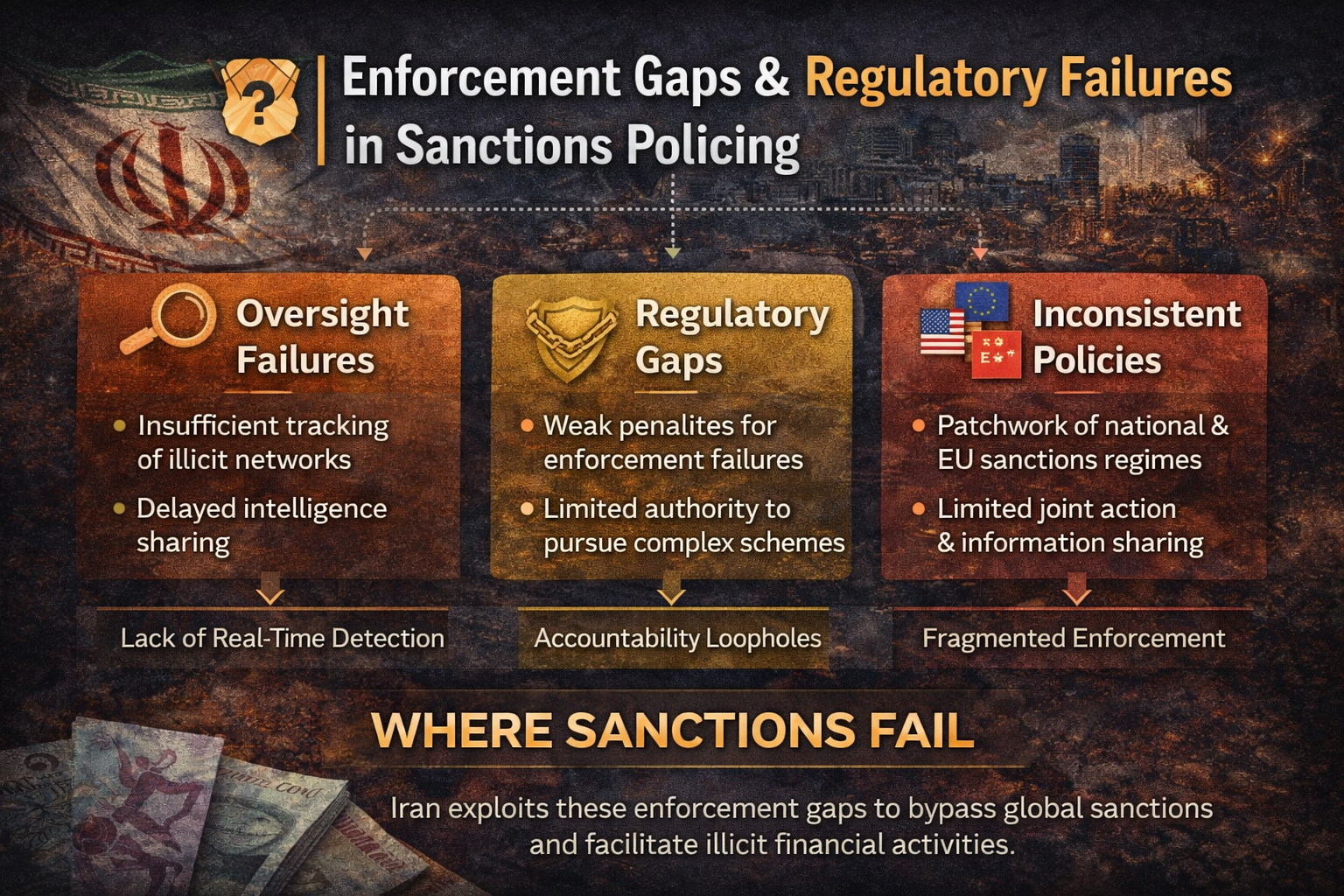
Crucially, these channels often operate in regulatory blind spots. Smaller financial institutions lack the compliance infrastructure of global banks, while national regulators may prioritize political alignment or economic necessity over strict enforcement. The result is a fragmented enforcement landscape in which Iranian transactions are dispersed, disguised, and normalized.
De-Dollarization as Opportunity, Not Ideology
While Iranian officials frequently frame their financial maneuvering as resistance to Western “economic warfare,” the reality is more transactional than ideological. Iran’s embrace of non-dollarized trade is driven less by principle and more by survival. Yet Tehran has adeptly embedded itself within a broader global trend: the push by certain states to reduce dependence on the U.S. dollar and Western financial infrastructure.
This convergence of interests has created space for Iran to cultivate financial relationships with countries willing to experiment with alternative settlement systems. In these environments, compliance with sanctions becomes negotiable, enforcement uneven, and risk tolerance higher. For Iran, this represents not only an escape route but a strategic hedge against future isolation.
Why Shadow Banking Networks Matter
Understanding Iran’s shadow banking and non-SWIFT financial channels is not an academic exercise—it is a policy imperative. These networks directly enable:
- The monetization of sanctioned exports
- The funding of state-linked enterprises and security institutions
- The circumvention of export-control and financial-monitoring regimes
Moreover, they expose structural weaknesses in the international financial system itself. As long as fragmented regulation, geopolitical alignment, and economic opportunism persist, sanctioned actors like Iran will continue to exploit the seams.
Scope and Purpose of This Report
This report maps the architecture of Iran’s shadow financial ecosystem, focusing on non-major financial institutions, alternative payment systems, and de-dollarized trade mechanisms that facilitate ongoing transactions with sanctioned Iranian banks. It is designed as a risk-assessment guide for international companies, financial institutions, compliance professionals, and policymakers, offering clarity on how these channels operate and where enforcement gaps remain.
By tracing the flow of money rather than rhetoric, this analysis aims to move beyond surface-level sanctions debates and confront the uncomfortable reality: sanctions are only as effective as the global system enforcing them. Where that system fractures, sanctioned finance survives—and in Iran’s case, evolves.
Chapter 1: Iran’s Financial Isolation and the Birth of a Parallel Banking System
Iran’s turn toward shadow banking and non-SWIFT financial channels was not a spontaneous adaptation—it was the predictable outcome of sustained international pressure colliding with a regime unwilling to alter its strategic behavior. Over successive sanctions cycles, the Islamic Republic did not reform its banking sector, improve transparency, or comply with global financial norms. Instead, it engineered a parallel financial system designed to preserve regime liquidity while shielding transactions from scrutiny.
This chapter examines how Iran’s growing financial isolation catalyzed the emergence of an alternative banking architecture—one that deliberately operates outside the safeguards of the international financial system.
1.1 Sanctions as Structural Shock, Not Financial Deterrent
Since the early 2000s, Iran has been subject to increasingly restrictive financial sanctions targeting its banks, central bank, and access to international clearing systems. Measures imposed by the United States, the European Union, and multilateral bodies were designed to sever Iran’s ability to transact internationally, raise capital, and repatriate export revenues.
Key pressure points included:
- Restrictions on correspondent banking relationships
- Blacklisting of major Iranian financial institutions
- Enhanced due diligence requirements for Iran-linked transactions
- Eventual disconnection from the SWIFT messaging network
In theory, these actions should have rendered large-scale international finance impossible. In practice, they forced a reconfiguration rather than a cessation of Iranian financial activity.
The Islamic Republic treated sanctions not as a signal to comply, but as a technical problem to be solved.
1.2 From Centralized Banking to Fragmented Financial Networks
Prior to intensified sanctions, Iran relied on a relatively centralized financial structure dominated by state-owned banks and the Central Bank of Iran (CBI). As these institutions became liabilities—highly visible, heavily sanctioned, and closely monitored—Iran shifted toward financial fragmentation as a survival strategy.
This fragmentation had several deliberate advantages:
- Smaller institutions attracted less regulatory attention
- Transactions could be dispersed across jurisdictions
- Financial risk could be diffused among intermediaries
- Enforcement actions became slower and more complex
Rather than moving large volumes through a few sanctioned banks, Iran began routing payments through networks of minor banks, exchange houses, front companies, and trade intermediaries, often operating in jurisdictions with weak compliance oversight.
This model mirrors classic shadow banking behavior: replicating core banking functions—payments, settlement, credit—without the transparency or accountability of regulated institutions.
1.3 The Strategic Abandonment of Compliance Norms
Unlike jurisdictions that reform under sanctions pressure, Iran made a conscious decision to reject international financial compliance norms altogether. Tehran’s refusal to fully implement Financial Action Task Force (FATF) standards, particularly on anti–money laundering (AML) and counter–terrorist financing (CTF), was not accidental or bureaucratic—it was strategic.
Compliance would have required:
- Disclosure of beneficial ownership
- Monitoring of politically exposed persons
- Transparency around state-linked financial flows
- Restrictions on funding channels tied to security institutions
For a regime whose economy is deeply entangled with military, intelligence, and paramilitary structures, such transparency posed an existential risk. Shadow banking, by contrast, offered opacity by design.
1.4 Non-SWIFT Channels as an Enabler of Regime Continuity
Iran’s removal from SWIFT is often portrayed as a crippling blow. In reality, it served as a catalyst for innovation in non-SWIFT financial messaging and settlement systems. These alternatives lack SWIFT’s global reach but offer something equally valuable to sanctioned actors: invisibility.
Non-SWIFT mechanisms employed by Iran include:
- Direct bank-to-bank messaging arrangements
- Manual settlement through third-country clearing accounts
- Local payment systems disconnected from Western oversight
- Cash-based and quasi-cash settlement through money service businesses
While slower and less efficient, these channels enable Iran to maintain a minimum viable level of international trade—enough to fund core regime priorities and strategic sectors.
1.5 The Role of Political Alignment and Economic Opportunism
Iran’s shadow banking system does not exist in isolation. It is sustained by foreign enablers—financial institutions and governments willing to tolerate sanctions risk in exchange for political leverage or economic gain.
Smaller banks in aligned or non-aligned countries often view Iranian transactions as:
- Low-competition revenue streams
- Politically protected activities
- Acceptable risks given limited Western exposure
This dynamic creates a permissive environment where compliance is selectively enforced, and sanctions become negotiable rather than absolute.
1.6 Shadow Banking as State Policy, Not Market Failure
It is critical to dispel the notion that Iran’s shadow banking ecosystem is the result of market improvisation. It is state-enabled, state-protected, and strategically managed. Regulatory ambiguity, weak enforcement, and opaque ownership structures are not flaws—they are features.
Through this system, the Islamic Republic has preserved access to:
- Export revenue settlement
- Import financing for controlled goods
- Capital mobility for regime-linked actors
- Financial channels insulated from political accountability
Shadow banking, in Iran’s case, is not merely a workaround. It is a cornerstone of regime resilience.
Chapter 2: The Global Shadow Banking Ecosystem — How Iran Moves Money Without SWIFT
Iran’s shadow banking system does not operate in a vacuum. It is embedded within a global ecosystem of small, under-scrutinized financial institutions, informal settlement mechanisms, and politically tolerant jurisdictions that collectively compensate for Iran’s exclusion from mainstream banking networks. While SWIFT disconnection closed the front door, this ecosystem opened dozens of side entrances—each narrower, slower, but far harder to police.
This chapter maps the architecture of that ecosystem and explains why it continues to function despite years of international enforcement efforts.
2.1 The Rise of “Small Bank Risk” in Global Finance
Modern sanctions enforcement is heavily concentrated on major financial institutions—global banks with deep exposure to U.S. and EU markets. This creates an enforcement asymmetry that Iran has learned to exploit.
Smaller banks—often regional, state-owned, or domestically focused—present a different risk profile:
- Limited exposure to U.S. correspondent banking
- Minimal dollar-clearing activity
- Weak compliance infrastructure
- Political insulation from Western regulators
For these institutions, Iranian transactions are not existential threats. They are manageable compliance risks—or, in some cases, profitable opportunities deliberately overlooked.
Iran’s strategy has been to scale down transaction visibility, not transaction volume. By breaking flows into smaller units and routing them through low-profile banks, Tehran reduces the likelihood of detection while preserving financial continuity.
2.2 Non-Major Jurisdictions as Financial Buffer Zones
Iran consistently favors jurisdictions that function as financial buffer zones—countries that maintain diplomatic or economic ties with Tehran while avoiding full alignment with Western sanctions regimes.
Common characteristics of these jurisdictions include:
- Partial or selective sanctions enforcement
- High tolerance for local-currency trade
- Politicized regulatory institutions
- Weak beneficial ownership disclosure requirements
These environments allow Iranian-linked entities to operate through local banks that are technically compliant with domestic law, yet functionally incompatible with international standards.
The result is a fragmented but resilient financial web that spans Eurasia, the Middle East, parts of Asia, and segments of Africa.
2.3 Local Currency Trade and the Erosion of Dollar Dominance
One of the most consequential trends supporting Iran’s shadow banking model is the deliberate shift toward non-dollarized trade. For Iran, reducing reliance on the U.S. dollar is not ideological posturing—it is operational necessity.
Local currency arrangements allow Iran to:
- Settle trade without touching U.S.-cleared transactions
- Avoid dollar-based correspondent banks
- Reduce exposure to secondary sanctions
- Mask transaction origins and end beneficiaries
These arrangements often involve bilateral agreements where trade imbalances are resolved through offsets, credits, or deferred settlement rather than direct currency transfers.
While inefficient, these systems significantly complicate enforcement—especially when layered across multiple jurisdictions.
2.4 Bespoke Payment Mechanisms and Manual Settlement
In the absence of standardized systems like SWIFT, Iran relies on bespoke, manual, and relationship-based payment mechanisms. These systems prioritize trust over transparency and speed over auditability.
Common mechanisms include:
- Direct account-to-account transfers within aligned banking systems
- Ledger-based settlements maintained by intermediaries
- Deferred netting arrangements settled periodically
- Third-party clearing through trade hubs or financial intermediaries
These methods resemble pre-digital banking practices—but with modern geopolitical intent. Their informality is precisely what makes them resistant to automated monitoring and compliance screening.
2.5 The Central Role of Money Service Businesses and Exchange Houses
Beyond formal banks, Iran relies heavily on money service businesses (MSBs), currency exchange houses, and remittance operators to bridge gaps in the formal system.
These entities:
- Operate under lighter regulatory frameworks
- Handle cash-intensive transactions
- Facilitate cross-border value transfer without formal messaging systems
- Serve as conduits between banks, traders, and front companies
In many jurisdictions, MSBs are poorly supervised, under-resourced, and politically protected—making them ideal tools for sanctions evasion.
For Iran, these actors are not peripheral. They are core infrastructure.
2.6 Political Cover and Strategic De-Dollarization
Iran’s shadow banking network is increasingly reinforced by countries pursuing strategic de-dollarization—not necessarily to support Iran, but to reduce their own exposure to Western financial leverage.
This convergence of interests creates a permissive environment where:
- Sanctions enforcement is deprioritized
- Financial experimentation is encouraged
- Regulatory ambiguity is tolerated
Iran positions itself as both a beneficiary and a test case, helping normalize alternative financial channels that undermine global financial transparency.
2.7 Why Enforcement Struggles to Keep Up
International enforcement frameworks are optimized for centralized, rules-based financial systems. Iran’s shadow banking ecosystem is the opposite: decentralized, informal, and adaptive.
Key enforcement challenges include:
- Jurisdictional fragmentation
- Lack of real-time transaction visibility
- Political resistance to cooperation
- Difficulty proving intent in indirect transactions
As a result, sanctions increasingly function as friction, not barriers—raising costs without eliminating access.
2.8 The Bigger Picture: Shadow Banking as a Geopolitical Tool
What emerges is not merely a financial workaround, but a geopolitical strategy. Iran’s use of shadow banking and non-SWIFT channels contributes to a broader erosion of global financial norms—one transaction at a time.
This system:
- Sustains sanctioned regimes
- Weakens collective enforcement mechanisms
- Incentivizes regulatory arbitrage
- Normalizes opacity in international finance
For Iran, survival is the immediate objective. For the global system, the long-term consequences are far more destabilizing.
Chapter 3: Country Case Studies — Where Iran’s Shadow Banking Actually Works
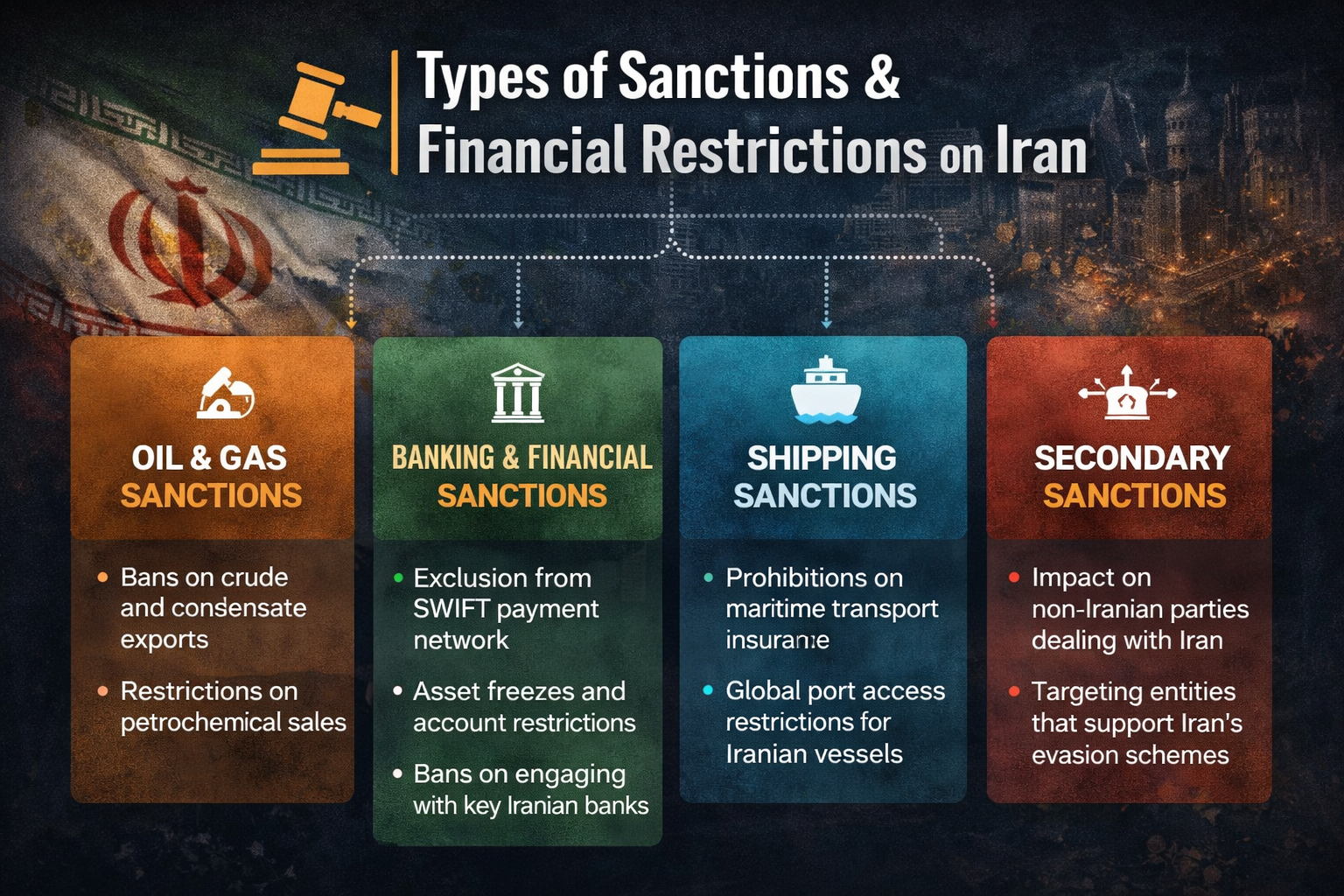
Abstract discussions of shadow banking only become meaningful when anchored to geography. Iran’s non-SWIFT financial operations are not evenly distributed across the globe; they are highly concentrated in specific countries where political alignment, regulatory weakness, or economic self-interest converge. These jurisdictions form the operational backbone of Iran’s financial survival strategy.
This chapter examines the most consequential country-level enablers—states that do not merely tolerate Iran’s financial workarounds, but actively benefit from them.
3.1 China: Strategic Ambiguity and Financial Tolerance
China is the most important node in Iran’s shadow banking ecosystem—not because of overt policy alignment, but because of deliberate ambiguity.
Chinese financial institutions officially comply with international sanctions frameworks. In practice, however, enforcement is selective, fragmented, and subordinated to strategic priorities.
Key features of Iran–China shadow financial ties include:
- Use of local currency settlement (RMB–rial structures)
- Transactions routed through small and mid-tier Chinese banks with limited Western exposure
- Reliance on state-linked enterprises as commercial intermediaries
- Deferred settlement through trade offsets rather than cash transfers
Iranian oil and petrochemical revenues are often credited inside China but restricted from outbound transfer, forcing Tehran to spend funds on Chinese goods, services, and infrastructure projects. While framed as a constraint, this arrangement suits Beijing perfectly: it locks Iranian capital inside the Chinese economy.
China does not need to openly defy sanctions. It merely needs to ensure that enough financial oxygen reaches Iran to preserve strategic leverage.
3.2 Russia: Sanctions Convergence and Parallel Financial Architecture
Russia’s post-2022 sanctions environment has accelerated its financial convergence with Iran. Both states now operate under extensive restrictions, creating incentives to share evasion tactics, payment mechanisms, and institutional experience.
Key elements of Iran–Russia financial cooperation include:
- Non-SWIFT messaging alternatives
- Ruble-rial trade settlement experiments
- Use of state banks shielded from Western exposure
- Clearing mechanisms linked to energy, arms, and technology trade
Unlike China’s ambiguity, Russia’s posture is increasingly openly defiant. Sanctions are treated as hostile acts rather than legal constraints, reducing internal pressure on banks to comply.
This partnership has transformed shadow banking from a workaround into a sanctions-resistant financial bloc, with Iran as both beneficiary and contributor.
3.3 Turkey: The Gray-Zone Financial Gateway
Turkey occupies a uniquely ambiguous position. As a NATO member with deep commercial ties to Iran, it has historically functioned as a gray-zone financial gateway.
Iran’s use of Turkey has included:
- Gold-for-gas arrangements
- Trade misinvoicing through Turkish firms
- Use of local banks with limited transparency
- Complex triangular trade involving Europe and Central Asia
While Ankara periodically tightens enforcement under Western pressure, economic realities—and political pragmatism—ensure that financial leakage continues.
Turkey’s value to Iran lies not in ideological alignment, but in its institutional duality: close enough to Western systems to transact, distant enough to bend the rules.
3.4 The United Arab Emirates: Commercial Sophistication, Regulatory Gaps
The UAE, particularly Dubai, remains one of Iran’s most effective financial logistics hubs. Despite regulatory reforms, enforcement remains uneven—especially outside major banks.
Iran-linked activity in the UAE often flows through:
- Exchange houses and money service businesses
- Free-zone registered entities
- Trade financing linked to re-exports
- Informal settlement between commercial partners
The UAE’s role is less about banking per se and more about financial intermediation, currency exchange, and trade facilitation. These functions are critical for converting restricted balances into usable value.
While Emirati authorities have increased scrutiny, the system’s scale ensures that selective blind spots persist.
3.5 Iraq: The Financial Lifeline Next Door
No country illustrates sanctions failure more starkly than Iraq.
Despite heavy U.S. oversight, Iran continues to access Iraqi financial infrastructure through:
- Electricity and gas payment mechanisms
- Iraqi banks acting as intermediaries
- Cash transfers across porous borders
- Currency auctions and local clearing systems
Iraq’s dependence on Iranian energy creates a built-in enforcement dilemma. Cutting off financial flows risks domestic instability—something Baghdad cannot afford.
As a result, Iran treats Iraq not as a foreign jurisdiction, but as an extension of its financial hinterland.
3.6 Malaysia and Southeast Asia: Quiet Financial Nodes
Malaysia and parts of Southeast Asia play a quieter but still significant role. These jurisdictions offer:
- Moderate regulatory scrutiny
- Active Islamic finance sectors
- Growing non-dollar trade frameworks
- Limited political incentive to aggressively enforce Iran-related sanctions
Iranian-linked entities often operate through export-import firms, trading companies, and regional banks that attract little international attention.
Their advantage is invisibility. They are not primary hubs—but they are reliable connectors.
3.7 Why These Countries Matter More Than Banks
A critical insight emerges from these case studies:
Iran’s shadow banking success depends less on specific institutions and more on jurisdictional environments.
Banks can be sanctioned.
Countries are far harder to isolate.
As long as certain states view sanctions as negotiable, political, or selectively enforceable, Iran will continue to find pathways—however inefficient—to move value across borders.
3.8 Risk Implications for Global Firms and Financial Institutions
For international companies and banks, these country-level dynamics create acute exposure:
- Indirect sanctions violations
- Counterparty risk hidden behind local entities
- Reputational damage from downstream exposure
- Regulatory penalties for insufficient due diligence
The danger is not obvious Iranian entities—it is normal-looking transactions routed through permissive jurisdictions.
Understanding where Iran’s shadow banking works is the first step toward understanding where compliance frameworks most often fail.
Chapter 4: How Non-SWIFT Payment Systems Actually Function — Mechanics, Workarounds, and Concealment
If Chapters 1–3 explained why Iran relies on shadow banking and where it operates most effectively, Chapter 4 addresses the most critical question:
How do these transactions actually work?
Contrary to popular belief, Iran’s non-SWIFT financial channels are not chaotic or improvised. They are structured, repeatable, and increasingly institutionalized. What appears externally as fragmentation is, internally, a deliberate architecture designed to move value without triggering sanctions enforcement.
4.1 Life After SWIFT: Replacing the Nervous System of Global Finance
SWIFT is not a bank—it is the messaging backbone of international finance. When Iranian banks were disconnected, the regime lost more than access; it lost financial visibility, speed, and legitimacy.
Iran responded by reconstructing financial functionality through:
- alternative messaging systems,
- manual confirmation processes,
- bilateral settlement frameworks,
- and non-bank intermediaries.
The result is a shadow financial nervous system—slower, riskier, but far harder to monitor.
4.2 Bilateral Clearing Agreements: Trading Without Transfers
One of Iran’s most effective tools is the bilateral clearing account.
Under these arrangements:
- Two countries agree to record trade values internally
- No cross-border money transfer occurs
- Imports and exports are offset over time
- Balances are settled periodically—or never fully settled
This mechanism allows Iran to:
- export oil or petrochemicals
- import food, machinery, or consumer goods
- avoid dollar transactions entirely
- bypass correspondent banking networks
These agreements are particularly common with countries seeking to de-dollarize trade or reduce exposure to U.S. sanctions pressure.
In practice, this is sanctions evasion disguised as economic sovereignty.
4.3 Local Currency Settlements: Weaponizing De-Dollarization
Iran aggressively promotes trade in:
- Chinese yuan
- Russian rubles
- Turkish lira
- Iraqi dinars
- regional currencies with limited convertibility
The regime frames this as resistance to “financial imperialism.” In reality, it is a survival tactic.
Local currency settlements:
- reduce traceability
- limit U.S. jurisdiction
- shift enforcement responsibility to weaker regulators
- trap value inside friendly economies
For Iran, non-convertibility is not a flaw—it is leverage.
4.4 Correspondent Banking Substitutes: Smaller Banks, Bigger Risks
While major global banks avoid Iran exposure, smaller financial institutions often become substitutes.
These banks typically share common traits:
- minimal Western exposure
- limited compliance capacity
- dependence on regional trade flows
- political insulation from U.S. pressure
Iranian-linked entities exploit these weaknesses by:
- fragmenting transaction volumes
- using layered counterparties
- rotating accounts frequently
- embedding payments inside legitimate trade flows
The goal is not invisibility—it is plausible deniability.
4.5 Trade-Based Money Laundering (TBML): The Core Financial Engine
Trade-based money laundering is the most important—and least understood—component of Iran’s shadow finance.
Common TBML techniques include:
- over-invoicing imports
- under-invoicing exports
- falsified commodity classifications
- phantom shipments
- circular trade involving related entities
In TBML schemes:
- goods become the payment instrument
- invoices replace wire transfers
- customs declarations replace bank scrutiny
This allows Iran to repatriate value while maintaining the appearance of lawful commerce.
4.6 Exchange Houses and Money Service Businesses
Exchange houses play a critical intermediary role, especially in the Middle East and South Asia.
They provide:
- rapid currency conversion
- off-ledger settlement
- cash pooling
- informal netting between traders
Because these entities are:
- lightly regulated
- locally embedded
- transaction-volume opaque
They serve as ideal bridges between formal trade and informal finance.
For Iranian networks, exchange houses are not peripheral—they are central.
4.7 Barter Trade: Sanctions Evasion in Its Oldest Form
When finance becomes too risky, Iran reverts to the oldest system:
barter.
Oil-for-goods deals allow Iran to:
- export hydrocarbons
- receive food, medicine, construction materials
- avoid financial transactions altogether
Barter is inefficient—but sanctions-proof.
It is also politically useful, allowing the regime to claim humanitarian justification while preserving revenue streams.
4.8 Digital Messaging Alternatives and Manual Confirmation
Some Iran-linked banks and intermediaries use:
- proprietary encrypted messaging
- email-based confirmations
- fax documentation
- human couriers for contract verification
While archaic by global standards, these methods:
- bypass automated monitoring
- leave minimal digital footprints
- frustrate real-time enforcement
Efficiency is sacrificed for survivability.
4.9 Why Compliance Systems Fail to Detect These Structures
Most sanctions compliance frameworks are designed to detect:
- sanctioned names
- restricted banks
- dollar-denominated transfers
- SWIFT messages
Iran’s shadow systems deliberately avoid all four.
As a result:
- risk migrates from banks to trade
- enforcement shifts from regulators to customs authorities
- accountability becomes diffuse
- detection becomes reactive, not preventative
This structural mismatch explains why Iran continues to operate—even under maximum pressure.
4.10 The Strategic Outcome: Functioning Finance Without Formal Access
Iran’s non-SWIFT architecture does not replicate the global financial system.
It replaces enough of it to function.
The regime does not need efficiency.
It needs continuity.
And through layered payment mechanisms, jurisdictional arbitrage, and trade-based settlement, Iran has built a financial ecosystem that survives not because sanctions are weak—but because enforcement systems are structurally outdated.
Chapter 5: Oil as Currency — How Iran Monetizes Crude Without Touching the Dollar
No sector reveals the scale, sophistication, and political protection of Iran’s shadow banking system more clearly than oil. Despite being one of the most heavily sanctioned commodities in the world, Iranian crude continues to move, sell, and generate revenue. This is not accidental—it is engineered.
Oil is not merely Iran’s primary export. Under sanctions, it has become Iran’s substitute currency.
5.1 Oil Under Sanctions: From Export Commodity to Financial Instrument
U.S. and EU sanctions were designed to sever Iran’s access to:
- international buyers,
- insurance markets,
- shipping services,
- and global payment channels.
What they failed to do was eliminate demand.
Instead, sanctions transformed oil into a financial workaround, allowing Iran to trade value without using banks. Crude shipments now function as:
- collateral
- payment
- barter medium
- debt settlement tool
In effect, Iran exports oil not to earn money—but to create liquidity outside the financial system.
5.2 The Chinese Anchor: Discounted Oil, Deferred Payment
China remains the single most important buyer of Iranian oil, absorbing millions of barrels per day through opaque channels.
Typical transaction structures include:
- oil sold at steep discounts
- payments delayed for months
- proceeds held in escrow-like accounts
- funds released only for approved imports
This arrangement benefits both sides:
- China secures cheap energy
- Iran gains controlled access to value
- U.S. jurisdiction is avoided
- SWIFT is irrelevant
What looks like trade is, in reality, managed financial containment.
5.3 Escrow Without Oversight: Frozen Funds That Still Function
Sanctions often freeze Iranian oil revenues in foreign jurisdictions. But “frozen” does not mean “useless.”
These funds are frequently:
- spent domestically in the holding country
- used to purchase sanctioned-friendly goods
- channeled through state-approved suppliers
- offset against other bilateral obligations
Iran cannot freely transfer the money—but it can extract value from it.
This is shadow banking by design, not by accident.
5.4 Oil-for-Goods Deals: Sanitizing Revenue Through Necessity
Oil-for-goods agreements allow Iran to:
- export crude
- receive food, medicine, infrastructure materials
- claim humanitarian exemption
- avoid financial transactions entirely
Common counterparties include:
- China
- Iraq
- Syria
- Venezuela
- select African and Asian states
These deals are politically defensible, economically efficient for partners, and legally ambiguous—making them extremely difficult to sanction.
5.5 Ghost Fleets and Financial Obfuscation
Iran’s maritime evasion is inseparable from its financial strategy.
Key tactics include:
- ship-to-ship transfers
- AIS spoofing
- frequent reflagging
- falsified cargo documentation
- layered ownership structures
Once oil changes ships and identities, payment becomes deniable. Financial institutions see a transaction—but not Iran.
This is not smuggling. It is industrial-scale deception.
5.6 National Iranian Oil Company (NIOC): The Financial Command Center
Despite sanctions, NIOC remains the regime’s most powerful economic actor.
It operates through:
- offshore subsidiaries
- trading arms registered abroad
- shell companies with rotating directors
- joint ventures in friendly jurisdictions
NIOC coordinates:
- pricing
- counterparties
- settlement methods
- political risk management
It does not merely sell oil—it orchestrates sanctions evasion.
5.7 Parallel Institutions and Revenue Capture
Oil revenue rarely flows into Iran’s formal budget.
Instead, it is diverted toward:
- IRGC-controlled entities
- sovereign-like funds without transparency
- security and proxy operations
- off-budget infrastructure projects
This financial opacity ensures:
- political insulation
- elite enrichment
- reduced public accountability
Sanctions did not weaken the regime.
They reshaped who controls its money.
5.8 Why Traditional Sanctions Fail in the Oil Sector
Sanctions assume:
- traceable buyers
- visible payments
- compliant insurers
- cooperative ports
Iran’s system avoids all four.
Oil moves.
Value transfers.
Budgets are funded.
And enforcement agencies remain reactive.
This is not sanctions failure—it is sanctions mismatch.
5.9 Risk Signals for International Stakeholders
For international companies and financial institutions, oil-linked exposure to Iran often appears indirectly:
- blended crude
- commodity swaps
- secondary shipping services
- trade finance for “non-Iranian” cargo
Risk does not announce itself.
It hides in normalcy.
5.10 Oil as Proof of Concept for Shadow Finance
If Iran can monetize oil—the most visible, regulated, and politicized commodity on Earth—without SWIFT, without dollars, and without major banks, then shadow finance is not a workaround.
It is a parallel system.
And oil is its proof of concept.
Chapter 6: The Architecture of Iran’s Shadow Banking System — Finance Beyond SWIFT
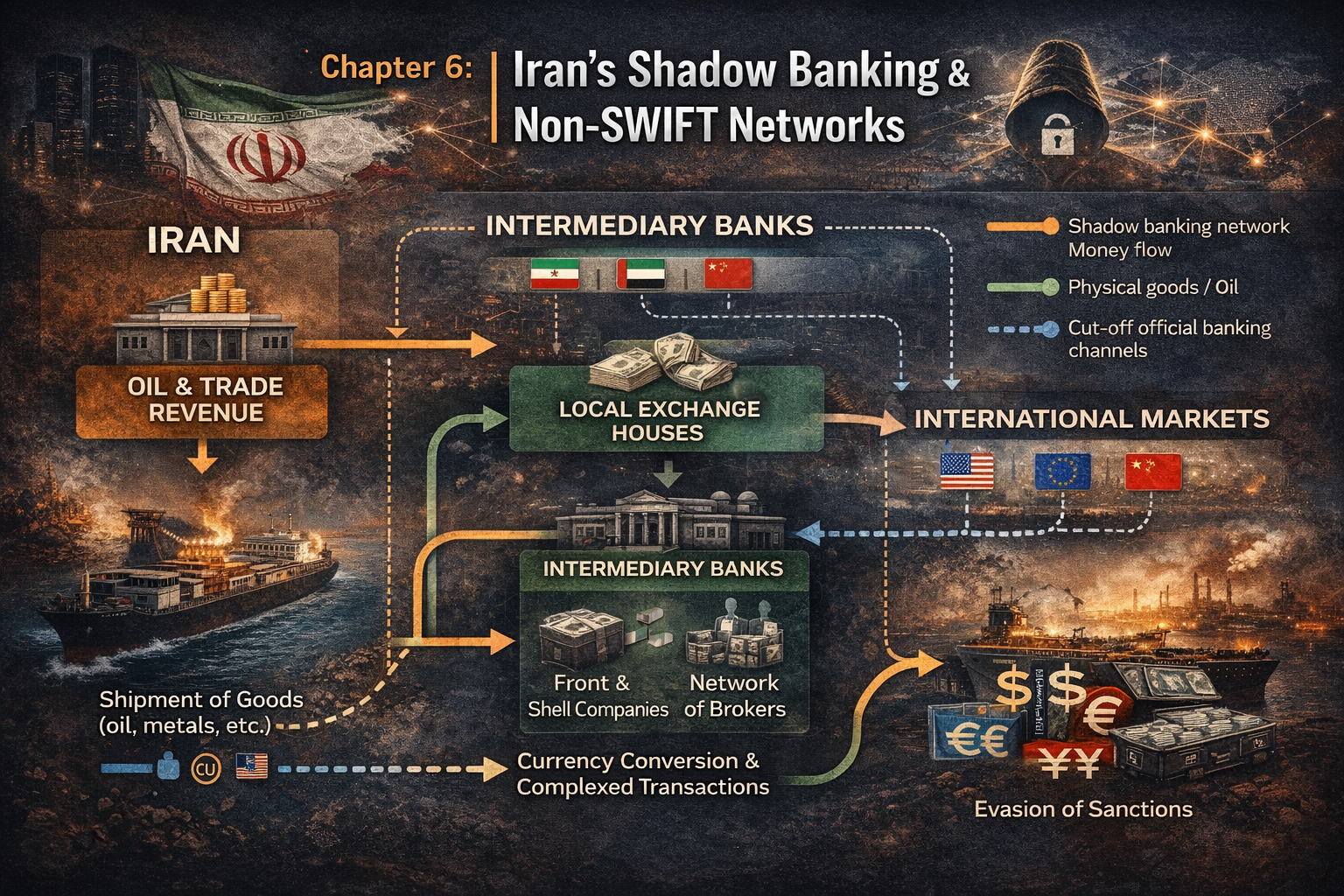
Iran’s sanctions-evasion strategy does not rely on a single workaround. It rests on an entire parallel financial architecture—one that functions deliberately outside the visibility of SWIFT, major correspondent banks, and Western compliance frameworks.
This is Iran’s shadow banking system: fragmented, adaptive, jurisdiction-hopping, and purpose-built to survive isolation.
6.1 What “Shadow Banking” Means in the Iranian Context
In conventional finance, shadow banking refers to non-bank financial intermediaries operating outside traditional regulation. In Iran’s case, the term is more expansive—and more dangerous.
Iranian shadow banking includes:
- small foreign banks with limited international exposure
- exchange houses and money service businesses
- trading companies performing financial functions
- logistics firms acting as payment conduits
- state-linked entities operating off-balance-sheet accounts
These actors do not merely complement the banking system.
They replace it.
6.2 Life After SWIFT: A System Forced to Decentralize
Iran’s partial and repeated disconnection from SWIFT was intended to be terminal. Instead, it forced decentralization.
The result:
- fewer large transfers
- more frequent small transactions
- multiple jurisdictions per deal
- layered intermediaries
- intentional opacity
This structure mirrors money-laundering typologies—but at a state scale.
6.3 Smaller Foreign Banks: Low Visibility, High Utility
Iran does not depend on global banks.
It depends on banks that global regulators rarely prioritize.
These institutions often share common traits:
- limited international correspondent relationships
- domestic or regional focus
- weak compliance capacity
- political insulation from Western pressure
- dependence on trade with Iran or Iranian partners
For these banks, Iranian business is not reputational risk—it is revenue.
6.4 Exchange Houses and Informal Transfer Networks
Where banks hesitate, exchange houses step in.
These entities:
- settle accounts through netting rather than transfers
- move value through offsetting obligations
- operate across borders without formal wires
- blur the line between legal FX services and hawala-style systems
In Iran’s ecosystem, exchange houses act as:
- currency converters
- settlement agents
- liquidity buffers
- enforcement blind spots
They are essential precisely because they generate no SWIFT data.
6.5 Trade as a Financial Instrument
In Iran’s shadow system, trade itself becomes the payment mechanism.
Common practices include:
- over- and under-invoicing
- delayed settlement arrangements
- commodity-for-commodity swaps
- inflated logistics costs masking value transfer
- third-party payment settlement by unrelated firms
Here, money moves without moving.
Only invoices do.
6.6 Front Companies as Financial Nodes
Front companies are not just procurement tools.
They are financial routers.
Their roles include:
- receiving payments on Iran’s behalf
- holding balances offshore
- redistributing funds through trade contracts
- shielding Iranian beneficiaries
Many never transact directly with Iran on paper—yet exist solely to serve Iranian interests.
6.7 Regulatory Arbitrage as Design Principle
Iran’s shadow banking system is built around exploiting:
- uneven AML enforcement
- conflicting sanctions regimes
- weak beneficial ownership rules
- opaque corporate registries
- political reluctance to enforce secondary sanctions
Each jurisdiction adds friction for regulators—and protection for Iran.
6.8 Why Enforcement Struggles to Keep Up
Traditional sanctions tools assume:
- centralized banking
- identifiable counterparties
- standardized payment rails
- jurisdictional clarity
Iran offers none of these.
Instead, investigators face:
- fragmented transaction trails
- non-bank intermediaries
- legally ambiguous trade structures
- constant entity churn
- intentional jurisdictional confusion
This is not accidental complexity.
It is engineered resilience.
6.9 Systemic Risk for Global Finance
Iran’s shadow banking network does not remain contained.
It:
- normalizes opaque financial practices
- incentivizes non-compliance
- lowers global AML standards
- creates templates reusable by other sanctioned actors
What begins as an Iranian workaround becomes a global vulnerability.
6.10 From Shadow Banking to De-Dollarization
Shadow banking is the foundation.
Non-dollarized trade is the multiplier.
Together, they allow Iran to:
- transact without SWIFT
- store value outside dollars
- evade detection at scale
- maintain export revenues under sanctions
This leads directly to the next phase of Iran’s strategy:
local currency agreements and de-dollarized trade, examined in Chapter 7.
Chapter 7 — Local Currency Trade, De-Dollarization, and Bilateral Settlement Mechanisms
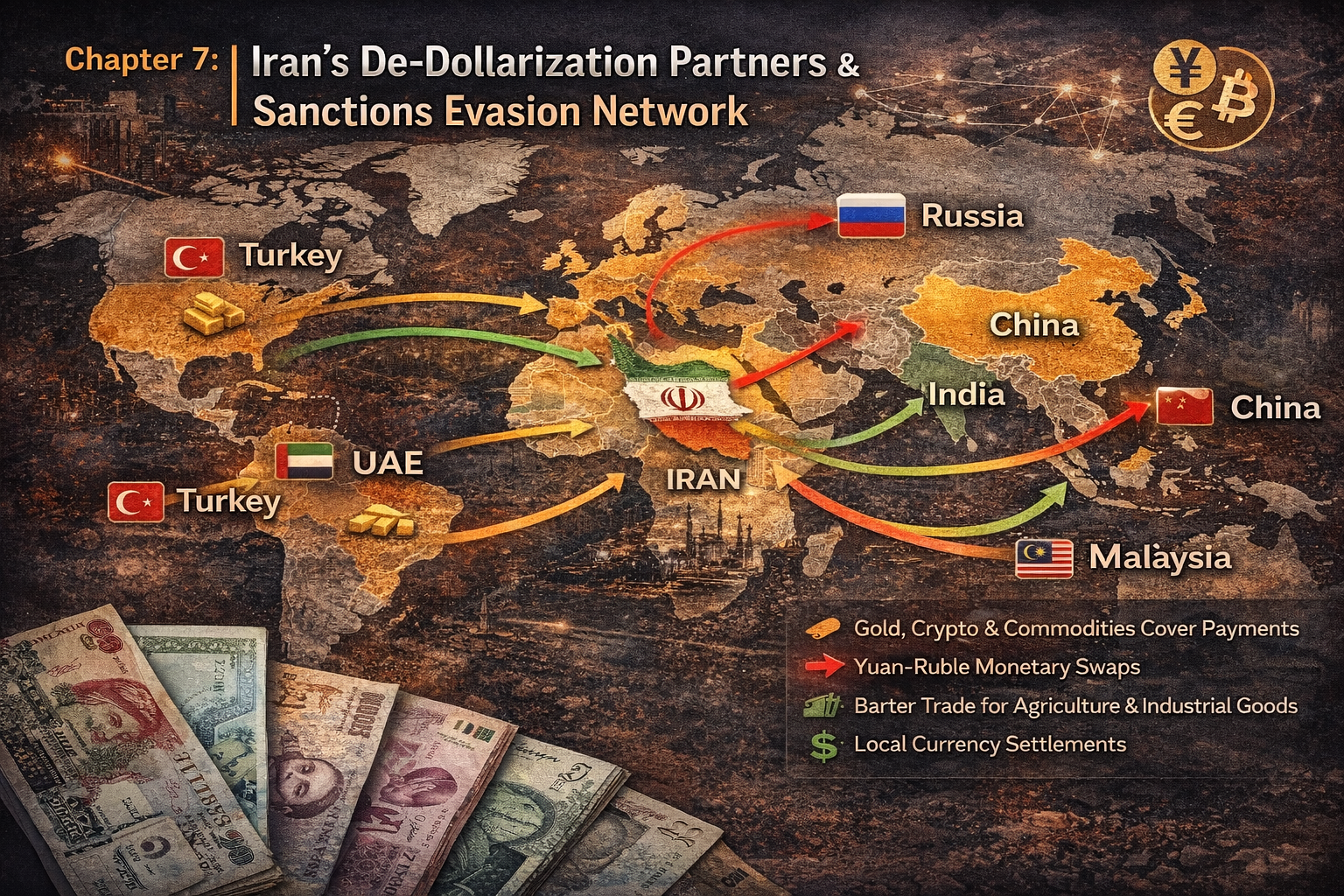
As access to SWIFT and dollar-clearing channels has narrowed, the Islamic Republic has aggressively repositioned itself within the global push toward de-dollarization—not as an ideological leader, but as a sanctions-dependent opportunist. For Tehran, local-currency trade and bilateral settlement mechanisms are not policy innovations; they are survival tools engineered to bypass compliance regimes and obscure financial traceability.
At the core of this strategy is a simple premise: sanctions enforcement weakens dramatically once transactions leave the dollar ecosystem. By shifting trade into local currencies, Iran reduces exposure to U.S. jurisdiction, correspondent banking scrutiny, and automated sanctions screening systems that dominate dollar-denominated finance.
7.1 How Local-Currency Trade Enables Sanctions Evasion
Local-currency trade arrangements allow Iran to export goods—primarily oil, petrochemicals, metals, and refined fuels—without receiving payment in USD or EUR. Instead, settlement occurs in the buyer’s domestic currency, which is:
- Held in restricted accounts at local banks
- Used to finance imports from the same country
- Converted through opaque offshore intermediaries
- Partially monetized via black-market FX channels
These funds are often non-convertible internationally, but that limitation is irrelevant to Tehran. The regime’s objective is not liquidity—it is continuity of trade and regime revenue.
This model has been repeatedly deployed in transactions involving:
- Energy exports to Asia
- Metals and petrochemical sales to regional markets
- State-to-state barter-style trade masked as “development cooperation”
7.2 Bilateral Clearing Accounts: The Architecture of Controlled Funds
Iran frequently relies on bilateral clearing accounts held in the importing country’s financial system. Under these arrangements:
- Payments for Iranian exports are deposited into local banks
- Funds cannot be freely transferred abroad
- Iran uses balances to purchase approved goods or services
- Transactions remain largely outside global monitoring systems
While often framed as “humanitarian” or “trade facilitation” mechanisms, these accounts function in practice as sanctions-insulated financial reservoirs. Oversight is minimal, transparency is selective, and enforcement relies entirely on the political will of the host country.
Crucially, these structures:
- Fragment transaction visibility
- Defeat automated sanctions screening
- Complicate asset-freeze enforcement
- Enable gradual value extraction through layered transactions
7.3 De-Dollarization as Cover, Not Cause
Iran’s participation in de-dollarization initiatives is frequently mischaracterized as ideological alignment with emerging-market financial reform. In reality, de-dollarization provides diplomatic and rhetorical cover for sanctions evasion.
By aligning itself with countries seeking to:
- Reduce dollar dependency
- Challenge U.S. financial dominance
- Promote regional settlement systems
Tehran reframes its sanctions-bypass mechanisms as legitimate financial experimentation. This narrative is particularly effective in multilateral forums and among states already skeptical of Western financial governance.
The result is a dangerous convergence:
- Political grievances against dollar hegemony
- Commercial incentives for discounted Iranian exports
- Weak compliance cultures in regional banking systems
7.4 Currency Risk, Arbitrage, and Regime Profit
Local-currency trade introduces volatility—but volatility itself becomes a profit mechanism. Iran exploits currency controls, parallel exchange rates, and arbitrage gaps to extract additional value.
Common techniques include:
- Purchasing undervalued local currency assets
- Reselling imports through domestic black markets
- Converting funds via informal money-service networks
- Timing settlements to exploit FX instability
This system disproportionately benefits state-linked entities and regime insiders, reinforcing elite capture while externalizing economic risk onto counterparties and domestic populations.
7.5 Risk Implications for International Firms and Banks
For foreign companies and financial institutions, local-currency arrangements involving Iran represent one of the highest sanctions-compliance risk profiles currently in operation.
Key risk indicators include:
- Trade invoicing in non-convertible currencies
- Payments routed through state-owned or second-tier banks
- Vague references to “special settlement mechanisms”
- Reliance on government-to-government memoranda
- Absence of independent transaction verification
Even when transactions appear legally structured under local law, secondary sanctions exposure remains acute, particularly where goods, technology, or services indirectly benefit sanctioned Iranian entities.
7.6 Strategic Assessment
Local-currency trade and bilateral settlement systems are not peripheral adaptations—they are central pillars of Iran’s modern sanctions-evasion architecture. They allow the regime to:
- Monetize exports under severe restrictions
- Preserve strategic industries
- Maintain foreign exchange inflows
- Undermine the deterrent effect of financial sanctions
As long as enforcement focuses narrowly on dollar-based systems, these mechanisms will continue to expand—quietly, incrementally, and with growing geopolitical justification.
In the next chapter, we examine how these financial arrangements are reinforced through regional political alliances and state-backed financial institutions, further insulating Iran from coordinated enforcement pressure.
Chapter 8 — Shadow Banking Networks and Non-SWIFT Payment Channels
As formal banking access narrows under sanctions, the Islamic Republic has entrenched itself in a parallel financial universe built on shadow banking, non-SWIFT messaging systems, and bespoke settlement arrangements. These channels do not merely supplement Iran’s financial activity—they replace core functions of the regulated international system, enabling sanctioned banks and state-linked entities to transact beyond meaningful oversight.
This chapter maps the architecture, actors, and risks of Iran’s non-SWIFT financial ecosystem.
8.1 What “Shadow Banking” Means in the Iranian Context
In sanctioned environments, shadow banking is not an abstract financial concept—it is an operational necessity. For Iran, shadow banking encompasses:
- Small and mid-tier foreign banks outside major compliance regimes
- Exchange houses and money-service businesses (MSBs)
- Trade-finance vehicles operating without correspondent relationships
- State-tolerated informal value transfer systems
- Government-linked financial intermediaries operating offshore
These entities perform functions traditionally handled by regulated banks: payments, clearing, trade finance, FX conversion, and liquidity provision—without the transparency or controls required under international standards.
8.2 Life After SWIFT: Alternative Messaging and Settlement Systems
Iran’s partial exclusion from SWIFT forced a strategic pivot toward non-SWIFT communication and settlement channels, including:
- Proprietary bank-to-bank messaging systems
- Regional payment platforms developed by non-Western states
- Manual confirmation processes via encrypted communication
- Central-bank-mediated settlement outside global clearing networks
While these systems lack SWIFT’s scale and efficiency, they offer one decisive advantage: they sit beyond Western regulatory visibility.
In practice, transactions are often:
- Confirmed through bilateral agreements
- Settled via netting mechanisms
- Reconciled manually or periodically
- Shielded from real-time screening
This structure dramatically weakens sanctions enforcement, which relies heavily on automated detection and standardized messaging.
8.3 The Role of Smaller Foreign Banks
Iranian banks increasingly transact through non-major financial institutions—often in jurisdictions with limited supervisory capacity or political incentives to resist Western pressure.
These banks typically share several characteristics:
- Minimal exposure to U.S. markets
- Limited dollar-clearing needs
- Weak AML/CFT enforcement
- Heavy reliance on regional trade flows
For these institutions, Iranian business is high-risk but high-margin. Compliance failures are rationalized as geopolitical positioning, regulatory ambiguity, or economic necessity.
Critically, many of these banks function as financial choke points—small enough to evade scrutiny, yet central enough to sustain significant transaction volumes.
8.4 Exchange Houses and Informal Value Transfer Systems
Beyond banks, Iran relies heavily on exchange houses and informal money networks to move value across borders. These actors:
- Aggregate payments from multiple sources
- Net transactions internally
- Settle balances periodically through trade or cash movements
- Operate across jurisdictions with limited reporting requirements
These systems are resilient precisely because they are fragmented, relational, and adaptive. Disrupting one node rarely dismantles the network; activity simply reroutes through alternative intermediaries.
For regulators, this creates an enforcement paradox: the more informal the system, the harder it is to monitor—yet the more central it becomes to sanctioned economies.
8.5 State Tolerance and Strategic Coordination
Contrary to the notion of purely private evasion, Iran’s shadow banking ecosystem operates with state knowledge and strategic coordination. The regime:
- Licenses or tolerates specific exchange operators
- Directs trade flows through approved intermediaries
- Protects key facilitators from domestic prosecution
- Integrates financial evasion into foreign policy planning
This blurring of public and private roles ensures deniability while maintaining control. Shadow banking is not a failure of governance—it is a governance choice.
8.6 Compliance Blind Spots and Enforcement Failure
Non-SWIFT and shadow-banking channels exploit several structural weaknesses in global enforcement:
- Sanctions screening tied to SWIFT metadata
- Overreliance on large-bank compliance
- Jurisdictional fragmentation
- Limited information sharing across regions
As long as enforcement frameworks prioritize formal financial institutions, parallel systems will continue to absorb displaced risk—not eliminate it.
8.7 Strategic Assessment
Iran’s shadow banking and non-SWIFT infrastructure represents a systemic challenge to sanctions-based financial control. It allows the regime to:
- Sustain cross-border trade
- Repatriate export revenues
- Maintain access to strategic imports
- Shield sanctioned banks from isolation
More importantly, it demonstrates a hard truth: financial sanctions lose potency when adversaries successfully migrate into alternative systems faster than regulators adapt.
The next chapter examines how these shadow networks are reinforced through political alliances and state-backed financial cooperation, further normalizing sanctions evasion under the banner of “financial sovereignty.”
Chapter 9 — De-Dollarization and Political Finance: How Iran Embeds Sanctions Evasion into State-to-State Trade
Iran’s shadow banking architecture does not operate in isolation. It is increasingly reinforced by political agreements aimed at reducing dependence on the U.S. dollar and Western financial infrastructure. Under the banner of “financial sovereignty,” Tehran has embedded sanctions evasion into formal bilateral and multilateral economic relationships, blurring the line between legitimate trade policy and deliberate circumvention of international controls.
This chapter examines how de-dollarization strategies and state-backed payment mechanisms function as force multipliers for Iran’s non-SWIFT financial ecosystem.
9.1 De-Dollarization as a Sanctions Evasion Strategy
For Iran, de-dollarization is not ideological posturing—it is operational survival.
By shifting trade away from dollar-denominated settlement, Tehran reduces:
- Exposure to U.S. correspondent banking
- Transaction screening under OFAC-linked systems
- Risk of asset freezes and payment reversals
Instead, Iran promotes:
- Local-currency trade agreements
- Currency swap arrangements
- Commodity-backed settlements
- Deferred netting structures
Each mechanism weakens the enforcement leverage embedded in dollar clearing.
9.2 Local Currency Trade Agreements
Iran has pursued bilateral trade frameworks where imports and exports are settled in local currencies, often with periodic balancing rather than real-time settlement.
Key features include:
- Accounts held at designated domestic banks
- Periodic reconciliation of trade imbalances
- Conversion via controlled exchange rates
- Limited transparency to third-party monitors
These arrangements reduce transaction visibility and allow sanctioned entities to remain financially active without touching the dollar system.
While volumes are often modest, their strategic value lies in durability rather than scale.
9.3 Currency Swaps and Central Bank Mediation
Currency swap agreements—whether formal or ad hoc—enable Iran to:
- Access foreign currency liquidity indirectly
- Support trade finance without open-market exposure
- Shield commercial banks from direct sanctions risk
In practice, central banks act as buffers, absorbing political risk while insulating private institutions. This transforms what would otherwise be sanctions violations into state-managed financial diplomacy.
Such structures are particularly attractive to governments seeking closer ties with Iran while minimizing private-sector exposure.
9.4 Commodity-Backed and Countertrade Settlements
Where currencies are unstable or politically sensitive, Iran relies on commodity-based settlement mechanisms, including:
- Oil-for-goods exchanges
- Petrochemicals for infrastructure services
- Metals for industrial equipment
- Energy products offset against agricultural imports
These transactions often bypass monetary settlement entirely, replacing payments with contractual value equivalence. The result is trade that is economically real but financially opaque.
From a compliance perspective, countertrade creates severe challenges:
- No payment trail to screen
- No bank transfer to flag
- No standardized documentation
9.5 Political Alignment and Financial Normalization
Countries engaging in de-dollarized trade with Iran frequently frame these arrangements as:
- Resistance to “financial imperialism”
- Protection against secondary sanctions
- Promotion of multipolar finance
This rhetoric provides political cover for what is, in effect, institutionalized sanctions evasion.
As more states normalize alternative settlement frameworks, the stigma associated with transacting with sanctioned actors diminishes—eroding the deterrent effect of sanctions over time.
9.6 Risks for International Financial Institutions
Even when direct exposure to Iran is avoided, international banks face secondary and tertiary risk through:
- Indirect trade financing
- Currency conversion services
- Clearing of netted balances
- Correspondent relationships with participating banks
These risks are often underestimated because they sit outside conventional sanctions screening logic.
Failure to account for de-dollarized trade flows creates blind spots that sophisticated actors actively exploit.
9.7 Strategic Implications
Iran’s embrace of de-dollarization illustrates a broader shift: sanctions evasion is no longer purely clandestine—it is embedded in state policy and diplomatic architecture.
By aligning financial innovation with geopolitical alignment, Tehran has transformed isolation into selective integration, sustaining economic lifelines while challenging the dominance of Western enforcement mechanisms.
The following chapter analyzes how these financial strategies intersect with trade-based money laundering and mispricing schemes, further complicating detection and enforcement.
Chapter 10 — Trade-Based Money Laundering and Price Manipulation Across Shadow Financial Channels
If de-dollarization and shadow banking provide the infrastructure for Iran’s sanctions evasion, trade-based money laundering (TBML) supplies the engine. Through systematic manipulation of invoices, shipping documents, and commodity pricing, Iranian-linked networks convert restricted exports into usable capital—often without triggering conventional financial alarms.
This chapter dissects how price distortion, misinvoicing, and trade complexity are weaponized to move value across borders while remaining formally compliant on paper.
10.1 Why Trade Became Iran’s Primary Laundering Vector
Traditional financial transfers are increasingly surveilled. Trade, by contrast, remains fragmented, under-digitized, and jurisdictionally siloed.
For Iran, trade offers:
- Plausible deniability through commercial documentation
- Legal cover via nominally civilian goods
- High transaction volumes that obscure anomalies
- Fragmented oversight across customs, banks, and regulators
In effect, TBML allows value transfer to masquerade as ordinary commerce.
10.2 Over-Invoicing and Under-Invoicing Schemes
The most common TBML techniques involve deliberate mispricing:
- Over-invoicing imports: Excess funds are transferred abroad under the guise of payment for goods, enabling capital flight or offshore accumulation.
- Under-invoicing exports: Revenue is partially retained offshore, bypassing domestic controls and sanctions monitoring.
These practices are often paired with:
- Related-party trading
- Shell intermediaries
- Artificially complex logistics routes
The result is a controlled distortion of value that benefits sanctioned actors.
10.3 Commodity Pricing Manipulation in High-Value Sectors
Iran’s key export sectors—oil, petrochemicals, metals—are particularly suited to price manipulation due to:
- Volatile global pricing
- Quality differentiation
- Confidential contract terms
- Non-transparent spot markets
Small adjustments in unit price can shift millions of dollars without appearing suspicious. When conducted repeatedly, these “micro-adjustments” create a steady, deniable flow of illicit value.
10.4 Phantom Shipments and Document Recycling
Beyond mispricing, some networks fabricate trade activity entirely:
- Bills of lading reused across multiple transactions
- Cargo manifests referencing non-existent shipments
- Goods declared but never delivered
Payments tied to these documents appear legitimate, while the underlying trade never occurs. In such cases, trade documentation becomes a laundering instrument rather than evidence of commerce.
10.5 Triangular Trade Structures
Iranian TBML frequently involves three or more jurisdictions, separating:
- Origin of goods
- Destination of payment
- Beneficial ownership
A typical structure may involve:
- Goods shipped from Iran to Country A
- Payment routed through Country B
- Offshore holding entities in Country C
This fragmentation defeats single-jurisdiction oversight and complicates attribution.
10.6 Integration with Shadow Banking and Non-SWIFT Channels
Trade-based laundering is rarely standalone. It is reinforced by:
- Non-SWIFT payment mechanisms
- Regional correspondent banks
- Informal settlement netting
- Currency swap balances
Together, these systems allow trade distortions to settle financially without exposure to Western clearing infrastructure.
10.7 Detection Challenges and Compliance Failures
Most financial institutions focus on transaction screening, not trade analytics. As a result:
- Price anomalies go unnoticed
- Related-party risks are under-assessed
- Shipping inconsistencies are ignored
Without cross-functional data—linking trade, finance, and logistics—TBML remains largely invisible.
10.8 Strategic Impact
Trade-based money laundering enables Iran to:
- Monetize sanctioned exports
- Repatriate funds covertly
- Maintain industrial output despite restrictions
It transforms sanctions from hard barriers into manageable friction.
In the next chapter, we examine how these mechanisms are institutionalized through state-linked enterprises and politically protected intermediaries, further insulating the system from disruption.
Chapter 11 — State-Owned Enterprises, Quasi-State Actors, and Political Protection
Iran’s shadow banking and non-SWIFT financial architecture does not operate in isolation. It is institutionally shielded by a dense web of state-owned enterprises (SOEs), quasi-state conglomerates, and politically protected intermediaries that blur the line between government, commerce, and covert finance.
This chapter examines how formal economic entities serve as structural cover for illicit financial activity—transforming sanctions evasion from an underground tactic into an embedded system of governance.
11.1 The Strategic Role of State-Owned Enterprises
Iran’s SOEs dominate key sectors:
- Energy
- Petrochemicals
- Mining and metals
- Shipping and logistics
- Infrastructure and construction
These entities enjoy:
- Preferential access to licenses and foreign exchange
- Political immunity from prosecution
- Regulatory opacity
- Direct links to security institutions
Because they are “official,” transactions involving SOEs often receive less scrutiny from foreign counterparties—especially in non-Western jurisdictions.
11.2 The Bonyads: Financial Power Without Transparency
Quasi-state foundations (bonyads) are among Iran’s most powerful economic actors. Officially charitable, in practice they function as:
- Massive holding companies
- Sanctions buffers
- Financial intermediaries for the political elite
Key characteristics:
- Exempt from normal audits
- Answerable only to the Supreme Leader
- Active across trade, finance, and real estate
Their hybrid status makes them ideal conduits for:
- Asset parking
- Trade settlement
- Off-book financial flows
For sanctions enforcement bodies, bonyads represent systemic blind spots.
11.3 IRGC-Linked Conglomerates as Financial Enforcers
The Islamic Revolutionary Guard Corps (IRGC) controls or influences hundreds of companies across:
- Shipping
- Energy services
- Construction
- Telecommunications
- Banking and exchange houses
These firms:
- Enforce loyalty within the system
- Penalize non-compliance internally
- Provide security guarantees to foreign partners
Participation in IRGC-linked trade is often a prerequisite for access to Iran’s most lucrative sectors—making foreign companies complicit by design.
11.4 Political Risk as a Competitive Advantage
In Iran’s economy, political alignment is a commercial asset.
Entities with regime backing can:
- Absorb sanctions losses
- Shift assets rapidly
- Receive state guarantees
- Outlast enforcement actions
This creates a dual economy:
- One vulnerable to sanctions
- One insulated by political protection
Shadow banking channels are routed almost exclusively through the latter.
11.5 Regulatory Capture and Enforcement Paralysis
Domestic regulators are structurally incapable of disrupting these networks because:
- Enforcement agencies report to political authorities
- Investigations stall when senior interests are involved
- Whistleblowers face retaliation
As a result, shadow financial practices are normalized, not prosecuted.
11.6 International Implications
For international firms and financial institutions, this creates severe exposure:
- Counterparties may appear legitimate but be politically embedded
- Ownership structures conceal sanctioned beneficiaries
- Legal contracts offer no protection against secondary sanctions
Engagement without deep political-risk assessment is not merely negligent—it is dangerous.
11.7 Strategic Takeaway
Iran’s shadow banking ecosystem survives not because it avoids the state—but because it is protected by the state.
Sanctions fail when enforcement targets transactions instead of power structures.
In the next chapter, we will examine how regional alliances and de-dollarization initiatives further reinforce these protected financial networks—expanding Iran’s reach beyond its borders.
Chapter 12: Risks for International Firms and Financial Institutions Engaging in Non-SWIFT Channels
For international companies and financial institutions, engagement—direct or indirect—with shadow banking networks linked to Iran represents one of the highest compliance risks in the contemporary global financial system. Unlike traditional sanctions breaches, exposure through non-SWIFT channels often occurs incrementally, obscured by layers of intermediaries, regional banks, and alternative settlement mechanisms.
One of the primary risks lies in counterparty opacity. Many smaller financial institutions facilitating Iranian transactions operate in jurisdictions with weak regulatory oversight, limited transparency, or politically motivated tolerance for sanctions evasion. These entities frequently lack robust know-your-customer (KYC) and anti–money laundering (AML) frameworks, making it extremely difficult for foreign firms to verify the ultimate beneficiary of funds.
A second critical risk is secondary sanctions exposure. The United States and its allies have increasingly shifted from targeting Iranian entities directly to penalizing third-country actors that enable Tehran’s access to financial services. Even non-dollar transactions—once perceived as safer—are now subject to enforcement when they involve sanctioned Iranian banks, front companies, or state-linked trading houses. This has resulted in asset freezes, loss of correspondent banking relationships, and exclusion from Western financial markets.
Operational risk is equally severe. Shadow banking arrangements rely heavily on informal trust networks, bespoke payment mechanisms, and politically contingent guarantees. When geopolitical conditions shift—or when enforcement pressure intensifies—these channels can collapse without warning, leaving foreign firms with unrecoverable receivables, stranded assets, or contractual disputes that cannot be adjudicated in neutral legal forums.
Reputational risk compounds these challenges. Investigations linking multinational firms to Iranian sanctions evasion—even indirectly—can trigger regulatory scrutiny, shareholder backlash, and long-term brand damage. In an era of heightened transparency and investigative journalism, plausible deniability is no longer a reliable defense.
Ultimately, participation in non-SWIFT financial ecosystems connected to Iran is not merely a compliance gamble; it is a strategic liability that exposes institutions to cascading legal, financial, and reputational consequences.
Chapter 13: Strategic Implications for Global Financial Governance and De-Dollarization Efforts
Iran’s reliance on shadow banking and non-SWIFT financial channels carries implications that extend far beyond sanctions enforcement. These networks reveal structural vulnerabilities within the global financial system and underscore the geopolitical tensions surrounding de-dollarization and alternative financial architectures.
At a strategic level, Tehran’s approach demonstrates how sanctioned states can weaponize fragmentation in global finance. By exploiting jurisdictional gaps, regional banking asymmetries, and political alignments among de-dollarization advocates, Iran has constructed a parallel ecosystem that operates beneath formal regulatory thresholds. This challenges the assumption that financial isolation can be fully enforced through traditional institutional mechanisms.
However, the Iranian model also exposes the limitations of de-dollarization narratives. While proponents frame non-dollar trade as a path to financial sovereignty, in practice these arrangements often rely on opaque accounting, inflated invoicing, and coercive state intervention. Rather than fostering stability, they create fragile systems prone to corruption, elite capture, and systemic risk—particularly in countries with weak financial governance.
For global regulators, Iran’s shadow banking architecture underscores the need for expanded multilateral coordination beyond SWIFT-centric frameworks. Enforcement strategies must increasingly focus on regional clearing systems, local currency swap agreements, and non-bank financial intermediaries that serve as conduits for sanctioned capital flows.
At the same time, these developments raise uncomfortable questions for countries pursuing strategic autonomy from Western financial institutions. Iran’s experience illustrates that de-dollarized trade, when driven by authoritarian imperatives rather than transparent reform, tends to replicate the very vulnerabilities it claims to escape.
In this sense, Iran’s shadow banking ecosystem is not a viable alternative model—it is a cautionary case study. It highlights how financial systems built to evade accountability ultimately deepen economic isolation, entrench political repression, and undermine long-term economic resilience.
Chapter 14: Policy, Compliance, and Strategic Responses to Iran’s Shadow Banking Networks
As Iran’s reliance on shadow banking and non-SWIFT financial channels deepens, the burden increasingly shifts to regulators, financial institutions, and multinational firms to close the remaining gaps. This chapter outlines practical policy responses and compliance strategies aimed at disrupting non-transparent payment mechanisms while managing the geopolitical realities of de-dollarization and fragmented financial governance.
14.1 Rethinking Sanctions Enforcement Beyond SWIFT
Traditional sanctions architecture has been heavily SWIFT-centric, assuming that exclusion from major messaging systems equates to financial isolation. Iran’s experience demonstrates the limits of that assumption. Effective enforcement now requires:
- Expanded monitoring of alternative messaging systems and bilateral clearing arrangements.
- Sanctions coverage that targets payment mechanisms, not just named institutions.
- Dynamic designation frameworks that account for rapidly changing correspondent relationships and proxy entities.
Without this shift, enforcement risks lagging behind the adaptive tactics of sanctioned actors.
14.2 Risk-Based Due Diligence for Non-Major Financial Institutions
Smaller banks and regional financial intermediaries—particularly in jurisdictions pursuing non-dollar trade—represent the highest risk nodes. Enhanced due diligence should include:
- Mapping indirect exposure to sanctioned Iranian banks, including nested correspondent relationships.
- Scrutinizing local-currency settlement flows that bypass traditional USD clearing.
- Assessing exposure to state-linked enterprises and trading companies with opaque ownership structures.
For compliance teams, the key risk is not overt sanctions violations, but facilitation through technical or procedural blind spots.
14.3 Data Integration and Financial Intelligence Sharing
Iran’s shadow banking networks thrive in fragmented data environments. A coordinated response depends on:
- Cross-border intelligence sharing between regulators, FIUs, and customs authorities.
- Integration of trade data, shipping records, and payment flows to detect triangular and circular transactions.
- Leveraging network analytics and AI-driven anomaly detection to identify non-obvious patterns of sanctions evasion.
Isolated compliance efforts are insufficient against transnational, networked financial structures.
14.4 Managing De-Dollarization Without Enabling Sanctions Evasion
Countries seeking to reduce dollar dependency are not inherently facilitating illicit finance—but Iran actively exploits this policy space. Governments and institutions can mitigate risks by:
- Establishing clear compliance standards for local-currency trade, aligned with international sanctions obligations.
- Conditioning bilateral payment mechanisms on transparency and auditability.
- Requiring beneficial ownership disclosure for all entities accessing alternative settlement systems.
De-dollarization does not have to mean de-regulation—but without safeguards, it often does.
14.5 Strategic Implications for International Companies
For multinational firms, exposure to Iran-linked shadow finance is as much a reputational and legal risk as a regulatory one. Best practices include:
- Sector-specific risk assessments for markets adjacent to Iran’s trade corridors.
- Contractual protections addressing payment routing, currency use, and counterparties.
- Ongoing monitoring of policy shifts in jurisdictions aligned with non-SWIFT financial ecosystems.
In an environment where formal compliance may still fail to capture real exposure, strategic risk judgment becomes critical.
Chapter 15: Strategic Implications for the Global Financial System
The persistence of Iranian shadow banking networks and non-SWIFT financial channels presents a structural challenge not only to sanctions enforcement but to the integrity of the global financial system itself. What initially emerged as tactical workarounds to bypass U.S. and EU restrictions has evolved into a semi-permanent parallel architecture—one that exploits regulatory asymmetries, geopolitical fragmentation, and the growing push toward de-dollarization.
At the systemic level, Iran’s use of non-transparent financial intermediaries underscores a broader vulnerability: the global financial ecosystem remains only as strong as its weakest regulatory nodes. Small regional banks, lightly supervised exchange houses, commodity traders, and fintech platforms operating outside robust compliance regimes have become force multipliers for sanctioned actors. Tehran’s experience demonstrates how a determined state actor can stitch together disparate financial fragments into a functional—if illicit—payments and settlement network.
For international banks and financial institutions, this reality reshapes risk exposure. Sanctions evasion is no longer confined to obvious red flags such as Iranian counterparties or state-owned banks. Instead, risk is embedded in indirect relationships: correspondent banking chains, commodity-linked payments, local-currency clearing arrangements, and opaque trade-finance instruments. Institutions that underestimate these second- and third-order risks face mounting exposure to regulatory penalties, reputational damage, and secondary sanctions.
Geopolitically, Iran’s shadow financial networks intersect with a wider trend of economic bloc formation. Countries seeking to reduce reliance on the U.S. dollar—whether for strategic autonomy or political leverage—have found in Iran both a test case and a willing participant. While these arrangements are often framed as sovereign financial innovation, in practice they frequently erode transparency, weaken anti-money-laundering norms, and create safe havens for sanctioned capital.
From a policy perspective, the Iranian case highlights the limitations of static sanctions frameworks in a dynamic financial environment. As long as enforcement mechanisms lag behind financial innovation, sanctioned regimes will continue to adapt faster than regulators respond. Effective countermeasures therefore require not only tighter controls but deeper international coordination, real-time intelligence sharing, and sustained pressure on jurisdictions that enable regulatory arbitrage.
Ultimately, Iran’s shadow banking ecosystem is not an isolated anomaly—it is a warning signal. Without decisive action, similar non-SWIFT, non-transparent financial channels may proliferate well beyond the Iranian case, undermining global compliance standards and normalizing sanctions evasion as a cost of doing business. Addressing this challenge is no longer a narrow policy issue; it is a strategic imperative for the future credibility of the international financial order.
Conclusion / Executive Summary
This report has demonstrated that Iran’s ability to survive under one of the most comprehensive sanctions regimes in modern history is not accidental, improvised, or temporary. It is the product of a deliberately constructed shadow banking ecosystem—a parallel financial architecture designed to bypass SWIFT, evade dollar-denominated oversight, and exploit structural weaknesses in global financial governance.
At the center of this system lies a network of non-major financial institutions, regional banks, exchange houses, state-aligned trading firms, and informal payment brokers operating across Asia, the Middle East, Eurasia, and parts of Africa. These actors facilitate Iranian transactions through non-dollarized trade, local currency settlements, bespoke clearing arrangements, and opaque correspondent relationships that remain largely invisible to traditional compliance frameworks.
Crucially, this ecosystem is not sustained by Iran alone. It is enabled by states and financial actors pursuing de-dollarization, strategic autonomy from Western financial power, or short-term economic gain. Countries experimenting with bilateral trade settlements, local currency swaps, or alternative messaging systems—often framed as sovereign financial innovation—have unintentionally (and sometimes knowingly) created space for sanctioned Iranian banks to re-enter international trade flows under new disguises.
The findings make clear that sanctions evasion has evolved faster than sanctions enforcement. Compliance systems built around SWIFT access, large correspondent banks, and dollar-clearing chokepoints are increasingly insufficient when transactions are fragmented, routed through secondary jurisdictions, or settled entirely outside the traditional financial core. Iran’s model shows how sanctioned states can leverage financial decentralization itself as a weapon.
For international companies and financial institutions, the risks are no longer theoretical. Exposure now extends beyond obvious Iranian counterparties to include small regional banks, trade finance intermediaries, commodity brokers, and payment mechanisms operating in jurisdictions with weak transparency or politicized enforcement. Reputational damage, secondary sanctions, and regulatory penalties increasingly hinge on whether institutions understand—not just who they are transacting with—but how money actually moves.
From a policy perspective, the report underscores an urgent need for sanctions modernization. Effective countermeasures must move beyond lists and designations toward network-based enforcement, enhanced information sharing, and scrutiny of alternative financial infrastructures. Without this shift, shadow banking channels will continue to expand faster than regulators can track them.
Ultimately, Iran’s shadow banking strategy is not merely a workaround—it is a long-term adaptation to a fragmented global financial order. Unless addressed systematically, it offers a replicable blueprint for other sanctioned or revisionist states. The challenge facing regulators, financial institutions, and policymakers is no longer whether sanctions can be evaded—but whether the international system is prepared to confront a world where sanctions evasion is structurally embedded in global finance.
References & Resources
Official Government & Multilateral Sources
- U.S. Department of the Treasury – Office of Foreign Assets Control (OFAC)
Sanctions programs, enforcement actions, advisories, and designation notices related to Iranian banks, shipping, oil, and shadow finance networks. - Financial Action Task Force (FATF)
High-Risk Jurisdictions subject to a Call for Action; mutual evaluation reports and typologies on money laundering, terror financing, and informal financial systems. - European Union External Action Service (EEAS)
EU restrictive measures against Iran, implementation guidance, and sector-specific compliance documentation. - United Nations Security Council (UNSC)
Resolutions related to Iran, proliferation financing, and international sanctions architecture.
Central Banks & Financial Authorities
- Bank for International Settlements (BIS)
Research on non-SWIFT payment systems, cross-border settlement mechanisms, and de-dollarization trends. - International Monetary Fund (IMF)
Working papers on sanctions impact, alternative payment arrangements, correspondent banking withdrawal, and shadow banking risks. - World Bank Group
Analyses on financial opacity, informal banking systems, and sanctions-driven market distortions.
Think Tanks & Policy Research Institutions
- Atlantic Council – Global Energy Center & GeoEconomics Center
Reports on Iranian sanctions evasion, oil exports, and alternative trade settlement mechanisms. - Foundation for Defense of Democracies (FDD)
In-depth investigations into Iranian shadow banking, front companies, non-SWIFT channels, and sanctions enforcement gaps. - Royal United Services Institute (RUSI)
Research on illicit finance, trade-based money laundering, and sanctions circumvention networks. - Center for Strategic and International Studies (CSIS)
Analysis of de-dollarization, geopolitical finance, and state-led sanctions evasion strategies.
Investigative Journalism & Open-Source Intelligence
- Reuters – Special Reports
Investigations into Iranian oil smuggling, ghost fleets, ship-to-ship transfers, and financial intermediaries. - Financial Times
Coverage of shadow banking, non-dollar trade, alternative payment systems, and emerging financial blocs. - The Wall Street Journal
Reporting on sanctions enforcement, illicit trade routes, and covert financial operations. - Bellingcat
Open-source investigations into shipping networks, shell companies, and sanctions evasion logistics.
Trade, Shipping & Energy Intelligence
- Lloyd’s List Intelligence
Data on maritime sanctions evasion, vessel tracking, and ship-to-ship transfer networks. - Kpler / Vortexa
Energy shipment analytics related to Iranian oil exports and concealed trade flows. - International Energy Agency (IEA)
Market reports and assessments relevant to sanctioned energy producers.
Compliance, Risk & Due Diligence Resources
- ACAMS (Association of Certified Anti-Money Laundering Specialists)
Guidance on identifying sanctions evasion typologies and shadow banking risks. - Global Financial Integrity (GFI)
Research on illicit financial flows, trade misinvoicing, and underground banking systems. - OECD – Trade and Financial Integrity Units
Reports on trade-based money laundering and cross-border financial abuse.
Academic & Legal Journals
- Journal of Financial Crime
- International Affairs
- Global Governance
- Review of International Political Economy