
Introduction
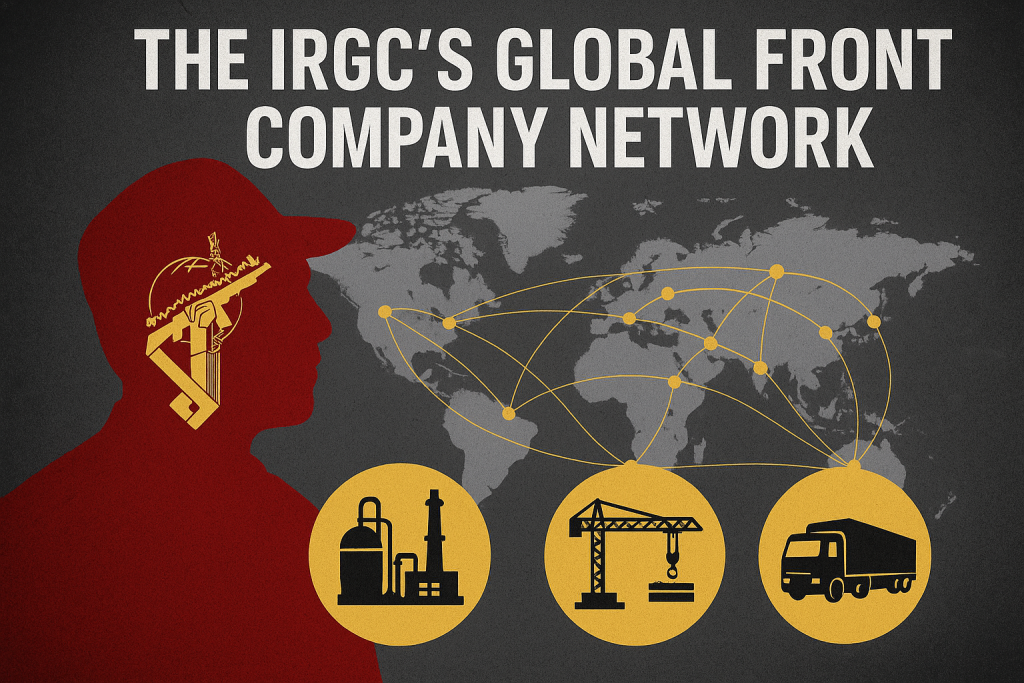
IRGC Front Company Network
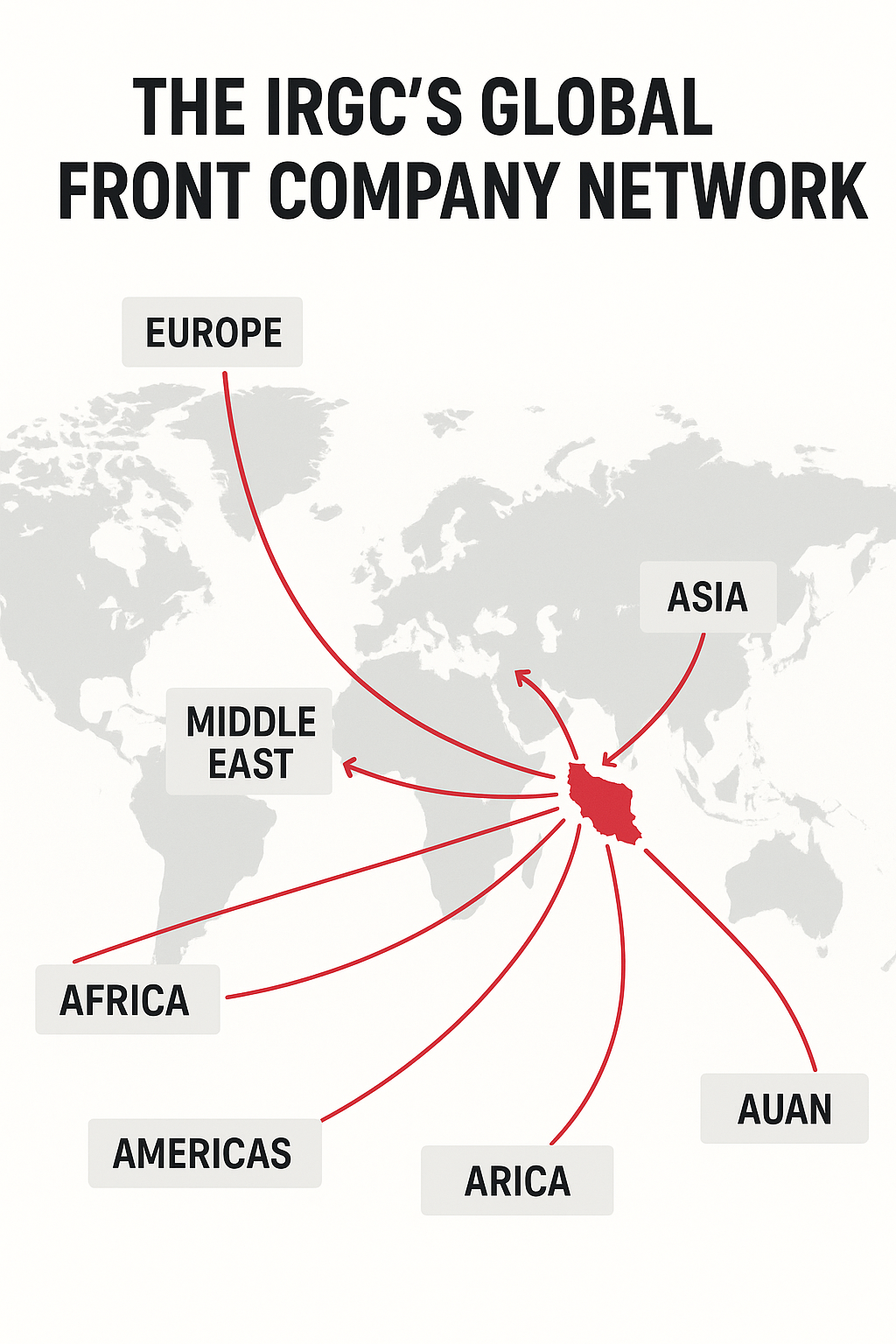
For years, global sanctions were expected to cripple the Islamic Revolutionary Guard Corps (IRGC), limit its financial reach, and disrupt its military expansion. Instead, the IRGC adapted, quietly constructing one of the most sophisticated front-company networks in the world. Today, this shadow economy spans Asia, Europe, Africa, and the Middle East, enabling the organisation to launder billions of dollars, bypass international regulations, and fund operations far beyond Iran’s borders.
This investigation pulls back the curtain on how the IRGC built its offshore empire: corporate layering, shell companies, maritime deception, falsified petrochemical documents, and covert logistics hubs designed to erase fingerprints and confuse regulators. The network is not random; it is engineered, deliberate, and highly adaptive, exploiting weaknesses in global financial systems and using jurisdictional loopholes to stay one step ahead of enforcement agencies.
Understanding this hidden architecture is essential. It reveals not only how the IRGC finances its regional operations, but also how the Islamic Republic has strategically weaponised the global economy to protect its interests. What follows is a detailed, region-by-region analysis of an international structure the regime was never meant to expose—one that shows how a sanctioned military organisation built a multinational business empire in plain sight
CHAPTER 1 — The Hidden Economic Empire Behind the IRGC
The Islamic Revolutionary Guard Corps (IRGC) is widely recognised as one of the most powerful military institutions in the Middle East. But in reality, its greatest battlefield is not military—it’s economic. Over the past two decades, the IRGC has engineered a global network of front companies, shell corporations, financial proxies, petrochemical intermediaries, and offshore vehicles that quietly move billions of dollars across borders. These networks fuel Iran’s geopolitical ambitions, insulate the regime from sanctions, and reinforce the IRGC’s grip on domestic and regional power.
To understand Iran’s modern authoritarian economy, you cannot simply look at Tehran, or at ministries, or even at the Supreme Leader’s office.
You follow the money—and the money leads to the IRGC.
1.1 — From Military Force to Multinational Conglomerate
The IRGC was created in 1979 as an ideological counter-balance to the regular army. But today, it resembles a state-owned megacorporation more than a military force. The transition began in the 1990s, when the IRGC secured major reconstruction contracts after the Iran-Iraq war. Khatam al-Anbiya, its engineering arm, evolved into a corporate empire with thousands of subsidiaries, giving the IRGC influence over:
- Energy and petrochemicals
- Shipping and logistics
- Construction and infrastructure
- Telecommunications and information systems
- Financial services
- Aviation, steel, and mining
By the late 2000s, the IRGC had embedded itself so deeply into Iran’s economic bloodstream that it became almost impossible to distinguish between “state companies,” “private contractors,” and IRGC front entities. Everything fused into a single opaque network.
1.2 — Sanctions Turned the IRGC Into a Shadow Economy Superpower
International sanctions—especially after 2010—should have crushed the IRGC.
Instead, they made it richer.
Sanctions cut off Iran from global banking, shipping, and trade. But the IRGC adapted faster than any other institution in the country. They built a parallel economic system using:
- Offshore companies in the UAE, Turkey, Malaysia, and Hong Kong
- “Ghost” petrochemical traders with no employees
- Reflagged shipping fleets
- Cut-out brokers and fake executives
- Cash-based informal networks (Hawala)
- Complex trade-based money-laundering schemes (TBML)
- Cryptocurrencies and digital financial obfuscation
Sanctions did not stop IRGC commerce—they pushed it into the shadows, where the Corps now operates with more freedom, fewer regulatory constraints, and lower public scrutiny.
This shift transformed the IRGC from a domestic power broker into a global sanctions-evasion machine, leveraging the vulnerability of international financial systems.
1.3 — Why Front Companies Are the IRGC’s Most Valuable Weapon
Front companies are not side tools—they are the core mechanism that keeps the IRGC’s multi-billion-dollar economy alive. These companies serve multiple strategic functions:
Shielding Beneficial Owners
Sanctioned commanders cannot sign contracts, open bank accounts, or buy cargo fleets. Their front men can.
Embedding Within Global Markets
A single shell company in Dubai can purchase machinery, move petrochemicals, book shipping insurance, or acquire spare airplane parts—all banned for Iran.
Blurring the IRGC’s Economic Footprint
A “private” petrochemical trader that exports 2 billion USD worth of products per year may actually be an IRGC conduit.
Accessing U.S. and European Financial Channels
Through layered offshore entities, many transactions eventually pass through Western banks without triggering alarms.
Creating Controlled Competition
IRGC-run companies compete with each other publicly while funneling profits into the same security apparatus.
1.4 — The Scale of the Global Network: A Hidden Web of Thousands
While exact numbers vary, Western intelligence agencies estimate:
- 3,000+ IRGC-linked companies inside Iran
- 1,600+ foreign-registered companies with confirmed or suspected ties
- Billions in annual petrochemical revenues laundered through offshore traders
- Shipping fleets reflagged under Panama, Tanzania, Mongolia, Sierra Leone
- Network expansion into Africa and Latin America (a growing trend)
This network spans at least 25 countries, from corporate secrecy havens like Cyprus and Malaysia to logistical hubs like Dubai and Istanbul.
What makes the system nearly indestructible is its distributed, flexible architecture: when one company is exposed or sanctioned, three more appear under different names, with new proxies, new banking partners, and new legal structures.
1.5 — The IRGC’s Economic Power Is Political Power
Behind every economic front is political influence.
Behind every commercial proxy is an ideological commitment.
And behind every dollar laundered is a regime survival strategy.
The IRGC’s financial power:
- Funds its military operations
- Supports proxy militias abroad
- Maintains domestic patronage networks
- Influences elections and policymaking
- Sustains the Supreme Leader’s economic interests
In simple terms, the IRGC’s financial network is the backbone of Iran’s authoritarian structure.
Dismantling this network—through exposure, transparency, and targeted intelligence—would destabilize the entire regime far more effectively than conventional sanctions ever did.
1.6 — Why This Report Matters
Most public research focuses on the IRGC’s military activity or Iran’s nuclear program. Far fewer investigations map the IRGC’s global corporate architecture—its companies, front offices, shadow traders, and offshore vehicles.
This report aims to fill that gap.
Using open-source intelligence (OSINT), leaked corporate registries, sanction filings, maritime databases, and journalistic investigations, this multi-chapter study will:
- Identify key IRGC front companies
- Map geographic hubs
- Expose trade routes & money channels
- Profile proxy businessmen
- Analyze corporate structures
- Provide interactive organizational charts
- Offer policy recommendations for governments, NGOs, and financial institutions
This is not just an exposé—it’s a blueprint.
A blueprint for understanding the economic engine behind Iran’s most powerful and least transparent institution.
Chapter 2 — Strategic Industries Targeted by IRGC Front Companies
The Islamic Revolutionary Guard Corps (IRGC) does not expand globally through random commercial ventures; its front-company ecosystem is engineered around high-leverage industries that deliver one of three strategic benefits:
- Revenue generation capable of bypassing sanctions
- Dual-use capabilities applicable to intelligence, logistics, or military needs
- Asset concealment and influence projection in foreign economies
Across dozens of countries, IRGC-linked entities repeatedly cluster in several core sectors. This chapter examines these sectors in depth, focusing on petrochemicals, construction & infrastructure, transportation & shipping, telecommunications & cyber infrastructure, metals & mining, banking & financial intermediaries, and humanitarian cover organisations. Together, these sectors form the economic backbone of the IRGC’s covert global footprint.
2.1 Petrochemicals: The IRGC’s Highest-Yield Sanctions-Evasion Industry
The IRGC’s most profitable network operates in petrochemicals—an industry uniquely suited to sanctions evasion due to its fragmented global market, complex supply chains, and ease of rebranding materials.
Key Characteristics
- High liquidity: Petrochemicals can be sold via intermediaries with minimal paper trails.
- Complex supply routes: Blending, relabelling, and offshore transfers obscure origin.
- Wide global demand: Almost every industrialised nation requires petrochemical imports.
Why this sector matters
Petrochemical revenue underpins IRGC projects abroad, including proxy financing and weapons R&D. Numerous front companies registered in the UAE, China, Malaysia, Singapore, and Turkey re-export Iranian petrochemical products under entirely different corporate identities. These entities typically operate with:
- Shelf companies purchased from corporate service providers
- Minimal physical presence (often only a mailbox)
- Frequent director rotation to avoid blacklisting
- Multiple shipping agents to blur documentation trails
2.2 Construction & Infrastructure: The IRGC’s Tool for Territorial Influence
Entities like Khatam al-Anbia Construction Headquarters, the IRGC’s engineering arm, operate through a constellation of foreign fronts in:
- Iraq
- Lebanon
- Syria
- Afghanistan
- Parts of Africa
Strategic benefits
- Access to government tenders in unstable or post-conflict states
- Control over infrastructure nodes (bridges, highways, dams, ports, telecom fiber lines)
- Direct influence on local elites through long-term contracts
Front companies in this sector often masquerade as:
- Civil engineering firms
- Consultancy agencies
- Energy project contractors
- Urban development companies
These entities allow the IRGC to embed within national infrastructure while disguising military interests under civilian development projects.
2.3 Transportation & Shipping: The Backbone of IRGC Logistics
The IRGC constantly adapts to sanctions on Iranian shipping by building layers of offshore entities that handle:
- Oil transport
- Cargo shipments
- Transshipment at third-country ports
- Vessel registration and flagging
Operational tactics
- Frequent flag-of-convenience changes
- Re-registering vessels in Panama, Tanzania, Comoros, and Liberia
- Using maritime service brokers to obscure beneficial ownership
- Turning off AIS transponders during high-risk routes
Shipping front companies effectively serve as the IRGC’s arterial network, enabling covert movement of:
- Refined petroleum
- Sensitive industrial goods
- Dual-use equipment
- Personnel and operatives
2.4 Telecommunications and Cyber Infrastructure: The Digital Domain of IRGC Influence
IRGC-affiliated telecom firms and cyber-adjacent companies operate subtly in:
- Data hosting
- Mobile services
- Cloud infrastructure
- Encryption solutions
- Cybersecurity contracts
Why this sector matters
Telecommunications provide:
- Access to metadata and communication channels in friendly states
- Infrastructure for cyber-operations and espionage
- Control over digital chokepoints (internet gateways, routing centers)
These companies rarely appear Iranian on paper—they often operate through:
- Local nominee directors
- European holding structures
- Balkan or Caucasus data centers
- Offshore equity funds
2.5 Metals, Mining & Industrial Materials
IRGC-linked industrial entities source and export:
- Aluminium
- Copper
- Steel products
- Rare metals
- Machinery components
Strategic relevance
Many of these materials feed Iran’s:
- Ballistic missile program
- Drone manufacturing
- Military industrial complex
These firms frequently operate in African and Central Asian jurisdictions where oversight is limited.
2.6 Financial Intermediaries: The Invisible Layer
Front companies rarely operate alone—they depend on financial intermediaries such as:
- Currency exchange houses
- Investment holding firms
- Brokerage agencies
- Offshore trusts
- Small local banks in permissive jurisdictions
Purpose
- Laundering petrochemical revenues
- Transferring funds to proxy groups
- Settling maritime insurance and freight payments
- Paying foreign agents or contractors
These financial fronts are often the most difficult to track because they exploit niche regulatory blind spots.
2.7 Humanitarian, Cultural & NGO Cover Networks
Not all IRGC-linked organisations are commercial. Some operate under:
- Cultural centers
- Charitable foundations
- Relief organisations
- Student exchange programs
Strategic utility
- Establishing local presence in target countries
- Recruiting assets under soft-power initiatives
- Gathering intelligence under legitimate cover
- Facilitating travel, visas, and community infiltration
These provide deniability while enabling direct engagement with diaspora communities.
2.8 Combined Effect: A Multi-Industry Global Ecosystem
By spreading across diverse industries, the IRGC accomplishes:
- Risk distribution: if one sector is sanctioned, others continue operating
- Revenue resilience: petrochemical losses can be offset by construction or metals
- Operational elasticity: logistics, finance, and cyber operations integrate seamlessly
- Deep geopolitical embedding in partner or weak-governance states
This multi-sector presence is not accidental—it’s a deliberately engineered architecture designed for long-term sustainability, financial insulation, and covert expansion.
Chapter 3 — Geographic Hubs of the IRGC’s Global Front Company Network
The Islamic Revolutionary Guard Corps (IRGC) has spent two decades constructing a geographically distributed, multi-layered global network of shell companies, holding structures, logistics hubs, and covert financial entities. These networks are intentionally positioned in regions where:
- Regulatory frameworks are weak or selectively enforced
- Port infrastructure supports high-volume transshipment
- Corporate secrecy is legalised through offshore jurisdictions
- Local elites are incentivised through political or financial partnerships
This chapter maps the major global hubs that host IRGC-linked entities, organised by region and supported by case studies, typologies, and operational patterns.
3.1 Middle East & North Africa (MENA): The IRGC’s Primary Operational Sphere
The MENA region serves as the IRGC’s natural geographic base of operations, with networks deeply embedded in states influenced by Iranian foreign policy or weakened by conflict.
3.1.1 United Arab Emirates (Dubai, Sharjah, Ras Al Khaimah)
The UAE is the single most important offshore hub for IRGC economic activity due to:
- Ease of company formation
- High financial liquidity
- Strong global shipping connections
- Large Iranian diaspora networks
- Free zones with minimal disclosure requirements
Entity Types Found Here
- Petrochemical trading firms
- Maritime logistics companies
- Freight-forwarding agencies
- Gold and precious metals traders
- Import/export re-labelling companies
Operational Patterns
- Companies often list non-Iranian nominee directors from India, Pakistan, or East Africa
- Re-exporting Iranian petrochemicals under completely new classifications
- UAE-based addresses used to mask Iranian beneficial ownership
- Multi-layered holding companies with no physical office presence
Dubai effectively functions as the IRGC’s commercial lungs, oxygenating its global networks.
3.1.2 Iraq (Baghdad, Basra, Najaf, Karbala)
Iraq is a front-line zone for IRGC-linked construction, transport, and religious-tourism entities.
Activities
- Large-scale construction via local subsidiaries of Khatam al-Anbia
- Fuel smuggling networks across Basra’s port ecosystem
- Religious travel agencies doubling as cash movement channels
- Procurement offices for industrial machinery and chemicals
The porous Iraq–Iran border enables high-volume unregistered cash and goods flows, which front companies exploit to bypass formal banking channels.
3.1.3 Syria & Lebanon
These states host IRGC-linked entities connected to military logistics and political influence operations.
Key Sectors
- Telecom infrastructure
- Fuel & energy distribution
- Construction firms rebuilding conflict zones
- Nonprofits used as fronts for local influence
Lebanon’s banking sector—especially pre-2019—served as a financial safe harbor, enabling multi-million-dollar transfers through Hezbollah-linked institutions.
3.1.4 Turkey
Turkey acts as a strategic bridge between the Middle East and Europe.
Why It Matters
- Large industrial base (automotive parts, metals, petrochemicals)
- Extensive import/export networks to Europe and Central Asia
- Corporate secrecy protections under Turkish Commercial Code
IRGC-linked companies often:
- Register as metal traders or auto parts exporters
- Serve as procurement nodes for machinery
- Participate in triangulated trades rerouting goods to Iran
3.2 Asia-Pacific: Emerging Logistics & Financial Hubs
The Asia-Pacific region has become essential for IRGC commercial survival following increased Western sanctions.
3.2.1 China (Guangzhou, Shenzhen, Shanghai)
China is the IRGC’s industrial procurement lifeline.
Key Roles
- Signing long-term petrochemical off-take agreements through intermediaries
- Hosting trading firms run by Chinese and Iranian dual nationals
- Manufacturing dual-use components (electronics, drone parts, industrial machinery)
Methods
- Using Guangzhou import/export companies to re-label Iranian goods
- Holding companies set up in Hong Kong for financial insulation
- Shifting corporate registrations to avoid blacklisting cycles
China remains indispensable for large-scale sanctions evasion and dual-use technology acquisition.
3.2.2 Malaysia & Singapore
These countries serve as shipping and re-labelling hubs.
Role of Malaysia
- Hosts numerous petrochemical traders tied to IRGC-controlled networks
- Frequently used for blending Iranian-origin chemicals
- Local nominee directors are common
Role of Singapore
- Global shipping headquarters
- Maritime insurance and freight coordination
- Complex transshipment operations
Companies registered here often exist solely on paper but control millions of dollars in cargo movement.
3.2.3 Indonesia
Indonesia offers:
- High maritime traffic
- Weak corporate transparency
- Access to small ports is ideal for discrete oil transfers
Several vessels involved in sanctioned oil shipments have been linked to Indonesian-registered operators.
3.3 Africa: High-Risk Jurisdictions & Resource Extraction Nodes
Africa provides the IRGC with low-regulation environments and access to strategic minerals.
3.3.1 East Africa (Kenya, Tanzania, Comoros)
Key Patterns
- Use of the Comoros and Tanzania for ship reflagging and corporate registration
- Kenya as a base for:
- Food-import companies
- Agricultural export firms
- Cash-based business models are suitable for laundering
Operational benefit
Weak anti-money-laundering controls + high cash movement = perfect for IRGC proxy financing.
3.3.2 West Africa (Ghana, Nigeria, Sierra Leone)
Front companies here engage in:
- Gold & precious metals trading
- Industrial machinery procurement
- Mining concessions (often through intermediaries)
Gold smuggling routes from West Africa provide the IRGC with a non-dollar liquidity stream, bypassing banking systems.
3.4 Europe: Corporate Legitimacy & Financial Masking
In Europe, the IRGC focuses less on physical goods and more on financial architecture and corporate camouflage.
3.4.1 United Kingdom, Germany & Netherlands
These states historically hosted:
- Tech procurement companies
- Electronics and machinery exporters
- Brokerage firms acting as financial intermediaries
Emerging Trends
- Migrating company ownership to Eastern European jurisdictions
- Using EU residency/citizenship holders of Iranian descent as nominee directors
- Operating “clean” European holding companies that own Asian offshore subsidiaries
3.4.2 Balkans (Serbia, Bosnia, Albania)
The Balkans offer:
- Lower regulatory scrutiny
- Access to EU markets
- Multiple citizenship and residency pathways
Front companies focus on:
- Telecom infrastructure
- Industrial equipment
- Food import/export
- Real estate investments
3.4.3 Cyprus & Malta
Key hubs for:
- Maritime management
- Offshore trusts
- Financial holding companies
These jurisdictions allow:
- Maximum separation between Iranian ownership and global operations
- Discreet maritime financing and vessel insurance
3.5 Latin America: Strategic Political Partnerships
Latin America hosts fewer IRGC-linked commercial fronts, but the region is geopolitically valuable.
3.5.1 Venezuela
Iran–Venezuela relations enable:
- Oil-for-gold transactions
- Fuel swaps
- Joint petrochemical ventures
- IRGC-linked technicians operating under “industrial cooperation programs”
3.5.2 Brazil & Paraguay (Tri-Border Area)
The TBA is historically linked to:
- Money laundering networks
- Informal financial systems
- Cash-based import/export companies
Some entities connected to Iranian networks in the TBA operate:
- Electronics shops
- Freight-forwarding agencies
- Real-estate holding companies
3.6 Integrated Network Mapping: How Geography Shapes IRGC Operations
Across these regions, IRGC front companies form a globally interlocking ecosystem:
Middle East → Primary command, construction, retail networks
Asia-Pacific → Manufacturing, shipping, procurement
Africa → Resource extraction, gold-based liquidity, weak regulations
Europe → Financial masking, corporate legitimacy, tech procurement
Latin America → Sanctions-proof partnerships, barter trade
This geographic spread gives the IRGC:
- Global operational reach
- Economic resilience under maximum pressure sanctions
- Multi-layered deniability
- Strategic presence in maritime and financial chokepoints
Chapter 4 — Organisational Anatomy of IRGC Front Companies: How They Are Built, Layered, and Controlled
The IRGC’s commercial empire does not operate like a traditional business ecosystem. It behaves like a hybrid intelligence–corporate apparatus, merging covert tradecraft with legitimate economic operations. The structure is intentionally modular, opaque, and designed for rapid restructuring when exposed. To understand the IRGC’s global presence, one must dissect the organisational DNA behind its front companies.
This chapter maps that architecture in detail.
4.1 The Core Logic: Plausible Legality + Maximum Obscurity
Every IRGC-linked front has two simultaneous identities:
- The legal identity: a company that exists, pays taxes, signs contracts, and behaves like any other corporate entity.
- The covert identity: a node in a larger operational network serving IRGC strategic aims—economic, military, political, or intelligence-related.
The result is a dual-purpose corporate organism that can blend into global markets while quietly advancing state objectives under the guise of normal commerce.
4.2 Typology of IRGC Front Companies
IRGC-linked companies generally fall into six major categories, each playing a unique strategic role:
4.2.1 Operational Fronts (Hands-on Businesses)
These companies engage directly in industries such as:
- petrochemicals
- construction and infrastructure
- transportation and logistics
- mining and metals
- telecommunications
- industrial equipment
They often mirror legitimate regional firms but with a hidden IRGC ownership structure.
4.2.2 Financial Fronts (Money Channels & Risk Buffers)
These entities exist primarily to:
- open foreign bank accounts
- move cash
- carry out complex currency exchanges
- hold financial assets
- transfer funds to proxies or affiliates
They often function as small holding companies, consulting firms, or import/export agencies with minimal physical presence.
4.2.3 Maritime Fronts (Ship Operators & Reflagging Firms)
Essential for sanction evasion, these companies:
- buy second-hand tankers
- reflag ships in Liberia, Panama, Comoros, Tanzania
- operate through maritime management companies in Cyprus or Malta
- alter AIS signals (ship identity)
- conduct ship-to-ship transfers
They often employ mixed-nationality crews to further obscure Iranian links.
4.2.4 Procurement Fronts (Technology & Industrial Parts)
These firms are located in:
- Germany
- Netherlands
- Turkey
- Malaysia
- China
They specialise in acquiring:
- electronics
- dual-use components
- industrial machinery
- drone parts
- advanced software systems
Ownership structures typically involve third-country nationals, making detection difficult.
4.2.5 Trust & Holding Structures (Ultimate Obfuscation Layer)
Usually established in:
- Hong Kong
- UAE
- Singapore
- Luxembourg
- Cyprus
These entities:
- own shares in lower-level operational companies
- provide legal insulation
- create multi-layered beneficial ownership chains
A single holding company may sit three or four layers above the actual IRGC-controlled operational firm.
4.2.6 Humanitarian & Charity Fronts (Influence + Financial Flows)
These entities appear benign—nonprofits, charity groups, foundations, religious associations—but serve dual purposes:
- moving funds under humanitarian exemptions
- establishing community legitimacy
- influencing diaspora communities
- masking intelligence activity
These fronts are highly resilient because closing them triggers political sensitivities.
4.3 The Structural Blueprint: How IRGC Front Companies Are Built
IRGC-linked firms follow a predictable blueprint, refined over 20 years of sanctions pressure.
4.3.1 Layer 1 — The Ground-Level Company (Operates in the Open)
This is the visible company. It:
- has a local office
- hires staff from the host country
- maintains a website
- signs contracts
- engages in trade
Publicly, it appears indistinguishable from any other regional business.
4.3.2 Layer 2 — The Nominee Ownership Structure
Owners listed on paper include:
- third-country nationals
- dual citizens
- businessmen tied to IRGC networks
- low-profile professional nominees
- deceased or unaware individuals (in rare cases)
IRGC affiliates control operations indirectly through:
- power of attorney
- informal agreements
- proxy family members
4.3.3 Layer 3 — The Offshore Holding Entity
When Western regulators get close, the holding company changes instantly.
Characteristics:
- registered in permissive jurisdictions
- used for shareholding, not operations
- can be dissolved and recreated within 48 hours
- provides legal insulation
This layer often links to trusts, private funds, or multi-jurisdictional corporate stacks.
4.3.4 Layer 4 — The Financial Umbrella (Banking & Payments)
Front companies leverage:
- small regional banks
- crypto & digital asset platforms
- hawala networks
- gold-based transactions
- barter trade systems
Each reduces exposure to direct sanctions.
4.3.5 Layer 5 — The IRGC Operational Command
This top layer represents the true decision-makers:
- IRGC-QF (Quds Force)
- IRGC Intelligence Organisation
- Khatam al-Anbia Construction Headquarters
- Economic arm sub-directorates
Instructions often pass through:
- informal family channels
- trusted businessmen
- religious networks
- diplomatic cover
This ensures maximum plausible deniability.
4.4 How IRGC Maintains Control Without Legal Ownership
IRGC influence rarely appears on paper. Control mechanisms include:
- Financial leverage (loans, seed capital, debt control)
- Exclusive contracts that bind a company to IRGC suppliers
- Embedded personnel placed inside management
- Security guarantees in volatile jurisdictions
- Access to Iranian ports and customs privileges
- Threat-based influence in weak states or conflict zones
This hybrid model allows the IRGC to manage global operations without exposing official ownership.
4.5 Avoiding Sanctions Detection: The Adaptive Corporate Model
IRGC front companies operate like evolving organisms.
When one entity is exposed:
- its bank accounts are replaced
- its beneficial owners are swapped
- its holding company reincorporates elsewhere
- its website is rebuilt under a new brand
- its logistics shift to another regional hub
In many cases, the employees themselves are unaware of the IRGC connection.
The network therefore behaves like a distributed, adaptive intelligence system, not a static organization.
4.6 Case Example (Anonymous): A Typical IRGC Corporate Stack
Level 1 — “Alpha Trading FZE” (UAE)
Visible importer/exporter of petrochemical products.
Level 2 — “Beta Resources LLC” (Turkey)
Nominee shareholder with no physical office.
Level 3 — “Gamma Holdings Pte Ltd” (Singapore)
Financial control, owns 90% of Beta Resources.
Level 4 — “Delta Trust” (Cyprus)
Ultimate beneficial ownership disguised by trustees.
Level 5 — “Khatam al-Anbia Procurement Unit” (Tehran)
Actual operational controller.
This structure allows the IRGC to run multimillion-dollar operations without a single Iranian name appearing anywhere in the chain.
4.7 Why This Structure Works: The Strategic Advantages
The IRGC’s design provides:
- Deniability
- Redundancy
- Speed of restructuring
- Access to global markets
- Embeddability in local economies
- Political protection through local elites
Sanctions regimes—slow, legalistic, bureaucratic—cannot keep up with the system’s fluid, adaptive architecture.
Chapter 5 — Sector-by-Sector Analysis of IRGC Front Companies: Industries, Methods, and Global Footprints
The IRGC’s economic machinery does not rely on a single industry. It operates like a multi-sector conglomerate, embedding itself in critical global supply chains across petrochemicals, construction, telecom, maritime transport, metals, and finance. Each sector serves a strategic need — revenue, logistics, intelligence, influence, or military procurement.
This chapter breaks down each major sector in detail.
5.1 Petrochemicals: The IRGC’s Most Profitable Global Cash Engine
5.1.1 Why Petrochemicals Matter
Petrochemicals account for up to 50–60% of all foreign currency inflows for Iran’s shadow economy.
Because crude oil is heavily sanctioned, IRGC networks pivot to:
- urea
- methanol
- polyethylene
- bitumen
- aromatics
- condensate
These products are easier to disguise, mix, rebrand, or relabel.
5.1.2 Key Geographic Hubs
- UAE (Dubai, Fujairah)
- Malaysia (Port Klang)
- China (Ningbo, Shandong)
- Turkey (Mersin)
- India (Mundra, Kandla)
5.1.3 How Front Companies Operate
Petrochemical fronts rely on:
- fake certificates of origin
- blending Iranian products with Malaysian or Emirati stock
- ship-to-ship transfers
- offshore storage tanks
- small brokers with disposable licenses
Often, the final buyer does not even know the cargo is Iranian.
5.1.4 Notable Structures
The IRGC relies heavily on:
- Bahman Group–linked entities
- Khatam al-Anbia subsidiaries
- Private brokers connected to the Quds Force
Many of these use multi-layered holding stacks in Hong Kong to mask origins.
5.2 Construction & Infrastructure: The Khatam al-Anbia Industrial Empire
5.2.1 The Strategic Purpose
This sector gives the IRGC:
- access to heavy machinery
- control over infrastructure projects
- influence in countries with weak governance
- massive domestic and international revenue
- contracts that can hide procurement of dual-use equipment
5.2.2 Major IRGC Entities
- Khatam al-Anbia Construction Headquarters (primary pillar)
- Mapna-affiliated shadow firms
- Local engineering fronts in Iraq, Syria, Afghanistan
5.2.3 International Footprint
In many regions, IRGC-linked companies position themselves as:
- “reconstruction partners” in conflict zones
- sub-contractors of Chinese Belt & Road projects
- engineering suppliers for Middle Eastern infrastructure
These engagements double as intelligence access platforms.
5.2.4 Procurement Through Construction
Construction fronts are perfect camouflage for acquiring:
- industrial valves
- power turbines
- GPS-denied equipment
- drilling tools
- explosives precursors
- surveying drones
These materials are dual-use and often evade sanctions when buried inside construction project budgets.
5.3 Telecommunications & Cyber-Infrastructure
5.3.1 Why Digital Infrastructure Is Critical
Telecom sectors allow IRGC affiliates to:
- monitor communications
- intercept data
- operate intelligence nodes abroad
- acquire sensitive cyber equipment
- build private, encrypted operational networks
5.3.2 Types of Front Firms
- IT security consulting companies
- VoIP providers
- satellite communication resellers
- server hosting companies
- digital surveillance importers
5.3.3 Key Locations
- Germany
- Netherlands
- Turkey
- Georgia
- Malaysia
- UAE
These countries have active Persian-speaking tech diaspora communities, making recruitment easy.
5.3.4 IRGC Cyber Needs Sourced via Front Firms
Front companies procure:
- DPI (deep packet inspection) tools
- interception hardware
- satellite communication terminals
- encrypted routers
- telecom switching systems
- IMSI catchers
These purchases often involve false end-user certificates and nominee buyers.
5.4 Shipping & Maritime Logistics
5.4.1 The Maritime Backbone of Sanctions Evasion
IRGC maritime fronts focus on:
- oil transport
- reflagging tankers
- falsifying cargo documents
- altering AIS tracking signals
- operating ghost fleets
Shipping is where the IRGC has built its most sophisticated global deception network.
5.4.2 Ship Types Used
- aged crude carriers
- chemical tankers
- product tankers
- feeder vessels for regional ports
These ships are bought cheaply, disguised through shell owners, and repurposed for covert trade.
5.4.3 Maritime Hubs
- Oman
- UAE
- Malaysia
- Indonesia
- China
- East Africa
5.4.4 Operational Tactics
Front companies use:
- flag-hopping
- shell vessel management companies in Cyprus & Malta
- fake insurance from small non-EU insurers
- ship-to-ship (STS) transfers at night
Some tankers transmit GPS coordinates of places they are not, while physically docking elsewhere.
5.5 Metals & Mining: Iran’s Shadow Export Corridor
5.5.1 Why Metals Are Attractive
Metals — especially steel, aluminum, and copper — are:
- high-value
- difficult to trace chemically
- globally in demand
- easy to blend with foreign stock
- less scrutinized than oil
This makes them ideal for IRGC’s revenue generation.
5.5.2 Known IRGC-Affiliated Actors
- Mobarakeh Steel–linked intermediaries
- Metals brokers in UAE Free Zones
- Turkey-based re-exporters
5.5.3 Operational Methods
The IRGC uses:
- forged mill certificates
- mixed-origin shipments
- cargo diversion through Oman
- re-invoicing fraud
Mining and metals front companies also help import:
- industrial crushers
- drilling equipment
- explosives precursors
- heavy machinery parts
5.6 Aviation & Transport: High-Risk, High-Impact Operations
5.6.1 What IRGC Uses Aviation Fronts For
- moving personnel
- transporting sensitive cargo
- smuggling sanctioned parts
- covertly shuttling Quds Forces operatives
- shifting humanitarian cover for intelligence missions
5.6.2 Typical Entities
- cargo charter companies
- small logistics firms with no real aircraft
- travel agencies used for passenger movements
5.6.3 Procurement Through Aviation Firms
These fronts acquire:
- aircraft components
- avionics
- turbine parts
- ground handling vehicles
- radar components
They often claim the goods are for private charter companies but route them to Iranian operators instead.
5.7 Finance, Crypto, and Money Laundering
5.7.1 The Backbone of All IRGC Operations
Without financial networks, the IRGC’s global empire collapses.
Front companies often maintain:
- multi-currency bank accounts
- EUR/USD-denominated offshore accounts
- crypto wallets (BTC, USDT, TRX)
- gold trading relationships
- hawala corridors
5.7.2 Global Hubs
- UAE
- Turkey
- Qatar
- Iraq
- Malaysia
- Armenia
- Georgia
5.7.3 Methods Used
- layered transactions through 3–5 shell entities
- invoice inflation/deflation
- cross-border cash couriers
- crypto tumblers
- gold-based payments
- CTF-exempt charity channels
These financial fronts sustain:
- procurement
- political influence
- proxy militias
- covert operations
- cyber warfare investments
5.8 How the Sectors Interlock: The IRGC’s Integrated Economic Warfare Strategy
Each sector is not isolated. They operate as an interdependent ecosystem:
- petrochemicals generate cash
- maritime moves the product
- finance launders the profits
- construction provides global presence & procurement cover
- cyber ensures secure communication
- metals build parallel export channels
- aviation moves people and sensitive components
This ecosystem allows the IRGC to maintain a global presence despite maximum sanctions pressure.
5.9 What Makes These Sectors Hard to Shut Down
- diversified geographic spread
- multi-layered ownership
- rapid reincorporation
- use of nationals from third countries
- overlap with legitimate economic activity
- cooperation from corrupt political elites
- global dependence on petrochemical and metal imports
Sanctions eliminate individual companies, but not the design.
The IRGC simply replicates the structure somewhere else.
Chapter 6 – IRGC Front Companies in Asia: Expanding Influence Through Strategic Business Hubs
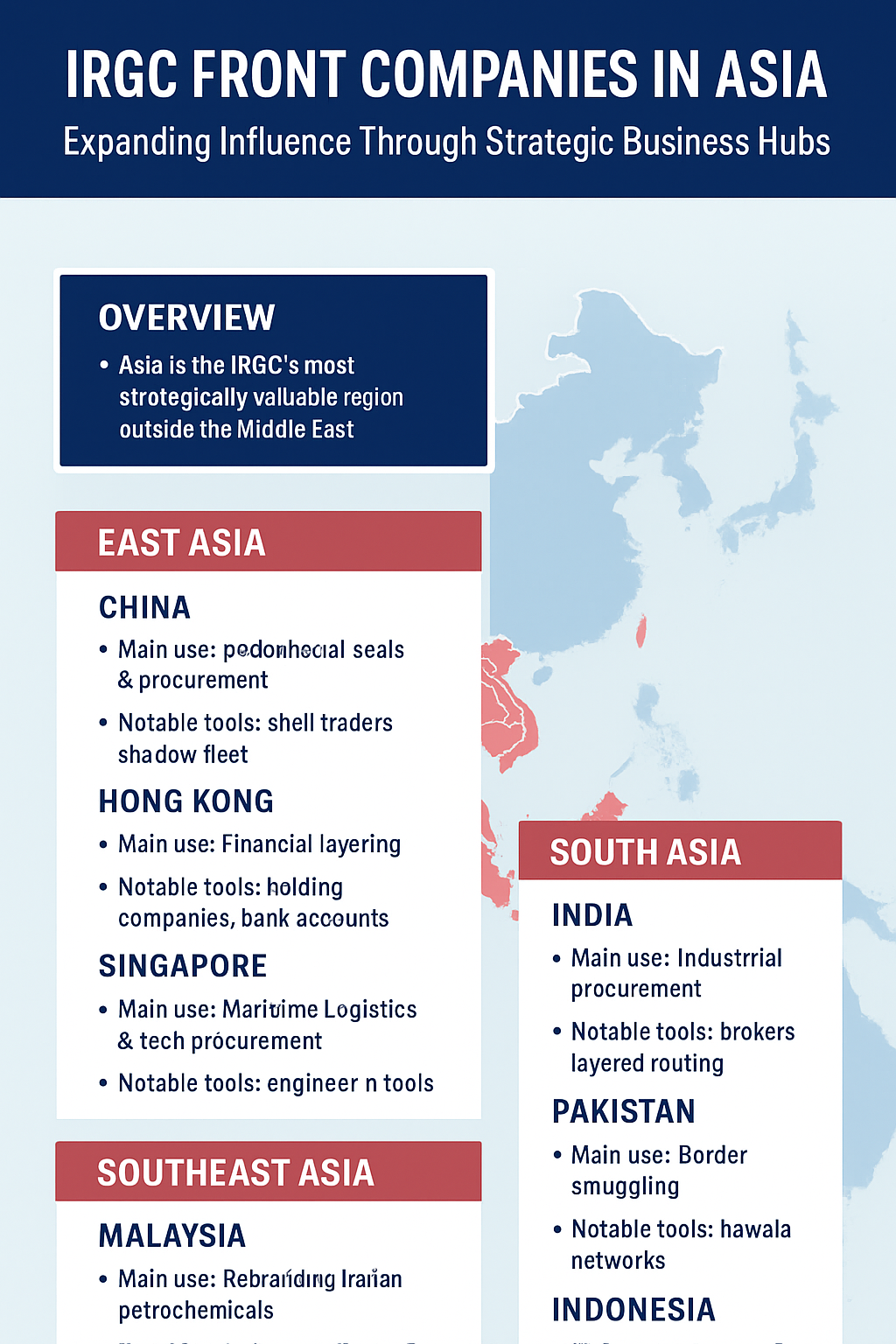
6.1. Overview: Why Asia Matters for the IRGC’s Global Business Machine
Asia is the IRGC’s most strategically indispensable region outside the Middle East. At a time when Western sanctions increasingly restrict formal banking access, fleet ownership, and commodity trade channels, Asia offers the IRGC something unique: a multi-layered environment where opportunity intersects with legal ambiguity.
Several characteristics make Asia the IRGC’s “perfect storm” operational zone:
High-volume, high-ambiguity trade ecosystems
Ports like Shanghai, Singapore, Port Klang, Mumbai, and Jakarta handle millions of containers monthly. In such overwhelming traffic, IRGC-linked shipments—whether petrochemicals, sanctioned equipment, or dual-use machinery—can be quietly absorbed.
Flexible corporate registration frameworks
Many Asian countries allow companies to be registered:
- without physical presence
- using nominee directors
- with minimal transparency
- through online portals with weak audits
This regulatory laxity is a gift to the IRGC, enabling it to establish entire commercial ecosystems with minimal visibility.
Energy-dependent economies
China, India, and several Southeast Asian nations rely heavily on oil imports. Iranian crude—sold well below global market prices due to sanctions—makes IRGC-controlled oil operations highly attractive despite the associated risks.
Strategic geography
Asia’s choke points and transit corridors—Strait of Malacca, South China Sea lanes, Gwadar–Chabahar axis—enable Iran-related logistics, both overt and covert.
In short:
Asia is not just a region where IRGC front companies exist. It is where they scale, connect, and extract maximum economic value.
6.2. East Asia – The Core of IRGC Commercial Camouflage
6.2.1. China: The Petrochemical Lifeline
China is the single most important external market for IRGC-linked petroleum exports. Despite sanctions, Iranian oil—much of it managed by IRGC-controlled groups—continues to reach Chinese refineries through:
- shell companies registered in Guangzhou and Shenzhen
- small “import-export” firms created by brokers
- AIS-dark tankers delivering oil to independent Chinese refineries (teapots)
In 2023–2024, Western intelligence indicated that over 80% of Iran’s oil exports reached China through disguised transactions involving front companies, many acting on behalf of IRGC-linked commercial networks.
Why China Works So Well
- A huge grey-market fuel sector.
- Local brokers willing to falsify documentation for fees as small as $3,000 per shipment.
- Local refineries that prefer discounted oil, regardless of origin concerns.
- Maritime zones like Fujian, Shandong, and Zhejiang, where ships frequently offload oil far from official terminals.
Common IRGC Sector Operations in China
| Sector | Purpose |
| Petrochemical trading | Rebranding, blending, smuggling Iranian crude |
| Maritime logistics | Tanker leasing, vessel switching |
| Industrial machinery | Acquisition of banned components |
| Dual-use electronics | Procurement using multi-step intermediaries |
Case Study: The “Yiwu Import Network”
Yiwu, a global hub for micro-exporters, is a core platform for IRGC operations. Companies with generic names—“Yiwu Silver Star Trading,” “Yiwu Sunrise Imports”—often act as:
- invoice issuers
- payment recipients
- fake end-user suppliers
They rarely hold physical stock. Their purpose is to sanitize paperwork, enabling Iranian-origin shipments to be processed as “Asian private trade.”
6.2.2. Hong Kong: The Banking and Paper Trail Hub
Hong Kong functions as the IRGC’s financial invisibility cloak.
Key Advantages
- Corporate structures can be created within 24 hours.
- Nominee directors and offshore shareholders are easily arranged.
- Banks historically accepted layered offshore accounts.
- Hong Kong companies can own mainland Chinese entities seamlessly.
Typical Operation Model
- Create a Hong Kong company (e.g., “Bright Peak Global Ltd”).
- Register a subsidiary in Guangdong or Fujian.
- Conduct trade using the Chinese subsidiary.
- Clear payments via Hong Kong banks.
Thus, the Hong Kong entity appears compliant, while the Chinese subsidiary operates in grey zones.
Sectors Frequently Used
- electronics and chip exports
- marine chartering
- commodity brokerage
- general consulting (a cover-all term used to mask cash flows)
Hong Kong’s role is not operational but financial—it gives IRGC affiliates access to global banking rails, often bypassing sanctions screening through maze-like ownership structures.
6.2.3. Singapore: Maritime Powerhouse and Procurement Hub
Singapore, though heavily regulated, remains a strategic procurement and maritime node.
Why Singapore Remains Valuable
- It hosts Asia’s most sophisticated maritime ecosystem.
- Thousands of ship-brokers, bunkering firms, and maritime insurance agencies operate there.
- Advanced tech procurement is easily disguised as lawful trade.
IRGC Activities Observed
- Leasing tankers via cut-out companies.
- Contracting Singapore-based maritime service providers for AIS manipulation software, underwater maintenance, and forged certification.
- Procuring machine tools and lab equipment through intermediaries and re-exporting them to Dubai or Malaysia before final transfer to Iran.
Singapore also hosts refineries and storage tanks that IRGC-linked tankers quietly interact with through ship-to-ship transfers in nearby waters.
6.3. South Asia – Heavy Industry, Mining, and Transport Corridors
6.3.1. India: The Procurement Crossroads
India is central to industrial and chemical supply chains benefiting IRGC operations.
Key Procurement Categories
- industrial solvents
- pharmaceutical precursors
- engineering machinery
- spare parts for manufacturing lines
- agri-commodities used for money cycling
IRGC-linked procurement agents exploit India’s enormous trading ecosystem, with millions of small-to-medium companies acting as middlemen.
Common Tactics
- Use of three or four layers of intermediaries to disguise end-users.
- Buying equipment under the name of Indian traders, routing through UAE, then re-exporting to Iran.
- Using Indian freight-forwarders for “cargo splitting” — dividing one sanctioned shipment into multiple small consignments.
Port cities like Mumbai, Mundra, Kandla, and even Chennai have recorded suspicious shipments linked to dual-use goods with Iranian final destinations.
6.3.2. Pakistan: Informal Networks and Border Economies
Unlike India, Pakistan supports the IRGC with informal networks, not corporate ones.
What Enables IRGC Activity in Pakistan?
- A 900-km porous border with Iran.
- Tribal networks involved in fuel and goods smuggling.
- Local construction firms that operate with cash-based accounting.
- The hawala system: enabling hard-to-trace fund transfers.
Key Activity Zones
- Fuel smuggling routes from Sistan-Baluchestan.
- Construction companies in Karachi and Quetta used as cash laundries.
- Mineral exports (e.g., chromite) used to mask proceeds of illicit trade.
Pakistani networks are valuable because they provide deniable, cash-driven, non-corporate routes for IRGC operations.
6.4. Southeast Asia – Maritime Shadow Fleet & Layered Corporate Laundering
6.4.1. Malaysia: A Hub for Petrochemical Rebranding and Offshore Structures
Malaysia’s offshore zones (especially Labuan) are a cornerstone of IRGC maritime commerce.
Why Malaysia Is Useful
- Offshore companies require minimal disclosure.
- Ports like Port Klang handle millions of containers with limited transparency.
- Local refiners can blend or relabel crude with minimal oversight.
IRGC-linked Malaysian Operations
- Creating Labuan companies used for tanker leasing.
- Issuing fake “certificates of origin” declaring cargo as Malaysian.
- Blending Iranian crude with Malaysian or Indonesian crude.
Many Malaysian front companies list vague activities like:
- petrochemical trading
- marine logistics
- general export
—but operate as paper entities masking IRGC revenue flows.
6.4.2. Indonesia: Epicentre of Shadow Maritime Operations
Indonesia is a logistics playground for the IRGC due to its geography.
Why Indonesia Works
- Over 17,000 islands—ideal for mid-sea transfers.
- Thousands of small shipping firms available for purchase or lease.
- Weak vessel-monitoring in remote waters.
Typical IRGC Maritime Workflow
- A rented Indonesian company acquires a tanker.
- The tanker reflags under Indonesian jurisdiction.
- It sails to remote waters near Batam or Belawan.
- Ship-to-ship transfer occurs with an Iranian vessel operating AIS-dark.
- Cargo is re-exported to East Asia.
These practices form the backbone of the shadow fleet—over 350–400 vessels globally—many used explicitly for IRGC-linked petroleum transport.
6.5. Summary: How Asia Helps the IRGC Avoid Global Visibility
Asia is not one operating zone—it is seven ecosystems, each providing the IRGC with unique operational advantages:
| Region | Main Use | Notable Tools |
| China | Oil sales, petrochemicals | shell traders, blending operations |
| Hong Kong | Banking + ownership layering | offshore holdings, nominee directors |
| Singapore | Maritime services | tanker leasing, tech procurement |
| India | Industrial procurement | multi-layer intermediaries |
| Pakistan | Smuggling & cash channels | hawala networks, informal routes |
| Malaysia | Oil relabeling & offshore fronts | Labuan companies, refineries |
| Indonesia | Shadow fleet operations | reflagged tankers, mid-sea transfers |
Across Asia, the IRGC leverages a combination of shell companies, shadow shipping, regional loopholes, and local brokers to sustain its sanctions-defying economy.
Chapter 7 — The IRGC in Africa: Strategic Expansion Through Minerals, Ports, and Political Alliances
7.1. Why Africa Became a Strategic Target for the IRGC
Africa is more than a peripheral market for the Islamic Revolutionary Guard Corps (IRGC)—it is a strategic frontier that offers:
- Access to critical minerals needed for Iran’s sanctioned industries (chromium, cobalt, copper, gold).
- Weak regulatory structures enable shell companies to operate with minimal scrutiny.
- Corruptible political elites willing to exchange business concessions for military support.
- Maritime gateways are crucial for shadow fleet operations.
Unlike Asia—where the IRGC often hides behind commercial trade—Africa provides something different:
a place where economic, political, and security influence can be fused into a unified expansion strategy.
From mining concessions in Sudan to port-linked logistics in Djibouti, the IRGC has built a silent empire on the continent, largely unnoticed by Western observers.
7.2. East Africa — Ports, Shipping, and the Shadow Fleet
7.2.1. Sudan: The IRGC’s Earliest African Foothold
Sudan was the IRGC’s first African “stronghold” in the 1990s and early 2000s.
Key IRGC activities included:
- Weapons manufacturing support via Iranian-linked factories.
- Training programs for local militias.
- Mining concessions through Iranian fronts, often disguised as “construction companies.”
Even after political shifts in Sudan, many of the corporate footprints remained—particularly in gold mining and logistics, now operated through third-party African partners.
7.2.2. Djibouti: A Gateway for the IRGC’s Maritime Network
Djibouti sits at one of the world’s most important maritime chokepoints: the Bab el-Mandeb Strait.
While Iran does not openly control assets there, IRGC-affiliated front companies use Djibouti’s:
- Port services
- Ship repair docks
- Freight-forwarding offices
…to mask the movement of sanctioned cargo.
Several “Somali-owned” logistics firms registered in Djibouti have been linked to dual-use goods shipments, quietly tied back to IRGC procurement networks in the Gulf.
7.3. West Africa — The Mining & Money Transfer Corridor
7.3.1. Nigeria: Cover Networks Through Construction and Energy
Nigeria’s massive informal economy and weak enforcement make it fertile ground.
IRGC-linked entities typically operate in:
- Construction firms
- Transport companies
- Energy services
- Private security consulting
The IRGC’s interest in Nigeria is not ideological—it’s commercial:
- Oil swap deals
- Mining permits
- Cash-heavy operations ideal for moving funds outside the global banking system
IRGC affiliates often embed themselves into local Shia organizations as logistical cover, though their activities are primarily economic, not religious.
7.3.2. Ghana & Togo: Gold Laundering and Export Fraud
These countries have become hubs for gold-based money laundering, which is one of the IRGC’s preferred methods of:
- Converting local currency to hard assets
- Avoiding SWIFT
- Funding overseas procurement
Typical scheme:
- IRGC-linked buyers acquire gold from informal mines.
- Gold is smuggled to Dubai or Tanzania.
- It’s sold for USD and reinvested through IRGC-controlled front companies.
Companies involved often present as:
- “Mining consultancies”
- “Investment groups”
- “Commodity exporters”
…with no real operational footprint.
7.4. Central and Southern Africa — Minerals and Industrial Procurement
7.4.1. Democratic Republic of Congo (DRC): Cobalt and Copper Access
DRC’s mining industry is a magnet for sanctioned states.
IRGC front companies usually enter indirectly through:
- Lebanese business networks
- Dubai-based holding firms
- Chinese mining contractors
The goal is simple:
acquire cobalt and copper, which are vital for:
- Iranian industrial manufacturing
- Military components
- Electronics products
These materials are often exported through front companies in Zambia and Tanzania to obscure Iranian involvement.
7.4.2. Tanzania & Kenya: Logistics and Port-Based Operations
The ports of Dar es Salaam (Tanzania) and Mombasa (Kenya) are pivotal nodes for:
- Re-exporting dual-use goods
- Transhipment of crude oil disguised as African origin
- Freight-forwarder networks with IRGC ties
Common sector covers include:
- Freight logistics
- Customs brokerage
- Automotive import/export
Some companies listed as “vehicle importers” are, in fact, registered fronts used to ship industrial components bound for Iran.
7.5. How the IRGC Embeds Itself Into African Economies — Core Methods
Across the continent, the IRGC relies on a mixture of:
- Third-Nation Intermediaries
Often Lebanese, Emirati, Pakistani, or Chinese nationals serve as company directors.
- Mining Concessions Under Shell Companies
These entities rarely operate mines—they act as export pathways for minerals acquired informally.
- Local Political Patronage
Bribes, “joint ventures,” and infrastructure agreements buy silence and logistical support.
- Shadow Fleet Support
African ports provide:
- bunkering
- repair services
- false cargo documentation
for tankers carrying sanctioned Iranian oil.
- Informal Finance Structures
Hawala networks and gold smuggling routes allow:
- fund transfers
- payment for procurement
- cash-based transactions under the radar
7.6. Human Dimension — How IRGC Operations Affect Local Communities
Beyond geopolitics, IRGC-linked networks leave deep human impacts:
- Environmental degradation at informal mining sites
- Corruption that worsens governance and public services
- Co-opted local businesses used for illegal exports
- Militarisation of political factions that receive IRGC support
- Economic distortions as legitimate traders can’t compete with sanctioned, cash-heavy networks
In many African countries, IRGC operations thrive in the exact areas where the state is weakest:
border regions, mining towns, and informal port economies.
7.7. Summary: Africa as the IRGC’s Invisible Expansion Belt
Africa provides the IRGC with:
| Region | IRGC Strategic Use | Example Activities |
| East Africa | Ports, shipping, logistics | Djibouti freight hubs, Sudan manufacturing |
| West Africa | Gold laundering, construction | Nigeria oil swaps, Ghana/Togo gold export |
| Central/Southern Africa | Minerals procurement | DRC cobalt, Tanzania/Kenya shipping |
Africa is not just a secondary theater, it is a core pillar of the IRGC’s long-term strategy to bypass sanctions, expand economic power, and sustain global illicit networks.
Chapter 8 — The IRGC in Europe: Sanctions Evasion, False Flags, and Corporate Layering
8.1. Introduction: Europe — A Controlled Battleground
Europe is the most difficult environment for the IRGC to operate in, yet paradoxically, it remains one of the most critical for Iran’s global sanctions-evasion system.
Why?
Because Europe offers what no other region provides:
- High-value industrial goods are needed for Iran’s energy, aerospace, and manufacturing sectors
- Advanced financial infrastructure that can move large sums with global legitimacy
- Complex corporate laws that create exploitable ambiguity
- Diaspora networks that can be co-opted for procurement or influence
Europe is not a place where the IRGC operates openly.
It is a place that hides behind the cleanest possible corporate masks, using local nationals, third-country intermediaries, and multi-layer holding structures to appear legitimate.
This chapter exposes how the IRGC embeds itself within the European economic ecosystem, even under intense regulatory pressure.
8.2. How the IRGC Enters Europe Despite Sanctions
8.2.1. The Three-Layer Model
Across Europe, IRGC-linked networks typically use a three-layer structure:
- A European-registered company
(often in Germany, the Netherlands, Austria, Romania, or Bulgaria) - A Middle Eastern intermediary firm
(usually UAE, Turkey, Oman, or Iraq) - A final Iranian importer or IRGC-controlled entity
This design provides plausible deniability for EU authorities and delays detection.
8.2.2. European Nationals as “Clean Directors”
IRGC affiliates often hire:
- retirees
- students
- small-business owners
- immigrant intermediaries
…to act as nominee directors for companies they secretly control.
These individuals are paid modest sums to allow their names on incorporation documents.
Common covers:
- “Consulting Services”
- “Industrial Equipment Trading”
- “Import/Export Logistics”
Behind the façade, the real beneficiary is an IRGC procurement agent working from Tehran, Mashhad, or Dubai.
8.2.3. Germany as the Procurement Hub
Germany is the IRGC’s most important European procurement source, due to:
- world-leading industrial machinery
- advanced automotive components
- chemical production technology
- precision engineering tools
IRGC-linked entities typically target:
- CNC machines
- laboratory equipment
- automotive electronics
- pumps and compressors
- industrial-grade chemicals
Goods are purchased legally by a German company, exported legally to a third country, then illegally rerouted to Iran.
German customs authorities have intercepted dozens of such cases—yet hundreds succeed undetected.
8.3. The Netherlands, Belgium & Luxembourg — Logistics and Financial Routing
8.3.1. Rotterdam & Antwerp — Europe’s maritime loopholes
Rotterdam (Netherlands) and Antwerp (Belgium) are among the world’s largest ports.
Their scale provides fertile ground for IRGC-linked operations:
- transhipment of goods destined for Gulf “front states”
- mislabeled containers
- complex freight-forwarder chains
- bulk chemicals disguised as agricultural shipments
Many shipments appear to be destined for the UAE or Oman—yet customs investigations have shown that final delivery was often to Iran.
8.3.2. Luxembourg — A Financial Blind Spot
Luxembourg hosts:
- holding companies
- special investment vehicles
- private equity funds
Some Iranian-linked networks use Luxembourg entities to:
- launder oil revenues
- hold assets
- transfer payments to intermediaries
Funds appear legitimate because they pass through EU-compliant accounts—yet final beneficiaries are IRGC-linked firms registered in Dubai or Istanbul.
Luxembourg rarely appears in news coverage, precisely because it is designed to be discreet.
8.4. Eastern Europe — Export Platforms for Dual-Use Goods
8.4.1. Bulgaria & Romania — Low-Visibility Procurement Channels
These countries are attractive because of:
- lower regulatory scrutiny
- smaller export control teams
- affordable incorporation fees
- large diaspora populations
- proximity to Turkey (a key IRGC node)
Common sectors used as front covers:
- agricultural machinery
- automotive spare parts
- construction materials
- chemicals
- electronics
From here, IRGC agents route goods to the Middle East through Turkish brokers.
8.4.2. Hungary & Slovakia — Electronics and Machine Tools
These states produce:
- industrial motors
- semiconductors
- power tools
- manufacturing equipment
Due to less publicised export controls, they are regularly used as procurement channels for Iranian industries seeking:
- missile components
- aerospace-grade materials
- advanced sensors
- dual-use electronics
Exporters often do not realise their goods are ending up in Iran until long after the shipment is complete.
8.5. Italy, Spain & Greece — Maritime and Energy Networks
8.5.1. Italy: The Shipping & Engineering Nexus
Italy plays two crucial roles for the IRGC:
- engineering goods procurement — especially for energy-sector machinery
- Maritime services — building, repairing, and registering vessels
Italian front companies commonly show activities like:
- “marine services”
- “industrial engineering”
- “oilfield equipment supply”
These firms often work indirectly through UAE-based partners.
8.5.2. Greece: Tanker Leasing and Flagging
Greece is one of the world’s biggest shipping economies.
IRGC-linked networks exploit:
- small Greek shipping firms
- single-vessel companies
- flag-of-convenience opportunities
- mid-sea transfer routes near Crete and Cyprus
The IRGC’s shadow fleet uses Greek-built or Greek-managed vessels under false ownership structures.
8.5.3. Spain: A Logistics and Brokerage Corridor
Spain is primarily used for:
- Brokerage services
- Dual-use industrial goods
- Energy-sector spare parts
Spanish companies generally maintain compliant records—but the IRGC exploits “middleman” networks that obscure end-users.
8.6. How the IRGC Avoids EU Enforcement
Despite strong regulations, the IRGC succeeds through:
- Multi-Jurisdictional Layering
Companies registered in:
- Cyprus
- Malta
- Netherlands
- Czech Republic
…own subsidiaries in the UAE or Turkey, which then transact with Iran.
- False End-User Certificates (EUCs)
IRGC networks produce fraudulent EUCs claiming goods are destined for:
- Iraq
- Oman
- UAE
- Georgia
European exporters often trust these certificates.
- Re-Export via Turkey and UAE
Turkey and the UAE are the pivot points for nearly all IRGC procurement coming out of Europe.
- No direct Iranian names in ownership records
Instead:
- Afghan nationals
- Pakistani nationals
- Turkish citizens
- Lebanese businesspeople
…are used as “clean faces” to disguise IRGC involvement.
- Academic and Scientific Cover
IRGC-linked researchers sometimes approach European universities for:
- technical cooperation
- joint research
- industrial equipment
- laboratory supplies
These collaborations, once established, provide procurement pathways.
8.7. Human Dimension — The Economic Shadow of IRGC Operations in Europe
European economies face hidden risks:
- legitimate exporters unknowingly violate sanctions
- shadow supply chains fund military programs
- diaspora communities face increased surveillance
- EU financial systems become conduits for state-sponsored networks
The IRGC’s European presence is not violent or ideological—it is surgical, commercial, and highly adaptive.
8.8. Summary: Europe as the IRGC’s High-Value, High-Risk Zone
| Region | IRGC Objective | Methods |
| Western Europe | high-tech procurement | false EUCs, industrial brokers |
| Benelux | logistics + financial layering | port transshipment, holding companies |
| Eastern Europe | dual-use goods | small trading firms, third-country routing |
| Mediterranean | maritime operations | tanker leasing, shadow fleet support |
Europe is the brain of the IRGC’s global sanctions-evasion ecosystem, the place where the most sophisticated disguises are crafted.
Chapter 9 — Geographic Hubs of IRGC Front Companies: The Strategic Choke Points of a Global Empire
The IRGC’s global front-company ecosystem is not random. It is engineered around geopolitical blind spots, loose regulatory environments, and jurisdictions with a high tolerance for opaque capital flows. Over the last two decades, this network has matured into a distributed global infrastructure, enabling Tehran to move money, hide ownership, bypass sanctions, and maintain operational continuity even when individual entities are exposed.
This chapter maps the main geographic hubs—from Southeast Asia to Eastern Europe, from the Gulf to the Caribbean—and explains the strategic logic behind each region. It also identifies key sectors and notable case studies within each hub.
- The United Arab Emirates: The Nerve Center of IRGC Commercial Operations
Why the UAE Matters
For the IRGC, Dubai and Sharjah are:
- A financial gateway where Iranian capital flows under the radar through informal money channels.
- A logistics hub with world-class ports (Jebel Ali, Port Khalid) used for re-export and document laundering.
- A jurisdiction where shell companies can be rapidly set up using nominee directors.
Even after the UAE tightened compliance obligations (2019–2022), the IRGC adapted by:
- Using Afghan, Pakistani, or Syrian nationals to register companies.
- Purchasing existing dormant firms to bypass background checks.
- Embedding operations in free zones with lower disclosure requirements.
Industries of Focus
- Petrochemicals resale
- Electronics and dual-use components
- Shipping & logistics
- Precious metals trading (gold, copper, aluminium)
Notable Structures
- Layered trade companies with paid-up capital under $100,000
- Constellations of firms owned by the same passport number
- Rapid dissolution and re-formation cycles
- Iranian-linked freight forwarders using “trans-shipment disguises”
Dubai remains the undisputed headquarters of IRGC commercial laundering operations.
- Turkey: A Hybrid Hub of Political Opportunity and Commercial Access
Turkey is one of the IRGC’s most strategically valuable territories due to:
- Proximity to Iran and porous land borders
- Access to the European market
- A political environment that occasionally intersects with Iranian interests
- A business culture tolerant of nominee ownership
Key Activities
- Procurement of sanctioned technology:
Especially aviation parts, energy infrastructure components, and industrial machinery. - Money laundering via real estate:
Where Iranian operatives use property purchases to park value. - Petrochemical blending schemes:
Mixing Iranian-origin products with regional products to obscure origin.
Networks of Note
- Front companies connected to IRGC-QF operatives sanctioned by OFAC
- Firms run by Turkish-Iranian dual nationals
- Logistics companies moving sanctioned cargo through Mersin Port
Turkey is both an operational hub and a safe intermediate zone for transactions that ultimately move to Europe or the Middle East.
- Malaysia & Singapore: Southeast Asia’s Technology Procurement Triangle
Why Southeast Asia Works
Malaysia and Singapore are essential for IRGC procurement due to:
- Access to advanced electronics
- Weak coordination between customs agencies
- Use of transhipment zones to obscure the final destination
Malaysia is preferred for cover operations; Singapore for high-grade components.
Critical Sectors
- Semiconductors
- Telecommunications equipment
- Industrial control systems
- Navigation electronics and drone components
Methods
- Malaysian shell companies register as “general trading” firms
- Goods are purchased from Singaporean distributors
- Items are shipped through multiple ports — Malaysia → UAE → Oman → Iran
This region provides the IRGC with the technological backbone of its missile, drone, and surveillance systems.
- China (Including Hong Kong): The Backbone of IRGC Industrial Supply Chains
China is not just a hub. It is the industrial lifeline of the entire IRGC procurement ecosystem.
Why China Is Critical
- Massive manufacturing base
- Non-transparent corporate registries
- Hong Kong’s flexible corporate structures
- The existence of large Iranian diaspora commercial networks
IRGC Activity in China
- Petrochemical sales under disguised brands
- Technology procurement using Chinese intermediaries
- Banking operations using underground exchange networks
- Ship-to-ship (STS) oil transfers off the Chinese coast
Hong Kong
Hong Kong is the IRGC’s financial cloak, used for:
- Establishing holding companies with minimal disclosure
- Routing payments through offshore banks
- Creating multi-layered ownership chains
China is where the IRGC blends legitimacy with concealment.
- Venezuela: The IRGC’s Western Hemisphere Outpost
The Strategic Alliance
Iran and Venezuela share:
- Anti-U.S. geopolitical alignment
- Sanctioned oil economies
- Mutual dependence on illicit commercial channels
IRGC Activities in Venezuela
- Running petrochemical refurbishing projects
- Establishing joint industrial ventures
- Using Venezuelan refineries for Iran-origin crude laundering
- Training programs between IRGC-linked operatives and Venezuelan intelligence
Notable Patterns
- Front companies registered in Panama operate as legal buffers between Iran and Venezuela
- Cargo routes between Bandar Abbas and La Guaira operate under altered manifests
Venezuela gives the IRGC a Western operational base, including access to South American markets and shipping routes.
- Iraq: The IRGC’s Backyard Economic Sphere
Iraq is the IRGC’s most penetrable and friendly environment. Front companies operate in:
- Construction
- Fuel distribution
- Telecommunications
- Consumer imports
Why Iraq Matters
- Weak regulatory oversight
- Deep political infiltration through allied militias
- Informal border crossings enabling unrecorded trade
Iraq is also a conduit for:
- Cash smuggling
- U.S. dollar procurement networks
- Human smuggling routes supporting IRGC-linked operations
Iraq functions as a domestic annexe of IRGC’s economic strategy.
- Oman & Qatar: The “Clean Route” to the West
Oman
Oman serves as a silent facilitator, providing:
- Maritime cover for re-export
- Alternative banking channels with lower scrutiny
- Access to European markets through indirect shipping
- A diplomatic shield enabling discreet transactions
Qatar
Qatar, although more tightly regulated, offers:
- Access to global logistics firms
- High-value banking infrastructure
- Opportunities for real estate-based money laundering
Together, they provide the IRGC’s low-friction corridor to Western markets.
- Eastern Europe: The Sanctions Evasion Gateway
Countries like Georgia, Armenia, Serbia, and Bulgaria serve as:
- Entry points to the EU commercial system
- Low-regulation registration hubs
- Pathways for acquiring dual-use goods
Why Eastern Europe Is Attractive
- Affordable shell companies
- Corruptible officials
- Weak export controls
- Proximity to Turkey and the Caucasus
Common Tactics
- Using Armenian and Georgian brokers to procure satellite components
- Creating Serbian firms to buy European industrial machinery
- Relocating IRGC-linked shipping assets to Bulgarian registries
Eastern Europe represents the IRGC’s European loophole belt.
- Africa: The Final Frontier for Expansion
Kenya, Tanzania, Nigeria, and South Africa are emerging nodes for:
- Gold laundering
- Minerals-for-cash transactions
- Electronics re-export
- Fuel smuggling
These jurisdictions offer:
- Minimal corporate oversight
- High corruption tolerance
- Large informal economies
Africa is the IRGC’s new expansion zone, ideal for long-term covert operations.
Conclusion
The IRGC’s global network of front companies is geographically engineered, not opportunistic. Each region fulfils a specific operational role:
- UAE = Financial/logistics epicentre
- Turkey = Procurement & regional re-export
- Malaysia/Singapore = Advanced tech
- China/Hong Kong = Industrial lifeline
- Venezuela = Western hemisphere base
- Iraq = Domestic extension
- Oman/Qatar = Clean access routes
- Eastern Europe = EU loophole gateway
- Africa = Future expansion zone
Together, these hubs create a self-sustaining global machine capable of:
- Laundering billions
- Bypassing sanctions
- Acquiring sensitive technology
- Maintaining covert mobility
This geographic spread is what makes the IRGC’s economic empire one of the most resilient illicit networks in modern geopolitical history.
Chapter 10 — Case Study Deep Dives: The IRGC’s Most Influential Front Company Networks Ever Exposed
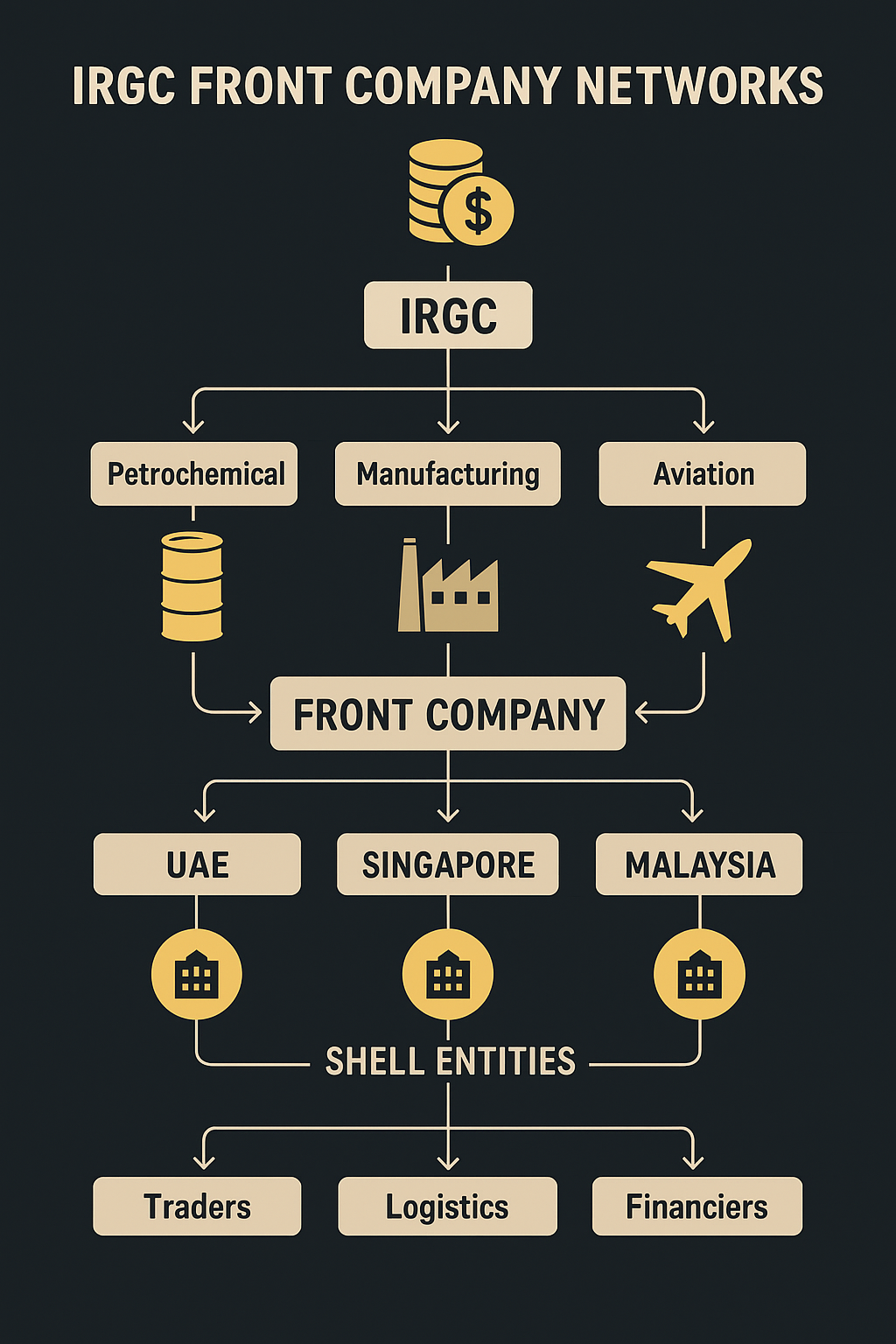
This final chapter dissects four of the most significant IRGC front-company ecosystems ever uncovered—networks that illustrate the scale, sophistication, and adaptability of the IRGC’s global commercial apparatus. These cases represent the architectural blueprints for the thousands of companies operating worldwide today. Each example reveals how the IRGC uses corporate layering, offshore finance, bilateral alliances, and illicit logistics pipelines to sustain one of the most resilient sanctions-evasion systems in modern geopolitics.
Case Study 1: The Persian Gulf Petrochemical Network (PGPCN)
The IRGC’s Billion-Dollar Global Oil Laundering Machine
Perhaps the most influential network exposed to date is the Persian Gulf Petrochemical Commercial Company Network, sanctioned by the U.S. Treasury for channeling over $1 billion annually to IRGC operations. This network is not just a group of companies—it is a shadow oil ministry, operating in parallel to Iran’s legal energy sector.
How the Network Works
The structure relies on:
- Petrochemical “rebranding” companies in the UAE, Malaysia, and China
- Shell distributors in Turkey and Singapore
- Masked tankers using ship-to-ship (STS) transfers
- Offshore holding companies registered in the BVI and Seychelles
The network sells petrochemicals under non-Iranian brand identities, using:
- Falsified country-of-origin certificates
- Misdeclared cargo types
- Third-party brokers
Scale and Impact
- It was capable of moving millions of barrels of petrochemical products annually.
- Payments were routed through Chinese shadow banks, then repatriated as “private investments” into IRGC-controlled foundations.
- The network proved that sanctions on oil exports alone cannot cripple the IRGC, because petrochemicals create a near-undetectable revenue stream.
This case laid the groundwork for dozens of successor networks.
Case Study 2: The Mahan Air Procurement & Logistics Network
The IRGC’s Aviation Lifeline for Equipment, Fighters, and Missions Abroad
Mahan Air is the IRGC’s civilian cover airline—a fleet used for transporting weapons, fighters, components, and cash across the Middle East. The network exposed by international investigators revealed over 60 front companies across Europe, the Middle East, and Asia.
Functions of the Network
- Aircraft Parts Procurement
- Through Turkish, German, and Malaysian intermediaries
- Using shell firms registered as “aviation consultancy companies”
- Smuggling components for Airbuses and Boeings
- Logistics Support for Quds Force Operations
Mahan flights were used to:- Move operatives into Syria and Lebanon
- Transport drones and missile parts
- Deliver cash to Hezbollah and militias
- Financial Layering
Payments were routed through:- Exchange houses in Istanbul
- Chinese capital circulators
- Dubai free-zone firms
Why This Network Was Revolutionary
Even after exposure:
- Mahan Air simply replaced old companies with new ones.
- Aircraft maintenance operations were outsourced to firms owned by Iranian-Turkish dual nationals.
- Real ownership was buried behind nominee directors and leased corporate identities.
This case study demonstrates the IRGC’s ability to survive even when the entire logistical backbone is publicly exposed.
Case Study 3: The Hong Kong Financial Cloaking Network
The IRGC’s Offshore Banking & Corporate Masking System
Hong Kong has long served as the IRGC’s financial invisibility cloak due to easy company registration, offshore banking access, and opaque shareholder structures.
Key Features of the Network
- Thousands of $1 founders’ companies created between 2006–2020
- Iranian shareholders hidden behind foreign student visas
- Use of non-bank financial institutions (NBFIs) to move money through Canada, China, and Australia
- Multi-layered holding companies owned by:
- BVI entities
- Seychelles IBCs
- Cook Islands trusts
Operational Roles
- Procurement Payments
Sensitive components purchased in East Asia were paid for using Hong Kong firms, creating plausible deniability. - Oil Revenue Routing
Oil shipped through Malaysia or China was paid into Hong Kong banks under unrelated commercial invoices. - Asset Concealment
IRGC senior commanders used Hong Kong firms to store:- Real estate
- Brokerage accounts
- Maritime assets
Why This Case Mattered
The exposure of these networks forced banks across Asia to:
- Increase due diligence
- Flag Iranian-linked UBOs (Ultimate Beneficial Owners)
- Shut down hundreds of accounts overnight
But the IRGC adapted by shifting to:
- Digital payment intermediaries
- Non-bank crypto OTC brokers
- Cambodian and Laotian offshore registries
This case reveals the IRGC’s evolution from simple shell companies to cyber-enabled finance operations.
Case Study 4: The Venezuela–Iran Joint Industrial Network
IRGC Economic Expansion Into the Western Hemisphere
The Iran–Venezuela industrial cooperation program has generated one of the most strategically important IRGC networks ever uncovered.
Core Elements
- Refinery Rehabilitation Companies
Iran used its state-owned engineering company (Khatam al-Anbia affiliates) to rebuild:- El Palito refinery
- Amuay complex
- Joint Manufacturing Ventures
These include:- Tractor and automotive assembly factories
- Petrochemical storage depots
- Pharmaceutical plants
- Front Companies in Panama
Panamanian logistics and trading firms acted as legal buffers between Tehran and Caracas. - Shipping and Aviation Cover
- “Ghost tankers” with disabled AIS systems
- Cargo flights delivering refinery catalysts and technology
Why It Matters
This network:
- Established the IRGC’s first sustained foothold in Latin America
- Created a sanctions-proof corridor between Iran and the Western Hemisphere
- Enabled resource exchanges: Iranian fuel → Venezuelan gold
The exposure of this network marked the moment the IRGC became a global geopolitical actor, not merely a Middle Eastern one.
Synthesis: What These Case Studies Reveal
Across all cases, the IRGC uses the same four principles:
- Corporate Redundancy
If a company is exposed, a replacement entity is formed within days.
- Geographical Diversification
Each region plays a different strategic role:
- China = manufacturing
- UAE = finance
- Turkey = procurement
- Venezuela = geopolitical cover
- Identity Masking
Heavy reliance on:
- Nominee directors
- Dual nationals
- Disposable passports
- Layered Transactions
No payment, shipment, or communication path begins and ends in the same place.
Conclusion: The Enduring Power of the IRGC’s Front Company Empire
These four case studies demonstrate a single reality:
The IRGC has built the most resilient sanctions-evasion architecture in the world.
It is:
- Distributed
- Redundant
- Global
- Adaptive
And—most importantly—it is designed to outlive exposure.