
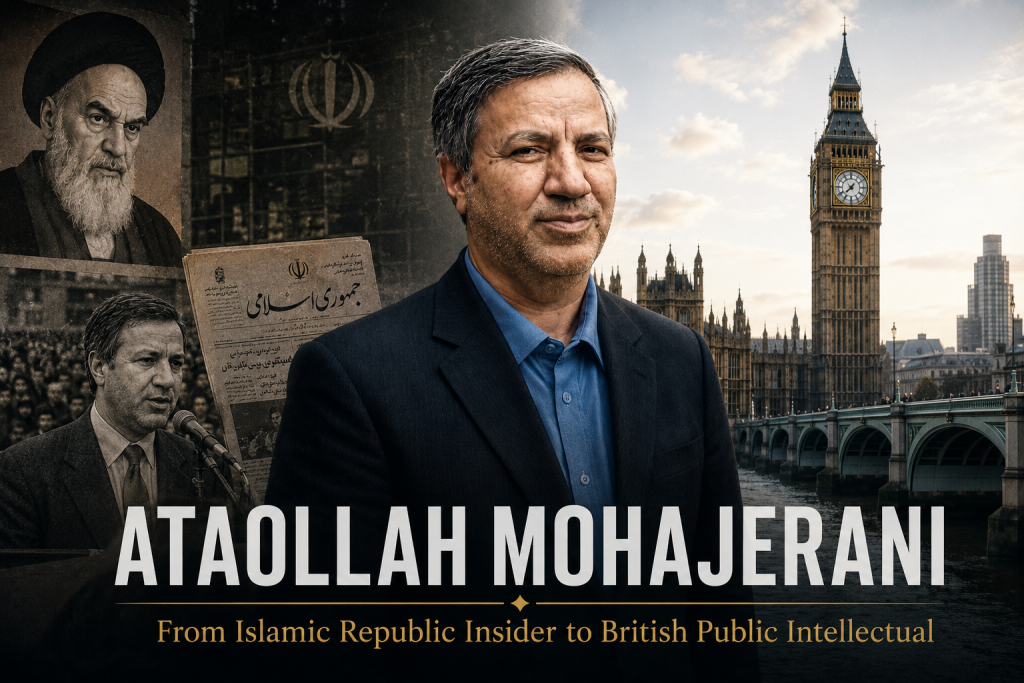
How Political Authority Built Inside the Islamic Republic Acquired a Second Life in Britain
Introduction: The Narrative Problem
The survival of authoritarian systems is often explained through the language of force.
Observers point to security services, prisons, intelligence agencies, censorship mechanisms and political repression. These instruments matter. The Islamic Republic has relied upon all of them throughout its existence. Yet coercion alone does not explain how a political system survives for nearly half a century despite recurring waves of public opposition, economic crisis, international isolation and repeated legitimacy shocks.
Authoritarian systems do not survive through fear alone.
They also survive through narratives.
They survive through individuals capable of explaining them, defending them, humanising them, contextualising them or simply making them appear less dangerous than they are. They survive through networks that shape perception. They survive through intermediaries who translate political realities into more acceptable language for external audiences. They survive through institutions willing to platform those narratives and audiences willing to consume them.
The Islamic Republic is no exception.
Previous IranSTO investigations have examined the financial structures that sustain the regime, the institutions responsible for repression, the international mechanisms that reduce accountability costs and the narratives that have repeatedly softened scrutiny of the system. From sanctions evasion networks and offshore financial structures to the mythology of reformism, transnational legitimacy and international accommodation, a recurring pattern emerges.
The survival of the Islamic Republic cannot be understood solely through events inside Iran.
It must also be understood through the ecosystem that exists outside Iran.
Questions surrounding that ecosystem did not begin after 1979.
Long before the Islamic Republic consolidated power, debates existed regarding the role of foreign platforms, international actors, political intermediaries and external narratives in shaping perceptions of Iran’s future. Those questions did not disappear with the establishment of the new regime. They evolved. Over the following forty-seven years, they became embedded within media environments, academic institutions, policy discussions, diaspora networks and diplomatic frameworks across the Western world.
At the centre of this process lies a simple but uncomfortable question.
Who gets to explain Iran to the outside world?
More specifically, who gets to explain the Islamic Republic?
The answer is rarely straightforward.
Many of the most visible voices discussing Iran in Western societies are not representatives of the Iranian public. Nor are they necessarily representatives of the victims of the regime’s repression. Some are former officials. Some are political insiders. Some participated directly in the institutions of the Islamic Republic. Others helped construct the narratives through which those institutions were presented to domestic and international audiences.
Over time, many of these figures acquired something that millions of ordinary Iranians never possessed.
Access.
Access to Western media.
Access to universities.
Access to policymakers.
Access to publishing platforms.
Access to public legitimacy.
Access to democratic protections.
The question is not whether they should be permitted to speak.
The question is why certain voices repeatedly acquire influence while others remain largely unheard.
The question is why some political histories are subjected to intense scrutiny while others appear to pass through democratic institutions with remarkably little examination.
This investigation begins with one such figure.
Ataollah Mohajerani is not a marginal participant in the history of the Islamic Republic. He is a former minister, a long-standing political insider, a public intellectual, an influential commentator and one of the most recognisable Iranian political figures to establish a public presence in Britain.
His career spans the revolutionary era, the consolidation of the Islamic Republic, the reformist period and the transnational political environment that emerged beyond Iran’s borders. Few individuals occupy so many intersections simultaneously.
For that reason, Mohajerani provides more than a biography.
He provides a case study.
His trajectory offers an opportunity to examine how political legitimacy travels across borders, how former regime insiders are received within democratic societies and how narratives associated with authoritarian systems can continue to circulate long after they leave the institutions that originally produced them.
This article is not an attempt to explain the Islamic Republic through a single individual.
Nor is it an argument that Ataollah Mohajerani alone shaped international perceptions of the regime.
Rather, his story serves as an entry point into a larger investigation.
An investigation into the networks, incentives, institutions and narratives that continue to influence how the Islamic Republic is understood, debated and often normalised outside Iran.
The most important question raised by the career of Ataollah Mohajerani is therefore not who he is.
It is what his career reveals about the wider ecosystem that made his transformation possible.
Chapter 1
From Revolution to Power
The story of Ataollah Mohajerani does not begin in exile.
Nor does it begin in Britain.
Long before he became a familiar figure in discussions about Iran outside the country’s borders, Mohajerani was a participant in the political system that emerged from the 1979 Revolution. His public profile, institutional authority and political influence were not developed in opposition to the Islamic Republic. They were developed within it.
This distinction is important.
In contemporary discussions, former officials who leave authoritarian systems are often presented primarily through the lens of their later careers. Public attention shifts towards their role as commentators, analysts, academics or critics. The result is that the institutional environments which originally produced their influence can gradually fade from view.
In the case of Ataollah Mohajerani, that institutional history is impossible to separate from the rest of his career.
Born in Arak in 1954, Mohajerani came of political age during a period of profound upheaval in Iran. The collapse of the Pahlavi monarchy and the establishment of the Islamic Republic created unprecedented opportunities for a new political class. Mohajerani was among those who entered public life during this formative period and would go on to spend decades inside the structures of the new state.
His integration into the post-revolutionary system occurred early.
In the first parliamentary elections of the Islamic Republic, Mohajerani was elected to the Majles as a representative of Shiraz. This was not a peripheral position. The first parliament played a significant role in consolidating the institutional foundations of the newly established regime. The Islamic Republic was not yet a mature political system. Its structures, priorities and governing norms were still being formed. Participation in these institutions therefore represented participation in the construction of the state itself.
Over the following years, Mohajerani continued to move through the upper levels of the political establishment.
During the premiership of Mir-Hossein Mousavi, he served in senior parliamentary and legal roles within government. Later, under President Akbar Hashemi Rafsanjani, he became Vice President for Legal and Parliamentary Affairs. These were positions located close to the centre of executive power. They were not symbolic appointments. They involved participation in the management and operation of the Islamic Republic at a national level.
By the 1990s, Mohajerani had become one of the most recognisable political figures associated with what would later be described as the reformist current of the Islamic Republic.
That label would become central to his public image.
Yet it is important to understand what reform meant within the political environment of the Islamic Republic. Reformist figures often disagreed with conservative factions over cultural policy, electoral participation and the pace of political change. However, these debates largely took place within the framework of the system itself. Reformism represented an internal political tendency, not a rejection of the Islamic Republic as a governing structure.
Mohajerani’s appointment as Minister of Culture and Islamic Guidance under President Mohammad Khatami in 1997 elevated him to one of the most visible positions in the country.
Outside observers frequently associated his tenure with cultural liberalisation and a more open intellectual climate. Newspapers expanded, publishing activity increased, and cultural debates became more visible than they had been in previous years. These developments contributed significantly to Mohajerani’s reputation both inside and outside Iran.
Yet the institution he led remained a central component of the state’s cultural architecture.
The Ministry of Culture and Islamic Guidance was not merely a cultural body. It functioned as a regulatory institution responsible for licensing, supervising and controlling large areas of public intellectual and cultural life. Publishing, journalism, cinema, literature and artistic production all operated within a framework shaped by state oversight. The boundaries of permissible expression remained subject to political authority even during periods described as reformist.
This dual reality would become a recurring feature of discussions surrounding Mohajerani.
To supporters, he represented cultural openness and gradual reform.
To critics, he remained a senior official of a system whose fundamental structures of power remained intact.
Both interpretations emerged from the same historical reality.
What cannot be disputed is that Mohajerani’s political authority was built inside the institutions of the Islamic Republic rather than outside them.
For nearly three decades he occupied positions within the state’s legislative, executive and cultural apparatus. He was not a dissident excluded from power. Nor was he a detached observer analysing events from a distance. He was part of the governing system during some of the most consequential decades of its development.
This fact matters because it provides the context through which every subsequent stage of his career must be understood.
Before Ataollah Mohajerani became a commentator, an author or a public intellectual in Britain, he was a political insider of the Islamic Republic.
The remainder of his story begins from that position, not apart from it.
Chapter 2
The Narrative Function
Power is exercised in different ways.
Some political figures command security forces. Others control budgets, ministries or bureaucracies. Some shape laws. Others shape perceptions.
The career of Ataollah Mohajerani is notable not simply because of the offices he held, but because of the particular role he came to occupy within the political ecosystem of the Islamic Republic. Throughout much of his public life, Mohajerani functioned less as an administrator of coercion and more as a communicator of political meaning.
This distinction matters.
Authoritarian systems require more than institutions capable of enforcing obedience. They also require individuals capable of explaining those institutions, defending them, contextualising their actions and presenting them in forms that are more acceptable to domestic and international audiences. Every political system relies upon narratives. Systems facing persistent legitimacy challenges depend upon them even more.
The Islamic Republic has spent much of its existence confronting precisely such challenges.
War, economic crisis, political unrest, international isolation, sanctions, human rights controversies and repeated waves of domestic protest have generated continuous pressure on the regime’s claim to legitimacy. Under such conditions, the management of political narratives becomes an essential function of governance.
Mohajerani emerged as one of the figures associated with that function.
Unlike many political officials whose influence remained largely confined to bureaucratic structures, Mohajerani developed a public profile that extended into journalism, publishing, cultural policy and political commentary. His prominence was linked not merely to his positions inside government but also to his ability to participate in public debates regarding the identity, direction and future of the Islamic Republic.
This became particularly visible during the presidency of Mohammad Khatami.
Outside Iran, the late 1990s were widely presented as a period of political opening. Terms such as “moderation”, “reform”, “civil society” and “dialogue” became closely associated with the public image of the Islamic Republic. For many Western observers, reformism appeared to represent a meaningful departure from the political practices of earlier decades.
Figures such as Mohajerani played an important role in shaping that perception.
As Minister of Culture and Islamic Guidance, he became one of the most internationally recognisable faces of the reformist era. His public statements, cultural policies and engagement with intellectual debates helped construct an image of gradual transformation within the system. Whether that transformation was substantial, limited or largely symbolic remains a subject of debate. What is not debatable is that the narrative itself became one of the most influential political products of the period.
The significance of this development extends beyond the question of reform.
Narratives possess strategic value.
A government widely perceived as capable of self-correction faces different levels of external pressure than one viewed as fundamentally incapable of reform. A political system believed to contain powerful reformist currents often receives greater patience from international actors than a system regarded as permanently closed.
This does not mean that every reformist figure consciously participated in a coordinated political project. Nor does it mean that all advocates of reform shared identical goals.
However, the broader effect of reformist discourse deserves examination.
For decades, reformist narratives contributed to a perception that meaningful political change remained achievable within the framework of the Islamic Republic itself. This perception persisted through repeated cycles of political disappointment, institutional resistance and state repression. Yet the narrative survived far longer than many of the expectations attached to it.
Mohajerani’s career sits at the centre of this history.
His public reputation became closely linked to the language of reform, openness and intellectual engagement. These themes helped establish his credibility both inside Iran and abroad. They also positioned him as a figure capable of speaking across multiple audiences simultaneously: political insiders, intellectual circles, media institutions and international observers.
The ability to move between these environments is significant.
Many political officials possess authority but lack public legitimacy. Others enjoy public visibility but have little direct experience of power. Mohajerani occupied an unusual position because he possessed both. He could speak as a former minister, a participant in the revolutionary system, a public intellectual and later as a commentator living beyond Iran’s borders.
This combination would become increasingly important after he departed from Iran.
The political authority acquired inside the Islamic Republic did not disappear when he left the country. On the contrary, it became one of the foundations of his public relevance abroad. The value of his voice in international discussions about Iran derived precisely from his historical proximity to the system itself.
That reality raises a question that extends beyond Mohajerani as an individual.
How should democratic societies evaluate political figures whose credibility is rooted in institutions that many of those same societies routinely criticise?
The question is particularly important when those institutions are associated with censorship, repression and restrictions on political freedoms.
Yet this tension is rarely examined in detail.
Former officials are often discussed through the lens of their present identities rather than the structures that originally produced their authority. The result is that political biographies can become detached from institutional history.
In the case of Ataollah Mohajerani, such a separation is impossible.
His later role as an author, commentator and public intellectual cannot be understood independently of the political system within which his influence was first created.
Understanding that relationship is essential because it reveals a broader pattern.
The Islamic Republic does not project influence exclusively through embassies, state media or official representatives. Influence also travels through individuals. It travels through biographies. It travels through public reputations constructed over decades.
Before examining Mohajerani’s life in Britain, it is therefore necessary to examine one of the most consequential controversies of his public career: his relationship to the Salman Rushdie fatwa.
It is here that questions of narrative, legitimacy, freedom of expression and political responsibility converge most clearly.
Chapter 3
The Rushdie Question
Some political controversies fade with time.
Others become part of the historical record and continue to shape public life decades after the events that first produced them.
For Ataollah Mohajerani, no issue better illustrates this reality than the controversy surrounding Salman Rushdie.
More than thirty years after the publication of The Satanic Verses, the question continues to occupy a unique place within his political biography. It remains one of the clearest examples of the intersection between ideology, political authority, freedom of expression and democratic accountability.
Unlike many controversies associated with the Islamic Republic, the Rushdie affair was never confined to Iran.
From the moment Ayatollah Ruhollah Khomeini issued his fatwa against Salman Rushdie in February 1989, the issue became international. Governments responded. Writers responded. Publishers responded. Security services became involved. Questions concerning the limits of free expression, religious offence and political violence moved from domestic politics into global debate.
The consequences extended far beyond the publication of a single novel.
For many observers, the fatwa represented a direct challenge to one of the foundational principles of democratic societies: the idea that ideas should be contested through argument rather than violence.
For others inside the Islamic Republic, the issue was framed very differently. The controversy was presented not as a question of freedom of expression but as a question of religious legitimacy, blasphemy and the defence of sacred values.
It was within this political environment that Ataollah Mohajerani entered the debate.
At the time, he was not an independent observer.
Nor was he a detached intellectual commenting from outside the system.
He was a political insider whose career was already developing inside the institutions of the Islamic Republic.
In 1989, Mohajerani published a book entitled A Critique of the Satanic Verses Conspiracy (Naghd-e To’te-ye Ayat-e Sheytani).
The book became one of the most widely cited intellectual defences of the Islamic Republic’s position regarding Salman Rushdie.
According to reporting and later analysis of the text, Mohajerani argued in support of the religious foundations underlying the fatwa and defended the view that insulting the Prophet of Islam carried severe consequences under traditional Islamic jurisprudence.
The significance of the book extends beyond the political atmosphere of 1989.
Political systems often produce passionate responses during moments of crisis. Individuals adopt positions that later evolve, soften or disappear entirely. Historical controversies frequently lose relevance as political circumstances change.
The Rushdie question followed a different trajectory.
Rather than disappearing, it remained attached to Mohajerani’s public identity.
The issue returned dramatically to international attention in August 2022 when Salman Rushdie was stabbed during a public event in New York and suffered life-changing injuries.
The attack revived global discussion surrounding the original fatwa and those who had publicly supported or defended it.
Questions that many assumed belonged to history suddenly became contemporary once again.
Among those asked to address their past positions was Ataollah Mohajerani.
The responses attracted attention because they appeared to reveal continuity rather than distance.
While expressing regret regarding the attack itself, Mohajerani did not publicly repudiate the book he had written in defence of the fatwa. Reports published after the attack indicated that he continued to defend the decision to write the book and did not disown its central arguments.
For critics, this was deeply significant.
The issue was no longer what had been written in 1989.
The issue was whether those arguments still carried political or moral legitimacy more than three decades later.
The controversy soon moved beyond public debate.
In Britain, complaints were submitted to the Metropolitan Police requesting an investigation into statements associated with Mohajerani’s support for the fatwa.
The legal merits of those complaints remain separate from the broader political questions raised by the case. What matters for this investigation is that the issue was not confined to historical archives.
It became a contemporary question inside Britain itself.
This development is important because it transformed the Rushdie affair from a historical controversy into a modern test of democratic accountability.
By this point, Mohajerani was no longer a serving official of the Islamic Republic.
He was a resident of Britain.
He was participating in public debate within a democratic society built upon principles of free expression and legal protection for writers, journalists and intellectuals.
The contrast could hardly have been sharper.
The same society that had spent decades defending Salman Rushdie’s right to write and publish also provided legal protections and public space to a former official associated with one of the most prominent defences of the fatwa issued against him.
This observation should not be interpreted as a call for censorship.
Nor is it an argument that controversial views should be prohibited.
The issue is not whether Mohajerani has the right to express his opinions.
The issue is how democratic societies evaluate the historical records of influential public figures.
Can support for a decree calling for violence against a writer be treated simply as a historical opinion?
Does the passage of time eliminate the need for scrutiny?
Should public influence acquired in democratic societies be examined independently of the political histories that originally produced it?
These questions do not have simple answers.
What is clear, however, is that the Rushdie affair occupies a unique position within the career of Ataollah Mohajerani.
It is not merely one controversy among many.
It is the point at which questions of political history, intellectual responsibility, democratic values and public legitimacy converge.
More importantly, it reveals a broader issue that extends beyond one individual.
The challenge facing democratic societies is not how to silence controversial voices.
The challenge is how to engage with them while maintaining a consistent standard of scrutiny.
The story of Ataollah Mohajerani and Salman Rushdie demonstrates why that distinction matters.
Because before questions of expertise, reform, moderation or political analysis can be addressed, a more fundamental question remains:
How should democratic societies understand public figures whose political histories include the defence of ideas fundamentally at odds with the freedoms those societies seek to protect?
Chapter 4
Ataollah Mohajerani in Britain
Political careers do not always end when officials leave power.
In many cases, they simply change geography.
Throughout modern history, former ministers, party officials, diplomats and political insiders have left the systems that originally produced them and established new public lives elsewhere. Some disappear from public view. Others remain politically active. A smaller number succeed in transforming themselves from participants in power into interpreters of power.
Ataollah Mohajerani belongs firmly to the latter category.
By the late 2000s, after decades spent inside the institutions of the Islamic Republic, Mohajerani had relocated to Britain. The move represented a geographical shift, but not a withdrawal from public life. His political relevance did not end when he left Iran. Instead, it entered a new phase.
The significance of this transition lies not in the fact that Mohajerani settled in Britain.
The significance lies in what happened afterwards.
Like many former officials who leave authoritarian systems, Mohajerani entered an environment fundamentally different from the one that had shaped his career. The Islamic Republic had provided the institutions through which he acquired political authority. Britain provided the institutions through which that authority could be repackaged, interpreted and projected into new audiences.
The distinction is important.
Political authority and political influence are not the same thing.
Authority is often acquired through office.
Influence is often acquired through access.
Britain provided access.
Access to publishing.
Access to media.
Access to public debate.
Access to academic and intellectual environments.
Access to transnational audiences.
Over time, Mohajerani established himself not primarily as a former minister but as an author, commentator and public intellectual. His public profile increasingly shifted away from direct association with government office and towards participation in wider discussions concerning Iran, the Middle East and international affairs.
Yet the source of his credibility remained unchanged.
His value as a commentator derived from the fact that he had been an insider.
The audience interested in Mohajerani was not interested in him despite his role inside the Islamic Republic.
It was interested in him because of it.
This dynamic would become visible across multiple platforms.
Mohajerani continued writing and publishing after leaving Iran. He became a contributor to international publications, including Al Majalla, where his profile identifies him as a former Minister of Culture and Islamic Guidance and a former member of the Iranian parliament. His public role was therefore built upon the authority of a political biography that remained inseparable from the Islamic Republic itself.
His presence also extended beyond publishing.
Over the years, Mohajerani participated in public events, cultural forums and international dialogue initiatives. Such participation illustrates a broader phenomenon visible throughout Western societies: former officials of authoritarian systems often acquire second careers as interpreters of the very systems they once served.
The process does not require formal representation.
Indeed, it often functions more effectively without it.
The former official appears not as a government spokesperson but as an independent commentator. The authority of lived experience remains intact while the formal responsibilities associated with office gradually recede into the background.
The result is a form of political continuity operating beneath the appearance of political distance.
One of the clearest examples emerged in November 2025.
Mohajerani participated in a debate at the Oxford Union, one of the most prestigious debating societies in the English-speaking world. The event focused on questions surrounding the Middle East and regional stability. Regardless of the positions advanced during the debate, the significance of the event lies elsewhere.
Oxford Union is not merely a venue.
It is a symbol.
For generations, political leaders, diplomats, academics, journalists and public intellectuals have used its platform to shape public discourse. Participation reflects admission into a highly visible environment of intellectual legitimacy.
The symbolism is difficult to ignore.
A former senior official of the Islamic Republic was participating in one of Britain’s most prominent institutions of public debate, discussing regional politics before an international audience.
The issue is not whether he should have been invited.
The issue is what such invitations reveal about the relationship between democratic institutions and former political insiders.
The pattern becomes even more striking when viewed alongside the controversy examined in the previous chapter.
By the time Mohajerani appeared in Oxford, questions surrounding his historical defence of the Salman Rushdie fatwa had already returned to public attention. Complaints had been submitted to the Metropolitan Police. Public debate regarding his earlier writings had re-emerged. Yet none of this prevented his continued participation within Britain’s public sphere.
This observation should not be interpreted as evidence of coordination.
Nor should it be interpreted as evidence of institutional endorsement.
Democratic societies do not function through centralised control of public participation.
The reality is both more complex and more revealing.
Individuals acquire influence because institutions repeatedly regard them as valuable participants in public discussion.
The question therefore shifts from intention to incentives.
Why are former insiders valuable?
The answer is straightforward.
They provide access.
They provide context.
They provide interpretation.
They provide insight into systems that outsiders struggle to understand.
These qualities make them attractive to journalists, researchers, universities, conference organisers and policy communities.
Yet they also create an important tension.
The authority that grants access to these platforms is frequently the same authority that was originally generated inside the political system under examination.
In the case of Mohajerani, the relationship is impossible to separate.
His credibility as a commentator on the Islamic Republic derives directly from his participation in it.
His public relevance outside Iran remains rooted in his public role inside Iran.
This reality does not invalidate his contributions.
Nor does it automatically diminish the value of his observations.
It does, however, require scrutiny.
Because political biographies do not disappear when borders are crossed.
The institutions that produced authority remain part of the story.
The case of Ataollah Mohajerani demonstrates how political influence can survive relocation, adapt to new environments and acquire renewed legitimacy within democratic societies. More importantly, it reveals that the movement of former officials into Western public life is not simply a story of exile or migration.
It is a story of transformation.
A story in which political authority generated inside an authoritarian system can become intellectual authority inside a democratic one.
And it is precisely this transformation that raises the central question of the next chapter.
How do democratic societies reconcile their commitment to openness with the accommodation of individuals whose authority remains inseparable from authoritarian power?
Chapter 5
The British Contradiction
The central question raised by the case of Ataollah Mohajerani is not whether he should be permitted to live in Britain.
Nor is it whether he should be allowed to write, publish, speak or participate in public debate.
The answer to those questions is straightforward.
In a democratic society, he should.
The more difficult question concerns something else entirely.
Scrutiny.
How do democratic societies evaluate individuals whose political authority was built inside authoritarian systems?
What standards are applied?
Are those standards applied consistently?
And perhaps most importantly, who benefits when those standards become selective?
These questions become unavoidable when examining the trajectory of Mohajerani.
For decades, he participated in the political institutions of the Islamic Republic. He served in parliament. He occupied senior executive positions. He became Minister of Culture and Islamic Guidance. His public reputation was constructed inside a political system that exercised extensive control over journalism, publishing, political participation and public expression.
Today, he lives within a society built upon principles fundamentally different from those that characterised much of the system in which his political identity was formed.
This is the contradiction.
Not because Mohajerani lives in Britain.
But because the relationship between democratic openness and political accountability is rarely examined with equal intensity.
Britain rightly takes pride in traditions of free expression, academic inquiry and political pluralism. These principles distinguish democratic societies from authoritarian ones. Individuals are not expected to prove ideological purity before participating in public life. Former officials, political opponents and controversial figures may all express their views without fear of state persecution.
This openness is a strength.
Yet openness alone does not eliminate the need for scrutiny.
The question is not whether individuals should be heard.
The question is how their histories are understood when they are.
Throughout modern political history, democratic societies have often subjected certain political backgrounds to extensive examination. Associations with extremist movements, authoritarian governments or repressive institutions frequently become subjects of public interest. Journalists investigate. Academics analyse. Political opponents question. Public debate follows.
Such scrutiny is often considered both legitimate and necessary.
Why then do some political biographies appear to attract far less attention than others?
The question becomes particularly relevant in relation to former officials of the Islamic Republic.
For nearly half a century, the Islamic Republic has been associated with censorship, political imprisonment, restrictions on civil liberties, suppression of dissent and repeated episodes of state violence. These realities are not matters of partisan interpretation. They are documented by governments, international organisations, journalists, researchers and human rights monitors across decades.
Yet former participants in this system frequently enter Western public discourse through different categories.
They become analysts.
Commentators.
Experts.
Public intellectuals.
Former reformists.
Middle East specialists.
The transformation is often so complete that the institutions from which their authority originally emerged become secondary details.
Political biographies are gradually replaced by professional identities.
Historical context fades.
Public memory shortens.
The individual remains.
The institutional history recedes.
This does not occur only in the case of Ataollah Mohajerani.
His significance lies in the fact that his career illustrates a broader pattern.
The issue is not whether every former official remains loyal to the system they once served. Nor is it whether personal views can evolve over time. People change. Political positions change. Historical circumstances change.
The issue is whether democratic societies apply the same level of curiosity to these transformations that they apply elsewhere.
How often are former officials of the Islamic Republic asked to account for the institutions that produced them?
How frequently are difficult questions raised regarding their past positions?
How often are their historical roles examined with the same intensity directed towards other political actors?
The answers are not always obvious.
What is obvious is that public attention often focuses far more heavily on current commentary than historical participation.
The result is a form of political asymmetry.
A former official may spend decades benefiting from the credibility derived from insider status while facing relatively limited examination of the structures that originally generated that credibility.
This dynamic becomes even more striking when viewed through the lens of freedom itself.
Millions of Iranians have spent decades living under restrictions that do not exist in Britain.
Journalists have faced censorship.
Writers have faced prosecution.
Publishers have faced state control.
Political activists have faced imprisonment.
Critics of the state have faced surveillance, intimidation and exclusion from public life.
The contrast is obvious.
The same democratic protections unavailable to many inside Iran are fully available to former officials once they enter Western societies.
Again, this observation is not an argument against those protections.
The opposite is true.
The protections should exist.
The question is why they so rarely generate deeper conversations about political accountability.
The case of Salman Rushdie illustrates this tension with unusual clarity.
Britain has spent decades defending the principle that writers should not face violence because of what they write. The protection of free expression is not a peripheral value within democratic society. It is one of its foundations.
Yet the controversy surrounding Mohajerani demonstrates how difficult these questions become when political history collides with democratic openness.
A former official of the Islamic Republic, residing within a liberal democracy, became associated with one of the most internationally controversial fatwas of the modern era. Decades later, those associations continued to generate public controversy inside Britain itself.
Whether one agrees with the complaints made against him is ultimately secondary.
The existence of the controversy raises a larger issue.
How should democratic institutions respond when the values that protect an individual appear fundamentally at odds with positions associated with that individual’s political past?
The question extends far beyond Mohajerani.
It reaches into universities.
Media organisations.
Publishing houses.
Policy institutions.
Research centres.
Conference platforms.
The wider ecosystem through which public legitimacy is produced.
Who is invited to speak?
Who is treated as an authority?
Who is considered representative?
Who becomes the public face of a complex political reality?
And who remains excluded from that conversation?
These questions matter because representation shapes perception.
When particular voices are repeatedly elevated, their perspectives acquire disproportionate influence. They help define what is considered reasonable, realistic, moderate or legitimate. Over time, such narratives can shape policy discussions, media coverage and public understanding.
This is where the British contradiction becomes most visible.
Britain presents itself as a defender of democratic values, political freedoms and open debate.
Yet within that environment, individuals whose political authority originated inside one of the world’s most enduring authoritarian systems can successfully acquire influence, credibility and legitimacy with remarkably little sustained examination of the institutions from which that authority emerged.
Perhaps this reflects the strengths of liberal openness.
Perhaps it reflects institutional complacency.
Perhaps it reflects a deeper tendency within Western societies to prioritise access, expertise and familiarity over historical accountability.
Whatever the explanation, the question deserves examination.
Because the issue is not merely who Ataollah Mohajerani is.
The issue is what his trajectory reveals about the broader relationship between democratic institutions and authoritarian power.
And once that question is asked, it becomes impossible to confine the discussion to a single individual.
It leads inevitably towards a larger investigation into the networks, intermediaries and legitimacy-producing structures that continue to shape international perceptions of the Islamic Republic long after their origins have disappeared from public view.
Chapter 6
From Individual Case to Structural Pattern
At this point, it would be easy to treat Ataollah Mohajerani as an exceptional case.
A former minister leaves Iran, settles in Britain, writes books, participates in public debate and becomes a commentator on the political system from which he emerged. Viewed in isolation, the story can appear unusual but ultimately limited to one individual trajectory.
That interpretation would miss the larger significance of the case.
The importance of Mohajerani lies not in his uniqueness.
It lies in his familiarity.
His story becomes more revealing when viewed not as an anomaly but as part of a recurring pattern that extends far beyond a single former minister.
For decades, Western societies have absorbed a wide range of political figures whose careers were shaped inside the institutions of the Islamic Republic. Some entered media environments. Others established academic careers. Some became policy advisers, commentators, researchers, authors or public intellectuals. Many developed new public identities that gradually overshadowed the institutional histories from which they emerged.
The details differ from case to case.
The broader pattern does not.
A political career is established inside the Islamic Republic.
Institutional authority is accumulated.
Public recognition is acquired.
The individual later relocates, gains access to Western platforms and re-enters public debate under a new set of political conditions.
The result is not necessarily direct advocacy on behalf of the Islamic Republic.
The process is often more subtle than that.
In many cases, the most significant function is not defence but mediation.
The role is not to act as an official representative of the regime.
The role is to interpret it.
To explain it.
To contextualise it.
To describe its actions as products of complexity, history, culture, factional rivalry, geopolitical pressure or misunderstanding.
Individually, such interventions may appear reasonable.
Collectively, they can produce something far more significant.
They can shape the boundaries of acceptable discussion.
This distinction is crucial.
The survival of authoritarian systems does not depend exclusively upon supporters.
It also depends upon interpreters.
Political systems facing legitimacy crises require individuals capable of translating their actions into narratives that external audiences are willing to accept, tolerate, or at least continue debating.
The Islamic Republic has benefited from such processes for decades.
Previous IranSTO investigations have examined how legitimacy travels through institutions.
The concept of transnational legitimacy refers to the ability of political systems to acquire forms of acceptance, normalisation or accommodation beyond their own borders. This process can occur through diplomacy, international organisations, academic engagement, media ecosystems and policy networks.
Yet institutions are only part of the story.
Legitimacy also travels through people.
It travels through biographies.
It travels through reputations.
It travels through individuals whose authority derives from proximity to power.
Mohajerani provides an example of this phenomenon.
His relevance within discussions of Iran does not originate from academic observation alone.
Nor does it originate solely from intellectual production.
His authority is inseparable from his historical role inside the Islamic Republic itself.
That pattern appears repeatedly across Western discussions of Iran.
Former insiders often possess qualities that institutions find attractive.
They speak the language.
They understand the political culture.
They possess personal networks.
They can provide context unavailable to outsiders.
Most importantly, they appear to offer access.
Access has value.
Journalists seek it.
Researchers seek it.
Policymakers seek it.
Governments seek it.
The demand for insight creates a market for intermediaries.
And wherever such a market exists, political legitimacy can travel alongside expertise.
This does not require conspiracy.
It does not require formal coordination.
It does not require secret instructions or hidden networks.
Political ecosystems rarely function in such simplistic ways.
Influence often emerges through incentives rather than commands.
The incentives are easy to understand.
Media organisations require commentators.
Universities require specialists.
Governments require analysts.
Think tanks require expertise.
The result is an environment in which individuals with insider experience acquire enduring value regardless of the political systems that originally produced them.
Over time, this process can generate an unexpected outcome.
The distinction between explanation and normalisation begins to blur.
The distinction between expertise and legitimacy becomes less clear.
The distinction between analysis and accommodation becomes increasingly difficult to identify.
This is not a problem unique to Iran.
Democratic societies have confronted similar questions in relation to former officials of authoritarian governments throughout modern history.
What makes the Iranian case distinctive is its longevity.
Nearly half a century after the establishment of the Islamic Republic, the same debates continue.
The same narratives reappear.
The same intermediaries often remain present.
The same assumptions about reform, moderation, engagement and gradual change continue to influence public discussion.
This persistence deserves attention.
Because it raises a difficult possibility.
Perhaps the endurance of the Islamic Republic cannot be understood solely through the actions of the regime itself.
Perhaps it must also be understood through the international ecosystems that continuously generate opportunities for reinterpretation, accommodation and narrative renewal.
Mohajerani’s trajectory points towards this possibility.
His career demonstrates how political influence can survive geographical relocation.
How authority acquired inside an authoritarian system can remain valuable outside it.
And how democratic societies can become environments in which former insiders acquire a second political life.
The significance of this observation extends beyond any individual biography.
Once the focus shifts from the person to the pattern, a broader landscape begins to emerge.
Former officials.
Former diplomats.
Media figures.
Political intermediaries.
Academic specialists.
Public intellectuals.
Different careers.
Different institutions.
Different public identities.
Yet often connected by a similar underlying dynamic: authority generated inside the Islamic Republic continues to produce influence outside it.
This is the point at which the investigation moves beyond Ataollah Mohajerani.
His story remains important.
But it is no longer sufficient.
The larger question is not why one former minister acquired a public platform in Britain.
The larger question is why similar trajectories appear repeatedly across multiple institutions, countries and decades.
Answering that question requires an examination not only of individuals but also of incentives.
Not only of biographies but of systems.
Not only of political actors but of the democratic environments that receive them.
It is to those incentives and structures that this investigation now turns.
Chapter 7
Accommodation, Incentives and Scrutiny
The case of Ataollah Mohajerani raises a question that extends far beyond one former minister.
Why does this pattern persist?
Why do democratic societies repeatedly absorb, platform and legitimise individuals whose political authority was originally constructed inside authoritarian systems?
The question is uncomfortable because it challenges assumptions that are often taken for granted.
A common explanation points towards the values of liberal democracy itself.
Open societies permit participation.
They permit debate.
They permit disagreement.
Former officials, political opponents, exiles and controversial figures are all entitled to speak. Unlike authoritarian systems, democratic states do not generally exclude individuals from public life solely because of their political histories.
This explanation contains an important truth.
The openness of democratic societies is one of their strengths.
The problem is that openness alone does not fully explain the phenomenon.
Freedom of expression explains why individuals are permitted to speak.
It does not explain why particular individuals repeatedly acquire influence.
It does not explain why some voices receive greater institutional attention than others.
Nor does it explain why certain political biographies appear to receive less scrutiny than comparable histories elsewhere.
To understand that process, it is necessary to move beyond principles and examine incentives.
Every political ecosystem operates through incentives.
Media organisations require commentators.
Universities require specialists.
Governments require expertise.
Think tanks require access.
Research institutions require insight.
The demand for knowledge about Iran creates a market for those capable of supplying it.
Former officials of the Islamic Republic possess an obvious advantage within that market.
They understand the system.
They know its personalities.
They understand its language, factions and internal culture.
Most importantly, they can claim proximity to power.
That proximity has value.
It creates credibility.
It generates attention.
It attracts invitations.
The process is understandable.
It is also politically significant.
Because expertise and legitimacy are not identical.
An individual may possess valuable knowledge while simultaneously carrying a political history that deserves examination.
Yet the demand for expertise often overwhelms the demand for scrutiny.
Institutions seeking explanation frequently prioritise access over accountability.
The result is a subtle but important shift.
The former insider becomes the recognised interpreter of the system.
The political history that originally created that authority becomes secondary.
Over time, the individual is no longer primarily understood through the institutions they once served.
They become known through the institutions that now platform them.
This transformation is not unique to Britain.
Yet Britain provides a particularly revealing environment in which to examine it.
For decades, London has functioned as one of the most important international centres for discussion of Iran.
Media organisations.
Publishing houses.
Universities.
Research institutes.
Policy communities.
Diaspora networks.
All operate within close proximity to one another.
As a result, Britain has become a major site for the production of narratives about Iran.
Who speaks within those spaces matters.
Who is treated as authoritative matters.
Who is repeatedly invited into public conversation matters.
Representation influences perception.
Perception influences policy.
Policy influences outcomes.
The chain is neither immediate nor mechanical, but it exists.
This is one reason questions of scrutiny are so important.
Consider the broader context.
For decades, millions of Iranians have experienced the Islamic Republic not as an academic subject but as a governing reality.
They have encountered censorship as lived experience.
They have encountered political restrictions as lived experience.
They have encountered state repression as lived experience.
Many have paid a personal price for opposing the system.
Yet the individuals who often acquire the greatest visibility outside Iran are not necessarily those who experienced the greatest consequences of the regime.
In many cases, visibility flows through institutional familiarity.
Former officials possess networks.
They possess credentials.
They possess recognisable biographies.
They are easier for institutions to identify, verify and engage.
The outcome is not necessarily intentional.
Yet outcomes matter regardless of intent.
Political influence does not require coordination.
It does not require hidden control.
It does not require secret instructions.
Influence frequently emerges from ordinary institutional behaviour.
An editor selects a commentator.
A university invites a speaker.
A conference assembles a panel.
A journalist seeks an interview.
A think tank requests analysis.
Each decision appears minor.
Collectively, however, such decisions shape the landscape of public understanding.
The cumulative effect deserves examination.
Because the issue is not whether former officials should be excluded.
The issue is whether the processes through which they acquire legitimacy are sufficiently transparent and critically examined.
This question becomes even more significant when viewed through the history of the Islamic Republic itself.
Over the past four decades, international debates concerning Iran have repeatedly been shaped by narratives of moderation, reform, pragmatism and internal evolution.
Many of these narratives contained elements of truth.
Some reflected genuine political disagreements within the system.
Others reflected sincere hopes for gradual change.
Yet the broader historical record presents a more complicated picture.
Repeated cycles of optimism were followed by repeated cycles of disappointment.
Political openings narrowed.
Institutional constraints remained.
The fundamental structures of power endured.
Despite this history, many of the same interpretive frameworks continued to dominate discussion.
The persistence of those frameworks raises an unavoidable question.
Who benefits when political systems are continuously interpreted through narratives that emphasise complexity, moderation and future possibility while downplaying structural continuity?
This is not an accusation.
It is an analytical question.
And it is precisely the type of question democratic societies should be willing to ask.
The answer may vary from case to case.
Some institutions may simply value expertise.
Others may value access.
Some may genuinely believe engagement produces better outcomes.
Others may fail to recognise the political significance of the biographies they platform.
Different incentives can produce similar results.
What matters is the result itself.
The result is a public environment in which former insiders frequently remain influential long after leaving the institutions that originally empowered them.
The story of Ataollah Mohajerani illustrates this dynamic.
But it does not end with him.
His case is best understood not as an isolated controversy but as a window into a broader ecosystem.
An ecosystem in which authority generated inside the Islamic Republic can continue to produce influence outside it.
An ecosystem in which political biographies are often transformed into intellectual credentials.
An ecosystem in which democratic openness sometimes coexists with surprisingly limited historical scrutiny.
Understanding that ecosystem is essential.
Because the endurance of the Islamic Republic cannot be explained solely through repression, diplomacy, economics or security policy.
It must also be understood through the narratives that surround it.
The intermediaries who interpret it.
The institutions that platform those interpretations.
And the incentives that allow those processes to continue decade after decade.
Only then can the full architecture of legitimacy become visible.
And only then can the story of Ataollah Mohajerani be understood not as the end of an investigation, but as its beginning.
Chapter 8
Why Britain?
By this stage of the investigation, one question becomes increasingly difficult to ignore.
Why Britain?
The question is not unique to Ataollah Mohajerani.
Nor is it limited to a single former minister, commentator or political insider.
Rather, it emerges from a broader pattern that has appeared repeatedly throughout the history of the Islamic Republic.
Again and again, Britain appears as a central arena in which discussions about Iran are conducted, narratives are produced, experts are cultivated and political intermediaries acquire influence.
The observation itself is not controversial.
The evidence is visible.
Major Persian-language media organisations operate from Britain.
Large sections of the Iranian diaspora are concentrated in Britain.
Universities with extensive Middle East programmes are concentrated in Britain.
Research institutes, policy forums and publishing networks focused on Iran are heavily represented in Britain.
London, in particular, occupies a uniquely influential position.
This reality predates Ataollah Mohajerani.
It predates the reformist era.
In many respects, it predates the Islamic Republic itself.
For generations, Britain has maintained an unusually prominent role in the political, economic and intellectual history of Iran. The legacy of imperial influence, diplomatic engagement, intelligence activity, energy interests and academic scholarship has produced a relationship that continues to shape perceptions on both sides.
Whether viewed positively or negatively, Britain has long occupied a disproportionate place in Iranian political consciousness.
The question is what this means today.
One explanation is straightforward.
Britain is an open society.
It possesses globally influential universities, media institutions, publishing houses and policy networks. Individuals from across the world are attracted to these opportunities. Former officials, dissidents, academics and commentators naturally gravitate towards environments capable of amplifying their voices.
This explanation undoubtedly contains truth.
Yet it does not fully explain the pattern.
The issue is not simply why people come to Britain.
The issue is why Britain repeatedly becomes one of the primary locations through which narratives about Iran are produced, filtered and distributed to international audiences.
The distinction matters.
Discussion about Iran does not occur in a vacuum.
The voices that receive attention influence the frameworks through which Iran is understood.
They influence how journalists report.
How researchers analyse.
How policymakers interpret events.
How the wider public understands a political system that remains distant from their daily experience.
The selection of voices therefore carries consequences.
Who becomes visible?
Who acquires authority?
Whose interpretations are repeated?
Whose perspectives are institutionalised?
These are not merely questions about media.
They are questions about knowledge itself.
Every political ecosystem develops mechanisms through which certain perspectives acquire legitimacy while others remain marginal.
The process is rarely the result of conspiracy.
More often, it emerges through incentives.
Institutions seek expertise.
Journalists seek access.
Universities seek specialists.
Governments seek insight.
The result is an environment in which particular categories of individuals become highly valuable.
Former officials.
Former insiders.
Political intermediaries.
Recognisable public figures.
People capable of translating a complex political reality into language that institutions can easily consume.
Ataollah Mohajerani fits comfortably within this pattern.
His significance lies not simply in what he says.
It lies in the fact that his voice is heard.
His authority derives from a political biography formed inside the Islamic Republic and subsequently legitimised within a democratic environment.
The same dynamic appears in numerous other contexts.
Different individuals.
Different institutions.
Different public identities.
Yet often a similar outcome.
The continued circulation of authority generated inside the Islamic Republic through platforms located outside it.
This observation does not prove coordination.
It does not prove intent.
And it certainly does not prove that every institution involved shares the same objectives.
That would be a simplistic conclusion unsupported by evidence.
The reality is more complicated.
Yet complexity should not become an excuse to avoid scrutiny.
If democratic institutions play a role in shaping international perceptions of authoritarian systems, then the processes through which those perceptions are produced deserve examination.
Britain occupies a uniquely important position within that process.
Not because it created the Islamic Republic.
Not because it controls it.
And not because every institution operating within Britain shares a common agenda.
Rather, because Britain has become one of the principal environments through which the Islamic Republic is interpreted, explained, contextualised and debated.
This role carries responsibility.
The greater the influence of an institution, the greater the importance of scrutiny.
The greater the concentration of expertise, the greater the need to examine how that expertise is constructed.
And the greater the role of intermediaries, the more important it becomes to understand where their authority originates.
The story of Ataollah Mohajerani illustrates why these questions matter.
A former senior official of the Islamic Republic built a second public life within Britain.
His trajectory reveals how political authority can survive geographical relocation.
How insider status can become intellectual capital.
How democratic openness can create opportunities unavailable within the political system that originally produced that authority.
Most importantly, his case demonstrates that the question is larger than any single individual.
The real subject of this investigation is not merely Ataollah Mohajerani.
It is the ecosystem that made his transformation possible.
Understanding that ecosystem requires asking difficult questions not only about the Islamic Republic, but also about the democratic environments that receive, platform and legitimise those who emerge from it.
Britain stands at the centre of that question.
Whether it also stands at the centre of the answer remains a matter worthy of continued investigation.
Conclusion
Beyond Ataollah Mohajerani
This investigation began with a simple question.
How does a former senior official of the Islamic Republic become an accepted participant in democratic public life while remaining connected to narratives, institutions and political histories associated with one of the world’s longest-surviving authoritarian systems?
The question led to Ataollah Mohajerani.
It does not end with him.
Throughout this investigation, Mohajerani has been examined not as an isolated anomaly but as a case study.
His biography reveals a trajectory that would have been difficult to understand if viewed only through the lens of his present identity.
Before he became an author, commentator or public intellectual in Britain, he was a participant in the construction and administration of the Islamic Republic. His authority did not emerge independently of the system. It emerged from within it.
That historical reality matters.
Not because political biographies should permanently define individuals.
Not because political transformation is impossible.
And not because democratic societies should deny participation to those who once served authoritarian governments.
The issue is not participation.
The issue is scrutiny.
The central finding of this investigation is not that Ataollah Mohajerani occupies a public platform in Britain.
The central finding is that the processes through which such platforms are acquired, maintained and legitimised often receive remarkably limited examination.
Throughout democratic societies, former officials frequently become commentators, analysts, experts and intermediaries. This is not unusual. Nor is it necessarily problematic.
The question is whether the institutions that platform them devote equal attention to the origins of their authority.
In the case of Mohajerani, that question becomes particularly significant.
His political identity was formed inside a state that has spent decades restricting freedoms that he now enjoys within Britain.
His public profile was built through institutions that exercised authority over publishing, media and cultural life.
His historical record includes controversies that continue to generate debate decades later, most notably the question of Salman Rushdie and the defence of a fatwa that remains one of the most internationally notorious episodes in the history of the Islamic Republic.
None of these facts automatically resolve the questions raised by his later career.
They do, however, make those questions impossible to ignore.
The significance of the Mohajerani case therefore extends beyond the individual.
His story reveals how political authority can travel.
How legitimacy can survive geographical relocation.
How influence generated inside authoritarian systems can continue to operate within democratic environments long after formal ties to power have ended.
More importantly, it reveals the existence of a broader ecosystem.
An ecosystem composed of media institutions, academic environments, policy communities, publishing networks and public platforms through which narratives about Iran are continuously produced and reproduced.
The Islamic Republic does not exist in isolation.
Neither do the narratives surrounding it.
The international understanding of Iran is shaped not only by the actions of the regime itself but also by the intermediaries who explain it, contextualise it and interpret it for external audiences.
Some perform that role consciously.
Others perform it indirectly.
The outcome remains significant regardless of intent.
This is particularly true in Britain.
As this investigation has shown, Britain occupies a uniquely influential position in the international conversation surrounding Iran. Its universities, media institutions, policy forums and diaspora networks help shape how Iran is understood far beyond British borders.
This influence carries responsibility.
The greater the role of an institution in producing knowledge, the greater the obligation to examine the origins of that knowledge.
The greater the influence of a public voice, the greater the need to understand how that voice acquired authority.
These are not arguments against openness.
They are arguments for consistency.
The principles of scrutiny applied to political actors should not weaken simply because those actors arrive carrying the language of expertise, reform, moderation or intellectual authority.
Democratic societies are strongest when difficult questions remain permissible.
The question raised by Ataollah Mohajerani is one such question.
How should democratic institutions engage with individuals whose authority was constructed inside authoritarian systems?
How should political transformation be evaluated?
What level of accountability should accompany public influence?
And how should societies distinguish between expertise, interpretation, advocacy and legitimacy?
These questions extend far beyond one former minister.
They touch upon a larger pattern that has received surprisingly limited examination.
The purpose of this investigation has not been to deliver a final verdict on Ataollah Mohajerani.
It has been to establish a framework through which his trajectory can be understood.
More importantly, it has sought to illuminate a broader phenomenon: the movement of political authority across borders and the role democratic societies play in receiving, amplifying and legitimising that authority.
For that reason, this article should not be read as the conclusion of an inquiry.
It should be read as the beginning of one.
Ataollah Mohajerani is not the final subject of this investigation.
He is the first.
The questions raised by his career point towards a wider landscape of intermediaries, narrative managers, former officials, media personalities and institutional actors whose roles in shaping international perceptions of the Islamic Republic deserve closer examination.
Understanding the Islamic Republic requires understanding more than the regime itself.
It requires understanding the networks through which its narratives travel.
The institutions through which those narratives are amplified.
And the environments in which political authority, once created, can acquire a second life far beyond the borders of Iran.
That investigation continues.
References & Resources
Source Note
This investigation relies on publicly available records, historical reporting, archived statements, published materials and institutional records available at the time of writing.
The purpose of this article is analytical and investigative. Inclusion of a source does not imply endorsement of the source’s conclusions. Sources are cited to document historical events, public statements, institutional affiliations and matters of public record.
Primary Sources
Ataollah Mohajerani
Mohajerani, Ataollah.
Naghd-e To’te-ye Ayat-e Sheytani
(A Critique of the Satanic Verses Conspiracy).
Published in Iran following the 1989 Salman Rushdie fatwa.
(Referenced through later reporting and public discussion due to limited availability of the original publication.)
Public Statements and Published Writings
Ataollah Mohajerani Author Profile – Al Majalla
Collection of published articles and author biography.
Secondary Sources
Political Biography and Career
Ataollah Mohajerani – Biographical Record (Wikipedia)
Overview of political career, parliamentary service, vice-presidential appointments and tenure as Minister of Culture and Islamic Guidance.
Rushdie Fatwa and Related Controversies
The Guardian – Met Police Urged to Prosecute Iranian Accused of Backing Salman Rushdie Fatwa
Coverage of complaints submitted to the Metropolitan Police concerning Mohajerani’s support for the Rushdie fatwa.
IranWire – Former Iranian Minister in London Defends His Book Backing the Salman Rushdie Fatwa
Reporting on Mohajerani’s defence of his book following the 2022 attack on Salman Rushdie.
Iran International – Reactions to Mohajerani’s Statements After the Rushdie Attack
Coverage of post-2022 public reactions and statements.
Justice for Iran – Complaint Submitted to UK Authorities Regarding Support for the Rushdie Fatwa
Documentation concerning legal complaints and public advocacy efforts.
The Spectator – Salman Rushdie and a Question of Power
Discussion of the historical context of the Rushdie fatwa and related political debates.
Britain, Public Platforms and International Engagement
Oxford Union Debate Archive (November 2025)
Documentation of Mohajerani’s participation in an Oxford Union debate.
Iran Heritage Foundation – Events and Public Engagement Archive
Records of cultural and intellectual events relating to Iranian public figures.
KAICIID Dialogue Centre – Public Events and Institutional Profiles
Documentation of dialogue initiatives and participation by international speakers.
Historical and Political Context
Islamic Republic Governance
Ruhollah Khomeini
Historical speeches, decrees and official records relating to the establishment of the Islamic Republic.
Mohammad Khatami
Public records concerning the reformist period and cultural policy debates.
Akbar Hashemi Rafsanjani
Government records and political history relevant to Mohajerani’s executive appointments.
Related IranSTO Investigations
For further context, readers may consult the following IranSTO investigations:
- Reformist Illusion: How the Myth of Moderation Enabled Mass Killing in Iran
- Transnational Legitimacy: Diaspora Mediation and the International Survival of the Islamic Republic
- Architecture of Impunity in Iran
- Who Benefits From Keeping the Islamic Republic Alive?
- Trump and Iran: The Outcome Test
Suggested Further Reading
- Studies on political legitimacy and authoritarian resilience
- Research on diaspora influence and transnational political networks
- Literature on narrative formation in international policy environments
- Historical accounts of the Salman Rushdie affair and its global impact
- Analyses of reformism and factional politics within the Islamic Republic