
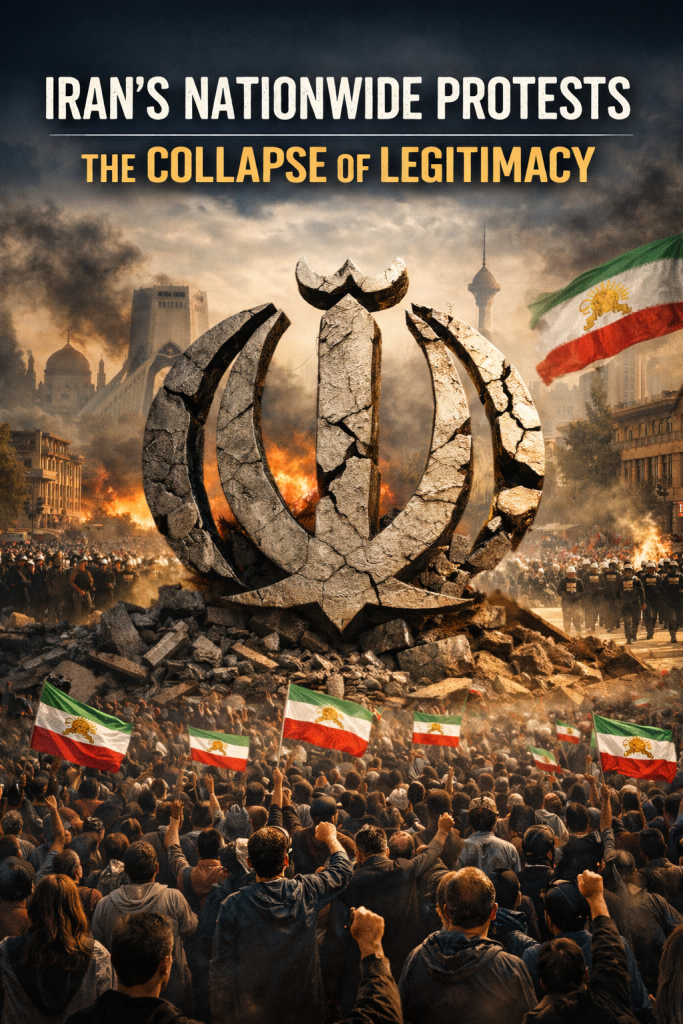
Introduction — Beyond Protest: Iran’s Uprising and the Regime’s Endgame
The current wave of unrest in Iran is not merely another episode in a long history of protests; it marks a critical turning point in the Iran nationwide protests against the Islamic Republic. What is unfolding on the streets today cannot be reduced to temporary economic hardship or isolated policy failures. It is the visible eruption of a deep, accumulated political crisis—rooted in decades of structural corruption, systemic repression, and the complete erosion of legitimacy at the core of clerical rule.
For years, the Iranian regime has attempted to frame public dissent as episodic, manageable, and ultimately containable. Each protest cycle has been dismissed as either economically motivated, externally orchestrated, or socially fragmented. Yet this narrative no longer holds. The present uprising is qualitatively different: it is political at its core, explicitly anti-regime in its demands, and sustained by a society that has largely moved beyond fear. What began in marketplaces and neighbourhoods has rapidly evolved into a nationwide confrontation with the very foundations of clerical rule.
This moment cannot be understood in isolation. It is the product of a prolonged process in which the Islamic Republic has systematically dismantled every remaining mechanism of accountability, representation, and social trust. Corruption has not merely coexisted with governance; it has become the governing logic. From the concentration of economic power within regime-affiliated networks to the militarisation of politics under the Islamic Revolutionary Guard Corps, the state has transformed itself into a closed system—extractive, coercive, and increasingly detached from the population it claims to rule.
Crucially, the current uprising is not about reform. It is about rejection. Iranian society is no longer negotiating the terms of its subjugation or appealing to a broken legal framework. The slogans, forms of mobilisation, and sheer persistence of the protests indicate a profound shift: the legitimacy of the system itself is being challenged, not merely its performance. This distinction matters because regimes can survive discontent, but they rarely survive the collapse of belief.
International observers have often misread such moments. Too frequently, Iran’s crises are interpreted through narrow economic lenses or reduced to the impact of sanctions and external pressure. While these factors shape the context, they do not explain the depth or resilience of the current unrest. To frame today’s protests as a response to inflation or unemployment alone is to fundamentally misunderstand the political consciousness driving them. Economic grievances may ignite protests, but they do not sustain revolutionary resolve. What sustains it is the recognition that the system is neither reformable nor accountable.
The Islamic Republic now faces a strategic dilemma of its own making. Repression, once its most reliable instrument, has reached diminishing returns. Each act of violence deepens public alienation and accelerates internal exhaustion within the security apparatus. At the same time, concessions—whether economic or political—risk exposing the regime’s weakness and emboldening further resistance. This is the paradox of authoritarian endgames: the tools that once preserved stability become catalysts for collapse.
This article examines Iran’s current uprising as part of a broader historical and structural trajectory. Rather than documenting events day by day, it seeks to analyse why the regime has arrived at this point, why previous methods of control are failing, and why the present moment represents a narrowing window rather than a cyclical disturbance. It builds on the premise that Iran is no longer experiencing isolated protests, but rather a sustained confrontation between a society that has lost its fear and a regime that has lost its future.
In doing so, this research aims to provide more than commentary. It offers a framework for understanding what comes next—whether prolonged instability, systemic breakdown, or a costly transition—and why postponing serious engagement with Iran’s political reality carries consequences far beyond its borders. The uprising now unfolding is not simply a domestic crisis. It is a test of how authoritarian systems unravel when legitimacy evaporates faster than repression can contain.
Chapter 1 — From Discontent to Defiance: The Political Roots of Iran’s Nationwide Protests
The Iran nationwide protests against the Islamic Republic did not emerge overnight, nor can they be credibly explained through the narrow lens of short-term economic stress. To frame these protests as reactions to inflation, subsidies, or currency collapse is not only analytically lazy—it is politically misleading. What Iran is witnessing today is the cumulative outcome of a long-term process in which political exclusion, institutionalised corruption, and systematic repression have converged to push society beyond the threshold of reformist tolerance.
Over 200 cities across 31 provinces have reported protest activity, involving hundreds of thousands of participants, with clusters in Tehran, Mashhad, Isfahan, Shiraz, and Tabriz showing particularly high mobilisation. This scale is unprecedented in the post-2009 era, signalling a national movement that crosses regional, ethnic, and socio-economic boundaries.
At their core, these protests represent a decisive shift from grievance to defiance. The public is no longer petitioning the state for relief; it is confronting the regime over its right to rule.
1.1 The End of the Social Contract
Every authoritarian system survives on an implicit social contract: political obedience in exchange for a minimum level of stability, security, or material predictability. In the Islamic Republic, that contract has collapsed entirely.
For decades, the regime justified its authoritarianism through revolutionary ideology, religious legitimacy, and controlled economic redistribution—particularly via oil revenues. Today, none of these pillars remains intact. Oil revenues have declined by nearly 50% since 2018, due to both sanctions and internal mismanagement, while the regime’s security spending consumes over 20% of the national budget. The revolutionary narrative has lost credibility across generations; clerical authority has been hollowed out by hypocrisy and abuse; and economic redistribution has been replaced by predatory extraction.
What remains is naked power. When a state ceases to provide either material security or moral legitimacy, compliance becomes coercive rather than consensual. Iran crossed that line years ago. The current protests are not demands for reform within the system—they are indictments of the system itself.
1.2 Structural Corruption as a Governing Principle
Corruption in Iran is not a deviation from governance; it is its organising logic. The Islamic Republic has evolved into a vertically integrated kleptocracy, where access to power determines access to wealth, and accountability is structurally impossible.
Key sectors—energy, construction, telecommunications, banking, and trade—are dominated by regime-linked networks, including the IRGC, quasi-state foundations (bonyads), and politically protected intermediaries. Estimates suggest that IRGC-affiliated conglomerates control over 60% of strategic domestic contracts, siphoning national resources while ordinary citizens absorb the costs through inflation exceeding 50% in urban centres, unemployment above 12%, and declining public services.
This system produces a specific form of political alienation: citizens are not merely impoverished—they are dispossessed. They watch national wealth converted into private fortunes, foreign proxy wars, and elite lifestyles, while the state demands further sacrifice in the name of “resistance.” Protests, in this context, become an act of reclaiming political agency—not a plea for better management.
1.3 Repression as Substitution for Legitimacy
As legitimacy eroded, repression intensified. The Islamic Republic has increasingly substituted violence for consent, deploying surveillance, mass arrests, internet shutdowns, and lethal force to manage dissent. Reports indicate that more than 1,200 protesters have been detained nationwide during the first six days of January 2026 alone, with dozens of fatalities confirmed.
Crucially, repression has ceased to be selective. Where earlier protest cycles targeted students, workers, or ethnic minorities, the current wave cuts across class, geography, and generation. Middle-class urban centres, provincial towns, industrial hubs, and peripheral regions are now part of the same protest continuum.
This universality matters. When repression is applied indiscriminately, it accelerates radicalisation. Each arrest, execution, or killing expands the circle of grievance, transforming fear into collective rage. The regime’s own behaviour has become a recruitment mechanism for dissent.
1.4 Why Economic Triggers Become Political Revolts
It is analytically dishonest to deny that economic pressures act as triggers. Inflation, currency collapse, and unemployment do matter. But in Iran, these pressures function as catalysts—not causes.
In functioning political systems, economic crises generate electoral punishment or policy correction. In closed systems like the Islamic Republic, where institutional channels for accountability do not exist, economic shocks expose the political core of the problem: unaccountable power. For example, the recent 80% spike in the price of essential goods in early 2026 directly catalysed large-scale mobilisation in urban and rural areas alike.
When protesters chant against the Supreme Leader, burn regime symbols, or reject the constitution itself, they are making a clear diagnosis. Their anger is not directed at mismanagement alone, but at the architecture of rule that makes mismanagement permanent.
1.5 A Point of No Return
The significance of the current protests lies not only in their scale but in their framing. The language of reform has largely disappeared. In its place is a vocabulary of rupture: rejection, overthrow, and post-Islamic Republic futures.
This rhetorical shift signals a psychological break. Once a population ceases to imagine its future within an existing political order, that order enters a phase of terminal instability—regardless of how long it manages to survive through force.
The Islamic Republic is no longer facing episodic unrest. It is confronting a legitimacy crisis that is structural, irreversible, and cumulative. And this is only the beginning.
Chapter 2 — A Pattern, Not an Exception: Two Decades of Escalating Protest in Iran
The current wave of unrest did not erupt in a historical vacuum. The Iran nationwide protests against the Islamic Republic are the latest phase in a long, traceable pattern of popular resistance—one that has evolved steadily from reformist dissent into outright rejection of the political system. What distinguishes today’s protests is not their novelty, but their culmination: they represent the endpoint of a process that began over two decades ago and has moved, cycle by cycle, toward radicalisation.
Each protest wave has exposed a deeper layer of regime failure. Each has been met with greater repression. And each has narrowed the distance between public grievance and systemic rupture, leaving behind institutional memory, activist networks, and a politically literate populace that now expects neither reform nor mercy.
2.1 1999: The First Crack in the Post-Revolutionary Order
The student protests of July 1999 marked the first mass challenge to the Islamic Republic from within its post-revolutionary generation. Triggered by the closure of the reformist newspaper Salam, the demonstrations initially reflected demands for press freedom, academic autonomy, and political openness—still framed within the constitutional boundaries of the regime.
The state’s response was decisive and brutal. University dormitories were raided, students were beaten, hundreds arrested, and several fatalities recorded. The message was unambiguous: even limited reformist dissent would be met with violence.
This moment shattered a key illusion—that gradual change within the Islamic Republic was institutionally tolerated. The regime revealed its red lines early, and they were absolute. The 1999 crackdown also catalyzed the first widespread networks of digital and print-based activism, laying the groundwork for future mobilisations.
2.2 2009: When Votes No Longer Mattered
A decade later, the Green Movement transformed political disillusionment into mass mobilisation. Sparked by widespread allegations of electoral fraud during the presidential elections, millions of Iranians took to the streets under the explosive slogan: “Where is my vote?”
At this stage, protesters were still engaging the system on its own terms. They demanded accountability, transparency, and respect for electoral outcomes. The regime’s response was industrial-scale repression: shootings, mass arrests, torture in detention, and a crackdown on media outlets.
The strategic consequence was irreversible. By nullifying the meaning of the ballot box, the Islamic Republic effectively delegitimised its own republican façade. A generation learned that participation could not produce change, fostering a long-term scepticism toward institutional channels of power.
2.3 2017–2018: The Periphery Speaks
The 2017–2018 protests marked a geographical and social shift. Unlike previous waves dominated by urban middle classes, demonstrations erupted in provincial towns, economically marginalised regions, and working-class communities.
Slogans now directly targeted the Supreme Leader and the ideological foundations of the regime, while demanding the redirection of national resources from foreign interventions toward domestic welfare. This wave punctured another regime myth: dissatisfaction was no longer confined to elites or urban centres. The periphery had entered the political arena without reformist intermediaries acting as buffers.
2.4 2019: Blood as a Policy Instrument In
November 2019, triggered by sudden fuel price hikes, escalated into nationwide protests within days. The regime responded with lethal force: security forces killed hundreds—possibly over a thousand—and imposed a near-total internet blackout to conceal the violence. Families were intimidated into silence, and accountability was systematically erased.
This was not crowd control. It was a calculated act of terror to reaffirm dominance through fear. Yet the political cost was enormous. By choosing mass killing over compromise, the regime crossed a moral threshold. The memory of 2019 became a permanent reference point for the limits of authoritarian tolerance.
2.5 2022: From Protest to Uprising
The death of Mahsa Amini ignited a qualitatively different phase. Initially women-led, the protests quickly evolved into a nationwide uprising that challenged clerical authority itself. For the first time, slogans rejecting the Supreme Leader and the Islamic Republic were dominant. Women, youth, and ethnic minorities assumed leadership roles, articulating an alternative vision: life beyond the Islamic Republic.
Cultural resistance, symbolic acts, and sustained defiance replaced episodic demonstrations. Even under executions, arrests, and relentless repression, the protest movement refused to collapse into silence. This was no longer a fight over policy or reform—it was a struggle over the very legitimacy of the system.
2.6 Today: Continuity, Not Surprise
The current protest wave must be understood as the continuation—not merely escalation—of this trajectory. What has changed is not the nature of dissent, but its density. Protest has become embedded in social consciousness. Fear persists, but it no longer paralyses. The regime has exhausted its repertoire: economic concessions fail, ideological appeals ring hollow, and violence now accelerates resistance rather than suppressing it.
History in Iran does not repeat mechanically—but it accumulates. Each protest wave leaves behind experience, memory, and networks. The Islamic Republic now governs a society that has rehearsed dissent for over two decades.
This is why the present moment is uniquely dangerous for the regime. It is not facing a spontaneous revolt. It is confronting a population that has learned, repeatedly and painfully, that the system cannot be reformed, only challenged—and that challenge is increasingly irrepressible.
Chapter 3 — Absolute Power, Absolute Failure: The Supreme Leader as the Epicentre of the Crisis
If earlier protest cycles exposed policy failures, elite incompetence, or economic mismanagement, the current phase of Iran’s nationwide protests against the Islamic Republic has clarified a far more consequential reality: the crisis is neither managerial nor factional—it is structural, and it is personalised at the apex of power.
This moment marks a decisive shift in public political consciousness. The Supreme Leader is no longer perceived as a distant arbiter, a symbolic guardian of the system, or a figure above day-to-day governance. He has become the central operational node through which repression, corruption, strategic paralysis, and institutional decay are continuously reproduced.
In a political system constructed around absolute authority, accountability does not diffuse—it travels upward. Iranian society has followed this logic to its unavoidable conclusion.
3.1 From Arbiter to Absolute Ruler
The doctrine of Velayat-e Faqih was initially framed—at least rhetorically—as a supervisory mechanism: a guardian of ideological continuity, not a monopolist of power. That fiction has long since collapsed.
What replaced it was not gradual institutional evolution, but the deliberate construction of an unaccountable command structure. Over time, the Supreme Leader’s office absorbed decisive authority over every strategic domain: security, judiciary, media, foreign policy, and large segments of the economy.
Under the current Supreme Leader, this transformation accelerated dramatically. Decision-making migrated away from formal state institutions and into opaque networks answerable only to his office. Parliament became ornamental. The presidency was reduced to crisis management without authority. The judiciary ceased to function as a legal institution and instead operated as a disciplinary arm of political power.
This was not institutional drift. It was an architectural design.
3.2 The Hollowing Out of Republicanism
The Islamic Republic continues to speak the language of republican governance—elections, councils, representation—but these mechanisms have been systematically stripped of substance. Candidate disqualifications, engineered outcomes, and post-election repression have rendered participation politically meaningless.
This hollowing-out process matters not as a democratic failure alone, but as a structural destabiliser. By eliminating institutional channels for change, the regime closed all internal pressure-release valves.
When citizens cannot influence leadership, policy, or accountability through formal mechanisms, dissent does not disappear—it relocates. In Iran, it relocates to the streets.
The regime’s insistence on preserving the appearance of republicanism while annihilating its function has produced a uniquely volatile contradiction: a population repeatedly invited to participate in a system that openly nullifies their participation. This contradiction is no longer sustainable.
3.3 The Supreme Leader as Political Shield
One of the most corrosive consequences of absolute power has been the transformation of the Supreme Leader into a political firewall for systemic abuse. Corruption scandals, economic collapse, security failures, and international isolation are consistently deflected downward—blamed on ministers, presidents, technocrats, or external conspiracies.
Yet this insulation is artificial.
Iranian society understands the real hierarchy of power. When accountability is blocked at every level below, blame inevitably concentrates at the top. This has produced a fundamental shift in protest discourse. Slogans now target the Supreme Leader directly—not as a symbolic figurehead, but as the operational centre of repression and corruption.
This shift is existentially dangerous for authoritarian systems. Regimes can survive criticism of policies. They can often survive factional infighting. They rarely survive the personalisation of blame at the apex of authority.
3.4 Fusion of Ideology and Force
As ideological legitimacy eroded, coercion filled the vacuum. The Supreme Leader’s authority has become structurally inseparable from the security apparatus—most notably the Islamic Revolutionary Guard Corps. This fusion has not merely militarised the state; it has militarised governance itself.
Political disagreements are no longer negotiated; they are securitised. Economic grievances are reframed as national security threats. Cultural dissent is treated as foreign subversion. The regime does not govern society—it manages it as a hostile population.
This security-first worldview explains the regime’s reflexive reliance on violence. Protest is not interpreted as feedback, but as insurrection. Dialogue becomes impossible once the state defines its own citizens as enemies.
Crucially, this approach does not restore control. It accelerates delegitimisation.
3.5 Why the Protests Are Now Unavoidably Personal
The evolution of protest rhetoric toward direct rejection of the Supreme Leader is not radicalisation—it is political rationalisation. When power is vertically concentrated, resistance follows the same vertical logic.
For decades, the regime attempted to fragment blame across institutions and factions. That strategy has collapsed. Protesters now articulate a clear diagnosis: the crisis is not misrule within the system—it is rule by the system itself, embodied in an unaccountable leader.
This clarity represents a critical inflexion point. Once authority loses its mystique and becomes politically legible, fear loses its deterrent power. The Supreme Leader’s greatest vulnerability is no longer organised opposition—it is recognition.
3.6 A Leadership Trapped by Its Own Design
Ironically, the very architecture designed to guarantee regime survival has produced its fragility. By centralising power, the system eliminated internal correctives. By suppressing dissent, it eliminated feedback. By personalising authority, it personalised failure.
The Supreme Leader now presides over a state that cannot reform without undermining itself, and cannot repress without accelerating resistance. This is the strategic deadlock at the heart of the Islamic Republic.
It is why today’s protests do not seek negotiation with power.
They seek to move beyond it.
Chapter 4 — Poverty by Design: The Political Economy of Control in the Islamic Republic
The economic collapse unfolding in Iran is not an unfortunate by-product of miscalculation, mismanagement, or external pressure. It is a governing strategy. Within the architecture of the Islamic Republic, economic dysfunction has evolved from policy failure into a deliberate instrument of control. Scarcity disciplines society. Dependency suppresses dissent. And inequality sustains loyalty within the ruling elite.
To understand the Iranian nationwide protests against the Islamic Republic, one must confront an uncomfortable truth: the regime does not merely endure economic crisis—it manages, engineers, and exploits it. Poverty is not a temporary deviation from normal governance; it is embedded in how power is exercised and preserved.
4.1 Sanctions Are Not the System
Sanctions undeniably shape Iran’s economic environment, but framing them as the primary cause of collapse is analytically dishonest and politically convenient. Sanctions operate on an existing structure; they did not create it.
Long before the intensification of secondary sanctions, Iran’s economy was already defined by opaque governance, politicised resource allocation, and the systematic exclusion of independent economic actors. Capital markets were distorted, private enterprise was subordinated to political loyalty, and state institutions functioned as rent-distribution mechanisms rather than regulators.
Sanctions magnified inefficiencies. Corruption institutionalised them.
More damaging than external pressure has been the regime’s own economic behaviour: capital flight by insiders, elite rent-seeking, and the systematic prioritisation of security spending over public welfare. Blaming sanctions serves a dual purpose: deflecting responsibility upward and reframing domestic dissent as foreign-instigated sabotage.
For a population experiencing decades of decline, this narrative has lost credibility.
4.2 The Security–Economy Nexus
At the core of Iran’s political economy lies a fusion of coercion and commerce. The Islamic Revolutionary Guard Corps and its affiliated networks dominate strategic sectors—energy, construction, logistics, telecommunications, and finance—operating beyond transparency and immune to accountability.
This is not a developmental model. It is a control model.
Contracts are allocated on the basis of loyalty, not competence. Competition is neutralised through regulatory capture. Losses are socialised through public budgets; profits are privatised within the regime’s inner circle. Economic power becomes a reward for obedience, while exclusion functions as punishment.
The outcome is a deliberately distorted economy: productivity declines, innovation stagnates, and corruption proliferates—yet political dependency deepens. The economy does not need to work well. It only needs to work hierarchically.
4.3 Managing Scarcity, Producing Compliance
Widespread hardship is not an emergency the regime seeks to resolve; it is a condition it actively manages. Inflation erodes savings. Currency collapse destroys long-term planning. Unemployment weakens the labour organisation. Precarity fragments collective action.
A population locked in survival mode has fewer resources to resist.
Subsidies, cash transfers, and selective relief are then deployed tactically—not to alleviate poverty, but to administer it. Assistance is conditional, unpredictable, and revocable. The state positions itself not as a guarantor of welfare, but as a gatekeeper of survival.
This transforms citizens into supplicants and reinforces asymmetric power relations in which dignity is exchanged for temporary relief.
4.4 Inequality as a Political Signal
Economic inequality in Iran is not merely tolerated; it is performative. The conspicuous wealth of regime insiders—luxury properties, foreign assets, protected lifestyles—exists alongside public calls for “resistance,” “patience,” and “sacrifice.”
This contrast is not accidental. It signals hierarchy. It communicates belonging.
For protesters, inequality becomes political evidence. It confirms that hardship is not shared, that suffering is not inevitable, and that national resources are deliberately misallocated. Each display of elite privilege erodes the moral authority of the regime’s demands.
Resentment, in this context, is not emotional—it is rational and politically informed.
4.5 Why Economic Pressure Fuels Political Radicalisation
In systems with responsive institutions, economic crises generate reform. In closed systems like Iran’s, they generate rupture. When citizens cannot influence economic policy through elections, unions, courts, or independent media, economic pain is translated directly into political anger.
This explains why protests triggered by price hikes or shortages rapidly escalate into demands for regime change. The public does not perceive hardship as temporary or cyclical—it understands it as structural and intentional.
Economic grievances cease to be technical complaints. They become political indictments of the system itself.
4.6 The Regime’s Strategic Miscalculation
For decades, the Islamic Republic assumed that economic pressure would eventually exhaust resistance. This assumption misunderstands the psychology of prolonged deprivation. When hardship becomes permanent, fear loses its leverage.
What replaces it is defiance.
Today’s protesters are not negotiating marginal improvements. They are confronting a system that has made survival itself precarious. In doing so, they reject the premise that stability can be purchased at the cost of dignity.
The regime’s political economy has reached a paradoxical endgame: the very conditions designed to suppress dissent are now producing it at scale.
Chapter 5 — Society Pushes Back: Women, Youth, and the Cultural Engine of Resistance
If structural corruption explains why the Islamic Republic is failing, and repression explains how it survives, society explains why it is now being openly challenged. The Iran nationwide protests against the Islamic Republic are not sustained by economic desperation alone; they are driven by a profound social transformation—one that the regime neither controls nor fully understands.
At the centre of this transformation stand women and youth, not as symbolic participants, but as the political and cultural engine of resistance.
5.1 Women as the Regime’s Structural Antagonists
From its inception, the Islamic Republic defined control over women’s bodies, behaviour, and visibility as a pillar of ideological authority. Mandatory veiling, gender segregation, and legal discrimination were not cultural by-products—they were instruments of rule.
This strategy has now backfired.
Women have emerged as the regime’s most consistent and visible challengers precisely because repression against them has been continuous, intimate, and unavoidable. The protest movement did not politicise women; the system did.
By turning everyday life into a site of surveillance and punishment, the regime transformed personal autonomy into political defiance. Acts as simple as refusing compulsory hijab, occupying public space, or speaking openly have become forms of resistance—irreversible and widely replicated.
5.2 Youth and the Collapse of Ideological Transmission
Authoritarian systems rely on generational continuity. The Islamic Republic has failed catastrophically in this regard. For a large segment of Iranian youth, the regime’s ideological language—revolution, martyrdom, resistance—has lost all emotional and moral resonance.
This generation did not experience the revolution. It inherited its costs.
Young Iranians face structural unemployment, restricted mobility, digital censorship, and a future defined by stagnation. They are hyper-connected globally yet politically trapped domestically. This contradiction has produced not apathy, but radical clarity.
The youth no longer seek inclusion within the system. They reject its premise altogether.
5.3 Culture as a Battlefield
One of the regime’s most significant miscalculations has been its dismissal of cultural resistance as superficial or apolitical. Music, art, fashion, language, and online expression have become powerful vectors of dissent precisely because they bypass formal political control.
Cultural defiance spreads faster than organisations. It cannot be easily decapitated through arrests. It reshapes norms before laws can respond.
Every viral image, banned song, or symbolic gesture erodes the regime’s claim to moral authority. The state can criminalise behaviour—but it cannot reverse cultural shifts once they become socially embedded.
5.4 The Feminisation of Protest and the Crisis of Control
The prominence of women in the protest movement has fundamentally altered the regime’s coercive calculus. Violence against women and girls—whether through arrests, beatings, or killings—carries a political cost that repression alone cannot neutralise.
Each act of brutality amplifies outrage rather than fear.
This dynamic exposes a deeper vulnerability: the regime’s security apparatus is designed to confront armed threats, not social transformation. It knows how to suppress organisations; it does not know how to suppress a generation.
5.5 Solidarity Beyond Identity
Contrary to regime narratives, the protest movement has not fragmented along ethnic, religious, or class lines. While diversity remains, a shared political diagnosis has emerged: the Islamic Republic is incompatible with dignity, autonomy, and the future.
Women’s resistance has not isolated men; it has mobilised them. Youth activism has not alienated older generations; it has reactivated them. Cultural dissent has not diluted political purpose; it has sharpened it.
This convergence matters. Authoritarian systems survive by dividing society. The current protest wave has systematically undermined that strategy.
5.6 Why Social Change Outpaces Political Repression
The most destabilising force facing the Islamic Republic today is not protest itself, but social evolution. Laws can be enforced. Streets can be cleared. But beliefs, expectations, and identities cannot be rolled back indefinitely.
The regime is attempting to govern a society that has already moved beyond it.
This asymmetry explains the persistence of unrest despite overwhelming force. The protests are not an anomaly—they are the political expression of a society that no longer recognises the legitimacy of clerical rule.
And once that recognition is lost, it cannot be legislated back into existence.
Chapter 6 — The Machinery of Repression: Power, Limits, and Internal Fractures
The Islamic Republic has survived repeated crises not through legitimacy, but through coercion. Security forces, intelligence agencies, and paramilitary groups have long formed the backbone of regime survival. Yet the ongoing nationwide protests in Iran reveal an uncomfortable truth: repression, once decisive, is no longer sufficient. The machinery of control remains violent—but it is increasingly strained, fragmented, and politically costly.
This chapter examines the structure of repression, its operational logic, and the cracks that now threaten its effectiveness.
6.1 Architecture of Coercion
Iran’s repressive apparatus is intentionally multilayered. The Islamic Revolutionary Guard Corps, Basij militia, intelligence services, regular police, and specialised judicial bodies operate in overlapping domains. This redundancy is designed to prevent defection, distribute responsibility, and ensure that no single institution becomes indispensable.
At the apex of this structure is the Supreme Leader, exercising direct or indirect control over all coercive institutions. Loyalty is rewarded; dissent is punished swiftly. This architecture has suppressed isolated unrest with brutal efficiency. Yet its success depends on perception, cohesion, and fear—all of which are eroding.
6.2 Violence as Governance
Repression in Iran is not merely reactive—it is pre-emptive, performative, and ritualised. Arrests, executions, and public intimidation are meant to shape behaviour across society. Justice is not the goal; deterrence is.
However, repeated, visible violence against women, minors, and non-violent demonstrators has undermined the strategic logic of force. Killing no longer ensures obedience—it generates moral outrage, galvanises protest, and erodes the regime’s legitimacy.
6.3 The Political Cost of Killing
Each act of lethal repression carries a political and social cost. Families of victims become permanent centres of resistance. Narratives of martyrdom are reclaimed from the regime. Memory persists, amplified by social media and citizen journalism.
Attempts to erase evidence through coercion, censorship, or intimidation now fail. Accountability, even if delayed, is unavoidable. Repression without legitimacy breeds resilience in society.
6.4 Signs of Strain and Fragmentation
Although the security apparatus remains formally cohesive, stress is evident. Extended deployments, fatigue, and moral injury erode discipline. Lower-level personnel, drawn from the same communities they suppress, face an impossible moral contradiction.
Defections are limited, but hesitation grows. Enforcement becomes uneven. At times, brutality is outsourced to less disciplined units to preserve plausible deniability. These signs are structural stress indicators, showing that the system is ill-equipped for prolonged confrontation.
6.5 Intelligence Overreach and the Paranoia of Control
Iranian intelligence agencies have expanded surveillance, infiltration, and preventive arrests in response to the protests. Cultural expression, online speech, and ordinary behaviour are treated as potential threats. This reveals a regime that cannot distinguish dissent from existence.
Paranoia is self-defeating. Overreach radicalises neutrals, criminalises daily life, and accelerates alienation. A society under constant suspicion ceases to negotiate—it resists.
6.6 Repression Without Resolution
The Islamic Republic can still inflict immense harm. It can delay change and raise the cost of resistance. But it cannot solve the political crisis through violence alone. Authoritarian systems collapse not when they lose the capacity to kill, but when killing no longer restores control.
Iran is approaching this threshold. The machinery of repression continues to turn—but now grinds against a society that no longer submits, a society that documents, shares, and refuses to be silenced.
Chapter 7 — The External Enablers: How International Silence Sustains the Islamic Republic
The endurance of the Islamic Republic cannot be explained by internal repression alone. Its longevity is also a product of external behaviour—calculated restraint, selective outrage, and sustained engagement that prioritises short-term stability over long-term accountability. The Iran nationwide protests unfold within an international environment that has repeatedly signalled tolerance for authoritarian persistence.
This chapter exposes how foreign governments, institutions, and economic actors—often unintentionally—enable the regime’s survival.
7.1 Stability Over Rights: Misdirected Pragmatism
For decades, Iran’s policy in many capitals has been guided by a narrow conception of stability. Despite systemic repression, the Islamic Republic has been treated as predictable, controllable, and preferable to uncertainty.
The result is a recurring pattern: internal crises are met with calls for restraint, dialogue, and “non-interference.” Violence is framed as an internal affair. Protesters are urged to de-escalate; the state is urged to self-investigate.
This is not neutral. It grants the regime diplomatic cover precisely when international pressure could matter most.
7.2 Nuclear Myopia: Misplaced International Priorities
Western focus on Iran’s nuclear programme has distorted engagement. Human rights violations, repression, and political accountability have been consistently subordinated to non-proliferation objectives.
The message to Iran’s leadership is clear: internal violence carries minimal external cost as long as nuclear negotiations proceed. Protesters witness executions alongside diplomatic talks, sanctions eased while repression escalates. Their lives, it seems, are negotiable.
7.3 Economic Engagement and Plausible Deniability
Even under sanctions, foreign entities continue interacting with regime-linked actors—through intermediaries, exemptions, or opaque channels. Legal ambiguity and corporate necessity create plausible deniability, normalising the regime’s rule.
For Iranians, the effect is obvious: the same elites prosper, the same institutions wield power, and violence remains unpunished.
7.4 The Cost of Selective Accountability
Selective condemnation undermines deterrence. The regime absorbs statements, ignores resolutions, and waits for attention spans. Executions increase; arrests multiply. Every unpunished act recalibrates the regime’s risk assessment. Silence, in this context, is not passive—it is instructive.
7.5 Protesters Without Patrons
Iran’s protest movement lacks powerful external patrons. No sustained diplomatic pressure, material support, or institutional advocacy shields them. This isolation is double-edged: it demonstrates authenticity, but exposes vulnerability.
Yet it also clarifies agency. Protesters do not act for foreign approval—they act despite its absence. The regime cannot delegitimise them through narratives of external manipulation. This truth is dangerous for the authorities.
7.6 International Responsibility Beyond Rhetoric
Foreign actors cannot dictate Iran’s future. But their choices determine whether repression is enabled or constrained. Targeted accountability, consistent human rights pressure, and refusal to normalise mass violence would not guarantee change—but their absence guarantees impunity.
The Islamic Republic survives isolation. What it has not yet faced is principled consistency.
Chapter 8 — The Road Ahead: Stalemate, Collapse, or Costly Transition
Iran no longer faces a question of crisis—it lives within it. The nationwide protests against the Islamic Republic have pushed the system into a prolonged, self-reinforcing state of instability—one that cannot be resolved with superficial reforms, episodic repression, or token concessions.
This chapter dissects the three broad trajectories visible today—and explains why each path carries existential risks for the regime.
8.1 The Illusion of a Sustainable Stalemate
The regime dreams of endless stalemate: recurring protests, crackdowns, temporary silences enforced by force. For authorities, this is the “least disruptive” path.
But stalemate is not stability. It is exhaustion writ large—socially, politically, institutionally. Each protest cycle:
- Depletes legitimacy
- Deepens mistrust
- Radicalises political consciousness
Security forces are stretched thin. Economic decay accelerates. Internal fractures widen. The system may survive—but only by hollowing itself out, leaving a façade of control over a crumbling core.
8.2 Managed Reform: A Dead-End
External observers often tout controlled reform as a solution: limited political openings, selective concessions, reduced repression.
In practice, this path is structurally blocked. Power is concentrated in unelected institutions that depend on ideological dominance, not consent. Any reform meaningful enough to satisfy public demands would destroy the mechanisms sustaining the regime itself. Past attempts failed not due to societal resistance—they failed because the system neutralised them.
8.3 Sudden Collapse: High Risk, Extreme Uncertainty
Abrupt rupture—sparked by external shock, elite defection, or cascading security failures—is possible but perilous. Authoritarian regimes appear resilient until they are not.
Collapse would not be clean. Decades of repression, absence of transitional planning, and fragmented governance make violence, chaos, and power struggles likely. The regime uses this fear to justify repression—but fear of collapse does not sustain legitimacy; it postpones reckoning.
8.4 The Most Likely Path: Prolonged, Costly Transition
The probable scenario is a drawn-out, high-cost transition. Protest cycles will continue; repression will intensify; the gap between state and society will widen. Change will accumulate gradually—through economic pressure, political confrontation, and moral weight.
The regime is not facing a movement it can outlast—it faces a society it can no longer govern by old rules. The cost is high, the timeline uncertain—but the direction is unmistakable.
8.5 Why Time No Longer Favours the Regime
Authoritarian systems often rely on time: waiting out dissent, exhausting movements, and betting on resignation. In Iran, this strategy is failing.
- Demographics and youth participation accelerate momentum
- Digital connectivity spreads organisational know-how
- Collective memory preserves the meaning of each crackdown
- Each martyr amplifies political significance
- Broken promises erode credibility
Time is no longer neutral. It amplifies pressure, radicalises society, and accelerates systemic fragility. The clock now ticks against the Islamic Republic, not for it.
Chapter 9 — Why This Moment Cannot Be Deferred
Iran stands at a crossroads of history. The protests sweeping the nation are not a transient episode—they are the culmination of decades of repression, corruption, and systemic failure. The Islamic Republic has exhausted its conventional tools: fear, manipulation, and institutional veneer no longer suffice. Any delay in acknowledging or responding to this moment risks cementing authoritarian control or fragmenting society in irreversible ways.
9.1 Exhaustion vs. Action
The regime’s long-standing strategy has been to wait out dissent, to let fatigue, fear, and survival instincts suffocate resistance. But every day of inaction by both domestic and international actors empowers the opposition morally and politically.
- Radicalisation of political consciousness accelerates
- Grassroots networks gain experience and coordination
- Collective memory preserves injustice, shaping long-term resistance
The paradox is stark: inaction strengthens the very forces the regime fears, while overt repression becomes increasingly costly and counterproductive.
9.2 The Danger of Normalising Repression
Repeated cycles of violence—arbitrary arrests, torture, public executions, and intimidation—risk becoming routine both inside and outside Iran. When brutal suppression is treated as inevitable:
- International actors begin to tolerate atrocities under the guise of “stability”
- Domestic institutions—judiciary, security forces—see impunity as standard
- Citizens internalise that the protest carries unbearable costs
Normalisation is a silent enabler of authoritarian endurance. Each unpunished act not only entrenches the regime but also delegitimises all channels of accountability, leaving society with only confrontation as a recourse.
9.3 The Shrinking Window of Opportunity
The moment for meaningful action—whether through credible international pressure, strategic solidarity, or domestic mobilisation—is narrow and rapidly closing. Delay compounds risk:
- The regime fortifies its defensive networks
- Repressive technologies—surveillance, intelligence, coercion—become harder to dismantle
- Human costs rise exponentially with each cycle of violence
- Political momentum shifts irreversibly against society
History rarely grants do-overs. For Iran, every day of delay narrows the margin for peaceful or strategic resolution.
9.4 The Strategic Imperative for Society
Iranian citizens now shape the trajectory of the crisis. Protests, strikes, and acts of civil disobedience are not spontaneous eruptions—they are strategic interventions in a tightly controlled, high-stakes environment.
- Each demonstration signals that fear has lost effectiveness
- Each act of defiance exposes systemic fragility
- Each public martyr shapes collective consciousness
Society is no longer negotiating with a government that can restore legitimacy—it is forcing the regime to respond to a historic crisis it cannot suppress.
9.5 International Responsibility Beyond Rhetoric
For the global community, the stakes are equally grave. Empty statements, selective condemnation, or delayed sanctions reinforce the regime’s impunity. Effective engagement requires:
- Consistency in human rights advocacy
- Targeted accountability for abuses
- Support for civil society initiatives without compromising local agency
Failure to act does not neutralise the crisis—it ensures that repression continues unchallenged, magnifying regional instability and human suffering.
9.6 The Moral and Historical Imperative
This is a moment that will define Iran’s next decade. Allowing authoritarian endurance to continue unchecked risks:
- Deepening societal trauma
- Generational radicalisation
- Erosion of any remaining institutional credibility
Inaction is not neutral. It is an act that benefits the regime while exacting a hidden cost on the entire nation. The moment to influence the outcome is slim, urgent, and unforgiving.
9.7 The Strategic Calculus for Change
Iran’s crisis is structural and inescapable. Recognising this, actors inside and outside the country must recalibrate their approach:
- Repression no longer restores order
- Incremental reform will not suffice
- International patience must not substitute for accountability
The calculus is clear: the regime cannot wait out history, and society cannot wait for benevolence. Every decision now compounds consequences. Every pause risks irreversible outcomes.
Chapter 10 — The Current Uprising: Iran 2026 in Real Time
The year 2026 marks a critical juncture in Iran’s long-running struggle between authoritarian consolidation and popular dissent. What began as localised economic grievances—rising prices, supply shortages, and deteriorating living conditions—quickly evolved into a nationwide political awakening. Unlike previous cycles of unrest, this wave is distinguished by its scale, its persistence, and the explicit targeting of the regime’s highest echelons. The Iran 2026 protests are not mere echoes of the past; they are a structural rupture, exposing the limits of repression and the fragility of a system long assumed unassailable.
10.1 The Spark and Spread
The initial spark occurred in Tehran’s central marketplaces, but the movement quickly transcended its economic origin. Social networks, encrypted messaging apps, and grassroots communication enabled rapid coordination among urban centres, smaller towns, and university campuses. Within days, major cities including Isfahan, Shiraz, Mashhad, and Tabriz witnessed sustained demonstrations. Unlike earlier waves, this one shows remarkable geographical and demographic breadth, involving women, young professionals, and middle-class families, not just students or marginalised workers.
10.2 Continuity and Escalation
While historical protests in 2009, 2017, 2019, and 2022 faced brutal suppression, each wave eventually receded into fragmented localised unrest. The 2026 uprising differs fundamentally:
- Irreversibility: Citizens are no longer content to return to “business as usual.”
- Direct targeting of leadership: Slogans explicitly denounce the Supreme Leader and core institutions.
- Rapid escalation: Protests are met with severe crackdowns, yet each act of violence fuels further mobilisation rather than quelling it.
The psychological landscape of the population has shifted. Fear, once the regime’s primary tool, has eroded. People understand that survival is inseparable from defiance, creating a feedback loop that the state struggles to interrupt.
10.3 Strategic Shifts in the Streets
Protesters in 2026 are tactically sophisticated. Coordinated strikes, flash demonstrations, and occupation of symbolic urban spaces demonstrate a learning curve built over years of repression. Women and younger generations play leading roles, challenging not only economic injustices but also structural patriarchal and authoritarian norms. The narrative is no longer merely reactive: it is constructively oppositional, articulating a vision for a society free from the grip of a monolithic, unaccountable leadership.
10.4 The Regime’s Response
The Islamic Republic’s security apparatus remains formidable but increasingly strained and internally fragmented. Extended deployments, moral fatigue, and hesitancy at mid-level ranks produce uneven enforcement. Attempts to suppress the protests often result in unintended amplification, as images of violence circulate globally. The state’s reliance on militarised governance and digital surveillance is met with citizen innovation, including encryption, decentralised communication, and symbolic acts of resistance. These developments highlight a strategic deadlock: the regime can apply force but cannot reassert authority effectively.
10.5 Regional and International Repercussions
The 2026 uprising is not contained by national borders. Regional powers and global actors monitor the crisis, balancing economic and security interests against human rights concerns. International responses are often selective and delayed, reinforcing the regime’s perception that repression carries manageable costs. Yet, the strategic isolation of Iran—combined with unprecedented internal unrest—creates new geopolitical vulnerabilities, from forced migration waves to economic instability in regional trade networks.
10.6 The Emerging Narrative
Media coverage—both domestic and international—is pivotal. Independent and diaspora networks document protests, disseminating real-time updates that undermine regime-controlled narratives. Citizens are actively crafting a counter-story: one that frames the regime as illegitimate, self-serving, and incapable of reform. This narrative strengthens domestic solidarity and builds moral legitimacy for sustained resistance, while delegitimizing state propaganda.
10.7 Key Lessons and Early Predictions
- Persistent unrest is now structural: the cycle of protests and repression has reached a tipping point, making reversal increasingly unlikely.
- Elite and societal fractures are accelerating: growing dissent within technocrats, security forces, and clerics indicates the erosion of authoritarian cohesion.
- Potential trajectories:
- Gradual systemic collapse, with intermittent violence
- A costly, negotiated transition shaped by citizen-led pressure
- An extended stalemate with high social and political costs
What is clear is that the Islamic Republic can no longer rely solely on fear, isolation, or coercion. The 2026 protests demonstrate that Iranian society is politically literate, digitally connected, and increasingly unwilling to compromise dignity for survival. Each demonstration reinforces a structural narrative: the crisis is not temporary, and the solution will not be superficial.
Conclusion — A Regime Without a Future
The Iran nationwide protests against the Islamic Republic should not be understood as the final act of a long political struggle, but as its irreversible beginning. What this article has traced—across history, institutions, economy, society, repression, and international context—is not the emergence of a crisis, but the slow exhaustion of a system that has been living on borrowed time.
The Islamic Republic did not fail because it faced protests. It faces protests because it failed—systematically, structurally, and repeatedly- to resolve its crisis of legitimacy. For decades, that crisis was deferred through repression, ideological mobilisation, selective redistribution, and international accommodation. None of these mechanisms resolved the underlying contradiction between an unaccountable ruling structure and a society that increasingly demanded dignity, agency, and a future. They merely postponed confrontation. That postponement has now ended.
The central argument of this article is simple but consequential: the Islamic Republic has not managed its legitimacy crisis—it has accumulated it. Each protest cycle added unresolved grievances, deeper distrust, and sharper political consciousness. Each act of repression may have restored short-term control, but at the cost of long-term authority. Over time, this imbalance became unsustainable. What Iran is experiencing today is the moment when accumulated legitimacy debt exceeds the regime’s capacity to enforce compliance.
This explains why the current uprising cannot be neutralised through familiar tactics. Economic concessions no longer pacify a society that understands poverty as a political design. Electoral rituals no longer mobilise participation in a system that openly nullifies representation. Repression no longer restores fear in a population that has learned—through painful repetition—that submission guarantees neither safety nor dignity. The regime’s tools still function mechanically, but they no longer function politically.
Crucially, the article demonstrates that this crisis is not confined to one domain. It is not merely economic collapse, nor merely political exclusion, nor merely cultural rebellion. It is the convergence of all three. Absolute power has produced absolute failure: a leadership incapable of reform, institutions stripped of purpose, an economy distorted for control rather than welfare, a society transformed faster than the state can repress, and a security apparatus increasingly trapped between violence and diminishing returns.
Time, once the regime’s greatest ally, has become its adversary. Demographic change, digital connectivity, collective memory, and accumulated experience have altered the strategic environment irreversibly. Protest today is not spontaneous; it is learned. Resistance is not episodic; it is embedded. The Islamic Republic is no longer confronting isolated demonstrations—it is governing a society that has internalised dissent as a permanent political condition.
From this perspective, the question is no longer whether the regime can restore the past. That option is closed. The question is whether Iran’s future unfolds through prolonged instability, abrupt rupture, or a costly and uneven transition. None of these paths is painless. What is clear, however, is that indefinite authoritarian equilibrium is no longer among them.
This conclusion carries implications beyond Iran’s borders. International actors who continue to prioritise short-term stability over principled consistency are not neutral observers. They are participants in the regime’s survival strategy. Silence, selective outrage, and compartmentalised engagement do not freeze the situation—they shape it. By tolerating repression as a manageable internal affair, external actors contribute to the accumulation of unresolved pressure that ultimately produces more violent, less controllable outcomes.
At the same time, this article does not argue that Iran’s future can or should be engineered from outside. The agency driving change is domestic, rooted in a society that has decisively withdrawn its consent. What external actors can influence is not the direction of history, but its cost—whether accountability is delayed or enforced, whether repression is normalised or constrained, whether political reality is acknowledged or denied.
This text is therefore offered not as commentary, but as a reference framework. It is intended to serve policymakers, analysts, journalists, and researchers seeking to understand Iran beyond daily headlines and episodic interpretations. It documents a structural transformation in state–society relations and situates the current uprising within a longer arc of authoritarian exhaustion.
The Islamic Republic still commands weapons, prisons, and institutions. What it no longer commands is belief. And regimes can survive without prosperity, without reform, and even without international legitimacy—but they rarely survive the loss of internal recognition. Once a society ceases to imagine its future within an existing political order, that order enters a phase of terminal instability, regardless of how long it persists by force.
Iran has crossed that threshold.
What unfolds next will be contested, uneven, and costly. But the direction is no longer ambiguous. The protests shaking Iran today are not asking whether the Islamic Republic can change. They are answering a question that history has already begun to close: whether a regime without legitimacy can still claim a future.
References & Resources
Human Rights & Repression (Core Sources)
- Amnesty International
Iran: Ongoing repression, executions, and protest crackdowns (2024–2026 updates)
https://www.amnesty.org/en/location/middle-east-and-north-africa/iran/ - Human Rights Watch (HRW)
Iran Events of 2024–2025
https://www.hrw.org/world-report/2025/country-chapters/iran - United Nations Human Rights Council
Independent International Fact-Finding Mission on Iran
https://www.ohchr.org/en/hr-bodies/hrc/ffm-iran - UN Special Rapporteur on the situation of human rights in Iran
https://www.ohchr.org/en/special-procedures/sr-iran
Protest Data, Violence, and Field Reporting
- ACLED (Armed Conflict Location & Event Data Project)
Iran protest & repression datasets
https://acleddata.com/iran/ - Hengaw Organisation for Human Rights
Real-time reporting on arrests, killings, and protests
https://hengaw.net/en/ - Iran Human Rights (IHRNGO)
Death penalty and protest-related executions
https://iranhr.net/en/ - OONI (Open Observatory of Network Interference)
Internet shutdowns and censorship in Iran
https://ooni.org/reports/
International & Independent Media (High-Credibility)
- Reuters — Iran Protests Coverage (2024–2026)
https://www.reuters.com/world/middle-east/ - Associated Press (AP)
Iran unrest, executions, and regional implications
https://apnews.com/hub/iran - The Guardian — Iran Protests & Human Rights
https://www.theguardian.com/world/iran - Financial Times — Iran Political & Economic Crisis
https://www.ft.com/iran - BBC World Service — Iran Analysis
https://www.bbc.com/news/world/middle_east
Political System, Supreme Leader & Power Structure
- Carnegie Endowment for International Peace
Iran’s power structure and authoritarian consolidation
https://carnegieendowment.org/region/iran - Brookings Institution — Iran Analysis
https://www.brookings.edu/topic/iran/ - International Crisis Group
Iran’s internal stability and protest dynamics
https://www.crisisgroup.org/middle-east-north-africa/iran
Political Economy, Sanctions, and Structural Collapse
- World Bank — Iran Economic Monitor
https://www.worldbank.org/en/country/iran/publication/iran-economic-monitor - International Monetary Fund (IMF)
Islamic Republic of Iran: Country Reports
https://www.imf.org/en/Countries/IRN - Centre for Strategic and International Studies (CSIS)
Iran sanctions, IRGC economy, and state capture
https://www.csis.org/middle-east-program/iran
Women, Society, and Cultural Resistance
- Amnesty International — Women’s Rights in Iran
https://www.amnesty.org/en/latest/news/iran-womens-rights/ - UN Women — Iran Gender & Repression Reports
https://www.unwomen.org/en/where-we-are/asia-and-the-pacific/iran - Journal of Democracy
Authoritarian legitimacy and protest dynamics
https://www.journalofdemocracy.org/
International Policy, Silence & Accountability
- European Council on Foreign Relations (ECFR)
Iran protests and Western policy failures
https://ecfr.eu/special/iran/ - Chatham House (Royal Institute of International Affairs)
Iran regime survival and international response
https://www.chathamhouse.org/regions/middle-east-and-north-africa/iran - United States Institute of Peace (USIP)
https://www.usip.org/regions/middle-east-and-north-africa/iran
Media Freedom & Information Control
- Reporters Without Borders (RSF)
Iran’s press freedom index and repression
https://rsf.org/en/country/iran - Freedom House — Iran Country Report
https://freedomhouse.org/country/iran/freedom-world
Contextual / Comparative Authoritarian Studies
- V-Dem Institute (University of Gothenburg)
Autocratization datasets
https://www.v-dem.net/ - Transparency International — Corruption Perceptions Index
https://www.transparency.org/en/cpi