
Introduction
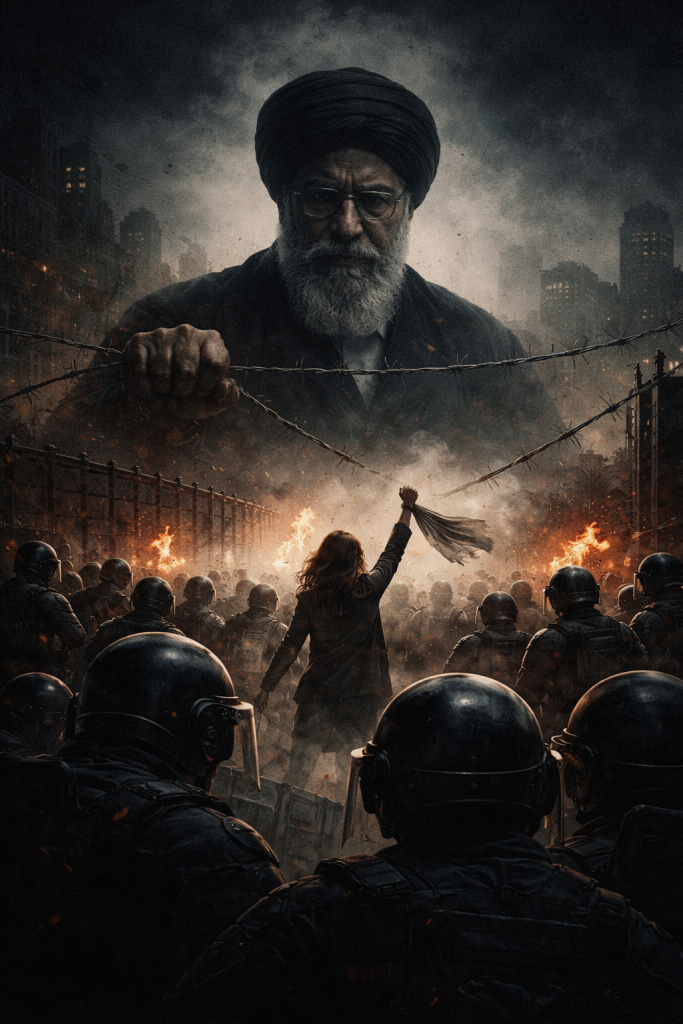
Iran has reached a tipping point. Decades of structural corruption within the regime, compounded by economic mismanagement and political repression, have left the population with mounting grievances. The resulting protests are not spontaneous outbursts; they are the inevitable consequence of a system that prioritises the protection of elites over the welfare of ordinary citizens. This investigation examines how Iran’s structural corruption protests have repeatedly erupted over the years, revealing patterns of oppression, social injustice, and systemic failure.
From the concentration of power in the hands of the Supreme Leader and his inner circle to the entrenchment of nepotism and patronage networks, Iran’s governing architecture has created a fertile ground for public outrage. Each wave of unrest, from student protests to nationwide demonstrations, offers insights into the mechanisms through which the regime suppresses dissent, while simultaneously fueling the conditions for future uprisings. Understanding the roots of these protests is critical for both analysts and the international community seeking to comprehend the resilience of Iran’s civil resistance.
Chapter 1 — Concentration of Power and Structural Corruption
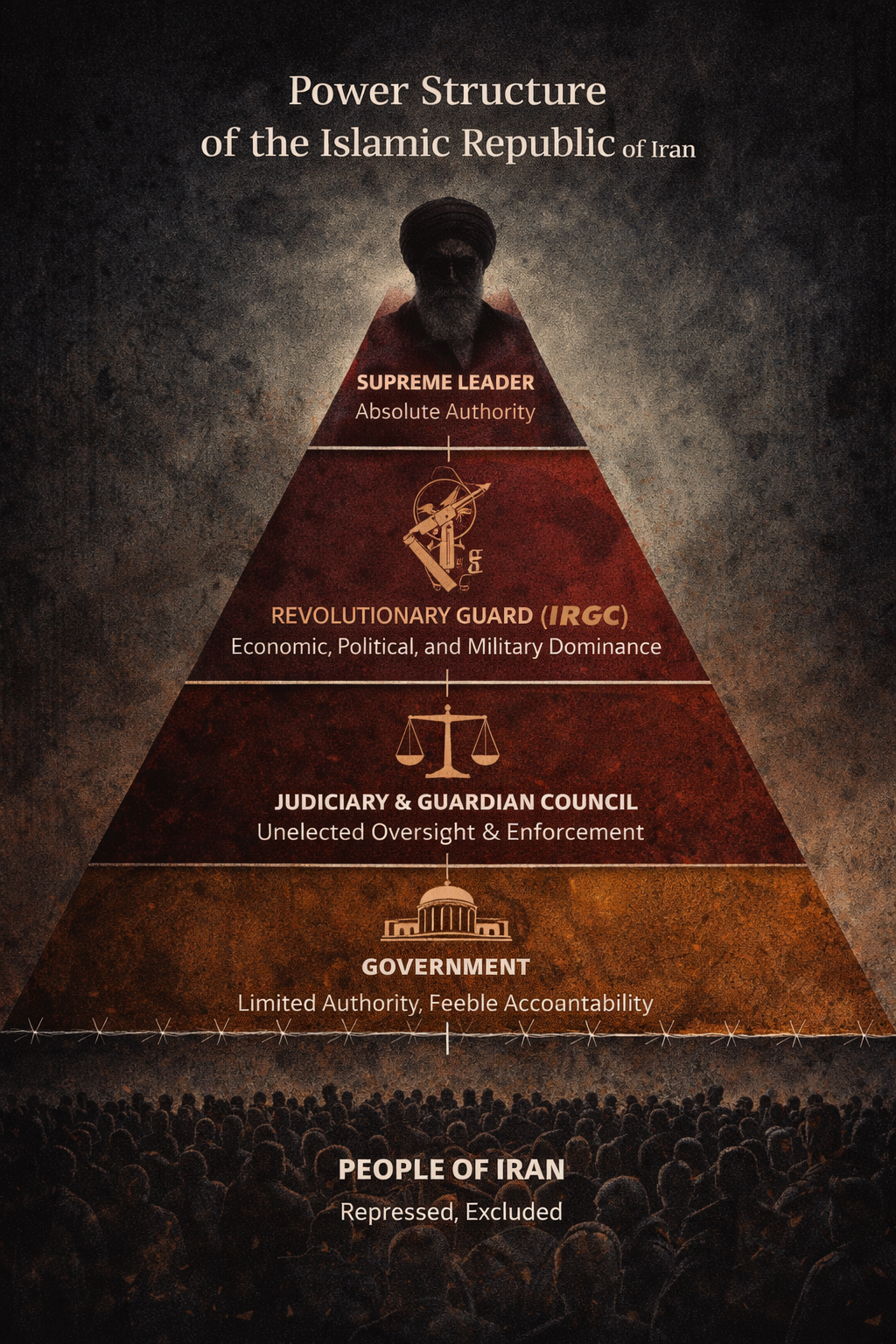
The architecture of power in Iran is designed to shield the regime’s elite from accountability while simultaneously consolidating control over every facet of society. At the apex stands the Supreme Leader, whose authority extends over the executive, legislative, and judicial branches, as well as the security and intelligence apparatus. This concentration of power creates an environment in which structural corruption is not only tolerated but systematically reinforced. Political loyalty and personal connections often supersede merit or legality, allowing a small network of individuals to extract wealth and influence unchecked.
Central to this structure is the intertwining of political, religious, and economic power. High-ranking clerics and regime-aligned business magnates operate within overlapping spheres, often controlling key sectors, including oil, banking, and infrastructure. Contracts are awarded based on loyalty, family ties, or revolutionary credentials, rather than competence or transparency. The result is a patronage system where public resources are diverted for private gain, and systemic mismanagement becomes the norm.
This environment fosters a culture of impunity. Officials implicated in embezzlement, nepotism, or fraud rarely face consequences, as oversight institutions—such as parliamentary commissions or audit bodies—are either under the influence of the ruling elite or deliberately undermined. Historical cases, including the notorious Petropars and DCI rig scandals, exemplify how corruption can flourish at the highest levels without meaningful investigation or accountability. Such cases reinforce the public perception that the regime is fundamentally self-serving and structurally incapable of reform.
Beyond the economic sphere, corruption permeates the political landscape. Electoral processes are tightly controlled, dissent is suppressed, and appointments across government institutions prioritise loyalty over expertise. Civil society and independent media are systematically marginalised, leaving citizens with few avenues to challenge or expose corruption. As a consequence, every act of malfeasance—whether misappropriation of funds or abuse of office—serves to deepen societal frustration and mistrust.
This concentration of power also creates mechanisms to protect perpetrators and suppress whistleblowers. Individuals who attempt to expose corruption face intimidation, imprisonment, or worse. Legal frameworks ostensibly designed to enforce accountability are frequently weaponised against those seeking transparency, further entrenching the structural barriers that shield elites from scrutiny. The intertwining of religious authority with political control amplifies this effect, legitimising practices that would otherwise be indefensible in a secular governance context.
Iran’s history is replete with examples where systemic corruption and concentrated authority intersected to produce both economic and social crises. From the privatisation of state assets to the allocation of government contracts, patterns emerge that highlight the deliberate obfuscation of accountability. Analysts observing these structures note that such concentration is not merely a byproduct of authoritarianism—it is a deliberate, self-reinforcing architecture that ensures the survival of the regime at the expense of ordinary citizens.
In summary, the structural corruption entrenched within Iran’s power hierarchy is both a cause and consequence of centralised authority. By consolidating control within a narrow elite, the regime simultaneously perpetuates inequality, mismanagement, and public disenchantment. This chapter lays the groundwork to understand why, despite repeated waves of protests over the decades, systemic corruption has persisted and, in turn, why citizens now mobilise with unprecedented intensity.
Chapter 2 — Economic Mismanagement and Public Hardship
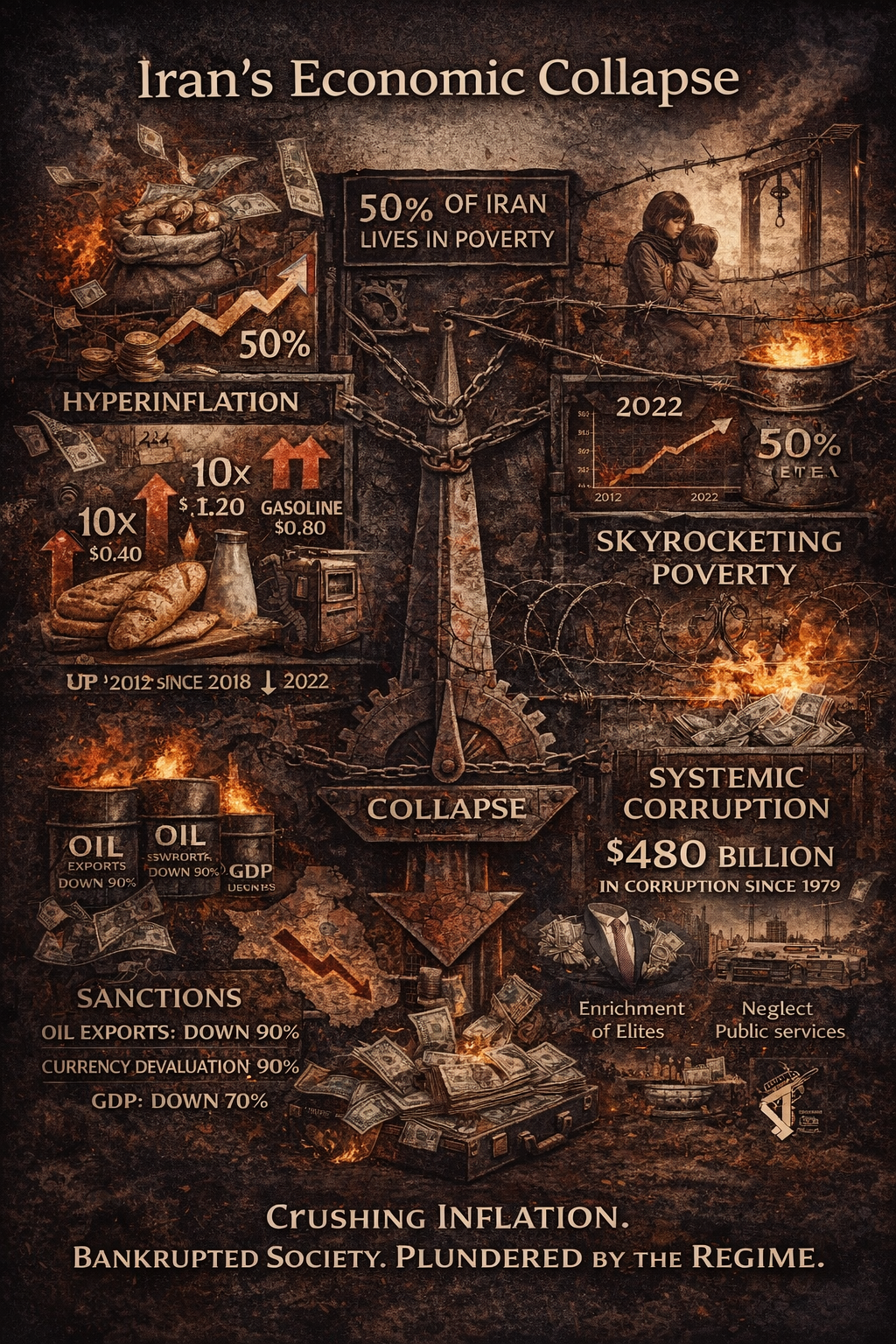
Iran’s economy has long been plagued by systemic mismanagement, exacerbated by corruption and the prioritisation of elite enrichment over public welfare. Despite vast natural resources, particularly in oil and gas, economic policies have consistently failed to benefit the broader population. Instead, wealth is concentrated in the hands of regime-aligned elites and connected business networks, leaving ordinary citizens to bear the burden of inflation, currency devaluation, and a faltering labour market.
The consequences of this mismanagement are stark. Inflation rates have periodically surged into double digits, eroding purchasing power and making necessities unaffordable for a growing segment of society. The rial has repeatedly collapsed against foreign currencies, intensifying poverty and driving citizens into informal, precarious labour markets. Access to essential services such as healthcare, education, and housing is uneven and often contingent on connections to political or religious networks, reinforcing societal inequality.
Corruption amplifies these economic hardships. State contracts, subsidies, and privatisation initiatives are frequently allocated to individuals with political ties rather than competence. The result is a cycle where public resources are siphoned off for private gain, major projects falter due to mismanagement, and opportunities for ordinary citizens remain scarce. Notable cases, such as embezzlement in the oil sector and misappropriation of infrastructure funds, illustrate how the intertwining of corruption and mismanagement directly harms the public.
The social ramifications are equally profound. Families face heightened economic insecurity, young graduates struggle to find meaningful employment, and basic aspirations for upward mobility become unattainable. This pervasive economic strain fuels frustration, despair, and, ultimately, a sense of injustice that catalyses public protest. Citizens are not merely reacting to isolated grievances; they are responding to decades of structural neglect that have systematically eroded trust in government institutions.
Moreover, economic mismanagement has tangible effects on the day-to-day lives of Iranians. Scarcity of essential goods, unreliable public services, and the rising cost of living disrupt social cohesion and exacerbate societal tensions. Citizens are forced to make difficult choices between subsistence and ambition, creating fertile ground for public dissent. In this sense, economic hardship acts as both a symptom and a driver of political unrest, linking personal suffering to broader systemic failures.
The regime’s reliance on sanctions as a scapegoat often masks internal failures. While external pressures from the US and EU have indeed affected Iran’s economy, domestic policies—ranging from unaccountable state-owned enterprises to the monopolisation of key industries by the elite—have amplified these pressures. Analysts consistently note that structural corruption within economic governance is the primary determinant of widespread hardship, not solely foreign sanctions.
In summary, Iran’s economic landscape is a testament to the intertwining of corruption, mismanagement, and inequality. The regime’s failure to deliver basic economic security has directly fueled public hardship, eroded trust, and set the stage for recurring waves of protests. Understanding this economic dimension is crucial to comprehending why citizens mobilise repeatedly, often at great personal risk, against a system that prioritises elite enrichment over societal welfare.
Chapter 3 — Political Oppression, Repression, and Media Control
Political oppression lies at the core of the Islamic Republic’s survival strategy. From its inception, the regime has relied on coercion, surveillance, and systematic repression to suppress dissent and maintain ideological control. Rather than functioning as a responsive political system, the state operates as a security apparatus designed to neutralise opposition before it can coalesce into an organised challenge.
One of the most defining characteristics of governance in Iran is the absence of meaningful political representation. Electoral processes are tightly controlled through mechanisms such as candidate vetting by the Guardian Council, effectively eliminating any form of genuine political competition. Reformist movements, when permitted to exist at all, operate within narrowly defined boundaries that pose no real threat to the core power structures centred around the Supreme Leader and the security institutions loyal to him.
This political exclusion is reinforced by a pervasive culture of repression. Peaceful protests, labour strikes, student activism, and women-led movements are routinely met with excessive force. Security forces—including the Islamic Revolutionary Guard Corps (IRGC), Basij militias, and intelligence agencies—play a central role in quelling dissent. Arbitrary arrests, enforced disappearances, torture, and prolonged detention without due process are not anomalies but structural tools of governance.
The criminalisation of dissent has produced a climate of fear that permeates everyday life. Journalists, academics, lawyers, artists, and civil society actors are routinely targeted under vague charges such as “propaganda against the state,” “acting against national security,” or “insulting sacred values.” These charges are deliberately broad, allowing the judiciary—widely recognised as lacking independence—to act as an extension of the security apparatus rather than a check on executive power.
Media control is a critical pillar of this repressive system. The state maintains a near-monopoly over broadcast media, while independent journalism is aggressively suppressed. Domestic media outlets operate under strict censorship rules, with editors facing constant pressure from security bodies. Red lines shift arbitrarily, ensuring that self-censorship becomes a survival mechanism rather than an editorial choice.
In the digital sphere, the regime has invested heavily in surveillance and information control. Social media platforms are routinely blocked, throttled, or disrupted during periods of unrest. Internet shutdowns—often nationwide—have become a standard response to mass protests, effectively isolating citizens from one another and from the international community. These shutdowns not only suppress mobilisation but also obscure human rights abuses from external scrutiny.
State propaganda plays a complementary role. Official narratives consistently frame protests as foreign-backed conspiracies, delegitimising public grievances and portraying demonstrators as threats to national security. This narrative strategy seeks to absolve the regime of responsibility while justifying violent crackdowns. At the same time, state-aligned media glorifies security forces and normalises repression as a necessary defence of “stability” and “Islamic values.”
The impact of political repression and media control is cumulative. Over time, the systematic silencing of dissent has eroded institutional legitimacy and destroyed public trust. Citizens increasingly view formal political channels as meaningless, leaving street protests as one of the few remaining avenues for expression. This dynamic helps explain why demonstrations in Iran often escalate rapidly: when peaceful mechanisms for change are blocked, frustration spills into open confrontation.
Importantly, repression has not eliminated opposition—it has radicalised it. Each wave of arrests, executions, and censorship deepens public anger and reinforces the perception that the regime is fundamentally irreformable. Rather than stabilising the system, political oppression has entrenched a cycle in which unrest becomes inevitable, recurring whenever economic pressure, social injustice, or symbolic triggers expose the fragility of authoritarian control.
In this context, today’s protests should not be viewed as spontaneous or isolated events. They are the predictable outcome of a political order that relies on force instead of consent, censorship instead of accountability, and fear instead of legitimacy. Political repression and media control have not preserved stability; they have merely postponed confrontation, ensuring that when it arrives, it does so with greater intensity and broader public participation.
Chapter 4 — Historical Waves of Protest and Unresolved Grievances
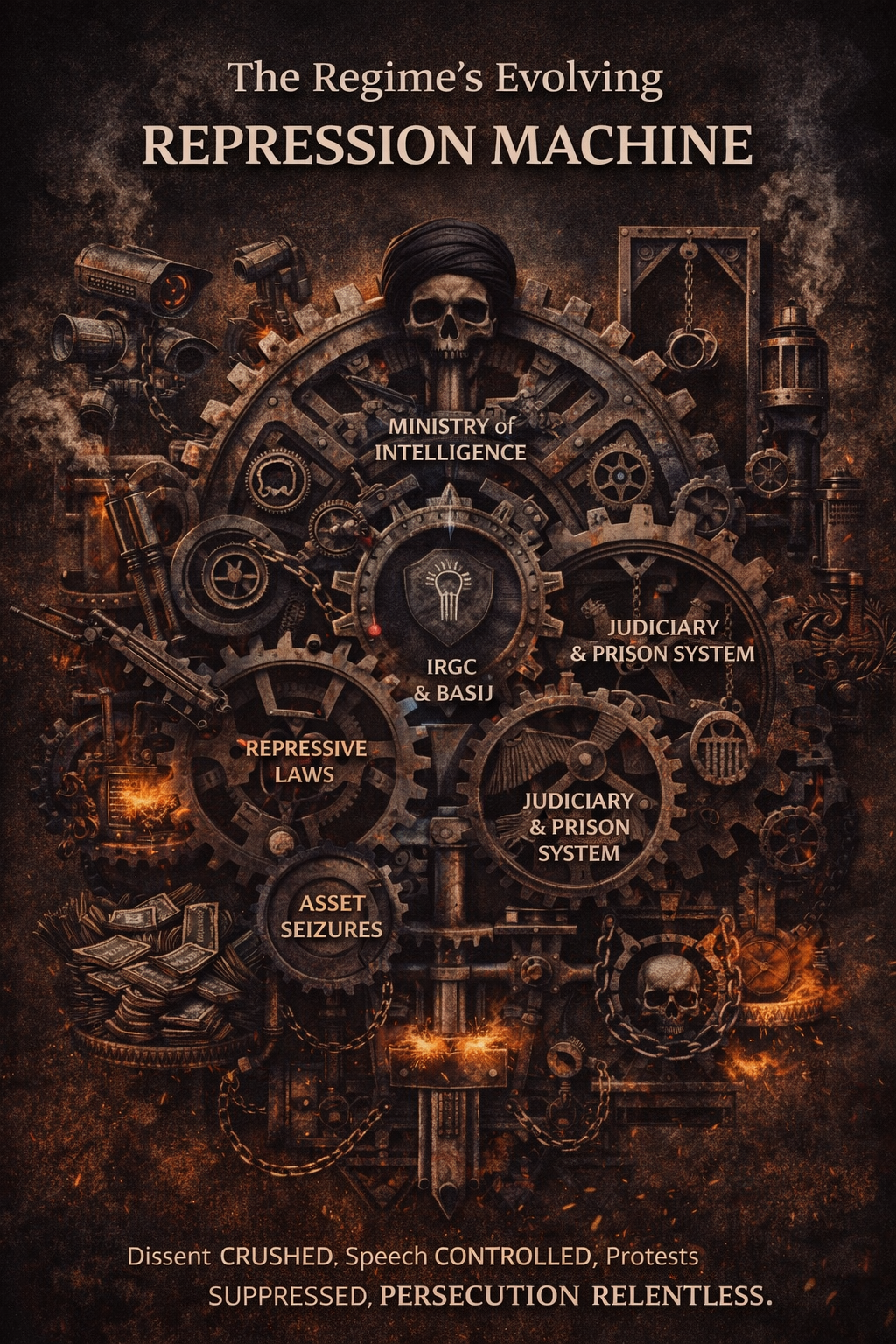
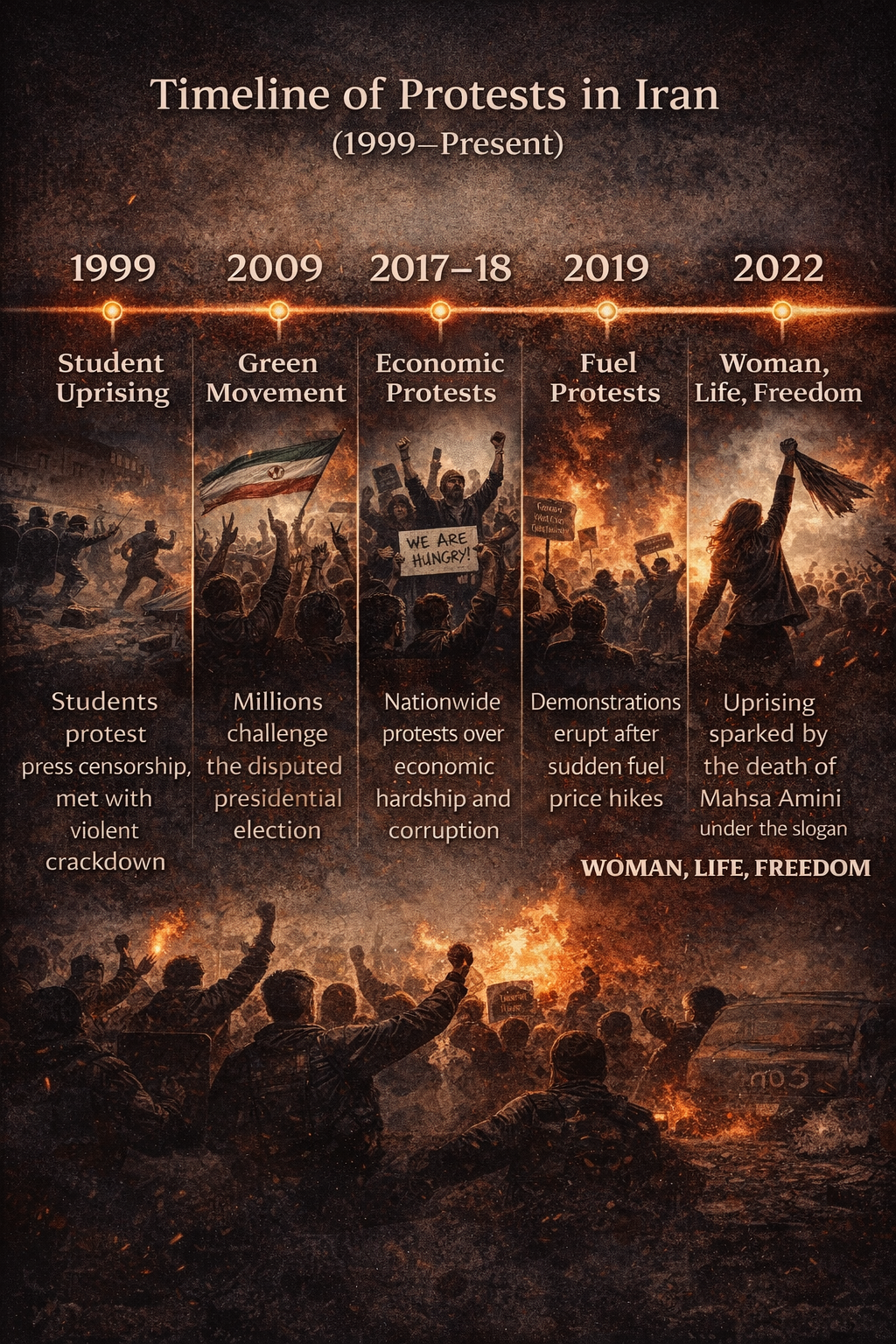
The current wave of protests in Iran cannot be understood in isolation. It is the latest manifestation of a long and unresolved history of public resistance against a political system that has consistently refused to address the root causes of popular discontent. Each major protest movement over the past four decades has exposed the same structural failures—economic injustice, political exclusion, and systemic repression—while leaving those failures fundamentally intact.
The first significant post-revolutionary rupture emerged in July 1999, when student protests erupted in response to the closure of reformist newspapers and the violent raid on Tehran University dormitories. Although framed at the time as a limited student movement, the protests revealed a deeper generational frustration with political stagnation and the betrayal of reformist promises. The state’s response—mass arrests, show trials, and forced confessions—set a precedent that dissent would be met not with dialogue, but with force.
A decade later, the 2009 Green Movement marked a turning point in both scale and political clarity. Triggered by widespread allegations of electoral fraud, millions of Iranians took to the streets demanding accountability and the right to choose their leaders. The movement directly challenged the legitimacy of the Supreme Leader for the first time since the revolution. The regime’s reaction—lethal violence, mass detentions, torture, and long-term house arrests of opposition figures—demonstrated that even system-inside reformist challenges would not be tolerated.
Crucially, the Green Movement did not fail due to a lack of public support. It was crushed by a security apparatus willing to use unlimited violence and unconstrained by legal or moral accountability. The absence of consequences for those responsible reinforced a dangerous lesson: repression works, and impunity is guaranteed.
The next major rupture came with the 2017–2018 protests, which differed significantly from earlier movements. These protests were decentralised, leaderless, and explicitly economic in nature. Demonstrations spread rapidly to smaller cities and rural areas, signalling that dissatisfaction was no longer confined to urban elites or students. Slogans targeted not just government policies but the entire political order, including the Supreme Leader himself.
This shift reflected a fundamental transformation in public consciousness. For the first time, large segments of the population openly rejected the regime’s ideological foundations, rather than seeking reform within its framework. Yet once again, the response was predictable: arrests, intimidation, and silence from official institutions.
The November 2019 protests represented an even more dramatic escalation. Sparked by a sudden fuel price increase, demonstrations spread nationwide within days. The regime responded with unprecedented violence, including the use of live ammunition against unarmed protesters. Internet access was shut down nationwide to prevent information flow, enabling security forces to operate with near-total impunity. Hundreds were killed in a matter of days, with the true toll still contested due to systematic obfuscation.
The aftermath of 2019 further deepened public mistrust. Families of victims were harassed, denied justice, and pressured into silence. No independent investigations were conducted, and no officials were held accountable. This reinforced the perception that the state viewed its own citizens as expendable obstacles to regime survival.
The 2022 protests, following the death of Mahsa Amini in morality police custody, marked a qualitative shift rather than a mere continuation. What began as outrage over gender-based violence quickly evolved into a nationwide uprising against the entire system of clerical rule. Women and young people emerged as the movement’s driving force, openly rejecting compulsory hijab, religious authoritarianism, and patriarchal control.
Unlike previous movements, the 2022 protests were explicitly existential. Slogans, symbols, and acts of defiance reflected a rejection of the Islamic Republic as a political project, not merely its policies. The regime’s response—executions, mass arrests, and intensified surveillance—failed to restore legitimacy. Instead, it further exposed the regime’s reliance on fear as its primary governing tool.
Across all these movements, a consistent pattern emerges: grievances are never resolved, only suppressed. Economic demands are ignored, political demands are criminalised, and social demands are framed as foreign conspiracies. Each protest wave ends not with reform, but with deeper alienation and accumulated anger.
This accumulation matters. Protest in Iran functions less as isolated events and more as a historical continuum. Each generation inherits unresolved grievances from the previous one, alongside lived memories of repression. The result is a society primed for recurring unrest, where even minor triggers can ignite widespread mobilisation.
Today’s protests are therefore not unprecedented—they are inevitable. They are the product of decades of unaddressed injustice, reinforced by a political system incapable of self-correction. Until the structural causes of dissent are confronted, the cycle of protest and repression will continue, with each iteration posing a greater existential challenge to the regime than the last.
Chapter 5 — The Supreme Leader, Absolute Power, and Systemic Accountability Failure
At the centre of Iran’s recurring political crises lies a structural reality that cannot be ignored: the concentration of unchecked power in the office of the Supreme Leader. The Islamic Republic is not merely an authoritarian state; it is a system designed to eliminate accountability at its highest levels while projecting the illusion of institutional governance.
The position of the Supreme Leader, as defined by the Iranian constitution, supersedes all branches of government. He exercises ultimate authority over the armed forces, intelligence services, judiciary, state media, and key economic foundations. In practice, this means that no meaningful decision—political, economic, or security-related—can occur independently of his approval or tolerance.
This concentration of power is not an accidental by-product of revolutionary governance. It is the system’s core feature. The doctrine of Velayat-e Faqih institutionalises the supremacy of a single unelected clerical authority over the will of the population. Elections, parliaments, and presidents function not as instruments of accountability, but as buffers designed to absorb public frustration without threatening the system’s foundations.
As protests erupt and grievances accumulate, the Supreme Leader remains structurally insulated. Responsibility for policy failures is routinely displaced onto subordinate institutions—governments, ministers, or external enemies—while ultimate authority remains untouched. This deliberate diffusion of blame is central to regime survival.
Crucially, the absence of accountability is enforced through institutional design. The judiciary, theoretically responsible for upholding the rule of law, operates under the direct or indirect influence of the Supreme Leader. Senior judges are appointed through mechanisms that ensure ideological loyalty rather than legal independence. As a result, investigations into state violence, corruption, or abuse of power rarely progress beyond performative inquiries.
This structural impunity has profound consequences. Security forces operate with the implicit understanding that they will not be held accountable for actions taken in defence of the regime. From mass arrests to extrajudicial killings, the pattern is consistent: violence is authorised, denied, and forgotten—never prosecuted.
The Supreme Leader’s role in this system is not passive. Public speeches, directives, and ideological framing repeatedly legitimise repression by defining dissent as sedition, foreign infiltration, or moral corruption. Protesters are not treated as citizens with grievances, but as threats to national and religious identity.
This framing serves a dual purpose. Internally, it justifies violence by portraying repression as a defensive necessity. Externally, it provides a narrative shield against international scrutiny, enabling the regime to dismiss criticism as politically motivated interference.
Economic governance follows the same logic. Vast segments of Iran’s economy are controlled by foundations and conglomerates directly or indirectly linked to the Supreme Leader’s office. These entities operate outside parliamentary oversight, financial transparency, and public accountability. Corruption is not an aberration—it is structurally embedded.
As economic hardship intensifies, the regime’s response remains unchanged. Instead of addressing systemic inequality, mismanagement, and elite capture, responsibility is shifted to sanctions, foreign conspiracies, or public “misunderstanding.” This refusal to acknowledge internal failures further erodes legitimacy.
The absence of accountability also explains the regime’s consistent failure to de-escalate protests through reform. Any meaningful concession would imply limits to absolute authority—an existential threat to the system itself. As a result, repression becomes the default response, not because it resolves problems, but because the system lacks alternative mechanisms.
Over time, this dynamic creates a self-reinforcing cycle. Absolute power generates impunity; impunity generates abuse; abuse generates protest; protest triggers repression; repression further consolidates absolute power. Each iteration deepens public alienation and radicalises demands.
Importantly, the Supreme Leader’s position renders succession a particularly destabilising factor. With no transparent or accountable process for leadership transition, uncertainty at the top magnifies systemic fragility. Competing power centres within the regime—security forces, clerical elites, and economic networks—operate not to reform the system, but to secure their position within it.
For the public, this reality is increasingly clear. Protests are no longer framed around policy change or leadership rotation. They reflect a growing recognition that the core problem lies not in governance failure alone, but in a political structure fundamentally incompatible with accountability.
The Supreme Leader is therefore not merely a symbol of authority; he is the keystone of a system designed to resist reform, deny responsibility, and outlast dissent through force. As long as this structure remains intact, cycles of unrest will persist—each more intense, more widespread, and more openly confrontational than the last.
This is not a crisis of legitimacy waiting to be resolved. It is a crisis of structure that cannot correct itself.
Chapter 6 — Corruption as a System of Governance
In the Islamic Republic, corruption is not a deviation from governance; it is one of its primary operating mechanisms. What distinguishes Iran’s political economy from conventional cases of state corruption is not merely scale, but function. Corruption in Iran is systemic, institutionalised, and strategically deployed to sustain political control.
From the earliest years after the revolution, economic assets were redistributed not to create efficiency or public welfare, but to consolidate loyalty. Over time, this process evolved into a dense network of power-holding institutions—security forces, religious foundations, and state-affiliated conglomerates—that operate beyond public oversight while absorbing an ever-growing share of national wealth.
At the centre of this network lies the fusion of political authority and economic privilege. Major sectors of Iran’s economy, including energy, construction, telecommunications, banking, and logistics, are dominated by entities linked to the Revolutionary Guards, parastatal foundations, and informal patronage networks. These actors benefit from preferential access to contracts, foreign currency, and regulatory exemptions, while ordinary citizens bear the cost of inflation, unemployment, and declining public services.
This structure fundamentally distorts economic outcomes. Productivity is subordinated to loyalty, competition is replaced by access, and accountability is eliminated. The result is an economy that generates enormous rents for a narrow elite while systematically impoverishing the broader population.
Public anger over economic hardship is therefore not rooted merely in poverty, but in perceived injustice. Inflation alone does not produce mass protest; inflation combined with visible elite enrichment does. When citizens observe officials’ families living abroad, transferring wealth overseas, or maintaining lavish lifestyles amid economic collapse, grievances transform into moral outrage.
This outrage is intensified by the regime’s refusal to acknowledge corruption as an internal problem. Economic crises are consistently attributed to external factors—sanctions, foreign hostility, or global conditions—while domestic mismanagement and elite capture remain unaddressed. This narrative strategy not only fails to convince the public, but it also deepens alienation by denying lived reality.
Sanctions, while economically significant, function in practice as an amplifier rather than the origin of corruption. They create opacity, restrict oversight, and incentivise informal financial networks—all of which benefit actors already embedded within the system. Those with political protection thrive; those without it suffer.
In this context, corruption becomes a method of governance. Access to economic opportunity is conditioned on political obedience, and exclusion functions as a disciplinary tool. This dynamic reinforces loyalty among insiders while systematically marginalising dissenting or unaffiliated populations.
The social consequences are profound. Young people face chronic unemployment and precarity, professionals emigrate in large numbers, and social mobility collapses. The promise of upward movement through education or merit has been replaced by resignation or rage. For many, protest becomes the only remaining avenue for agency.
Crucially, economic grievances intersect with broader political demands. Protest slogans increasingly link corruption to authoritarianism, identifying elite enrichment as inseparable from political repression. This convergence marks a departure from earlier protest movements that treated economic and political issues as distinct.
The regime’s response has been consistent: repression rather than reform. Anti-corruption campaigns, when initiated, target rival factions rather than systemic abuse. Selective prosecutions serve to manage internal power struggles, not to restore public trust.
This selective accountability further confirms public perceptions that corruption is not punished because it is not accidental. It is tolerated, protected, and reproduced because it sustains the existing power structure.
As living conditions deteriorate and opportunities vanish, the legitimacy costs of corruption rise. What was once endured as an unfortunate reality is now increasingly perceived as an existential injustice. The social contract—already fragile—has effectively collapsed.
In this environment, protests are not demands for economic adjustment; they are indictments of an entire governing order. Corruption is no longer seen as a technical problem to be solved, but as evidence of a system fundamentally hostile to the public interest.
The persistence of unrest is therefore unsurprising. As long as corruption remains a pillar of governance rather than a target of reform, economic hardship will continue to translate into political rebellion. The regime may suppress demonstrations, but it cannot suppress the structural conditions that produce them.
Chapter 7 — Repression as Policy: The Architecture of State Violence
Repression in the Islamic Republic is neither reactive nor improvised. It is a deliberate, institutionalised policy embedded within the state’s security, judicial, and ideological apparatus. Understanding why protests in Iran are met with systematic violence requires recognising that coercion is not a last resort—it is a governing principle.
The regime’s security architecture is designed to operate on multiple, overlapping levels. This redundancy ensures that dissent can be contained, fragmented, and punished even when one component falters. At its core are the Islamic Revolutionary Guard Corps (IRGC), the Basij militia, intelligence agencies, and a judiciary structured to legitimise repression after the fact.
The IRGC occupies a unique position within this architecture. It functions simultaneously as a military force, an intelligence agency, an economic conglomerate, and an ideological guardian of the regime. Unlike conventional armed forces, its mandate is explicitly internal: protecting the Islamic Republic from perceived domestic threats. Protest movements, regardless of their peaceful nature, are therefore framed as security risks rather than political expressions.
This framing is critical. Once dissent is securitised, it becomes exempt from political negotiation and subject instead to counterinsurgency logic. Protesters are not citizens exercising rights; they are adversaries to be neutralised.
The Basij militia serves as the regime’s most visible instrument of street-level repression. Organised, ideologically indoctrinated, and often drawn from economically dependent populations, Basij forces operate with broad discretion and minimal accountability. Their role extends beyond crowd control. They are used to intimidate communities, enforce moral codes, gather intelligence, and signal the omnipresence of state power.
Intelligence agencies—both formal and informal—complete this architecture. Surveillance, infiltration, and pre-emptive arrests are central tactics. Activists, journalists, lawyers, and even grieving families are monitored and pressured. The aim is not merely to punish dissent but to prevent its organisation.
What distinguishes Iran’s system from many other authoritarian models is the judiciary’s role as an enforcement mechanism rather than a constraint. Courts function as instruments of deterrence through arbitrary charges, coerced confessions, and disproportionate sentences. Legal language is deployed not to establish guilt, but to manufacture legitimacy for repression already carried out.
Trials related to protests are typically swift, opaque, and procedurally hollow. Defendants are denied access to independent counsel, evidence is withheld, and verdicts often mirror political directives rather than legal reasoning. Executions and long prison sentences serve as public warnings, reinforcing fear across society.
The coordination between security forces and judicial institutions is neither accidental nor informal. It reflects a system in which violence is administered through bureaucratic channels, reducing the personal liability of individual actors while preserving collective responsibility within the regime.
Equally important is the ideological dimension of repression. State media and official rhetoric portray protesters as morally corrupt, foreign-backed, or socially deviant. This narrative serves to dehumanise dissenters, making violence against them appear not only permissible but necessary. By framing repression as moral defence, the regime seeks to mobilise loyalists while discouraging neutrality.
The use of gendered and cultural narratives is particularly pronounced. Women protesters are depicted as threats to social order; young men are depicted as manipulated agents of chaos. This framing legitimises disproportionate violence while obscuring the political substance of demands.
Repression is also deliberately uneven. Certain regions, ethnic minorities, and marginalised communities are subjected to harsher measures, reflecting both strategic calculation and structural discrimination. This selective application of violence aims to fracture solidarity and prevent the formation of a unified national movement.
Despite its brutality, repression is not cost-free for the regime. Each deployment of force erodes legitimacy, deepens public resentment, and widens the psychological gap between state and society. The reliance on violence signals weakness rather than strength—a lack of political tools to manage dissent through consent.
Importantly, the regime’s commitment to repression reveals its underlying fear: that meaningful engagement with public demands would expose the system’s fundamental incompatibility with accountability. Violence becomes the only viable option precisely because reform is structurally impossible.
This architecture of state violence has succeeded in suppressing individual protest waves, but it has failed to restore stability. Instead, it has transformed dissent from episodic mobilisation into a persistent condition. Protest is no longer an anomaly; it is a recurring feature of political life.
By institutionalising repression as policy, the Islamic Republic has narrowed its own options. Each cycle of violence raises the stakes, radicalises demands, and accelerates the erosion of fear. What remains is a regime increasingly dependent on coercion, facing a society that has learned—through repeated experience—that silence offers no protection.
This dynamic sets the stage for the next critical question: if repression is so extensive, why does it no longer achieve its intended effect?
Chapter 8 — Society Against the State: Why Fear No Longer Works
For decades, fear functioned as the Islamic Republic’s most effective instrument of social control. Arrest, torture, execution, and public humiliation were sufficient to suppress dissent and restore temporary calm. Today, that mechanism is visibly failing. Despite intensified repression, protests persist, re-emerge, and evolve. The question is no longer whether fear exists—but whether it still governs behaviour.
The erosion of fear in Iranian society is not sudden. It is the cumulative outcome of repeated exposure to violence without resolution. When repression becomes routine rather than exceptional, its deterrent power diminishes. Citizens adapt, recalibrate risk, and gradually internalise the reality that compliance does not guarantee safety.
One of the most significant shifts has occurred at the generational level. Younger Iranians have no lived memory of the revolution or its ideological promises. Their political consciousness has been shaped not by revolutionary mobilisation, but by economic stagnation, social restriction, and the visible hypocrisy of elites. For this generation, fear is no longer counterbalanced by hope.
Unlike their parents, many young protesters do not believe that patience will yield reform. They have witnessed the failure of gradualism, electoral participation, and elite negotiations. What remains is a stark calculation: the costs of protest may be high, but the costs of silence are permanent.
This shift is particularly evident in the role of women. Women’s bodies have long served as ideological battlegrounds for the regime, regulated through compulsory dress codes and moral policing. Resistance to these controls is therefore not symbolic—it is existential. When women publicly reject enforced norms, they challenge the regime’s claim to moral authority at its core.
The prominence of women in recent protests reflects a broader transformation. Acts of defiance are no longer confined to organised movements; they are embedded in daily life. From refusing compulsory hijab to confronting security forces in public spaces, resistance has become decentralised and personal.
This decentralisation weakens the effectiveness of repression. Leaderless movements are harder to dismantle, and individual acts of defiance are difficult to criminalise without exposing the regime’s fragility. The state can imprison leaders; it cannot incarcerate an entire social attitude.
Another critical factor is the collapse of credibility. State narratives that once justified repression—national security, religious duty, foreign plots—have lost persuasive power. The public increasingly recognises these narratives as tools of control rather than explanations of reality. When propaganda fails, fear loses its ideological reinforcement.
Digital connectivity, despite censorship, has accelerated this process. Even under heavy surveillance, Iranians share images, testimonies, and evidence of state violence. The visibility of repression undermines the regime’s ability to deny or distort events. Fear thrives in isolation; it weakens under collective awareness.
Importantly, fear has not disappeared—it has been recontextualised. Protesters are acutely aware of the risks they face. What has changed is their assessment of inevitability. Many now perceive repression as unavoidable regardless of behaviour. When danger becomes constant, fear ceases to function as a deterrent and instead becomes a background condition.
This psychological transformation has profound political implications. A society that no longer expects protection from obedience is a society that becomes increasingly difficult to govern through coercion alone. The regime’s reliance on escalating violence signals not renewed control, but diminishing returns.
The social contract, already eroded by corruption and exclusion, has effectively collapsed. The state no longer provides security, prosperity, or dignity in exchange for compliance. In the absence of reciprocal obligation, fear loses its moral and practical foundation.
This does not imply that the regime is on the verge of immediate collapse. Authoritarian systems can persist long after legitimacy has eroded. However, it does mean that stability has been replaced by volatility. Each act of repression now carries the risk of catalysing further resistance rather than suppressing it.
The relationship between state and society has fundamentally changed. Protest is no longer an extraordinary response to crisis; it is an ongoing expression of unresolved conflict. The public no longer seeks accommodation within the system but increasingly positions itself against it.
Fear once sustained the Islamic Republic by fragmenting society and enforcing silence. Today, shared experience of repression has produced the opposite effect: solidarity through suffering. The regime confronts not a fearful population, but a society that has learned—through decades of repression—that fear is no longer enough.
This shift represents a structural challenge that repression alone cannot resolve. It sets the stage for the final analytical question of this article: why this moment—despite similarities to past uprisings—carries different implications for the future of the Islamic Republic.
Chapter 9 — International Silence and Strategic Complicity
The persistence of repression in Iran cannot be explained solely by internal dynamics. It is sustained, enabled, and in some cases normalised by an international environment that prioritises strategic convenience over accountability. While global actors frequently express concern over human rights abuses, their actions reveal a consistent pattern of restraint, delay, and selective engagement.
This gap between rhetoric and response has significant consequences. For the Islamic Republic, international hesitation functions as implicit permission. Each protest violently suppressed without meaningful external consequence reinforces the regime’s belief that repression carries manageable costs.
Geopolitical calculations lie at the heart of this silence. Iran occupies a strategic position in regional security, energy markets, and nuclear negotiations. As a result, major powers often treat domestic repression as a secondary issue—an unfortunate but tolerable side effect of maintaining diplomatic channels and strategic stability.
Nuclear diplomacy provides a clear illustration. Periods of intensified negotiation have repeatedly coincided with muted international responses to domestic crackdowns. Human rights concerns are deferred, softened, or compartmentalised to avoid disrupting talks. This sequencing sends a clear signal: internal violence is negotiable.
Economic interests further complicate accountability. Despite sanctions, numerous states and corporations continue to engage indirectly with Iranian markets through intermediaries and loopholes. Enforcement is uneven, and violations are often addressed administratively rather than politically. The result is a system in which economic engagement persists without corresponding pressure for reform.
Regional considerations also shape responses. Iran’s role in conflicts across the Middle East has led some governments to view internal stability—even if achieved through repression—as preferable to uncertainty. This logic frames protest movements not as expressions of legitimate grievance, but as potential sources of regional instability.
International institutions, while vocal, are structurally constrained. Statements of concern, resolutions, and fact-finding missions rarely translate into binding consequences. Investigations are delayed, access is denied, and accountability mechanisms stall. For victims inside Iran, these processes appear distant and ineffectual.
The cumulative effect is corrosive. When protesters witness global inaction following mass killings, executions, or systemic abuse, international norms lose credibility. Appeals to universal human rights ring hollow when enforcement is selective.
This perception is not lost on the regime. Officials routinely dismiss criticism as symbolic, confident that strategic priorities will override moral considerations. In this environment, repression becomes not only domestically viable but internationally sustainable.
Importantly, silence is not always passive. In some cases, diplomatic engagement actively sidelines human rights concerns in favour of transactional outcomes. This hierarchy of priorities reinforces a message that certain abuses are tolerable under specific circumstances.
For Iranian society, this reality deepens isolation. Protesters do not expect foreign intervention, but they do recognise when global actors fail to uphold their stated principles. This recognition fuels cynicism and reinforces the belief that change must emerge internally, regardless of cost.
At the same time, international complicity carries long-term risks. By enabling repression, external actors contribute to instability rather than preventing it. Suppressed societies do not become stable partners; they become volatile pressure points.
History suggests that ignoring structural injustice for short-term strategic gain often produces greater disruption in the long run. Iran’s recurring unrest is not an anomaly—it is a warning. Continued international silence does not preserve order; it postpones reckoning.
This does not absolve the regime of responsibility. The primary agents of repression remain domestic institutions. However, the international environment shapes the boundaries within which those institutions operate. When those boundaries are permissive, violence proliferates.
The current moment, therefore, represents not only a test for Iranian society but for the international system that claims to defend human rights. Whether this silence persists will shape not just Iran’s future, but the credibility of global norms themselves.
Chapter 10 — Why This Moment Is Different
At first glance, the current unrest in Iran may appear consistent with past protest cycles: familiar slogans, familiar repression, familiar denials. Yet beneath these surface similarities lies a fundamental shift. This moment is not merely another episode in a recurring pattern; it represents a structural rupture in the relationship between state and society.
What distinguishes the present is not the scale of protest alone, but the transformation of political expectations. Earlier movements—despite their intensity—often carried residual hope for reform, negotiation, or institutional correction. Today, that hope has largely evaporated. Protest is no longer framed as a demand for inclusion within the system, but as a rejection of the system itself.
This shift is evident in language. Slogans no longer target individual policies or officials; they challenge the ideological and political foundations of clerical rule. The erosion of taboo around the Supreme Leader and the regime’s core symbols marks a psychological crossing point. Once crossed, such thresholds are rarely reversible.
Another defining feature is the collapse of mediation. In previous crises, reformist figures, political factions, or elite intermediaries functioned—however imperfectly—as buffers between state and society. That space has now closed. Reformist narratives lack credibility, and institutional channels are widely perceived as performative rather than transformative.
The state, in turn, has lost its capacity to recalibrate. Governance has become reactive, security-driven, and strategically rigid. Instead of absorbing pressure through limited concessions, the regime escalates repression by default. This rigidity reflects not confidence, but constraint: meaningful reform would destabilise the very structures that sustain power.
Social composition also marks a departure. Protest participation is broader, more diverse, and less geographically concentrated. Urban centres, provincial towns, marginalised regions, and diaspora networks are increasingly interconnected. This diffusion complicates containment and undermines traditional divide-and-rule tactics.
Crucially, collective memory now operates against the regime. Decades of unfulfilled promises, broken reforms, and violent crackdowns have produced a society that anticipates repression rather than fearing it. This anticipation alters behaviour. Protesters no longer miscalculate the state’s capacity for violence; they incorporate it into their risk assessment.
Economic collapse further amplifies this dynamic. When material conditions deteriorate beyond a certain threshold, political patience erodes irreversibly. Inflation, unemployment, and capital flight are no longer perceived as temporary crises but as permanent features of governance. For many, there is little left to lose.
The regime’s reliance on executions and exemplary punishment underscores this desperation. Such measures are effective only when fear retains credibility. When deployed repeatedly without restoring control, they signal weakness rather than authority.
The international context also contributes to this moment’s uniqueness. While global attention fluctuates, the Iranian public increasingly operates under the assumption that external actors will not intervene decisively. This realism, paradoxically, sharpens internal resolve. The struggle is understood as domestic, long-term, and costly—but unavoidable.
Perhaps most importantly, the moral landscape has shifted. The regime’s claim to religious and revolutionary legitimacy has eroded beyond repair for large segments of society. When a state loses moral authority, it must rely entirely on force. History suggests that such arrangements are inherently unstable.
This does not mean collapse is imminent. Authoritarian systems often endure prolonged periods of decay. However, decay itself alters outcomes. Governance becomes less effective, repression more visible, and resistance more embedded in everyday life.
The current moment is therefore defined not by immediacy, but by trajectory. Iran has entered a phase in which stability is no longer sustainable through existing mechanisms. Each attempt to restore order reproduces the conditions for future unrest.
This is what makes today different. The question is no longer whether protests will recur, but how the system will manage an opposition that no longer seeks reform, no longer trusts mediation, and no longer fears repression in the way it once did.
The Islamic Republic faces a society that has moved beyond expectation and into confrontation—not as a momentary reaction, but as a structural condition.
Chapter 11 — Possible Trajectories: What Comes Next for Iran
Assessing Iran’s political future requires caution. Authoritarian systems rarely collapse in linear or predictable ways, and external observers often underestimate their capacity for endurance. However, while outcomes remain uncertain, trajectories are not. Certain paths have narrowed, others have closed entirely, and some have become increasingly costly for the regime to sustain.
The most significant shift is the collapse of the reformist pathway. For decades, the Islamic Republic relied on controlled pluralism to manage public discontent. Elections, factional rivalry, and rhetorical moderation functioned as pressure valves rather than instruments of change. That mechanism no longer operates. Reformist actors lack credibility, institutional leverage, and social legitimacy. For a growing portion of society, participation in regime-sanctioned political processes is no longer perceived as meaningful.
This closure has strategic implications. Without reform as a stabilising option, the regime is left with two primary tools: repression and economic survival. Both are increasingly constrained.
Repression, while effective in the short term, produces diminishing returns. As explored in previous chapters, fear no longer operates as a reliable deterrent. Escalation—through executions, mass arrests, and expanded surveillance—may suppress visible dissent, but it deepens structural hostility. Each cycle of violence raises the reputational and legitimacy costs of governance, both domestically and internationally.
At the same time, repression is resource-intensive. Sustaining an expansive security apparatus amid economic decline places additional strain on state capacity. Loyalty must be purchased, not assumed. As fiscal pressure intensifies, the regime’s ability to maintain cohesion within its own enforcement institutions becomes less certain.
Economic stabilisation offers no clear alternative. Structural corruption, sanctions, capital flight, and demographic pressure severely limit recovery. Even under optimistic scenarios, economic relief would require transparency, foreign investment, and institutional reform—conditions incompatible with the current power structure. As a result, economic policy oscillates between short-term fixes and denial, rather than strategic transformation.
Another trajectory involves controlled isolation. Faced with domestic unrest and international pressure, the regime may seek deeper alignment with non-Western partners and authoritarian peers. While such alliances provide temporary diplomatic cover, they do not resolve internal legitimacy deficits. External backing cannot substitute for domestic consent.
Fragmentation within the elite represents a further variable. Prolonged crisis often intensifies competition among power centres—security forces, clerical institutions, and economic networks. While overt splits have thus far been contained, succession uncertainty amplifies internal tension. The absence of a transparent leadership transition mechanism increases the risk of factional instability rather than reform.
Importantly, none of these trajectories implies imminent collapse. Authoritarian systems frequently persist through stagnation and decay. However, persistence should not be mistaken for stability. Governance under conditions of permanent crisis produces unpredictable outcomes, including sudden ruptures triggered by seemingly minor events.
For society, the trajectory is clearer. Public expectations have shifted irreversibly. The population no longer anticipates reform from within the system, nor protection through compliance. Political engagement increasingly takes the form of resistance rather than participation. This transformation alters the long-term balance between state and society, even if short-term outcomes remain uncertain.
International dynamics may influence timing but are unlikely to alter direction. Diplomatic engagement, sanctions relief, or renewed isolation can affect resources and pressure points, but they cannot restore legitimacy or reverse social transformation. External actors can shape margins, not fundamentals.
The most consequential trajectory, therefore, is structural rather than episodic. Iran is entering a prolonged period in which governance relies on coercion without consent, and society operates without expectation of institutional redress. Such arrangements are inherently unstable, even if they endure.
What comes next is not a single event but an evolving condition. The regime may survive, but at the cost of deepening alienation and accelerating decay. Society may not achieve immediate transformation, but it has crossed thresholds that constrain reversal.
In this sense, the future of Iran is not defined by inevitability, but by narrowing options. Paths once available—to reform, reconciliation, and legitimacy—have been largely foreclosed. What remains is a system managing decline and a society navigating resistance under constraint.
This trajectory does not answer the question of when change will occur. It clarifies something more fundamental: why the status quo is no longer sustainable in its current form.
Conclusion — A System at War with Its Own Society
The unrest unfolding in Iran today is not a temporary crisis, nor the result of isolated policy failures. It is the manifestation of a prolonged structural conflict between a political system designed to resist accountability and a society that has outgrown fear, illusion, and expectation. The Islamic Republic is no longer governing through consent; it is governing against its own population.
This conflict did not emerge suddenly. It is the cumulative outcome of decades of corruption, repression, exclusion, and broken promises. Each wave of protest exposed unresolved grievances; each crackdown reinforced public alienation. Rather than correcting course, the system entrenched itself further, mistaking endurance for legitimacy and silence for stability.
At the core of this crisis lies an architecture of power that cannot reform itself without self-negation. Absolute authority concentrated in unelected institutions has eliminated meaningful accountability. Corruption has become a mode of governance, repression a policy instrument, and justice a performative façade. Within such a structure, dissent is not an anomaly—it is inevitable.
What distinguishes the current moment is not the intensity of protest alone, but the transformation of social consciousness. Large segments of Iranian society no longer seek accommodation within the system. They no longer believe in reformist pathways, electoral mediation, or institutional redress. Protest has evolved from episodic mobilisation into a sustained expression of rejection.
The regime’s response—escalating violence, executions, and surveillance—reflects this reality. Repression is no longer a corrective measure; it is the only tool remaining. Yet its effectiveness has eroded. Fear persists, but it no longer governs behaviour in the way it once did. When obedience fails to provide safety or dignity, repression loses its deterrent logic.
International silence and strategic calculation have further enabled this trajectory. By prioritising geopolitical considerations over accountability, external actors have contributed to an environment in which domestic violence carries limited consequences. This silence has not stabilised Iran; it has entrenched instability.
None of this implies immediate collapse. Authoritarian systems often survive prolonged periods of decay. But survival under such conditions comes at a cost. Governance becomes brittle, legitimacy irreparable, and society increasingly oppositional. Each attempt to restore order reproduces the conditions for future unrest.
Iran now exists in a state of structural confrontation. The regime manages decline through coercion; society navigates repression through resistance. This dynamic may persist, but it cannot resolve itself within the existing framework.
The significance of this moment lies not in predicting outcomes, but in recognising thresholds crossed. A political system has lost the capacity to persuade. A society has lost the expectation of protection through compliance. These shifts constrain the future more decisively than any single protest or crackdown.
What remains is not a question of if pressure will re-emerge, but when and in what form. The Islamic Republic faces not a crisis it can outlast, but a society it can no longer convincingly govern.
References and Resources
International Human Rights & Legal Documentation
- United Nations Human Rights Council (UNHRC)
Reports on the situation of human rights in the Islamic Republic of Iran
https://www.ohchr.org/en/countries/iran - UN Special Rapporteur on the Situation of Human Rights in Iran
Thematic and country reports
https://www.ohchr.org/en/special-procedures/sr-iran - Amnesty International
Iran country reports, protest crackdowns, executions, and repression
https://www.amnesty.org/en/location/middle-east-and-north-africa/iran/ - Human Rights Watch
Documentation of state violence, arbitrary detention, and systemic repression
https://www.hrw.org/middle-east/north-africa/iran - International Federation for Human Rights (FIDH)
Joint investigations and legal analyses
https://www.fidh.org/en/region/middle-east-north-africa/iran
Academic & Policy Research
- Brookings Institution – Iran Project
Structural analysis of the Islamic Republic and protest dynamics
https://www.brookings.edu/topic/iran/ - Carnegie Endowment for International Peace
Authoritarian resilience, elite fragmentation, and protest movements
https://carnegieendowment.org/region/iran - Chatham House (Royal Institute of International Affairs)
Iranian governance, legitimacy crisis, and societal change
https://www.chathamhouse.org/regions/middle-east-and-north-africa/iran - Center for Strategic and International Studies (CSIS)
Political stability, repression, and regime survival models
https://www.csis.org/regions/middle-east/iran - Middle East Institute (MEI)
Longitudinal studies on Iranian protests and state response
https://www.mei.edu/regions/iran
International Media & Investigative Journalism
- BBC World (BBC News – International)
Coverage of protests, executions, and political developments
https://www.bbc.com/news/world/middle_east - Reuters
Fact-based reporting on protests, state violence, sanctions, and executions
https://www.reuters.com/world/middle-east/iran/ - Associated Press (AP News)
On-the-ground reporting and international verification
https://apnews.com/hub/iran - The Guardian (International Edition)
Investigative reporting on repression and corruption
https://www.theguardian.com/world/iran - The New York Times – Iran Coverage
Political analysis and investigative features
https://www.nytimes.com/topic/destination/iran
Data, Protest Documentation & Civil Society Sources
- Iran Human Rights (IHRNGO)
Execution data and judicial violence documentation
https://iranhr.net/ - Abdorrahman Boroumand Center
Archive of political violence and repression in Iran
https://www.iranrights.org/ - Article 19
Freedom of expression, censorship, and digital repression
https://www.article19.org/region/middle-east-north-africa/iran/ - NetBlocks
Internet shutdowns and digital repression during protests
https://netblocks.org/
Historical & Structural Context
- Ervand Abrahamian – A History of Modern Iran
- Asef Bayat – Revolution without Revolutionaries
- Saeid Golkar – Captive Society: The Basij Militia and Social Control in Iran
Note on Source Selection
All references were selected based on:
- Verifiability and international credibility
- Independence from Iranian state influence
- Suitability for academic, legal, and journalistic citation
State-affiliated Iranian media and politically aligned outlets were deliberately excluded.