
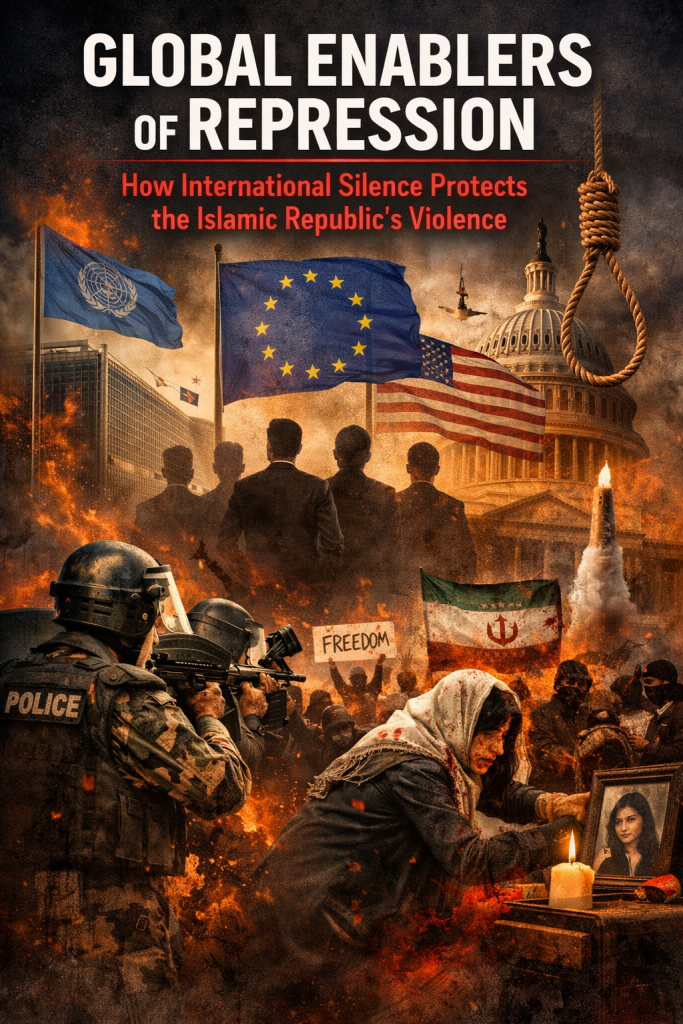
Introduction — Repression Does Not Survive Alone
The Islamic Republic’s survival in the face of nationwide protest is often explained as a function of internal repression: batons, bullets, prisons, and fear. This explanation is incomplete. Authoritarian violence does not operate in a vacuum. It requires tolerance, accommodation, and silence beyond national borders. What is unfolding in Iran today is not sustained by repression alone, but by an international ecosystem that has repeatedly chosen stability over accountability, engagement over consequence, and pragmatism over principle.
The current phase of Iran’s nationwide protests against the Islamic Republic has made one fact unmistakably clear: the regime has lost domestic legitimacy. Large segments of society no longer recognise clerical authority as morally, politically, or socially valid. Repression no longer restores order; it merely postpones collapse at an ever-increasing human cost. Yet despite this internal erosion, the system continues to function. It pays its security forces. It suppresses dissent. It executes protesters. It endures.
This endurance is not accidental.
It is enabled.
For decades, international actors—particularly in Europe—have approached Iran through a narrow framework of risk management. The Islamic Republic has been treated not as a system of systematic violence, but as a difficult partner: problematic, repressive, yet ultimately preferable to uncertainty. Human rights violations have been acknowledged rhetorically, while policy has remained anchored in containment, dialogue, and selective engagement. The result has been a persistent gap between declared values and operational behaviour.
This gap is not neutral. It has consequences.
Every statement that condemns repression without triggering accountability recalibrates the regime’s cost-benefit analysis. Every diplomatic channel preserved without conditions signals tolerance. Every corporation that continues operating through legal grey zones communicates that profit outweighs principle. Every media narrative that reduces protests to “economic unrest” strips victims of political agency and shields perpetrators from scrutiny.
Together, these choices form an architecture of enablement.
This article argues that the Islamic Republic’s capacity to sustain mass repression is inseparable from international behaviour. Foreign governments do not need to fund violence to facilitate it. Silence, delay, selective enforcement, and plausible deniability are sufficient. When repression is framed as an internal matter, and accountability is endlessly deferred in the name of diplomacy, authoritarian systems learn that brutality is a manageable liability.
The Iranian protesters understand this dynamic. They see executions carried out while negotiations continue. They see sanctions adjusted while repression intensifies. They see expressions of “concern” replace action, year after year. From their perspective, the message is unmistakable: their lives are negotiable within international calculations.
This research does not treat international actors as passive observers. It examines them as participants—sometimes reluctant, sometimes calculating, often complicit. It maps how governments, corporations, institutions, and media narratives have collectively lowered the cost of repression, allowing the Islamic Republic to absorb internal resistance without facing proportional external consequences.
Crucially, this article does not argue that foreign actors can determine Iran’s future. They cannot. Iranian society alone will shape the outcome of this confrontation. But international behaviour determines whether repression is constrained or rewarded, whether accountability is delayed or enforced, and whether violence remains a viable strategy for regime survival.
There are moments when neutrality ceases to exist as a moral or political position. Iran has reached such a moment. The question facing the international community is no longer whether to intervene, but whether continued silence will be recognised for what it is: an active choice that sustains violence.
This article examines the global enablers of repression—not to assign abstract blame, but to document a system of complicity that has become structurally embedded in how the Islamic Republic is managed, tolerated, and sustained.
There are no neutral actors left.
Chapter 1 — The Myth of Non-Interference
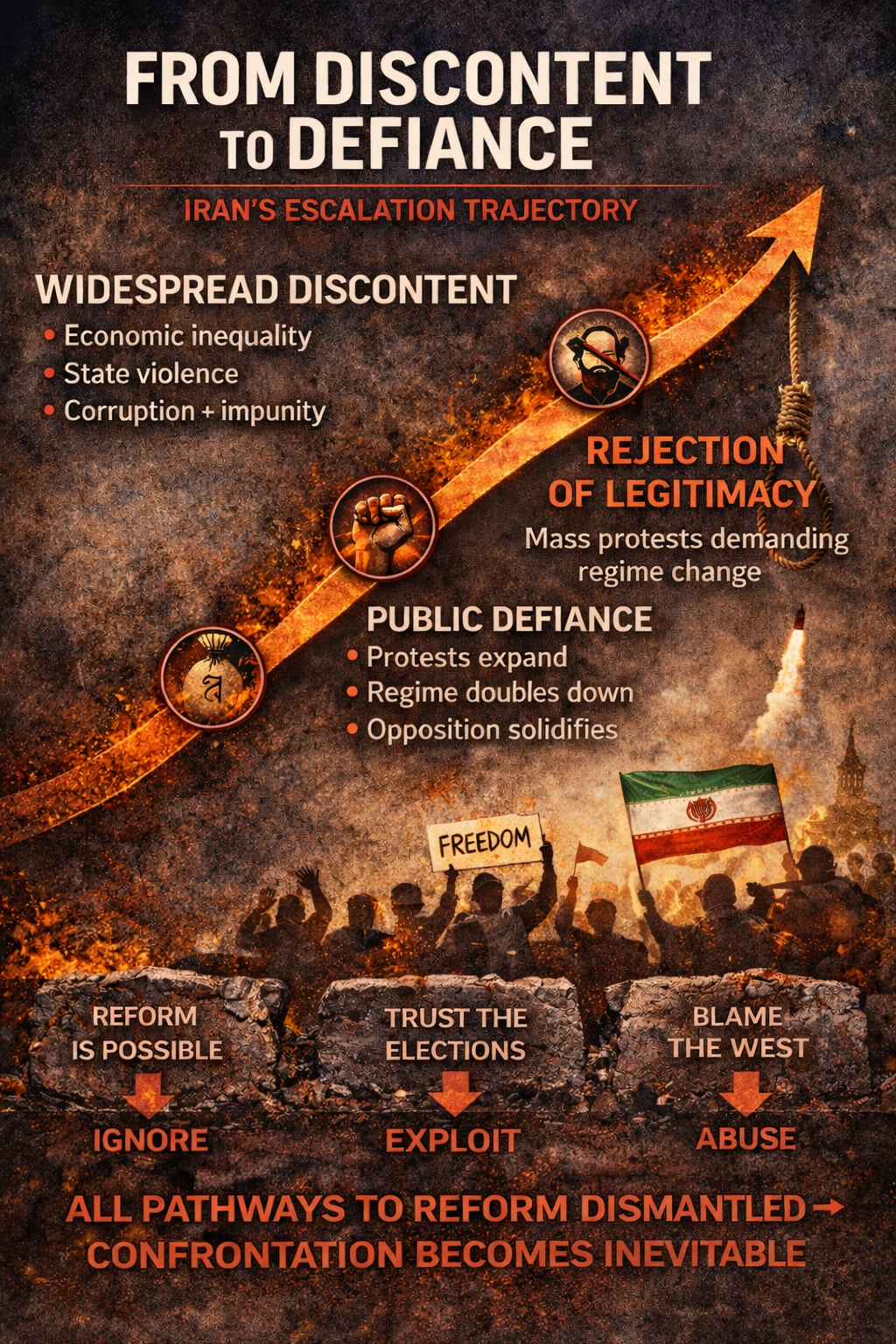
The language of “non-interference” has long been one of the most effective shields protecting the Islamic Republic from international accountability. Framed as respect for sovereignty and cultural specificity, it has allowed foreign governments—particularly in Europe—to observe systematic repression while maintaining the appearance of principled restraint. In practice, non-interference has functioned not as neutrality, but as a permissive condition under which violence is normalised and consequences are deferred.
This doctrine rests on a deliberate misrepresentation of reality. The Islamic Republic’s repression is not a purely internal affair. Its methods, sustainability, and scale are directly shaped by external tolerance. When a regime calculates the costs of mass arrests, executions, and lethal force, it does so within an international context—one defined by expected reactions, diplomatic thresholds, and the likelihood of material consequences. Silence is not absence. It is information.
1.1 Sovereignty as a Shield, Not a Principle
International law recognises sovereignty to prevent arbitrary external domination, not to legitimise crimes against a population. Yet in the case of Iran, sovereignty has been repeatedly invoked to insulate state violence from scrutiny. Executions of protesters, enforced disappearances, torture in detention, and mass surveillance have been described as “internal matters,” despite their clear violation of international human rights obligations to which Iran is formally bound.
This selective reading of sovereignty has emptied the concept of its ethical foundation. It transforms a protective principle into an offensive tool—one that regimes wield to suppress scrutiny rather than defend autonomy. By accepting this framing, external actors do not merely respect borders; they reinforce impunity.
1.2 Europe’s Calculated Restraint
European governments, in particular, have refined a model of engagement that combines rhetorical condemnation with operational caution. Statements expressing “deep concern” over human rights abuses are routinely followed by calls for de-escalation, dialogue, and stability. These responses are carefully calibrated to avoid triggering diplomatic rupture, economic retaliation, or strategic uncertainty.
The result is a predictable pattern: violence occurs, concern is voiced, normalisation resumes.
This is not the failure of policy—it is the policy. European engagement with the Islamic Republic has prioritised risk containment over accountability. The regime is treated as a problem to be managed rather than a system to be confronted. In this framework, repression becomes an unfortunate but tolerable cost of maintaining channels, preventing escalation, and preserving a fragile status quo.
1.3 Non-Interference as Strategic Communication
Authoritarian regimes are attentive observers of international behaviour. They track responses, test boundaries, and adapt accordingly. Each episode of repression met with limited external reaction recalibrates expectations. When executions provoke statements rather than sanctions, when mass arrests prompt appeals for restraint rather than accountability, regimes learn that violence is a manageable variable.
In Iran’s case, this lesson has been internalised over decades. The Islamic Republic has repeatedly escalated repression following moments of external hesitation, not resistance. The absence of decisive response is interpreted not as uncertainty, but as consent.
This dynamic explains why crackdowns intensify precisely when international attention peaks. Visibility without consequence emboldens violence. It signals that outrage will fade, negotiations will resume, and the costs of brutality will remain largely symbolic.
1.4 The Fiction of Stability
The primary justification for non-interference is stability. European policymakers have long argued—implicitly or explicitly—that pressure risks collapse, chaos, or regional destabilisation. This argument presumes that the Islamic Republic is a stabilising force, and that its survival mitigates greater harm.
This assumption is empirically false.
The regime’s repression has generated chronic instability: waves of migration, regional proxy violence, economic volatility, and radicalisation driven by despair rather than ideology. What is described as stability is, in reality, deferred crisis. By treating authoritarian endurance as order, external actors mistake stagnation for security.
Stability enforced through mass violence is not stability—it is suspended rupture.
1.5 The Human Cost of Abstraction
For policymakers, non-interference is a strategic abstraction. For Iranian citizens, it is a lived reality. Every decision to delay action translates into prolonged detention, broken families, unmarked graves, and erased futures. Protesters are not unaware of international debates. They watch them unfold while facing batons, bullets, and courts designed to punish dissent as treason.
The gap between diplomatic language and lived experience is vast. While governments debate proportionality and escalation, individuals confront irreversible consequences. This asymmetry lies at the heart of the crisis. The costs of restraint are not distributed equally—they are exported to those with the least protection.
1.6 Non-Interference as Complicity
At a certain point, restraint ceases to be prudence and becomes complicity. When patterns of violence are documented, systemic, and ongoing, continued inaction is not neutral. It is a choice that sustains the conditions under which repression remains viable.
The Islamic Republic has not survived because the world did not know. It has survived because knowing did not lead to action.
Non-interference, in this context, is not a failure of imagination. It is a deliberate posture—one that prioritises short-term manageability over long-term accountability. This posture has allowed repression to become routine, predictable, and institutionally entrenched.
The myth of non-interference is therefore precisely that: a myth. It obscures responsibility, sanitises passivity, and normalises violence. To dismantle the architecture of repression, this myth must be confronted—not as an abstract principle, but as a concrete mechanism through which authoritarian power is sustained.
Chapter 2 — Governments That Look Away
The endurance of the Islamic Republic’s repression cannot be explained without examining the conduct of foreign governments that have chosen observation over intervention, language over leverage, and continuity over consequence. While Iranian protesters face imprisonment, torture, and execution, many governments—most notably in Europe—have refined a posture of managed distance: close enough to engage, far enough to avoid responsibility.
This posture is not accidental. It is structured, repeatable, and strategic.
2.1 Condemnation Without Consequence
European governments have mastered the art of rhetorical opposition. Statements condemning violence, expressing “grave concern,” or calling for restraint are issued with reliable regularity after major crackdowns. These declarations create the appearance of moral alignment without triggering any material cost for the perpetrators.
Crucially, these statements are rarely followed by actions that alter the regime’s behaviour. Diplomatic relations remain intact. Economic channels stay open. Officials implicated in repression face few personal consequences. Over time, this pattern has rendered condemnation performative—predictable enough to be priced into the regime’s calculations.
For Tehran, the message is clear: words will follow violence, but consequences will not.
2.2 Engagement as a Default, Not a Reward
European policy toward Iran has treated engagement as a baseline rather than a conditional privilege. Dialogue persists irrespective of internal conduct. Human rights violations are compartmentalised, discussed in parallel forums, and carefully insulated from core diplomatic and economic interactions.
This compartmentalisation is politically convenient. It allows governments to claim ethical concern while preserving channels deemed strategically important. But it also communicates that repression does not meaningfully disrupt international relations. Engagement becomes decoupled from behaviour.
In effect, the regime learns that dialogue is guaranteed—even during periods of peak violence.
2.3 The Fear of “Destabilisation”
One of the most persistent justifications for restraint is the fear of destabilisation. European officials routinely warn that pressure could provoke escalation, empower hardliners, or produce unpredictable outcomes. This framing assumes that the Islamic Republic is a stabilising force whose collapse would create greater harm.
This assumption is flawed.
The regime’s own conduct—regional militarisation, internal repression, economic collapse, and forced migration—has been a consistent source of instability. What European policymakers describe as stability is often nothing more than deferred crisis management. By prioritising short-term predictability, they externalise long-term risk.
Stability, in this context, is not preserved. It is postponed.
2.4 Selective Standards and Normative Erosion
European foreign policy frequently presents itself as values-driven, anchored in human rights, rule of law, and accountability. Yet Iran exposes the limits of this self-image. Standards applied elsewhere—targeted sanctions, diplomatic isolation, legal accountability—are diluted or delayed when strategic interests intervene.
This selectivity erodes credibility. It signals that principles are conditional, activated only when convenient. For authoritarian regimes, this inconsistency is not confusing—it is instructive. It clarifies which violations are tolerable and which are not.
The Islamic Republic has learned that mass repression does not automatically trigger international isolation. It merely complicates messaging.
2.5 The Politics of Time
Another enabling strategy is delay. Governments frequently argue that pressure should wait: for investigations, for dialogue, for de-escalation, for “the right moment.” Time is presented as a neutral variable.
It is not.
Delay disproportionately benefits the perpetrator. Every week without action allows the regime to consolidate control, intimidate witnesses, destroy evidence, and normalise violence. By the time responses materialise, urgency has faded and attention has shifted.
Time, in authoritarian contexts, is a weapon.
2.6 The Signal Received in Tehran
From the regime’s perspective, international behaviour has been remarkably consistent. Crackdowns provoke criticism but not rupture. Executions generate headlines but not sustained action. Protest movements fade from front pages while diplomatic routines resume.
This pattern has taught the Islamic Republic that repression is survivable. Not because it is hidden, but because it is tolerated.
Governments that look away do not merely fail to stop violence. They help define its acceptable limits. By refusing to escalate beyond language, they participate—indirectly but materially—in sustaining a system that relies on brutality as governance.
The question is no longer whether European governments oppose repression in principle. It is whether their actions meaningfully challenge it in practice. So far, the answer has been unambiguous.
Looking away has become policy.
Chapter 3 — Corporations That Stay: Profiting From Repression
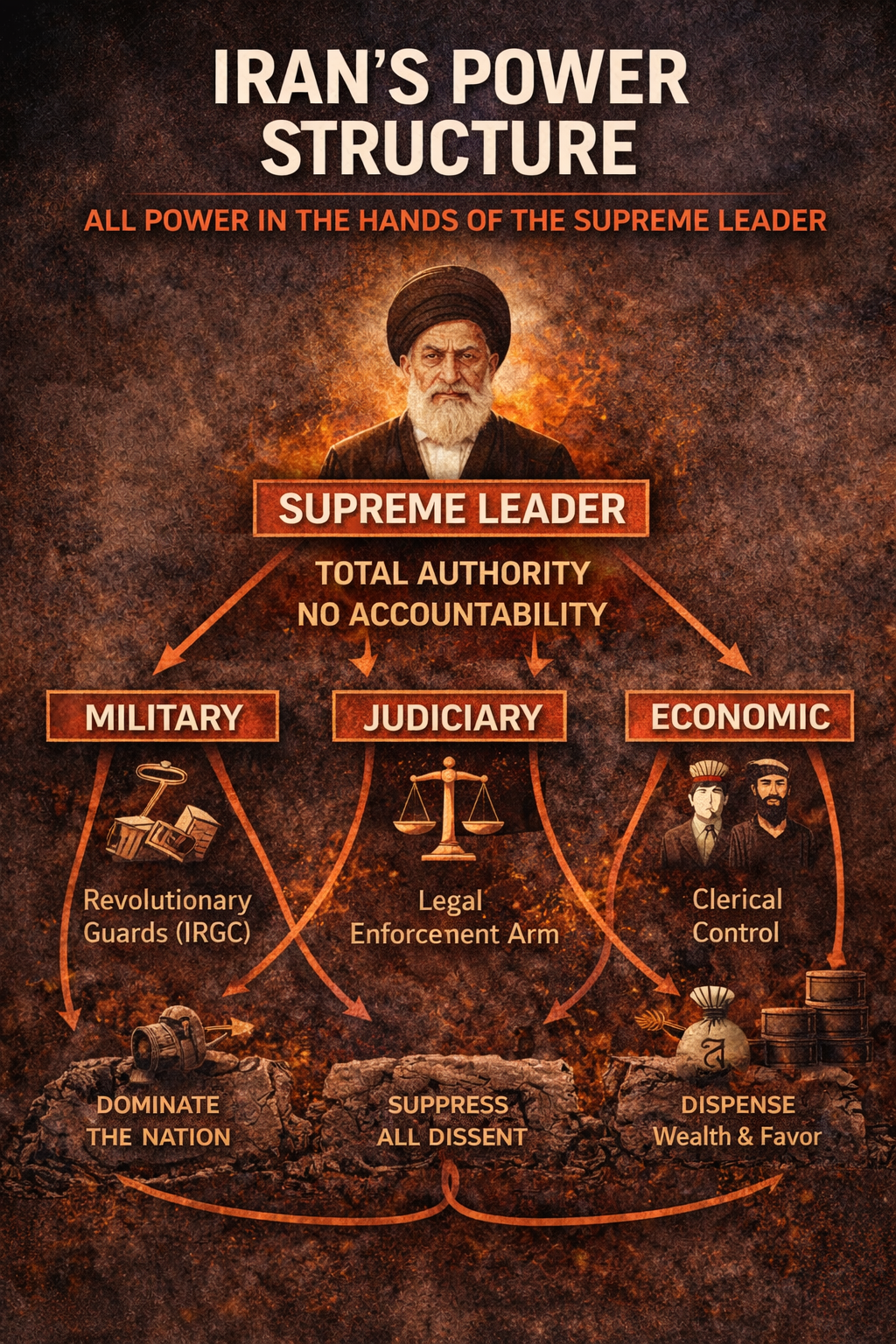
Repression does not sustain itself on ideology alone. It requires revenue, logistics, technology, and financial circulation. While governments provide diplomatic cover, corporations and financial institutions provide the material continuity that allows the Islamic Republic to function under pressure. Contrary to popular framing, this is not primarily a story of illicit smuggling networks operating in isolation. It is a story of lawful engagement, strategic ambiguity, and deliberate risk tolerance by companies that choose to remain embedded in a system built on coercion.
The persistence of corporate engagement with Iran is often defended through the language of legality. Contracts are described as compliant. Transactions are routed through intermediaries. Activities are framed as humanitarian, essential, or legacy obligations. Yet legality does not equal neutrality. In authoritarian contexts, continued economic participation has political effects—whether intended or not.
3.1 Europe’s Corporate Comfort Zone
European corporations have been among the most adept at navigating Iran’s sanctions landscape while maintaining a posture of ethical distance. Large firms in energy, engineering, shipping, insurance, and industrial manufacturing have repeatedly sought to preserve access to Iranian markets through exemptions, restructuring, or indirect engagement.
This behaviour is not accidental. It reflects a calculated assessment that reputational damage and legal exposure remain manageable. When enforcement is inconsistent and political will fragmented, compliance becomes a box-ticking exercise rather than a substantive ethical constraint.
The result is a corporate ecosystem that benefits from Iran’s market while remaining insulated from the human consequences of repression. The violence that secures regime control is treated as external to business operations—despite being integral to the stability that enables those operations to continue.
3.2 Banks, Intermediaries, and Plausible Deniability
Financial institutions play a central role in sustaining this system. While many European banks have formally withdrawn from direct exposure, financial flows continue through layered intermediaries, correspondent relationships, and jurisdictional arbitrage. Transactions are structured to remain technically compliant while functionally enabling trade with regime-linked entities.
This architecture of plausible deniability allows institutions to claim distance from repression while facilitating the economic activity that underwrites it. Risk is dispersed, responsibility diluted, and accountability deferred.
In practice, this means that capital continues to circulate even as protesters are executed, journalists silenced, and civil society dismantled. The separation between financial compliance and political consequence is maintained through complexity rather than principle.
3.3 Turkey and the UAE as Operational Gateways
Beyond Europe, regional hubs have become critical conduits for sustaining Iran’s economy under pressure. Turkey and the United Arab Emirates, in particular, have functioned as operational gateways—providing logistics, trade facilitation, financial access, and corporate registration mechanisms that bridge sanctioned and unsanctioned markets.
These jurisdictions often present themselves as neutral intermediaries, facilitating trade without political alignment. In reality, their role has been structural. By enabling routing, re-exportation, and financial services, they reduce the friction of sanctions and blunt the impact of international pressure.
This is not merely a technical issue. When repression intensifies and economic lifelines remain intact, regimes learn that violence does not threaten survival. It becomes an acceptable tool rather than a last resort.
3.4 China and the Normalisation of Authoritarian Trade
China’s engagement with Iran illustrates a different but equally consequential model: normalisation without conditionality. Energy purchases, infrastructure projects, and long-term strategic agreements have continued with minimal concern for Iran’s internal conduct.
This approach reframes repression as irrelevant to economic partnership. Human rights are treated as domestic matters, external to trade and investment decisions. The message to Tehran is unambiguous: political violence carries no meaningful cost within this relationship.
While European actors often cloak engagement in ethical language, China dispenses with the pretense entirely. The effect, however, is similar. Repression is decoupled from consequence.
3.5 Compliance Without Accountability
Corporate actors frequently defend their presence in Iran by invoking compliance. They adhere to sanctions lists, avoid prohibited entities, and follow formal regulations. This narrow conception of responsibility ignores a broader reality: compliance frameworks were never designed to address mass repression.
A company can be fully compliant and still materially benefit a system that relies on violence. By paying taxes, fees, or service charges; by employing regime-linked contractors; by contributing to economic stability under authoritarian control, corporations become indirect stakeholders in repression.
Compliance, in this sense, becomes a moral alibi rather than a safeguard.
3.6 The Human Cost of Corporate Distance
For those facing repression inside Iran, distinctions between legal and illegal engagement are meaningless. What they experience is continuity. The same institutions function. The same elites remain insulated. The same violence is deployed without interruption.
When corporations remain, repression is stabilised. When capital flows persist, accountability is postponed. When markets function despite mass violence, the regime learns that brutality is compatible with business as usual.
This is not an argument for disengagement as a cure-all. It is an argument against the fiction that economic participation is apolitical. In authoritarian systems, there is no neutral commerce. Every transaction exists within a structure of power—and contributes, however indirectly, to its endurance.
Corporations that stay may not intend to enable repression. But intention is not the measure of impact. In Iran’s current context, continued economic engagement functions as a quiet but powerful form of complicity.
Chapter 4 — The Sanctions Illusion: Why Pressure Without Accountability Fails
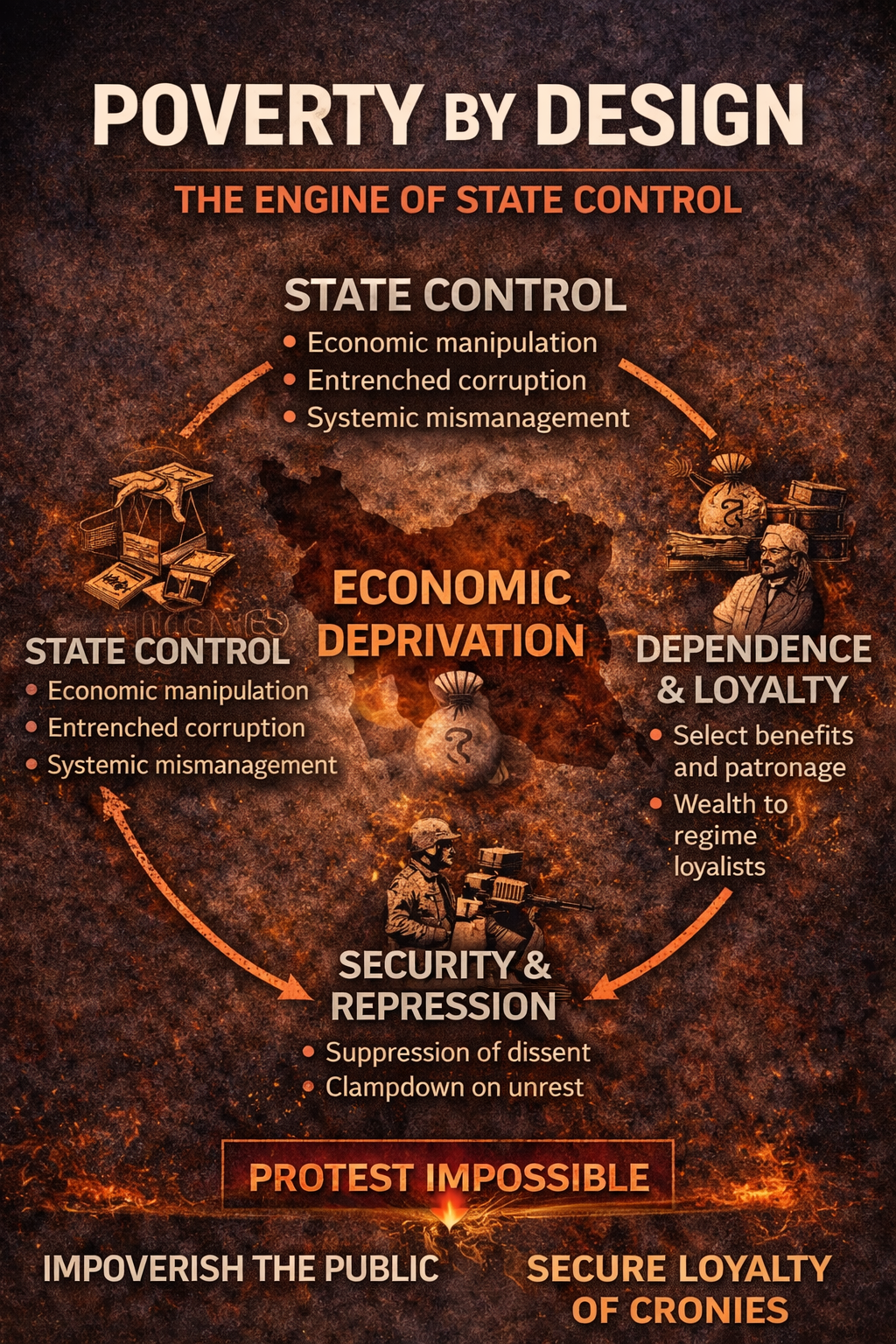
Sanctions are often presented as the international community’s primary response to repression in Iran. They are invoked as evidence of resolve, framed as tools of deterrence, and cited as proof that violence carries a cost. Yet decades of experience demonstrate a more uncomfortable reality: sanctions, when detached from accountability and enforcement consistency, function less as constraints and more as adaptable conditions within which repression continues.
The Islamic Republic has not survived despite sanctions. It has learned to survive through them.
This chapter examines how sanctions have repeatedly failed to curb repression—not in theory, but in practice—by analysing concrete cases that reveal the gap between pressure and consequence.
4.1 Case One: Sanctions and the Normalisation of Executions
Periods of intensified repression in Iran have frequently coincided with moments of active diplomatic engagement. Mass arrests, executions of protesters, and the expansion of security powers have unfolded alongside negotiations, sanctions adjustments, or enforcement pauses.
This overlap has created a dangerous precedent. The regime has learned that internal violence does not necessarily disrupt external processes. Sanctions may constrain revenue streams, but they do not automatically target decision-makers responsible for repression. As long as political survival remains decoupled from personal accountability, coercion remains rational.
Executions, in this context, become administratively manageable rather than politically catastrophic.
4.2 Case Two: Sanctioned Economies, Unsanctioned Repression
Sanctions regimes are designed to regulate economic behaviour, not state violence. This structural limitation is repeatedly exploited. While trade, banking, and energy sectors are monitored, security institutions responsible for repression often remain insulated from direct consequences.
In Iran, this separation has been critical. Security forces continue to receive funding, equipment, and institutional protection even as the broader economy contracts. Sanctions squeeze society far more effectively than they constrain the machinery of repression.
The result is perverse: economic pressure weakens the population while leaving coercive capacity largely intact.
4.3 Case Three: Enforcement Gaps and Strategic Adaptation
The effectiveness of sanctions depends not on their announcement, but on their enforcement. In Iran’s case, enforcement has been uneven, delayed, and fragmented across jurisdictions. This inconsistency creates space for adaptation.
The regime has responded by:
- Diversifying trade routes
- Expanding intermediary networks
- Leveraging regional hubs
- Shifting transactions into grey zones
Each enforcement gap becomes a lesson. Each workaround becomes institutional knowledge. Over time, sanctions cease to function as shocks and instead become predictable constraints to be managed.
Predictability favours authoritarian systems.
4.4 Case Four: Humanitarian Exemptions and Political Abuse
Humanitarian exemptions are essential to protect civilian populations—but in Iran, they have repeatedly been instrumentalised. Goods intended for civilian use are diverted, monetised, or politicised. Access becomes conditional. Scarcity is managed rather than alleviated.
This abuse does not invalidate humanitarian principles, but it exposes the regime’s capacity to weaponise relief while maintaining repression. Sanctions frameworks that fail to account for this dynamic risk enabling the very structures they aim to mitigate.
When exemptions are exploited without consequence, repression gains both resources and legitimacy.
4.5 Case Five: Symbolic Sanctions and the Absence of Deterrence
Targeted sanctions against individuals implicated in abuses are often cited as progress. In practice, these measures frequently lack teeth. Travel bans are irrelevant to officials who rarely travel. Asset freezes are symbolic when wealth is concealed through proxies, foundations, or informal networks.
Without sustained legal follow-through—investigations, prosecutions, and personal exposure—targeted sanctions function as reputational gestures rather than deterrents. They signal disapproval without imposing meaningful cost.
Authoritarian elites learn to absorb symbolism.
4.6 The Core Failure: Sanctions Without Accountability
These cases point to a consistent pattern. Sanctions constrain behaviour only when they threaten personal risk. Economic pressure alone does not alter the calculus of leaders who prioritise survival over prosperity.
In Iran, repression persists because:
- Decision-makers are insulated
- Enforcement is fragmented
- Accountability is delayed
- Violence remains a viable strategy
Sanctions without accountability do not stop repression—they coexist with it.
4.7 From Pressure to Consequence
The failure of sanctions is not inevitable. It is structural. Pressure that does not translate into legal, political, and personal consequence invites adaptation rather than compliance.
For the Islamic Republic, sanctions have become a manageable condition rather than an existential threat. They shape tactics, not strategy. They impose cost, but not risk.
Until repression itself—not merely economic activity—becomes the trigger for sustained accountability, sanctions will remain an illusion of action rather than a mechanism of restraint.
Chapter 5 — Media Laundering of Violence
Repression does not rely on force alone. It relies on narrative management. In authoritarian systems, violence must be explained, reframed, minimised, or normalised to remain sustainable. In Iran’s case, this function has not been performed solely by state media or propaganda outlets. It has been reinforced—often unintentionally—by international media ecosystems that simplify, sanitise, or distort the reality of repression.
This chapter examines how coverage choices, framing conventions, and editorial caution have collectively contributed to the laundering of violence—transforming systemic repression into manageable headlines rather than urgent political facts.
5.1 From Political Uprising to “Unrest”
One of the most persistent distortions in international coverage of Iran is linguistic. Protests are routinely described as “unrest,” “disturbances,” or “clashes.” These terms obscure agency and flatten power dynamics. They suggest symmetry where none exists.
A population demanding dignity and accountability is linguistically reduced to a destabilising force. A heavily armed state deploying lethal violence is rendered a neutral actor restoring order.
This framing matters. Language shapes perception. When repression is described as a response to disorder rather than the cause of it, responsibility is subtly reassigned away from the perpetrator.
5.2 Economic Reductionism as Narrative Shield
Another dominant pattern is the reduction of political protest to economic grievance. Inflation, currency collapse, fuel prices, and unemployment are frequently positioned as primary explanations for mobilisation. While these factors act as triggers, treating them as causes strips protests of political intent.
This framing serves two functions:
- It depoliticises dissent, portraying protesters as reactive rather than deliberate.
- It implicitly validates the regime’s claim that protests are manageable policy failures rather than existential challenges.
By foregrounding economics and backgrounding repression, media narratives unintentionally reinforce the regime’s preferred explanation: that legitimacy remains intact, and only management needs adjustment.
5.3 False Balance and the Illusion of Neutrality
In pursuit of objectivity, many outlets adopt a false balance between state narratives and citizen testimony. Official statements are quoted alongside eyewitness accounts as competing interpretations rather than unequal claims to truth.
This approach collapses under scrutiny. A state that controls courts, prisons, and security forces does not offer a perspective—it exercises power. Treating official denials as equivalent to documented abuses legitimises deception under the guise of fairness.
Neutrality, in this context, becomes a distortion mechanism rather than a corrective.
5.4 Erasing Victims Through Abstraction
Mass repression is often reported through statistics rather than stories. Arrest numbers, death tolls, and casualty figures appear without names, faces, or trajectories. While aggregation is necessary, abstraction has consequences.
Victims become data points. Their experiences lose specificity. Their political agency disappears. Repression is transformed into an unfortunate trend rather than an intentional strategy.
This abstraction aligns neatly with diplomatic inertia. It is easier to delay action when violence lacks human texture.
5.5 Temporal Fragmentation and Attention Decay
International media coverage of Iran tends to follow a predictable arc: intense focus during moments of peak violence, followed by rapid decline as attention shifts elsewhere. Repression, however, does not follow news cycles. It persists long after headlines fade.
This temporal fragmentation benefits the regime. It allows crackdowns to be absorbed gradually, outside sustained scrutiny. When coverage resumes, it often lacks continuity, presenting each wave of violence as a discrete event rather than part of a cumulative strategy.
Without narrative continuity, accountability dissolves.
5.6 Platform Asymmetry and Voice Suppression
Iranian protesters operate under extreme informational asymmetry. Internet shutdowns, surveillance, arrests, and intimidation restrict their ability to communicate. Meanwhile, state narratives benefit from institutional access, official spokespeople, and diplomatic platforms.
When international media rely disproportionately on official briefings, accredited sources, or “authoritative voices,” they amplify this asymmetry. Citizen testimony is treated as anecdotal; state messaging is treated as factual.
This imbalance does not reflect credibility—it reflects access.
5.7 When Caution Becomes Collaboration
No media outlet intends to enable repression. Yet intention does not determine impact. When violence is softened through euphemism, when political intent is diluted through economic framing, when perpetrators are shielded by procedural balance, repression is normalised.
The laundering of violence does not require propaganda. It requires restraint without context, neutrality without power analysis, and caution without consequence.
For the Islamic Republic, this environment is not incidental—it is advantageous. It allows brutality to coexist with engagement, executions with negotiations, and mass arrests with diplomatic routine.
Media narratives do not merely reflect reality. They structure the space in which policy decisions are made. When repression is narratively contained, political urgency evaporates.
Violence, once laundered, becomes administratively tolerable.
Chapter 6 — Legal Accountability Is Catching Up
Authoritarian systems often project the illusion of permanence. Courts are controlled, judges are obedient, and violence appears legally sanitised through domestic procedures. For years, the Islamic Republic has relied on this illusion—treating accountability as a purely internal matter, confined to courts it dominates and laws it manipulates. That illusion is eroding.
What the regime increasingly confronts is not international condemnation, but legal exposure. Unlike sanctions, statements, or diplomatic pressure, legal accountability does not expire with attention cycles. It accumulates quietly, case by case, precedent by precedent, until impunity becomes unsustainable.
This chapter examines why legal accountability represents the most serious long-term threat to the Islamic Republic—and why the regime fears courts more than protests.
6.1 Universal Jurisdiction: The End of Safe Distance
Universal jurisdiction rests on a simple but destabilising principle: certain crimes are so severe that no state may shield perpetrators from prosecution, regardless of where the crime occurred or the nationality of those involved. Torture, crimes against humanity, enforced disappearance, and extrajudicial killing fall squarely within this category.
For Iranian officials implicated in repression, this principle collapses the concept of safe distance. Borders no longer guarantee immunity. Time no longer guarantees erasure.
European courts have already demonstrated willingness to apply this doctrine in cases involving non-European perpetrators. Each investigation, arrest, or conviction sends a clear signal: domestic impunity does not preclude international liability.
The regime understands this. It monitors these cases closely—not because they are symbolic, but because they establish precedent.
6.2 From Documentation to Prosecution
For years, human rights documentation was dismissed as advocacy rather than evidence. That distinction is fading. Detailed reports, survivor testimony, forensic evidence, and digital documentation increasingly meet evidentiary thresholds required for prosecution.
What once served to shame now serves to indict.
The proliferation of citizen documentation—videos, images, metadata, witness accounts—has radically altered the accountability landscape. Repression is no longer ephemeral. It leaves records. These records circulate, persist, and resurface in legal contexts far removed from their origin.
The Islamic Republic’s attempt to erase violence through censorship and intimidation is colliding with a legal environment that values accumulation over immediacy.
6.3 Individual Liability, Not Abstract Responsibility
One of the regime’s core strategies has been to diffuse responsibility. Orders are opaque. Chains of command are obscured. Institutions are blamed rather than individuals. This strategy falters under international criminal law, which prioritises individual responsibility.
Judges, prosecutors, security officials, interrogators, and commanders are not shielded by institutional affiliation. “Following orders” does not absolve participation in systematic abuse.
This shift is existentially threatening. Sanctions target sectors. Legal accountability targets people.
When officials begin to assess personal risk—travel limitations, asset exposure, arrest warrants—the calculus of repression changes. Violence ceases to be cost-free.
6.4 The Slow Violence of Law
Unlike political pressure, legal processes move slowly. Investigations take years. Cases advance incrementally. From the regime’s perspective, this delay has often been misinterpreted as weakness.
It is not.
Law operates cumulatively. Each documented case strengthens the next. Each precedent lowers procedural barriers. Each conviction normalises the idea that accountability is possible.
The Islamic Republic’s fear is not of immediate prosecution, but of inevitability. Once legal pathways are established, they do not close. They expand.
6.5 Europe’s Double Role: Delay and Exposure
European governments occupy a contradictory position. Politically, many have delayed accountability in favour of engagement. Legally, however, their courts operate with relative independence.
This creates a growing disconnect. While executives pursue caution, prosecutors pursue evidence. While diplomats call for restraint, judges issue warrants. The regime cannot control this divergence.
Ironically, the same European systems that have politically enabled repression may become legal arenas where impunity collapses.
6.6 Why the Regime Responds With Fear
The Islamic Republic’s hostility toward documentation, diaspora activism, and international legal advocacy is not rhetorical—it is strategic. Witnesses are threatened. Families are pressured. Lawyers are targeted. Archives are criminalised.
These responses reveal vulnerability.
Authoritarian regimes fear exposure only when exposure carries consequence. The intensity with which the Islamic Republic attempts to suppress legal documentation indicates recognition that accountability is no longer theoretical.
6.7 Law as the Regime’s Long Game Enemy
Protests challenge legitimacy. Sanctions constrain resources. But law undermines permanence.
A regime can survive unrest. It can adapt to economic pressure. It cannot easily survive a world in which its officials are personally liable for crimes that do not expire.
Legal accountability does not promise immediate justice. It promises something more destabilising: persistence.
For the Islamic Republic, this represents the most dangerous horizon. Not because courts will act tomorrow—but because they will still be there when repression can no longer be hidden, denied, or normalised.
Impunity thrives on forgetting. Law is designed to remember.
Chapter 7 — Silence for Sale: How Europe Converts Iran’s Repression into Business as Usual
The Islamic Republic does not survive on repression alone. It survives because repression is tolerated, absorbed, and ultimately normalised within international economic and diplomatic systems—particularly in Europe. While European officials routinely issue statements of “deep concern” over Iran’s human rights abuses, an extensive infrastructure of engagement continues to function uninterrupted.
This is not a contradiction. It is coordination.
Europe’s relationship with the Islamic Republic has evolved into a model in which political violence is externalised, discounted, and priced in. Repression is acknowledged rhetorically but excluded from decision-making. The result is a system where silence is not accidental—it is transactional.
7.1 From Human Rights to Predictability: Europe’s Strategic Downgrade
European policy toward Iran has undergone a quiet but decisive shift. Human rights, once framed as a foundational pillar of engagement, have been reduced to a secondary variable—invoked symbolically, ignored operationally.
The priority is not justice. It is predictability.
A regime that kills its protesters but maintains contracts, controls borders, and suppresses internal volatility is treated as a “manageable” partner. Popular mobilisation, by contrast, is framed as risk—chaotic, uncertain, destabilising.
This logic inverts moral reasoning: repression becomes preferable to transition.
Europe does not endorse violence openly. It simply recalibrates its tolerance threshold until violence no longer interrupts business.
7.2 Economic Engagement Under Repression: The Normalisation Trap
Despite sanctions and public condemnation, European economic interaction with Iran has never ceased. It has merely adapted.
Engagement continues through:
• intermediary states
• shell entities
• sanctions carve-outs
• narrow compliance interpretations
This architecture allows European actors to claim legal conformity while avoiding substantive responsibility. Transactions are evaluated not by their political impact, but by their technical defensibility.
The operative question is no longer “Should this relationship exist?”
It is “Can this relationship be legally justified?”
That shift transforms repression into background noise—acknowledged, but irrelevant.
7.3 Corporate Ethics as Risk Management Theatre
European corporations operating in or around Iran increasingly treat state violence as a compliance issue rather than a moral boundary. Human rights abuses are folded into ESG language, risk disclosures, and reputational assessments—stripped of urgency and consequence.
In this framework:
• Executions become “internal security developments”
• Mass arrests become “periods of unrest”
• Protesters become “operational risks”
This is not ethical engagement. It is ethical simulation.
Violence is not confronted—it is managed.
7.4 Legalism as Alibi
European institutions frequently retreat behind legalism: if an action does not violate sanctions law, it is deemed acceptable.
This argument is deliberately misleading.
Sanctions regimes define minimum constraints, not moral limits. They are floors, not ceilings. Treating legality as absolution allows European actors to disengage ethically while remaining economically embedded.
Law becomes an alibi for indifference.
This is how responsibility is outsourced—to statutes, procedures, and bureaucratic delay—while repression accelerates on the ground.
7.5 Migration Control: The Unspoken Bargain
One of the most cynical dimensions of Europe’s tolerance is migration containment. The Islamic Republic plays an indirect but significant role in regulating population movement toward Europe—whether through border control, regional influence, or sheer coercion.
This creates leverage.
As repression intensifies, European pressure softens. Human rights advocacy is quietly deprioritised to avoid destabilisation that might produce refugee flows.
In effect, Iranian citizens are rendered hostages to geopolitical convenience:
• Repressed at home
• Feared abroad
Their suffering is weighed against Europe’s domestic political comfort—and consistently found expendable.
7.6 How Silence Is Manufactured
European silence is not passive. It is actively produced.
Through:
• delayed statements
• diluted language
• procedural deferrals
• endless calls for “dialogue”
Each response is calibrated to appear engaged while avoiding consequence. The regime learns the pattern quickly: outrage fades, business resumes.
Executions increase. Arrests multiply. Europe adjusts its tone—not its policy.
Silence becomes structural.
7.7 Complicity Without fingerprints
European actors often insist they are not responsible for repression because they are not pulling triggers or issuing orders.
This is a convenient fiction.
When a regime’s capacity for violence is sustained through economic normalisation, diplomatic engagement, and political restraint, responsibility does not disappear—it diffuses.
No single transaction sustains repression. But together, they create an environment in which repression is survivable, sustainable, and profitable.
That is complicity without fingerprints.
7.8 The Strategic Failure Behind the Moral One
Europe’s approach is often defended as pragmatism. In reality, it is short-sighted.
By sustaining a regime that governs through violence:
• Social rupture deepens
• Migration pressure increases
• Regional instability compounds
• Legal and reputational exposure accumulates
What is purchased as “stability” is merely delayed collapse—at higher human and political cost.
Europe is not preventing crisis. It is financing its prolongation.
7.9 Silence Is a Choice
European officials often describe their posture toward Iran as cautious, balanced, or pragmatic. These terms obscure a simpler truth.
Silence is a choice.
It signals that:
• Contracts outweigh lives
• Predictability outweighs dignity
• Order outweighs justice
The Islamic Republic understands this clearly. It does not misread European restraint—it exploits it.
As long as silence remains profitable, repression will remain policy.
Chapter 8 — The Cost of Enabling Repression
The international debate surrounding Iran’s ongoing nationwide protests often remains trapped in moral abstractions: human rights violations, ethical responsibility, or rhetorical condemnations of violence. While these dimensions matter, they obscure a more consequential reality. The sustained tolerance of repression in Iran—particularly by European governments—has generated tangible, accumulating costs that extend far beyond Iran’s borders. What was once framed as pragmatic restraint has evolved into a strategic liability.
This chapter argues that enabling repression in Iran is no longer a local moral failure; it is a policy choice producing regional, demographic, and security consequences that Europe can neither control nor externalise. The costs of inaction are no longer theoretical. They are unfolding in real time.
8.1 Radicalisation as a Policy Outcome, Not a Cultural Trait
One of the most persistent misconceptions in European policy circles is the assumption that radicalisation in Iran—or among Iranian society more broadly—is an inherent ideological risk that must be contained. This framing is analytically flawed. Radicalisation in Iran is not a cultural constant; it is a political outcome.
When institutional pathways for reform are systematically dismantled, political expression does not disappear—it mutates. Over the past two decades, Iranian society repeatedly attempted engagement within the system: through elections, civil society, professional associations, and limited protest. Each attempt was met with disqualification, repression, imprisonment, or violence. The current protest movement is not radical because it rejects the Islamic Republic; it rejects the Islamic Republic because all moderate pathways were deliberately destroyed.
European policies that prioritised “stability” over accountability directly contributed to this trajectory. By maintaining diplomatic engagement without meaningful conditionality, European governments reinforced the regime’s belief that repression carried limited external cost. This, in turn, incentivised escalation rather than restraint.
Radicalisation, in this context, is not an ideological drift toward extremism. It is the logical response of a society denied peaceful avenues of political participation. When reform becomes structurally impossible, rupture becomes rational.
8.2 From Contained Repression to Uncontainable Migration
For years, European policymakers treated Iran’s internal repression as a tragic but geographically contained phenomenon. That assumption no longer holds.
Authoritarian repression produces migration not as a side effect, but as a structural outcome. When economic survival, personal safety, and political dignity are simultaneously eroded, exit becomes the only remaining form of agency. Iran’s current crisis is generating precisely this convergence.
Unlike previous migration waves driven primarily by economic aspiration, the current exodus is increasingly political. It includes:
- Skilled professionals and technocrats
- Academics and medical personnel
- Artists, journalists, and cultural workers
- Women facing systemic legal and physical violence
- Youth with no credible future inside the country
This demographic profile matters. It signals not temporary displacement but long-term rupture between state and society.
European governments cannot simultaneously tolerate repression and expect migration to remain manageable. Border enforcement, asylum restrictions, and deterrence policies address symptoms—not causes. As long as repression continues unchecked, migration pressures will intensify, diversify, and become less predictable.
The political cost is twofold: internal strain on European societies and the moral erosion of asylum frameworks increasingly forced to choose between humanitarian commitments and domestic political backlash.
8.3 Repression at Home, Aggression Abroad
The Islamic Republic’s internal legitimacy crisis has direct implications for regional stability. Authoritarian regimes facing sustained domestic unrest rarely respond with inward reform; they externalise insecurity.
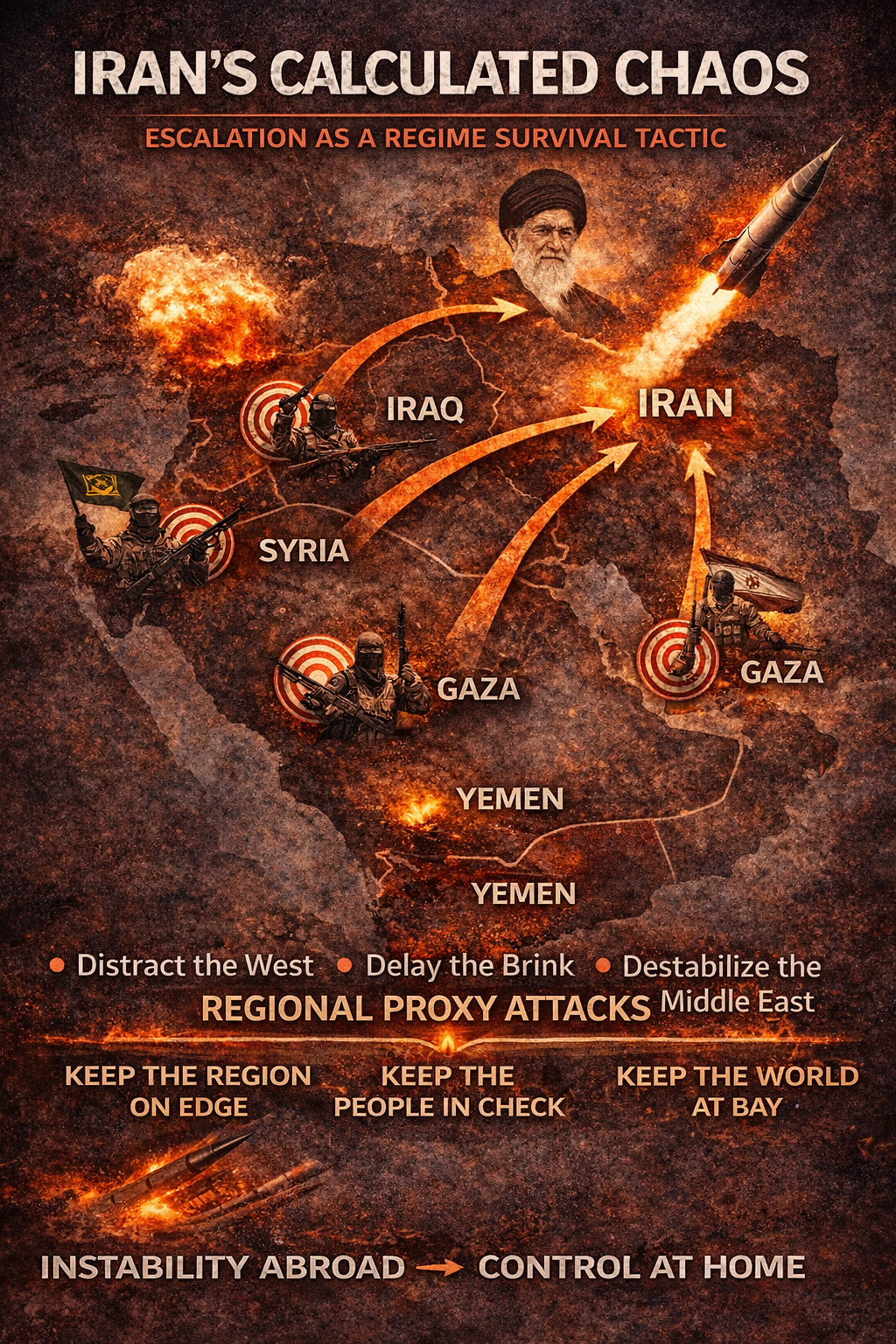
Iran’s regional posture—support for proxy groups, escalation through non-state actors, and strategic ambiguity—cannot be separated from its domestic vulnerabilities. External aggression serves multiple functions:
- It redirects public attention away from internal crisis
- It justifies securitisation and repression as “national defence”
- It signals strength to internal elites amid legitimacy erosion
European tolerance of domestic repression indirectly reinforces this behaviour. By compartmentalising human rights and regional security as separate policy domains, Europe underestimates the causal link between internal violence and external instability.
There is no durable regional de-escalation without domestic accountability. A regime that survives through repression at home will export insecurity abroad. This is not ideological—it is structural.
8.4 Why These Costs Can No Longer Be Externalised
For decades, the Islamic Republic’s violence was treated as an internal Iranian tragedy—politically condemnable, strategically manageable, and geographically distant. That era has ended.
The costs of repression now manifest across multiple European policy domains:
- Migration and asylum systems under sustained pressure
- Energy security disrupted by regional instability
- Diplomatic credibility eroded by selective human rights advocacy
- Domestic polarisation intensified by perceived hypocrisy
- Strategic unpredictability amplified by authoritarian fragility
The assumption that these costs could be indefinitely outsourced—to Iranian society, to neighbouring states, or to abstract future risks—has proven false. Blowback is no longer hypothetical; it is cumulative.
Each cycle of repression produces downstream effects that return to European political systems with increasing force and diminishing controllability.
8.5 Strategic Blowback: When Stability Becomes Instability
European engagement with the Islamic Republic has long been justified by a belief in controlled risk: that engagement mitigates volatility, preserves channels of communication, and prevents collapse. In practice, this strategy has produced the opposite outcome.
By insulating the regime from accountability while society absorbs the cost of repression, European policy has contributed to:
- The erosion of reformist intermediaries
- The collapse of trust in international norms
- The delegitimisation of diplomatic engagement itself
- The acceleration of zero-sum confrontation between state and society
Stability purchased through silence is inherently unstable. It delays resolution while magnifying eventual rupture. What Europe mistook for risk management has become risk accumulation.
8.6 The Illusion of Neutrality
European officials frequently invoke neutrality—non-interference, balanced engagement, diplomatic caution—as a virtue. In the context of sustained mass repression, neutrality is not neutral.
When violence is systematic, silence functions as permission. When accountability is deferred indefinitely, impunity becomes policy. The Islamic Republic has learned this lesson well. It has calibrated repression based not on domestic resistance alone, but on international tolerance thresholds.
Neutrality in the face of mass repression does not preserve options; it forecloses them.
8.7 The Long-Term Strategic Cost
Beyond immediate consequences lies a deeper strategic cost: the erosion of Europe’s normative influence. Human rights frameworks derive power not from declarations, but from consistency. When European governments selectively enforce norms based on strategic convenience, they weaken the very architecture they rely on elsewhere.
This erosion is not confined to Iran. It signals to other authoritarian regimes that repression can coexist with engagement, trade, and diplomatic legitimacy—as long as it remains internally contained. Iran demonstrates that it never remains contained for long.
8.8 Repression as a Multiplier of Instability
The Islamic Republic’s survival strategy increasingly relies on force, surveillance, and intimidation. Each application of repression may delay protest temporarily, but it multiplies long-term instability.
European policy has failed to internalise a critical insight: authoritarian repression does not stabilise failing systems—it accelerates their decay. The longer repression is enabled, the more abrupt, violent, and unmanageable the eventual transition becomes.
The choice is not between stability and chaos. It is between early accountability and late collapse.
8.9 A Strategic Threshold Has Been Crossed
Iran has entered a phase where repression no longer restores order; it depletes it. European policy has not adapted to this reality. Continued reliance on outdated assumptions—incremental reform, elite pragmatism, controlled engagement—risks strategic blindness.
The costs of enabling repression are no longer deferred. They are immediate, compounding, and politically unavoidable.
8.10 Conclusion of the Chapter: From Moral Failure to Strategic Error
The Islamic Republic’s repression has long been a moral indictment. It is now a strategic error for those who enable it through silence or accommodation.
Europe faces a narrowing set of choices. It can continue to treat repression as an internal Iranian matter and absorb escalating external consequences—or it can recognise that authoritarian endurance built on violence inevitably exports instability.
The costs are already being paid. The question is no longer whether Europe will bear them—but whether it will acknowledge their source.
Chapter 9 — The Point of No Plausible Deniability
There was a time when international actors could plausibly claim ignorance about the nature and scale of repression in Iran. That time has passed. The current phase of Iran’s nationwide protests against the Islamic Republic has eliminated the last remaining excuses that once shielded governments, institutions, and corporations from responsibility.
Today, denial is no longer plausible. It is performative.
This chapter argues that the accumulation of evidence—visual, testimonial, forensic, and institutional—has closed every avenue of strategic ambiguity. Claims of uncertainty, complexity, or internal sovereignty no longer withstand scrutiny. What remains is not lack of information, but deliberate refusal to act on it.
9.1 “We Didn’t Know” Is No Longer Credible
The assertion of ignorance has become untenable.
The scale and visibility of repression in Iran today exceed those of previous protest cycles in both intensity and documentation. Unlike earlier periods, violence is not hidden behind information blackouts or fragmented reporting. It is recorded, timestamped, geolocated, and disseminated in near real time.
Killings, mass arrests, raids on hospitals, executions, and the targeting of women and minors are no longer allegations awaiting confirmation—they are documented events. The volume of evidence has crossed a critical threshold: it is now impossible to claim lack of awareness without admitting willful blindness.
Ignorance is no longer an explanation. It is a posture.
9.2 “It’s Complicated” as a Strategy of Evasion
Complexity has long served as a convenient shield. Iran’s political system, its factions, its sanctions environment, its regional entanglements—these are often invoked to justify delay, caution, or inaction.
But complexity does not negate clarity.
While Iran’s political structure may be opaque, the regime’s response to dissent is not. The pattern is consistent, repetitive, and unmistakable:
- Protest → lethal force
- Dissent → mass arrest
- Documentation → denial
- Accountability → obstruction
Invoking complexity in the face of such repetition does not reflect analytical sophistication. It reflects strategic evasion.
At this stage, appeals to nuance function less as tools of understanding and more as mechanisms for postponing responsibility.
9.3 “It’s an Internal Matter” Has Collapsed
The claim that repression in Iran constitutes an internal affair rests on a narrow and outdated interpretation of sovereignty. That interpretation collapses when violence becomes systematic, widespread, and directed at civilians exercising fundamental rights.
International norms do not require intervention in every domestic crisis—but they do require accountability when states engage in mass repression. Iran’s actions meet that threshold repeatedly.
Moreover, the internal-external distinction is no longer operationally valid. The consequences of repression—migration, regional destabilisation, transnational security risks—do not remain within Iran’s borders. What spills over cannot be dismissed as domestic.
Sovereignty does not extend to impunity.
9.4 The Evidence Is Not Fragmentary — It Is Overwhelming
One of the most decisive shifts in the current protest cycle is the nature of evidence itself.
The record now includes:
- High-resolution video of live fire against protesters
- Hospital raids documented by medical staff and civilians
- Testimonies from families of detainees and victims
- Verified execution records and judicial procedures
- Satellite imagery corroborating security deployments
- Independent reporting by international media and NGOs
This evidence is not anecdotal. It is cumulative, cross-verified, and consistent across sources.
The volume of documentation has transformed repression from a contested narrative into an established factual record. Disagreement is no longer about what is happening, but about whether those witnessing it are willing to respond.
9.5 Information Saturation and the End of Strategic Ambiguity
In earlier phases, authoritarian regimes relied on information scarcity to preserve deniability. Iran’s leadership has lost that advantage.
Digital connectivity, diaspora networks, citizen journalism, and encrypted communication have produced a condition of information saturation. Attempts to suppress documentation now generate more attention, not less. Each crackdown expands the evidentiary archive.
This saturation has strategic consequences. When evidence is abundant and persistent, delay becomes a form of decision-making. Inaction communicates acceptance.
Plausible deniability requires uncertainty. Iran’s repression now produces certainty.
9.6 Institutional Awareness Is No Longer in Question
Governments, international organisations, and major corporations possess intelligence capacities far exceeding those of civil society. To suggest that they lack clarity where journalists and activists do not is implausible.
Internal reports, diplomatic cables, intelligence assessments, and risk analyses all reflect awareness of the regime’s conduct. The issue is not access to information, but prioritisation.
This distinction matters. Responsibility attaches not only to action, but to informed inaction.
9.7 From Ambiguity to Complicity
When denial becomes implausible, neutrality dissolves. Actors are no longer positioned between uncertainty and action—they are positioned between complicity and accountability.
Continued engagement, silence, or deferral in the face of overwhelming evidence does not preserve flexibility. It aligns interests with repression.
Complicity does not require endorsement. It requires accommodation.
9.8 The Moral Record Is Being Written in Real Time
History does not judge based on declared intentions. It judges based on documented choices.
The current phase of Iran’s uprising is producing an indelible record:
- Of who spoke
- Of who acted
- Of who delayed
- Of who remained silent
Future inquiries—legal, political, and historical—will not ask whether actors knew. They will ask what they did once knowing became unavoidable.
9.9 The Threshold Has Been Crossed
Iran’s nationwide protests have forced a transition from uncertainty to clarity. The evidentiary threshold has been crossed. The language of ambiguity no longer applies.
What remains is a binary condition:
- Either repression is acknowledged as intolerable
- Or it is accepted as manageable
There is no longer a credible middle ground.
9.10 Closing the Door on Denial
Plausible deniability is not a permanent privilege. It expires when evidence accumulates beyond dispute. That expiration has now occurred.
The Islamic Republic’s violence is documented, systematic, and ongoing. Those who continue to engage without consequence do so knowingly.
The era of “we didn’t know” has ended.
The era of “we chose not to act” has begun.
Conclusion — A Regime Without a Future
The nationwide protests unfolding across Iran are not an endpoint. They are the manifestation of a long-accumulating political rupture that the Islamic Republic has neither resolved nor contained—only deferred and intensified. What the regime faces today is not a crisis of governance, but a crisis of legitimacy so deep that repression has become its primary language of rule.
This research has demonstrated that the current uprising is not spontaneous, emotional, or episodic. It is the outcome of structural conditions deliberately engineered over decades: the concentration of absolute power, the systematic elimination of accountability, the conversion of corruption into governance, and the substitution of violence for consent. Iranian society has not arrived at confrontation impulsively. It has arrived there methodically, after exhausting every internal avenue for reform.
The protests signal a decisive shift in political consciousness. The public no longer negotiates with the system; it rejects it. The language of reform has collapsed, replaced by demands that challenge the very foundations of clerical rule. This matters because authoritarian regimes can survive discontent. They rarely survive the collapse of belief.
Equally central to this analysis is the role of external actors. The Islamic Republic’s endurance cannot be understood solely through domestic repression. It has been sustained—actively or passively—by an international environment that prioritised stability over accountability, engagement over consequence, and caution over consistency. European governments, in particular, refined a posture of managed distance that insulated the regime from meaningful pressure while Iranian society absorbed the cost.
That posture is no longer sustainable.
The evidence of repression is overwhelming. The consequences—radicalisation, migration, regional instability—are no longer containable. Plausible deniability has expired. What remains is a clear record of choices: who acted, who delayed, and who accommodated violence under the guise of pragmatism.
This article does not predict an immediate outcome. It does not romanticise collapse or underestimate the costs of transition. What it establishes is more fundamental: the Islamic Republic has entered a phase in which its governing model no longer reproduces stability, only resistance. Repression delays change, but it accelerates decay. Time, once the regime’s ally, now compounds its vulnerability.
For policymakers, analysts, and media institutions, the implications are unavoidable. Treating Iran’s crisis as cyclical misreads its nature. Framing repression as an internal affair ignores its external consequences. And continuing engagement without accountability transforms caution into complicity.
Iran is not approaching a moment of resolution. It is moving through a prolonged endgame in which society has already moved beyond the regime, while the regime remains trapped by the very structures it built to survive.
The protests, therefore, are not the story’s conclusion.
They are its irreversible beginning.
And how this moment is confronted—by Iranians and by the international community—will define not only the fate of the Islamic Republic, but the credibility of the norms claimed to govern the global order.
References & Resources
International Human Rights & Monitoring Reports
- United Nations Human Rights Council
Report of the Independent International Fact-Finding Mission on Iran (latest updates)
https://www.ohchr.org/en/hr-bodies/hrc/ffm-iran - UN Special Rapporteur on the situation of human rights in Iran
Thematic and country reports (2024–2026)
https://www.ohchr.org/en/special-procedures/sr-iran - Amnesty International
Iran: Systematic Repression of Nationwide Protests
https://www.amnesty.org/en/location/middle-east-and-north-africa/iran/ - Human Rights Watch
Iran: Protest Crackdowns, Arbitrary Detention, and Executions
https://www.hrw.org/middle-east/n-africa/iran
Verified Casualty & Arrest Data
- Iran Human Rights (IHRNGO)
Executions, protest killings, and judicial abuse databases
https://iranhr.net - Center for Human Rights in Iran (CHRI)
Arrest data, hospital raids, legal repression documentation
https://iranhumanrights.org - Hengaw Organization for Human Rights
Regional protest fatalities and arrests
https://hengaw.net
Reputable International Media (Non-Persian)
- Reuters
Investigative reporting on Iran protests and state violence
https://www.reuters.com/world/middle-east/ - Associated Press (AP News)
Protest coverage, executions, and regional implications
https://apnews.com/hub/iran - Financial Times
Political economy, sanctions, and regional instability analysis
https://www.ft.com/iran - The Guardian (International Edition)
Protest movements, gender repression, and state violence
https://www.theguardian.com/world/iran - BBC World Service (English)
International reporting on Iran’s protests and repression
https://www.bbc.com/news/world-middle-east
Academic & Policy Research
- International Crisis Group
Iran: Domestic Unrest and Regional Implications
https://www.crisisgroup.org/middle-east-north-africa/gulf-and-arabian-peninsula/iran - Carnegie Endowment for International Peace
Analysis on Iranian authoritarian resilience and protest cycles
https://carnegieendowment.org/region/iran - Chatham House (The Royal Institute of International Affairs)
Iran governance, repression, and European policy analysis
https://www.chathamhouse.org/regions/middle-east-and-north-africa/iran - Brookings Institution
Iranian domestic politics and international responses
https://www.brookings.edu/topic/iran/
Legal Accountability & International Justice
- UN Office on Genocide Prevention & Responsibility to Protect
Frameworks relevant to mass repression and state violence
https://www.un.org/en/genocideprevention - International Criminal Court (ICC)
Jurisdictional and accountability frameworks
https://www.icc-cpi.int - European Parliament Research Service (EPRS)
Human rights mechanisms and Iran-related resolutions
https://www.europarl.europa.eu/thinktank/en
Digital Evidence & Open-Source Verification
- Bellingcat
Open-source investigations into state violence and repression
https://www.bellingcat.com - Amnesty International – Citizen Evidence Lab
Verification of protest videos and state violence
https://citizenevidence.org
Economic & Structural Context
- World Bank — Iran Overview
Economic indicators and structural decline
https://www.worldbank.org/en/country/iran - International Monetary Fund (IMF)
Iran economic outlook and macroeconomic data
https://www.imf.org/en/Countries/IRN
Note on Methodology
This article relies on cross-verification between international human rights reporting, reputable global media, academic research, and open-source intelligence. Where Iranian state transparency is absent or manipulated, corroborated external sources are prioritised.