
Introduction
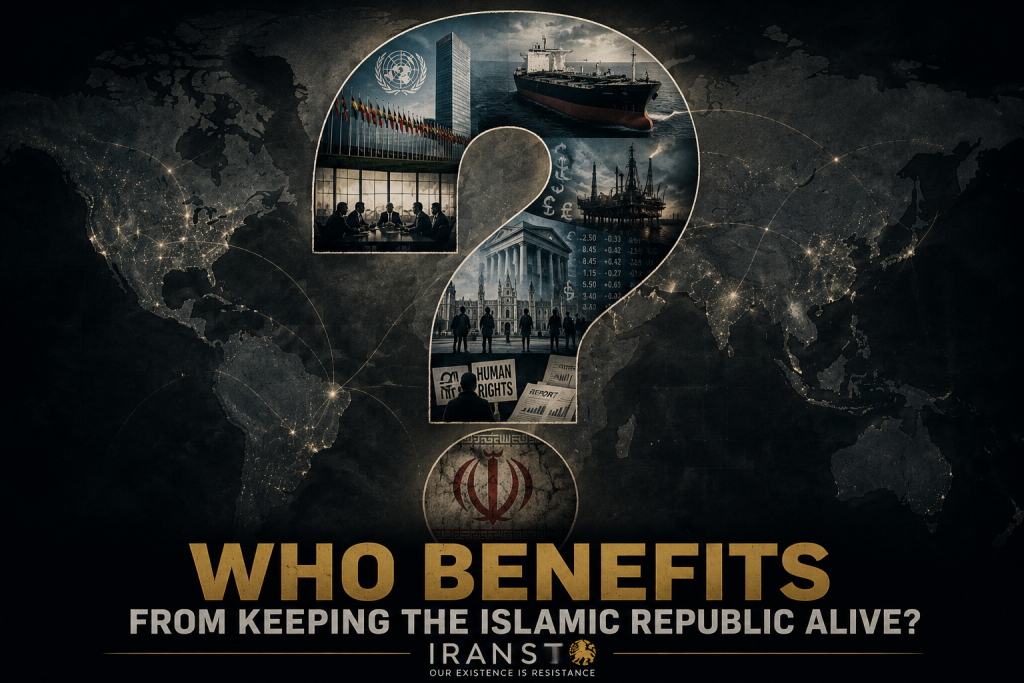
Who benefits from keeping the Islamic Republic alive?
For decades, discussions about the Islamic Republic have revolved around a familiar question: Why does the regime survive?
The answers usually focus on internal factors. Repression. Ideology. Security institutions. Patronage networks. Control of information. Economic coercion. Political fragmentation among opponents.
Each explanation contains an element of truth. The Islamic Republic has invested heavily in the mechanisms required for survival. It has built extensive security structures, developed sophisticated systems of political control, and demonstrated a willingness to employ violence when challenged. The events of January 2026, examined in previous IranSTO investigations, illustrated the extent to which the state remains prepared to use force in defence of its own continuity.
Yet a focus on the regime alone leaves an important question unanswered.
Many governments describe the Islamic Republic as a destabilising force. International organisations regularly document human rights violations. Policymakers speak of regional threats. Security agencies monitor its activities. Sanctions programmes target its institutions. Advocacy organisations campaign against its abuses.
If so many actors agree that the Islamic Republic represents a serious problem, why has the broader international system become so effective at managing its existence rather than ending the conditions that sustain it?
This article does not argue that foreign governments secretly support the Islamic Republic.
It does not claim the existence of a hidden alliance.
It does not suggest that international organisations, academic institutions, advocacy groups or diplomatic structures consciously seek the survival of the regime.
Such claims would require evidence that does not exist.
The issue is not coordination.
The issue is adaptation.
Over more than four decades, an extensive ecosystem has emerged around the management of the Islamic Republic. Governments have developed policies designed to contain it. Diplomatic institutions have constructed permanent frameworks to negotiate with it. Security establishments have incorporated it into long-term strategic planning. Academic communities have built specialisations around studying it. Advocacy organisations have created enduring monitoring structures to document its conduct. Entire professional sectors now exist to navigate the sanctions systems associated with it.
Each of these developments can be justified independently.
Taken together, however, they raise a more uncomfortable possibility.
What if the persistence of the Islamic Republic is no longer explained solely by the strength of the regime itself?
What if part of that persistence reflects the degree to which surrounding institutions have adapted to its continued existence?
Political systems often become remarkably efficient at managing problems they repeatedly fail to solve.
Over time, crises that were once considered temporary become permanent features of the landscape. Bureaucracies expand around them. Professional expertise develops around them. Funding structures emerge around them. Policy frameworks become organised around their continuation. Entire careers, institutions and industries adapt to a reality that was originally expected to disappear.
The result is not necessarily support for the underlying problem.
The result is often a system that becomes more experienced at administering the problem than resolving it.
This dynamic is visible far beyond Iran.
Protracted conflicts generate mediation industries. Long-running sanctions regimes generate compliance industries. Persistent security threats generate permanent bureaucracies. Humanitarian crises generate extensive aid architectures. International disputes create generations of specialists whose professional lives become intertwined with managing conditions that were once expected to be temporary.
The Islamic Republic presents a particularly revealing case study because its survival has now spanned multiple generations of policymakers, diplomats, analysts and advocacy organisations.
An entire international ecosystem has matured alongside it.
This reality produces a distinction that is often overlooked in public debate.
There is a significant difference between opposing a regime and prioritising its disappearance.
Many institutions may sincerely oppose aspects of the Islamic Republic’s behaviour while simultaneously viewing the risks associated with its collapse, transformation or replacement as undesirable, unpredictable or costly.
In such circumstances, stability can gradually become a more powerful policy objective than change.
Management can become more important than resolution.
Containment can become more realistic than transformation.
The status quo can become easier to administer than uncertainty.
This article examines that possibility.
It asks whether governments, diplomatic institutions, security structures, sanctions systems, academic communities, advocacy networks and regional actors have developed incentives that favour the continuation of existing conditions over the disruption associated with fundamental change.
The objective is not to identify villains.
Nor is it to construct a theory of conspiracy.
The objective is to examine incentives.
Institutions generally respond to incentives more consistently than they respond to ideals.
Understanding those incentives often reveals more about political outcomes than official statements, public rhetoric or declared intentions.
Throughout the modern history of the Islamic Republic, international actors have repeatedly expressed support for human rights, accountability, regional stability and democratic aspirations.
The question explored in the following chapters is not whether those statements were sincere.
The question is whether the systems surrounding the Islamic Republic have become structurally more compatible with its continuation than with its disappearance.
If that is the case, the survival of the regime may reveal something larger than the regime itself.
It may reveal the emergence of an international ecosystem that has gradually learned how to live with a problem that it has never fully resolved.
And if that ecosystem now possesses its own interests, incentives and forms of institutional inertia, then the question is no longer simply why the Islamic Republic survives.
The more revealing question may be who has adapted to its survival—and why.
Chapter 1
The Rhetoric–Outcome Gap
Throughout the modern history of the Islamic Republic, one theme has remained remarkably consistent.
Governments condemn its human rights record.
International organisations document abuses.
Politicians express solidarity with the Iranian people.
Diplomatic statements emphasise democratic aspirations, civil liberties and accountability.
The language varies across administrations and institutions, but the underlying message rarely changes.
The Islamic Republic is routinely presented as a source of regional instability, domestic repression and international concern.
At the level of rhetoric, there is little ambiguity.
At the level of outcomes, however, the picture becomes considerably more complicated.
This distinction sits at the centre of the debate surrounding the survival of the Islamic Republic.
Political rhetoric and policy outcomes are not the same thing.
They often serve different purposes.
Public statements communicate values.
Policy decisions manage risks.
When those two objectives collide, risk management frequently prevails.
This dynamic is not unique to Iran.
It is visible throughout international politics.
Governments routinely advocate principles that are constrained by practical considerations once policy decisions are required.
Yet the Iranian case remains particularly revealing because the gap between declared objectives and observable outcomes has persisted for decades.
Successive administrations across multiple countries have condemned the conduct of the Islamic Republic.
At the same time, those same governments have generally prioritised policies designed to manage the regime rather than fundamentally alter the conditions under which it operates.
This distinction matters.
A state can strongly oppose aspects of a regime’s behaviour while simultaneously preferring the continuation of that regime to the uncertainties associated with its disappearance.
The two positions are not mutually exclusive.
In fact, they often coexist.
The language of international politics frequently suggests that support for the Iranian people and pressure on the Islamic Republic are complementary objectives.
In practice, however, policymakers are often forced to weigh those objectives against other priorities.
Regional stability.
Energy security.
Nuclear proliferation concerns.
Migration pressures.
Economic interests.
Alliance management.
Military risk.
The result is that policy outcomes are rarely determined by a single objective.
They emerge from competing incentives.
Understanding those incentives is essential to understanding why the Islamic Republic remains in power.
When protests erupt inside Iran, international reactions often follow a familiar pattern.
Statements are issued.
Concern is expressed.
Violence is condemned.
Targeted sanctions may be announced against specific officials or institutions.
Political leaders reaffirm support for fundamental rights and freedoms.
For a brief period, attention intensifies.
Then the broader policy framework usually remains intact.
Negotiations continue.
Strategic calculations remain unchanged.
Regional security concerns persist.
Diplomatic channels stay open.
The underlying architecture of engagement survives.
This pattern has repeated itself through multiple cycles of unrest, repression and international condemnation.
The details change.
The structure remains surprisingly consistent.
This observation should not be misunderstood.
The argument is not that statements of support are insincere.
Nor is it that governments secretly approve of repression.
Rather, the issue is that public rhetoric and operational priorities frequently operate on different levels.
One addresses values.
The other addresses perceived risks.
When decision-makers assess the potential consequences of major political change inside Iran, they are not evaluating human rights concerns alone.
They are evaluating uncertainty.
What happens to regional security arrangements?
What happens to nuclear infrastructure?
What happens to existing diplomatic frameworks?
What happens to migration patterns, energy markets and regional power balances?
Whether those concerns are justified is ultimately a separate debate.
The important point is that they influence behaviour.
And behaviour determines outcomes.
This helps explain one of the most striking contradictions in the international approach to Iran.
The Islamic Republic is frequently described as a serious problem.
Yet much of the surrounding policy architecture is designed around the assumption that it will continue to exist.
Sanctions frameworks are built for long-term administration.
Diplomatic mechanisms are built for ongoing engagement.
Security strategies are built around sustained deterrence.
Academic institutions develop permanent specialisations.
Advocacy organisations establish long-term monitoring systems.
Each of these responses is understandable in isolation.
Collectively, however, they suggest adaptation rather than transition.
The system behaves less like a coalition preparing for fundamental change and more like a collection of institutions preparing for indefinite management.
This distinction may help explain why discussions about the Islamic Republic often produce a sense of strategic contradiction.
Public discourse frequently emphasises transformation.
Institutional behaviour frequently reflects permanence.
The regime is condemned as unacceptable.
Its continued existence is treated as expected.
Its conduct is criticised.
Its persistence is incorporated into planning assumptions.
Its legitimacy may be challenged rhetorically.
Its survival is often accommodated operationally.
Over time, these contradictions accumulate.
Eventually, they begin to shape the environment in which policy decisions are made.
The question then becomes increasingly difficult to avoid.
If the Islamic Republic is consistently described as a threat, why do so many institutions organise themselves around its continued existence?
The answer may not lie in hidden support.
It may lie in the difference between opposing a problem and adapting to it.
And once adaptation becomes embedded within political, diplomatic and institutional structures, permanence can become easier to manage than change.
That possibility forms the foundation of everything that follows.
The remaining chapters examine the incentives that emerge when a regime survives long enough for entire systems to adjust to its presence.
The question is not who supports the Islamic Republic.
The question is who has adapted to a world in which its survival is treated as the most likely outcome.
Chapter 2
The Stability Industry
One of the most frequently repeated assumptions in discussions about the Islamic Republic is that governments naturally prefer political change to political stagnation.
The historical record suggests something different.
Governments often prefer predictability to uncertainty.
They frequently prefer management to transformation.
And they almost always prefer known risks to unknown outcomes.
This reality helps explain a paradox that has shaped international policy towards Iran for decades.
Many governments describe the Islamic Republic as a problem.
Far fewer appear willing to embrace the risks associated with a fundamental transformation of the Iranian state.
The distinction is critical.
Opposing a regime is not the same thing as supporting its replacement.
Condemning a government is not the same thing as welcoming its collapse.
In practice, policymakers often view those as entirely separate questions.
This creates a strategic environment in which the Islamic Republic can simultaneously be regarded as undesirable and indispensable.
Undesirable because of its conduct.
Indispensable because it has become embedded within countless calculations about regional order, security and stability.
The result is a form of political contradiction that rarely appears in official statements but repeatedly emerges in policy outcomes.
The regime is condemned.
The status quo is preserved.
The government is criticised.
The broader structure remains intact.
The Islamic Republic is presented as a threat.
The possibility of its disappearance is frequently treated as an even greater risk.
This logic is not unique to Iran.
Throughout modern history, governments have often supported stability over transformation, even when the existing order was deeply flawed.
The reason is straightforward.
Transformation introduces uncertainty.
And uncertainty is one of the least attractive conditions in international politics.
For policymakers, uncertainty creates questions that cannot be answered in advance.
Who replaces the existing government?
What institutions survive the transition?
What happens to military command structures?
What happens to strategic infrastructure?
What happens to border security?
What happens to regional alliances?
What happens to existing conflicts?
These questions become particularly significant in the case of Iran.
Iran is not a small state.
It occupies one of the most strategically important positions in the world.
It borders multiple regions simultaneously.
The Persian Gulf.
The Caucasus.
Central Asia.
South Asia.
The Middle East.
Any major transformation inside Iran would inevitably produce consequences extending far beyond its borders.
This reality has encouraged a risk-management approach among many external actors.
The objective becomes less about resolving the underlying problem and more about limiting its consequences.
Containment replaces transformation.
Management replaces resolution.
Stability becomes the overriding priority.
At first glance, this may appear reasonable.
Governments exist to manage risk.
They are expected to consider worst-case scenarios.
They are expected to prepare for instability.
They are expected to avoid outcomes that could produce large-scale disruption.
Yet this logic contains a rarely discussed consequence.
When stability becomes the highest priority, even deeply dysfunctional political systems can become beneficiaries of risk aversion.
The threshold for meaningful change rises continuously.
Every potential alternative is judged against worst-case scenarios.
Every disruption becomes a danger.
Every transition becomes a gamble.
Meanwhile, the existing system benefits from familiarity.
Its flaws are known.
Its behaviour is understood.
Its reactions can be anticipated.
The result is a powerful structural bias in favour of continuity.
This dynamic has repeatedly appeared in discussions surrounding Iran.
For decades, policymakers have debated the risks associated with various forms of political transformation.
Concerns are routinely raised about regional instability.
Questions emerge regarding the future of security institutions.
Analysts speculate about succession struggles, political fragmentation and strategic uncertainty.
Many of these concerns are legitimate.
The issue is not whether risks exist.
The issue is how those risks influence behaviour.
Because once uncertainty becomes the dominant concern, a remarkable shift occurs.
The focus moves away from what the Islamic Republic is doing.
The focus shifts towards what might happen if it no longer exists.
This is an important distinction.
A government can commit serious abuses.
It can generate regional instability.
It can create humanitarian crises.
It can undermine international norms.
Yet if policymakers become more concerned about the consequences of its disappearance than the consequences of its existence, the political incentives surrounding that government begin to change.
The debate is no longer centred on accountability.
It becomes centred on risk management.
That transition has profound implications.
It encourages institutions to invest in continuity.
It encourages policymakers to preserve communication channels.
It encourages diplomatic engagement designed to prevent escalation rather than achieve transformation.
Most importantly, it encourages the gradual normalisation of permanence.
Over time, the Islamic Republic ceases to be treated as a temporary challenge awaiting resolution.
It becomes a permanent feature of strategic planning.
An enduring variable.
A condition to be managed.
A reality to be incorporated into long-term calculations.
This process does not require sympathy towards the regime.
It does not require ideological agreement.
It does not require support.
It requires only one assumption:
That the uncertainties associated with change are perceived as more dangerous than the costs of continuation.
Once that assumption becomes embedded within policy thinking, an entire ecosystem of stability management begins to emerge.
Diplomatic structures evolve to maintain communication.
Security institutions evolve to prevent escalation.
International organisations evolve to monitor rather than transform.
Political leaders evolve strategies designed to contain rather than resolve.
Each decision appears rational when viewed independently.
Collectively, however, they generate a powerful outcome.
The continuation of the status quo becomes the safest option available to decision-makers.
And when the status quo becomes the safest option, the beneficiaries are not necessarily the populations living under that system.
The beneficiaries are often the institutions responsible for managing it.
This may be one of the most uncomfortable realities surrounding the survival of the Islamic Republic.
The regime does not need to convince external actors that it is desirable.
It merely needs to convince them that the alternatives are unpredictable.
For more than four decades, that argument has repeatedly influenced international behaviour.
Whether intentionally or not, the result has been the same.
The Islamic Republic is frequently described as a source of instability.
Yet many of the policies surrounding it remain driven by the pursuit of stability.
That contradiction sits at the heart of the modern international approach to Iran.
And it raises a difficult question.
If a system repeatedly prioritises stability over transformation, at what point does stability cease to be a solution and become part of the mechanism through which the existing order survives?
The answer may explain why so many institutions continue to organise themselves around the management of the Islamic Republic rather than the possibility of a post-Islamic Republic future.
Because once permanence becomes an assumption, survival becomes easier.
Not because the regime grows stronger.
But because the surrounding system gradually learns how to live with it.
Chapter 3
The Diplomacy Economy
Diplomacy is often presented as the alternative to conflict.
Negotiation is portrayed as the pathway to resolution.
Dialogue is described as a mechanism through which disputes can be reduced, managed or ultimately settled.
In principle, these assumptions are difficult to challenge.
Diplomatic engagement remains an essential component of international relations.
The problem arises when diplomacy ceases to function as a route towards resolution and instead becomes a system organised around the management of permanence.
At that point, an uncomfortable question emerges.
What happens when a crisis survives long enough for an entire diplomatic ecosystem to develop around its continued existence?
The history of the Islamic Republic provides a revealing case study.
For more than four decades, governments, international organisations, mediators, special envoys, negotiators and policy institutions have been engaged in various forms of diplomatic interaction with Tehran.
Administrations have changed.
Governments have fallen.
Regional alliances have shifted.
International priorities have evolved.
Yet the underlying diplomatic architecture surrounding the Islamic Republic has remained remarkably resilient.
Indeed, in many respects it has expanded.
New negotiation frameworks have emerged.
Additional monitoring mechanisms have been created.
New diplomatic channels have been established.
New rounds of engagement have been launched.
New conferences have been organised.
New mediation initiatives have been introduced.
The infrastructure of diplomacy has continued to grow even as the underlying disputes have persisted.
This observation should not be interpreted as criticism of diplomacy itself.
The issue is not negotiation.
The issue is institutional incentives.
Because institutions, once created, rarely seek their own irrelevance.
Diplomatic structures are no exception.
Every long-running dispute generates a network of actors whose professional responsibilities become connected to its management.
Negotiators negotiate.
Mediators mediate.
Special envoys coordinate.
Policy teams analyse.
Advisers advise.
International forums convene.
Working groups meet.
Reports are produced.
Assessments are published.
Briefings are prepared.
Funding is allocated.
Careers develop.
Departments expand.
The longer a dispute persists, the larger this ecosystem often becomes.
Eventually, the dispute ceases to be merely a political problem.
It becomes an institutional environment.
This distinction matters because institutions are generally rewarded for activity, not necessarily for resolution.
Success is often measured through engagement.
Meetings held.
Channels maintained.
Escalation prevented.
Dialogue preserved.
Progress managed.
The complete disappearance of the underlying problem is rarely the metric upon which bureaucratic systems operate.
The Islamic Republic has existed long enough to become deeply embedded within this type of diplomatic environment.
Entire generations of diplomats have built careers around managing relations with Tehran.
Entire policy frameworks have evolved around recurring cycles of negotiation, tension, escalation and de-escalation.
A substantial portion of modern diplomatic engagement with Iran has focused not on ending disputes but on preventing those disputes from becoming worse.
At first glance, this may appear entirely reasonable.
Preventing escalation is a legitimate objective.
Reducing risk is a legitimate objective.
Avoiding conflict is a legitimate objective.
Yet over time, these priorities can produce an unintended consequence.
The management of a crisis can gradually become more institutionally important than its resolution.
This phenomenon is not unique to Iran.
It can be observed throughout international politics.
Long-running territorial disputes generate permanent mediation structures.
Enduring conflicts produce recurring diplomatic initiatives.
Frozen crises develop entire bureaucratic ecosystems dedicated to maintaining stability.
The longer these arrangements survive, the more difficult it becomes to distinguish between managing a problem and preserving the conditions under which management remains necessary.
Iran provides a particularly striking example because many of the central disputes surrounding the Islamic Republic have now persisted for decades.
Nuclear concerns have generated repeated negotiation cycles.
Regional security concerns have produced recurring diplomatic engagement.
Sanctions disputes have created extensive consultation mechanisms.
Human rights concerns have generated continuing international dialogue.
Each issue has produced its own institutional infrastructure.
Together they form a complex diplomatic ecosystem that has adapted to the assumption of permanence.
This adaptation influences behaviour.
When institutions become organised around management, disruption becomes unattractive.
Transformational outcomes introduce uncertainty.
Established channels may disappear.
Existing frameworks may become obsolete.
Long-standing assumptions may no longer apply.
The result is a subtle but important shift in incentives.
The objective increasingly becomes preserving communication rather than resolving underlying contradictions.
Maintaining engagement becomes more important than evaluating outcomes.
Dialogue itself becomes evidence of progress.
Process begins to substitute for results.
This tendency is particularly visible whenever diplomatic engagement with the Islamic Republic is publicly discussed.
The language frequently focuses on preserving channels.
Keeping conversations open.
Maintaining communication.
Avoiding breakdowns.
Preventing escalation.
Protecting dialogue.
These objectives are understandable.
Yet they also reveal something important.
The survival of the diplomatic process often becomes a priority in its own right.
The continuation of negotiations becomes an achievement independent of whether those negotiations fundamentally alter the underlying situation.
This creates a paradox.
The Islamic Republic is frequently described as a source of international concern.
Yet the diplomatic systems surrounding it often operate according to incentives that favour continuity, predictability and sustained engagement.
The regime becomes the subject of perpetual diplomacy.
Not because diplomacy supports the regime.
But because diplomacy has adapted to a world in which the regime continues to exist.
This distinction is crucial.
No conspiracy is required.
No hidden agreement is necessary.
No coordinated strategy needs to exist.
All that is required is institutional adaptation.
The longer a political problem survives, the more likely institutions are to organise themselves around managing it.
Over time, those institutions begin to acquire their own momentum.
Their own assumptions.
Their own priorities.
Their own definitions of success.
In such an environment, the disappearance of the underlying problem may become more disruptive to the system than its continuation.
This possibility should not be exaggerated.
Diplomatic institutions do not determine the future of Iran.
Nor do they control the internal dynamics of the Islamic Republic.
However, they do shape the environment in which international decisions are made.
And that environment increasingly reflects an assumption that has remained largely unchallenged for decades.
The assumption that the Islamic Republic will continue to exist.
Once that assumption becomes embedded within diplomatic structures, a significant transformation occurs.
Policy ceases to focus on a post-Islamic Republic future.
Policy focuses instead on managing the Islamic Republic that already exists.
The horizon narrows.
Expectations adjust.
Possibilities contract.
The regime becomes less a temporary challenge than a permanent diplomatic reality.
And when permanence becomes the organising principle of diplomacy, the objective is no longer transformation.
The objective becomes management.
That shift may help explain why decades of diplomatic activity have produced such an extensive architecture of engagement while leaving the central political reality largely unchanged.
The question, therefore, is not whether diplomacy has failed.
The more revealing question may be whether diplomacy has gradually evolved into an industry whose primary function is the administration of permanence.
If so, the survival of the Islamic Republic is not merely a challenge being managed by diplomacy.
It is also one of the conditions upon which that diplomatic ecosystem increasingly depends.
Chapter 4
The Security Incentive Structure
Every enduring threat generates a response.
That response often begins as a temporary measure.
A security review.
An intelligence assessment.
A military planning process.
A new monitoring capability.
An expanded regional partnership.
A revised defence strategy.
Initially, these measures are designed to address a specific challenge.
Over time, however, something else occurs.
The response develops its own institutional life.
Structures expand.
Budgets increase.
Specialisations emerge.
Personnel are assigned.
Departments are created.
Reporting systems become permanent.
Strategic assumptions become embedded.
What began as a reaction gradually becomes an institution.
The Islamic Republic has existed long enough to undergo this transformation repeatedly.
For more than four decades, Iran has occupied a central position in regional security planning across the Middle East and beyond.
Military organisations analyse it.
Intelligence agencies monitor it.
Security officials assess it.
Strategic planners model scenarios around it.
Defence institutions build capabilities designed to respond to it.
Successive generations of policymakers have entered office and inherited security frameworks that already assumed the continued existence of the Islamic Republic.
This observation is important because security institutions do not operate in the same manner as political campaigns.
Political rhetoric can change quickly.
Security structures rarely do.
They are built for continuity.
They are designed around long-term planning horizons.
Their assumptions often survive multiple governments and multiple political cycles.
As a result, persistent threats frequently become permanent organising principles within national security systems.
The issue is not whether the threat is real.
The issue is what happens after institutions spend decades adapting to its existence.
The Islamic Republic has become one of the most durable threat variables in modern strategic planning.
Regional missile programmes.
Proxy networks.
Maritime security concerns.
Nuclear disputes.
Regional military competition.
Energy infrastructure risks.
Each has generated its own security architecture.
Each has contributed to an expanding ecosystem of monitoring, planning and deterrence.
The cumulative effect is substantial.
Entire strategic frameworks now assume the continuation of the Islamic Republic as a baseline condition.
This is where the discussion becomes uncomfortable.
Not because it reveals a conspiracy.
But because it reveals a structural dependency.
Security institutions are designed to respond to threats.
Persistent threats justify persistent responses.
Persistent responses sustain institutions.
The relationship is not ideological.
It is organisational.
The longer a threat remains unresolved, the more deeply it becomes integrated into planning assumptions.
This process can be observed across virtually every major security bureaucracy.
Threat assessments become annual exercises.
Strategic reviews become recurring requirements.
Dedicated task forces emerge.
Specialist analytical units expand.
Joint exercises are organised.
Military procurement decisions are influenced.
Alliance structures adjust.
Operational doctrines evolve.
The threat becomes part of the institution’s operating environment.
Eventually, an entire generation of security professionals may spend their careers working within systems built around managing that threat.
Again, this does not imply bad faith.
Security professionals do not invent threats to justify their existence.
The Islamic Republic’s actions have provided ample material for genuine concern.
The question is not whether concerns exist.
The question is what happens when those concerns become permanent.
Because permanence changes incentives.
A temporary threat encourages resolution.
A permanent threat encourages management.
A temporary threat creates urgency.
A permanent threat creates systems.
The distinction may appear subtle.
In practice, it can reshape policy outcomes.
Once institutions become organised around long-term deterrence and containment, transformational outcomes can begin to appear disruptive rather than desirable.
This does not mean that security planners oppose change.
It means that they are trained to evaluate uncertainty.
And uncertainty is often treated as a risk multiplier.
Consider the implications of a hypothetical major political transformation inside Iran.
From a purely security perspective, such a development would generate an extraordinary number of questions.
Who controls military assets?
What happens to command structures?
What happens to regional proxy relationships?
What happens to missile programmes?
What happens to intelligence networks?
What happens to strategic infrastructure?
What happens to border security?
What happens to nuclear facilities?
These are not political questions.
They are security questions.
And security institutions are built to prepare for precisely these types of scenarios.
The problem is that when uncertainty becomes the primary lens through which change is evaluated, continuity frequently acquires a strategic advantage.
The existing system may be problematic.
It may even be dangerous.
But it is known.
Its behaviour has been studied.
Its decision-making patterns have been analysed.
Its capabilities have been mapped.
Its vulnerabilities are understood.
By contrast, an unknown future presents countless variables.
For institutions tasked with risk management, that uncertainty carries weight.
This helps explain a recurring pattern visible across international security discourse.
The Islamic Republic is routinely described as a source of instability.
Yet many security strategies are ultimately designed around preserving a stable balance with that instability.
The objective is not resolution.
The objective is equilibrium.
Escalation is prevented.
Deterrence is maintained.
Risk is managed.
Crisis is contained.
The threat remains.
The system adapts.
Over time, this adaptation becomes self-reinforcing.
New security frameworks are created because the threat persists.
The existence of those frameworks then assumes the continued existence of the threat.
Long-term planning documents are written around it.
Procurement strategies account for it.
Intelligence priorities reflect it.
Regional partnerships are shaped by it.
The threat becomes embedded within the architecture of security itself.
This dynamic is particularly visible in the Middle East.
For decades, Iran has served as one of the central reference points around which regional security calculations have been organised.
Military spending.
Strategic partnerships.
Defence agreements.
Intelligence cooperation.
Regional force posture decisions.
All have been influenced, to varying degrees, by the perceived challenge posed by the Islamic Republic.
The result is not a coordinated effort to preserve the regime.
The result is something arguably more significant.
An entire security ecosystem has evolved within a world where the Islamic Republic is assumed to remain.
The regime has become a permanent planning variable.
A fixed strategic reference point.
A foundational assumption.
And assumptions matter.
Because once an assumption becomes embedded within institutions, questioning it becomes difficult.
Planning begins from that assumption.
Budgets are allocated according to that assumption.
Strategies are developed around that assumption.
Risk assessments depend upon that assumption.
The future is imagined through that assumption.
The consequence is subtle but profound.
The disappearance of the threat can become as disruptive to institutional planning as the threat itself.
This does not mean security institutions desire the continuation of the Islamic Republic.
It means that decades of adaptation have produced systems optimised for managing its existence.
Those systems possess their own momentum.
Their own priorities.
Their own definitions of stability.
Their own incentives.
The survival of the Islamic Republic therefore cannot be understood solely through the actions of the regime itself.
It must also be understood through the structures that have emerged around it.
Every enduring threat generates institutions.
Every enduring institution develops assumptions.
And every assumption, if left unchallenged for long enough, can become part of the architecture that sustains the very reality it was created to confront.
The security environment surrounding Iran illustrates this phenomenon with unusual clarity.
The issue is not support.
The issue is adaptation.
And after more than four decades, adaptation may be one of the most powerful forces shaping the international response to the Islamic Republic.
The regime remains a threat.
The threat sustains institutions.
The institutions adapt to permanence.
And permanence, in turn, makes survival easier.
Not because anyone planned it.
But because entire systems have learned how to operate within a world in which the Islamic Republic continues to exist.
Chapter 5
The Sanctions Industry
Sanctions are often presented as instruments of pressure.
Governments impose them to alter behaviour.
International institutions defend them as alternatives to military confrontation.
Policymakers describe them as mechanisms through which states can impose costs without resorting to force.
In theory, sanctions are intended to produce outcomes.
A government changes course.
A programme is halted.
A policy is abandoned.
A dispute is resolved.
The sanctions are lifted.
The system returns to normal.
This is the official logic.
The reality is often far more complicated.
Many sanctions regimes survive for years.
Some survive for decades.
Entire generations of policymakers can spend their careers administering sanctions that were originally introduced as temporary measures.
The result is the emergence of something rarely discussed in public debate.
A sanctions industry.
Not an industry in the traditional sense.
Not a conspiracy.
Not a coordinated effort to preserve the problems sanctions were designed to address.
Rather, a vast professional ecosystem whose existence depends upon the continued complexity of sanctions administration.
The Islamic Republic occupies a central position within this ecosystem.
For decades, Iran has been one of the most heavily sanctioned countries in the world.
The scale and complexity of those sanctions have generated an enormous infrastructure dedicated to understanding, implementing, monitoring and navigating them.
Compliance departments.
Regulatory consultants.
Legal specialists.
Financial investigators.
Risk analysts.
Due diligence providers.
Screening platforms.
Trade compliance firms.
Advisory services.
Monitoring mechanisms.
Software vendors.
Audit structures.
Training providers.
Policy specialists.
The list continues to expand.
Each component performs a legitimate function.
Each can justify its existence independently.
Yet collectively they reveal an important reality.
Sanctions do not simply target an economy.
They create an economy.
A parallel economy of administration, interpretation, enforcement and compliance.
This distinction matters because institutions adapt to the environments in which they operate.
The longer a sanctions regime survives, the larger the surrounding ecosystem becomes.
What begins as a policy instrument gradually develops its own infrastructure.
That infrastructure acquires budgets.
Personnel.
Clients.
Revenue streams.
Institutional responsibilities.
Professional incentives.
Eventually, an entire sector emerges whose daily activity revolves around the management of sanctions.
This observation should not be misunderstood.
The argument is not that compliance firms support the Islamic Republic.
Nor is it that sanctions consultants secretly prefer Iranian repression to continue.
Such claims would be absurd.
The issue is structural dependence.
The ecosystem depends upon the continuation of sanctions complexity.
And sanctions complexity depends upon the continuation of unresolved disputes.
This relationship produces a subtle but important shift.
The objective increasingly becomes administration.
Interpretation.
Monitoring.
Enforcement.
Compliance.
The sanctions system becomes highly effective at sustaining itself.
Whether it remains equally effective at resolving the underlying political problem becomes a separate question.
The Iranian case illustrates this dilemma with unusual clarity.
For decades, sanctions have expanded, evolved, adapted and multiplied.
New entities have been designated.
New restrictions have been introduced.
New enforcement mechanisms have been developed.
New reporting requirements have emerged.
New compliance frameworks have been implemented.
The administrative architecture surrounding sanctions has grown continuously.
Yet the central political reality has remained remarkably stable.
The Islamic Republic still exists.
Its core power structures remain intact.
Its governing institutions remain operational.
Its security apparatus remains active.
Its regional activities continue.
Its domestic repression continues.
Its strategic disputes continue.
This contradiction deserves closer examination.
If sanctions are intended to produce change, what happens when the sanctions system becomes permanent while the underlying problem remains?
At what point does administration begin to replace resolution?
This question becomes particularly relevant when examining the incentives embedded within sanctions ecosystems.
Consider the practical reality.
Every new sanctions package generates work.
Law firms analyse it.
Consultants interpret it.
Financial institutions update procedures.
Technology providers modify screening databases.
Compliance teams conduct reviews.
Auditors verify implementation.
Risk specialists issue assessments.
Training programmes are updated.
Advisory contracts are renewed.
None of this is illegitimate.
In fact, much of it is necessary.
The point is not that sanctions administration exists.
The point is how large and sophisticated that administrative ecosystem has become.
Across major financial centres, substantial professional sectors now exist whose primary purpose is helping institutions navigate sanctions regimes.
These sectors are not organised around the disappearance of sanctions.
They are organised around their management.
Their expertise derives from complexity.
Their value derives from persistence.
Their relevance derives from continued uncertainty.
The longer sanctions survive, the more institutionalised these functions become.
Over time, sanctions cease to be temporary policy tools.
They become permanent operating environments.
This creates an uncomfortable paradox.
Sanctions are often justified as mechanisms designed to produce political change.
Yet many of the institutions surrounding sanctions derive their purpose from the assumption that sanctions will continue indefinitely.
Resolution eliminates complexity.
Resolution reduces demand.
Resolution shrinks administrative requirements.
Permanence does the opposite.
Permanence expands systems.
Permanence increases specialisation.
Permanence sustains professional relevance.
Again, this is not evidence of bad faith.
No compliance officer determines foreign policy.
No sanctions consultant controls geopolitical outcomes.
The issue is not intent.
The issue is incentives.
Institutions generally adapt to permanence more effectively than they adapt to resolution.
This pattern can be observed repeatedly throughout modern bureaucratic systems.
Temporary measures become permanent programmes.
Emergency structures become standing institutions.
Administrative frameworks survive long after the conditions that created them have changed.
The sanctions environment surrounding Iran displays many of these characteristics.
Decades of restrictions have produced a vast architecture dedicated to administration.
The architecture continues to expand.
The disputes continue.
The sanctions continue.
The management systems continue.
Each reinforces the others.
At a certain point, the question becomes unavoidable.
Who benefits from this arrangement?
The answer is not necessarily governments.
Nor is it necessarily the Islamic Republic.
The immediate beneficiaries are often the institutions responsible for managing the sanctions environment itself.
The firms providing compliance services.
The consultants providing regulatory guidance.
The platforms providing risk assessments.
The specialists providing due diligence.
The bureaucracies responsible for enforcement.
The organisations responsible for monitoring.
Together they form an ecosystem that did not exist before sanctions became permanent features of international policy.
The longer sanctions survive, the more embedded this ecosystem becomes.
And the more embedded it becomes, the more the conversation shifts away from whether sanctions are achieving their stated objectives and towards how sanctions should be administered.
This is one of the least discussed consequences of long-running sanctions regimes.
The policy instrument gradually develops a constituency of managers.
Not advocates.
Not conspirators.
Managers.
People and institutions whose professional responsibilities depend upon the continued operation of the system.
The Islamic Republic therefore occupies a unique position within the global sanctions landscape.
It is not merely a target of sanctions.
It has become one of the foundations upon which a substantial sanctions administration ecosystem has been built.
This does not explain the survival of the regime on its own.
No single factor can.
However, it does reveal a broader pattern emerging throughout this article.
Diplomatic systems adapt to permanence.
Security systems adapt to permanence.
And sanctions systems adapt to permanence.
Each develops its own structures.
Its own incentives.
Its own forms of institutional inertia.
The result is an international environment increasingly optimised for managing long-term disputes rather than ending them.
The question is therefore not whether sanctions exist for good reasons.
Many clearly do.
The more revealing question is whether a sanctions regime that survives for decades eventually begins to generate interests that are more compatible with administration than resolution.
If so, then the Islamic Republic is no longer merely confronting sanctions.
It is operating within an entire sanctions ecosystem that has itself adapted to the assumption of permanence.
And once permanence becomes the dominant assumption, survival becomes easier.
Not because sanctions disappear.
But because the system surrounding them increasingly learns how to function without expecting the underlying problem to be resolved.
Chapter 6
The Professionalisation of Iran
Not every industry built around permanence is financial.
Some are intellectual.
Some are academic.
Some are bureaucratic.
Some exist within universities, policy institutes, research centres and conference networks.
The incentives are different.
The structures are different.
The funding mechanisms are different.
Yet the underlying dynamic often follows a familiar pattern.
Long-running crises generate long-running expertise.
Long-running expertise generates institutions.
Institutions generate incentives.
Over time, an entire professional ecosystem can emerge around the continued existence of a problem.
The Islamic Republic provides a particularly revealing example.
More than four decades after the 1979 Revolution, Iran has become not merely a country studied by specialists.
It has become a field.
A professional specialisation.
An academic niche.
A policy sector.
A research ecosystem.
Entire careers have been built around understanding, explaining, analysing and forecasting the behaviour of the Islamic Republic.
University programmes examine it.
Research centres specialise in it.
Think tanks publish on it.
Academic journals analyse it.
Policy institutes organise conferences around it.
Government agencies recruit experts on it.
Media organisations regularly consult commentators whose professional identity is linked to expertise on Iran.
None of this is inherently problematic.
Complex countries require specialists.
Governments need expertise.
Universities conduct research.
Think tanks provide analysis.
The issue is not expertise itself.
The issue is what happens when expertise becomes dependent upon permanence.
This is where a structural tension begins to emerge.
Every long-running crisis creates a class of professionals whose relevance is connected to the continuation of the subject they study.
Again, this is not a moral criticism.
Most researchers do not choose their subjects based on career incentives alone.
Most analysts genuinely seek to understand the issues they examine.
Most scholars pursue knowledge rather than institutional self-preservation.
The argument here is not about individual motives.
It is about systemic outcomes.
Because institutions often behave differently from individuals.
An individual researcher may have no interest whatsoever in maintaining a crisis.
An academic ecosystem, however, may gradually become organised around the assumption that the crisis will continue.
This distinction is crucial.
The longer a problem survives, the more infrastructure develops around studying it.
Research grants are awarded.
Specialist positions are created.
Departments expand.
Publication networks emerge.
Policy communities develop.
Professional reputations are established.
Conferences become recurring events.
Funding streams stabilise.
The subject becomes institutionalised.
Eventually, permanence is no longer treated as a temporary condition.
It becomes the foundation upon which the entire field operates.
The Islamic Republic has reached this stage.
After more than four decades, there are now multiple generations of Iran specialists across academia, journalism, government and policy institutions.
Some have spent their entire careers analysing the same regime.
Many entered their professions assuming the Islamic Republic would remain a central geopolitical issue.
Many will likely retire under the same assumption.
This reality inevitably shapes incentives.
Research funding generally follows relevance.
Institutional attention generally follows relevance.
Media demand generally follows relevance.
Policy demand generally follows relevance.
A permanent crisis provides all four.
The result is not support for the crisis.
The result is dependency upon its continued relevance.
And relevance often depends upon continuity.
This helps explain a recurring phenomenon in policy discourse.
Certain assumptions become remarkably durable.
Certain analytical frameworks become remarkably resistant to challenge.
Certain narratives survive repeated failures.
The issue is not necessarily ideological bias.
It is institutional inertia.
Entire professional communities often develop shared assumptions regarding the subjects they study.
Those assumptions influence research priorities.
Funding priorities.
Policy recommendations.
Conference agendas.
Publication opportunities.
Recruitment decisions.
Over time, an intellectual ecosystem begins to form around a common understanding of reality.
The Islamic Republic has generated precisely such an ecosystem.
Across universities, think tanks and policy institutions, a vast body of expertise now exists dedicated to understanding the regime.
This expertise often provides valuable insights.
Yet it also creates a subtle risk.
When an entire field becomes organised around analysing a phenomenon, imagining the disappearance of that phenomenon becomes increasingly difficult.
The field becomes oriented towards interpretation rather than transition.
Management rather than transformation.
Prediction rather than replacement.
The assumption of permanence becomes embedded within professional culture.
This tendency is particularly visible within policy analysis.
A large proportion of Iran-related research focuses on questions of adaptation.
How should governments engage with Iran?
How should sanctions be adjusted?
How should negotiations be structured?
How should escalation be managed?
How should deterrence be maintained?
How should risks be reduced?
These are legitimate questions.
Yet they all share a common assumption.
The Islamic Republic remains.
The regime survives.
The future is imagined within the framework of continuity.
Far less attention is devoted to alternative futures.
What would a post-Islamic Republic transition look like?
How would international institutions respond?
What structures would emerge?
What opportunities might become possible?
What challenges would arise?
These questions certainly exist within academic literature.
Yet compared to the enormous volume of work devoted to managing the existing reality, they often occupy a secondary position.
The imbalance is revealing.
It suggests an intellectual environment increasingly focused on administration rather than transformation.
This dynamic becomes even more pronounced within think tank culture.
Think tanks operate within systems that reward relevance, access and policy influence.
Research that aligns with ongoing policy debates often receives greater attention.
Analysts become known for expertise within established frameworks.
Institutions build reputations around specialised knowledge.
Funding frequently follows subjects already regarded as strategically important.
The result is a reinforcing cycle.
The more permanent a crisis becomes, the larger the expert ecosystem surrounding it.
The larger the ecosystem becomes, the more resources are invested in understanding the crisis.
The more resources are invested, the more institutional assumptions develop around its permanence.
No conspiracy is required.
No coordination is necessary.
The process emerges naturally.
Permanent problems create permanent experts.
Permanent experts create permanent institutions.
Permanent institutions create incentives that assume permanence.
The same pattern can be observed in conferences and policy forums.
Every year, experts gather to discuss Iran.
Panels are organised.
Reports are launched.
Recommendations are issued.
New assessments are published.
The topics evolve.
The participants change.
The conversations continue.
What rarely changes is the foundational assumption underpinning the discussion.
The Islamic Republic remains the central organising reality.
The regime is criticised.
Its behaviour is analysed.
Its policies are debated.
Its future is forecast.
Yet the existence of the regime itself is often treated as a constant rather than a variable.
This may be one of the most overlooked consequences of long-term geopolitical crises.
The longer a system survives, the more expertise becomes invested in explaining it.
Eventually, explanation can become more institutionally important than resolution.
Understanding becomes an industry.
Analysis becomes an ecosystem.
The subject becomes permanent.
The Islamic Republic is therefore not merely a political system.
It has become an intellectual economy.
A source of research agendas.
Professional identities.
Academic specialisations.
Policy careers.
Institutional relevance.
Again, this observation is not moral.
It is structural.
The issue is not whether experts support the regime.
The overwhelming majority do not.
The issue is whether decades of permanence have created a professional environment that increasingly assumes the regime will continue to exist.
And assumptions matter.
Because assumptions shape the questions institutions ask.
They shape the futures they imagine.
They shape the possibilities they consider realistic.
If an entire ecosystem becomes organised around explaining the Islamic Republic rather than preparing for a post-Islamic Republic future, then permanence ceases to be merely a political reality.
It becomes an intellectual one.
And intellectual permanence can be just as powerful as political permanence.
Not because it protects the regime.
But because it narrows the boundaries of what influential institutions consider possible.
The result is another layer of adaptation.
Another system that has learned how to operate within a world where the Islamic Republic survives.
Another example of a broader pattern running throughout this investigation.
Diplomatic institutions adapt.
Security institutions adapt.
Sanctions systems adapt.
And eventually, even expertise itself adapts.
The regime becomes a permanent subject.
The institutions become permanent observers.
And permanence, once again, becomes easier to manage than change.
Chapter 7
The Accountability Industry
Every year, new reports are published.
New violations are documented.
New investigations are launched.
New testimonies are collected.
New databases are expanded.
New briefings are delivered.
New statements are issued.
New warnings are released.
The evidence grows.
The archives grow.
The documentation grows.
The monitoring grows.
Yet one question remains remarkably difficult to answer.
Where is the accountability?
This question sits at the centre of one of the most uncomfortable contradictions surrounding the Islamic Republic.
Few regimes in the modern world have been documented as extensively.
Few governments have been the subject of such sustained monitoring.
Few political systems have generated such large volumes of reports, investigations, assessments, testimonies and advocacy campaigns.
And yet the gap between documentation and consequence remains striking.
The problem is not a lack of information.
The problem is not a lack of evidence.
The problem is not a lack of awareness.
The world does not suffer from a shortage of reports about the Islamic Republic.
The world suffers from an abundance of reports and a scarcity of consequences.
This distinction matters.
Because documentation and accountability are not the same thing.
Monitoring and accountability are not the same thing.
Recording abuse and imposing costs are not the same thing.
Over time, however, these distinctions can become blurred.
Particularly when a crisis survives long enough for monitoring itself to become institutionalised.
The Islamic Republic has existed long enough for precisely this process to occur.
Across international organisations, advocacy networks, research institutions and monitoring bodies, a vast accountability infrastructure has emerged.
Special rapporteurs investigate.
Human rights organisations document.
International bodies review.
Advocacy groups campaign.
Legal experts analyse.
Researchers archive evidence.
Victims provide testimony.
Witnesses submit documentation.
Every year the system becomes more sophisticated.
More comprehensive.
More technologically advanced.
More professionalised.
More efficient at collecting information.
Yet the central political reality often remains unchanged.
The documentation improves.
The consequences remain inconsistent.
The reporting expands.
The accountability gap survives.
At first glance, this appears paradoxical.
The entire purpose of monitoring is presumably to facilitate accountability.
The entire purpose of documentation is presumably to generate consequences.
The entire purpose of exposure is presumably to alter behaviour.
Why, then, does the accountability deficit remain so persistent?
Part of the answer may lie in the distinction between systems designed to observe and systems designed to act.
Observation and action operate according to different incentives.
Documentation can continue indefinitely.
Accountability usually requires political decisions.
Documentation requires evidence.
Accountability requires power.
Documentation can be produced every year.
Accountability often depends upon circumstances that institutions do not control.
The result is a structural imbalance.
Monitoring systems expand because monitoring is possible.
Accountability stagnates because accountability remains politically difficult.
Over time, this imbalance produces its own ecosystem.
An ecosystem dedicated to documenting abuse.
Tracking abuse.
Measuring abuse.
Archiving abuse.
Reporting abuse.
Publishing abuse.
Explaining abuse.
The issue is not whether this work is valuable.
Much of it is indispensable.
Without documentation there can be no accountability.
Without evidence there can be no justice.
Without monitoring there can be no historical record.
The problem emerges when documentation becomes permanent while accountability remains exceptional.
At that point, a troubling possibility begins to emerge.
The international system becomes extraordinarily effective at recording violations while remaining comparatively ineffective at imposing consequences.
The architecture functions.
The outcome does not.
Every year new evidence enters the record.
Every year the archive becomes stronger.
Every year the documentation becomes more difficult to dispute.
And yet the same names often reappear.
The same institutions remain.
The same structures survive.
The same abuses continue.
This is where the accountability ecosystem begins to resemble the patterns identified throughout the previous chapters.
Diplomatic institutions adapted to permanence.
Security institutions adapted to permanence.
Sanctions systems adapted to permanence.
Expert communities adapted to permanence.
Now the same question must be asked of accountability structures.
What happens when monitoring itself becomes permanent?
The answer is uncomfortable.
Permanent monitoring creates permanent organisations.
Permanent organisations create permanent bureaucracies.
Permanent bureaucracies develop permanent incentives.
Funding cycles emerge.
Reporting cycles emerge.
Publication cycles emerge.
Campaign cycles emerge.
Annual reviews become expected.
Regular updates become routine.
Institutional continuity becomes a priority.
Again, this is not evidence of bad faith.
The overwhelming majority of people working within these systems are motivated by genuine concern.
Many perform difficult and essential work.
Many operate under extraordinary constraints.
The issue is not motive.
The issue is outcome.
Because outcomes reveal a reality that official rhetoric often obscures.
The accountability system surrounding Iran has become highly sophisticated at generating records.
It has been far less successful at generating consequences proportional to the scale of the documented abuses.
This reality becomes particularly striking when viewed across decades rather than individual incidents.
One report can be dismissed.
One investigation can be ignored.
One warning can be overlooked.
But when the same patterns are documented repeatedly over years and decades, a larger question emerges.
At what point does repeated documentation without corresponding accountability begin to normalise the absence of accountability itself?
This question strikes at the heart of the modern human rights architecture.
Because every monitoring system ultimately derives its legitimacy from an implied promise.
The promise that documentation matters.
The promise that evidence matters.
The promise that recording abuses is a step towards consequences.
When consequences repeatedly fail to materialise, the relationship between monitoring and accountability begins to weaken.
The process continues.
The reports continue.
The statements continue.
The conferences continue.
The briefings continue.
The documentation continues.
Yet the expectation of meaningful consequences gradually declines.
What was once presented as a pathway towards accountability risks becoming an exercise in perpetual observation.
A system that watches.
Records.
Measures.
Catalogues.
Archives.
And repeats.
The danger is not merely institutional.
It is psychological.
Repeated exposure without meaningful consequence can generate resignation.
Expectations adjust.
Standards decline.
Failure becomes normal.
The absence of accountability ceases to be shocking.
It becomes familiar.
And familiarity is one of the most powerful forces sustaining permanence.
This may be one of the least discussed dimensions of the Islamic Republic’s survival.
The regime operates within an international environment that has become extraordinarily skilled at documenting its conduct.
Yet documentation alone does not threaten power.
Archives do not threaten power.
Reports do not threaten power.
Monitoring does not threaten power.
Consequences threaten power.
And consequences remain the rarest component of the entire system.
The result is an extraordinary contradiction.
The world possesses more information about abuses.
More evidence.
More testimony.
More documentation.
More monitoring.
More investigative capacity.
Than at any point in modern history.
Yet the gap between knowledge and consequence remains stubbornly intact.
This is not merely a failure of accountability.
It is the emergence of an accountability industry.
A system capable of continuously expanding the production of evidence without necessarily expanding the production of consequences.
A system that increasingly measures its success through documentation outputs rather than accountability outcomes.
A system that records violations with growing precision while often struggling to alter the political realities that generate those violations.
The issue is not conspiracy.
The issue is adaptation.
Over time, institutions learn how to monitor permanence.
They learn how to report permanence.
They learn how to manage permanence.
What they often struggle to do is end permanence.
And that distinction may explain why the Islamic Republic continues to face one of the most extensive monitoring architectures in the world while simultaneously remaining one of the clearest examples of the limits of accountability in modern international politics.
The reports continue.
The evidence continues.
The monitoring continues.
The archive continues to grow.
And the regime continues to exist.
The question is no longer whether the world knows what is happening.
The question is why knowing so much has produced so little consequence.
Because once a system becomes better at documenting a problem than solving it, permanence ceases to be an accident.
It becomes part of the architecture itself.
Chapter 8
Regional Incentives
For decades, discussions about the Islamic Republic have largely focused on what Iran gains from the existing regional order.
Far less attention has been devoted to a different question.
Who else benefits from that order?
This question is often avoided because it is easily misunderstood.
The objective is not to identify supporters of the Islamic Republic.
The objective is not to argue that neighbouring states prefer repression, instability or regional confrontation.
The objective is far simpler.
Every geopolitical reality creates winners and losers.
The continued isolation of Iran is no exception.
The question is whether some regional actors have adapted to an environment in which Iran remains sanctioned, constrained and economically underutilised.
If so, the survival of the status quo may impose fewer costs on them than a fundamental transformation of Iran’s relationship with the world.
This distinction matters.
Because international politics is not driven solely by values.
It is also driven by incentives.
And incentives frequently emerge from outcomes rather than intentions.
The modern Middle East provides a striking example.
For more than four decades, one of the region’s largest economies has operated under varying degrees of isolation, sanctions, investment restrictions and geopolitical uncertainty.
The consequences have extended far beyond Iran itself.
Trade routes have shifted.
Investment patterns have shifted.
Energy markets have shifted.
Strategic calculations have shifted.
Regional competition has shifted.
The effects have been systemic.
Whenever a major economy becomes constrained, opportunities emerge elsewhere.
Capital seeks alternative destinations.
Investment seeks alternative destinations.
Trade seeks alternative destinations.
Energy consumers seek alternative suppliers.
Regional influence adjusts accordingly.
These are not political theories.
They are ordinary economic dynamics.
The question is who benefits from them.
Consider energy markets.
Iran possesses some of the largest hydrocarbon reserves in the world.
Under different political circumstances, it could potentially function as one of the most significant energy producers and exporters on the planet.
Its full integration into global markets would inevitably reshape regional energy competition.
Production levels would change.
Export flows would change.
Investment flows would change.
Market shares would change.
The regional balance of economic influence could change.
These possibilities do not automatically mean that other energy producers oppose such an outcome.
But they do mean that the continuation of Iran’s isolation preserves an existing competitive landscape.
The status quo protects existing market positions.
Transformation introduces uncertainty.
The same logic extends beyond energy.
Iran represents a market of more than eighty million people.
It occupies a strategic geographic position connecting multiple regions.
It possesses significant industrial capacity.
It possesses substantial human capital.
Its integration into international markets could alter regional investment patterns in profound ways.
Capital that currently flows elsewhere might seek opportunities inside Iran.
Trade corridors might be reconfigured.
Logistics networks might evolve.
Transportation routes might shift.
Regional economic hierarchies might change.
Again, this is not an argument about support.
It is an argument about incentives.
Because incentives emerge whenever economic opportunities are redistributed.
The larger the potential redistribution, the stronger those incentives become.
This reality is particularly important because geopolitical discussions often treat regional actors as passive observers of Iran’s situation.
They are not.
Regional actors continuously adapt to the environment around them.
They make investment decisions based on that environment.
Security decisions based on that environment.
Infrastructure decisions based on that environment.
Strategic decisions based on that environment.
The longer a condition persists, the more deeply those adaptations become embedded.
The Islamic Republic has now existed for more than four decades.
That is enough time for entire economic and strategic systems to adjust.
An entire generation of policymakers has operated within a regional order where Iran remains partially isolated from global markets.
An entire generation of investors has allocated capital under similar assumptions.
An entire generation of governments has developed strategies based upon that reality.
The question therefore becomes increasingly relevant.
What happens if that reality changes?
What happens if Iran becomes fully integrated into global financial systems?
What happens if sanctions disappear?
What happens if investment restrictions vanish?
What happens if Iran attracts large-scale international capital?
What happens if energy production expands significantly?
What happens if trade networks are reconfigured?
What happens if Iran’s economic potential is fully activated?
The answer is simple.
The regional competitive environment would change dramatically.
And whenever competitive environments change, some actors gain while others lose.
This is not unique to Iran.
It is a basic principle of economics and geopolitics.
Yet it is often absent from discussions about the future of the Islamic Republic.
The focus remains on Iran itself.
The broader distribution of regional incentives receives far less attention.
The consequences extend beyond economics.
Strategic positioning also matters.
The continued existence of an isolated Iran influences alliance structures, diplomatic relationships and regional balancing strategies.
Governments build policies around existing realities.
Security partnerships emerge around existing realities.
Regional initiatives evolve around existing realities.
The longer those realities persist, the more institutional investment accumulates around them.
This creates another form of adaptation.
Not adaptation to the regime itself.
Adaptation to the environment created by the regime.
The distinction is critical.
Regional actors do not need to support the Islamic Republic to benefit from aspects of the geopolitical landscape associated with its continued existence.
Nor do they need to oppose change.
They simply need to calculate costs and benefits.
And in many cases, transformational change introduces uncertainty.
Uncertainty regarding markets.
Investment uncertainty.
Trade uncertainty.
Uncertainty regarding regional influence.
Uncertainty regarding strategic positioning.
As previous chapters have demonstrated, uncertainty is one of the most powerful forces shaping institutional behaviour.
Governments dislike uncertainty.
Security institutions dislike uncertainty.
Diplomatic systems dislike uncertainty.
Markets dislike uncertainty.
Regional actors are no different.
The result is a recurring pattern.
A sanctioned and isolated Iran is widely described as undesirable.
Yet the environment created by that isolation has generated systems, relationships and competitive advantages that many actors have spent decades adapting to.
This adaptation does not require approval.
It does not require coordination.
It does not require hidden agreements.
It requires only time.
And four decades is a very long time.
Long enough for trade patterns to adapt.
Long enough for investment flows to adapt.
Long enough for energy markets to adapt.
Long enough for regional strategies to adapt.
Long enough for assumptions to become entrenched.
This brings us to one of the central questions of the entire article.
If the Islamic Republic disappeared tomorrow, how many regional actors would need to redesign major elements of their economic and strategic planning?
The answer is almost certainly more than most public discussions acknowledge.
Because the issue is no longer merely Iran.
The issue is an entire regional order that has evolved around Iran’s continued isolation.
That order has generated winners.
It has generated losers.
It has generated incentives.
And incentives shape behaviour.
This does not mean that regional actors seek the survival of the Islamic Republic.
That conclusion would go far beyond the available evidence.
The more defensible conclusion is also more revealing.
Some actors may face fewer costs from the continuation of the current system than from the uncertainties associated with a transformed Iran.
That distinction may seem subtle.
In practice, it can be enormously consequential.
Because international systems are rarely sustained by active support alone.
More often, they are sustained by a distribution of incentives in which too many actors perceive continuity as less risky than change.
The Islamic Republic may therefore benefit from a reality that extends far beyond its own actions.
Not a regional conspiracy.
Not a hidden alliance.
Something far more durable.
A regional environment that has spent decades adapting to its existence.
And once adaptation becomes embedded within economic and strategic structures, the status quo acquires a resilience of its own.
A resilience that exists independently of the regime itself.
A resilience created not by ideology, but by incentives.
And incentives, more often than ideology, determine how political realities endure.
Chapter 9
The Ecosystem of Permanence
Throughout this article, a recurring pattern has emerged.
Diplomatic institutions adapted.
Security institutions adapted.
Sanctions systems adapted.
Academic ecosystems adapted.
Advocacy structures adapted.
Regional actors adapted.
Each chapter examined a different part of the landscape.
Each focused on a different set of incentives.
Each analysed a different institutional environment.
Yet all of them pointed towards the same conclusion.
The survival of the Islamic Republic cannot be understood solely through the actions of the Islamic Republic.
The environment surrounding the regime matters.
And after more than four decades, that environment has become extraordinarily complex.
This observation is important because discussions about Iran often become trapped between two simplistic explanations.
The first argues that the regime survives because it is strong.
The second argues that the regime survives because powerful actors secretly support it.
Both explanations are incomplete.
The first ignores the role of external systems.
The second overstates coordination.
Reality is often more complicated.
And far more uncomfortable.
The evidence examined throughout this article suggests a different possibility.
The Islamic Republic may survive not because a hidden coalition protects it.
But because too many institutions have adapted to a world in which it continues to exist.
That distinction changes everything.
Because adaptation does not require agreement.
Adaptation does not require coordination.
Adaptation does not require shared ideology.
Adaptation does not require a conspiracy.
It requires only one condition.
Permanence.
Once a political reality survives long enough, institutions begin adjusting to it.
Governments rewrite policies around it.
Security structures plan around it.
Diplomatic systems organise around it.
Markets respond to it.
Researchers specialise in it.
Advocacy organisations monitor it.
Bureaucracies manage it.
Over time, the reality becomes embedded within the architecture of decision-making itself.
Eventually, the system stops asking how to replace the reality.
The system begins asking how to operate within it.
This transition may be one of the most significant yet least discussed dimensions of the Islamic Republic’s survival.
Because permanence creates incentives.
And incentives shape behaviour.
Throughout the previous chapters, one principle appeared repeatedly.
The institutions surrounding Iran are often rewarded for management rather than resolution.
Diplomatic systems are rewarded for maintaining engagement.
Security systems are rewarded for maintaining stability.
Sanctions systems are rewarded for maintaining compliance.
Academic systems are rewarded for producing expertise.
Advocacy systems are rewarded for producing documentation.
Regional actors are rewarded for adapting to existing realities.
None of these incentives is inherently illegitimate.
Most are entirely rational.
Many are necessary.
The problem emerges when rational incentives begin pointing in the same direction.
Not intentionally.
Structurally.
This is where the concept of an ecosystem becomes useful.
An ecosystem does not require central control.
No single actor directs it.
No single institution designs it.
No single organisation owns it.
It emerges through interaction.
Independent actors pursue independent objectives.
Yet collectively they generate a stable environment.
The same principle applies here.
A diplomat seeks stability.
A security official seeks predictability.
A sanctions specialist seeks compliance.
An academic seeks understanding.
A human rights organisation seeks documentation.
A regional government seeks strategic advantage.
Each objective may be reasonable on its own.
Yet when all these objectives operate within the same environment, they can produce a remarkable outcome.
The continuation of the underlying reality becomes easier than its transformation.
Not because anyone planned it.
Because the incentives align.
This distinction is critical.
Most discussions of power focus on intention.
Who wanted something to happen?
Who benefited?
Who was responsible?
Those questions matter.
But institutional systems often function according to a different logic.
Outcomes frequently emerge without coordination.
Structures persist without architects.
Patterns develop without central direction.
The ecosystem surrounding the Islamic Republic illustrates this phenomenon with unusual clarity.
No evidence suggests the existence of a grand design.
No evidence suggests a coordinated effort to preserve the regime.
Indeed, many actors within this ecosystem openly criticise the Islamic Republic.
Many oppose its conduct.
Many support greater accountability.
Many support political reform or transformation.
Alignment Is Not Conspiracy
At this point, an important distinction must be made.
Critics may interpret this argument as a conspiracy theory.
That would fundamentally misunderstand the argument being presented.
Conspiracies require coordination.
They require agreements, shared intent and collective action directed towards a common objective.
The argument developed throughout this article requires none of these elements.
An ecosystem functions differently.
Independent actors pursue independent interests.
Governments pursue stability.
Diplomats pursue engagement.
Security institutions pursue predictability.
Researchers pursue understanding.
Advocacy organisations pursue documentation.
Regional actors pursue strategic advantage.
Each may operate according to entirely different motivations.
Yet outcomes do not require coordination.
They require incentives.
When enough institutions adapt to the same reality, their behaviour can begin moving in similar directions even when no formal relationship exists between them.
The distinction is critical.
The survival of the Islamic Republic does not require a hidden coalition committed to its preservation.
It requires only a sufficient number of institutions that perceive adaptation as less costly than transformation.
This is not a theory of conspiracy.
It is a theory of alignment.
And alignment can often prove more durable than coordination because it emerges naturally from the incentives embedded within the system itself.
This distinction allows the discussion to move beyond questions of intent and towards questions of outcome.
Because institutions are ultimately judged not by what they claim to seek, but by the realities they help sustain.
And the reality examined throughout this article has remained remarkably consistent.
Yet outcomes matter more than intentions.
And outcomes reveal something significant.
The regime remains.
The monitoring expands.
The diplomacy expands.
The sanctions expand.
The expertise expands.
The management structures expand.
The accountability gap remains.
This contradiction sits at the heart of the modern Iranian question.
How can so many systems grow while the central problem remains largely intact?
The answer may lie in the difference between opposing a problem and depending upon its permanence.
Dependence does not require support.
It requires adaptation.
And adaptation can occur gradually.
So gradually that institutions often fail to recognise it.
Each year appears rational.
Each decision appears reasonable.
Each adjustment appears necessary.
Each adaptation appears temporary.
Yet after four decades, temporary adaptations accumulate.
What emerges is not a collection of responses.
What emerges is an ecosystem.
An ecosystem of permanence.
A landscape in which the Islamic Republic has become more than a regime.
It has become an organising principle.
A strategic assumption.
A policy framework.
A security variable.
An academic field.
A sanctions environment.
An advocacy subject.
A regional reality.
This transformation carries profound implications.
Because once a reality becomes an organising principle, the costs of changing that reality increase dramatically.
Entire systems must adjust.
Entire assumptions must be reconsidered.
Entire planning frameworks must be rewritten.
Entire professional ecosystems must adapt.
Change becomes disruptive.
Continuity becomes comfortable.
And comfort is often one of the strongest allies of permanence.
This is why the survival of the Islamic Republic cannot be explained solely through repression.
Repression matters.
Violence matters.
Institutional control matters.
But these factors explain only part of the story.
The broader story involves adaptation.
The gradual adjustment of external systems to an enduring political reality.
The transformation of a regime into an assumption.
The transformation of a crisis into an environment.
The transformation of a challenge into a permanent condition.
This process may ultimately prove more durable than any security apparatus.
Because security systems can fail.
Governments can change.
Policies can shift.
But assumptions often survive.
And after more than four decades, one assumption has become deeply embedded across multiple institutions.
The assumption that the Islamic Republic will continue to exist.
Once that assumption becomes sufficiently widespread, it begins shaping decisions before those decisions are even made.
Policy is designed around it.
Strategy is designed around it.
Research is designed around it.
Monitoring is designed around it.
Investment is designed around it.
The future itself begins to be imagined through it.
This may be the most powerful form of resilience available to any political system.
Not military resilience.
Not economic resilience.
Not ideological resilience.
Institutionalised expectation.
The expectation that the system will survive.
The expectation that permanence is normal.
The expectation that continuity is more realistic than transformation.
At that point, the regime benefits from something larger than support.
It benefits from alignment.
Not coordinated alignment.
Structural alignment.
An environment in which numerous actors pursue different goals while collectively reinforcing the same outcome.
The preservation of an existing reality.
The Islamic Republic did not create this ecosystem by itself.
Nor does it control it.
Yet it operates within it.
And the longer that ecosystem persists, the more difficult it becomes to separate the survival of the regime from the survival of the assumptions surrounding it.
This is the central conclusion of the article.
No government needs to support the Islamic Republic.
No organisation needs to defend it.
No industry needs to promote it.
Every actor may simply pursue rational self-interest.
Collectively, however, those incentives can generate a world in which permanence becomes easier than change.
The system does not need to be coordinated.
Only aligned.
And that alignment may be one of the most overlooked explanations for why the Islamic Republic continues to endure.
Conclusion
The Question Nobody Wants To Ask
For more than four decades, analysts, diplomats, policymakers and commentators have attempted to explain the survival of the Islamic Republic.
Some point to repression.
Others point to ideology.
Others focus on security institutions, economic networks, regional strategy or political control.
Each explanation captures part of the picture.
Yet none fully explains a reality that has now endured across generations.
The central argument of this article is that the persistence of the Islamic Republic may reveal less about the strength of the regime than about the incentives surrounding it.
This investigation began with a simple observation.
Virtually every major institution involved in the Iranian question describes the Islamic Republic as a problem.
Governments condemn its conduct.
Diplomats seek to manage its behaviour.
Security institutions monitor its activities.
Experts analyse its decisions.
Advocacy organisations document its abuses.
Sanctions systems attempt to constrain its capabilities.
Yet despite decades of activity, the central structure remains.
The reports multiply.
The negotiations continue.
The sanctions expand.
The conferences continue.
The monitoring intensifies.
The expertise grows.
The institutions adapt.
The regime survives.
This contradiction sits at the heart of the modern Iranian question.
If so many actors regard the Islamic Republic as a problem, why has the broader international system become so effective at managing its existence?
Throughout this article, a recurring pattern emerged.
Diplomatic systems adapted to permanence.
Security systems adapted to permanence.
Sanctions systems adapted to permanence.
Academic ecosystems adapted to permanence.
Advocacy structures adapted to permanence.
Regional actors adapted to permanence.
Each adaptation appeared rational when viewed independently.
Each response addressed a legitimate concern.
Each institution pursued objectives that could be justified on their own terms.
Yet taken together, these adaptations reveal something larger.
The emergence of an ecosystem.
An ecosystem that does not require agreement.
An ecosystem that does not require coordination.
An ecosystem that does not require support for the Islamic Republic.
Only incentives.
Because incentives shape behaviour more consistently than declarations.
Governments speak of human rights.
Diplomats speak of engagement.
Experts speak of management.
Advocates speak of monitoring.
Security institutions speak of deterrence.
Markets speak of stability.
Bureaucracies speak of continuity.
Each language appears different.
Yet many of these systems ultimately converge around a similar operational assumption.
The Islamic Republic remains.
That assumption may be the most important finding of all.
Not because it proves the existence of a hidden alliance.
But because it reveals something potentially more durable than an alliance.
Expectation.
The expectation that the regime will continue to exist.
The expectation that permanence is the most realistic scenario.
The expectation that adaptation is more practical than transformation.
Once that expectation becomes embedded across institutions, the political landscape changes.
Questions about replacement gradually give way to questions about management.
Questions about transition gradually give way to questions about containment.
Questions about transformation gradually give way to questions about stability.
The horizon narrows.
Possibilities contract.
The existing reality becomes the default framework through which the future is imagined.
This process does not require bad faith.
It does not require secret coordination.
It does not require ideological sympathy.
It requires only time.
And after more than four decades, time has allowed entire systems to adjust to the continued existence of the Islamic Republic.
That adjustment may be one of the least examined forces in contemporary discussions about Iran.
Because political debates often focus on what institutions say.
Far less attention is paid to what institutions are organised to do.
And institutions frequently reveal their priorities through structure rather than rhetoric.
A system built around management behaves differently from a system built around resolution.
A system built around permanence behaves differently from a system built around transition.
A system built around adaptation gradually learns how to function without expecting fundamental change.
The question, therefore, is no longer simply why the Islamic Republic survives.
That question has been asked for decades.
A more revealing question may be whether too many institutions have become invested—not in the regime itself—but in a world in which the regime remains.
This is not an accusation.
It is an analytical challenge.
A challenge directed at governments.
At diplomats.
At security institutions.
At policy communities.
At advocacy networks.
At regional actors.
At everyone who has spent decades responding to the Islamic Republic while increasingly assuming its permanence.
Because if the answer is yes, then the implications extend far beyond Iran.
It would suggest that modern political systems can gradually adapt to realities they publicly reject.
It would suggest that permanence can emerge not from support, but from accumulated incentives.
It would suggest that the greatest protection enjoyed by some regimes is not ideological loyalty, military strength or diplomatic backing.
It is institutional adaptation.
The gradual normalisation of their continued existence.
The Islamic Republic may therefore be protected not by a hidden alliance, but by something far more durable.
An international ecosystem that has learned how to live with its existence.
And until that ecosystem is examined with the same scrutiny applied to the regime itself, one of the most important questions in modern Iranian politics will remain unanswered.
Not why the Islamic Republic survives.
But why so much of the world has adapted to its survival.
References / Resources
Primary Sources
- United Nations Human Rights Council – Iran Documentation and Reporting
- United Nations Fact-Finding Mission on Iran
- UN Special Rapporteur on the Situation of Human Rights in Iran
- U.S. Department of the Treasury – Iran Sanctions Program
- Office of Foreign Assets Control (OFAC) – Iran Programs
- European Union Sanctions Map – Iran
- International Atomic Energy Agency (IAEA) – Iran Safeguards and Verification Reports
- United Nations Security Council – Iran Documentation Archive
Research & Analytical Sources
Diplomacy, Incentives and Institutional Behaviour
- Bureaucracy
- The Logic of Collective Action
- Thinking, Fast and Slow
- The Structure of Scientific Revolutions
- Institutional Change and Economic Performance
Iran Policy and Strategic Analysis
- Carnegie Endowment – Iran Program
- Brookings Institution – Iran Research Archive
- Council on Foreign Relations – Iran Research Collection
- Center for Strategic and International Studies (CSIS) – Iran Studies
- Chatham House – Iran Research
Sanctions and Compliance Ecosystems
- Peterson Institute for International Economics – Sanctions Research
- Royal United Services Institute (RUSI) – Sanctions and Illicit Finance Studies
- Atlantic Council – Economic Statecraft and Sanctions Research
Human Rights Monitoring and Accountability
- Amnesty International – Iran Archive
- Human Rights Watch – Iran Reports
- Center for Human Rights in Iran
- Abdorrahman Boroumand Center
Academic and Policy Ecosystems
- Middle East Institute – Iran Program
- Stimson Center – Middle East and Iran Research
- Wilson Center – Iran Research Collection
Related IranSTO Investigations
- The Architecture of Impunity
- The Reformist Illusion
- Transnational Legitimacy
- Washington’s Iran Deal Panic
- Global Enablers of Repression
- The January 2026 Mass Killings Series