
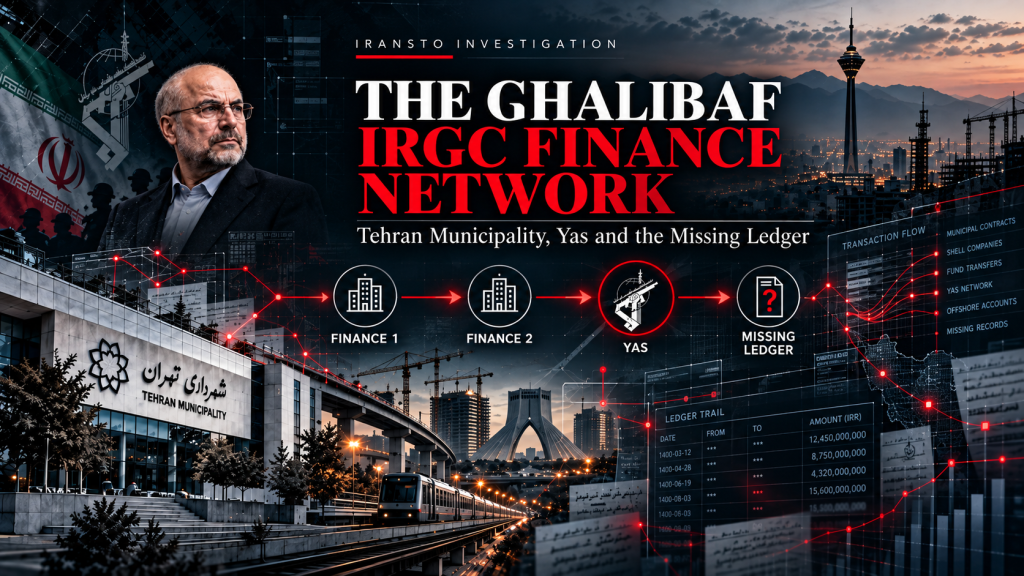
Introduction: The Ledger Behind the Network
The Yas corruption case exposed only part of a much larger financial system built inside Tehran City Hall during Mohammad Bagher Ghalibaf’s mayoralty. From 2009 onwards, Tehran Municipality committed public property, development rights, municipal revenues and other city assets to financing arrangements with the IRGC Cooperative Foundation. IranSTO refers to this structure as the Ghalibaf IRGC finance network. Finance 1 began with a ceiling of 2 trillion toman, approximately US$2.0 billion at the 2009 annual market-estimated exchange rate. By May 2014, Finance 2 had expanded the relationship into a nominal 20 trillion toman framework, equivalent to roughly US$6.1 billion at the contemporaneous free-market exchange rate. The system linked the municipality to the Cooperative Foundation, Khatam al-Anbiya Construction Headquarters, IRGC-linked financial institutions and corporate intermediaries operating across the Guards’ wider commercial network.
Historical US dollar equivalents in this investigation are approximate and are included only to indicate the scale of the agreements at the time, not their present-day value. The 2009 figure uses the annual market-estimated exchange rate, while the May 2014 figures use the contemporaneous free-market rate reported immediately before the Finance 2 agreement. The underlying investigation remains denominated in toman, the unit used in the municipal, contractual and investigative records.
The arrangement was built around Tehran’s own assets. The municipality could contribute property, construction rights, permits, charges and other non-cash resources, while the IRGC Cooperative Foundation was expected to organise financing for the projects. Bank Ansar was designated as a bank agent within that structure. The sequence placed public assets at risk from the outset: municipal value could move into the system before the corresponding project credit had been activated. Tehran could therefore surrender identifiable assets first and wait for the financing that was supposed to justify those transfers.
The later Tehran City Council investigation found that this mechanism did not operate as designed. Municipal resources continued to move through the system while City Hall also began paying contractors directly. Tehran was supplying assets to a structure created to finance its infrastructure and, at the same time, using its own money to keep the projects running. What began as a financing arrangement had become a far more difficult accounting problem: what had Tehran transferred, what financing had actually arrived, which institutions and companies had handled the transactions, and what remained unpaid?
The scale was vast. Investigators identified 12.94 trillion toman in municipal resources across the relationships they examined. By March 2021, after properties had been recovered and years of reconciliation had taken place, Tehran City Council still recorded approximately 4.294 trillion toman as owed by the IRGC Cooperative Foundation to the municipality. These figures represent different stages of the accounting history. The first measures the scale of municipal resources identified by the inquiry; the second records a later unresolved balance. They cannot be collapsed into a single loss figure. What they establish is already serious: public assets measured in trillions of toman entered a financing structure whose accounts remained unsettled years after the administration that created it had left office.
Yas matters because the same institutional environment later produced criminal convictions. Issa Sharifi, Ghalibaf’s long-serving deputy and one of the most powerful officials in his administration, was convicted in the case. Companies and executives connected to the municipal financing arrangements also reappeared in the wider Yas network. The first investigation in this Ghalibaf series examined that affair as part of a wider struggle over power, protection and institutional survival around Ghalibaf. This investigation follows the money instead. The Finance system existed before Yas became a criminal case. Its contracts, assets and liabilities have to be reconstructed independently before the later prosecutions can be understood properly.
Ghalibaf is not peripheral to that record. He was mayor when the Finance system was created and expanded. His deputy occupied a central executive position inside it, his financial administration participated in its formal approval structure, and Ghalibaf himself approved the major Finance 2 framework. That places him inside the documented decision chain and establishes responsibility for authorising the system at mayoral level, even where the surviving evidence does not identify him as the individual executor of every property transfer, payment order or banking decision. IranSTO applies the same evidentiary standard used in its investigation of Ghalibaf’s managerial repression: authority, execution and individual conduct must be traced through evidence rather than blurred together for convenience.
Bank Ansar illustrates why that distinction matters. Its formal role in Finance 2 is documented, but the public record does not contain a complete ledger showing every credit line activated or every payment released under the agreement. The frequently cited 700 billion toman allocation involving Bank Ansar and Tehran Metro Line 7 belongs to Finance 1, not Finance 2. The central question is therefore not whether a banking mechanism existed on paper, but how much financing that mechanism actually delivered after Tehran had already begun committing public value to the system.
The surviving record is sufficient to establish the architecture. Under Ghalibaf, Tehran Municipality placed public assets inside a financial relationship connecting City Hall to the IRGC’s construction, financing and commercial institutions. Corporate intermediaries operated between the principal parties, while the financing mechanism later failed to perform in the manner investigators said the agreements required. Municipal resources continued to move, contractors were paid directly, and substantial accounts remained open long after Ghalibaf left office.
This investigation reconstructs how that system was built, who authorised it, how Tehran’s assets moved through it, where the contractual mechanism broke down, what remained unresolved and how far the later Yas criminal case can actually be traced back into the same financial architecture. The paper trail begins in 2009, with Finance 1.
Chapter 1: Finance 1: Building the Model
The first layer of the Ghalibaf IRGC finance network was built in 2009, when Tehran Municipality entered what became known as Finance 1 with the IRGC Cooperative Foundation. The agreement began with a ceiling of 2 trillion toman, approximately US$2.0 billion at the 2009 annual market-estimated exchange rate, and was intended to finance major urban infrastructure over five years. Khatam al-Anbiya Construction Headquarters occupied the construction side of the arrangement, while the Cooperative Foundation was responsible for organising the financing. From the outset, Tehran had placed the contractor, financier and parts of the banking apparatus within the same wider IRGC economic sphere.
The relationship carried particular institutional weight under Ghalibaf. Before becoming mayor, he had held senior positions in the IRGC and had previously headed Khatam al-Anbiya. Under his administration, Khatam became one of Tehran Municipality’s major infrastructure contractors. Finance 1 gave that relationship a formal financial mechanism through which public assets and project financing could move between City Hall and institutions tied to the Guards. A later addendum increased the agreement’s ceiling from 2 trillion to approximately 2.6 trillion toman, expanding the municipality’s exposure before the original relationship had been fully settled.
The banking structure reflected the same institutional concentration. Municipal audit material divided the contemplated Finance 1 funding among Bank Ansar and the Mehr and Samen financial institutions. Bank Ansar was allocated 700 billion toman, with Tehran Metro Line 7 among the projects associated with that financing. The surviving public record does not provide a complete project schedule capable of reconstructing every Finance 1 allocation. It does establish the design: Tehran was seeking financing through institutions with direct or historical links to the IRGC and its cooperative network rather than through a dispersed group of unrelated lenders.
Khatam’s position extended beyond its engineering capacity. When Tehran City Council later investigated the agreements, Mahmoud Mirlohi said the arrangement had effectively channelled the relevant municipal works towards Khatam and criticised the absence of ordinary competitive procedures. Investigators also found that the Finance agreements had been treated as confidential, restricting scrutiny over commitments involving trillions of toman in public value. Finance 1 was therefore operating with concentrated contractor access, concentrated financing and limited external visibility from an early stage.
The property record shows how deeply municipal assets became embedded in the arrangement. Between 2009 and 2014, Tehran Municipality entered 43 property-transfer agreements connected to Finance 1. The later council inquiry valued those transfers at approximately 2.645 trillion toman. City land and property were no longer peripheral guarantees attached to a conventional financing arrangement. They had become part of the financing machinery itself, transferring tangible public assets into the relationship with the IRGC Cooperative Foundation.
The figures also show how far the arrangement expanded. The council investigation described the 2.645 trillion toman in property transfers as 645 billion toman above Finance 1’s original 2 trillion ceiling. That comparison is correct against the first agreement. Once the later addendum increased the ceiling to approximately 2.6 trillion toman, the excess fell to roughly 45 billion. The distinction is important for the accounting, but it does not alter the larger finding: the value of the property transfers alone slightly exceeded the entire amended Finance 1 ceiling.
The later inquiry also challenged the governance of the arrangement. Mirlohi told Tehran City Council that Finance 1 and Finance 2 had not been submitted for council approval. Investigators criticised weaknesses in guarantees, supervision and the allocation of obligations, arguing that commitments of this scale had proceeded without oversight proportionate to the public assets involved. A separate conflict-of-interest review based on the inquiry also highlighted institutional links between senior municipal officials and the IRGC. These were oversight findings rather than criminal judgments on every underlying contract, but they documented the governance structure within which trillions of toman in municipal value had been committed.
By the end of Finance 1’s intended term, the essential machinery of the later system was already in place. Khatam occupied the construction position, the IRGC Cooperative Foundation organised financing, IRGC-linked financial institutions were assigned credit functions, and Tehran Municipality supplied property and other forms of public value. The accounts had still not been cleanly closed.
Instead of dismantling that unresolved structure, Tehran Municipality and the IRGC Cooperative Foundation expanded it. In 2014, they entered Finance 2, raising the nominal framework from the original 2 trillion toman to 20 trillion. Finance 1 had established the operating model. Finance 2 would enlarge it into a financial architecture operating at an entirely different scale.
Chapter 2: From 2 Trillion to 20 Trillion
Finance 1 had established the model. Finance 2 transformed its scale. On 24 May 2014, Tehran Municipality and the IRGC Cooperative Foundation entered a four-year agreement with a nominal ceiling of 20 trillion toman, approximately US$6.1 billion at the contemporaneous free-market exchange rate. The new framework was more than seven times the amended value of Finance 1. A relationship that had begun with a 2 trillion toman ceiling had become large enough to reach across a substantial part of Tehran’s infrastructure programme.
The municipality itself was expected to provide a 10 trillion toman cash component, approximately US$3.0 billion at the same historical exchange rate. Contemporary reporting placed Tehran Municipality’s annual cash budget at roughly 7 trillion toman. The scale of the commitment was therefore exceptional: the cash component alone exceeded the city’s reported annual cash budget.
The remaining side of the framework depended on municipal non-cash resources and financing organised through the IRGC Cooperative Foundation. Later Tehran City Council investigators described the arrangement as 10 trillion toman in cash and another 10 trillion in non-cash resources, including property and other municipal assets. The contractual structure was more nuanced, with the Foundation expected to arrange financing against resources agreed with Tehran Municipality. In practical terms, Finance 2 exposed both the city’s cash resources and its wider asset base to the arrangement.
Land, development rights, construction permissions and other forms of municipal value could therefore be brought into a framework whose nominal scale already exceeded Tehran’s annual cash resources. The city was no longer simply purchasing construction services from an IRGC contractor. It was committing public assets to a financing structure in which the IRGC Cooperative Foundation occupied a central position between municipal resources, project finance and contractor selection.
The agreement also gave the Foundation substantial operational power. It was responsible for identifying or selecting contractors for projects brought under the framework, while Tehran Municipality would proceed with the corresponding project arrangements. Khatam al-Anbiya was already one of City Hall’s major infrastructure contractors. Finance 2 created a mechanism through which that relationship could extend across a much larger pipeline of municipal works.
The signatures show the level at which the arrangement was authorised. On the municipal side, Issa Sharifi, Ghalibaf’s senior deputy, and Seyed Dadoush Hashemi, the deputy mayor responsible for finance and urban economy, signed the agreement. Mohammad Bagher Ghalibaf approved it at the mayoral level. On the IRGC side were Jamaleddin Aberoumand, chairman of the IRGC Cooperative Foundation; Parviz Fattah, its managing director; Massoud Mehrdadi, one of its senior economic officials; and Mohammad Ali Jafari, then commander-in-chief of the IRGC. Finance 2 therefore carried authority reaching the senior leadership of both institutions.
That approval matters because the later financial scandal is easily reduced to intermediary companies and officials further down the administrative chain. Finance 2 existed before Rasa Tejarat became central to the municipal investigation and before Yas became a criminal case. The framework came first. Senior municipal and IRGC officials had already authorised a system capable of directing tens of trillions of toman in public resources through institutions embedded in the Guards’ economic structure.
Finance 2 was structured as an umbrella framework rather than a closed schedule of projects with final prices and fixed payment dates. Individual urban projects could subsequently be brought beneath it through separate arrangements. The four-year term was linked to the first payment made for a project rather than simply to the date of signature. This allowed project contracts, financing obligations and asset transfers to develop beneath the wider framework without every future transaction being specified in the original agreement.
The 20 trillion toman ceiling did not end the contractual evolution. The later City Council investigation identified two further amendments, reportedly produced on the same day, involving 3 trillion and 4 trillion toman. The surviving public record does not establish whether those amendments enlarged the overall ceiling, redistributed obligations already contained within it, altered project allocations or served another accounting function. They cannot therefore be added mechanically to produce a 27 trillion toman agreement. What their existence does show is that commitments measured in trillions of toman continued to be modified after the original framework had been authorised.
The scale and structure of Finance 2 also triggered opposition inside Tehran City Council. Gholamreza Ansari, a member of the council’s Planning and Budget Commission, challenged the agreement after its details became public, raising concerns about the 10 trillion toman non-cash component and its implications for competitive contracting. Other councillors defended the municipality’s authority to enter such an arrangement as an executive matter. The dispute exposed a governance problem before the later financial investigation began: councillors responsible for overseeing Tehran’s finances were debating the limits of their supervisory power after a 20 trillion toman framework had already been approved.
By 2014, the original Finance model had changed in three fundamental ways. Its nominal ceiling had risen from 2 trillion to 20 trillion toman. Tehran’s exposure had expanded from cash and property into a much broader pool of municipal assets and rights. The relationship had also moved upwards institutionally, connecting the senior leadership of Tehran Municipality directly to the IRGC Cooperative Foundation and the Guards’ wider economic apparatus.
The size of the framework establishes what was authorised, not what was ultimately delivered. It does not show that 20 trillion toman in financing actually reached municipal projects, which assets supported particular credit lines or how much external capital was ever released to contractors. Finance 2 created the machinery. Whether that machinery operated as the agreement contemplated is a separate question.
Chapter 3: How the Financing Was Supposed to Work
Finance 2 did not begin with capital flowing into Tehran Municipality. It began with municipal value moving out. Under the mechanism later reconstructed by Tehran City Council, the city could transfer property, development rights, construction permits, municipal authorisations and other non-cash resources into the arrangement. Only after those resources had been committed was the IRGC Cooperative Foundation expected to organise the corresponding project finance through the designated banking mechanism. Tehran’s contribution therefore came first; the financing intended to match it depended on subsequent action by the Foundation and the bank.
Four institutional functions defined the structure. Tehran Municipality supplied public resources and commissioned the projects. Khatam al-Anbiya Construction Headquarters occupied the contractor position. The IRGC Cooperative Foundation was responsible for arranging the financing. Bank Ansar served as the bank agent through which project credit lines were to be activated. These functions were legally distinct, but the construction, financing and banking sides were concentrated within the IRGC’s broader economic sphere.
The intended sequence was straightforward. Tehran would transfer the agreed assets, permissions or other municipal value. The Cooperative Foundation would then request activation of the corresponding credit line. Bank Ansar, acting as the designated bank agent, was expected to release project credit in stages, allowing contractors to be paid as work progressed. Municipal assets transferred into the structure were therefore supposed to be matched by financing delivered through the other side of the arrangement.
That sequence exposed Tehran from the moment an asset was transferred. Once a property had left municipal ownership or a development right had been granted, the city’s contribution was no longer theoretical. The corresponding financing still depended on later action by the Cooperative Foundation and the bank. Any delay, partial activation or failure of the credit line created an imbalance after Tehran had already performed its side of the exchange.
The contract also attached a substantial financing cost to the mechanism. According to the later City Council investigation, payments made to projects through the bank agent were to carry a 25 per cent financing charge. Mirlohi later questioned the basis for such a charge where the contemplated financing had not actually been provided. The 25 per cent figure is therefore significant as a contractual term. It does not establish that Bank Ansar advanced the full Finance 2 ceiling or that the charge was collected across the entire arrangement. Establishing what was actually lent, when it was released and what financing cost was ultimately charged requires the banking ledger that has never been made public.
The frequently cited 700 billion toman Bank Ansar figure belongs to Finance 1. It included financing associated with Tehran Metro Line 7 and cannot be carried into the 2014 agreement as evidence of a Finance 2 disbursement. For Finance 2, the surviving record establishes Ansar’s assigned role as bank agent but does not provide a complete public schedule of the credit lines it actually activated.
Ansar’s role still matters because of where the bank sat institutionally. The Cooperative Foundation responsible for arranging the financing, the bank appointed to administer project credit and Khatam, the principal construction actor, all operated within the same wider IRGC economic environment. IranSTO has examined that corporate ecosystem separately in its investigation of the IRGC front-company network. In Tehran, the result was a structure in which closely connected institutions occupied the construction, financing and banking positions while the municipality supplied the public assets supporting the arrangement.
The legal and accounting structure beneath those institutions was considerably more complex than the headline agreement suggested. Tehran Municipality was the employer. Khatam performed construction. The Cooperative Foundation arranged financing. Bank Ansar administered the credit mechanism. Individual projects could then generate separate contracts, payment schedules and asset transfers. Municipal property might support one part of a project while expenditure travelled through another record entirely. Once cash, land, permits, development rights and bank credit were moving simultaneously, a consolidated ledger was essential to match every municipal contribution against the financing and construction delivered in return.
Finance 2 also allowed Tehran to fund infrastructure using resources that did not appear as immediate cash expenditure. Land could be transferred. Development density could be granted. Construction permissions and municipal claims could be assigned economic value. That gave City Hall access to a much wider pool of resources than the annual cash budget alone, but it also placed a much broader range of public assets inside the financing system.
The accounting risk followed directly from that design. A conventional loan can usually be reconstructed through a relatively concentrated banking trail showing principal advanced, financing cost and repayment. Finance 2 dispersed economic value across institutions and different forms of municipal property and authority. A land transfer, a development permission and a bank drawdown might all relate to the same project while appearing in separate records held by different entities.
The later Tehran City Council investigation concluded that the sequence did not operate as intended. Mirlohi told councillors that the Cooperative Foundation had been obliged to create credit lines through the bank agent, yet the expected financing was not reaching municipal projects through the prescribed mechanism. Tehran had transferred resources first, while the financing intended to match those transfers failed to follow in the manner contemplated by the agreements.
That finding fundamentally changes how Finance 2 has to be examined. The issue is not simply that Tehran entered a vast and opaque financing relationship with the IRGC’s economic institutions. Public assets had already begun moving into a system whose next stage depended on financing organised by the institutions on the other side of the transaction.
The mechanism was therefore capable of exposing Tehran before its promised counterpart had been delivered. Understanding how that structure continued to operate requires identifying the officials who authorised it and the chain of authority under which the later transfers took place.
Chapter 4: Who Authorised the System?
Finance 2 was authorised at senior level on both sides of the arrangement. The 20 trillion toman framework did not originate with an intermediary company or a technical department operating at the margins of Tehran Municipality. It connected the executive leadership of City Hall directly to the economic hierarchy of the IRGC. On the municipal side stood Mohammad Bagher Ghalibaf, his senior deputy Issa Sharifi, and Seyed Dadoush Hashemi, the deputy mayor responsible for finance and urban economy. On the IRGC side were Mohammad Ali Jafari, then commander-in-chief of the Guards; Jamaleddin Aberoumand, chairman of the IRGC Cooperative Foundation; Parviz Fattah, its managing director; and Massoud Mehrdadi, a senior economic official within the Foundation.
The agreement identified Sharifi and Hashemi as representatives of Tehran Municipality and Aberoumand and Fattah as representatives of the IRGC Cooperative Foundation. Ghalibaf and Jafari approved the framework at the head of their respective institutions, while contemporary publication of the agreement also identified Mehrdadi among the senior IRGC officials involved. Finance 2 therefore entered operation with formal backing extending from Tehran’s mayoral administration to the leadership overseeing the IRGC’s economic institutions.
That approval matters because the later scandal became increasingly associated with intermediary companies, individual property transfers and officials further down the administrative chain. Those actors played important roles in execution, but they did not create the framework under which the transactions became possible. Finance 2 existed before Rasa Tejarat became central to the municipal investigation and before Yas emerged as a criminal case. The decision to place municipal cash, property and other public resources inside this relationship had already been taken.
Sharifi occupied a particularly important position in that chain. As Ghalibaf’s senior deputy, he represented Tehran Municipality directly in an agreement governing construction, financing and the deployment of public resources on an exceptional scale. Hashemi’s participation connected the same framework to the office responsible for the municipality’s financial and urban-economic administration. Finance 2 was therefore embedded in City Hall’s senior executive and financial machinery from the moment it was authorised.
Ghalibaf’s own approval fixes his institutional position in the record. Finance 2 operated under his mayoralty and with his approval. Municipal departments and officials then acted beneath the authority created by that framework. Delegation determined who executed individual property transfers, contracts and payments; it did not remove the senior decision through which the municipality entered the arrangement.
The same distinction applies on the IRGC side. Jafari’s approval placed the agreement above the level of an isolated commercial relationship involving the Cooperative Foundation. Aberoumand, Fattah and Mehrdadi occupied positions within the institutions responsible for the economic side of the arrangement, while the commander-in-chief of the IRGC approved the wider framework. Construction, financing and military-economic authority were therefore connected at senior institutional level before individual projects began moving through the system.
Finance 2 also created substantial operational authority beneath those approvals. The IRGC Cooperative Foundation was responsible for selecting contractors for projects brought under the framework, while Tehran Municipality would pursue the corresponding project agreements. Bank Ansar was designated as the bank agent responsible for opening project credit lines. City Hall, meanwhile, undertook a 10 trillion toman cash component while making additional municipal resources available to support the financing structure. The agreement therefore went beyond a general statement of cooperation. It established a mechanism through which the Foundation could influence contractor selection and financing while Tehran committed public assets to the arrangement.
The scale of that delegation triggered opposition inside Tehran City Council soon after details became public. In July 2014, Gholamreza Ansari, a member of the council’s Planning and Budget Commission, challenged the 20 trillion toman framework and raised concerns about its 10 trillion toman non-cash component and the effect of the arrangement on competitive contracting. Other councillors defended the municipality’s authority to enter such agreements as part of its executive powers. The sequence is important: the dispute over oversight occurred after the framework had already been signed. Councillors responsible for supervising Tehran’s finances were debating the extent of their authority over an agreement that had already committed the municipality to a multi-trillion-toman relationship with the IRGC’s economic institutions.
Years later, Tehran City Council’s investigation returned to the same governance problem. Investigators argued that Finance 1 and Finance 2 had proceeded without the level of council scrutiny appropriate to commitments of their size and criticised weaknesses in guarantees, supervision and the allocation of obligations between the parties. Those findings did not convert every decision made under the agreements into a criminal act. They documented something more fundamental: public assets measured in trillions of toman had been placed inside a system whose safeguards and oversight were themselves disputed.
The surviving record therefore allows Ghalibaf’s institutional responsibility to be stated precisely. He approved Finance 2 while serving as mayor. His senior deputy and financial administration represented Tehran Municipality inside the agreement. The framework expanded an existing relationship between City Hall and the IRGC Cooperative Foundation and gave that relationship access to contractor selection, project finance and municipal assets. Those are documented acts of senior institutional authority.
The available record does not identify Ghalibaf as the personal executor of every transaction carried out beneath that authority or establish that he personally received proceeds from the transactions examined in this investigation. Those are separate evidentiary questions. They do not alter what the agreement itself establishes: Tehran Municipality entered Finance 2 through an identifiable chain of senior municipal and IRGC approval.
Once that authority had been created, execution moved into a less visible corporate layer. Companies acting for the IRGC Cooperative Foundation began handling brokerage, asset transfers and settlement between the larger institutions. That intermediary structure would become crucial when unfinished Finance 1 obligations collided with the expanding Finance 2 framework.
Chapter 5: The Intermediary Layer
The Finance agreements did not operate through a direct line between Tehran Municipality and the IRGC Cooperative Foundation. Corporate intermediaries sat between the institutions that authorised the system and the public assets moving through it, handling brokerage, transactions and parts of the settlement process on the Foundation’s side. That additional layer became increasingly important once municipal property, payment instruments and other resources began moving through companies whose accounts were separate from both City Hall and the Cooperative Foundation.
Under Finance 1, the intermediary was Tejarat Almas Mobin. Material later examined by Tehran City Council identified Mohsen Sajadinia, also known as Mahmoud Seif, as the company’s managing director and the representative introduced by the IRGC Cooperative Foundation for the agreement. Tejarat Almas Mobin therefore operated on the Foundation’s side of the financing structure and became part of the machinery through which Finance 1 was executed.
Its wider corporate history gives that position additional significance. In November 2017, the US Treasury designated Mahmoud Seif and Tejarat Almas Mobin in connection with support for an IRGC-Quds Force counterfeiting network. Treasury identified Seif as the company’s managing director and described Tejarat Almas Mobin as controlled by him. That designation concerned conduct separate from Tehran’s municipal financing agreements and does not establish that municipal assets financed the activities identified by the US government. It does establish that a company used inside Tehran’s financing relationship also operated within a broader IRGC-linked commercial network. IranSTO has examined comparable structures in its investigation of the IRGC front-company network.
The more consequential development for the municipal ledger came before that designation. By March 2016, the IRGC Cooperative Foundation had introduced Rasa Tejarat Mobin as the successor to Tejarat Almas Mobin. According to the later City Council investigation, Rasa was acting for the Foundation across both Finance 1 and Finance 2. Finance 1 had still not been cleanly closed when the intermediary changed, while Finance 2 had already expanded the municipal relationship into a nominal 20 trillion toman framework.
Rasa therefore entered more than a new financing programme. It inherited a structure containing unfinished obligations from Finance 1 while new transactions were accumulating under Finance 2. Property transfers originating under the earlier agreement, subsequent municipal resources and later settlement activity could now pass through the same intermediary even though the underlying obligations belonged to agreements signed years apart.
A transition of that kind required a clear accounting bridge. The outgoing intermediary’s liabilities needed to be identified, unsettled municipal claims carried forward, previously transferred assets matched against the obligations they were intended to satisfy, and the incoming intermediary given a documented opening balance. No complete public handover schedule between Tejarat Almas Mobin and Rasa Tejarat Mobin has emerged.
That missing bridge became more consequential as Rasa’s role expanded. The City Council investigation later examined the company alongside Finance 1, Finance 2, municipal property transfers, holograms, payment orders and other forms of public value. Rasa had become one of the principal points through which investigators could trace the municipality’s financial relationship with the IRGC Cooperative Foundation. It stood across old liabilities and new transactions at the same time.
Separate brokerage agreements made the accounting trail more fragmented. The council investigation identified arrangements involving municipal property and financial institutions, including Samen Credit Institution, in which intermediaries participated in property acquisition and the settlement of municipal liabilities. A single financing relationship could therefore generate several parallel records: the principal Finance agreement, individual project contracts, brokerage agreements, property documentation, payment orders and the intermediary’s own accounts.
Investigators also questioned how some of those records had been produced and authorised. Mahmoud Mirlohi told Tehran City Council that agreements connected to the Finance structure had, in some cases, been prepared on an intermediary company’s letterhead and linked back to the principal arrangement by reference. He also described transactions that proceeded with fewer municipal signatures than the relevant procedures required. These were findings of the council inquiry rather than judicial determinations covering every transaction, but they show that the intermediary layer participated directly in the documentation, movement and accounting of municipal assets.
The documented problem is not the existence of corporate intermediaries in itself. Such companies can perform legitimate functions in complex financing structures. The problem is the accounting continuity visible in this case: the intermediary changed before earlier obligations had been fully reconciled, the scale of the financing relationship had already increased dramatically, and no consolidated public ledger has emerged showing how outstanding liabilities moved from one company to the next.
That sequence made the intermediary layer one of the most difficult parts of the Ghalibaf IRGC finance network to reconstruct. Finance 1 obligations did not disappear when Tejarat Almas ceased to occupy the central intermediary role. Finance 2 did not begin with a clean balance sheet. Rasa stood across both arrangements while municipal resources continued moving through a structure whose accounting history had already been divided between multiple contracts, companies and institutions.
The consequences became visible when the financing mechanism itself began to fail. Tehran had already committed assets into a system whose obligations were distributed across the Cooperative Foundation, banks, contractors and corporate intermediaries. Once the financing expected under the agreements failed to follow the contractual sequence, that fragmented corporate structure became the accounting trail City Hall would later have to reconstruct.
Chapter 6: When the Financing Mechanism Broke Down
Finance 1 and Finance 2 had been presented as financing arrangements. Tehran Municipality would place assets and other resources into the structure, while the IRGC Cooperative Foundation would use its financial capacity to mobilise project funding through the designated banking mechanism. That exchange provided the economic rationale for committing municipal property and rights to the system. According to the later Tehran City Council investigation, the financing side of that exchange failed to operate as intended.
Mahmoud Mirlohi told the council that the agreements had been justified by the IRGC’s claimed ability to bring financial resources into Tehran’s infrastructure programme. Under the agreed mechanism, municipal assets would enter first, the Cooperative Foundation would establish the corresponding credit through the bank agent, and that credit would finance project expenditure. Investigators concluded that the financing expected under the agreements was not reaching municipal projects through the prescribed process. Tehran had already committed public value, while the corresponding financing failed to follow.
The breakdown became more serious when Khatam al-Anbiya complained that the financing side was not paying it. Tehran Municipality did not stop the arrangement while the accounts were being resolved. Instead, City Hall began paying project costs directly. The council investigation found that the municipality was issuing cheques to contractors while continuing to transfer property and other municipal resources to Rasa Tejarat. Tehran was therefore supporting the same construction programme through two channels: public assets continued to enter the Finance structure while municipal funds were also being used to pay the contractor directly.
That development reversed the economic logic of the arrangement. Property, development rights, permits, municipal holograms and other public resources had been transferred on the premise that the Cooperative Foundation would organise financing against them. Once Tehran began paying contractors from its own funds, the municipality was carrying costs that the Finance structure had been created to finance.
The City Council investigation criticised both sides of that failure. It challenged Khatam’s departure from the agreed financing process and Tehran Municipality’s decision to accept requests for direct payment before settling the city’s claims against the IRGC Cooperative Foundation. Investigators also pointed to inadequate guarantees protecting the municipality if the financing side failed to perform. Tehran had transferred assets before securing an effective mechanism for ensuring that equivalent financing would return through the other side of the structure.
The contractual 25 per cent financing charge made the contradiction sharper. Payments routed through the bank mechanism were supposed to carry a financing cost of 25 per cent. Mirlohi questioned how such a charge could be justified where the contemplated financing had not actually been provided. The public record does not establish that a 25 per cent charge was collected across the entire Finance 2 framework. It establishes that a substantial financing charge formed part of a structure whose actual delivery of financing later became one of the central disputes in the council investigation.
Meanwhile, municipal resources continued to move. The inquiry identified property, municipal charges, holograms, payment orders and cash among the forms of value supplied by Tehran within the relationships it examined. The holograms were municipal instruments used in property and development transactions, allowing development-related municipal rights or obligations to carry transferable economic value alongside land and cash. Every additional transfer increased the volume of public resources that would eventually have to be matched against financing delivered, construction completed, repayments made or property returned.
The institutional design made that reconciliation increasingly difficult. The IRGC Cooperative Foundation carried the financing obligation. Khatam occupied the contractor position. Bank Ansar held a defined banking function. Rasa Tejarat handled transactions between the larger institutions. Once the agreed sequence failed, reconstructing what Tehran had supplied and what it remained entitled to recover required records held across several organisations. Economic functions were concentrated within the same wider IRGC-linked environment while the accounting trail was dispersed across separate legal entities.
Mirlohi’s presentation of the inquiry went beyond allegations of poor contract management. He described the scale of the transfers as evidence of serious mismanagement and alleged an organised process involving the IRGC Cooperative Foundation and Rasa Tejarat through which municipal resources had been removed. That was an allegation of the City Council investigation rather than a judicial finding against every participant or transaction. Its significance lies in the scale of what the investigators themselves were describing: a systemic failure involving trillions of toman in public assets rather than a small number of defective invoices.
Tehran Municipality was also an active participant in the continuation of the arrangement after the financing mechanism had begun to fail. Direct contractor payments required municipal approval, as did continued transfers of property and other resources. The surviving evidence does not establish the motive behind every decision to keep the system operating, but its continuation depended on further administrative acts inside City Hall.
That is the central failure revealed by the investigation. Finance 1 and Finance 2 had been designed to use Tehran’s assets to unlock financing for major infrastructure. In practice, the municipality reached a point where it was still transferring assets, paying contractors directly and carrying unresolved claims against the institution responsible for organising the financing. Tehran was increasingly supplying the resources required to sustain a structure that had been created to finance Tehran.
The resulting exposure cannot be reconstructed from individual cheques or property deeds alone. Tehran City Council eventually identified 12.94 trillion toman in municipal resources across the relationships it examined. The figure combines different categories of public value and does not represent a calculation of net financial loss. Its significance is different: it measures the extraordinary volume of municipal resources investigators found inside a system whose central financing mechanism had already diverged from its contractual design.
From that point, the central accounting question was no longer whether Finance 2 had performed as intended. It was how much public value Tehran had actually placed inside the system and what had been received in return.
Chapter 7: Reconstructing the Municipal Ledger
By the time Tehran City Council reconstructed the Finance relationships, one figure captured the scale of municipal resources that had moved through the system: 12.94 trillion toman. Mahmoud Mirlohi told the council that this amount had been provided to Rasa Tejarat through the relationships under investigation. It included property, municipal charges, holograms, payment orders and cash. The figure therefore represented an accumulation of different forms of public value moving out of Tehran Municipality through several contractual and financial channels, rather than a single transfer or bank payment.
Its composition is as important as its size. Tehran was not exposing only its cash budget. Physical property entered the structure. Municipal charges and development-related rights carried economic value. Payment orders created claims against City Hall. Holograms, municipal instruments used in property and development transactions, could also carry transferable economic value within the settlement system. The Finance architecture had therefore reached beyond ordinary expenditure and into the city’s property base and regulatory authority.
The 12.94 trillion toman figure is best understood as a gross municipal-resource figure. It records the scale of public value identified by the inquiry across the relationships it examined. The published material does not provide a complete schedule showing how much belonged to each category, which individual asset supported which project, what subsequently moved from Rasa Tejarat to another entity or what was later recovered. Because the total combines different forms of value transferred over several years, assigning it a single historical US dollar equivalent would create a precision the underlying record does not support.
Some parts of the ledger can be reconstructed independently. Finance 1 alone involved 43 municipal property-transfer agreements between 2009 and 2014, valued by the council inquiry at approximately 2.645 trillion toman. By the time Rasa Tejarat became the principal intermediary, however, the relationship had expanded far beyond those property agreements. Land, municipal charges, permits, holograms, payment orders and cash were moving through records associated with Finance 1, Finance 2 and related brokerage arrangements.
The entire 12.94 trillion therefore cannot be assigned automatically to Finance 2. The council investigation examined a broader body of relationships involving both Finance agreements, Rasa Tejarat, property transfers, brokerage arrangements and municipal financial instruments. The published record does not divide the 12.94 trillion into a complete Finance 1 and Finance 2 allocation. Treating the whole amount as expenditure under the 2014 framework would impose an accounting distinction that the surviving evidence does not provide.
Direct contractor payments create another unresolved boundary. The council found that Tehran Municipality was issuing cheques directly to contractors while continuing to transfer property and other resources to Rasa Tejarat. That finding is central to the breakdown of the financing mechanism, but the published material does not establish whether every direct contractor payment was already included within the 12.94 trillion total or was recorded separately. Adding those payments to the gross-resource figure without the underlying ledger would therefore risk double counting.
The hologram record requires the same discipline. The inquiry separately referred to approximately 14 trillion toman in holograms issued through the municipal system. That figure cannot simply be added to the 12.94 trillion as another pool of financial loss. The surviving public material does not establish how much of the hologram figure overlaps with resources already counted by investigators, how much was redeemed or cancelled, or which underlying municipal obligations the instruments represented.
A complete hologram register would be required to answer those questions. It would identify issuance dates, beneficiaries, face values, the municipal obligations attached to the instruments, their redemption or cancellation status and any relationship to Rasa Tejarat or the Finance agreements. Without that record, the 14 trillion toman figure establishes the extraordinary scale at which the instrument was used, but not an additional 14 trillion toman in proven loss.
Property creates a similar accounting problem. A municipal asset could leave City Hall at one valuation, remain outside municipal ownership for years, and later return under different legal or market conditions. Development rights and permits were even more dependent on location, density and administrative decisions. The public record does not contain a consolidated schedule showing the valuation method applied to every asset included within the 12.94 trillion total. A nominal ledger can therefore document the movement of property without capturing its full economic consequence over time.
The central distinction is between gross municipal resources and net financial loss. Calculating the latter would require every asset and payment supplied by Tehran to be matched against financing actually delivered, construction completed, repayments made, properties returned and other value recovered. The City Council investigation established the scale of what entered the system. The public record still lacks the counter-ledger required to complete that matching exercise transaction by transaction.
That evidentiary boundary does not reduce the significance of the 12.94 trillion figure. It establishes that public value measured in trillions of toman entered a financial architecture whose banking mechanism later failed to operate as intended and whose accounting records were dispersed across City Hall, the IRGC Cooperative Foundation, financial institutions and intermediary companies. Tehran could identify enormous quantities of value that had left the municipality far more easily than it could reconstruct the full value returned through the other side of the arrangement.
The gross ledger was therefore only one side of the financial problem. Years after the transfers began, and after municipal properties had been recovered, the IRGC Cooperative Foundation still carried a multi-trillion-toman unresolved balance on Tehran’s books.
Chapter 8: The Unresolved Balance
The 12.94 trillion toman figure established the scale of municipal resources identified by Tehran City Council. It did not establish whether the account had ever been closed. By the time the investigation reached its final stage, Tehran Municipality had recovered properties, reversed parts of the relationship and spent years attempting to reconcile what had moved through the Finance system. A substantial balance remained.
By March 2021, the council investigation recorded approximately 4.294 trillion toman as owed by the IRGC Cooperative Foundation to Tehran Municipality after property recovery and other settlement efforts. Mahmoud Mirlohi told councillors that numerous municipal assets had been returned and several agreements rescinded, yet roughly 4.3 trillion toman remained outstanding. He also stressed that the balance was still being expressed using valuations from the 2014–16 period rather than values current in 2021.
The timing is as important as the amount. Finance 1 had begun more than a decade earlier. Finance 2 had been signed in 2014. Ghalibaf had left Tehran City Hall in 2017. Years after the administration that created the system had ended, the municipality was still carrying a multi-trillion-toman claim against the institution that had been responsible for organising the financing.
The 4.294 trillion toman balance therefore records something more consequential than another large number in the case. Years of asset recovery and reconciliation had not closed the account. Properties had been returned, agreements revisited and claims reconstructed, yet Tehran Municipality still recorded a liability measured in trillions of toman against the IRGC Cooperative Foundation.
That balance cannot be derived by simply subtracting it from the earlier 12.94 trillion total. The two figures represent different stages of the financial history. The 12.94 trillion figure records gross municipal resources identified across the relationships investigated by the council. The latter 4.294 trillion figure records what investigators said remained unresolved after recoveries, offsets and other adjustments. The public record does not contain the full reconciliation schedule needed to reconstruct the bridge between them.
The recovered properties make that reconciliation more complicated. Returning a municipal asset years later does not necessarily reverse the original transaction economically. A property may have left City Hall at one valuation, remained outside municipal ownership for years, changed in market value or acquired legal complications before being returned. The public record confirms that properties were recovered, but it does not provide a consolidated schedule showing the original valuation of each asset, its condition or legal status at recovery, or the amount ultimately credited against the outstanding debt.
The use of historical valuations sharpens the problem. Mirlohi said the remaining balance was still being calculated using values from the 2014–16 period. Tehran’s property market changed substantially in the years that followed. Converting the 4.294 trillion toman balance into US dollars at a 2021 exchange rate would therefore be misleading, while applying a single earlier rate would falsely imply that every asset and liability entered the account at the same moment. The defensible finding is the one produced by the council investigation itself: a multi-trillion-toman balance remained unresolved years later, and even that balance was still being expressed at older valuations.
The inquiry also identified a separate accounting anomaly involving 1.7 trillion toman in debt attributed to the IRGC Cooperative Foundation. Mirlohi said the liability appeared in the Tehran Municipal Property Organisation’s 2015–16 audit records but was absent from the following reporting period. The public record does not explain whether the amount was paid, offset, reclassified, written off or removed through another accounting decision. Nor does it establish how, if at all, the figure relates to the later 4.294 trillion toman balance.
A liability of that size should leave an accounting trail. A settlement should generate settlement records. A reclassification should create a corresponding entry elsewhere in the accounts. A write-off should carry an approval trail. What remains visible in the published material is the discrepancy: 1.7 trillion toman appeared as a liability in one audit period and was absent from the next.
The unresolved balance also exposes the weakness of the protections available to Tehran once the Finance mechanism began to fail. The City Council investigation criticised inadequate guarantees from the IRGC Cooperative Foundation and found that the municipality continued paying Khatam al-Anbiya directly before its own claims against the financing side had been settled. City Hall had already transferred public assets into the structure. When the expected financing failed to arrive through the agreed mechanism, Tehran continued supporting the projects while carrying unresolved receivables against the institution responsible for arranging that financing.
The asymmetry persisted long after the projects themselves had moved forward. Tehran could identify properties, payments and municipal instruments it had supplied, but establishing the complete value received in return required records held across the Cooperative Foundation, banks, contractors and intermediaries. Recovery therefore depended on reconstructing a counter-ledger spread across institutions outside City Hall.
The financial consequences outlived the administration that created them. Later municipal officials inherited the task of recovering properties, reversing agreements and calculating what remained owed. Ghalibaf’s departure from the mayor’s office did not close the liabilities generated under the system his administration had authorised.
By March 2021, after years of attempted recovery and settlement, Tehran City Council still recorded approximately 4.294 trillion toman as owed by the IRGC Cooperative Foundation. The figure was based on historical valuations and cannot serve as a final calculation of criminal loss. Its significance is more immediate: more than a decade after Finance 1 began, Tehran Municipality still had not closed the account.
That unresolved balance is where the municipal Finance investigation begins to intersect directly with Yas. Several companies and individuals already visible inside the financing architecture later appeared in criminal proceedings. The remaining question is how far that overlap can be traced through the surviving evidence.
Chapter 9: The Yas Connection: What Can Actually Be Traced
The Yas case did not create the financial architecture reconstructed in this investigation. Finance 1 had been operating since 2009. Finance 2 expanded the relationship dramatically in 2014. Municipal property and other public resources had already moved through companies acting for the IRGC Cooperative Foundation. Yas emerged later. What the criminal case exposed was that several companies and individuals already embedded in Tehran’s financing system also occupied positions inside the economic network that became the subject of prosecution.
The corporate connection runs through Rasa Tejarat Mobin and Tejarat Almas Mobin. Reporting reconstructing the Yas group identified both companies within its wider corporate structure. Tehran City Council, independently, placed the same companies inside the municipal Finance record: Tejarat Almas acted as the earlier intermediary for Finance 1, while Rasa later operated across Finance 1 and Finance 2. The corporate machinery surrounding Tehran’s municipal agreements therefore overlapped directly with the business environment later associated with Yas.
The connection becomes more specific at board level. Mahmoud Khakpour, later convicted in the Yas case, joined the board of Rasa Tejarat in November 2016 as a representative of Tejarat Almas Mobin. Massoud Mehrdadi, another later defendant, had served inside both the Yas structure and the economic hierarchy of the IRGC Cooperative Foundation. These were not simply companies with similar institutional affiliations. Personnel moved between entities appearing in both the municipal financing record and the later criminal case.
Issa Sharifi provides the municipal bridge. He had spent years as one of the most powerful officials in Ghalibaf’s City Hall, signed Finance 2 on the municipal side and occupied a central position in the administration managing the relationship with the IRGC Cooperative Foundation. Mahmoud Seif, also known as Mohsen Sajadinia, provides another connection. Before Yas became publicly known as a criminal case, he had managed Tejarat Almas Mobin, the company used as an intermediary in Finance 1. Mehrdadi connected the same institutional history back to the economic leadership of the Cooperative Foundation.
In March 2021, Iran’s Armed Forces Judicial Organisation announced that the Supreme Court had upheld the principal Yas convictions. Mahmoud Seif received thirty years in prison, Issa Sharifi twenty years, Mahmoud Khakpour five years and six months, and Massoud Mehrdadi two years. The announced offences included participation in organised fraud, money laundering and the unlawful withdrawal and appropriation of funds. The official statement also said that approximately 5.853 trillion rials, equivalent to about 585 billion toman, had been returned in property and real estate at values corresponding to the period in which the offences occurred.
Those convictions turn the institutional overlap into something more serious than association. Financial crimes were proven against individuals who had occupied identifiable positions inside the same municipal and IRGC economic environment reconstructed in the preceding chapters. Seif connects the criminal case to Tejarat Almas. Khakpour connects Tejarat Almas directly to Rasa. Sharifi connects Yas to the senior executive machinery of Ghalibaf’s municipality. Mehrdadi connects it to the economic leadership of the IRGC Cooperative Foundation.
The published judicial record does not provide a transaction schedule mapping the criminal counts onto individual Finance 1 or Finance 2 transfers, specific municipal properties, Rasa transactions, Bank Ansar credit lines or the 12.94 trillion toman in municipal resources later reconstructed by Tehran City Council. The Yas convictions establish criminal conduct by named defendants. They do not establish that every transaction executed beneath the Finance architecture formed part of one judicially proven criminal scheme.
That evidentiary boundary should not be mistaken for institutional separation. The companies and personnel appear in overlapping positions across the two histories. The criminal case reached into a corporate and managerial environment already carrying municipal assets and Finance obligations. What remains unavailable is the transaction-level record showing precisely where the municipal financing system intersected with the conduct prosecuted in Yas.
A second body of evidence emerged publicly in February 2022, when Radio Farda released a recording reported as dating from 2018–19 of a conversation between Mohammad Ali Jafari, then commander-in-chief of the IRGC, and Sadegh Zolghadrnia, a senior official involved in the Guards’ economic and construction affairs. The discussion concerned Yas, the IRGC Cooperative Foundation, Tehran Municipality and large financial shortfalls inside the Guards’ economic apparatus. Fars News Agency, which is affiliated with the IRGC, subsequently reported that its own inquiries had confirmed the authenticity of the recording. The following day, IRGC spokesman Ramezan Sharif separately acknowledged that mismanagement and a violation had occurred in a company affiliated with the Cooperative Foundation and said the case had been referred to the judiciary.
The most consequential allegation in the recording concerned approximately 8 trillion toman. Zolghadrnia said that the team around Jamaleddin Aberoumand at the IRGC Cooperative Foundation had developed a shortfall of roughly that scale. He alleged that Ghalibaf subsequently pressed him to sign an 8 trillion toman memorandum intended to resolve the problem. Zolghadrnia said he refused because he considered the proposed arrangement unlawful and warned that signing it would expose those involved. Jafari, according to the recording, expressed relief that the memorandum had not been signed.
Zolghadrnia’s account went further. He alleged that money which should have gone to Rasa had instead been directed to another company, Pajouhab, and described confronting Ghalibaf over the proposed settlement. These remain allegations contained in the recorded discussion rather than findings from a published judgment. Their significance lies in their specificity: the recording alleges direct involvement by Ghalibaf in a later attempt to address a multi-trillion-toman financial problem arising inside the same institutional environment examined in this investigation.
The 8 trillion toman figure cannot be inserted into the municipal ledger as though it were another confirmed Finance loss. The recording does not establish that the amount was identical to the 12.94 trillion toman in municipal resources, the latter 4.294 trillion unresolved balance or any other single figure reconstructed by Tehran City Council. The memorandum Zolghadrnia said he was asked to sign has not been published, nor have the calculations producing the 8 trillion amount. Its exact relationship to the municipal accounts therefore remains unresolved.
The leaked discussion nevertheless makes it difficult to confine Yas to misconduct by lower-level intermediaries. According to the recording, the financial consequences were being discussed directly by the IRGC commander and a senior official responsible for the Guards’ economic affairs, while the conversation also concerned figures connected to Tehran Municipality. The financial problem had reached senior command level, and the sums under discussion were measured in trillions of toman.
The broader power struggle surrounding Yas, including the roles attributed to Hossein Taeb, Qasem Soleimani, Mohammad Ali Jafari and other senior IRGC figures, has already been examined in the first investigation in this series. The relevance here is financial. Years after the Finance architecture had been created, senior IRGC officials were still discussing the consequences of the same economic environment, including an alleged multi-trillion-toman shortfall and an attempted settlement involving Ghalibaf.
Ghalibaf’s legal position remains distinct from those convicted in Yas. The published Yas judgment did not convict him, while the judiciary publicly stated that the charges in Sharifi’s case had not been directed at Ghalibaf. That defines the criminal record. It does not alter his documented approval of Finance 2, the position of his senior deputy inside both the Finance system and Yas, the municipal resources transferred under his administration, or the later allegation in the IRGC recording that he personally pressed for an 8 trillion toman memorandum.
The evidence therefore supports a conclusion stronger than simple institutional proximity but narrower than treating Finance 1, Finance 2 and Yas as interchangeable names for one proven conspiracy. Their corporate structures overlapped. Their personnel overlapped. Convicted defendants occupied positions inside the Finance architecture. Senior IRGC officials later discussed a major financial crisis connected to the same institutional environment, and the recording contains a specific allegation of Ghalibaf’s involvement in an attempted settlement.
What remains missing is the documentary bridge between those facts and individual transactions. The Finance agreements, Yas judgments, municipal accounts and leaked IRGC discussion illuminate different parts of the same financial landscape. Until the underlying ledgers, settlement records and judicial financial schedules can be placed side by side, the precise boundary between municipal financing, institutional misconduct and criminal appropriation remains hidden inside records that have never been made fully public.
Chapter 10: The Missing Ledger
By the time Tehran City Council completed its investigation, investigators had reconstructed much of the Finance system’s institutional architecture. They could identify the agreements, the principal institutions, the movement of municipal assets, the failure of the financing mechanism and balances measured in trillions of toman. The public record still lacked the transaction-by-transaction account needed to match what Tehran Municipality surrendered against the financing, construction and other value it ultimately received.
Access to the underlying records had itself been a problem. Mahmoud Mirlohi told the council that Finance 1 and Finance 2 had been treated as confidential and that investigators spent considerable time overcoming restrictions on access to documents. Officials connected to the agreements were invited to participate in the inquiry, but according to his account, some did not appear. The city was therefore reconstructing one of the largest financial relationships of the Ghalibaf era years after the transactions had occurred and without unrestricted access to every record required to close the account.
The first major gap is the banking record. Finance 2 designated Bank Ansar as the bank agent responsible for opening project credit lines, while the IRGC Cooperative Foundation was expected to organise financing against municipal resources. The later council inquiry concluded that the contemplated financing did not reach projects through the agreed mechanism. Yet no complete public Bank Ansar ledger shows every Finance 2 credit line, the date and value of each drawdown, the beneficiary, financing charges applied, the municipal asset supporting the transaction or the subsequent repayment history. Ansar’s contractual role is documented. The complete record of what it actually disbursed under that role is not.
That ledger would answer one of the central financial questions in the case. It could show which projects received external financing, which received only part of what had been contemplated, which were financed late and which were supported through routes outside the published municipal record. Without those transactions, the documented failure of the financing mechanism cannot be converted into a reliable calculation of how much external financing failed to arrive.
The contractual record also remains incomplete. Finance 2 created a nominal 20 trillion toman framework in 2014, while the later City Council investigation identified two further amendments, involving 3 trillion and 4 trillion toman, reportedly produced on the same day. Investigators themselves said the reason for the two amendments remained unclear. Their complete schedules and approval correspondence have not been published in a form permitting independent reconstruction. The additional figures therefore cannot simply be added to the original ceiling. The missing documents are needed to determine whether the amendments increased the framework, redistributed existing obligations, altered project allocations or served another contractual purpose.
A second major gap lies in the intermediary and asset records. Rasa Tejarat became the company spanning unfinished Finance 1 obligations and the much larger Finance 2 structure. Tehran City Council later identified 12.94 trillion toman in municipal resources across the relationships it examined, but no complete public Rasa ledger shows every asset received from Tehran, the liability recorded against it, onward transfers to the IRGC Cooperative Foundation or another entity, and every subsequent settlement, reversal or adjustment. Nor has a complete handover account between Tejarat Almas Mobin and Rasa Tejarat Mobin emerged.
The property record is similarly incomplete. Finance 1 alone involved 43 property-transfer agreements valued by the inquiry at approximately 2.645 trillion toman. Later transactions introduced additional municipal property and other assets, some of which were eventually recovered. A complete register would identify each asset, its valuation at transfer, the obligation it was intended to satisfy, the entity that received it, any subsequent transfer, the circumstances of its return and the amount credited against the outstanding account. Without such a schedule, the recovery of property documents an event in the reconciliation process but cannot establish its full financial effect.
Municipal holograms create the same problem in another form. Investigators examined their issuance, verification and cancellation on a scale measured in trillions of toman, yet the public record does not contain the complete register needed to determine how those instruments intersected with Rasa, the Finance agreements and the 12.94 trillion toman gross-resource figure. That register would need to identify each instrument, beneficiary, face value, underlying municipal obligation, redemption status and cancellation status. Without it, aggregate hologram figures establish scale but cannot responsibly be converted into an additional loss figure.
The third major gap is the reconciliation producing the outstanding balance. By March 2021, Tehran City Council still recorded approximately 4.294 trillion toman as owed by the IRGC Cooperative Foundation after property recovery and other settlement efforts. The public record does not show the complete calculation behind that figure: the opening balance, assets returned, payments credited, offsets recognised, valuation changes, disputed entries removed and the adjustments producing the final amount. The 4.294 trillion figure is therefore a documented finding of the council investigation, but it cannot be independently reconstructed from the earlier 12.94 trillion gross-resource total.
The separate 1.7 trillion toman audit anomaly makes that missing trail more consequential. Mirlohi said a liability attributed to the IRGC Cooperative Foundation appeared in the Tehran Municipal Property Organisation’s 2015–16 audit records and was absent from the following reporting period. The published record does not explain whether it was paid, offset, reclassified, written off or removed through another accounting decision. Resolving the discrepancy requires the journal entry and approval trail showing what happened to the liability. A debt of that scale should leave an identifiable accounting record.
The fourth gap lies inside the Yas criminal case. The military judicial system publicly disclosed convictions, sentences and an aggregate restitution figure involving Issa Sharifi, Mahmoud Seif, Mahmoud Khakpour and Massoud Mehrdadi. The full financial schedules linking individual criminal counts to specific properties, corporate transfers, Finance transactions or municipal assets have not been made public. The convictions establish serious financial crimes by individuals already visible inside the same institutional environment. They do not provide the documentary map required to identify which Finance transactions, if any, formed part of each offence.
The leaked IRGC discussion introduces another unresolved document. In the recording published by Radio Farda, Sadegh Zolghadrnia alleged that an approximately 8 trillion toman shortfall had emerged and that Ghalibaf pressed him to sign a memorandum intended to address it. The precise date of the recording is not publicly established, although the discussion appears to predate Mohammad Ali Jafari’s departure as IRGC commander in 2019. The memorandum itself has never been published, nor have the calculations said to produce the 8 trillion figure. Those records are necessary to establish whether the amount concerned a Yas deficit, liabilities inside the Cooperative Foundation, a municipal claim, a proposed internal settlement or some combination of them.
The final gap concerns the decisions made after the principal agreements had been approved. Finance 2 created senior authority for the framework, but its execution required numerous subsequent acts by departments responsible for property, contracts, finance and project administration. On the municipal side, the relevant records would include delegated authorities, committee minutes, legal opinions, property-board decisions, payment approvals and correspondence with the IRGC Cooperative Foundation. On the Foundation side, comparable records would include board approvals, instructions to Bank Ansar, directions to Tejarat Almas and Rasa, project accounts and settlement decisions. These documents would show who authorised individual transactions and how responsibility travelled beneath the senior officials who created the framework.
Project-level accounts would provide the final accounting test. Tehran did receive infrastructure under these arrangements. Any defensible calculation of net financial loss must therefore match the value of work actually delivered against direct municipal payments, external financing, transferred assets, recovered property and outstanding liabilities for each project. Without that exercise, neither the 12.94 trillion gross-resource figure nor any other aggregate amount can become a reliable calculation of Tehran’s final financial loss.
The records required to complete the investigation are therefore identifiable: the Finance 2 banking ledger; full contractual amendments and annexes; Tejarat Almas and Rasa accounts; the intermediary handover record; property and valuation schedules; the hologram register; the reconciliation producing the 4.294 trillion toman balance; the audit trail behind the 1.7 trillion liability; project-level accounts; internal municipal and Cooperative Foundation approvals; the alleged 8 trillion toman memorandum; and the financial evidence underlying the Yas convictions.
The absence of those records does not establish what they would reveal. It explains why one of the largest municipal financing arrangements of the Ghalibaf era still cannot be reconstructed completely from public evidence.
The evidence already available establishes the central architecture. Tehran Municipality transferred public assets on a multi-trillion-toman scale into a financial relationship with the IRGC Cooperative Foundation. Investigators later found that the financing mechanism had failed to perform as intended. City Hall continued paying project costs, properties had to be recovered, major balances remained unresolved years later, and individuals occupying positions inside the same corporate and institutional environment were subsequently convicted in the Yas case.
The outstanding question concerns the contents of the full ledger. Answering it requires the institutions involved to place their banking, contractual, asset, settlement and project records on the same table.
Conclusion: The Municipal–IRGC Finance Architecture
The financial relationship built between Tehran Municipality and the IRGC Cooperative Foundation during Mohammad Bagher Ghalibaf’s mayoralty developed into an institutional architecture linking municipal assets, infrastructure contracts, financing and the Guards’ economic network. Finance 1 established the model in 2009. Finance 2 expanded it in 2014 into a nominal 20 trillion toman framework, equivalent to roughly US$6.1 billion at the contemporaneous free-market exchange rate. By then, municipal property, development rights, cash, charges and other forms of public value could move through a structure connecting City Hall to the Cooperative Foundation, Khatam al-Anbiya Construction Headquarters, IRGC-linked financial institutions and corporate intermediaries.
The system depended on a defined exchange. Tehran would commit public resources. The Cooperative Foundation would organise financing. The designated banking mechanism would activate project credit, and contractors would carry out the work. Tehran City Council’s later investigation found that this sequence broke down. Municipal assets continued entering the structure while City Hall also began paying contractors directly. A mechanism created to finance Tehran’s infrastructure had reached a point where the municipality was supplying both assets and cash while carrying unresolved claims against the institution responsible for organising the financing.
The figures reconstructed by the council show the scale and persistence of that failure. Investigators identified 12.94 trillion toman in municipal resources across the relationships they examined. Years later, after properties had been recovered and accounts partially reconciled, approximately 4.294 trillion toman was still recorded as owed by the IRGC Cooperative Foundation to Tehran Municipality. The two figures belong to different stages of the accounting history and cannot be converted into a single loss calculation. Together, however, they establish that public value measured in trillions of toman moved through a system whose accounts remained unresolved long after the administration that created it had left office.
The later Yas prosecutions placed proven financial crime inside part of the same institutional environment. Issa Sharifi had signed Finance 2 and occupied one of the most powerful positions in Ghalibaf’s administration. Mahmoud Seif had managed Tejarat Almas Mobin, the intermediary used under Finance 1. Mahmoud Khakpour later connected Tejarat Almas directly to Rasa Tejarat at board level. Massoud Mehrdadi had operated inside the economic hierarchy of the IRGC Cooperative Foundation. All were subsequently convicted in the Yas case.
Those convictions establish more than institutional proximity. Individuals already visible inside the Finance architecture were later convicted of serious financial offences. The published judicial record, however, does not provide the transaction schedules required to map each criminal count onto individual Finance 1 or Finance 2 transfers, municipal properties, Rasa transactions or Bank Ansar credit lines. The corporate and personnel overlap is documented. The complete transaction-level relationship between the Finance system and the crimes prosecuted in Yas remains unavailable.
Ghalibaf’s own institutional position is equally clear. He was mayor when the Finance structure was created and expanded. His senior deputy and financial administration occupied central positions inside it, and Ghalibaf approved the Finance 2 framework that exposed tens of trillions of toman in municipal resources to a long-term financial relationship with the IRGC Cooperative Foundation. The documentary record therefore places him inside the senior decision chain responsible for authorising the system.
The surviving evidence does not establish that Ghalibaf personally executed every asset transfer or received proceeds from the transactions examined in this investigation. A later IRGC recording adds a separate and more specific allegation. In the conversation between Mohammad Ali Jafari and Sadegh Zolghadrnia, reported as dating from the period before Jafari left command of the IRGC in 2019, with Fars News Agency later reporting that its inquiries had confirmed the recording’s authenticity, Zolghadrnia alleged that Ghalibaf pressed him to sign an approximately 8 trillion toman memorandum intended to address a major financial shortfall. The memorandum and the calculations behind that figure have never been published. The allegation therefore cannot be converted into another entry in Tehran’s municipal ledger, but it places Ghalibaf inside a later internal discussion over the financial consequences of the same wider economic environment.
The broader significance of the case lies in the concentration of institutional functions. Khatam occupied the construction side. The Cooperative Foundation organised financing. IRGC-linked financial institutions entered the banking mechanism. Corporate intermediaries handled transactions and settlement. Tehran Municipality supplied the public assets that gave the structure economic value. Functions that would ordinarily produce separate lines of accountability became concentrated across institutions belonging to, or historically embedded in, the same military-economic sphere.
When the financing mechanism failed, that concentration made reconstruction harder rather than easier. Tehran could identify properties, payments and municipal instruments that had left City Hall, while the corresponding banking, intermediary and settlement records were dispersed across institutions outside the municipality. Years later, investigators were still attempting to match public resources against financing delivered, construction completed, properties recovered and liabilities remaining.
That is what makes the Ghalibaf IRGC finance network significant beyond the accounting history of Tehran Municipality. It provides a documented example of municipal authority and IRGC economic power being joined through formal contracts, public assets and long-term financial relationships. The architecture pre-dated the Yas criminal case, survived changes in corporate intermediaries and generated liabilities that outlasted Ghalibaf’s tenure as mayor. Parts of the same corporate and managerial environment later appeared in criminal proceedings.
The financial record also completes the third layer of IranSTO’s wider investigation into Ghalibaf. The first article traced the personnel and institutional networks that followed him across the IRGC, the police, Tehran Municipality and national politics. The second examined the continuity of command structures and security-management practices as he moved into civilian administration. This investigation identifies the economic counterpart: relationships formed inside the military-security establishment were translated into contractual and financial structures embedded inside Tehran City Hall.
The remaining uncertainty concerns the final account. The Finance agreements, asset transfers, corporate intermediaries, council investigation, unresolved balances, criminal convictions, and later IRGC discussion establish the architecture with considerable clarity. What the public still lacks is the complete ledger capable of showing, transaction by transaction, what Tehran surrendered, what financing was delivered, what infrastructure and other value the city received, what was recovered and what ultimately remained unpaid.
Until that ledger is produced, the exact financial loss cannot be stated with confidence. The existence, scale and institutional character of the system can.
References / Resources
Persian-language source titles have been translated into English for consistency. All dates are given in the Gregorian calendar.
- Shargh, reproduced by Sarpoosh. “Opaque Financial Transactions: Tehran City Council Investigation into Municipal Contracts and Rasa Tejarat.” 10 May 2021. Core source for the Tehran City Council investigation into Finance 1, Finance 2 and Rasa Tejarat, including the contractual structure, signatories, amendments, property transfers, 25 per cent financing charge, direct contractor payments, municipal holograms, the 12.94 trillion toman gross-resource figure, the 4.294 trillion toman unresolved balance, the 1.7 trillion toman audit anomaly and the inquiry’s findings on oversight and approval.
Source: Sarpoosh / Shargh report - Radio Farda. “Tehran City Council Warns Ghalibaf over Multi-Trillion-Toman Agreement with the IRGC.” 9 July 2014. Contemporary reporting on the Finance 2 agreement, including the 20 trillion toman framework, contractor-selection mechanism, non-cash component and concerns raised inside Tehran City Council.
Source: Radio Farda - U.S. Department of the Treasury. “Fact Sheet: Treasury Designates Iranian Entities Tied to the IRGC and IRISL.” 21 December 2010. Official designation material on Bonyad Taavon Sepah, also known as the IRGC Cooperative Foundation, including its institutional relationship with the IRGC, Parviz Fattah’s role and the creation of Ansar Bank and Mehr Bank by the Foundation.
Source: U.S. Department of the Treasury - U.S. Department of the Treasury. “Treasury Designates Large-Scale IRGC-QF Counterfeiting Ring.” 20 November 2017. Official designation identifying Mahmoud Seif as managing director of Tejarat Almas Mobin and describing Tejarat Almas Mobin Holding as controlled by him, together with its role in an IRGC-Quds Force-linked procurement and counterfeiting network.
Source: U.S. Department of the Treasury - U.S. Department of the Treasury. “United States Disrupts Large-Scale Front Company Network Transferring Hundreds of Millions of Dollars and Euros to the IRGC and Iran’s Ministry of Defence.” 26 March 2019. Official Treasury material describing Ansar Bank as IRGC-controlled and documenting its use of intermediary companies within a broader sanctions-evasion and financial network.
Source: U.S. Department of the Treasury - Armed Forces Judicial Organisation of Iran, reported by Tasnim News Agency. “Twenty-Year Prison Sentence for Issa Sharifi Upheld: Details of the Yas Economic Group Case.” 17 March 2021. Official judicial announcement confirming the Supreme Court sentences imposed on Mahmoud Seif, Issa Sharifi, Mahmoud Khakpour and Massoud Mehrdadi, the offences cited in the Yas case and restitution of approximately 5.853 trillion rials in property and real estate at historical valuations.
https://www.tasnimnews.ir/fa/news/1399/12/27/2471818/%D8%AD%DA%A9%D9%85-%D8%AD%D8%A8%D8%B3-20-%D8%B3%D8%A7%D9%84%D9%87-%D8%B9%DB%8C%D8%B3%DB%8C-%D8%B4%D8%B1%DB%8C%D9%81%DB%8C-%D8%AA%D8%A3%DB%8C%DB%8C%D8%AF-%D8%B4%D8%AF-%D8%AC%D8%B2%D8%A6%DB%8C%D8%A7%D8%AA - Euronews Persian. “Corruption inside the IRGC’s Economic Arm: What Do We Know about Yas Holding?” 15 February 2022; updated 17 February 2022. Reconstruction of the Yas corporate network and its personnel, including Rasa Tejarat Mobin, Tejarat Almas Mobin, Mahmoud Khakpour, Massoud Mehrdadi and the wider relationship between Yas, the IRGC Cooperative Foundation and Tehran Municipality.
Source: Euronews Persian - Radio Farda. “Leaked Secret Meeting of Major General Jafari Reveals Corruption and Mafia Networks at the Highest Levels of the IRGC.” 10 February 2022. Publication of the leaked conversation involving Mohammad Ali Jafari and Sadegh Zolghadrnia, including allegations concerning the approximately 8 trillion toman shortfall, the proposed memorandum involving Ghalibaf, Rasa Tejarat, Pajouhab and the wider Yas and Cooperative Foundation dispute.
Source: Radio Farda - RFE/RL’s Radio Farda and Golnaz Esfandiari. “Radio Farda Exposé on IRGC Corruption, Infighting Raises Ire of Iranian Authorities.” 18 February 2022. Follow-up reporting on the leaked recording, including Fars News Agency’s confirmation of the recording’s authenticity, the subsequent IRGC acknowledgement of “mismanagement” and a “violation,” and the uncertainty surrounding the precise date of the conversation.
Source: RFE/RL - Federal Reserve Bank of St. Louis, FRED / Penn World Table 11.0. “Exchange Rate (Market + Estimated) for Islamic Republic of Iran.” Annual series. Used for the approximate historical conversion of the original 2 trillion toman Finance 1 ceiling. The series records a 2009 value of approximately 9,864 rials per US dollar.
Source: FRED - Bijan Khajehpour, Al-Monitor. “Iranian Currency on Downward Trend.” 23 May 2014. Contemporary economic reporting placing the Iranian rial’s free-market exchange rate at approximately 33,000 rials per US dollar immediately before the Finance 2 agreement; used for the approximate historical dollar equivalents of the 20 trillion and 10 trillion toman figures.
Source: Al-Monitor