
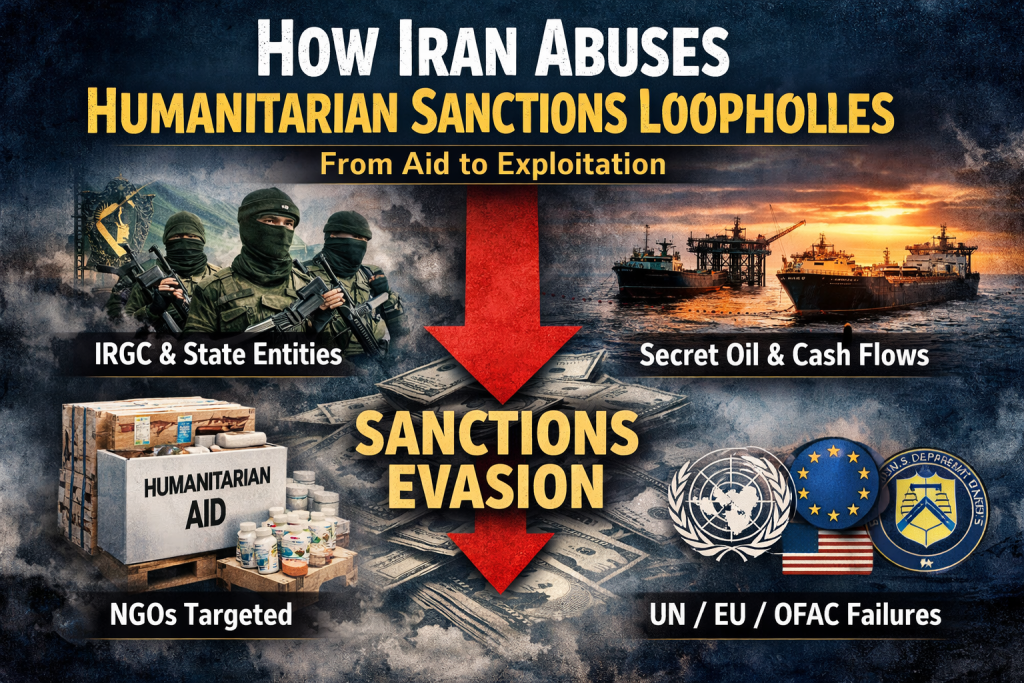
Introduction — The Humanitarian Loophole: An Unintended Escape Hatch
Iran’s humanitarian exemption sanctions abuse has become one of the most under-scrutinised vulnerabilities in the global sanctions architecture. For decades, international sanctions regimes have carved out humanitarian exemptions—allowing the export of food, medicine, and medical equipment—to protect civilian populations from collective punishment. In theory, these exemptions are a moral necessity. In practice, they have evolved into an unintended escape hatch—one that sanctioned regimes, particularly the Islamic Republic of Iran, have learned to exploit with increasing sophistication.
Sanctions were designed to restrict state capacity, not civilian survival. Yet Iran has systematically blurred this line, transforming humanitarian channels into revenue-generating mechanisms and covert trade corridors. What was meant to safeguard access to essential goods has, in multiple documented instances, been repurposed to facilitate disguised commerce, move restricted funds, launder payments, and shield illicit financial activity behind the moral shield of humanitarian need.
This exploitation does not occur in isolation. It is enabled by weak enforcement, fragmented compliance standards, and a global reluctance to scrutinise transactions labeled “humanitarian.” Food and medicine—by their very nature, politically sensitive—create a compliance blind spot. Iranian state-linked entities, front companies, and aligned intermediaries have learned to weaponize that blind spot, embedding commercial profit and sanctions evasion inside shipments and payment structures nominally protected from restriction.
The result is a dangerous paradox: humanitarian exemptions that simultaneously preserve civilian access and undermine the very sanctions designed to constrain a sanctioned state’s behavior. In Iran’s case, this paradox has material consequences. Revenues generated through humanitarian trade channels do not exist in a vacuum; they circulate through a political economy dominated by the Islamic Revolutionary Guard Corps (IRGC), state-controlled conglomerates, and parallel financial institutions. Money is fungible—even when goods are not.
This report investigates how humanitarian exemptions are allegedly abused by sanctioned Iranian entities across trade, logistics, and finance. It maps the mechanisms of misuse, identifies the compliance failures that enable them, and assesses the risks faced by governments, banks, humanitarian organizations, and multinational companies operating in good faith. Crucially, it does not argue for the removal of humanitarian access. Instead, it confronts the harder question the international community has largely avoided:
How can humanitarian trade be preserved without allowing it to become a structural vulnerability in sanctions enforcement?
By examining Iran as a central case study, this analysis exposes a broader systemic flaw—one that extends beyond any single regime. The humanitarian loophole is not merely an Iranian tactic; it is a global policy failure. And unless it is addressed with precision rather than sentiment, it will continue to erode both sanctions credibility and humanitarian integrity.
With this foundation established, the next chapter examines the legal and regulatory architecture of humanitarian exemptions—and why it is far more permissive than policymakers often admit.
Chapter 1 — The Legal Architecture of Humanitarian Exemptions
Humanitarian exemptions sit at the moral core of modern sanctions regimes. They are designed to ensure that civilians—not governments—are protected from the unintended consequences of economic pressure. Food, medicine, and basic medical equipment are therefore carved out from most sanctions frameworks, even in cases involving some of the world’s most heavily sanctioned states. In theory, these exemptions represent a safeguard for human dignity. In practice, they have become one of the most systematically abused features of global sanctions architecture—particularly in the case of the Islamic Republic of Iran.
- The Original Purpose: Civilian Protection, Not Economic Relief
Humanitarian exemptions emerged from a hard-learned lesson of the 1990s: comprehensive sanctions can devastate civilian populations while leaving political elites largely untouched. International outrage over the humanitarian toll of sanctions in Iraq led policymakers to recalibrate. Sanctions would henceforth be “smart,” “targeted,” and explicitly structured to avoid shortages of food and medicine.
As a result, most sanctions regimes—including those imposed by the United States, the European Union, and the United Nations—contain explicit language allowing:
- the export of foodstuffs and agricultural commodities,
- the sale of medicines and medical devices,
- and, in some cases, humanitarian services and technical assistance.
These exemptions are not loopholes by design. They are ethical obligations embedded in international law and humanitarian norms. But they rely on a critical assumption: that sanctioned states and their intermediaries will not deliberately manipulate civilian-focused channels for strategic or financial gain.
That assumption does not hold in Iran’s case.
- How Humanitarian Exemptions Are Structured in Practice
Legally, humanitarian exemptions operate through a combination of general licenses, case-by-case authorizations, and compliance guidance issued by regulators. For example:
- U.S. sanctions frameworks typically allow food and medicine exports under general licenses, provided that transactions avoid designated individuals, entities, and prohibited financial channels.
- EU sanctions regimes similarly permit humanitarian trade but require exporters and financial institutions to conduct due diligence on end-users and payment pathways.
- UN sanctions often include broad humanitarian carve-outs but delegate enforcement to member states, resulting in uneven implementation.
On paper, these frameworks appear robust. In reality, they are highly fragmented. Enforcement responsibility is split among customs authorities, financial regulators, export-control agencies, and private-sector compliance teams—none of which possess a complete, real-time picture of the transaction lifecycle.
This fragmentation creates precisely the kind of structural weakness that sophisticated sanctions-evasion actors thrive on.
- Iran’s Systemic Advantage: A State Built for Exploitation
Unlike accidental violators, the Islamic Republic approaches sanctions compliance as an adversarial environment. Over decades, Tehran has institutionalized evasion, embedding it into state policy, commercial networks, and intelligence operations. Humanitarian exemptions, therefore, are not treated as moral safeguards—but as operational opportunities.
Iranian state-linked entities and front companies exploit three structural features of humanitarian exemptions:
- Ambiguity of classification
Many goods fall into grey zones between humanitarian and commercial use. This allows sanctioned actors to mislabel or bundle items without triggering immediate scrutiny. - Lower compliance thresholds
Humanitarian transactions are often subject to lighter due diligence to avoid disrupting aid. This creates reduced friction—exactly what illicit actors seek. - Political sensitivity
Regulators are cautious about over-enforcement in humanitarian trade, fearing reputational damage or accusations of harming civilians. Iran leverages this hesitation.
In effect, humanitarian exemptions become a low-risk, high-reward channel for sanctioned entities seeking access to global markets and hard currency.
- The Compliance Paradox: Designed for Trust, Confronted with Deception
At the heart of the humanitarian exemption system lies a paradox: it is built on trust in environments where trust is systematically abused. Exporters are expected to verify end-use; banks are expected to screen counterparties; regulators are expected to intervene only when clear violations emerge.
But in Iran’s case, end-users are frequently obscured behind layers of shell companies, nominally private importers, and semi-state institutions. Payment flows are routed through indirect channels, often in non-dollar currencies, while documentation is crafted to appear compliant at each individual checkpoint.
No single actor in the chain sees enough to definitively halt the transaction. Collectively, the system fails—quietly, repeatedly, and at scale.
- From Safeguard to Strategic Vulnerability
The legal architecture of humanitarian exemptions was never designed to confront a regime that treats sanctions evasion as a national skillset. As long as exemptions rely on fragmented oversight, voluntary disclosure, and politically cautious enforcement, they remain vulnerable to abuse.
In the Iranian context, humanitarian exemptions do not merely soften sanctions—they actively undermine them, enabling revenue generation, trade continuity, and financial manoeuvrability under the guise of civilian protection.
Understanding this legal foundation is essential. Because what follows in the next chapters is not accidental misuse—but the predictable outcome of a system that underestimates a regime willing to weaponize humanitarian norms for strategic survival.
Chapter 2: How the Humanitarian Exemption Is Exploited — Mechanisms, Actors, and Financial Pathways
The humanitarian exemption was designed as a moral safeguard—to ensure that sanctions do not starve civilians or deny patients life-saving medicine. In practice, however, this exemption has evolved into a highly exploitable conduit for sanctioned regimes, particularly the Islamic Republic of Iran, to generate revenue, move money, and disguise illicit trade. The abuse is not incidental. It is systematic, institutionalized, and enabled by weak compliance, political caution, and fragmented oversight.
This chapter dissects how the abuse works: the mechanisms, the actors, and the financial pathways that convert humanitarian access into a parallel sanctions-evasion economy.
2.1 The Structural Vulnerability of Humanitarian Trade
Humanitarian trade is uniquely vulnerable to abuse for three reasons:
- Expedited approvals and reduced scrutiny
- Political sensitivity discourages aggressive enforcement
- Complex, cross-border logistics that obscure end-use verification
In Iran’s case, these vulnerabilities intersect with a regime that controls import licenses, distribution networks, currency allocation, and domestic resale. The result is a system where humanitarian goods become financial instruments, not merely relief supplies.
Unlike oil or metals, humanitarian goods benefit from:
- relaxed documentation standards,
- limited customs inspections,
- and moral reluctance by regulators to disrupt flows.
These conditions form the foundation of exploitation.
2.2 Import Monopolization by State-Linked Entities
Despite claims of private-sector participation, humanitarian imports into Iran are overwhelmingly controlled by state-linked actors, including:
- IRGC-affiliated holding companies
- Regime-approved importers tied to the Ministry of Health
- Foundations (bonyads) under the Supreme Leader’s office
- Front companies operating on behalf of sanctioned banks
Licenses to import food and medicine are not granted competitively. They are allocated politically. This allows sanctioned entities to:
- capture preferential exchange rates,
- control supply scarcity,
- and extract rents at multiple points in the chain.
In effect, the regime monetizes humanitarian suffering.
2.3 Currency Arbitrage: Turning Aid into Cash
One of the most profitable abuse mechanisms is currency arbitrage.
Here’s how it works:
- Humanitarian importers receive access to subsidized or special exchange rates.
- Goods are imported at artificially low cost.
- Products are sold domestically at market or inflated prices.
- The spread is captured by regime-linked intermediaries.
This differential—often massive during periods of currency volatility—has repeatedly generated hundreds of millions of dollars in off-book revenue.
In some documented cases:
- medicines were resold multiple times before reaching pharmacies,
- Food staples were diverted to black markets,
- and shortages were engineered to justify further allocations.
The humanitarian exemption becomes a state-sponsored profit engine.
2.4 Financial Channels: Non-SWIFT and Shadow Banking
Payments for humanitarian trade are often routed through:
- non-SWIFT bilateral clearing mechanisms,
- local currency settlement agreements,
- third-country correspondent banks,
- and opaque escrow structures.
While technically compliant, these systems collapse transparency.
Sanctioned Iranian banks—often under new names or via affiliates—remain deeply embedded in:
- payment processing,
- trade finance guarantees,
- and currency conversions.
This enables:
- money laundering through over-invoicing,
- round-tripping of funds,
- and cross-subsidisation of non-humanitarian activities.
Humanitarian trade thus bleeds into the broader shadow-banking ecosystem.
2.5 Trade Misinvoicing and Quantity Manipulation
Another core tactic is trade misinvoicing, including:
- overstating quantities to justify larger currency allocations,
- misclassifying goods to avoid controls,
- bundling humanitarian items with dual-use components,
- falsifying end-user documentation.
Because humanitarian shipments face reduced inspection, verification failures are endemic.
In several investigations, audits found:
- discrepancies between declared and delivered volumes,
- missing inventory records,
- and unexplained price surges downstream.
These practices allow illicit financial flows to hide in plain sight.
2.6 Distribution Capture and Internal Resale
Even when goods enter Iran legitimately, the final stage is where abuse peaks.
Distribution networks are dominated by:
- IRGC-linked logistics firms,
- regime-approved wholesalers,
- and politically protected retail chains.
This enables:
- selective distribution to loyal constituencies,
- resale to neighboring countries,
- or diversion into private stockpiles.
In some cases, humanitarian goods have been traced to regional re-export markets, generating foreign currency earnings—precisely what sanctions aim to restrict.
2.7 Plausible Deniability and the Compliance Gap
Perhaps the most dangerous feature of humanitarian abuse is plausible deniability.
International suppliers often claim:
- lack of visibility into end users,
- reliance on local partners,
- or humanitarian necessity.
Regulators, in turn, hesitate to intervene for fear of:
- political backlash,
- accusations of collective punishment,
- or humanitarian fallout.
This creates a compliance vacuum where abuse thrives—not because rules don’t exist, but because no one wants to enforce them aggressively.
2.8 The Bottom Line: A Loophole by Design
The humanitarian exemption has become an unintended escape hatch, not because of legal ambiguity, but because of political timidity and enforcement asymmetry.
In Iran’s case, abuse is:
- coordinated across ministries,
- facilitated by sanctioned financial institutions,
- and shielded by humanitarian rhetoric.
As long as humanitarian trade remains structurally opaque, the regime will continue to convert compassion into capital.
The next chapter examines sector-specific case studies, tracing how these mechanisms operate in food, pharmaceuticals, and medical equipment—where abuse is both most prevalent and most profitable.
Chapter 3: How the Humanitarian Exemption Is Exploited — Mechanisms, Actors, and Financial Pathways
Infographic showing how Iran exploits humanitarian sanctions exemptions through NGOs, front companies, and illicit financial flows.
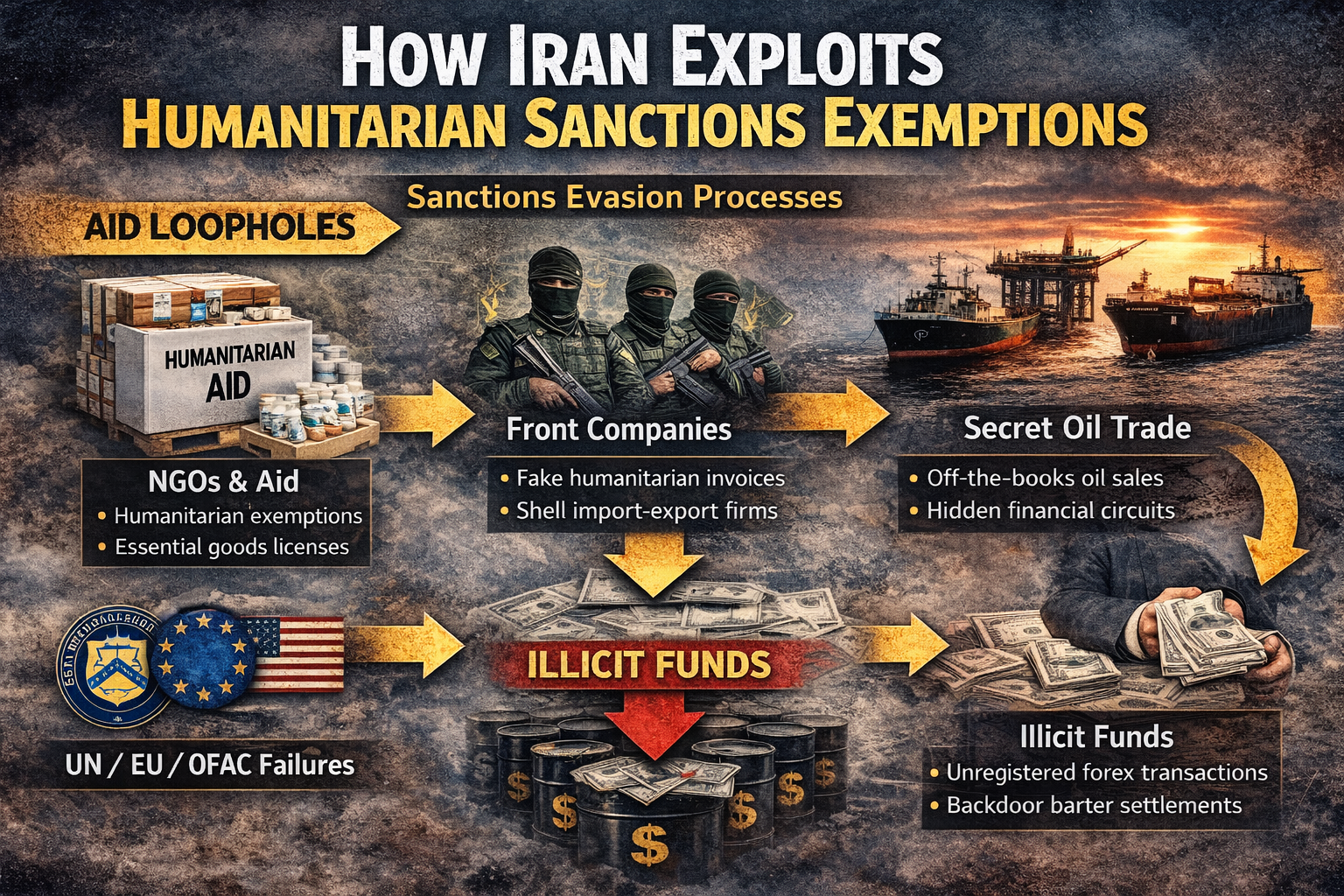
The abuse of humanitarian exemptions is not incidental or opportunistic; it is systematic. Over time, sanctioned regimes—most notably the Islamic Republic of Iran—have learned how to weaponize humanitarian carve-outs by embedding illicit activity within otherwise legitimate trade flows. This chapter dissects the how: the concrete mechanisms, institutional actors, and financial pathways that enable abuse while maintaining a veneer of compliance.
- Over-Invoicing, Under-Delivery, and the Profit Margin Hidden in Plain Sight
One of the most common tactics is trade mispricing within humanitarian shipments. Exporters invoice food or medicine at inflated prices, while delivering goods of lower quality, reduced quantity, or both. The difference—often substantial—is captured as profit by intermediaries aligned with sanctioned entities.
Key features of this model include:
- Over-invoicing of pharmaceuticals, medical devices, or staple foods.
- Substitution with generic or near-expiry products.
- Bundling of humanitarian goods with non-exempt items disguised under the same customs codes.
- Re-export of subsidized humanitarian goods into regional black markets.
Because humanitarian shipments are presumed benign, customs scrutiny is often lighter, and post-shipment verification is rare—especially when goods enter countries with weak regulatory capacity.
- State-Controlled Importers Masquerading as Civilian End-Users
In Iran, humanitarian imports are rarely handled by independent private firms. Instead, they are funneled through a dense ecosystem of state-linked importers, including:
- parastatal conglomerates,
- foundations (bonyads),
- IRGC-affiliated trading arms,
- and regime-approved distributors.
These entities present themselves as civilian end-users—hospitals, food distributors, relief organizations—while functioning as revenue-generating nodes for sanctioned institutions. In practice:
- Payment flows are routed through front companies abroad.
- Profits are siphoned into parallel budgets beyond public oversight.
- Distribution is selectively restricted, reinforcing political loyalty and social control.
The humanitarian label thus becomes a shield, not a safeguard.
- Shadow Banking and Non-Transparent Payment Channels
Although humanitarian trade is theoretically permitted, payments remain constrained by sanctions on Iranian banks. To bypass this, Iranian networks rely on non-SWIFT financial channels, including:
- hawala and informal value transfer systems,
- third-country escrow accounts,
- non-dollar local currency settlements,
- barter arrangements involving oil, metals, or petrochemicals,
- and increasingly, crypto-adjacent mechanisms masked as trade finance.
In many cases, the same intermediaries handling humanitarian payments also facilitate non-humanitarian transactions, blurring compliance boundaries. Financial institutions in permissive jurisdictions—often smaller banks seeking fee income—play a critical role by:
- failing to conduct enhanced due diligence,
- accepting vague end-use certifications,
- or deliberately fragmenting transactions to avoid detection.
The result is a fungibility problem: humanitarian payments free up other resources for prohibited activities.
- NGOs, Relief Labels, and the Problem of Delegated Trust
Humanitarian exemptions rely heavily on delegated trust—the assumption that NGOs, aid organizations, and relief channels act independently of state capture. In authoritarian systems, this assumption often fails.
In Iran:
- Domestic NGOs operate under licensing regimes controlled by security agencies.
- International NGOs face access restrictions and are often forced to partner with state-approved entities.
- Relief labels are used to legitimize logistics infrastructure that also serves sanctioned sectors.
Even when foreign donors act in good faith, control over last-mile distribution frequently rests with regime-linked actors. This enables:
- diversion of aid,
- resale at market prices,
- preferential allocation to regime constituencies,
- and data collection on recipients for surveillance purposes.
Humanitarian access, in this context, becomes another instrument of governance.
- Dual-Use Creep Within Humanitarian Supply Chains
A more subtle form of abuse involves dual-use creep—the gradual inclusion of items that are technically humanitarian but operationally sensitive. Examples include:
- advanced medical imaging equipment with industrial applications,
- chemical precursors labeled for pharmaceutical use,
- laboratory instruments adaptable for R&D,
- cold-chain logistics usable for non-civilian materials.
Once admitted under humanitarian exemptions, these items often escape downstream monitoring. Exporters rely on end-user certificates that are:
- unverifiable,
- issued by compromised authorities,
- or recycled across multiple transactions.
This creates a procurement grey zone where compliance is nominal and enforcement is absent.
- The Role of Third-Country Facilitators
No humanitarian abuse scheme operates in isolation. Third-country facilitators—often in the UAE, Turkey, Malaysia, Armenia, and parts of Europe—provide:
- corporate registration services,
- logistics coordination,
- customs brokerage,
- and financial routing.
These facilitators thrive in jurisdictions where enforcement is inconsistent and political appetite for confrontation is low. While not always ideologically aligned with Tehran, they are economically incentivised to maintain plausible deniability.
Critically, many of these actors are repeat players, appearing across unrelated cases involving oil, metals, and dual-use procurement—underscoring the integrated nature of Iran’s sanctions-evasion architecture.
- Abuse as Policy, Not Deviation
The most uncomfortable conclusion is this: humanitarian exemption abuse is not a deviation from Iranian state policy—it is an extension of it.
By design:
- humanitarian trade generates hard currency,
- alleviates domestic pressure without structural reform,
- sustains patronage networks,
- and weakens international sanctions cohesion.
The regime’s messaging frames this behavior as “resilience” and “economic resistance,” while external actors often hesitate to intervene for fear of harming civilians. This asymmetry is precisely what makes the loophole effective.
Bottom Line:
The humanitarian exemption was built on trust. Authoritarian systems exploit it through control, opacity, and financial engineering. Without structural reforms to verification, payments, and end-use monitoring, humanitarian access will continue to double as an illicit revenue stream—undermining both sanctions integrity and the very civilians the exemption was meant to protect.
The next chapter examines concrete case studies in which humanitarian channels were demonstrably abused—and the warning signs that regulators failed to act on.
Chapter 4 — The Money Behind the Mask: Financial Facilitation of Humanitarian Abuse
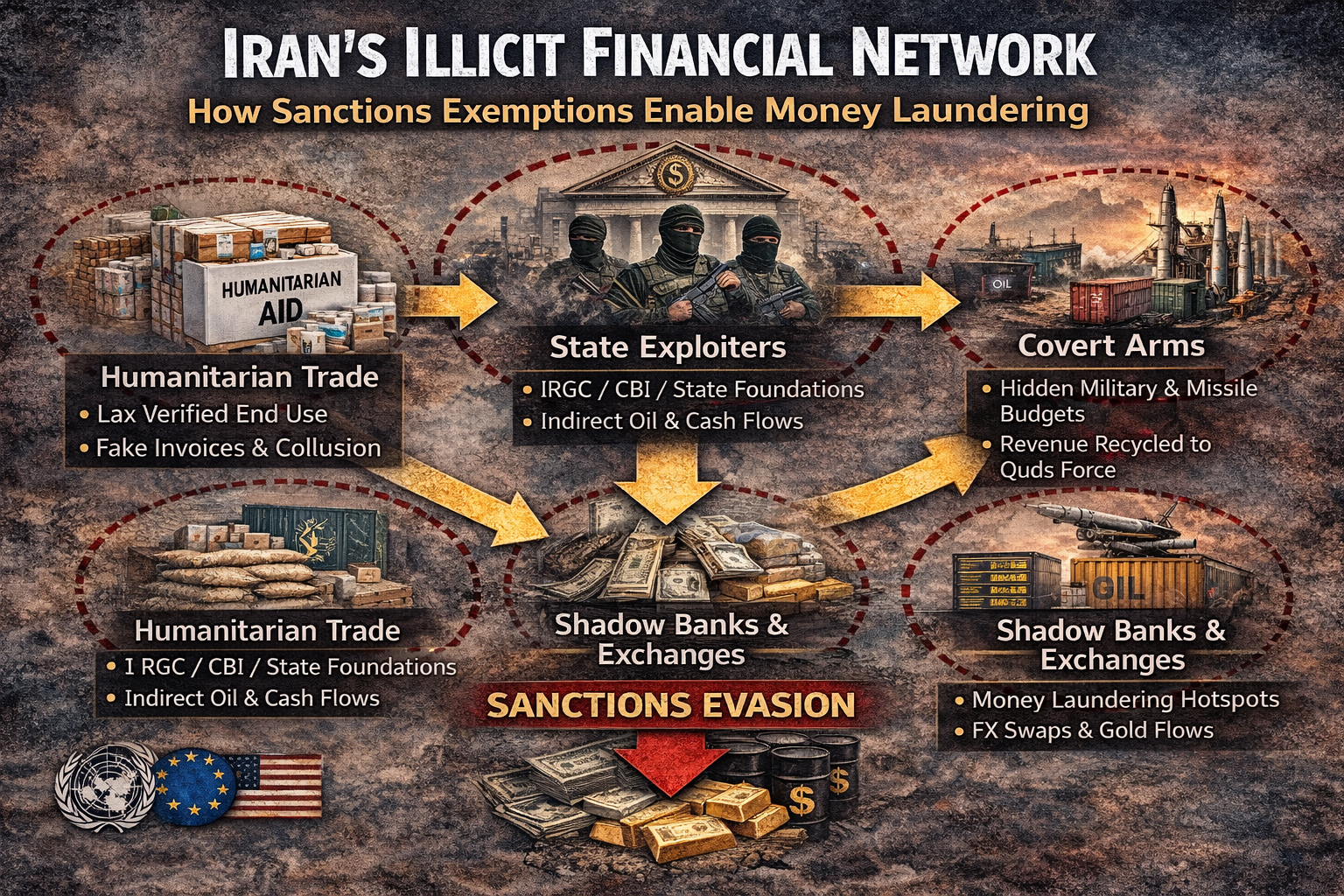
Humanitarian trade does not move on sympathy—it moves on money.
Behind every shipment of food, medicine, or medical equipment entering Iran under humanitarian exemptions lies a financial architecture carefully engineered to hide value transfer, obscure beneficiaries, and neutralise sanctions controls. The abuse of humanitarian channels is therefore not merely logistical; it is fundamentally financial.
The Islamic Republic has perfected a model in which humanitarian legitimacy becomes a financial camouflage, enabling revenue generation, sanctions evasion, and capital mobility under the cover of civilian necessity.
4.1 Payment Mechanisms Hidden in Non-Dollar Trade
One of the regime’s most effective tactics is the systematic avoidance of the U.S. dollar and Western correspondent banking channels. Instead, humanitarian transactions are increasingly settled through:
- Local currency arrangements (rial–yuan, rial–lira, rial–rupee)
- Non-convertible currency balances held abroad
- Clearing accounts managed by state-aligned banks in third countries
- Bilateral settlement frameworks are framed as “humanitarian facilitation”
These mechanisms allow Iranian entities to receive value without triggering dollar-clearing oversight, while foreign counterparties maintain plausible deniability by claiming compliance with humanitarian exemptions.
In practice, these structures enable:
- monetization of sanctioned exports through indirect offsets,
- accumulation of usable foreign currency abroad,
- cross-sector value transfers disconnected from the humanitarian shipment itself.
Humanitarian trade becomes not an exception—but a parallel financial corridor.
4.2 Shadow Banking Meets Humanitarian Trade
Formal banks are only part of the equation. Much of Iran’s humanitarian-linked finance flows through shadow banking systems operating alongside or beneath regulated institutions.
These include:
- exchange houses and money changers operating under humanitarian licenses,
- informal settlement networks tied to diaspora communities,
- state-tolerated hawala-style systems,
- non-bank financial intermediaries embedded in trade companies.
Humanitarian NGOs and suppliers often interact with these entities out of necessity, not choice—yet this interaction creates exploitable interfaces where:
- transaction tracing breaks down,
- beneficial ownership becomes opaque,
- compliance obligations are diluted.
Iran exploits these gaps deliberately, embedding regime-linked actors within ostensibly civilian financial flows.
4.3 Escrow Accounts and Offset Arrangements
Escrow mechanisms—often promoted as safeguards—have become another tool of manipulation.
Under humanitarian frameworks, payments are frequently:
- deposited into restricted escrow accounts abroad,
- earmarked for “approved humanitarian purchases,”
- overseen by third-party banks or governments.
However, enforcement is rarely airtight. Iran leverages:
- offset arrangements, where humanitarian imports are matched against unrelated exports,
- reclassification of goods post-payment,
- internal reallocations once funds clear compliance checks.
In effect, escrow accounts delay misuse—they do not prevent it. Once funds enter semi-controlled environments, Iranian entities regain operational control through layered intermediaries.
4.4 Invoicing Manipulation and Trade-Based Money Laundering
Trade-based money laundering (TBML) is the connective tissue between humanitarian abuse and sanctions evasion.
Common practices include:
- over-invoicing humanitarian imports to move excess value,
- under-invoicing parallel commercial exports,
- mismatched quantities between customs documents and actual cargo,
- dual invoices—one for regulators, one for settlement.
Because food and medicine are rarely scrutinized with the same intensity as military or industrial goods, they provide ideal cover for value distortion. The humanitarian label lowers risk tolerance across banks, insurers, and customs authorities.
The result is a laundering mechanism that converts:
humanitarian legitimacy → financial opacity → regime liquidity.
4.5 Why Financial Oversight Consistently Fails
The failure is not technological—it is structural.
Regulators assume humanitarian trade is low risk.
Banks assume exemptions equal immunity.
Humanitarian actors assume financial compliance is someone else’s responsibility.
Iran understands this collective abdication perfectly.
By fragmenting transactions across:
- multiple jurisdictions,
- non-dollar currencies,
- semi-regulated intermediaries,
- humanitarian justifications,
The regime ensures that no single actor sees the full picture.
This is not accidental. It is engineered.
4.6 The Strategic Outcome: Sanitized Illicit Finance
The ultimate achievement of Iran’s humanitarian abuse model is not smuggling—it is sanitization.
Illicit finance is:
- laundered through moral legitimacy,
- insulated by humanitarian urgency,
- protected by political sensitivity,
- normalized by repeated tolerance.
As long as humanitarian exemptions are treated as sacrosanct rather than risk-managed, they will continue to function as financial escape hatches—not just for Iran, but for any sanctioned regime sophisticated enough to weaponize compassion.
Chapter 5 — Third Parties and Intermediaries: The Invisible Architects of Humanitarian Abuse
If Iran’s humanitarian abuse model is the architecture, third parties and intermediaries are the engineers who make it function.
These actors rarely appear in official sanctions lists, rarely attract headlines, and almost never face criminal accountability—yet without them, the humanitarian loophole would collapse.
The Islamic Republic does not abuse humanitarian exemptions directly.
It outsources deniability, embedding its operations inside global supply chains that appear neutral, civilian, and commercially routine.
- Middlemen as the Regime’s Strategic Shock Absorbers
At the core of humanitarian abuse is a simple logic: distance decision-makers from consequences.
Iran achieves this by relying on:
- regional trading houses,
- nominally independent distributors,
- export agents with no visible political affiliation,
- and “logistics consultants” operating across multiple jurisdictions.
These middlemen perform three critical functions:
- They mask the Iranian end-user.
- They fragment responsibility across borders.
- They create legal ambiguity, allowing all parties to claim ignorance.
In practice, this means humanitarian goods never move from “Iran” to “exporter.”
They move through a maze of intermediaries, each one technically compliant—but collectively complicit.
- Proxy Companies and the Art of Corporate Disappearance
Iran’s sanctions playbook relies heavily on proxy companies—entities that exist primarily to absorb legal risk.
These firms are often:
- recently incorporated,
- thinly capitalized,
- registered under nominee directors,
- dissolved or rebranded once flagged.
In humanitarian trade, proxy companies typically present themselves as:
- food importers,
- pharmaceutical distributors,
- medical equipment wholesalers,
- NGO-affiliated procurement agents.
Their paperwork checks out.
Their ownership does not.
Once exposed, these companies vanish—replaced instantly by new entities with different names, jurisdictions, and bank accounts. Enforcement chases shadows while the trade continues uninterrupted.
- Freight Forwarders and Logistics Firms: Where Abuse Becomes Operational
Few actors are more critical—and more overlooked—than freight forwarders and logistics providers.
Humanitarian abuse depends on logistics firms willing to:
- accept vague cargo descriptions,
- ignore inconsistencies in documentation,
- route shipments through opaque transit hubs,
- split consignments to avoid scrutiny,
- misclassify goods at customs.
These firms operate in the grey zone:
“We don’t verify contents—only documents.”
That posture transforms logistics companies into de facto sanctions enablers, especially when operating in free-trade zones or under-resourced customs regimes.
The result:
Containers labeled “medical supplies” carrying industrial components.
Food shipments masking high-value commercial goods.
Humanitarian cargo blended seamlessly with revenue-generating trade.
- Jurisdictions That Enable Abuse Through Weak Oversight
Iran does not need global complicity—only selective permissiveness.
Humanitarian abuse thrives in jurisdictions characterized by:
- weak AML enforcement,
- limited customs capacity,
- fragmented regulatory authority,
- political incentives to preserve trade flows.
Common features include:
- underfunded customs agencies,
- reliance on self-declared cargo classifications,
- minimal beneficial ownership transparency,
- limited information sharing with sanctions authorities.
These environments don’t need to actively support Iran.
They only need to fail at asking hard questions.
- Financial Intermediaries Hiding Behind “Trade Facilitation”
Banks, exchange houses, and payment processors often claim humanitarian transactions fall outside their risk appetite—precisely because exemptions exist.
This creates a dangerous loophole:
- payments labeled as humanitarian,
- routed through non-dollar currencies,
- processed by regional banks with limited compliance capacity,
- justified under “essential goods” frameworks.
Once money flows, accountability dissolves.
The transaction becomes legally permitted, morally compromised, and strategically abused.
- Why Global Supply Chains Remain Structurally Porous
The persistence of intermediary abuse is not accidental.
It is structural.
Global supply chains are designed for:
- speed,
- efficiency,
- cost reduction,
- and plausible deniability.
They are not designed for:
- sanctions enforcement,
- political risk analysis,
- or ethical filtering.
Iran exploits this design flaw ruthlessly.
Each intermediary claims limited visibility.
Each actor passes responsibility downstream.
Each jurisdiction enforces only its narrow slice.
Collectively, they form a perfect system for abuse without accountability.
- The Consequence: Sanitized Illicit Trade
By the time humanitarian abuse reaches Iran:
- no single actor has “violated sanctions”,
- no clear criminal threshold has been crossed,
- and enforcement arrives too late to reverse the damage.
The regime gains:
- revenue,
- leverage,
- strategic goods,
- and political cover.
Meanwhile, the humanitarian system absorbs the reputational damage.
The tragedy is not just that abuse occurs—but that it is designed to appear legitimate at every step.
Chapter 6 — Compliance and Due Diligence Weaknesses
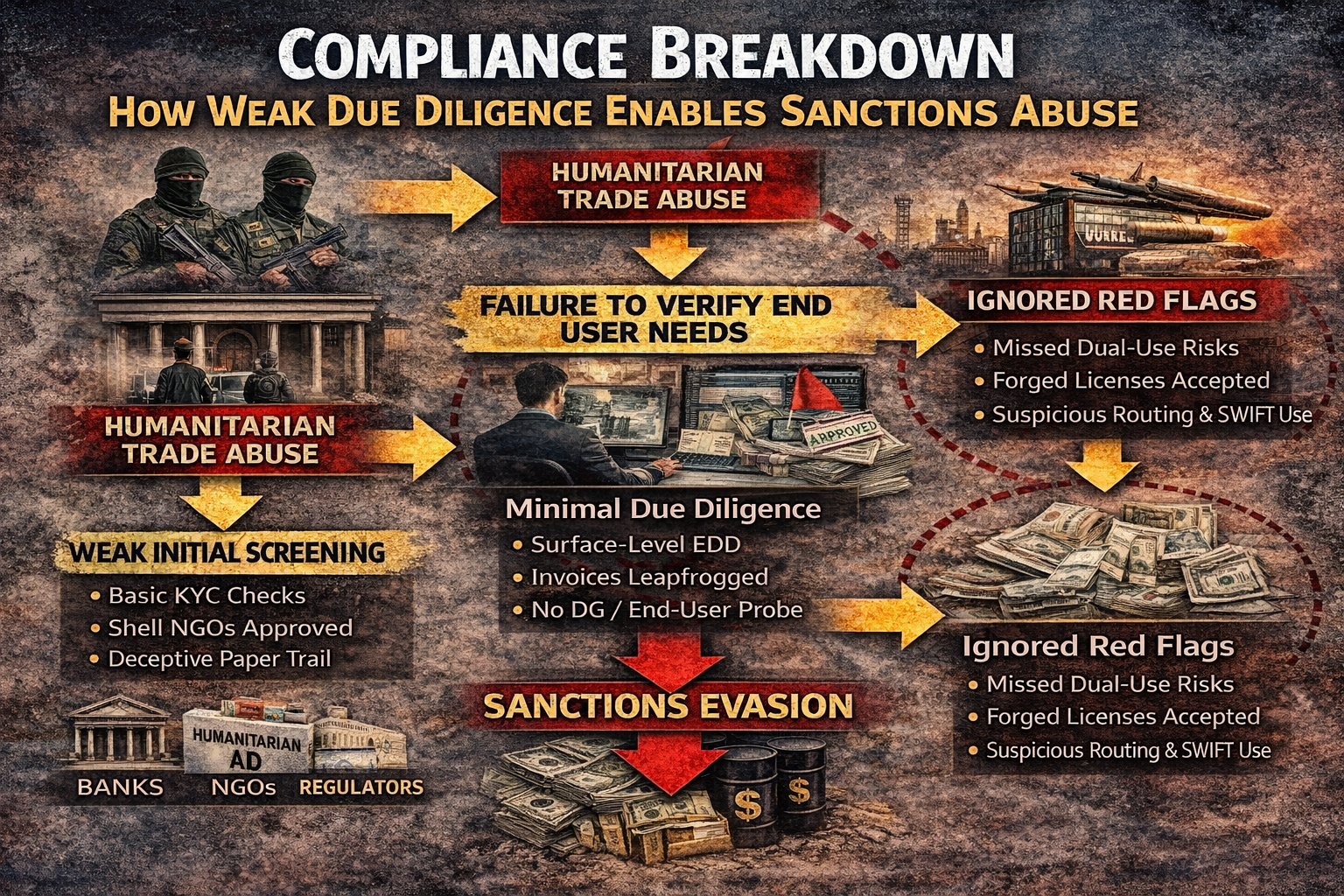
Humanitarian abuse does not succeed because sanctions frameworks are absent. It succeeds because compliance systems are structurally unfit for adversarial exploitation—and Iran has learned how to weaponize that weakness with precision.
At every stage of humanitarian trade—banking, shipping, certification, customs, and NGO facilitation—the system relies on assumptions of good faith. The Islamic Republic exploits those assumptions relentlessly.
6.1 Banks Ignoring Red Flags Behind “Plausible Humanitarian Cover”
Financial institutions operating humanitarian channels often treat “food” and “medicine” as automatic risk reducers. This is a critical flaw.
In Iran-linked transactions, repeated red flags are routinely dismissed when humanitarian exemptions are invoked, including:
- Payments routed through newly formed intermediaries with no trade history
- Repeated invoice amendments and vague product descriptions
- Counterparties linked to previously sanctioned entities via ownership chains
- Unusual payment timing inconsistent with standard humanitarian logistics
- Overreliance on local or non-convertible currencies without economic rationale
Instead of triggering enhanced due diligence (EDD), these indicators are often neutralized by a single justification: “humanitarian trade.”
This creates a compliance blind spot where sanctions risk is deliberately downgraded—not because risk is absent, but because enforcement is inconvenient.
6.2 NGOs and Humanitarian Actors as Unwitting Conduits
Many humanitarian organizations operating in or around Iran face an impossible dilemma:
maintain access or demand transparency.
The regime exploits this pressure by:
- Mandating local partners affiliated with regime-linked foundations
- Requiring logistics services controlled by IRGC-connected firms
- Enforcing customs clearance through politically protected agencies
- Restricting independent audits under “national security” pretexts
As a result, NGOs may unknowingly:
- Facilitate diversion of goods to non-civilian actors
- Enable revenue generation via resale or substitution schemes
- Provide reputational cover for transactions that would otherwise fail compliance
Importantly, this does not imply malice by humanitarian actors—but it does expose how aid access becomes leverage, not protection.
6.3 The Failure of Origin and End-Use Verification
Humanitarian exemptions rely heavily on documentation: certificates of origin, end-user statements, shipping manifests, and customs declarations.
In Iran’s case, these instruments are systematically compromised.
Common failure points include:
- End-user certificates signed by regime-controlled entities
- Verification agencies operating inside Iran with no independence
- Third-country origin laundering through free trade zones
- Product substitution after customs clearance
- Post-import diversion beyond monitoring reach
Once goods cross the border, verification effectively collapses. There is no reliable mechanism to track whether humanitarian items reach civilians—or become part of commercial, military, or political supply chains.
6.4 Weak KYC and the Recycling of Sanctioned Actors
Know-Your-Customer (KYC) frameworks were not designed to handle state-sponsored identity rotation.
Iran exploits this by:
- Constantly cycling directors and shareholders
- Using family members and low-level proxies as nominal owners
- Registering entities in jurisdictions with minimal beneficial ownership disclosure
- Exploiting inconsistencies between corporate, shipping, and banking registries
As a result, the same sanctioned networks reappear repeatedly—technically “new,” functionally identical.
Compliance systems treat them as separate risks. Iran treats them as interchangeable assets.
6.5 Why Enhanced Due Diligence (EDD) Fails in Practice
EDD is often invoked—but rarely enforced meaningfully.
In humanitarian contexts, EDD is weakened by:
- Time pressure to release aid shipments
- Political sensitivity around “blocking food and medicine”
- Fragmented data across banks, regulators, and customs agencies
- Fear of reputational backlash rather than legal exposure
The result is a dangerous equilibrium:
Everyone knows the risk exists.
Everyone assumes someone else is responsible.
No one stops the transaction.
6.6 Compliance Theater vs. Compliance Reality
What exists today is not effective enforcement—it is compliance theater.
Forms are filled.
Boxes are checked.
Statements are archived.
But the underlying reality remains untouched:
- The same networks operate.
- The same intermediaries profit.
- The same regime-linked entities extract value.
Iran does not defeat sanctions through brilliance alone—it defeats them through predictability, fatigue, and institutional reluctance.
6.7 Structural Conclusion: Humanitarian Risk Is Treated as Reputational, Not Strategic
Perhaps the most critical weakness is conceptual.
Most institutions treat humanitarian abuse as:
- a reputational issue,
- a compliance nuance,
- or a legal technicality.
Iran treats it as statecraft.
Until regulators, banks, and humanitarian actors acknowledge that humanitarian exemptions are now a primary vector for sanctions evasion, not a peripheral risk, abuse will remain systemic.
The loophole is not accidental.
It is operational.
And it is being exploited by design.
Chapter 7 — Humanitarian Actors Under Pressure
How Iran’s Abuse of Exemptions Corrupts Aid, Distorts Ethics, and Endangers Civilians
Humanitarian exemptions were designed to protect civilians—not to shield authoritarian regimes from accountability. Yet in the Iranian case, the regime’s systematic abuse of humanitarian channels has placed genuine humanitarian actors in an impossible position: operate within a poisoned system or abandon vulnerable populations altogether.
This chapter examines how the Islamic Republic’s exploitation of humanitarian trade does not merely violate sanctions—it actively undermines humanitarian ethics, compromises aid neutrality, and endangers civilian populations, while shifting risk and blame onto NGOs, relief agencies, and frontline humanitarian workers.
- Weaponizing Humanitarian Access: Aid as Political Leverage
The Islamic Republic does not view humanitarian access as a neutral necessity—it treats it as a strategic asset.
Tehran routinely uses humanitarian corridors as leverage to:
- extract political concessions,
- weaken sanctions enforcement,
- and normalize illicit financial and trade practices under the banner of “civilian protection.”
Access to food and medicine is selectively politicized. Regions, hospitals, or populations perceived as politically disloyal are deprioritized, while regime-linked institutions—often controlled by the IRGC or bonyads (parastatal foundations)—become gatekeepers of aid distribution.
In effect, humanitarian goods are absorbed into Iran’s internal patronage and control system, reinforcing regime power rather than alleviating civilian suffering.
- NGOs as Unwitting Conduits: Structural Vulnerability by Design
Most international NGOs operating in sanctioned environments rely on:
- host-state approvals,
- local banking arrangements,
- customs cooperation,
- and state-licensed distributors.
In Iran, this dependence is systematically exploited.
Humanitarian organizations face:
- mandatory partnerships with regime-approved local entities,
- restricted access to independent verification,
- opaque customs clearance processes,
- and financial channels indirectly tied to sanctioned banks or IRGC-linked intermediaries.
The result is not isolated risk—it is structural entanglement.
Even well-intentioned NGOs can unknowingly facilitate:
- trade-based money laundering,
- revenue repatriation for sanctioned entities,
- or diversion of goods into parallel commercial markets.
The regime benefits twice: it gains material advantage while outsourcing reputational and legal risk to humanitarian actors.
- Diversion of Aid: From Civilians to Regime-Controlled Networks
Multiple investigations and NGO internal audits have documented a recurring pattern in Iran:
humanitarian goods do not always reach civilians.
Instead, they are diverted to:
- regime-linked pharmacies and distributors,
- black-market resale networks,
- military-adjacent institutions,
- or barter arrangements involving non-humanitarian commodities.
Medical supplies are particularly vulnerable:
- imported under humanitarian licenses,
- stored in state-controlled warehouses,
- then selectively released or monetized.
This diversion:
- inflates prices for ordinary Iranians,
- entrenches corruption,
- and transforms aid into a revenue stream for sanctioned elites.
The humanitarian exemption becomes not a safeguard—but a subsidy.
- Ethical Collapse: Neutrality Under Authoritarian Capture
Humanitarian principles—neutrality, independence, impartiality—cannot survive when one party controls access, distribution, and finance.
In Iran:
- neutrality is coerced,
- independence is structurally impossible,
- and impartiality is subordinated to regime priorities.
NGOs are often forced to choose between:
- accepting compromised operating conditions,
- or withdrawing entirely and abandoning civilians.
This is not a moral failure of humanitarian actors—it is the result of deliberate state manipulation.
The Islamic Republic exploits the ethical restraint of NGOs, knowing that humanitarian actors will stretch compliance boundaries to avoid civilian harm—boundaries the regime has no intention of respecting.
- Legal Exposure and Reputational Risk for Humanitarian Organizations
As enforcement agencies increase scrutiny, humanitarian actors face growing legal and reputational exposure.
Key risks include:
- secondary sanctions for indirect facilitation,
- regulatory penalties for inadequate due diligence,
- donor withdrawal over compliance concerns,
- and public accusations of enabling sanctioned regimes.
Ironically, the regime responsible for the abuse bears the least risk.
Instead, NGOs become:
- legal shock absorbers,
- reputational shields,
- and compliance scapegoats.
This dynamic discourages responsible humanitarian engagement while rewarding regime obstructionism.
- The Chilling Effect: When Aid Withdrawal Becomes the Only Safe Option
Faced with escalating risk, many humanitarian organizations quietly reduce operations, limit scope, or exit Iran entirely.
The consequences are severe:
- reduced medical supply availability,
- increased dependence on regime-controlled channels,
- and greater civilian vulnerability.
The Islamic Republic then weaponizes this outcome—blaming sanctions and “Western cruelty” for shortages it actively engineered.
This creates a vicious cycle:
regime abuse → humanitarian withdrawal → civilian suffering → propaganda exploitation.
- The Core Reality: Abuse Thrives Because Accountability Is Asymmetric
At the heart of this problem lies a fundamental asymmetry:
- humanitarian actors are accountable,
- regulators are fragmented,
- and the regime faces minimal consequences.
Iran understands this imbalance and exploits it relentlessly.
Humanitarian exemptions remain porous not because they are poorly designed—but because authoritarian regimes are allowed to operate inside them with impunity.
Until this imbalance is addressed, humanitarian actors will remain trapped between ethical duty and systemic exploitation.
Chapter 8 — Political Protection and Systemic Tolerance
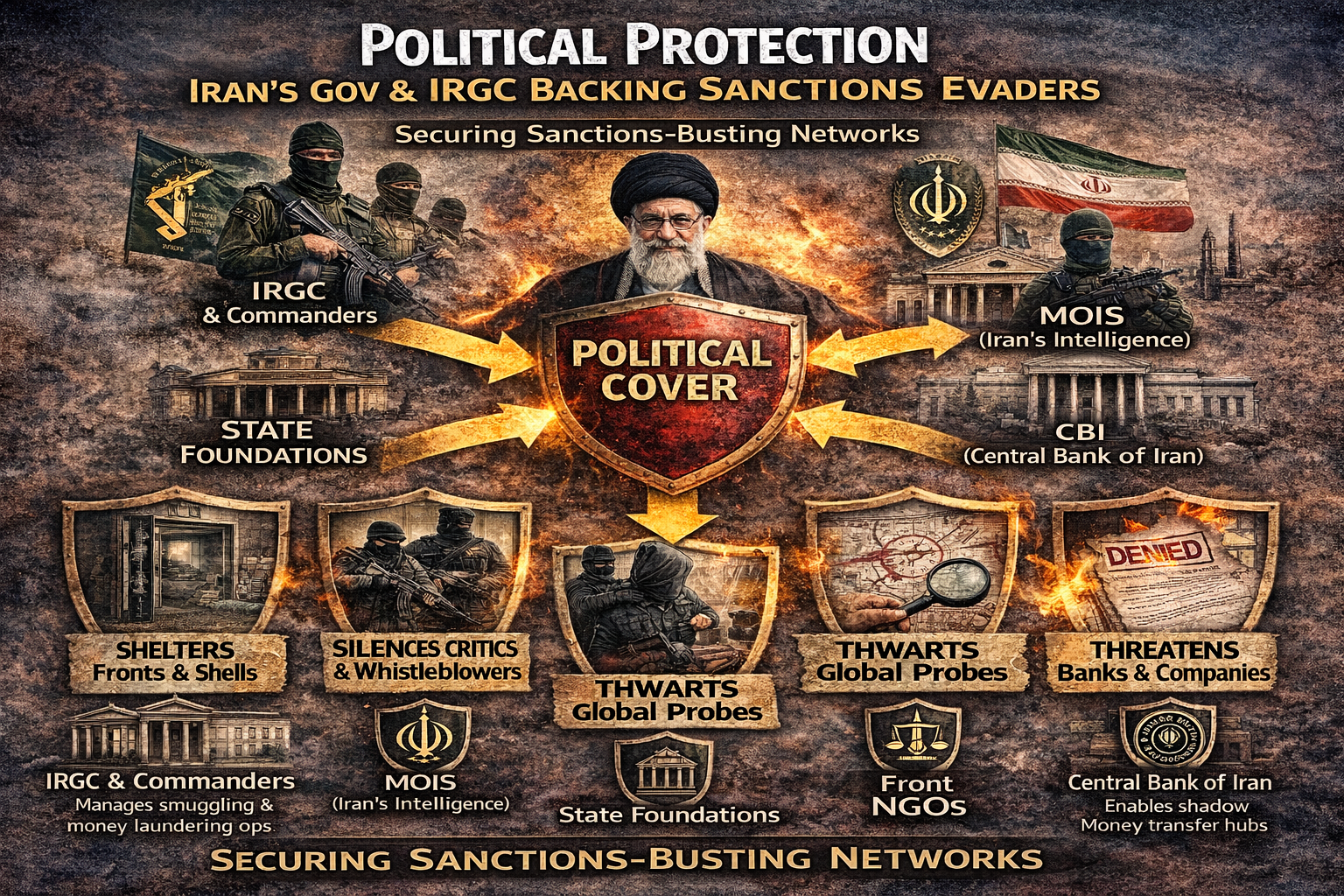
Why Humanitarian Abuse Persists: Power, Profit, and Willful Blindness
Humanitarian loophole abuse does not survive on technical weaknesses alone. It endures because it is politically protected, economically tolerated, and diplomatically convenient. In the Iranian case, the misuse of humanitarian exemptions is not merely a compliance failure—it is the product of a global ecosystem where accountability is routinely subordinated to geopolitical calculus, commercial interest, and institutional risk aversion.
At the center of this ecosystem stands the Islamic Republic, a regime that has learned how to convert moral protection mechanisms into strategic economic assets.
- Abuse Is Not Hidden — It Is Tolerated
The continued exploitation of humanitarian channels by Iran is not the result of insufficient information. It persists despite:
- repeated OFAC enforcement actions,
- UN Panel of Experts reports,
- investigative journalism by Reuters, OCCRP, and the Financial Times,
- NGO warnings about diversion and misuse,
- and internal compliance alerts within major banks and logistics firms.
The evidence exists. The patterns are known.
What is missing is political will.
Governments and regulators are often reluctant to act decisively because humanitarian trade provides the perfect shield: any aggressive enforcement action can be reframed as “blocking food and medicine.” Tehran understands this dynamic and exploits it relentlessly.
- Diplomatic Blackmail: Weaponizing Civilian Suffering
Iran has perfected a strategy of diplomatic blackmail centered on humanitarian optics. Whenever enforcement pressure increases, the regime responds with a predictable script:
- claims of medicine shortages,
- accusations of “economic warfare,”
- state-orchestrated media campaigns blaming sanctions for civilian suffering,
- and pressure on NGOs to lobby Western governments.
This narrative deliberately obscures the reality that:
- humanitarian exemptions already exist,
- legal trade channels remain open,
- and shortages are often the result of domestic mismanagement, corruption, or deliberate diversion.
By framing enforcement as cruelty, the regime forces regulators into a defensive posture—one where restraint is politically safer than accountability.
- Countries That Look Away — Because It’s Convenient
Iran’s abuse of humanitarian exemptions is sustained by a constellation of states that benefit from ambiguity. These include:
- countries seeking cheap Iranian commodities,
- governments pursuing de-dollarization agendas,
- jurisdictions positioning themselves as “neutral humanitarian corridors,”
- and states that prioritize geopolitical leverage over compliance integrity.
In these environments:
- customs enforcement is selective,
- AML scrutiny is diluted under “humanitarian urgency,”
- and suspicious transactions are reframed as politically sensitive rather than legally problematic.
This is not neutrality. It is strategic tolerance.
- Regulators Trapped by Their Own Narratives
Western regulators face an uncomfortable paradox:
They helped design humanitarian exemptions as moral safeguards—yet now struggle to admit that these safeguards have become structural vulnerabilities.
As a result:
- enforcement agencies hesitate to escalate,
- penalties are delayed or reduced,
- and systemic abuse is treated as isolated misconduct.
In multiple cases, enforcement actions targeting humanitarian-linked abuse occurred only after years of documented red flags—by which point the financial damage and diversion had already occurred.
The cost of this delay is not theoretical. It is measured in:
- diverted resources,
- strengthened sanctioned entities,
- and prolonged survival of illicit networks.
- Iran’s Diplomatic Engineering of Loophole Protection
Tehran does not passively benefit from humanitarian exemptions—it actively engineers their protection.
This includes:
- embedding humanitarian trade within bilateral diplomacy,
- negotiating local-currency or barter arrangements under humanitarian pretexts,
- leveraging international organizations to normalize certain trade corridors,
- and cultivating intermediaries who present themselves as “humanitarian facilitators.”
Once embedded, these channels become politically untouchable. Any attempt to scrutinize them risks diplomatic friction, public backlash, or accusations of collective punishment.
This is not accidental exploitation.
It is statecraft.
- When Humanitarianism Becomes Political Cover
Perhaps the most corrosive consequence of systemic tolerance is reputational laundering. When illicit actors operate behind humanitarian façades:
- sanctions lose credibility,
- NGOs lose trust,
- compliance frameworks lose authority,
- and genuine aid delivery becomes harder—not easier.
The Islamic Republic benefits twice:
- financially, through illicit trade and revenue generation;
- politically, by eroding confidence in sanctions themselves.
The result is a perverse equilibrium where everyone acknowledges abuse, but no one wants to confront it fully.
- The Real Cost of Tolerance
Systemic tolerance does not preserve humanitarian access—it undermines it.
By allowing abuse to persist:
- legitimate humanitarian actors face increased scrutiny and delays,
- banks exit humanitarian corridors entirely due to reputational risk,
- and civilians ultimately suffer from reduced access, not increased protection.
Iran’s exploitation of humanitarian exemptions thus produces the very harm it publicly claims to oppose.
- Bottom Line: Abuse Persists Because It Is Politically Useful
Humanitarian loophole abuse continues not because it is invisible, but because it is useful—to sanctioned regimes, to intermediaries, to risk-averse regulators, and to governments balancing morality against convenience.
Iran is not an outlier.
It is the clearest example of what happens when humanitarian policy is divorced from enforcement reality.
And until that gap is closed, humanitarian exemptions will remain what Tehran has turned them into:
not safeguards for civilians—but shields for sanctioned power.
Chapter 9 — Enforcement Gaps and Regulatory Failures
If humanitarian loophole abuse persists year after year, it is not because regulators lack information. It persists because enforcement systems are fragmented, politically constrained, and structurally unprepared to confront a regime that treats sanctions evasion as statecraft. Iran’s exploitation of humanitarian exemptions is not merely a compliance failure—it is the predictable outcome of weak coordination, delayed action, and selective enforcement across global regulatory bodies.
This chapter examines where enforcement fails, why it fails, and how Iran systematically exploits those failures.
- Fragmented Sanctions Enforcement: A System Designed to Miss the Big Picture
Sanctions enforcement is divided across multiple institutions that rarely operate as a unified system:
- Customs authorities focus on physical goods
• Financial regulators monitor payments
• Banks conduct transaction screening
• Export-control agencies assess licensing
• NGOs handle humanitarian delivery
Each actor sees only a fragment of the transaction.
Iran exploits this fragmentation ruthlessly.
A shipment labeled as “medical supplies” may pass customs without scrutiny, while its financing—structured through local currency settlements or shadow banks—never triggers financial alarms. No single authority connects the dots between cargo, counterparties, payment routing, and end-use.
This siloed enforcement model creates institutional blind spots—and Iran lives inside those blind spots.
- Delayed Enforcement: Action Comes After the Damage Is Done
One of the most consistent patterns in sanctions enforcement involving Iran is a chronically delayed response.
By the time:
• a shell company is designated,
• a shipping network is exposed,
• or a front distributor is sanctioned,
The transaction has already cleared, revenue has already been repatriated, and the network has already been replaced.
Investigations by Reuters and OCCRP repeatedly show that Iranian-linked humanitarian trade schemes often operate for years before enforcement occurs—and even then, consequences are limited to paper penalties rather than operational disruption.
Iran does not fear enforcement.
It prices enforcement delay into its business model.
- Weak Data Sharing Between Customs, Banks, and Regulators
In theory, modern sanctions enforcement depends on real-time data sharing. In practice, data remains fragmented across jurisdictions and agencies.
Common failures include:
• Customs authorities not sharing shipment data with banks
• Banks lacking access to shipping manifests or end-use declarations
• NGOs operating without visibility into payment intermediaries
• Regulators are unable to cross-reference trade data with financial flows
This disconnection allows Iran to run parallel trade and payment tracks—one visible, one hidden.
For example:
• Humanitarian goods are cleared legally
• Payments are settled through unrelated trade offsets
• Revenue is captured outside the humanitarian channel
• Compliance reviews see nothing abnormal in isolation
Iran succeeds not by hiding transactions—but by splitting them across institutional boundaries.
- Case Study: Enforcement Too Late to Matter
Multiple enforcement actions illustrate the problem:
- Iranian-linked distributors sanctioned years after operating openly in Europe
• UAE-based logistics firms facilitating “medical shipments” long after red flags were raised
• Banks fined modestly for processing humanitarian payments tied to sanctioned entities—without criminal accountability
In nearly every case, enforcement arrives after the strategic objective has already been achieved.
This creates a perverse incentive structure:
Iran profits first.
Regulators respond later.
No meaningful deterrence occurs.
- Political Constraints and Selective Enforcement
Sanctions enforcement is not purely technical—it is political.
Governments often hesitate to:
• disrupt humanitarian supply chains publicly
• confront NGOs operating in sensitive regions
• challenge powerful trading partners
• expose regulatory failures
Iran understands this hesitation and exploits it by embedding illicit activity inside politically protected humanitarian narratives.
The regime knows regulators fear accusations of:
• “blocking medicine”
• “punishing civilians”
• “weaponizing aid”
So Iran positions itself as the victim, while systematically abusing the system behind the scenes.
- Compliance Theatre: The Illusion of Control
Many enforcement systems function as compliance theater:
• rules exist on paper
• reporting requirements are met
• Audits are conducted
• forms are filed
Yet substance is ignored.
Iran’s networks comply just enough to avoid scrutiny—while violating the spirit, intent, and security logic of sanctions regimes. The result is a system that looks rigorous but performs poorly under adversarial pressure.
- The Structural Truth: Enforcement Is Not Designed for Hostile State Actors
Most sanctions enforcement frameworks were designed to deter:
• commercial opportunism
• isolated violations
• profit-driven misconduct
They were not designed to confront a state that weaponizes trade, finance, and humanitarian law simultaneously.
Iran is not cheating the system.
It is playing a different game entirely.
Until enforcement frameworks adapt to this reality, Iran will continue to operate ahead of regulators, ahead of enforcement, and inside the gaps of global governance.
Key Takeaway
The humanitarian loophole does not survive because enforcement is absent.
It survives because enforcement is slow, fragmented, politically constrained, and structurally misaligned with the threat.
Iran exploits this not as an exception, but as a strategy.
Chapter 10 — Lessons from Other Sanctions Regimes
What Iran’s Abuse of Humanitarian Exemptions Reveals About a Global Systemic Failure
Iran is not unique in exploiting humanitarian exemptions—but it is the most systematic, institutionalized, and strategically disciplined actor to do so. Examining comparable sanctions regimes reveals a sobering truth: the loophole Iran weaponizes is not an accident of Iranian ingenuity; it is a structural weakness embedded in global sanctions design.
By comparing Iran’s behavior with other sanctioned states—North Korea, Syria, and Venezuela—we can isolate what makes Iran’s abuse especially dangerous, scalable, and difficult to dismantle.
North Korea: Centralized Illicit Control, Limited Commercial Scale
North Korea has long abused humanitarian channels, particularly for food and medical aid. However, its model differs fundamentally from Iran’s.
Key characteristics of North Korea’s abuse:
- Aid diversion to military elites and party cadres
- Resale of humanitarian goods on domestic black markets
- Use of foreign NGOs as logistical shields
- Currency generation via aid monetisation
Yet North Korea’s system is highly centralized and economically primitive. It lacks:
- deep integration into global supply chains,
- diversified intermediary networks,
- advanced trade-based money laundering infrastructure.
Most importantly, North Korea does not control a diversified export economy capable of masking illicit trade behind humanitarian flows.
Lesson:
North Korea exploits humanitarian aid opportunistically. Iran exploits it strategically and industrially.
Syria: Fragmented Abuse, War-Driven Diversion
Syria’s sanctions-evasion behavior during the civil war involved:
- diversion of food and medicine by regime-linked militias,
- manipulation of UN aid convoys,
- collusion between regime actors and humanitarian contractors.
However, Syrian abuse was:
- conflict-driven, not systemic,
- dependent on territorial control,
- exposed through physical diversion rather than financial sophistication.
Syria lacked the institutional continuity to build durable global trade mechanisms. Its abuse relied on local coercion, not global finance engineering.
Lesson:
Syria weaponized humanitarian access tactically. Iran operationalized it as state policy.
Venezuela: Oil-for-Aid and Political Rent-Seeking
Venezuela provides a closer parallel—especially in:
- oil-for-food style barter schemes,
- humanitarian imports tied to regime survival,
- corruption embedded in aid distribution.
Yet Venezuela’s system remains:
- economically fragile,
- dependent on external patrons,
- constrained by collapsing infrastructure.
Iran, by contrast, maintains:
- resilient export industries,
- disciplined procurement agencies,
- a parallel financial architecture designed for sanctions survival.
Lesson:
Venezuela’s abuse is extractive. Iran’s abuse is strategic, repeatable, and exportable.
What Makes Iran Different: Institutionalization of Abuse
Iran’s exploitation of humanitarian exemptions stands apart due to five defining features:
- Bureaucratic Normalization
Humanitarian abuse is not rogue behavior—it is embedded in Iranian ministries, banks, and trade entities.
- Legal Engineering
Iran structures transactions to remain technically compliant while functionally illicit, exploiting:
- vague definitions of “humanitarian goods,”
- jurisdictional fragmentation,
- enforcement asymmetries.
- Financial Sophistication
Iran integrates:
- shadow banking,
- non-dollar trade,
- trade-based money laundering,
- offset arrangements,
directly into humanitarian trade flows.
- Political Shielding
Diplomatic pressure, geopolitical bargaining, and humanitarian blackmail protect Iran’s access to exemptions.
- Global Intermediary Reliance
Unlike isolated regimes, Iran operates inside global commerce, not outside it.
The Broader Systemic Failure
Across all regimes, one pattern is consistent:
Humanitarian exemptions were designed for trust-based access in a low-adversarial environment.
They were never engineered for sustained abuse by hostile, adaptive states.
Key global failures include:
- lack of real-time trade transparency,
- siloed enforcement authorities,
- absence of beneficiary verification,
- political reluctance to restrict “humanitarian space.”
Iran did not break the system.
It used it exactly as designed—against its creators.
The Iran Case as a Global Warning
Iran demonstrates what happens when:
- exemptions lack enforcement teeth,
- humanitarian actors are shielded from scrutiny,
- Financial channels operate without integrated oversight.
This is no longer an Iran problem.
It is a sanctions architecture problem.
And unless the humanitarian exemption framework is redesigned—not merely patched—the same abuse will be replicated by:
- future sanctioned states,
- hybrid authoritarian regimes,
- non-state actors operating under humanitarian cover.
Chapter 11 — Policy Recommendations: Closing the Humanitarian Loophole Without Strangling Aid
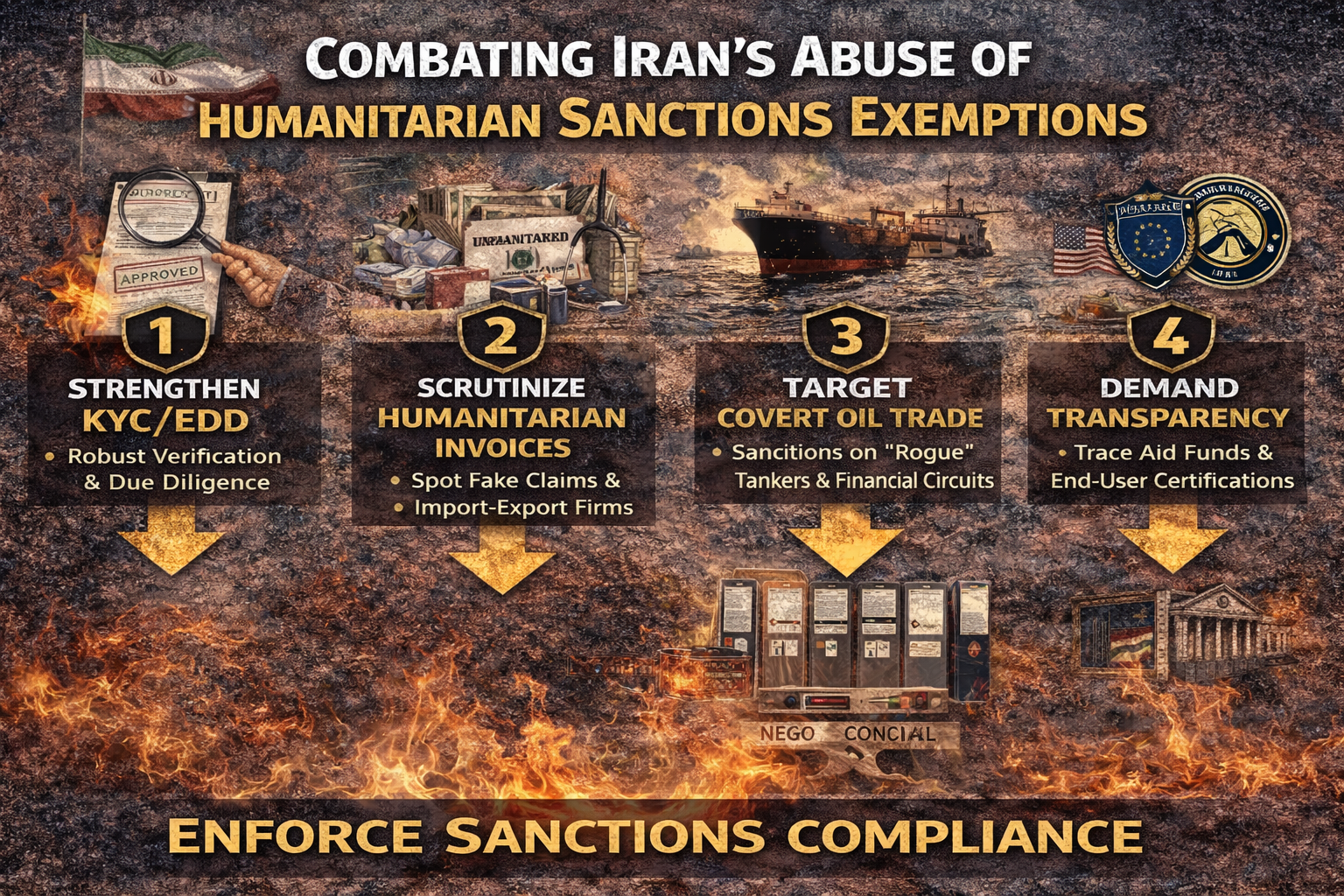
The abuse of humanitarian exemptions by the Islamic Republic of Iran is not the result of a single regulatory failure. It is the cumulative outcome of fragmented enforcement, outdated compliance assumptions, political hesitation, and a persistent underestimation of how aggressively sanctioned regimes weaponize legal grey zones.
This chapter moves beyond diagnosis. It lays out concrete, actionable policy reforms aimed at governments, regulators, financial institutions, NGOs, and multinational suppliers—reforms designed to preserve genuine humanitarian access while dismantling the financial and logistical scaffolding Iran exploits.
The objective is not to restrict aid.
The objective is to stop Tehran from turning food and medicine into instruments of regime survival and revenue generation.
- Tightening Documentation and Provenance Verification
At the heart of humanitarian abuse lies a simple failure: insufficient verification of origin, end-use, and end-user.
Current documentation requirements—certificates of origin, shipping manifests, and end-user declarations—are often treated as formalities rather than enforcement tools. Iran’s procurement networks exploit this weakness systematically.
Recommended actions:
- Mandatory multi-layered provenance verification for all humanitarian shipments into sanctioned jurisdictions
- Independent verification of manufacturers, not just exporters or distributors
- Requirement that end-users be verified entities (hospitals, clinics, NGOs) with physical inspection capabilities
- Elimination of self-certified end-user declarations in high-risk jurisdictions
For Iran specifically, no humanitarian shipment should rely solely on Iranian-provided documentation—a regime with a proven record of falsification cannot be treated as a good-faith counterparty.
- Unified Global Compliance Databases
One of the Islamic Republic’s greatest advantages is institutional fragmentation among regulators.
Customs authorities, banks, export-control agencies, and sanctions offices often operate in parallel silos, allowing Iranian intermediaries to exploit gaps between datasets.
Policy reform must focus on integration:
- Creation of shared, real-time compliance databases linking customs data, sanctions lists, shipping registries, and financial intelligence
- Mandatory reporting of humanitarian shipments into sanctioned states to centralized oversight bodies
- Integration of adverse media, enforcement actions, and NGO diversion reports into compliance systems
Without a unified data architecture, Iran will continue to exploit the fact that what is visible to one regulator remains invisible to another.
- Mandatory Supply Chain Transparency
Humanitarian trade cannot remain opaque in high-risk contexts.
Iran’s abuse thrives on complex, layered supply chains involving proxy companies, re-export hubs, and freight forwarders operating across permissive jurisdictions.
Key reforms:
- Full disclosure of the entire supply chain—from manufacturer to final delivery
- Identification of all intermediaries, subcontractors, and logistics providers
- Disclosure of ultimate beneficial ownership (UBO) for all corporate participants
- Mandatory disclosure of re-routing, transhipment, or consolidation points
Supply chains that cannot be fully disclosed should not qualify for humanitarian exemptions. Transparency is not a burden—it is the price of legitimacy.
- Real-Time Customs and Payment Monitoring
Iran’s exploitation of humanitarian exemptions relies heavily on time lags—the delay between shipment, payment, inspection, and enforcement.
To counter this, regulators must move toward real-time monitoring mechanisms:
- Live tracking of humanitarian shipments using tamper-resistant GPS and digital seals
- Real-time payment monitoring for transactions tied to exempted goods
- Automated alerts for inconsistencies between declared goods, shipment weight, routing, and payment values
- Post-delivery audits are tied directly to future licensing eligibility
If a shipment is humanitarian, there is no legitimate reason for opacity or delayed disclosure.
- Humanitarian Trade Registries with Audit Trails
One of the most effective reforms would be the creation of humanitarian trade registries—centralized platforms where all exempt transactions are logged, monitored, and audited.
Such registries should include:
- Shipment details
- Payment structures
- Beneficiary institutions
- Delivery confirmation
- Post-delivery usage reports
For Iran, registry participation should be mandatory, not voluntary.
Failure to comply should result in automatic suspension of exemption privileges.
This creates a clear trade-off: access in exchange for transparency.
- Stronger Penalties for Misclassification and Abuse
Currently, the penalties for humanitarian abuse are often insufficient to deter misconduct—especially for intermediaries earning outsized profits.
Policy upgrades must include:
- Escalated civil and criminal penalties for misclassification of goods
- Automatic blacklisting of intermediaries involved in diversion
- Secondary sanctions on foreign facilitators knowingly enabling abuse
- Public naming of entities abusing humanitarian exemptions
As long as the profits outweigh the risks, Iran’s networks will continue to operate. Deterrence must be real, visible, and financially painful.
- Redefining Risk: Treating Iran as a High-Abuse Jurisdiction
A fundamental shift is required in how Iran is treated within sanctions frameworks.
The Islamic Republic should no longer be assessed under generic humanitarian-risk models. Its documented history of abuse warrants a distinct, elevated risk classification.
This means:
- Presumption of heightened scrutiny for all humanitarian trade
- Automatic enhanced due diligence (EDD)
- Narrower exemption scopes
- Shorter licensing validity periods
- Mandatory third-party audits
Iran has earned this status—not through allegation, but through repeated, documented misconduct.
- Protecting NGOs Without Shielding the Regime
Humanitarian organizations must be protected—but not weaponized.
NGOs operating in Iran face coercion, access threats, and regulatory manipulation. Policy must:
- Provide NGOs with compliance support and safe reporting mechanisms
- Protect whistleblowers exposing diversion or pressure
- Penalize regimes that coerce NGOs into complicity
- Create exit mechanisms for NGOs unable to operate ethically
Humanitarian access cannot come at the cost of becoming a logistics arm of the sanctioned state.
- Political Will: The Missing Ingredient
None of these reforms will succeed without political resolve.
Iran’s abuse persists because:
- Enforcement is politically inconvenient
- Energy markets distort regulatory courage
- Humanitarian narratives are exploited to deflect scrutiny
- Diplomacy is prioritized over accountability
The reality is uncomfortable but unavoidable:
Every tolerated abuse strengthens the regime financially, politically, and strategically.
- The Core Principle Going Forward
Humanitarian exemptions must operate under a new governing principle:
Access is a privilege conditioned on transparency, not a right exploited through deception.
Iran has demonstrated—repeatedly—that it views humanitarian exemptions not as safeguards for civilians, but as tools of regime resilience.
Until policy frameworks reflect that reality, the humanitarian loophole will remain exactly what Tehran needs it to be:
A legal escape hatch from economic pressure—paid for in food, medicine, and human suffering.
Chapter 12 — Building a Sanctions Framework That Preserves Aid but Prevents Abuse
For decades, sanctions architects have framed humanitarian exemptions as a moral necessity—a legal safeguard to ensure civilians are not punished for the crimes of authoritarian regimes. In theory, this logic is sound. In practice, however, Iran’s systematic exploitation of humanitarian channels has exposed a structural failure at the heart of global sanctions design.
The problem is no longer whether humanitarian exemptions can be abused. Iran has conclusively proven that it can—and will be—weaponized. The real challenge now is designing a sanctions framework that preserves genuine humanitarian access without allowing sanctioned regimes to convert moral exceptions into financial infrastructure.
This chapter lays out how such a framework can—and must—be built.
- The False Binary: Aid vs. Enforcement
One of the most damaging myths in sanctions policy is the idea that policymakers must choose between:
- protecting humanitarian access, or
- enforcing sanctions effectively.
This false binary has been actively exploited by Tehran.
Iranian officials, state media, and diplomatic proxies consistently frame any tightening of humanitarian oversight as “collective punishment” or “economic warfare against civilians.” Western regulators—fearful of political backlash, NGO pressure, or reputational harm—often respond by loosening controls rather than refining them.
The result is a compliance environment where:
- humanitarian intent is presumed, not verified,
- financial opacity is tolerated, not interrogated,
- and risk-based enforcement is replaced with political caution.
Iran thrives in precisely this grey zone.
A functional sanctions framework must reject this binary entirely. Humanitarian access and enforcement are not opposites—they are interdependent. Without enforcement, humanitarian channels become revenue streams for sanctioned elites. Without humanitarian access, sanctions lose legitimacy.
- Risk-Based Humanitarian Trade: Moving Beyond Blanket Exemptions
Current sanctions regimes rely heavily on categorical exemptions:
- Food is allowed,
- medicine is allowed,
- Medical equipment is allowed.
What is missing is contextual risk assessment.
Iran has demonstrated that:
- identical goods pose radically different risks depending on who imports them, who finances them, and where proceeds ultimately flow.
- a shipment of insulin handled by an independent NGO is not equivalent to one routed through a state-affiliated distributor tied to the IRGC.
A modern framework must therefore shift from goods-based exemptions to actor-based and transaction-based risk models, incorporating:
- ownership transparency of importers,
- links to sanctioned entities or state foundations,
- historical diversion or misclassification patterns,
- jurisdictional risk of intermediaries and banks involved.
Humanitarian trade should not be banned—but it must be scored, monitored, and conditioned.
- Centralized Transparency Systems: Ending Fragmentation
One of Iran’s greatest advantages is fragmentation.
Today:
- Customs authorities operate separately from banks,
- banks operate separately from export-control agencies,
- NGOs operate with minimal visibility into financial enforcement data,
- Regulators across jurisdictions rarely share real-time intelligence.
Iran exploits these silos with precision.
A reformed framework must include centralized humanitarian trade registries, ideally coordinated through multilateral bodies such as:
- the UN,
- FATF-aligned mechanisms,
- or IMF-linked financial transparency platforms.
Such registries should include:
- registered humanitarian traders and NGOs,
- approved banking corridors,
- verified suppliers and manufacturers,
- real-time shipment tracking,
- auditable payment flows.
This is not surveillance—it is accountability.
Without shared visibility, sanctions enforcement will always trail abuse rather than prevent it.
- Smart Sanctions vs. Blunt Exemptions
Iran’s case illustrates why blunt exemptions fail.
By contrast, smart sanctions—when properly implemented—can:
- allow aid while isolating regime-linked actors,
- protect NGOs while excluding state-controlled distributors,
- preserve civilian access without financing repression.
Smart sanctions require:
- granular designation updates,
- continuous mapping of front companies,
- dynamic compliance guidance for banks and exporters,
- and rapid response mechanisms when abuse is detected.
This approach demands more work from regulators—but far less damage than the status quo, where exemptions function as permanent blind spots.
- The Role of Global Financial Institutions
International banks and insurers often claim that humanitarian trade is “too sensitive” to be scrutinised aggressively. In reality, this reluctance has less to do with ethics and more to do with risk avoidance and profit protection.
Iran benefits from:
- banks that process humanitarian payments without enhanced due diligence,
- insurers that cover shipments without end-use verification,
- correspondent banks that rely on paperwork rather than behavioral analysis.
A credible framework must impose mandatory enhanced due diligence (EDD) for humanitarian transactions involving sanctioned jurisdictions—no exceptions, no discretion.
Humanitarian labeling must trigger more scrutiny, not less.
- Iran as a Warning, Not an Exception
It would be a mistake to treat Iran’s abuses as unique.
What Iran has built is a proof of concept:
- that moral exemptions can be monetised,
- that compliance fatigue can be exploited,
- and that political hesitation can be weaponized.
If left unaddressed, the same model will continue to spread across regimes, sectors, and conflicts.
Iran is not the anomaly.
It is the stress test.
- From Moral Intent to Structural Integrity
Humanitarian exemptions were designed to protect civilians.
Iran has turned them into a financial architecture of abuse.
Restoring credibility to sanctions does not require abandoning humanitarian principles—it requires embedding them within enforceable systems.
Aid without oversight is not compassion.
It is complicity.
The task ahead is not philosophical. It is structural.
And the cost of failure is no longer theoretical—it is already measurable in cash flows, diverted goods, and prolonged repression.
Chapter 13 — Emerging Risks and the Next Phase of Humanitarian Abuse
How Iran Is Adapting Faster Than Regulators
One of the most dangerous assumptions in current sanctions policy is that humanitarian abuse is a static problem—one that can be addressed by tightening existing controls or issuing clearer guidance. Iran’s behavior demonstrates the opposite. The regime does not merely exploit humanitarian exemptions; it iterates, innovates, and adapts faster than regulators can respond.
What is unfolding now is not a repetition of past abuses, but the next generation of humanitarian loophole exploitation—more decentralized, more opaque, and harder to detect.
- Digitalization of Humanitarian Trade Channels
Iran is increasingly shifting humanitarian trade facilitation into semi-digital and non-traditional platforms:
- Private B2B procurement portals hosted outside Iran
- Messaging-app–based trade coordination (Telegram, WhatsApp, Signal)
- Informal digital invoicing systems disconnected from banks
- Hybrid paper–digital documentation intentionally designed to fragment audit trails
These systems allow sanctioned entities to:
- Fragment responsibility across dozens of micro-actors
- Prevent any single institution from seeing the full transaction
- Create plausible deniability for banks, NGOs, and suppliers
The result is compliance blindness by design.
- Humanitarian Trade Meets Crypto-Adjacent Finance
While Iran’s use of cryptocurrency is often discussed in isolation, its integration into humanitarian-linked trade is becoming more deliberate:
- Crypto used to settle side balances in humanitarian shipments
- Stablecoins acting as interim value stores for exporters awaiting offset payments
- Mining revenue indirectly supports humanitarian import financing
- Crypto wallets linked to logistics facilitators, not end-users
This creates a hybrid model where:
- Humanitarian trade appears clean on paper
- Financial settlement occurs entirely off-ledger
- Enforcement agencies chase documentation while value moves elsewhere
Crucially, these mechanisms are not used to replace humanitarian finance—they are used to launder it.
- The Rise of “Humanitarian Grey Actors”
A growing category of actors now sits between legitimate aid and outright sanctions evasion:
- Semi-commercial NGOs with opaque funding
- Faith-based charities aligned with regime institutions
- Relief distributors tied to IRGC-affiliated foundations
- “Medical import facilitators” embedded in Iran’s parallel economy
These entities:
- Are legally registered
- Perform some legitimate aid functions
- Simultaneously facilitate diversion, markup, and resale
This duality makes enforcement politically sensitive and operationally difficult—especially when Western governments fear disrupting aid flows.
Iran understands this pressure and actively engineers it.
- Weaponizing Delay and Bureaucratic Fatigue
Another emerging tactic is Iran’s exploitation of regulatory exhaustion:
- Overwhelming authorities with documentation
- Appealing enforcement decisions repeatedly
- Leveraging humanitarian urgency to force fast approvals
- Exploiting inter-agency jurisdictional confusion
In effect, Iran doesn’t need to defeat the system—it only needs to slow it down.
Humanitarian exemptions become shields not because regulators approve abuse, but because they cannot keep pace with it.
- Why Traditional Reforms Will Fail
Incremental reforms—updated guidance, better checklists, clearer definitions—are no longer sufficient.
Iran’s humanitarian abuse now features:
- Multi-layered intermediaries
- Fragmented value chains
- Jurisdiction hopping
- Deliberate obfuscation of responsibility
- Legal compliance at the surface, illicit conduct underneath
This is not a loophole problem.
It is a systems design problem.
As long as humanitarian trade remains structurally disconnected from financial transparency, enforcement will always lag behind exploitation.
- Strategic Warning: The Globalization of Iran’s Playbook
What makes Iran’s case especially dangerous is its exportability.
Other sanctioned or sanctions-adjacent regimes are already learning from Tehran:
- Venezuela is adopting barter–aid hybrids
- Syria is using medical imports to support regime-linked commerce
- North Korea is experimenting with “aid-adjacent” shipping networks
Iran is not just abusing humanitarian exemptions—it is setting a precedent.
If left unaddressed, humanitarian loophole abuse will become normalized, institutionalized, and politically untouchable.
- The Core Reality Policymakers Must Confront
The uncomfortable truth is this:
Humanitarian exemptions are no longer merely safeguards for civilians.
They have become strategic infrastructure for sanctioned regimes.
Iran did not corrupt humanitarian access accidentally.
It engineered a system where abuse is low-risk, high-reward, and morally shielded.
Until this reality is acknowledged openly—not euphemized, not minimized—any reform will remain cosmetic.
Transition to Conclusion
The humanitarian loophole was created to save lives.
In Iran’s hands, it has been transformed into a financial instrument, a diplomatic shield, and a sanctions-evasion engine.
The final question is no longer whether abuse occurs.
It is whether the international system is willing to confront the paradox it created—and redesign humanitarian access without surrendering it to authoritarian exploitation.
That question brings us directly to the conclusion.
Chapter 14 — Institutional Responsibility and Systemic Failure: Who Enables the Abuse?
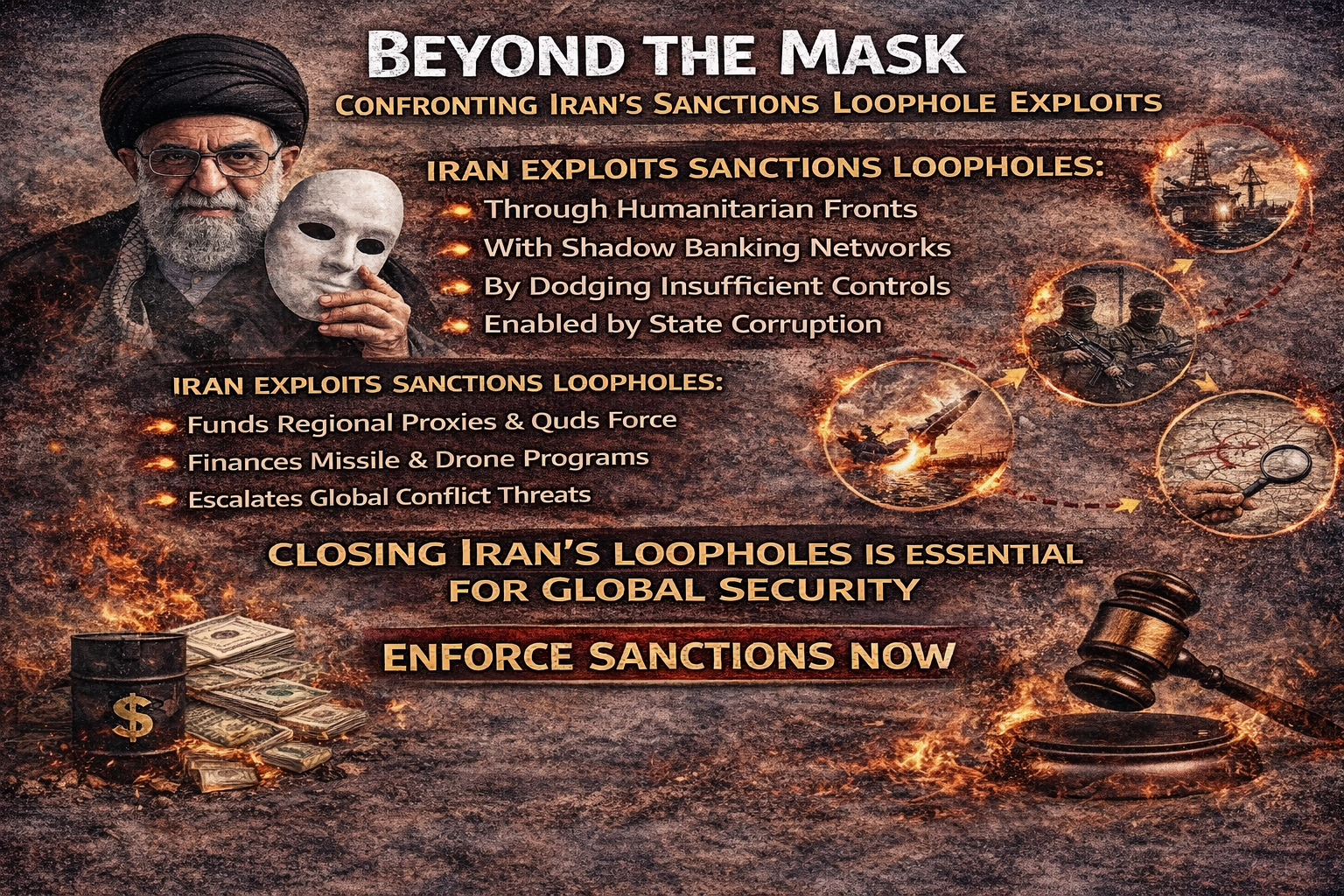
The abuse of humanitarian exemptions in Iran is not an accidental byproduct of sanctions complexity. It is the predictable outcome of deliberate institutional behavior, both inside the Islamic Republic and across the global sanctions enforcement architecture. This chapter addresses three uncomfortable truths that policymakers often avoid:
- Iranian state institutions are directly involved in humanitarian abuse.
- Real humanitarian actors are being harmed—operationally, ethically, and reputationally.
- The global sanctions system (UN, EU, OFAC) is structurally unfit to prevent this exploitation.
Together, these failures form a closed loop of impunity.
14.1 Direct State Involvement: This Is Not “Rogue Abuse”
The Islamic Republic does not merely tolerate humanitarian loophole abuse—it orchestrates it.
Multiple Iranian state-linked entities repeatedly appear in investigations, enforcement actions, and leaked financial records tied to humanitarian trade misuse:
- Islamic Revolutionary Guard Corps (IRGC)
Particularly through its economic arms and logistics affiliates, the IRGC has embedded itself in:- pharmaceutical import channels,
- food commodity trading firms,
- shipping and freight forwarding networks,
- financial clearing mechanisms tied to “humanitarian” transactions.
- Bonyads (State Foundations) such as:
- Setad (Execution of Imam Khomeini’s Order)
- Mostazafan Foundation
These entities operate with: - opaque ownership structures,
- tax exemptions,
- direct Supreme Leader oversight,
and have been repeatedly linked to sanctioned trade conducted under humanitarian cover.
- Iran’s Ministry of Industry, Mine and Trade (MIMT)
Plays a critical role in:- issuing import licenses,
- classifying goods as “essential,”
- approving intermediaries that later surface in sanctions cases.
This is not plausible deniability.
It is policy-level weaponization of humanitarian access.
14.2 The IRGC’s Economic Doctrine: Humanitarianism as Shield
The IRGC’s economic doctrine explicitly frames sanctions evasion as a form of “resistance.” Humanitarian exemptions become:
- legal shields for cash flow,
- procurement pathways for dual-use materials,
- reputational cover in international forums.
Humanitarian trade allows the regime to claim moral high ground—“we are feeding our people”—while simultaneously:
- diverting goods,
- taxing imports unofficially,
- monetising aid-linked access.
This is moral laundering, not humanitarianism.
14.3 The Human Cost: NGOs Pay the Price
The most damaging consequence of this abuse is not regulatory failure—it is humanitarian degradation.
Real NGOs operating in Iran face:
- increased scrutiny,
- delayed approvals,
- frozen accounts,
- compliance costs that small organizations cannot absorb.
As a result:
- legitimate aid delivery slows,
- fewer organizations remain operational,
- Civilian populations suffer shortages,
- while regime-linked actors continue operating freely.
This creates a perverse hierarchy:
The more politically connected the entity, the easier humanitarian access becomes.
Independent NGOs are squeezed out.
State-linked “humanitarian” fronts thrive.
14.4 Reputational Contagion: Aid Organizations as Collateral Damage
When humanitarian channels are abused repeatedly, the consequences extend beyond Iran:
- Banks de-risk entire aid corridors.
- Correspondent relationships are terminated.
- Humanitarian trade becomes synonymous with “high-risk.”
This is not theoretical.
Major international NGOs have already faced:
- account closures,
- transaction delays,
- blocked shipments
Due to Iran-linked compliance fear.
The Islamic Republic’s behavior poisons humanitarian trust globally.
14.5 UN, EU, OFAC: A Design Failure, Not an Enforcement Gap
This abuse persists because the sanctions architecture was never designed for adversarial exploitation at this scale.
UN Frameworks
- Rely on state self-reporting.
- Lack enforcement authority.
- Avoid naming and shaming to preserve diplomatic consensus.
EU Sanctions
- Fragmented across member states.
- Weak customs harmonisation.
- Overreliance on documentation supplied by exporters themselves.
OFAC
- Strong designation power.
- Weak transaction-level visibility.
- Reactive rather than preventative enforcement.
All three share a fatal assumption:
Humanitarian actors operate in good faith.
Iran has built an entire strategy around proving that assumption wrong.
14.6 The Political Reluctance to Confront Abuse
Why does this continue?
Because confronting humanitarian abuse requires:
- diplomatic confrontation,
- naming state actors,
- risking accusations of “collective punishment.”
As a result:
- regulators hesitate,
- politicians delay,
- enforcement becomes symbolic.
Iran exploits this hesitation relentlessly.
14.7 Accountability Vacuum: No Consequences, No Change
To date:
- very few humanitarian-linked facilitators face prosecution,
- even fewer Iranian institutions are named publicly,
- penalties focus on peripheral actors, not architects.
Without:
- public attribution,
- institutional sanctions,
- cross-agency enforcement,
the system signals one message:
Abuse is low-risk, high-reward.
14.8 The Reality Check
The humanitarian loophole has become:
- a financing mechanism,
- a procurement channel,
- a diplomatic shield,
- a reputational weapon.
And Iran is not an anomaly—it is simply the most advanced practitioner.
Unless institutional responsibility is acknowledged—explicitly and publicly—the same failures will repeat, in Iran and beyond.
Chapter 15 — Closing the Humanitarian Loophole Without Killing Aid
From Policy Failure to Enforceable Reform
The exposure of Iran’s systematic abuse of humanitarian exemptions leaves regulators with no defensible excuse for inaction. The challenge is no longer conceptual; it is operational. The question is not whether humanitarian trade can be protected without enabling abuse, but why existing institutions have refused to implement the tools already available to them.
This chapter outlines practical, enforceable mechanisms capable of preserving humanitarian access while decisively shutting down regime-level exploitation, with Iran serving as the central case study.
- The False Binary: Aid vs. Enforcement Is a Manufactured Myth
Sanctions architects frequently defend weak enforcement by invoking a moral dilemma:
“Tightening controls risks harming civilians.”
This framing is intellectually dishonest.
Iran’s abuse demonstrates that unchecked exemptions harm civilians more, not less:
- Funds diverted from food and medicine finance repression and foreign militancy.
- Genuine NGOs lose access as compliance risks escalate.
- Inflation accelerates when regime actors monopolize “humanitarian” imports.
The real binary is:
- Unmonitored exemptions that empower sanctioned states, or
- Structured humanitarian corridors with enforceable transparency
There is no humanitarian justification for opacity.
- Mandatory Humanitarian Trade Registries (HTRs)
One of the most glaring failures across UN, EU, and OFAC frameworks is the absence of centralized humanitarian trade registries.
Recommended reform:
- All humanitarian exports to sanctioned jurisdictions must be logged in a public–private registry.
- Required disclosures:
- End user
- Ultimate beneficial owner (UBO)
- Shipping route
- Payment mechanism
- Local distribution partner
- Registry access granted to:
- Regulators
- Correspondent banks
- Auditors
- Select NGOs
This single measure would dismantle:
- Phantom NGOs
- Proxy importers
- Recycled shell companies
Iran’s networks thrive precisely because no unified visibility exists.
- Ring-Fenced Payment Channels with Real Oversight
Humanitarian payments are currently routed through:
- Shadow banks
- Local currency swaps
- Politically protected clearing houses
Reform requires more than “comfort letters.”
Concrete measures:
- Designated humanitarian escrow accounts under joint international oversight
- Disbursements triggered only after:
- Shipment verification
- Customs clearance confirmation
- Independent NGO receipt acknowledgment
- Automatic reporting to OFAC / EU regulators
Iran has repeatedly used humanitarian payments as revenue-recycling mechanisms. Ring-fencing is not optional—it is overdue.
- NGO Protection Through Structural Firewalls
Ironically, NGOs are both victims and unwitting tools of abuse.
Many are forced to:
- Partner with regime-linked distributors
- Accept government-approved logistics firms
- Operate under surveillance and coercion
Policy correction:
- Explicit legal immunity for NGOs that report diversion attempts
- International ombudsman mechanism for humanitarian interference
- Independent logistics corridors managed outside regime control where feasible
Iran’s strategy relies on co-opting humanitarian legitimacy. Removing that shield weakens the regime, not aid.
- Sanctions Design Must Target State Capture, Not Paper Compliance
Iran’s success exposes a deeper flaw: sanctions regimes are still designed around corporate misconduct, not state-level capture of trade systems.
Future sanctions must:
- Treat humanitarian abuse as state financial crime, not regulatory oversight failure
- Sanction:
- Government-linked distributors
- Customs authorities enabling diversion
- State-owned banks clearing “humanitarian” flows
- Trigger automatic escalation when abuse thresholds are crossed
Iran did not exploit loopholes accidentally. It engineered them.
- Naming, Not Nudging: Ending Diplomatic Evasion
The final reform is political, not technical.
UN bodies, EU institutions, and even OFAC routinely:
- Avoid naming Iranian state entities publicly
- Downplay evidence to preserve diplomatic space
- Frame abuse as “isolated incidents”
This has failed.
Effective deterrence requires:
- Public attribution
- Sanctions designations tied explicitly to humanitarian abuse
- Enforcement actions that treat diversion as hostile economic warfare
Silence has been interpreted—correctly by Tehran—as permission.
- Why Iran Matters Beyond Iran
Iran is not unique—it is simply the most advanced practitioner.
The same humanitarian loopholes are now visible in:
- Venezuela’s food import schemes
- Syria’s NGO gatekeeping apparatus
- North Korea’s medical aid laundering networks
Iran is the proof of concept for authoritarian abuse of humanitarian norms.
Failing to act here guarantees replication elsewhere.
- The Line That Must Finally Be Drawn
Humanitarian exemptions were designed to protect civilians—not to bankroll repression, fund proxy warfare, or launder state revenue under the cover of compassion.
Iran crossed that line years ago.
The international system noticed.
It documented.
It debated.
What it has not yet done is enforce.
Conclusion — From Humanitarian Intent to Systemic Exploitation
Humanitarian exemptions were designed as moral safeguards—narrow corridors through which food, medicine, and lifesaving assistance could reach civilian populations trapped under sanctions. In the Iranian case, those corridors have been systematically widened, weaponized, and monetized. What emerges from this investigation is not a story of accidental leakage, but of deliberate exploitation—enabled by state-linked entities, tolerated by weak enforcement, and financed through opaque global mechanisms that convert humanitarian cover into strategic advantage.
Across the chapters, a consistent pattern is clear. Iranian state and quasi-state actors—including ministries, regime-linked conglomerates, IRGC-affiliated networks, and designated banks—have embedded themselves within humanitarian trade flows. They have done so by mislabeling goods, blending licit and illicit cargo, manipulating invoices, routing payments through non-dollar and shadow-banking channels, and leaning on third-party intermediaries operating in permissive jurisdictions. These are not marginal abuses at the edges of compliance; they are repeatable, scalable practices that exploit known blind spots in UN, EU, and OFAC sanctions design.
The human cost of this abuse is profound. As exemptions are distorted, legitimate NGOs and humanitarian actors bear the consequences—facing heightened scrutiny, delayed transfers, frozen accounts, and shrinking operational space. Resources meant for civilians are diverted, politicized, or priced out of reach. The result is a perverse outcome: sanctions regimes that are simultaneously porous to abuse by sanctioned elites and punitive toward the very organizations meant to alleviate suffering.
Equally troubling is the structural failure of enforcement coordination. Fragmented data systems, inconsistent standards, and slow information-sharing between customs authorities, regulators, and financial institutions allow exploitation to persist long after red flags are raised. Political hesitation—driven by fears of escalation, humanitarian backlash, or diplomatic friction—further entrenches tolerance. In practice, the humanitarian exemption has become a shield of plausible deniability, behind which revenue generation and sanctions evasion continue largely uninterrupted.
This report argues that the solution is neither to abolish humanitarian exemptions nor to rely on cosmetic tightening. What is required is a fundamental redesign: risk-based exemptions anchored in end-to-end transparency; unified registries with auditable trails; real-time monitoring of trade and payments; and meaningful penalties for misclassification and facilitation. Crucially, accountability must extend beyond front companies to named state institutions and senior facilitators who orchestrate abuse.
Iran is not an outlier—it is a test case. Its success in exploiting humanitarian channels exposes a broader vulnerability in global sanctions architecture. If left unaddressed, this vulnerability will be replicated by other sanctioned regimes. Preserving humanitarian access while preventing abuse is not a technical challenge alone; it is a political choice. The evidence presented here makes one conclusion unavoidable: good intentions are no longer enough. Without structural integrity, humanitarian exemptions will continue to serve not the vulnerable—but those who profit from their suffering.
References & Resources
- Government & Regulatory Sources (Primary, Authoritative)
U.S. Treasury / OFAC
- OFAC – Iran Sanctions Program
https://ofac.treasury.gov/sanctions-programs-and-country-information/iran-sanctions - OFAC – Humanitarian Trade Authorizations (Iran)
https://ofac.treasury.gov/iran-humanitarian-assistance-and-related-authorizations - OFAC Enforcement Actions & Settlements
https://ofac.treasury.gov/enforcement/actions
European Union
- EU Sanctions Map – Iran
https://www.sanctionsmap.eu/#/main/details/26 - EU Guidance on Humanitarian Exemptions
https://finance.ec.europa.eu/eu-and-international-sanctions/guidance_en
United Nations
- UN Security Council Sanctions Committees (Iran legacy frameworks)
https://www.un.org/securitycouncil/sanctions - UN Panel of Experts Reports (dual-use & diversion patterns)
https://www.un.org/securitycouncil/subsidiary-organes/panels-of-experts
- Financial Crime, AML & Compliance Authorities
FATF
- FATF – High-Risk Jurisdictions (Iran)
https://www.fatf-gafi.org/en/countries/high-risk-and-other-monitored-jurisdictions.html - FATF – Trade-Based Money Laundering
https://www.fatf-gafi.org/en/publications/Methodsandtrends/trade-based-money-laundering.html
IMF / World Bank
- IMF – Illicit Financial Flows & Sanctions Impact
https://www.imf.org/en/Topics/Illicit-Financial-Flows - World Bank – Trade Misinvoicing & Sanctions Evasion
https://www.worldbank.org/en/topic/financialmarketintegrity
- Investigative Journalism & Media (High-Impact)
Reuters (Highly Recommended)
- Reuters Investigations – Iran sanctions evasion, humanitarian misuse
https://www.reuters.com/investigates/ - Reuters Special Reports on Iran oil, banking & trade
https://www.reuters.com/world/middle-east/
Financial Times
- FT – Sanctions, trade finance & compliance failures
https://www.ft.com/sanctions
The New York Times
- NYT Investigations – Iran, sanctions & humanitarian trade
https://www.nytimes.com/topic/subject/economic-sanctions
OCCRP
- OCCRP – Iran-linked shell companies & trade abuse
https://www.occrp.org/en/investigations
- NGO & Humanitarian Sector Analysis
International Crisis Group
- Sanctions, humanitarian access & Iran
https://www.crisisgroup.org/middle-east-north-africa/iran
Human Rights Watch
- Sanctions impact & humanitarian diversion risks
https://www.hrw.org/topic/economic-sanctions
Norwegian Refugee Council
- Sanctions & humanitarian exemptions analysis
https://www.nrc.no/perspectives/
- Academic & Policy Research
Chatham House
- Sanctions effectiveness & loopholes
https://www.chathamhouse.org/topic/international-sanctions
Brookings Institution
- Iran sanctions architecture & enforcement failures
https://www.brookings.edu/topic/iran/
Carnegie Endowment
- Financial channels, de-dollarization & sanctions evasion
https://carnegieendowment.org/sanctions
- Trade, Shipping & Customs Intelligence
UN Comtrade
- Trade flows & misclassification analysis
https://comtradeplus.un.org/
MarineTraffic / Lloyd’s List
- Sanctioned shipping & AIS manipulation
https://lloydslist.maritimeintelligence.informa.com/
- Legal & Compliance Guidance (For Chapter 11–12)
- Wolfsberg Group – Correspondent Banking & Sanctions
https://www.wolfsberg-principles.com/ - BIS – Export Controls & Dual-Use Goods
https://www.bis.doc.gov/