IRGC

Mohammad Bagher Ghalibaf from police command to managerial repression

Mohammad Bagher Ghalibaf: From Police Command to Managerial Repression

Introduction: The Security Logic That Survived Command   On 7 January 2026, one day before the principal lethal escalation of the nationwide uprising, Mohammad Bagher Ghalibaf chaired a closed parliamentary session in Tehran. Ahmad-Reza Radan, commander of FARAJA, the regime’s national Law Enforcement Command, and a deputy intelligence minister briefed MPs on the security and […]

Mohammad Bagher Ghalibaf: From Police Command to Managerial Repression Read More »

Mohammad Bagher Ghalibaf and the survivor network in the post-Khamenei power architecture

Mohammad Bagher Ghalibaf: The Survivor Network in the Post-Khamenei Power Architecture

Introduction: The Man Who Survived the System   Any serious attempt to map the Mohammad Bagher Ghalibaf power network has to begin with a problem that conventional factional analysis cannot explain. There is no formal organisation carrying his name, no stable military bloc publicly answerable to him and no evidence that the senior commanders, security

Mohammad Bagher Ghalibaf: The Survivor Network in the Post-Khamenei Power Architecture Read More »

Supreme National Security Council and the architecture of security power in the Islamic Republic

Inside the Supreme National Security Council: The Architecture of Security Power

Introduction: The Institution Between the Leader and the State   The Supreme National Security Council (SNSC) serves as the point where the Islamic Republic translates supreme authority into coordinated state action. It brings the presidency, parliament, the judiciary, security ministries, senior military commanders and two representatives of the Supreme Leader into the same constitutional structure.

Inside the Supreme National Security Council: The Architecture of Security Power Read More »

Mojtaba Khamenei and the architecture of connective authority

Mojtaba Khamenei and the Architecture of Connective Authority

Introduction — The Authority the State Never Defined For more than two decades, Mojtaba Khamenei appeared repeatedly at the edges of the Islamic Republic’s most consequential political and security decisions. His name surfaced in accounts of electoral intervention, relations with the Islamic Revolutionary Guard Corps, the management of political crises and the increasingly restricted circle

Mojtaba Khamenei and the Architecture of Connective Authority Read More »

Ali Asghar Hejazi and the hidden security architecture of the Office of the Supreme Leader

The Security Gatekeeper: Ali Asghar Hejazi and the Hidden Security Architecture of the Office of the Supreme Leader

Introduction   The Security Architecture of the Office of the Supreme Leader has received remarkably little scholarly attention despite occupying one of the most strategically important positions within the political system of the Islamic Republic. Political systems are usually analysed through the people who stand in front of them. Presidents deliver speeches, ministers announce policy,

The Security Gatekeeper: Ali Asghar Hejazi and the Hidden Security Architecture of the Office of the Supreme Leader Read More »

Who Benefits From Keeping the Islamic Republic Alive? Global question mark showing diplomacy, sanctions, security and human rights institutions linked to regime survival

Who Benefits From Keeping the Islamic Republic Alive? The International Incentive Structure Behind Regime Survival

Introduction   Who benefits from keeping the Islamic Republic alive? For decades, discussions about the Islamic Republic have revolved around a familiar question: Why does the regime survive? The answers usually focus on internal factors. Repression. Ideology. Security institutions. Patronage networks. Control of information. Economic coercion. Political fragmentation among opponents. Each explanation contains an element

Who Benefits From Keeping the Islamic Republic Alive? The International Incentive Structure Behind Regime Survival Read More »

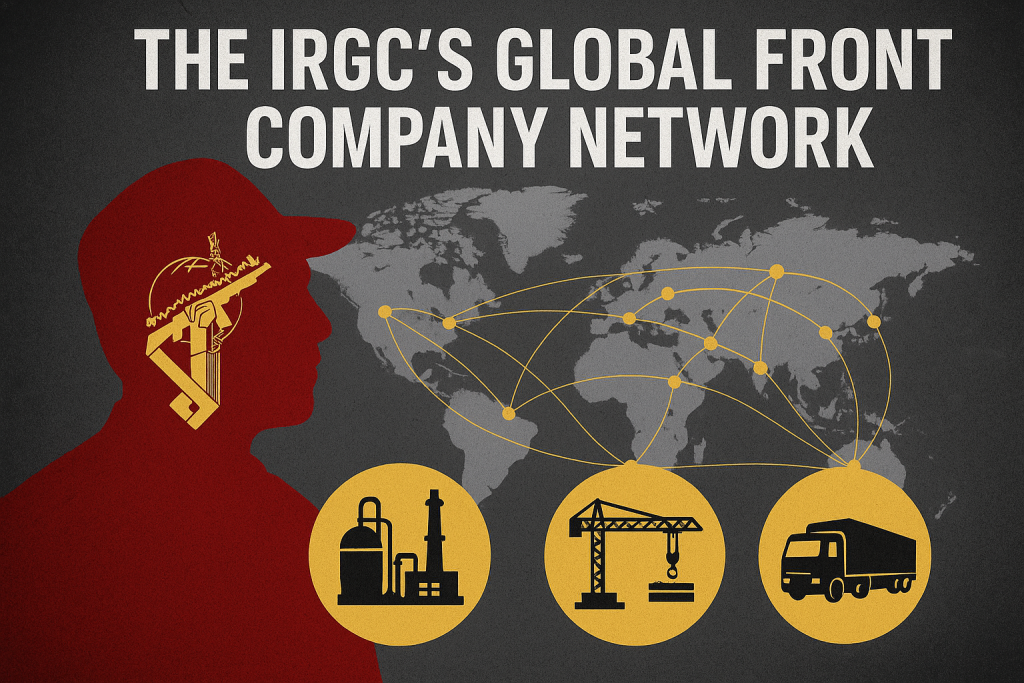
A dark world-map graphic showing global connection lines representing the IRGC’s international front-company network. A red silhouette of a soldier with the IRGC emblem appears on the left, and three yellow industry icons—petrochemicals, construction, and transport—sit at the bottom, symbolizing the sectors used by IRGC-linked shell companies.

The IRGC’s Global Front Company Network

Introduction IRGC Front Company Network For years, global sanctions were expected to cripple the Islamic Revolutionary Guard Corps (IRGC), limit its financial reach, and disrupt its military expansion. Instead, the IRGC adapted, quietly constructing one of the most sophisticated front-company networks in the world. Today, this shadow economy spans Asia, Europe, Africa, and the Middle

The IRGC’s Global Front Company Network Read More »

Tracing the Murky Maze: Illicit Financial Flows from Iran and the Conceptual Ambiguity of “Illicit”

Abstract: This paper examines the complexities of tracing illicit financial flows (IFFs) originating from Iran, particularly within the context of prolonged international sanctions. It highlights the challenges in defining and measuring IFFs, especially when activities reside in the gray areas between legality and ethical norms. The paper analyzes the mechanisms employed by Iranian actors to

Tracing the Murky Maze: Illicit Financial Flows from Iran and the Conceptual Ambiguity of “Illicit” Read More »