
Introduction
Diplomacy or Damage Control?
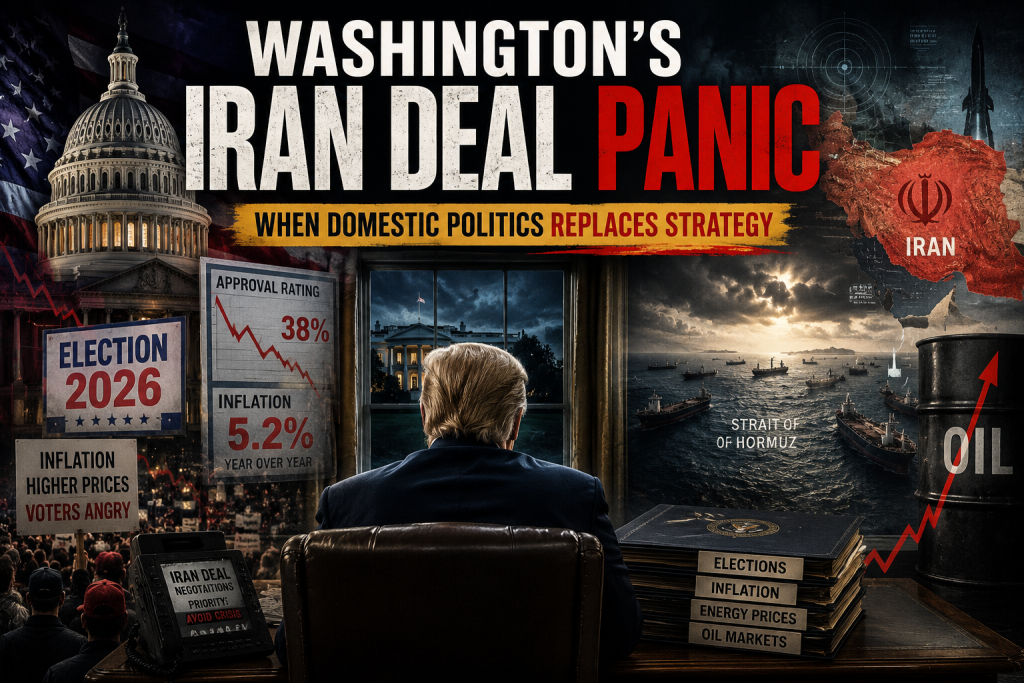
Washington’s Iran Deal strategy is increasingly being presented as diplomacy. Yet behind the language of negotiation lies a growing effort to manage political risk rather than achieve strategic transformation.
For months, political leaders, commentators and policy institutions across the West have framed negotiations with Tehran as a necessary mechanism for reducing tensions and preventing a wider regional conflict. The language is familiar. Stability. De-escalation. Risk reduction. Crisis management. Yet behind this diplomatic vocabulary lies a more uncomfortable reality. The strategic objectives that once dominated discussions of Iran appear to be narrowing.
The question is no longer whether the Islamic Republic has fundamentally changed its behaviour. The question is whether Western policymakers still consider such change a realistic objective at all.
Only months ago, the political atmosphere surrounding Iran looked markedly different. Following one of the bloodiest periods of internal repression in the Islamic Republic’s recent history, Western officials and political figures repeatedly emphasised the regime’s treatment of its own population. Pressure on Tehran was frequently justified not merely through security concerns, but through reference to the Iranian people themselves. The argument was straightforward: a government willing to employ such violence against its own citizens represented a broader source of instability that could not be ignored indefinitely.
Today, that rhetoric appears increasingly absent from the conversation.
Instead, discussions have shifted towards shipping lanes, energy markets, oil prices and escalation management. The focus is no longer centred on the political character of the regime or the consequences of its actions inside Iran. It is centred on preventing disruption. Preventing market shocks. Preventing regional escalation. Preventing economic consequences that could reach Western voters.
This shift matters because it suggests a deeper transformation in policy priorities.
A strategy aimed at changing the behaviour of an adversary is fundamentally different from a strategy aimed at managing the consequences of that adversary’s behaviour. One seeks resolution. The other seeks containment. One attempts to alter the trajectory of a problem. The other attempts to make the problem temporarily bearable.
Increasingly, Washington appears to be pursuing the latter.
The timing is difficult to ignore. With the 2026 midterm elections approaching, economic stability has become a political imperative. Inflation remains a sensitive issue. Energy prices remain politically toxic. Any disruption to global oil flows, particularly through the Strait of Hormuz, carries consequences that extend well beyond the Middle East and directly into domestic American politics.
Under such conditions, strategic patience becomes politically expensive.
The result is a growing incentive to prioritise short-term stability over long-term transformation. A limited agreement, even one that leaves fundamental disputes unresolved, can become attractive if it reduces immediate risks. The objective ceases to be solving the problem. The objective becomes postponing its consequences.
This article argues that Washington’s current approach to Iran increasingly reflects this logic. Rather than pursuing a comprehensive resolution of the challenges posed by the Islamic Republic, policymakers appear increasingly focused on managing economic exposure, reducing political risk and preserving short-term stability. In the process, the Iranian people, once presented as a central justification for pressure, have largely disappeared from the policy discussion.
That omission raises an important question.
If the objective is no longer transformation, and if stabilisation has replaced strategy, what exactly is the end state that Western policymakers are trying to achieve?
Chapter 1
The Electoral Constraint Behind Iran Policy
Foreign policy is often presented as a contest between states. In reality, it is frequently a contest between political calendars.
The popular image of American foreign policy portrays Washington as a strategic actor pursuing long-term geopolitical objectives irrespective of electoral cycles. The reality is considerably less romantic. Every administration operates within domestic political constraints, and those constraints become increasingly visible as elections approach.
The approaching 2026 midterm elections are one such constraint.
For policymakers in Washington, the question is not simply whether a particular foreign policy objective is strategically desirable. The question is whether the domestic political costs of pursuing that objective are manageable. A policy that appears rational from a geopolitical perspective may become politically toxic if it contributes to inflation, economic uncertainty, or rising energy costs in the months preceding a national election.
This is where the Iran question becomes inseparable from domestic American politics.
The dominant assumption in many foreign policy discussions is that negotiations with Tehran are primarily driven by security concerns: nuclear enrichment, regional influence, proxy networks, maritime security, or military deterrence. These factors undoubtedly matter. Yet they do not exist in a political vacuum. Their significance is filtered through domestic considerations that ultimately determine how much risk Washington is willing to tolerate.
A prolonged confrontation with the Islamic Republic carries costs. Military costs. Diplomatic costs. Economic costs. Of these, economic costs are often the most politically dangerous because they are the most visible to voters.
The average American voter does not spend their day analysing enrichment levels at Fordow or debating maritime security in the Persian Gulf. They do, however, notice rising fuel prices. They notice inflation. They notice increasing household costs. Politicians understand this reality far better than many foreign policy analysts.
For decades, economic performance has remained one of the strongest predictors of electoral outcomes in the United States. Administrations may attempt to frame elections around ideology, identity or foreign policy achievements, but voters repeatedly demonstrate a tendency to prioritise their own economic circumstances. Inflation, in particular, possesses a uniquely corrosive political effect because it reaches almost every aspect of daily life. Rising prices transform abstract economic indicators into immediate personal experiences.
Energy prices occupy a particularly sensitive position within this equation.
Unlike many economic variables, fuel prices are highly visible. Consumers encounter them directly. They appear on roadside signs, in household budgets and in media coverage. They serve as a constant reminder of economic conditions. Consequently, even modest increases can generate political pressure disproportionate to their actual economic significance.
This creates a powerful incentive structure for any administration approaching an election cycle.
Policies that risk sustained disruptions to global energy markets become politically hazardous. Escalation that threatens oil flows becomes politically hazardous. Regional instability that increases market uncertainty becomes politically hazardous. What may appear strategically manageable from the perspective of national security planners can quickly become politically unacceptable from the perspective of elected officials facing voters.
The Strait of Hormuz sits directly at the centre of this calculation.
Any serious disruption to one of the world’s most important energy transit routes carries implications far beyond the Middle East. Oil markets react immediately to perceived threats. Shipping costs respond. Investor confidence shifts. Inflationary pressures emerge. The consequences travel rapidly through the global economy before eventually appearing where politicians fear them most: in domestic economic data and public opinion polling.
Under these conditions, foreign policy objectives begin to narrow.
The question ceases to be what outcome would be strategically ideal. The question becomes what outcome can be achieved without creating unacceptable domestic political costs.
This distinction matters because it helps explain an increasingly visible shift in Washington’s approach towards Iran. A policy initially justified through strategic pressure can gradually evolve into a policy focused on risk reduction. Long-term ambitions become subordinate to short-term stability. Structural objectives give way to immediate political necessities.
In such an environment, negotiations become attractive not because underlying disagreements have been resolved, but because uncertainty itself becomes politically expensive.
The closer Washington moves towards the midterm elections, the more powerful this incentive becomes.
Understanding this electoral constraint is essential because it provides the foundation for everything that follows. To understand why policymakers may seek stability over transformation, one must first understand the political cost of instability itself.
And nowhere is that cost more visible than in the global energy market.
Chapter 2
Energy Markets as Political Infrastructure
Much of the discussion surrounding the Strait of Hormuz is framed in military terms. Analysts debate naval deployments, missile capabilities, shipping security and regional deterrence. While these considerations are important, they often obscure a more fundamental reality.
The Strait of Hormuz is not merely a strategic waterway.
It is political infrastructure.
The significance of Hormuz does not stem primarily from geography. It stems from dependency. According to data from major energy institutions, a substantial proportion of globally traded crude oil and liquefied natural gas passes through this narrow maritime corridor every day. The result is a system in which a single chokepoint exerts influence far beyond the Gulf itself.
When policymakers in Washington discuss Hormuz, they are not simply discussing maritime security. They are discussing the stability of global energy markets, inflation expectations, investor confidence and, ultimately, domestic political risk.
This distinction is essential.
The traditional geopolitical interpretation assumes that energy security is primarily an economic concern. In reality, energy security has become inseparable from political stability. Modern governments depend on predictable energy flows not merely to sustain economic growth but to preserve public confidence. Disruptions in energy markets have a habit of spreading rapidly through the wider economy, affecting transport costs, consumer prices, industrial production and inflation metrics.
The transmission mechanism is remarkably efficient.
A threat emerges in the Gulf.
Markets react.
Oil prices rise.
Investors reassess risk.
Shipping costs increase.
Inflation expectations adjust.
Political pressure follows.
What begins as a regional security issue can quickly become a domestic political problem thousands of miles away.
This explains why even the possibility of disruption frequently generates concern in Western capitals. Markets do not wait for shipping routes to close completely. They react to uncertainty itself. The perception of risk often proves almost as significant as the material reality.
For this reason, the Islamic Republic does not need to permanently block the Strait of Hormuz to exercise leverage. The mere possibility of disruption can influence market behaviour. The mere possibility can alter political calculations.
That leverage is frequently misunderstood.
Many discussions focus on whether Iran possesses the capability to sustain a prolonged closure of the Strait. While this question is relevant from a military perspective, it is not necessarily the most important one politically. The more significant question is whether Tehran can create sufficient uncertainty to influence decision-making elsewhere.
History suggests that it can.
Energy markets have repeatedly demonstrated sensitivity to tensions in the Gulf. Periods of regional escalation routinely trigger market reactions disproportionate to the immediate physical disruption involved. Traders price risk. Governments anticipate consequences. Politicians monitor economic indicators. The system responds long before worst-case scenarios materialise.
This reality creates a structural vulnerability for governments heavily exposed to electoral pressure.
A military planner may view a temporary market disruption as manageable. A politician approaching an election cycle may view the same disruption very differently.
From this perspective, the strategic logic behind Washington’s current approach becomes easier to understand.
The objective is not necessarily to eliminate the source of instability. Eliminating sources of instability is difficult, expensive and politically risky. The objective is increasingly to prevent instability from reaching politically dangerous levels.
That distinction marks a significant departure from more ambitious strategic visions.
A policy focused on transformation accepts disruption in pursuit of a larger objective.
A policy focused on stabilisation seeks to minimise disruption regardless of whether the larger objective is achieved.
The difference between those approaches is not semantic.
It determines how governments negotiate, how they assess risk and how they define success.
Viewed through this lens, the renewed urgency surrounding negotiations with Tehran becomes less surprising. If energy markets function as political infrastructure, then protecting those markets becomes a political necessity. Under such conditions, de-escalation acquires value independent of any broader strategic outcome.
The question is no longer whether a comprehensive solution has been achieved.
The question becomes whether enough stability can be purchased to prevent economic consequences from reaching voters.
Once that becomes the primary objective, policy begins to change.
And so do the standards by which success is measured.
Chapter 3
The Collapse of Strategic Ambition
Foreign policy is often judged by outcomes. It can be equally revealing to examine how objectives change over time.
One of the most striking features of Washington’s current approach towards Iran is not what policymakers are saying. It is what they are no longer saying.
During earlier phases of confrontation, the language surrounding the Islamic Republic was considerably more ambitious. Discussions centred on pressure, deterrence, containment and long-term strategic change. The regime was presented not merely as a diplomatic challenge, but as a source of persistent regional instability whose behaviour required meaningful alteration.
The objective was not simply to manage tensions.
The objective was to change the strategic environment.
Whether one agreed with that vision or not, its ambitions were clear. Economic pressure was intended to generate leverage. Diplomatic isolation was intended to generate costs. Military deterrence was intended to alter calculations inside Tehran. Every instrument was justified as part of a broader effort to reshape the behaviour of the regime and constrain its ability to project influence across the region.
Today, that language has become noticeably less prominent.
Strategic ambitions rarely disappear overnight.
More often, they are gradually replaced by narrower objectives presented as pragmatic necessities. What begins as a temporary adjustment becomes a permanent framework. Emergency measures become normal policy. Short-term priorities become long-term assumptions.
The shift is rarely announced openly.
It occurs incrementally, justified by changing circumstances, political realities and immediate pressures until the original objectives become increasingly difficult to recognise.
Instead, discussions increasingly revolve around stability, de-escalation, maritime security and risk reduction. The emphasis has shifted away from what Washington hopes to achieve and towards what Washington hopes to avoid.
Avoid a regional war.
Avoid disruptions in shipping.
Avoid energy market shocks.
Avoid inflationary pressure.
Avoid economic instability.
Avoid political fallout.
These are not identical objectives.
One set of objectives seeks transformation.
The other seeks damage limitation.
The distinction is not merely rhetorical. It reflects a fundamentally different understanding of what is politically achievable.
A government pursuing strategic transformation accepts a degree of uncertainty because it believes the potential rewards justify the risks. A government pursuing stabilisation operates according to a different logic. It prioritises predictability. It seeks to reduce exposure. It attempts to minimise disruption rather than fundamentally alter underlying conditions.
Increasingly, Washington appears to be operating according to the second model.
This raises an uncomfortable question.
What happened to the larger objectives?
If pressure was intended to generate leverage, where was that leverage expected to lead?
If deterrence was intended to change behaviour, what behavioural changes were required before negotiations resumed?
If confrontation was justified as a response to the regime’s conduct, what measurable improvements have occurred that justify lowering expectations?
These questions are rarely addressed directly. Instead, the conversation often moves immediately towards the practical benefits of de-escalation. Lower risks. Lower tensions. Lower economic exposure. While these outcomes may indeed be desirable, they do not answer a more fundamental question: whether the original strategic objectives have been achieved, abandoned or merely deferred.
The distinction matters because success can only be measured against stated goals.
If the goal was structural change, then stability alone cannot be presented as victory.
If the goal was behavioural transformation, then the avoidance of escalation cannot automatically be treated as success.
If the goal was long-term strategic realignment, then maintaining the status quo under calmer conditions does not necessarily represent meaningful progress.
Yet much of the current policy discussion appears to blur these distinctions.
The avoidance of crisis increasingly substitutes for the resolution of crisis.
The management of risk increasingly substitutes for strategic achievement.
The reduction of pressure increasingly substitutes for evidence that pressure accomplished its intended purpose.
This pattern is not unique to Iran. Governments frequently redefine success when original objectives prove difficult, costly or politically inconvenient. Ambitious goals gradually become modest goals. Structural change becomes stability. Resolution becomes management. Transformation becomes postponement.
The language remains reassuring.
The objectives become smaller.
This process is particularly visible when domestic political pressures begin to outweigh strategic considerations. Under such conditions, policymakers naturally gravitate towards outcomes that reduce immediate exposure. Stability becomes attractive not because underlying problems have been solved, but because instability itself becomes politically dangerous.
The result is a narrowing of ambition.
What began as a strategy designed to alter the behaviour of an adversary evolves into a strategy designed to manage the consequences of that adversary’s continued existence.
This is the central paradox of the current moment.
The more policymakers emphasise de-escalation as an objective in itself, the less clear it becomes what larger strategic outcome they are attempting to achieve.
An open shipping lane is not a strategy.
A stable energy market is not a strategy.
Lower political risk is not a strategy.
These are conditions.
The question remains whether those conditions are intended to support a broader strategic objective or whether they have become the objective themselves.
That question is particularly important in the case of Iran because the costs of postponement have never been borne equally by all actors involved.
For Western governments, postponement may create breathing space.
For energy markets, it may create temporary predictability.
For elected officials, it may create political relief.
For others, however, postponement means something very different.
And nowhere is that contradiction more visible than in the case of the Iranian people themselves.
Chapter 4
The Forgotten Variable: The Iranian People
Every policy reveals its priorities.
Not through official statements. Not through press conferences. Not through carefully crafted diplomatic language.
Through what it chooses to discuss.
And, perhaps more importantly, through what it chooses to ignore.
Few aspects of the current debate surrounding Iran are more revealing than the near disappearance of the Iranian people from the policy conversation itself.
This omission is striking because it represents a dramatic departure from the rhetoric that dominated earlier phases of confrontation. For years, Western leaders, policymakers and commentators repeatedly justified pressure on the Islamic Republic by referencing the regime’s treatment of its own population. Human rights abuses were not presented as a secondary concern. They were frequently invoked as evidence that the regime represented a broader source of instability, repression and insecurity.
The argument was straightforward.
A government willing to imprison, torture, silence and kill its own citizens could not be viewed purely through the narrow lens of traditional diplomacy. The regime’s internal behaviour was presented as inseparable from its external conduct. Its treatment of ordinary Iranians was not merely a domestic matter. It was increasingly framed as evidence of a deeper political problem that extended beyond Iran’s borders.
That argument did not emerge from theory.
It emerged from events.
And few events exposed the nature of the Islamic Republic more clearly than the mass repression that followed the nationwide unrest of January 2026.
The scale of the violence was impossible to ignore.
Reports emerged of live ammunition being used against demonstrators. Mass arrests followed. Internet restrictions intensified. Families searched for missing relatives. Human rights organisations documented allegations of unlawful killings, arbitrary detention and widespread state violence. As the crackdown unfolded, international headlines filled with condemnations, statements of concern and declarations of solidarity.
Yet the significance of the January 2026 massacres extended beyond human rights reporting.
The events rapidly became part of the political justification for a tougher Western approach towards Tehran.
Senior officials, political leaders and commentators repeatedly pointed to the regime’s conduct as evidence that the Iranian question could not be reduced to a narrow discussion about nuclear enrichment or regional diplomacy. The argument increasingly centred on the nature of the regime itself.
In the United States, President Trump repeatedly referenced the bloodshed when discussing Iran. Public statements from the administration cited death tolls reaching into the tens of thousands, with figures exceeding 40,000 victims appearing in official political rhetoric. The message was unmistakable. The regime’s treatment of its own population was not being presented as a peripheral concern. It was being presented as one of the central reasons why pressure on Tehran was necessary.
Whether those figures ultimately prove entirely accurate is not the central issue.
More important is the political role they played. The reported scale of the bloodshed was repeatedly used to frame the regime’s conduct as a matter of strategic significance rather than merely a domestic human rights concern. The argument presented to Western audiences was clear: the nature of the regime itself had become part of the strategic problem.
Western officials spoke of human rights.
They spoke of accountability.
They spoke of standing with the Iranian people.
They spoke of the moral bankruptcy of a regime willing to wage war against its own society.
At the time, these statements carried strategic implications.
The treatment of Iranian citizens was not merely presented as a humanitarian concern. It was increasingly used to justify broader pressure on Tehran. The regime’s domestic conduct became part of the rationale for confrontation.
That context matters because it establishes a benchmark against which current policy can be measured.
And measured against that benchmark, the shift is difficult to ignore.
Only months later, the Iranian people appear largely absent from the centre of the policy discussion.
The language of current negotiations reveals the change.
The dominant topics are no longer political prisoners, state violence, repression or accountability.
The dominant topics are oil flows.
Shipping lanes.
Regional escalation.
Market stability.
Energy security.
Risk management.
The contrast is striking.
One discussion centres on citizens.
The other centres on markets.
One concerns state violence.
The other concerns commodity prices.
One asks how a regime treats its own population.
The other asks whether oil tankers can move through a strategic waterway without disruption.
This is not an argument against energy security. Nor is it an argument against preventing wider conflict.
It is an observation about priorities.
When policymakers repeatedly invoke the suffering of a population to justify pressure, only to remove that population from the conversation once negotiations resume, legitimate questions inevitably emerge.
What exactly changed?
Did the underlying behaviour of the regime improve?
Did the political prisoners disappear?
Did the machinery of repression suddenly cease to function?
Did the grievances that drove nationwide unrest somehow resolve themselves?
There is little evidence to suggest that any of these things occurred.
Yet the emphasis of policy appears to have shifted regardless.
This is where the contradiction becomes increasingly difficult to ignore.
If support for the Iranian people formed part of the justification for confrontation, then the disappearance of that objective from current negotiations requires explanation. Policymakers cannot simultaneously present human rights concerns as a strategic imperative during periods of pressure and then treat them as a peripheral issue during periods of negotiation without inviting questions about consistency, credibility and intent.
The issue is not whether governments should pursue diplomacy.
The issue is whether governments are willing to acknowledge what their current priorities reveal.
Because priorities reveal hierarchy.
And hierarchy reveals intent.
At present, the hierarchy appears increasingly clear.
Preventing energy market disruption appears more urgent than addressing state repression.
Maintaining regional stability appears more urgent than confronting the causes of instability inside Iran.
Protecting shipping lanes appears more urgent than defending the principles repeatedly invoked during earlier phases of confrontation.
This reality may be politically convenient.
It may even be strategically understandable.
But it should at least be acknowledged honestly.
The uncomfortable truth is that the Iranian people increasingly appear not as participants in policy discussions, but as rhetorical instruments within them. Their suffering becomes highly visible when pressure requires justification. It becomes considerably less visible when negotiations require flexibility.
This pattern creates a credibility problem.
Not simply for Washington.
Not simply for Europe.
But for the broader claim that values and principles occupy a meaningful place within Western policy towards Iran.
For ordinary Iranians, the message is difficult to miss.
When the regime opens fire on demonstrators, world leaders issue statements.
When the regime fills prisons, world leaders issue statements.
When the death toll rises, world leaders issue statements.
When negotiations resume, the conversation changes.
The priorities shift.
The headlines shift.
The diplomatic language shifts.
The calculations shift.
The dead do not.
This is not merely a moral contradiction.
It is a strategic one.
Because every time policymakers reduce the Iranian people to a temporary talking point rather than a sustained policy consideration, they reinforce a perception that stability matters more than accountability, that market confidence matters more than political reality, and that managing the consequences of the regime has become more important than confronting the behaviour that made confrontation necessary in the first place.
Whether fair or unfair, that perception carries consequences.
And it leads directly to the next question.
If the very behaviours that originally justified pressure remain largely unchanged, why has negotiation once again become the preferred policy instrument?
Who, exactly, benefits from a process that repeatedly postpones resolution while leaving the underlying conflict intact?
Chapter 5
The Negotiation Trap
Diplomacy is often presented as the alternative to conflict.
In reality, diplomacy can serve many different functions.
It can resolve disputes.
It can establish durable agreements.
It can reduce tensions.
It can create stability.
But it can also perform a very different role.
It can buy time.
This distinction is essential because negotiations are not inherently evidence of progress. The existence of a negotiating process tells us very little about whether underlying disputes are moving towards resolution. In some cases, negotiations function less as mechanisms for solving problems and more as mechanisms for postponing decisions that neither side wishes to make.
The history of the Iranian nuclear dispute is filled with examples of this pattern.
Deadlines emerge.
Negotiations intensify.
Optimistic statements follow.
Partial understandings are reached.
Disagreements remain unresolved.
New deadlines emerge.
The cycle begins again.
The process continues.
The underlying conflict survives.
This is not necessarily the result of bad faith. It is often the result of incentives.
Negotiations endure because multiple actors benefit from their continuation, even when those negotiations fail to produce a comprehensive settlement.
For Tehran, the advantages are relatively obvious.
The mere existence of negotiations can reduce immediate pressure. Diplomatic engagement creates uncertainty regarding future sanctions. International attention shifts from confrontation towards process. Political momentum behind more aggressive policies weakens. Time becomes an asset rather than a liability.
This does not require a complete agreement.
In many cases, the expectation of future progress can prove nearly as valuable as progress itself.
Markets react.
Governments delay decisions.
Coalitions fragment.
Urgency declines.
The process generates breathing space.
From Tehran’s perspective, time has frequently been one of the most valuable strategic resources available.
The longer difficult decisions are postponed elsewhere, the longer the regime preserves room for manoeuvre.
Yet the incentives are not confined to Tehran.
Washington also benefits from negotiations, albeit for different reasons.
As discussed in previous chapters, the domestic political cost of instability remains significant. Negotiations create the appearance of control. They reassure markets. They reduce fears of immediate escalation. They provide policymakers with evidence that a crisis is being managed.
Most importantly, they postpone the possibility of sudden disruption.
A government approaching a sensitive electoral period may find uncertainty manageable.
What it fears is crisis.
Negotiations help prevent crises from materialising on politically inconvenient timelines.
This creates a curious situation in which both sides derive benefits from continuation, even if neither side achieves its publicly stated objectives.
Tehran buys time.
Washington buys stability.
The process continues.
The dispute remains.
This dynamic becomes particularly important when pressure campaigns are interrupted before producing measurable strategic outcomes.
Pressure is often justified as a mechanism for generating leverage. The assumption is straightforward. Costs are imposed to alter calculations. Pressure creates incentives for behavioural change. Negotiations then occur from a stronger position.
But what happens when negotiations resume before those outcomes become visible?
What happens when the pressure itself becomes the temporary phase, while negotiation becomes the permanent condition?
The answer is that leverage becomes increasingly difficult to measure.
Success becomes increasingly difficult to define.
The process itself begins to replace the objective.
This is the core danger of the negotiation trap.
The existence of dialogue gradually becomes confused with evidence of progress.
Activity becomes mistaken for achievement.
Meetings become mistaken for outcomes.
Statements become mistaken for solutions.
Meanwhile, the fundamental disputes that produced the confrontation remain largely intact.
The regime remains the regime.
The disagreements remain the disagreements.
The sources of instability remain the sources of instability.
Only the timeline changes.
This helps explain why negotiations can persist for years without fundamentally altering the strategic landscape. The process survives because multiple actors derive value from avoiding the alternatives.
Markets prefer predictability.
Governments prefer flexibility.
Diplomats prefer engagement.
Politicians prefer delay.
Every participant discovers a reason to keep the process alive.
The question becomes whether the process itself has become the destination.
That question is particularly relevant today because many of the original justifications for pressure remain unresolved. The concerns repeatedly cited by Western governments have not disappeared. The strategic disagreements remain. The political tensions remain. The underlying conflict remains.
Yet the dominant objective increasingly appears to be maintaining the negotiation itself.
At some point, an uncomfortable question must be confronted.
If negotiations continue while the conditions that originally justified pressure remain largely unchanged, who is actually benefiting from the continuation of the process?
The answer may be more complicated than advocates or critics of diplomacy would prefer.
Because the negotiation trap does not require either side to win.
It merely requires both sides to benefit from postponement.
And once postponement becomes mutually beneficial, achieving resolution becomes increasingly difficult.
This is where the current policy trajectory becomes particularly revealing.
The objective no longer appears to be achieving a decisive strategic outcome.
The objective increasingly appears to be preventing a decisive strategic moment from occurring at all.
And that raises a deeper question about the strategy’s coherence.
If negotiations have become a mechanism for managing risk rather than resolving conflict, what larger objective is guiding the process?
Or has the management of risk become the objective in its own right?
Chapter 6
Trump, Washington and Strategic Drift
One of the most common assumptions in discussions of Iran policy is that Washington acts according to a single, coherent strategy.
The reality is considerably more complicated.
States do not think.
Institutions do.
Governments do not possess a single objective.
They contain multiple actors pursuing multiple objectives simultaneously, often with very different understandings of risk, success and acceptable outcomes.
This distinction is particularly important when examining the apparent inconsistencies that have characterised Washington’s approach towards Iran.
Critics frequently describe the policy as contradictory. At times, it appears to prioritise pressure. At other moments, negotiation. At times, deterrence. At other moments, de-escalation. One week the rhetoric emphasises strength. The next week it emphasises restraint. The result often appears confused.
Yet confusion may not be the most accurate explanation.
The problem may not be the absence of strategy.
The problem may be the presence of too many competing strategies operating simultaneously.
The modern Washington policy ecosystem is not a unified actor pursuing a single objective. It consists of political leaders, security institutions, diplomatic bureaucracies, military planners, intelligence agencies, congressional interests, economic actors and international partners. While these groups may broadly agree that Iran presents a challenge, they often disagree about what outcome should be prioritised and what risks should be accepted to achieve it.
The result is a policy framework pulled in multiple directions at once.
This tension is visible across nearly every major component of the current approach.
Pressure Without Escalation
Washington continues to emphasise pressure.
Sanctions remain.
Military capabilities remain deployed throughout the region.
Deterrent messaging continues.
Political rhetoric frequently stresses strength and resolve.
Yet pressure only functions as a strategic instrument if there is a credible willingness to accept the consequences of escalation.
That willingness appears increasingly uncertain.
The objective seems to be maintaining pressure while avoiding the risks normally associated with pressure campaigns. Policymakers seek leverage without disruption. Coercion without confrontation. Pressure without escalation.
This is an attractive political position.
It is also an inherently unstable one.
Adversaries may eventually conclude that the pressure itself is more durable than the willingness to intensify it.
Deterrence Without Resolution
A similar contradiction appears within the logic of deterrence.
Deterrence is often presented as a means rather than an end. Its purpose is to shape behaviour and alter strategic calculations. It is intended to produce outcomes.
Yet much of the current discussion surrounding Iran increasingly treats deterrence as an objective in its own right.
The emphasis is placed on preventing immediate escalation rather than resolving the underlying dispute that creates the risk of escalation in the first place.
The consequence is a form of strategic limbo.
The threat is contained.
The dispute remains.
The immediate crisis is avoided.
The long-term conflict persists.
Deterrence succeeds operationally while the broader strategic challenge survives intact.
Negotiation Without Settlement
The same pattern appears in diplomacy.
Negotiations continue.
Meetings occur.
Intermediaries engage.
Deadlines shift.
Statements are issued.
Yet a comprehensive settlement remains elusive.
This raises a difficult question.
If negotiations are not producing settlement, what function are they serving?
As discussed in the previous chapter, negotiations may still provide value by reducing tensions, calming markets and delaying confrontation. However, these benefits should not be confused with resolution.
A negotiation process can survive for years without solving the dispute that created the need for negotiation.
At that point, process begins to replace outcome.
Dialogue becomes the achievement.
Continuation becomes the success metric.
The existence of negotiations becomes more important than their destination.
Regional Transformation Without Instability
Perhaps the most significant contradiction concerns the broader strategic ambitions frequently articulated by Western policymakers and regional partners.
Many of the objectives associated with Iran policy imply substantial regional change.
Reducing Tehran’s influence.
Weakening proxy networks.
Altering regional power balances.
Constraining strategic capabilities.
Reshaping the security architecture of the Middle East.
These are not modest ambitions.
They are transformational ambitions.
Yet transformational ambitions carry costs.
History offers few examples of major geopolitical change occurring without periods of instability, uncertainty or disruption. Structural change is rarely comfortable. It creates winners and losers. It generates resistance. It produces unintended consequences.
The difficulty is that many policymakers appear to desire transformation while simultaneously rejecting the instability historically associated with transformation.
They seek a different regional order without accepting the risks involved in creating one.
They seek strategic change without strategic disruption.
They seek geopolitical consequences without geopolitical costs.
This may be politically understandable.
It may not be strategically realistic.
The contradiction becomes particularly visible when discussions of de-escalation occur alongside discussions of regional transformation. The two objectives are not always compatible. In some circumstances they may directly conflict with one another.
A strategy that prioritises stability will often avoid actions necessary to produce structural change.
A strategy that prioritises structural change will often generate instability.
Attempting to maximise both objectives simultaneously can result in paralysis.
The Problem of Competing Priorities
Taken individually, each of these objectives appears reasonable.
Pressure.
Deterrence.
Negotiation.
Stability.
Regional transformation.
None are inherently irrational.
The problem emerges when all are pursued simultaneously without a clear hierarchy.
When every objective becomes a priority, no objective truly remains one.
Policy becomes reactive rather than strategic.
Decisions become driven by immediate pressures rather than long-term outcomes.
Short-term risk management begins to replace coherent strategic planning.
This may explain much of the inconsistency visible in current Iran policy.
The issue is not necessarily that Washington lacks goals.
The issue may be that Washington possesses too many goals, some of which are fundamentally incompatible with one another.
Pressure requires risk.
Transformation creates instability.
Deterrence does not automatically produce resolution.
Negotiation does not automatically produce settlement.
Ignoring these realities does not eliminate them.
It merely postpones the moment when policymakers must choose which objective matters most.
And that choice becomes increasingly unavoidable as the gap between stabilisation and strategy continues to widen.
Because a policy can successfully manage risks for a time.
It cannot indefinitely substitute risk management for strategic direction.
At some point, a more fundamental question must be answered.
Is stabilisation serving a larger strategy?
Or has stabilisation become the strategy itself?
Chapter 7
Stabilisation Is Not Strategy
By this point, a pattern has emerged.
Pressure is applied, but escalation is avoided.
Negotiations continue, but settlement remains elusive.
Deterrence is maintained, but underlying disputes persist.
Regional transformation is discussed, but instability is treated as unacceptable.
Each policy component appears rational when viewed in isolation.
Together, however, they point towards a different conclusion.
The central objective no longer appears to be resolution.
The central objective appears to be stabilisation.
This distinction is far more significant than it first appears.
Stability is not inherently undesirable. Governments have a legitimate interest in preventing war, protecting economic activity and reducing uncertainty. Markets function more efficiently under stable conditions. Supply chains operate more effectively. Energy prices become more predictable. Political leaders face fewer crises.
The problem emerges when stabilisation begins to replace strategy rather than support it.
A policy designed to prevent disruption is not necessarily a policy designed to eliminate the source of disruption.
These are fundamentally different objectives.
One addresses symptoms.
The other addresses causes.
One seeks to reduce immediate risk.
The other seeks to alter the conditions that generate risk in the first place.
Confusing the two can produce the illusion of progress without the substance of progress.
This danger is particularly visible in the current debate surrounding Iran.
Much of the discussion focuses on preventing escalation.
Preventing disruptions to energy markets.
Preventing threats to maritime traffic.
Preventing wider regional conflict.
Preventing economic shocks.
Preventing political fallout.
Preventing crisis.
The list continues to grow.
What receives considerably less attention is the question of what, if anything, is actually being resolved.
The distinction matters because the absence of disruption should not automatically be mistaken for the presence of a solution.
A dormant problem is still a problem.
A postponed conflict is still a conflict.
An unresolved strategic challenge remains unresolved regardless of how effectively its immediate consequences are managed.
History provides numerous examples of governments mistaking temporary stability for durable resolution.
The logic is understandable.
If tensions decline, policymakers claim success.
If markets calm, policymakers claim success.
If shipping continues uninterrupted, policymakers claim success.
If headlines become less alarming, policymakers claim success.
Yet none of these outcomes necessarily indicate that the underlying dispute has been addressed.
Often they indicate only that the dispute has become temporarily less visible.
Visibility and resolution are not the same thing.
The danger of stabilisation-focused policy is that it encourages a gradual redefinition of success.
Originally, success may involve achieving a strategic objective.
Later, success becomes avoiding a strategic failure.
Eventually, success becomes avoiding disruption altogether.
The objective quietly shrinks.
The standards become lower.
The ambition becomes narrower.
The policy survives.
The problem survives with it.
This dynamic appears increasingly visible in the case of Iran.
At various points, policymakers have spoken about deterrence, regional security, behavioural change, nuclear concerns and the broader conduct of the regime. Yet contemporary discussions increasingly revolve around managing consequences rather than altering conditions.
The goal becomes keeping oil flowing.
Keeping shipping lanes open.
Keeping markets calm.
Keeping tensions contained.
These may all be worthwhile objectives.
They are not, however, comprehensive strategic outcomes.
They are maintenance objectives.
Management objectives.
Stabilisation objectives.
The difference is important because maintenance does not automatically produce resolution.
A government can spend years managing a problem without solving it.
In some cases, management becomes so effective that the incentive to pursue resolution actually declines. The immediate costs appear manageable. The urgency fades. Political attention shifts elsewhere.
The problem remains.
Only the timetable changes.
This creates a paradox.
The more successful policymakers become at managing the symptoms of a problem, the easier it becomes to postpone confronting the problem itself.
For elected officials, this can be attractive.
Management is usually cheaper than transformation.
It is less risky.
It generates fewer political shocks.
It avoids difficult decisions.
It postpones confrontation with uncomfortable realities.
But postponement carries costs of its own.
Problems that are managed rather than resolved do not disappear.
They accumulate.
They evolve.
They adapt.
They return under new circumstances.
Frequently under less favourable conditions than before.
This is particularly true in the Middle East, where unresolved disputes rarely remain static. Political tensions, security dilemmas and regional rivalries possess a habit of resurfacing precisely when policymakers believe they have been successfully contained.
The result is a cycle of recurring crisis management.
Stability is achieved.
The underlying problem remains.
Instability returns.
A new stabilisation effort begins.
The cycle repeats.
What begins as a temporary measure gradually becomes a governing philosophy.
This is why the distinction between stabilisation and strategy matters so profoundly.
Strategy requires an end state.
Strategy requires a vision of what success actually looks like.
Strategy requires a pathway between present conditions and future objectives.
Stabilisation alone provides none of these things.
It tells policymakers what they wish to avoid.
It does not necessarily tell them what they wish to achieve.
That is the question increasingly confronting Washington today.
If preventing disruption has become the dominant objective, then what larger outcome is that stability intended to serve?
If negotiations continue, if deterrence continues, if pressure continues and if crisis management continues, what destination are these policies ultimately moving towards?
Because stability can be a tool.
It can even be a necessary tool.
But when a tool becomes an objective in its own right, strategy begins to disappear.
And once strategy disappears, policymakers are left managing events rather than shaping them.
The challenge then is no longer achieving victory.
The challenge becomes preventing the next crisis.
And that is a very different kind of policy altogether.
Chapter 8
What a Limited Deal Actually Means
By this stage, the debate has become remarkably narrow.
The discussion is no longer centred on what outcome would fundamentally alter the strategic landscape. It is centred on what outcome would be sufficient to reduce immediate pressure.
This distinction matters because limited agreements are often presented as solutions when they are, in reality, management mechanisms.
They lower tensions.
They reduce uncertainty.
They create breathing space.
They buy time.
What they do not necessarily do is resolve the disputes that made negotiations necessary in the first place.
This raises a simple but frequently overlooked question.
What exactly would a limited agreement solve?
The answer is considerably less impressive than many of its advocates suggest.
The Nuclear Question
The most obvious starting point is the nuclear file itself.
Supporters of a limited agreement frequently argue that any arrangement capable of slowing escalation should be considered preferable to uncontrolled confrontation. On the surface, this argument appears reasonable.
The difficulty is that slowing a dispute is not the same as resolving it.
A limited agreement may establish temporary restrictions, monitoring mechanisms, confidence-building measures or technical understandings. It may reduce immediate tensions. It may create diplomatic momentum.
What it does not automatically do is eliminate the underlying dispute.
The central disagreement has never been merely technical.
It is political.
Questions surrounding enrichment, inspections, verification and compliance ultimately derive from a deeper problem: a profound lack of trust between the parties involved.
No limited agreement can eliminate that reality.
At best, it manages it.
The dispute remains.
The timeline changes.
The negotiating calendar expands.
The fundamental strategic question survives.
Regional Influence
The same pattern applies to the broader regional landscape.
Much of the concern surrounding Iran extends beyond the nuclear issue. For years, policymakers have cited regional influence, proxy networks, strategic partnerships and security concerns as central components of the challenge.
Yet limited agreements rarely address these issues comprehensively.
Nor are they typically designed to.
Their purpose is often narrower.
Reduce tensions.
Create predictability.
Prevent immediate escalation.
These objectives may be achievable.
Regional transformation is not.
A limited agreement may alter the atmosphere surrounding regional competition.
It is unlikely to eliminate the competition itself.
The strategic interests of the actors involved do not disappear because negotiations resume.
The rivalries remain.
The incentives remain.
The disputes remain.
The mechanisms used to manage them simply become more diplomatic.
Maritime Leverage
Perhaps nowhere is the distinction between management and resolution clearer than in the case of maritime security.
A significant portion of the current urgency surrounding negotiations stems from concerns about shipping routes, energy flows and the stability of global markets.
This is understandable.
As discussed earlier, the Strait of Hormuz functions as far more than a geographic chokepoint. It is a critical component of the global economic system.
But a limited agreement does not eliminate that reality.
The leverage remains.
The vulnerability remains.
The dependence remains.
At best, a limited agreement reduces the likelihood that the leverage will be exercised in the near term.
That is not the same thing as removing it.
The distinction is critical.
A threat temporarily placed on hold remains a threat.
A strategic vulnerability temporarily managed remains a vulnerability.
Policymakers may succeed in reducing immediate market anxiety.
They do not necessarily alter the structural conditions that produced that anxiety in the first place.
The Future Negotiation Problem
The final issue may be the most revealing.
Limited agreements rarely conclude negotiations.
They usually create the need for more negotiations.
Deadlines approach.
New disputes emerge.
Verification questions arise.
Interpretations differ.
Political conditions change.
A new negotiating cycle begins.
This is not necessarily evidence of failure.
It is, however, evidence that the underlying problem remains unresolved.
A genuinely transformative settlement reduces dependence on future negotiations.
A limited agreement often increases it.
The process survives because the dispute survives.
Every unresolved issue becomes tomorrow’s diplomatic challenge.
Every temporary arrangement creates a future expiration date.
Every postponed disagreement eventually returns.
The question is not whether future negotiations will occur.
The question is how quickly they will become necessary.
The Politics of Calling Management a Solution
This is where the current debate becomes particularly revealing.
Advocates of a limited agreement frequently emphasise what such an arrangement might prevent.
It might prevent escalation.
It might prevent market disruption.
It might prevent a regional crisis.
It might prevent a breakdown in diplomacy.
All of these outcomes may indeed be valuable.
Yet preventing negative outcomes is not the same as achieving positive ones.
A policy should ultimately be judged not only by the crises it avoids, but by the problems it solves.
And this is where the central weakness of the limited-agreement argument becomes difficult to ignore.
Its strongest case is largely defensive.
It tells us what may not happen.
It is often far less convincing when asked what will actually change.
Will the fundamental strategic dispute disappear?
No.
Will the regional competition disappear?
No.
Will the underlying mistrust disappear?
No.
Will the political tensions disappear?
No.
Will future negotiations become unnecessary?
Almost certainly not.
The answer to most of the major questions remains remarkably similar.
The problem remains.
The management framework changes.
This is why limited agreements are often attractive to political leaders.
They create the appearance of progress without requiring the achievement of resolution.
They reduce immediate pressure.
They calm markets.
They generate headlines.
They create political breathing space.
Most importantly, they move difficult decisions into the future.
But moving a problem into the future is not the same thing as solving it.
The distinction has shaped every major theme examined throughout this article.
The electoral pressures remain.
The energy vulnerabilities remain.
The strategic contradictions remain.
The unresolved disputes remain.
The Iranian people remain trapped within a political conversation that increasingly treats stability as the primary objective.
The question, therefore, is no longer whether a limited agreement can reduce immediate risks.
It probably can.
The more important question is whether reducing immediate risks has quietly become the only objective that still matters.
Because if that is the case, then the debate is no longer about strategy.
It is about postponement.
And postponement, however politically convenient, has never been synonymous with victory.
Conclusion
Postponement Is Not Victory
The central argument of this article is not that diplomacy is inherently flawed.
Nor is it that negotiations should never occur.
The issue is something far more fundamental.
It is the growing gap between the objectives that originally justified pressure on the Islamic Republic and the objectives that now appear to be driving policy.
Throughout the earlier phases of confrontation, Western policymakers frequently framed Iran as a strategic challenge requiring more than routine crisis management. Discussions centred on deterrence, regional security, behavioural change and, at least rhetorically, the rights and aspirations of the Iranian people. The language suggested ambition. It suggested a willingness to pursue outcomes larger than temporary stability.
That language has changed.
Today, the dominant priorities appear increasingly defensive.
Prevent escalation.
Prevent disruptions to shipping.
Prevent energy market shocks.
Prevent inflationary pressure.
Prevent political fallout.
Prevent crisis.
Each of these objectives may be understandable in isolation.
Taken together, however, they reveal a significant shift in strategic thinking.
The focus is no longer on transformation.
The focus is on stabilisation.
This distinction has shaped every major theme explored throughout this article.
Electoral pressures constrain decision-making.
Energy markets influence political calculations.
Negotiations create incentives for postponement.
The Iranian people have largely disappeared from the centre of policy discussions.
Competing priorities generate strategic contradictions.
Limited agreements manage symptoms while leaving underlying disputes unresolved.
Viewed individually, these developments may appear disconnected.
Viewed together, they tell a coherent story.
Washington increasingly appears less interested in resolving the Iranian challenge than in managing its consequences.
This does not necessarily reflect weakness.
Nor does it necessarily reflect bad faith.
It reflects prioritisation.
The question is what has been prioritised.
The evidence increasingly suggests that immediate stability has become more important than long-term resolution.
That choice may deliver short-term benefits.
Markets may calm.
Shipping lanes may remain open.
Political pressures may ease.
Diplomatic tensions may temporarily decline.
But none of these outcomes automatically resolve the underlying disputes that generated the crisis in the first place.
A managed problem remains a problem.
A delayed confrontation remains a confrontation.
An unresolved strategic challenge remains unresolved regardless of how effectively its consequences are contained.
This is particularly important because the costs of postponement are rarely distributed equally.
Governments gain time.
Markets gain predictability.
Politicians gain breathing space.
The people living under the consequences of the underlying conflict gain considerably less.
This reality is especially difficult to ignore in the aftermath of January 2026.
The same political system that repeatedly invoked the suffering of the Iranian people to justify pressure now appears increasingly focused on restoring stability without addressing the conditions that produced that suffering. Whether intentional or not, the message is clear: the urgency of the crisis declines once the urgency of managing its consequences takes precedence.
Perhaps this is the unavoidable logic of modern politics.
Perhaps electoral calendars will always exert greater influence than strategic ambitions.
Perhaps governments will always prefer manageable instability to unpredictable change.
If so, policymakers should at least be honest about the trade-offs involved.
Because stabilisation is not resolution.
De-escalation is not transformation.
Negotiation is not settlement.
And postponement is not victory.
The central question confronting Washington today is therefore not whether a limited agreement can reduce immediate risks.
It probably can.
The real question is whether reducing immediate risks has quietly become the only objective that still matters.
If that is the case, then the United States is no longer attempting to solve the Iranian challenge.
It is attempting to manage it.
And history offers a warning about policies built primarily around management.
Crises postponed for electoral convenience rarely disappear.
In the Middle East, they usually return larger, more expensive, and more dangerous than before.
References & Resources:
Energy Markets, Strait of Hormuz & Global Oil Transit
- U.S. Energy Information Administration (EIA) – The Strait of Hormuz is the world’s most important oil transit chokepoint
- EIA – World Oil Transit Chokepoints
- EIA – Amid Regional Conflict, the Strait of Hormuz Remains Critical to Global Energy Trade
- International Energy Agency (IEA) – Strait of Hormuz: Oil Security and Emergency Response
- IEA – The Middle East and Global Energy Markets
- UNCTAD – Strait of Hormuz Disruptions: Implications for Global Trade and Development
- Stanford University – Understand Oil Trade and Transportation
Oil Market Volatility, Inflation Risk & Energy Security
- Reuters – IEA Forecasts Chance of Critically Low Stockpiles Before Peak Summer Demand
- Reuters – Global Oil Supply to Plunge Below Demand Due to Iran War, IEA Says
- Reuters – Natural Gas Spending to Hit 10-Year High as Oil Investment Falls
- Wall Street Journal – IEA Warns Recovery From Hormuz Supply Shock Will Take Months
- Wall Street Journal – New Iran Clashes Send Oil Prices and Bond Yields Surging
- Barron’s – Oil Prices Are Down. The Supply Problem Isn’t Fixed
- Wood Mackenzie – Oil Prices Could Hit $100/bbl as Strait of Hormuz Traffic Halts
Maritime Security & Hormuz Disruptions
- Reuters – Oil Products Shipments Exit Hormuz, LNG Tanker Loads at UAE
- MarketWatch – Many Big Oil Tankers Remain Stuck in the Strait of Hormuz
- MarketWatch – There’s a ‘Shot Clock’ as Iran Says Four Tankers Made It Through the Strait of Hormuz
- Visual Capitalist – Global Energy Flows at Risk in the Strait of Hormuz
- Visual Capitalist – Oil Trade Through the Strait of Hormuz by Country
January 2026 Crackdown, Human Rights & State Repression
- Human Rights Watch – Growing Evidence of Countrywide Massacres in Iran
- Amnesty International – What Happened at the Protests in Iran?
- UK Government – Iran Country Policy and Information Notes: Protests of December 2025 to January 2026
- The Guardian – Iran Protests, Death Toll and Mass Burials Reporting
Trump Statements, U.S. Political Rhetoric & Iran
- Wall Street Journal – Trump References Mass Casualties While Discussing Iran
- New York Post – Trump Claims Regime Killed 45,000 Protesters
- Wikipedia – Prelude to the 2026 Iran War (for chronology and speech references)
- Wikipedia – 2026 Iran Massacres (for documented public references and reporting trail)
Policy Analysis, Negotiations & Strategic Debate
- IEA – How the Middle East War Has Upended Oil Markets
- Energy Institute – IEA Analysis on Hormuz Blockade and Oil Demand Reduction Measures
- UNCTAD – Global Trade Vulnerabilities Linked to Hormuz Disruptions
- Reuters – Oil Prices Rise Amid Uncertainty Over U.S.–Iran Negotiations