

INTRODUCTION
Illicit Finance in Regional Proxy Group Funding
For more than four decades, Iran has built one of the most sophisticated proxy-financing architectures in the world—an ecosystem of shadow networks designed to survive sanctions, evade international scrutiny, and maintain influence across the Middle East. From Beirut to Sanaa, and from Damascus to Baghdad, Iran’s proxy groups do not merely receive funding; they operate within a parallel financial system purposely engineered to bypass the global banking order.
This system is not accidental.
It is the product of political necessity, geographic opportunity, and relentless adaptation. Since the 1980s, Iran has faced tightening sanctions, financial isolation, and constant monitoring by global regulators—yet its regional network has only expanded. How? Through a hybrid model of hawala brokers, front companies, fuel-smuggling routes, corrupt banking channels, cash couriers, and—more recently—cryptocurrency transactions.
What makes Iran’s illicit finance machine unique is not just its persistence, but its resilience. When banks close their doors, hawala opens windows. When shipping lanes tighten, land convoys and small tankers appear. When sanctions target bank accounts, cash couriers and dual-use charities step in. Every pressure creates a workaround; every restriction produces a new channel.
Today, groups like Hezbollah, the Houthis, and various Iraqi and Syrian militias are sustained not by one funding pipeline, but by an entire financial ecosystem—a network flexible enough to reroute, rebrand, and rebuild every time it is exposed.
This article traces that ecosystem.
It unpacks the informal financial networks, country-specific pathways, and estimated flows behind Iran’s regional influence machine. Using data from leaked banking documents, FATF reports, UN panel findings, and regional investigations, we map how money leaves Tehran and ends up in Beirut’s Dahieh, Sana’a, or the battlefields of Deir ez-Zor.
Our focus is clear:
🔍 How does Iran fund its proxies in a world designed to stop exactly that?
🔍 Which financial corridors carry the money?
🔍 How have sanctions reshaped (but not stopped) these flows?
🔍 And what can regional governments and global policymakers do about it?
This introduction sets the stage for a deep, structured investigation—chapter by chapter—into the hidden financial arteries of Iran’s proxy network.
CHAPTER 1 — The Architecture of Iran’s Proxy Financing Network
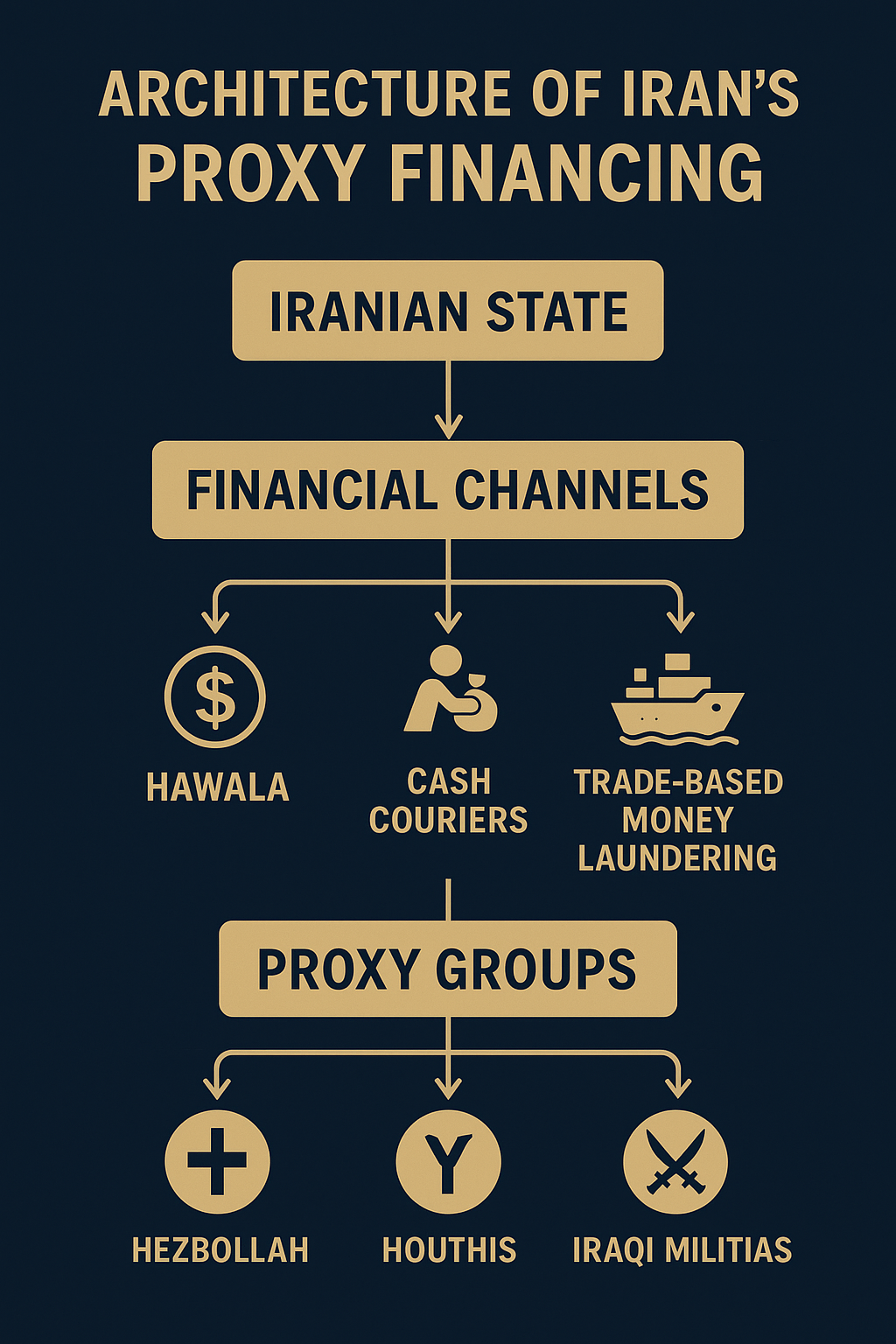
Iran’s proxy-financing system is not an improvised structure—it is a multi-layered financial architecture engineered to function even under maximum international pressure. At its core, this architecture combines state-directed funding, semi-official institutions, and informal value transfer networks, forming a resilient ecosystem that supplies Iran’s regional partners with operational continuity.
The purpose is simple:
To fund allied militant groups without leaving fingerprints in the formal financial system.
But the method is complex.
- State-Directed Funding Channels
Although Iran’s official budget allocates funds to organisations like the IRGC-QF (Islamic Revolutionary Guard Corps – Quds Force), the actual distribution of proxy financing happens through concealed pathways.
These include:
- Revolutionary Guard-controlled companies operating inside Iran and abroad
- State-owned enterprises (SOEs) whose profits are partially diverted
- Dual-use charities that act as plausible humanitarian fronts
- Ministries and municipal institutions with opaque accounting structures
Funds may originate from official sources, but the transfer mechanisms are intentionally deniable.
- The Economic Wing of the IRGC
The IRGC’s control over vast sectors of Iran’s economy—including construction, petrochemicals, banking, energy, and ports—generates parallel revenue streams.
Through networks like Khatam al-Anbiya, the IRGC gains:
- Access to no-bid contracts
- Foreign currency reserves
- Cash flow is independent of Iran’s state budget
- Partnerships with opaque foreign business entities
This allows proxy financing to continue even during severe economic downturns, as the IRGC is not dependent on domestic tax collection or official government spending.
- Informal Value Transfer Systems (IVTS)
When formal banking channels tighten, Iran leans heavily on hawala, the backbone of its regional shadow economy.
Hawala networks provide:
- Cross-border transfers with no bank accounts
- Exchange of value through trusted brokers
- Anonymity and deniability
- The ability to move funds into conflict zones inaccessible to banks
Proxy groups like Hezbollah, the Houthis, and Iraqi militias all maintain their own hawala-linked nodes, facilitating seamless integration with Iran’s financial hubs.
- Front Companies and Commercial Cover
Across the Gulf, Levant, and parts of Asia, Iran operates a constellation of front companies that blend into legitimate business environments. These companies:
- Trade goods that mask money flows
- Produce false invoices
- Move funds through over- and under-invoicing
- Serve as logistical hubs for smuggled commodities (fuel, metals, electronics)
Their commercial façade helps transfer millions of dollars under routine trade documentation.
- Cash-Based Corridors
Despite digital finance, cash remains king in Iran’s proxy ecosystem.
Reasons:
- Cash is untraceable
- Sanctioned individuals cannot access international banking
- Conflict zones often operate without functional banking systems
Cash is moved through:
- Couriers
- Diplomatic pouches
- Pilgrimage routes (e.g., Iraq–Iran)
- Religious foundations
- NGO supply convoys
Once inside host countries, cash is exchanged via local brokers and integrated into militia-controlled economies.
- Multilayered Redundancy = Indestructibility
What makes the architecture powerful is not its innovation, but its redundancy.
For every blocked channel, three alternatives exist:
- A bank shuts down → hawala handles the transfer
- A front company is exposed → another replaces it
- A smuggling route is monitored → operations shift to a parallel path
- Currency is restricted → payment moves via gold, fuel, or goods
The system is designed not to collapse, but to adapt upstream of enforcement.
Chapter 2: Iran’s Informal Financial Ecosystem and Funding Architecture
Iran’s ability to finance regional proxy groups—such as Hezbollah, the Houthis, Iraqi militias, and various networks in Syria and Gaza—relies heavily on a multilayered, informal, and largely opaque financial ecosystem. This system was not created overnight; it has evolved over decades in direct response to international sanctions, financial isolation, and the need for deniable channels that bypass conventional banking scrutiny. Chapter 2 explores the core structures, actors, and operational mechanisms that enable Tehran to move funds covertly across borders.
2.1 Historical Evolution of Iran’s Informal Funding Networks
Iran’s reliance on informal value transfer systems predates recent sanctions. However, the 2010s—marked by intensified U.S. secondary sanctions, FATF pressure, and widespread banking restrictions—accelerated Iran’s shift toward alternative systems. Over time, Tehran:
- Decreased dependency on formal banks due to global surveillance and sanctions.
- Expanded IRGC-QF–aligned financial fronts in the Middle East and Africa.
- Strengthened ties with Hawala brokers, money exchangers, and traders capable of moving funds under the radar.
- Built an international web of dual-use businesses that both generate revenue and facilitate transfers.
This evolution created an ecosystem that remains resilient even under maximum economic pressure.
2.2 The Role of the IRGC-Quds Force
The IRGC-QF is the central architect of Iran’s proxy funding model. It coordinates:
- The selection of financial channels (Hawala, cash couriers, trade-based laundering).
- The distribution of funds from Tehran to proxy commanders.
- Partnerships with regional money-service businesses (MSBs), gold traders, and exchange houses.
Its financial units often use:
- Front companies, posing as import/export firms.
- Exchange houses in Iraq, Lebanon, and the UAE act as intermediaries.
- Beneficial ownership concealment, masking real controllers.
- Local facilitators embedded within proxy communities.
2.3 Hawala: The Backbone of Iran’s Illicit Transfers
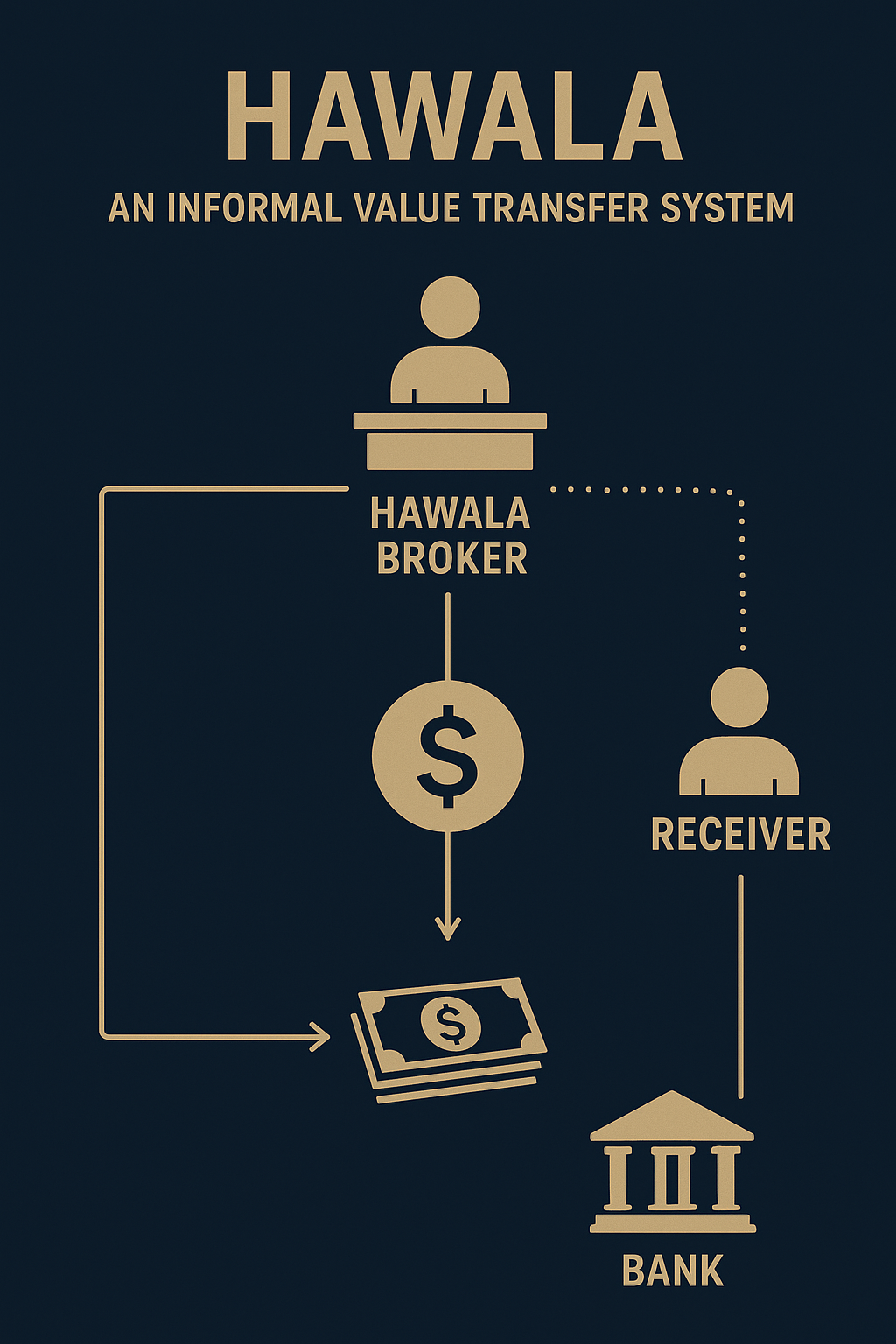
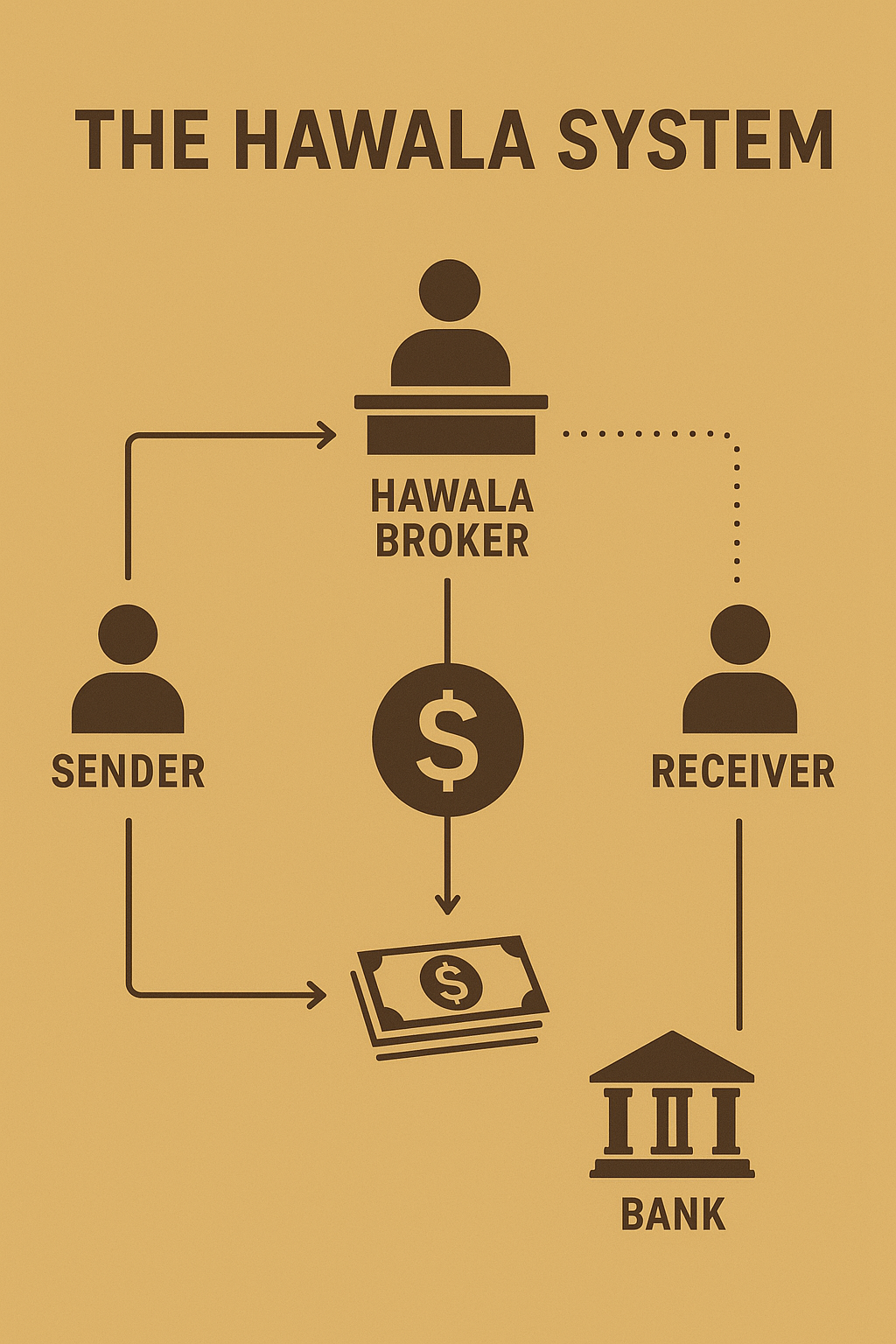
Hawala networks represent Iran’s fastest and most adaptable mechanism for moving funds abroad. These systems:
- Operate on trust-based ledgers, not formal banking rails.
- Leave minimal documentation, making them ideal for sanctions evasion.
- Allow movement of large sums across Iraq, Syria, Lebanon, and Yemen in less than 24 hours.
Common practices include:
- Triangular settlement, where a payment in Tehran triggers a release of funds in Beirut or Baghdad.
- Settlements are made through trade goods, such as foodstuffs, electronics, or auto parts.
- Use of brokers loyal to both Iran and local militia leaders.
For groups like Hezbollah (Lebanon), PMF factions (Iraq), and the Houthis (Yemen), Hawala is the primary artery.
2.4 Cash Couriers and Diplomatic Channels
Cash remains central to covert operations. Iran routinely uses:
- Diplomatic pouches, shielded from inspection.
- IRGC-linked airline routes, particularly those operating Tehran–Baghdad, Tehran–Damascus, and Tehran–Beirut.
- Overland couriers across Iraq’s porous borders, often protected by militia control points.
Cash deliveries are especially prominent in:
- Syria (where banking systems are degraded),
- Yemen (where the Houthis require physical currency), and
- Lebanon during banking crises.
2.5 Trade-Based Money Laundering (TBML)
Iran leverages trade networks to disguise proxy payments as legitimate commercial flows. TBML techniques include:
- Over- and under-invoicing of shipments.
- Phantom cargo (declaring shipments that never existed).
- Use of commodities (oil, petrochemicals, metals) to settle debts within proxy networks.
- Circular trade routes across the Gulf, East Africa, and the Caucasus.
In this architecture, merchants become pivotal financial intermediaries.
2.6 Dual-Use Businesses and Revenue Generation
Tehran’s funding model relies not only on transfers, but also on local revenue streams generated by proxies. These include:
- Telecommunications companies in Iraq and Syria
- Charitable organizations
- Real-estate portfolios
- Fuel smuggling rings, particularly in the Iraq–Syria corridor
- Local taxation systems (e.g., Houthis in Yemen)
Such enterprises both collect revenue and launder money, while reducing dependency on direct transfers from Iran.
2.7 The Multi-Layered Flow Structure
Iran’s proxy financing architecture can be summarised as:
Donor Layer (Tehran):
IRGC-QF, Ministry of Defence, state budgets, covert revenues (oil, petrochemicals).
Conduit Layer:
Hawala dealers, MSBs, traders, front companies, diplomatic channels.
Receiver Layer:
Hezbollah, Houthis, PMF groups, Syrian militias, and intelligence units.
Each layer is intentionally isolated so that:
- No single participant sees the full picture,
- Attribution becomes difficult,
- Disruption requires targeting multiple nodes simultaneously.
Chapter 3: Financial Pathways from Iran to Hezbollah — The Oldest and Most Sophisticated Pipeline
Among all Iran-aligned proxy groups, Hezbollah enjoys the most advanced, diversified, and durable funding pipeline. Unlike newer militias, Hezbollah has had decades to refine its financial channels, expand its revenue streams, and integrate deeply into global illicit finance networks. This chapter traces the exact mechanisms used to move funds from Iran to Hezbollah—across formal, informal, and covert pathways.
3.1 Why Hezbollah Has the Largest and Most Resilient Funding Network
Hezbollah’s financial infrastructure is built on three strategic advantages:
- Geography — Lebanon’s proximity to Syria and its porous borders allow seamless movement of cash, couriers, and goods.
- Institutionalisation — Hezbollah operates like a state-within-a-state, with its own banks, charities, telecoms, and taxation.
- Shared identity and ideological trust make value-transfer systems (like Hawala) even more efficient.
This enables Tehran to channel funds with minimal friction and minimal visibility.
3.2 Core Financial Channels Iran Uses to Fund Hezbollah
- Hawala Networks (Primary Channel)
This is the backbone of Iran–Hezbollah financial transfers. Typical routes include:
- Tehran → Damascus → Beirut (Dahieh) through trusted brokers.
- Tehran → Baghdad → Beirut via IRGC-linked exchange houses in Iraq.
Key features:
- Movements occur within 12–48 hours.
- No official banking records.
- Settlements are done through gold, electronics, construction materials, and fuel shipments.
For Hezbollah, Hawala provides a continuous, untraceable flow of cash and credit.
- Cash Couriers and IRGC-QF Transfers
A significant portion of funds still arrives in physical cash, often in USD or euros. Routes include:
- IRGC flights into Damascus International Airport.
- Land convoys moving through the Al-Qusayr corridor (Hezbollah-controlled).
- Lebanese couriers returning from Tehran under diplomatic or security cover.
These channels are preferred when:
- U.S. surveillance tightens,
- Banking systems become unstable (as in Lebanon’s 2019 collapse),
- Hezbollah needs quick liquidity for operations.
- Front Companies and Trade-Based Money Laundering (TBML)
Hezbollah and Iran operate a network of businesses that disguise funds as legitimate trade. Common industries:
- Construction and engineering
- Telecommunications
- Automotive parts
- Pharmaceuticals
- Import/export general trading companies
Methods:
- Over-invoicing Iranian exports to Lebanon
- Under-invoicing Lebanese exports to Iran
- Circular trade with Syria or the UAE
- Using West African trade hubs (Benin, Sierra Leone, Côte d’Ivoire)
These schemes both move funds and generate revenue.
- Lebanese Banking System (Historical but Still Partially Functional)
Before Lebanon’s financial collapse, Hezbollah used allied banks and exchange houses to move money through:
- Bulk cash deposits into small regional banks
- Shell NGOs and religious institutions
- Phantom loans masking Iranian fund injections
Post-crisis, Hezbollah shifted to:
- Hard currency vaults
- Private money-service businesses
- Off-grid financial ecosystems
But remnants of the old model still assist low-volume transfers.
3.3 Specific Iran–Hezbollah Transfer Routes (Mapped)
Below is a distilled mapping of the most commonly used flow paths:
Primary Route:
Tehran → Damascus → Bekaa Valley → Beirut (Dahieh)
- Uses Hawala + cash
- Supported by Syrian intelligence and Hezbollah logistics units
Secondary Route:
Tehran → Baghdad → Baalbek → Beirut
- Uses Iraqi exchange houses (Al-Kifah, Al-Hafez, etc.)
- Settlements made via gold and imported goods
Tertiary Route:
Tehran → Turkey → Lebanon
- Mostly TBML
- Involves front companies and commercial shipments
Global Support Route:
Iran → West Africa → Lebanon
- Hezbollah’s West African cells generate revenue through trade and used-car networks.
- Funds sent back via Hawala or gold shipments.
3.4 How Much Money Actually Moves? (Estimated Range)
Exact figures vary annually, but most credible intelligence reports place Iranian support at:
- $600 million to $1 billion per year in direct funding,
- An additional hundred million generated by Hezbollah’s own enterprises.
Of this, a significant portion flows through informal systems that never touch a bank.
3.5 Why Disrupting These Channels Is Extremely Difficult
Hezbollah’s financial ecosystem is uniquely durable because it is:
- Decentralised — no single chokepoint.
- Deeply embedded in local Lebanese society and business culture.
- Protected by political alliances within Lebanon.
- Integrated with Iran’s regional logistical networks, especially in Syria and Iraq.
- Supported by diaspora communities that trust Hawala more than banks.
Sanctioning one node simply pushes activity to another.
Chapter 4: Funding the Houthis — Iran’s Most Covert and Evasive Financial Network
If Hezbollah’s financing is sophisticated, the Houthis’ financial pipeline is the most covert, shaped by war, blockades, and extreme geographic constraints. Yemen is isolated, fragmented, and economically collapsed — making traditional transfers nearly impossible. Yet Iran has built a resilient, multi-layered system that moves money, weapons, and supplies into Houthi-controlled areas with relentless efficiency.
This chapter breaks down how Iran funnels funds to the Houthis, which channels dominate, and why the network is almost impossible to fully dismantle.
4.1 Why Yemen Requires a Different Financial Architecture
Iran cannot rely on banking systems or large commercial networks as it does with Hezbollah. Instead, Houthi financing depends on:
- Hard-to-detect maritime smuggling corridors
- Regional Hawala hubs (primarily Oman, Somalia, and the UAE)
- Shadow exchanges involving fuel and commodities
- Humanitarian-aid diversion, which has become a major revenue source
Funding the Houthis is not just about cash — it involves a complex ecosystem of goods-for-services exchanges, covert shipments, and multi-country financial laundering.
4.2 Core Financial Channels Iran Uses to Fund the Houthis
- Hawala Networks in Oman & the Gulf (Primary Channel)
Oman’s neutral foreign policy and lightly regulated money-transfer environment make it the central hub.
Typical flow:
Tehran → Muscat → Mahra Province (Yemen) → Sana’a
Features:
- Cash rarely crosses borders physically; value is transferred through accounts and commercial settlements.
- Many brokers are tribal or family-linked, providing high trust and low visibility.
- Settlement is often done through commodity shipments (fuel, food items, machinery).
- Maritime Smuggling & Ship-to-Ship Transfers
Because banking is impossible, maritime routes have become the Houthis’ lifeline.
Common routes include:
- Iran → Gulf of Oman → Arabian Sea → Yemeni coast (Al-Mahra, Shabwah, Al-Hudaydah)
- Iran → Somalia → Yemen, through multiple intermediary vessels
- Ship-to-ship transfers near Socotra or off Somalia, which avoid port documentation
Funds move through:
- Smuggled fuel is sold in Yemen for local currency
- Electronics and spare parts are used to settle Hawala balances
- Gold shipments sent from Yemen back to intermediaries
Money is embedded in trade activity — extremely difficult to track.
- Front Companies in Oman, Dubai, and East Africa
Iranian and Houthi-linked facilitators run companies that look legitimate but serve as:
- Import/export fronts
- Fuel transport operators
- Logistics contractors
- Maritime cargo handlers
- Cash-intensive businesses (restaurants, retail, small trading houses)
These front companies:
- Over-invoice Iranian exports
- Under-invoice Yemeni imports
- Create phantom shipments to disguise the movement of money and goods
- Use “dual-use cargo” to cover weapons and electronics
Dubai’s large, diverse trade environment is especially useful for laundering funds through container consolidation.
- Humanitarian Aid Diversion (A Major Revenue Source)
The Houthis have turned Yemen’s humanitarian crisis into a stable funding stream.
Mechanisms include:
- Taxing NGOs and logistics operators
- Controlling warehouses and distribution centres
- Selling aid supplies on the black market
- Requiring aid organisations to use Houthi-approved partners, many of whom are linked to financial networks
This generates hundreds of millions in internal revenue, reducing the need for overt Iranian cash transfers.
- The Iranian Fuel Pipeline: “Oil for Operations”
Perhaps the most important channel is fuel:
Iran provides subsidised fuel to Houthi-linked traders →
The fuel enters Yemen (legally or illegally) →
It is sold at market prices →
Profits go directly to Houthi coffers.
This system:
- Requires no banking infrastructure
- Produces massive liquidity
- It is nearly impossible to sanction without full maritime interdiction
Fuel is effectively currency in Yemen.
4.3 Specific Yemen-Based Nodes Critical to the Network
Al-Mahra Province
A historically autonomous region where tribal relationships matter more than state authority.
It hosts:
- Hawala brokers
- Fuel-smuggling pipelines
- Cross-border payments facilitated by tribal intermediaries
Sana’a (Financial Capital of Houthi-Controlled Yemen)
The Houthis control:
- Central bank branches
- Customs offices
- Telecom revenues
- Visa, passport, and tax systems
Iran funnels money into these structures through aligned commercial actors.
Al-Hudaydah Port
Despite UN supervision attempts, the port remains a:
- Revenue generator
- Gateway for regulated and unregulated imports
- Key point for aid diversion
4.4 How Much Money Actually Moves? (Estimated Range)
Reliable estimates suggest:
- Iran provides $100–$300 million annually to the Houthis
- Fuel revenue and internal taxation generate $1 billion+ annually inside Yemen
- Smuggling networks move hundreds of millions worth of goods, indirectly funding military operations
The Houthis therefore rely more on internal illicit revenue than on direct Iranian financial support — a strategic design by Tehran.
4.5 Why Disrupting the Houthis’ Financial Network Is Still Nearly Impossible
The challenge is structural:
- Yemen’s war economy is heavily informal
- Maritime monitoring is limited across millions of square kilometres
- Hawala is culturally embedded and trusted
- Smuggling is normalised and economically necessary
- Houthi-controlled territory contains Yemen’s population centres
- Iran leverages states with neutral or ambiguous positions (e.g., Oman)
This creates a resilient, layered network built for survival under sanctions.
Chapter 5: Financing Iraq’s Proxy Militias — The Islamic Republic’s Most Politically Sensitive and Denied Network
Iraq is the core of Iran’s regional proxy architecture. No other country hosts a network as large, as politically embedded, or as financially sophisticated as the militias operating under — and around — the Popular Mobilisation Forces (PMF/PMU).
While Hezbollah is Iran’s most iconic proxy and the Houthis are its most unconventional one, Iraqi militias are the backbone of Tehran’s regional power projection. Their financial ecosystem is so intertwined with Iraq’s economy and institutions that untangling it would require a structural transformation of the Iraqi state itself.
This chapter exposes how Iran moves funds into Iraq, how militias generate revenue internally, and why sanctions have repeatedly failed to disrupt this system.
5.1 Understanding the Iraqi Context: A Hybrid State and Militia Economy
Since 2014, Iraqi militias have transitioned from “armed groups” into state-integrated financial actors. Many PMF units now:
- Control border crossings
- Operate customs points
- Manage multimillion-dollar logistics companies
- Own banks, exchange houses, and charities
- Influence ministries and state contracts
- Control oil field security and, indirectly, smuggling
This means Iranian funding flows into an environment where militias already have revenue streams of their own — Iran acts as a strategic allocator and stabiliser rather than the primary financier.
5.2 The Three Main Pillars of Iran’s Funding System in Iraq
Iran’s financing of Iraqi militias relies on three interconnected channels:
- Cash and Banking Transfers from Iran to Iraq
Despite sanctions, Iran continues to push funds through:
- Iranian banks with opaque subsidiaries in Iraq
- Exchange houses (ṣarrafas) operating across Najaf, Karbala, Baghdad, and Basra
- Charitable foundations tied to religious networks (bonyads)
- Pilgrimage-related cash flows
- Iran-linked trade settlements disguised as import/export payments
The movement is high-volume and intentionally blended with legitimate economic activity.
- Internal Revenue Generated by Militias Inside Iraq
This is the most important pillar, producing billions annually. Revenue streams include:
- Border Crossing Control
PMF-linked groups control or influence:
- Al-Qaim
- Shalamcheh
- Mundhiriyah
- Safwan
- Several Kurdish-region crossings indirectly
They collect “informal fees,” control trucking corridors, and tax commercial convoys.
Annual estimates: $300 million–$1 billion in unofficial revenue.
- Fuel Smuggling and Oil Manipulation
Militias oversee:
- Fuel transportation routes
- Refinery distribution
- Local resale networks
- “Missing barrels” accounting loopholes
- Protection fees for illegal refineries in Kirkuk, Maysan, and Basra
A single militia can make tens of millions per month during peak smuggling periods.
- State Contracts and Ministry Influence
The PMF has embedded itself deep inside:
- Electricity sector contracting
- Construction tenders
- Customs operations
- Agriculture imports
- Ministry of Communications (fibre optics, telecom fees)
- Health Ministry procurements (medical supply contracts)
Militia-aligned businessmen win contracts at inflated prices, redistributing profits back to the armed groups.
- Religious Pilgrimage Revenues
The Arbaeen pilgrimage alone moves hundreds of millions in cash annually.
Militia-linked groups operate:
- Hotels
- Transportation companies
- Exchange houses
- Visa and entry-service intermediaries
Tehran uses pilgrimage flows as liquid, untraceable financial lubrication.
- Military and Material Support from Iran
The IRGC moves:
- Weapons
- Drones
- Training resources
- Technical advisors
- Sophisticated communication systems
- Untraceable cash delivered in secure convoys
This allows Iran to reduce direct financial outflows while strengthening the militias operationally.
5.3 Core Iranian-to-Iraq Transfer Routes
- The Najaf–Karbala Religious Corridor
Highly cash-intensive, lightly monitored, and covered by religious legitimacy.
Perfect for:
- Cash drops
- Hawala settlements
- Bonyad-linked transfers
- Basra–Shalamcheh Commercial Route
Fuel trucks, construction materials, and industrial shipments hide the movement of:
- Cash
- High-value goods
- Over/under-invoiced cargo
Basra is also a major point for militia control over logistics and customs.
- Kurdistan Region Financial Centres
Sulaymaniyah and Erbil host:
- Exchange houses
- Business elites operating across borders
- Gold traders
- Real-estate settlements
This region is used for triangulated transactions, adding deniability.
5.4 Key Militia Actors and Their Financial Structures
- Kata’ib Hezbollah (KH)
Iran’s most loyal and strategically important Iraqi militia.
Funding channels include:
- Tehran direct transfers
- Control of logistics companies
- Border taxation
- High-level influence inside the Ministry of Communications
KH also controls cyber networks used for phishing, crypto theft, and online extortion.
- Asa’ib Ahl al-Haq (AAH)
Masters of:
- Local taxation
- Oilfield “security” contracts
- Extortion operations
- Political financing through business elites
- Controlling trucking syndicates in Baghdad and Basra
AAH is deeply embedded in provincial governance structures.
- The Badr Organisation
The oldest Iran-aligned Iraqi faction, integrated directly into:
- Ministry of Interior
- Border security apparatus
- Customs operations
Their access to state systems provides unmatched visibility over financial flows.
- Smaller PMF Units (Harakat al-Nujaba, Kata’ib Sayyid al-Shuhada, etc.)
They rely more on:
- Iranian direct funding
- Local extortion
- Tribal commerce networks
- Crypto-enabled fundraising
But collectively, they form a major part of Iran’s deterrence strategy against the U.S. inside Iraq.
5.5 Estimated Size of the Financial Network
Based on intelligence estimates, NGO reports, and leaked Iraqi government data:
- Iran’s direct cash transfers: $100–$200 million per year
- Internal militia-generated revenue: $1.5–$2.5 billion annually
- State contract manipulation: $500 million–$1 billion
- Fuel/oil smuggling: $1 billion+ per year during peak seasons
This makes Iraq Iran’s most financially productive proxy ecosystem.
5.6 Why Disruption Is Nearly Impossible
- Militias are embedded inside the state
They run ministries, police units, customs, and contract offices.
- Funding is mixed with legitimate economic activity
Meaning sanctions cannot isolate illicit flows without harming Iraq’s economy.
- Hawala remains dominant despite formal banks
Militias use long-established Iraqi tribal networks.
- Iran benefits from Iraq’s political dependency.
The Baghdad–Tehran relationship gives militias diplomatic and institutional cover.
- Every actor profits from the status quo.
Militias, politicians, tribes, border authorities, and contractors all have incentives to maintain the system.
Chapter 6: Hezbollah’s Evolved Global Financial Architecture — From Local Patronage to a Transnational Financial Empire
Among all Iran-backed groups, Hezbollah possesses the most sophisticated, diversified, and globally embedded financial network. What began in the 1980s as a religious movement funded directly by Tehran has transformed into a multilayered, multinational financial empire generating revenue from Latin America to West Africa, the Levant, Europe, and online ecosystems.
This chapter maps out Hezbollah’s funding architecture through the lens of illicit finance, examining Iran’s role, global revenue sources, laundering routes, criminal partnerships, and the organisation’s unique ability to hybridise ideology, state institutions, and transnational commerce.
6.1 Iran’s Financial Patronage: Still Significant, but No Longer the Majority
For decades, Iran served as Hezbollah’s primary bank. Today, that dynamic has shifted.
- U.S. intelligence assessments indicate Iran transfers $700 million annually to Hezbollah (though wartime estimates vary).
- However, only 30–40% of Hezbollah’s total budget now relies on Iranian financing.
- The rest is self-generated through a global web of commercial, charitable, and criminal activities.
Iran remains the strategic guarantor of military capability — but Hezbollah has built financial autonomy, ensuring resilience even under sanctions.
6.2 Hezbollah’s Global Revenue Model: A Three-Tier Financial System
Hezbollah operates using three interconnected revenue layers:
Tier 1 — Domestic Lebanese Revenue Streams
Inside Lebanon, Hezbollah controls a massive parallel economy. Sources include:
- Telecommunication and ISP Networks
Hezbollah-linked companies operate secure networks, fibre lines, and internet service nodes, generating millions annually.
- Construction, Real Estate, and Municipal Contracts
From Bekaa to Beirut’s southern suburbs, Hezbollah-affiliated businesses dominate:
- Waste management
- Road construction
- Housing projects
- Municipality-level service fees
- Fuel Imports and Subsidy Manipulation
The group has leveraged Lebanon’s economic collapse by monopolising subsidised fuel distribution, earning huge margins during shortages.
- Charitable Organizations
The Martyrs Foundation, Imam al-Mahdi Scouts, and religious charities are used to:
- Channel donations
- Move cash
- Pay salaries
- Mask financial flows as humanitarian activities
Tier 2 — Regional Networks Across the Middle East
Hezbollah maintains regional laundering and commercial infrastructures, especially in:
Syria
- Real-estate acquisitions in Damascus and Homs
- Captagon production and trafficking
- Fuel convoys and border taxation
Iraq
- Joint operations with Kata’ib Hezbollah and AAH
- Involvement in oil smuggling corridors
- Access to PMF-dominated banking channels
Gulf States (covert)
Low-profile donation networks and trading companies operate through Shi’a business circles.
Tier 3 — Global Illicit and Commercial Networks
This layer is what makes Hezbollah uniquely powerful.
- Latin America — The Tri-Border Area (TBA)
The most critical hub outside the Middle East. Activities include:
- Trade-based money laundering
- Counterfeit goods
- Drug trafficking partnerships
- Large-scale cash smuggling
- Used-car export networks
Hezbollah operatives collaborate with:
- Brazilian crime syndicates
- Paraguayan contraband networks
- Colombian narco-traffickers
Estimated revenue: $200–$500 million annually.
- West Africa
Hezbollah-linked business elites in Côte d’Ivoire, Ghana, Senegal, Gambia, and Nigeria facilitate:
- Gold and diamond trading
- Cash remittances
- High-value goods smuggling
- Money laundering through import–export firms
These networks draw from decades-old Lebanese diaspora communities.
- Europe and North America
Activities focus on:
- Counterfeit pharmaceuticals
- Cigarette smuggling
- Used-car trades
- Restaurant and retail laundering
- Online scams
- Illicit shipping intermediaries
Cells typically avoid violent operations and focus on revenue.
6.3 The Captagon Connection — A Transformational Revenue Source
Since 2020, Hezbollah and allied Syrian groups have become key players in the Captagon narcotics industry, worth an estimated $5–10 billion annually.
Hezbollah’s roles:
- Managing production labs in Qalamoun
- Securing transportation routes to Jordan, Iraq, and the Gulf
- Providing chemical procurement pathways
- Laundering profits via Lebanese businesses and African intermediaries
Captagon has become a strategic financial pillar and a major source of friction between Gulf monarchies and the Iran–Syria–Hezbollah axis.
6.4 Hezbollah’s Financial Laundering Architecture
The group launders money through four major mechanisms:
- Hawala Networks
Hezbollah’s hawala system is one of the largest in the region, connecting:
- Lebanon
- Syria
- Iraq
- Iran
- Turkey
- West Africa
- Latin America
Hawala is used for fast, untraceable settlements.
- Trade-Based Money Laundering (TBML)
Hezbollah is a master user of:
- Over-invoicing
- Under-invoicing
- Phoney import/export documents
- Used-car shipments
- Consumer goods re-exporting through Africa
TBML allows multi-million-dollar transfers disguised as normal trade.
- Gold, Diamonds, and High-Value Commodities
The group frequently uses:
- Gold trading in West Africa
- Diamond intermediaries in Sierra Leone and Liberia
- Precious metal smuggling through Turkish and Emirati markets
Gold is a preferred asset due to its portability and global liquidity.
- Cryptocurrency and Online Fraud Ecosystems
Hezbollah-linked cells have begun:
- Crypto-based schemes
- Online phishing operations
- Virtual donation campaigns
- Tech-based laundering using mixers and exchanges
This gives them resilience against traditional sanctions.
6.5 Iran’s Role in Hezbollah’s Modern Funding Model
Although Hezbollah is increasingly self-funded, Iran still provides:
- Strategic cash infusions
- Military payroll for high-level units
- Weapons systems and drones
- Training infrastructure
- Intelligence and cyber support
Iran acts as a financial stabiliser, ensuring Hezbollah never faces operational collapse even if global revenue is disrupted.
6.6 Estimated Financial Scale
Approximate annual Hezbollah revenue:
- Iranian Support: $700 million
- Domestic Lebanese Revenues: $300–$600 million
- Regional Operations: $200–$400 million
- Global Criminal/Commercial Networks: $400–$1 billion
Total Estimated Annual Budget:
👉 $1.6–$2.7 billion
This makes Hezbollah one of the wealthiest non-state armed groups in the world.
6.7 Why Hezbollah Is Almost Impossible to Financially Isolate
- Deeply rooted global diaspora networks
Lebanese communities across Africa and Latin America provide built-in commercial networks.
- A hybrid ideological–commercial model
Unlike other groups, Hezbollah popularises the narrative that business success supports “resistance.”
- Ability to operate inside failed and semi-failed states
Lebanon and Syria provide ideal environments for shadow economies.
- A decentralised financial ecosystem
Multiple nodes mean no single point of failure.
- Sanctions have forced adaptation
Every new sanction makes Hezbollah more innovative, not weaker.
Chapter 7: The Houthi Financial Matrix — How a Local Insurgency Became a Regional Illicit Finance Powerhouse
If Hezbollah represents the mature model of Iran-backed illicit finance, the Houthis movement (Ansar Allah) represents its fastest-evolving version. In less than a decade, the Houthis have transformed from a tribal insurgency confined to Yemen’s northern mountains into a regional financial actor capable of generating hundreds of millions annually through taxation, smuggling networks, maritime disruption, and Iranian-backed financial channels.
This chapter dissects the Houthi financial ecosystem — its revenue streams, money-laundering infrastructure, maritime leverage strategy, and the unprecedented financial impact of the Red Sea crisis.
7.1 Iran’s Support: The Catalyst for State-Like Revenue Expansion
Iran provides the Houthis with:
- Weapons shipments via dhows and land routes
- Advisors from IRGC-Quds Force
- Intelligence and drone technology
- Financial transfers through hawala and commodity channels
But unlike Hezbollah, Iranian funding is not the core of the Houthis’ economy.
Tehran’s support functions more as:
- A military multiplier
- A political shield
- A logistics enabler
The Houthis’ real financial strength comes from their control over population centres, ports, and revenue-producing state institutions.
7.2 The Houthis’ Domestic Revenue Empire
By capturing Sana’a and western Yemen, the Houthis gained access to Yemen’s economic heartland, giving them control over:
- Customs Revenues
At ports and land crossings they control (Hodeidah, Salif, Sana’a airport), Houthis impose:
- Import taxes
- Fuel duties
- “War effort surcharges”
- Forced customs revaluations
Estimated annual revenue: $1–1.5 billion.
- Fuel Trade Monopoly
The single largest domestic revenue source.
Houthis manipulate:
- Fuel shipments
- Black-market sales
- Humanitarian fuel flows
- Port access for fuel tankers
They generate profits through:
- Overpricing imported fuel
- Seizing fuel convoys
- Allowing only Houthi-approved companies to participate
Estimated margin on black-market fuel: 60–120%.
- Telecommunications and Internet
The Houthis control Yemen’s main telecom infrastructure, including YemenNet.
Revenues come from:
- Internet and mobile data packages
- SIM card taxes
- Forced “service fees”
Telecom operations deliver high-cash-flow, low-risk income and facilitate surveillance and financial tracking.
- Zakat and Forced Donations
The group institutionalised its own taxation system:
- Zakat
- “Khums” (20% war tax)
- “Donations for Palestine” (reallocated to Houthi operations)
- Business protection fees
Businesses in Sana’a are heavily targeted.
- Real Estate & Seizures
Properties belonging to:
- Political opponents
- Journalists
- Former government workers
- Exiled businessmen
…are confiscated and added to Houthi-controlled financial entities.
7.3 Cross-Border Smuggling Networks — The Houthi Lifeline
The Houthis run one of the most profitable smuggling ecosystems in the region.
- Iran–Yemen Weapons Smuggling
Using:
- Small dhows
- Omani tribal routes
- Somali intermediaries
- Qatari sea corridors (historically)
Weapons shipments also contain:
- Cash
- Electronics
- Drone parts
- Fuel additives
- Horn of Africa Trade Corridors
Critical hubs include:
- Somalia
- Djibouti
- Eritrea
- Somaliland
Activities:
- Fuel smuggling
- Arms resupply
- Cash movement
- Human trafficking taxes
- Livestock and charcoal smuggling routes (shared with Al-Shabaab networks)
This network functions through informal maritime hubs, making it extremely hard to interdict.
- The Red Sea Economy
Before 2023, the Houthis already taxed:
- Fishing fleets
- Informal boat traders
- Cargo movements between Eritrea & Yemen
After 2023, this escalated into a geopolitical financial weapon.
7.4 Maritime Disruption as a Revenue Strategy — The Red Sea Crisis
With the escalation of global shipping attacks, the Houthis effectively weaponised the Red Sea.
This shift produced three major financial outcomes:
- Insurance & Rerouting Impact
Global shipping rerouted around the Cape of Good Hope, causing:
- Longer routes
- Higher costs
- Massive insurance premiums
This disrupted maritime economies across:
- Egypt
- Saudi Arabia
- Jordan
- Djibouti
The chaos increases the Houthis’ strategic value to Iran.
- Protection Payments (informal)
Some regional carriers reportedly paid intermediaries for:
- Safe passage agreements
- Avoidance guarantees
- Reduced targeting risks
These payments move through:
- Hawala networks
- Omani intermediaries
- Somali merchants
- Cryptocurrency mixers
- Houthi Fundraising Through “War Economy” Narratives
The Red Sea operations boosted:
- Public donations in Houthi areas
- “War effort fees”
- Zakat collections
- Diaspora remittances
The movement successfully reframed maritime attacks as:
“Defending Palestine and Yemen from Western aggression.”
This ideological monetisation is unprecedented in the region.
7.5 The Houthi Hawala & Laundering Ecosystem
Like Hezbollah, the Houthis rely heavily on hawala.
Key routes include:
- Tehran → Muscat → Sana’a
- Beirut → Damascus → Saada
- Dubai → Djibouti → Hodeidah
- Somalia → Yemen (Northern Coast)
Laundering mechanisms:
- Import–export invoice manipulation
- Charcoal & livestock re-export scams
- Cryptocurrency wallets tied to Gulf intermediaries
- Fuel shipments disguised as humanitarian cargo
The U.S. Treasury has already designated several Houthi-linked hawaladars in Turkey, Oman, and the Gulf.
7.6 Estimated Annual Houthi Revenue
Combined financial flows:
- Domestic revenues: $1.5–2.5 billion
- Smuggling networks: $300–600 million
- Iranian support: $100–250 million
- Maritime disruption-related gains: Unknown, but possibly tens of millions via indirect channels
- Crypto & online fundraising: $10–30 million
Total estimated annual budget:
👉 $2–3.4 billion
This places the Houthis on par with — or in some years even higher than — Hezbollah.
7.7 Why the Houthis Are Financially Resilient
- They control Yemen’s most populated and economically vital regions
Over 70% of Yemen’s population lives under Houthi authority.
- They inherited state institutions.
Customs, telecom, energy — all major revenue sectors are under their control.
- Smuggling networks operate across failed-state regions
Somalia, Djibouti, and Eritrea offer ideal environments for illicit trade.
- Ideology is monetised
War fundraising is integrated into daily life in Houthi areas.
- Iranian backing provides stability
Even partial support ensures continuity.
Chapter 8: Country Case Studies – Lebanon, Yemen, Iraq, and Syria
This chapter provides country-specific breakdowns of the financial pathways Iran uses to fund Hezbollah, the Houthis, Iraqi militias, and Syrian networks. Each case study follows a structured model: financial channels, intermediaries, estimated flows, risks, and external enablers.
8.1 Lebanon – Financing Hezbollah
Primary Mechanisms
- Hawala networks operating between Beirut, Dahieh, South Lebanon, Iran, Turkey, and West Africa.
- Front companies in construction, telecommunications, and fuel import sectors.
- Charitable organisations serving as façade institutions for moving funds under “humanitarian” labels.
- Cash smuggling via Beirut–Damascus routes and through Beirut Airport.
Key Intermediaries
- Lebanese and Syrian exchange houses.
- West African Shi’a business networks (notably in Côte d’Ivoire, Benin, and Senegal).
- Hezbollah-aligned businessmen are using dual-purpose trade invoices.
Estimated Flows
- Annual financial support from Iran is estimated between $700 million–$1 billion, including weapons, salaries, and operational funding.
External Enablers
- Weak Lebanese banking oversight since the 2019 collapse.
- Political protection through Hezbollah’s influence in state institutions.
8.2 Yemen – Financing the Houthis
Primary Mechanisms
- Maritime smuggling networks in the Gulf of Aden and the Red Sea are moving cash, fuel, and components.
- Weapons-smuggling routes doubling as financial channels; arms shipments are often prepaid through Hawala.
- Use of Oman-based and Somali-based exchange houses for quiet value transfers.
- Crypto and prepaid cards have been used by Houthi operatives since 2022 to bypass sanctions.
Estimated Flows
- Iran’s direct annual financial assistance is estimated at around $100–$150 million, excluding weapons shipments.
External Enablers
- Lack of unified Yemeni financial oversight.
- Corruption within ports controlled by the Houthis (Hodeidah, Salif).
- Somali and Djiboutian intermediaries operate with limited AML enforcement.
8.3 Iraq – Financing Iranian-Backed Militias
Primary Mechanisms
- Cash couriers are moving funds from Iran through land borders at Kermanshah, Diyala, and Basra.
- Religious shrines and pilgrim charities used to move millions through donations.
- Oil-sector corruption, including illicit oil sales and inflated contracts by militia-controlled ministries.
- Banking exploitation, such as using Iraqi banks with weak due diligence standards to process large dollar transfers.
Key Militias Receiving Funds
- Kata’ib Hezbollah
- Asa’ib Ahl al-Haq
- Harakat al-Nujaba
Estimated Flows
- Annual Iranian financial support ranges between $150–$300 million, potentially higher during active conflict periods.
External Enablers
- Fragmented governance and militia penetration of the Iraqi state.
- High corruption tolerance in government procurement.
- Presence of hundreds of lightly regulated exchange houses.
8.4 Syria – Financing Government and Militia Networks
Primary Mechanisms
- Credit lines extended by Iran’s central bank to Damascus (estimated billions since 2011).
- Hawala routes between Tehran → Baghdad → Damascus → Beirut.
- Fuel shipments, often delivered under subsidy agreements and repaid through favours instead of formal payments.
- Proxy militias receiving direct cash for operations (Liwa Fatemiyoun, Zainabiyoun brigades).
Estimated Flows
- Although exact figures vary, Iranian support to Syria is estimated at $1–$2 billion annually during peak conflict years.
External Enablers
- Dependence of the Assad government on Iranian backing.
- Sanctions-isolated Syrian banking system relying on informal value transfer.
- Militia-controlled border crossings enable unchecked cash movement.
Chapter 9: Key Financial Nodes and Corridors
This chapter maps the geographic and logistical pathways through which Iran channels funds to Hezbollah, the Houthis, and other regional proxies. These corridors combine informal financial networks, physical smuggling routes, trade hubs, and permissive jurisdictions that allow large volumes of money to move quietly across borders.
9.1 Gulf Region—The Primary Financial Interface
United Arab Emirates (UAE) – Dubai & Sharjah
- Acts as a major trade and re-export hub, enabling dual-use goods and sanctioned items to move under commercial cover.
- Home to thousands of small and medium-sized currency exchange houses and “free zone” companies, many of which have historically lacked strict verification procedures.
- Iranian-linked networks use:
- Front companies
- Bulk cash smuggling via ports
- Trade-based money laundering (TBML), especially through gold, electronics, and auto parts.
Oman
- Serves as a quiet corridor for funds entering Yemen.
- Hawala networks in Muscat and Salalah maintain long-standing ties to East African intermediaries used by the Houthis.
9.2 Iraq—The Central Overland Bridge
Iraq serves as Iran’s primary land corridor for funding militias in Iraq, Syria, and Lebanon.
Key Nodes
- Border crossings: Mehran, Khosravi, Basra, Mandali.
- Exchange hubs: Baghdad’s Karrada district, Najaf, Karbala.
- Banking gateways: Local banks with minimal AML checks that allow dollar-denominated transactions.
Routes
- Iran → Diyala → Baghdad → Syria (via al-Qaim)
- Iran → Basra → Kuwait/Gulf waters
- Iran → Kurdistan Region → Turkey
Role in the Network
- Facilitates cash shipments, Hawala settlements, religious donation flows, and oil-related corruption schemes benefitting Iranian-backed militias.
9.3 Syria—A Multi-Directional Smuggling Hub
Syria functions both as a transit corridor and a financial distribution zone:
Key Corridors
- Damascus → Beirut: The most significant path for funds destined for Hezbollah.
- Boukamal / Al-Qaim corridor: Controlled by militias, used for weapons and cash transfers.
- Latakia Port: Historically used for sanctioned goods and Iranian shipments under mislabeled cargo.
Financial Functions
- Syria acts as the settlement country where Iraqi and Iranian Hawala operators balance accounts before the money continues to Lebanon.
9.4 Turkey—Commercial Gateway and Exchange Hub
Though not directly aligned with Iran politically, Turkey’s large commercial ecosystem offers indirect avenues:
Why It Matters
- Its huge gold market allows for gold-for-currency swaps, benefitting Iranian networks.
- Presence of tens of thousands of Iranian-owned companies.
- Istanbul’s exchange houses and informal traders conduct high-volume Hawala operations connecting:
- Iran ↔ Europe
- Iran ↔ Lebanon
- Iran ↔ Gulf
- Iran ↔ East Africa
Smuggling Role
- Goods are purchased in Turkey, shipped to the Gulf or Iraq, and used for trade-based laundering.
9.5 East Africa—A Parallel Financial Ecosystem
Iranian proxies maintain deep connections with African Shi’a business networks that operate large Hawala corridors.
Key Countries
- Tanzania, Kenya, Uganda: Used for cash storage and discreet settlements.
- Somalia & Somaliland: Major Houthi-linked Hawala pathways through Mogadishu, Bosaso, and Hargeisa.
- West Africa (Côte d’Ivoire, Benin, Ghana): Home to Lebanese diaspora networks that move millions for Hezbollah through diamonds, used cars, and general trade.
Role
- Provides alternative corridors when the Gulf or Levant channels are monitored.
9.6 Caucasus Region
Armenia & Georgia
- Used by Iranian businessmen to open companies, access international banking, and move funds into Europe and Asia.
- Acts as a detour when routes through Turkey or the Gulf face scrutiny.
9.7 Summary of Corridor Importance
| Corridor | Primary Use | Beneficiary Groups | Risk Level |
| Iraq → Syria → Lebanon | Cash + weapons + Hawala | Hezbollah, Iraqi militias | Very High |
| Gulf → Yemen | Cash + fuel + crypto | Houthis | High |
| Turkey ↔ Iran ↔ Gulf | TBML + gold swaps | Hezbollah, IRGC networks | Medium |
| East Africa ↔ Levant | Hawala + trade routes | Hezbollah | Medium–High |
| Caucasus | Banking access | All proxies | Medium |
Chapter 10: Cryptocurrency Channels and Digital Payment Pathways
While traditional Hawala and trade-based systems remain dominant, Iran and its regional proxies increasingly exploit cryptocurrencies and digital financial tools to bypass sanctions, obscure fund origins, and accelerate cross-border transactions. This chapter details the architecture, actors, and platforms involved in the shift toward digital finance within Iran’s proxy funding networks.
10.1 Why Cryptocurrency Appeals to Sanctioned Networks
Cryptocurrencies offer three major advantages to Iranian actors and their affiliates:
- Anonymity and Pseudonymity
Transactions can occur without relying on the global banking system.
Even when blockchains are traceable, identifying the real-world owner requires cooperation from exchanges—something Iran often avoids.
- Global Transmissibility
A transaction executed from Tehran or Beirut can be received within seconds by an operator in Yemen, Iraq, or East Africa.
- Weak Regulation Across Borders
Many countries with high crypto adoption lack:
- Stringent KYC requirements
- Real-time reporting
- Blockchain analytics systems
These weaknesses allow illicit actors to move funds quietly.
10.2 Iran’s Domestic Crypto Ecosystem
Iran has one of the highest crypto mining footprints in the region due to subsidised electricity.
Mining as a Sanctions Evasion Tool
- Government-approved miners sell Bitcoin to international brokers.
- Revenues bypass traditional banking entirely.
- The state can redirect mined Bitcoin to fund proxy groups.
OTC Markets in Tehran & Mashhad
Large over-the-counter (OTC) crypto desks operate informally, allowing:
- Cash-for-crypto swaps
- Wallet-to-wallet transfers
- Anonymous settlements linked to Hawala traders
These desks connect directly to networks in Turkey, Iraq, and the UAE.
10.3 Hezbollah’s Use of Digital Currencies
Hezbollah has increasingly relied on cryptocurrency for portions of its financial inflows.
Key Practices
- Crowdfunding in crypto from supporters in Europe and Latin America.
- Wallet clusters tied to Hezbollah-linked charities and media outlets.
- Use of privacy coins such as Monero (XMR) to reduce traceability.
International cybersecurity reports have flagged repeated attempts by Hezbollah to use exchanges with weak compliance in:
- Malaysia
- Indonesia
- Turkey
- Lebanon
10.4 Houthi Crypto Patterns
While less technologically sophisticated, Houthi financiers leverage crypto in two ways:
- Gulf-Based Traders
Supporters in the UAE, Oman, and Kuwait use crypto to send funds to Yemen-based coordinators.
- Somalia & East Africa Nodes
Regions like Puntland and Mogadishu host crypto brokers who:
- Receive crypto donations
- Convert them into dollars or Somali shillings
- Move funds via maritime traders to Yemen
These brokers often operate outside any formal licensing regime.
10.5 IRGC-Linked Crypto Laundering Networks
The IRGC relies on multi-jurisdictional crypto laundering chains:
Common Techniques
- Layering funds by using dozens of low-volume wallets.
- Routing transactions through mixers or tumblers.
- Using stablecoins (USDT, USDC) to reduce volatility.
- Settling accounts with Chinese importers through crypto payments.
Chinese and Turkish trading companies play a significant role in this structure by accepting USDT for large-volume commodity shipments.
10.6 Exchanges and Platforms Frequently Exploited
Based on leaked reports, forensic analyses, and international investigations, Iranian and proxy networks repeatedly target:
Exchanges With Weak KYC
- LocalBitcoins (historically)
- KuCoin
- OKX
- Bitzlato
- Several regional P2P platforms in Turkey, the UAE, and Malaysia
Decentralised Platforms (DEXs)
DEXs are especially attractive because they avoid intermediaries:
- Uniswap
- PancakeSwap
- 1inch
- Tron-based DEXs (TRX is extremely popular in Iran due to low fees)
Telegram-Based Brokers
Thousands of channels operate on:
- Telegram
- Instagram
These allow near-instant crypto sales and Hawala settlements.
10.7 The Rise of USDT (Tether) as the Primary Settlement Currency
Across nearly all illicit finance corridors, one trend is dominant:
USDT is the new backbone of sanctions evasion.
Why?
- Pegged to the dollar
- Fast
- Ubiquitous
- Supported on cheap blockchains like Tron
- Easily used in OTC markets globally
Iranian and Hezbollah-linked brokers routinely request settlement in USDT because it replicates U.S. dollar movement without involving a bank.
10.8 Challenges for Detection
Blockchain Intelligence Limits
Advanced tracing tools (Chainalysis, TRM Labs, Elliptic) help, but:
- Privacy coins block analytics
- Mixers obscure transaction origins
- DEXs lack jurisdictional oversight
Jurisdictional Gaps
Many African, Asian, and Middle Eastern regulators lack the capacity or political motivation to enforce strict crypto oversight.
10.9 Why Cryptocurrency Will Continue Growing in Proxy Funding
Cryptocurrency is not replacing Hawala—it is amplifying it.
Digital assets give Tehran and its proxies:
- Faster settlements
- Cross-border reach
- Reduced reliance on vulnerable banks
- Access to global supporters without detection
Crypto, combined with Hawala and trade-based schemes, makes the financial network more resilient than ever.
Chapter 11: Maritime and Cargo-Based Funding Routes
While financial transfers through Hawala networks and cryptocurrencies form the backbone of Iran’s proxy financing, maritime logistics and cargo-based mechanisms remain some of the most lucrative and resilient pathways for moving value across borders. These routes rely not only on physical goods but also on falsified documentation, ship-to-ship transfers, and complex ownership structures that mirror offshore financial secrecy.
This chapter breaks down how Iran leverages maritime channels to finance Hezbollah, the Houthis, and other regional proxies—often in plain sight of global regulators.
11.1 Why Maritime Networks Are So Effective
- High Volume, Low Transparency
Shipping lanes carry millions of containers monthly. Hidden among legitimate cargo, illicit shipments easily blend into global commercial flows.
- Layers of Corporate Obfuscation
Most vessels are registered under:
- Shell companies
- Flags of convenience
- Offshore jurisdictions (Marshall Islands, Panama, Seychelles)
This mirrors the same secrecy structures documented in tax haven investigations.
- Limited Monitoring Capacity
Ports in East Africa, the Gulf, and parts of Asia lack advanced cargo-scanning tools, allowing high-risk shipments to pass unchecked.
11.2 IRGC’s Maritime Shadow Network
The Islamic Revolutionary Guard Corps (IRGC), particularly the Quds Force, operates a parallel shipping ecosystem designed expressly for sanctions evasion and proxy financing.
Common Tactics
- Ship-to-ship transfers in the Gulf of Oman, the Red Sea, and the Mediterranean.
- Keeping AIS (Automatic Identification System) deliberately switched off.
- Using false bills of lading, labelling sanctioned goods as “agricultural parts” or “construction materials.”
- Moving oil through intermediary ports—especially in Oman, Malaysia, Singapore, and East Africa.
These shipments generate millions in off-book revenues later diverted to proxy groups.
11.3 Hezbollah’s Logistics Network in the Mediterranean
Hezbollah relies heavily on maritime channels to supplement its funding pipeline.
Key Nodes
- Lebanese ports with historically weak auditing practices.
- Syrian ports, especially Latakia and Tartus, are controlled by regime-aligned networks.
- Cypriot and Greek waters for offshore cargo swaps.
Types of Cargo Involved
- Consumer electronics
- Automotive parts
- Pharmaceutical products
- Cigarettes and counterfeit goods
These goods are often acquired through Iranian front companies, shipped to intermediaries, and resold by Hezbollah-linked traders.
11.4 Houthi Maritime Networks in the Red Sea
Though less sophisticated than Hezbollah’s system, Houthis utilize maritime corridors extensively.
Main Pathways
- Smuggling routes from Iran’s Jask port into Yemen’s Al-Hudaydah and Salif.
- Shipments through Somalia and Djibouti acting as informal staging grounds.
- IRGC naval units are escorting high-risk shipments.
The Role of Dhow Vessels
Traditional wooden dhows—common across the Arabian Sea—are a preferred transport mode due to:
- No digital tracking
- Low visibility
- Ability to operate in shallow or remote waters
- Cultural familiarity that deters inspection
These vessels move weapons, spare parts, fuel, and in some cases, cash or gold intended for Houthi commanders.
11.5 The Somali Connection: Smuggling, Fuel, and Arms
Somalia acts as a critical offshore extension of Iranian maritime networks.
Activities Include
- Fuel smuggling operations generate cash that is later remitted to IRGC affiliates.
- Arms shipments disguised as fishing equipment.
- Payments are settled using a hybrid Hawala-crypto structure involving brokers in Puntland and Mogadishu.
This creates a regional feedback loop between Somalia, Yemen, and Iran’s eastern ports.
11.6 Cargo Diversion and “Phantom Warehouses”
Iranian-linked operators use phantom warehouses—nonexistent storage facilities listed on shipping documents—to divert cargo to unregulated locations.
How the Diversion Works
- Cargo is declared to be destined for an authorised warehouse in a Gulf or Asian port.
- Documentation is falsified to indicate the cargo was received.
- Instead, the shipment is moved to a covert site controlled by proxy affiliates.
- Goods are sold to generate unrestricted cash flow.
This method is extremely difficult to detect without high-level port audits.
11.7 Use of Gold and Precious Metals in Maritime Transfers
Gold plays a critical role in bypassing banking scrutiny.
Methods
- Gold bars moved in small consignments hidden within legitimate cargo.
- Transfer of refined gold between Iranian and Turkish traders, later used to pay proxy networks.
- Resmelting and rebranding gold to obliterate origin markers.
Gold’s portability, liquidity, and anonymity make it one of the most secure methods of funding regional militant groups.
11.8 Why Maritime Routes Will Continue to Thrive
Maritime financing is resilient because:
- Global trade is too vast to fully police.
- Ports in developing countries lack enforcement capacity.
- Shipping companies often avoid responsibility due to complex corporate chains.
- The IRGC has decades of experience operating covert sea routes.
Even if digital financial monitoring improves, maritime logistics provide Iran and its proxies with options that are low-risk, high-reward, and difficult to fully disrupt.
Chapter 12: Charitable Fronts, NGOs, and Social Service Networks
While maritime and financial systems form the hard infrastructure of Iran’s proxy funding strategies, charitable organisations, NGOs, and social service networks act as the soft infrastructure—creating legitimacy, masking flows, and embedding influence within local populations. These entities offer a perfect cover: humanitarian branding, legal registration, and community presence. But beneath the surface, many operate as fundraising, logistics, and recruitment engines for Iran-aligned groups.
This chapter unpacks how these fronts work, examines their regional footprints, and identifies why dismantling them is far more challenging than disrupting other illicit finance channels.
12.1 Why Charitable Fronts Are So Effective
- They Blend Into Legitimate Humanitarian Spaces
Humanitarian sectors in conflict zones are crowded. Amid food distribution centres, medical clinics, social programs, and reconstruction efforts, illicit activities can easily be disguised as “aid delivery.”
- They Have Legal Registration
Unlike smuggling vessels or covert financial networks, these entities often have:
- Government-issued permits
- Public websites
- Social media activity
- Tax-exempt status
This veneer of compliance reduces scrutiny.
- They Serve as Community Anchors
By providing genuine services—food, medicine, schooling—they secure local trust. That trust translates into:
- Political loyalty
- Recruitment opportunities
- Protection for covert operations
12.2 Hezbollah’s Institutional Empire: The Blueprint
Hezbollah is the undisputed master of charitable front financing in the Middle East. Its institutional network is vast enough to resemble a parallel state.
Key Entities
- Al-Qard Al-Hasan Association
Functions as an unlicensed financial institution, issuing loans and managing cash flows under the guise of charity. - Martyrs Foundation (Mu’assasat al-Shahid)
Provides stipends to families of fighters; serves as a funding channel for Iranian support. - Jihad Al-Bina’
Reconstruction organisation funded by Iran; used to mask inflows of materials, cash, and equipment.
How Funding Moves Through These Entities
- Iran wires or physically transfers value to the charity’s offshore or regional facilitators.
- The charity “allocates” funds for social projects.
- A percentage is quietly siphoned to Hezbollah’s military wing.
- Remaining funds reinforce community dependency and legitimacy.
This dual-function system—social and militant—ensures resilience even when financial pressure intensifies.
12.3 The Houthis’ Expanding Social Welfare Network
The Houthis have rapidly copied Hezbollah’s model.
Key Fronts
- Yemen Martyrs Foundation
- Local zakat authorities commandeered after 2016
- Education, health, and media offices controlled by Ansar Allah
These institutions collect:
- Taxes
- Donations
- “War effort contributions”
- Transfer fees from traders and humanitarian convoys
Funds routinely move through Houthi-controlled accounts or informal networks before being dispersed to military operations.
Hijacking of Aid Programs
The Houthis have interfered with UN-led and NGO-led relief programs by:
- Redirecting food aid
- Imposing “coordination fees”
- Manipulating beneficiary lists
- Confiscating fuel and medical supplies
- Requiring NGOs to hire Houthi-approved staff
These mechanisms both generate revenue and embed the group deeper into governance structures.
12.4 Iraqi and Syrian Militia Charities: Localised, Fragmented, but Potent
Iran-backed militias in Iraq and Syria maintain a more fragmented ecosystem of charitable fronts, but the pattern is the same.
Examples
- Iraqi Popular Mobilisation Units (PMU) charities attached to groups like Kataib Hezbollah and Asaib Ahl al-Haq.
- Syrian “reconstruction offices” in Deir ez-Zor, Aleppo, and Damascus.
- Religious endowments (waqf) institutions reclaimed or newly established in areas under militia control.
These fronts generate cash through:
- Donations
- Pilgrimage fees
- Reconstruction contracts
- Government budget allocations (particularly in Iraq)
Funds are then blended with militia budgets and Iran-directed financial flows.
12.5 How Charitable Fronts Evade Detection
- Dual Books
Many organisations maintain:
- A clean financial ledger for regulators
- A hidden ledger for illicit military or political funding
- Mislabeling of Funds
Money appears as:
- “Aid distributions”
- “Educational support”
- “Widow or orphan relief”
- “Reconstruction grants”
Meanwhile, the funds support weapons procurement, salaries, or media propaganda.
- Collaboration with Local Elites
Charities often partner with:
- Business families
- Tribal leaders
- Local administrators
These alliances provide political protection.
- Online Crowdfunding Disguises
Some groups increasingly use global crowdfunding platforms under humanitarian themes—especially for:
- Medical aid
- Refugee support
- Reconstruction projects
The collected funds are later diverted through Hawala or trusted intermediaries.
12.6 Why Charitable Networks Are So Hard to Sanction
- Community Backlash Risks
Sanctioning a group that provides food or medical care risks harming civilians and damaging international legitimacy.
- Legal Complexity
Most entities claim humanitarian status. Shutting them down requires concrete evidence—often extremely difficult to gather.
- Political Sensitivity
Governments in Lebanon, Iraq, and Yemen rely on these groups to fill governance gaps. Targeting them can destabilise local politics.
- They Are Interwoven With Genuine Aid Work
Many of these organisations perform real humanitarian tasks. This mixed role shields them from blanket sanctions.
12.7 The Strategic Purpose Behind Iran’s Charitable Fronts
These charities do more than move money—they reshape societies.
Strategic Outcomes
- Entrenching Iran’s ideological influence
- Securing public loyalty
- Expanding recruitment pipelines
- Normalising Iranian-aligned governance models
- Creating a financial ecosystem immune to international banking oversight
This aligns with Iran’s long-term proxy strategy: build parallel states, not just armed groups.
Chapter 13: Policy Implications and Global Counter-Financing Strategies
The persistence of illicit finance in regional proxy group ecosystems demonstrates a clear reality: financial disruption is just as critical as military or diplomatic intervention. Effective counter-measures require coordination that transcends national borders, intelligence silos, and isolated sanctions lists. This chapter outlines the key policy implications and comprehensive strategies needed to weaken and ultimately dismantle the financial lifelines of proxy networks.
- Strengthening International Regulatory Cooperation
Proxy groups exploit gaps between jurisdictions—especially regions with weak AML/CTF frameworks, permissive company-registration laws, and limited information-sharing.
Key policy needs include:
- Unified beneficial-ownership transparency standards
Mandating public registries that reveal ultimate owners of companies, trusts, and foundations reduces anonymity for shell structures. - Joint sanction enforcement units
Multinational enforcement teams can track sanction evasion, freeze assets, and prosecute intermediaries across borders. - Cross-border real-time data exchange
Financial intelligence units (FIUs) should engage in continuous collaboration rather than episodic reporting.
- Enhancing Financial Sector Oversight
Banks, fintech platforms, crypto exchanges, and informal remittance networks often serve as conduits—knowingly or unknowingly. Improving oversight involves:
- Risk-based supervision for high-exposure institutions
Banks operating in high-risk regions must follow enhanced due diligence (EDD) and continuous transaction monitoring. - Mandatory reporting for high-value cross-border transactions
Large or unusual fund transfers involving politically exposed persons (PEPs) or sanctioned jurisdictions should trigger immediate alerts. - Regulation of virtual asset service providers (VASPs)
Crypto exchanges must comply with FATF’s Travel Rule and implement robust KYC/AML systems to prevent proxy groups using tokens and mixers.
- Disrupting Alternative and Informal Financing Channels
Proxy groups increasingly rely on channels outside formal banking:
- Monitoring trade-based money laundering (TBML)
Over- and under-invoicing, phantom shipments, and commodity swaps are common in conflict-zone supply chains. - Targeting hawala and informal value-transfer systems
Licensing, monitoring, and integrating these networks with FIUs can reduce anonymity. - Cracking down on illicit fundraising (charities, NGOs, shell foundations)
Many groups disguise revenue under humanitarian, religious, or cultural activities.
- Leveraging Technology and Digital Intelligence
New tools are essential to map and disrupt hidden financial flows:
- AI-driven network analysis for identifying suspicious clusters, intermediaries, and layered transactions.
- Blockchain forensics for tracing crypto wallets, mixers, and cross-chain swaps.
- Big-data models for predicting financial behaviour linked to proxy group activities.
These technologies help distinguish criminal activity from legitimate civilian transactions—critical in politically sensitive conflict zones.
- Policy Coordination With Conflict-Region Governments
Governments in regions influenced by proxy groups often struggle with corruption, limited resources, or political fragmentation. Effective policy requires:
- Capacity-building for local enforcement agencies
Training, funding, and technology can improve financial investigation capabilities. - Anti-corruption frameworks tied to international aid
Donor states can condition aid on transparency reforms, reducing corruption-enabled financing. - Engagement with local communities
Grassroots outreach can reduce reliance on proxy-group financial networks.
- Balancing Security Measures With Humanitarian Considerations
While financial restrictions can disrupt illicit activity, they may also impact civilian populations. Policymakers must:
- Ensure targeted sanctions, avoiding broad measures that harm essential sectors.
- Implement humanitarian exemptions for food, medicine, and civilian infrastructure funding.
- Use proportionate enforcement to prevent economic destabilisation in fragile states.
- A Holistic “Follow the Money” War Strategy
Ultimately, weakening proxy groups requires treating finance as a battlefield. Effective strategies include:
- Simultaneous sanctioning of leaders, intermediaries, logistics operators, and front companies
- Coordinated asset freezes across multiple jurisdictions
- Financial pressure campaigns that raise operational costs for proxy networks
- Public-private partnerships, where banks, tech firms, and governments collaborate on intelligence and compliance
Conclusion of Chapter 13
Policy solutions must be global, integrated, and dynamic. Proxy groups adapt quickly—often faster than governments. A coordinated global approach that combines legal reforms, technological innovation, intelligence-sharing, and targeted enforcement can significantly weaken the financial architecture sustaining these networks. This sets the stage for the next chapter, which will focus on long-term stabilisation and the future outlook of global counter-financing measures.
Chapter 14 — Policy Implications and Global Recommendations
Illicit financial flows that support regional proxy groups continue to undermine stability in the Middle East, fuel conflict, and weaken international financial integrity. The complexity of these networks—spanning informal value transfer systems, offshore jurisdictions, front charities, cryptocurrency channels, and state-linked intermediaries—requires coordinated, multi-layered policy action. This chapter outlines actionable recommendations for governments, international bodies, and regulatory institutions based on the findings throughout the report.
- Strengthening Oversight of Informal Value Transfer Systems (IVTS)
Hawala and similar systems remain deeply embedded in local economies, making outright bans ineffective. Instead, policymakers should pursue:
- Regulated registration frameworks for Hawaladars, modelled after the UAE and India reforms.
- Mandatory transaction reporting thresholds without compromising community trust.
- Cross-border Hawala mapping initiatives supported by Interpol and FATF.
- Incentives for formal financial inclusion make regulated channels more accessible than informal ones.
- Expanding Sanctions Intelligence and Enforcement Capacity
Current sanctions regimes often lag behind the evolving techniques used by Iran and its proxy networks. Improvements include:
- Real-time sanctions intelligence sharing between the EU, GCC, U.S., and Southeast Asian regulators.
- Unified sanctions databases synthesising OFAC, EU, UK, and UN lists.
- Targeted sanctions on facilitators, especially accountants, brokers, and logistics actors operating between Tehran, Beirut, Sanaa, and Baghdad.
- AI-supported anomaly detection to flag suspicious cross-border payments resembling proxy financing patterns.
- Regulating Cryptocurrency Gateways and Mixers
Crypto is not the largest channel, but it is rapidly growing. Governments should:
- Mandate full KYC/AML integration on all exchanges operating across the Middle East, Turkey, East Africa, and South Asia.
- Blacklist mixers and tumblers associated with proxy or militia fundraising.
- Enforce “Travel Rule” compliance to ensure sender/receiver identity data accompanies each transfer.
- Increase blockchain analytics cooperation among global compliance firms
- Increasing Transparency in Charities, NGOs, and Humanitarian Transfers
Proxy groups frequently exploit loopholes in poorly regulated civil-society funding flows. Countermeasures:
- Create international registries of approved humanitarian intermediaries.
- Require independent auditing for all cross-border NGO transactions linked to high-risk countries.
- Control cash-based aid operations, especially in Yemen, Iraq, and Lebanon.
- Prohibit dual-use organisations from operating without enhanced due diligence standards.
- Monitoring Trade-Based Money Laundering (TBML)
TBML remains a preferred tool for Iran-linked networks because it blends seamlessly with legitimate commerce. Governments should:
- Improve trade data integration across customs administrations.
- Deploy AI-driven valuation tools to detect under-/over-invoicing.
- Target dual cargo routes, especially between Dubai–Iraq, Oman–Yemen, and Malaysia–Iran.
- Pressure free-trade zones to adopt FATF-level compliance obligations.
- Addressing State-Level Complicity and Diplomatic Channels
A significant challenge arises when state institutions—financial or diplomatic—are directly involved. Policy improvements include:
- Establishing consequences for state-enabled networks, including coordinated sanctions on banking officials and diplomatic entities.
- Strengthening FATF grey/blacklisting mechanisms for countries that consistently enable proxy funding.
- Encouraging regional counter-financing treaties, especially within the GCC and ASEAN.
- Developing Regional Task Forces
Given the transnational nature of these networks, isolated national policies are insufficient. Recommended actions:
- Middle East & Horn of Africa Illicit Finance Task Force, combining intelligence from GCC, Jordan, Kenya, Ethiopia, and Turkey.
- Cyber-finance collaboration units to monitor crypto flows and darknet platforms.
- Integrated maritime and logistics monitoring, targeting smuggling routes supporting fund transfers.
- Engaging Private Sector Partners
Banks, fintech startups, remittance services, logistics firms, and even telecom operators hold critical data. Policymakers should:
- Mandate risk-based compliance for remittance houses in Turkey, the UAE, Oman, and Africa.
- Integrate telecom metadata into financial investigations, helping trace IVTS operators.
- Support fintech training programs so small institutions can detect militia-linked funds.
- Provide safe reporting channels for financial employees who uncover suspicious networks.
- Public Awareness and Counter-Narrative Strategies
Communities often unknowingly engage with financial intermediaries linked to armed groups. Policymakers should:
- Launch public awareness programs explaining the risks of unregulated money transfer systems.
- Develop religious and community partnerships to counter charitable abuse.
- Create media campaigns highlighting how proxy funding harms local economies.
- Long-Term Strategy: Addressing Root Causes
Illicit financing thrives in environments where:
- Banking access is limited
- Currencies collapse
- Corruption is systemic
- Borders are porous
- Conflict persists
Thus, meaningful long-term solutions require:
- Economic stabilisation programs, particularly in Lebanon, Iraq, and Yemen.
- Support for alternative livelihoods to reduce local dependence on militia economies.
- Governance reforms are improving transparency and reducing corruption.
- Durable diplomatic engagement to reduce the strategic incentives for proxy warfare.
Summary
Chapter 14 consolidates the report’s findings into a framework of practical recommendations. These policies address the structural, technological, and geopolitical dimensions of illicit finance, providing governments and international institutions with tools to disrupt Iran’s proxy funding networks sustainably and effectively.
Conclusion
Illicit finance remains the core enabler of Iran’s regional proxy ecosystem. While weapons, logistics, and ideology sustain influence on the ground, none of them function without steady, covert financial lifelines. This report has traced how those flows move—through Hawala networks stretching from Iran to Lebanon and Yemen, through charitable fronts embedded in conflict zones, through trade-based schemes across the Gulf and East Africa, through offshore jurisdictions offering anonymity, and through emerging digital pathways such as cryptocurrency.
These channels do not operate in isolation. They form an interconnected financial architecture built to withstand sanctions, exploit regulatory loopholes, and leverage the vulnerabilities of fragile states. Each chapter has shown that no single mechanism explains the resilience of groups like Hezbollah, the Houthis, and Iraqi militias. Instead, their funding is sustained by a hybrid system optimised for opacity, flexibility, and deniability.
At the same time, international countermeasures remain fragmented. Regulatory regimes differ sharply from one country to another; political interests often limit enforcement; and compliance capabilities in key transit states are inconsistent. This uneven landscape gives proxy networks room to manoeuvre, adapt, and innovate faster than regulators can respond.
Yet disruption is possible. The analysis presented here demonstrates that coordinated action—combining financial intelligence, sanctions harmonisation, IVTS oversight, trade data integration, crypto monitoring, and regional partnerships—can significantly constrain illicit flows. Success requires treating the problem as systemic rather than episodic, regional rather than national, and financial rather than purely military.
Ultimately, achieving long-term impact depends on addressing the structural conditions that make these networks viable: economic collapse, weak governance, corruption, and ongoing conflict. As long as these drivers persist, illicit finance will continue to serve as a strategic tool in regional competition.
A comprehensive, sustained response—built on collaboration, transparency, and adaptive regulation—is the only path toward undermining the financial foundations of proxy power and fostering a more stable Middle East.
Resources / References
U.S. Department of the Treasury – Office of Foreign Assets Control (OFAC)
Sanctions programs, advisories, SDN listings, terrorism financing designations.
U.S. Department of the Treasury – Financial Crimes Enforcement Network (FinCEN)
Advisories on Hawala, informal value transfer systems, trade-based money laundering, and Middle East illicit finance.
Financial Action Task Force (FATF)
Mutual Evaluation Reports (MERs), grey-list/black-list actions, and typology reports on terrorist financing.
United Nations Security Council (UNSC) Reports
Panels of Experts on:
– Yemen (Houthis)
– Lebanon (Hezbollah)
– Iran sanctions
– Arms trafficking & illicit finance in the region.
Egmont Group of Financial Intelligence Units (FIUs)
Typologies on terrorist financing, Hawala networks, and cross-border informal value transfers.
Interpol & Europol Reports
Global and regional assessments on money laundering, IVTS networks, and cyber-enabled financial crime.
Global Initiative Against Transnational Organised Crime (GI-TOC)
Reports on regional illicit economies, Gulf financial hubs, and cross-border smuggling systems.
Carnegie Middle East CentreResearch on Iranian proxy economics, Lebanese financial corruption, and militia-state financing models.
International Crisis Group
Country reports covering Lebanon, Yemen, Iraq, and Iran, including financing dynamics of militant groups.
ACAMS (Association of Certified Anti-Money Laundering Specialists)
Analysis of Hawala regulation, correspondent banking risk, and sanctions circumvention.
Chatham House
Reports on regional militia funding, Gulf financial flows, and Iranian strategic networks.
Atlantic Council
Studies on cryptocurrency misuse, Gulf compliance gaps, and sanctions evasion ecosystems.
Wilson Centre – Middle East Program
Iran regional strategy analysis, proxy relationships, and historical financing patterns.
SWIFT – Compliance Publications
Typologies on cross-border payment risks and financial infrastructure vulnerabilities.
World Bank & IMF
Country AML/CFT capacity assessments, regulatory gap analyses, and governance risk reports.
Academic Research (Selected Works)
– Studies on Hawala efficiency and operational models.
– Analyses of Hezbollah’s global financing network.
– Research on trade-based money laundering in the Middle East and East Africa.
– Papers on informal financial systems under sanctions pressure.
Investigative Journalism Sources
– ICIJ (International Consortium of Investigative Journalists): “Panama Papers,” “Paradise Papers,” “FinCEN Files.”
– OCCRP (Organised Crime and Corruption Reporting Project): Middle East illicit finance investigations.
– Reuters Special Investigations.
– Al-Monitor, Middle East Eye, The Guardian (selected reports on proxy funding and sanctions evasion).