

Introduction — The Digital Escape: Iran’s Crypto Revolution
Iran’s financial isolation is no secret. Decades of sanctions, exclusion from the global banking system, and diplomatic pressure have forced the country to innovate—or collapse. But while sanctions aimed to choke Tehran’s economy, Iran discovered a loophole hidden in plain sight: cryptocurrencies and decentralized finance (DeFi).
What started as an underground experiment with Bitcoin mining quickly evolved into a state-level digital strategy capable of challenging the very rules of international finance.
- Why Cryptocurrency Matters to Iran
For a country cut off from SWIFT, foreign banks, and the dollar economy:
- Bitcoin and other digital assets offer borderless liquidity.
- Privacy coins like Monero or Zcash provide transaction opacity.
- DeFi protocols allow Iran to borrow, lend, and swap assets without intermediaries.
In short, crypto transformed sanctions from an absolute constraint into a technical puzzle Iran could navigate.
Suggested reference: Chainalysis reports on Iranian crypto activity, OFAC sanctions lists, Bloomberg coverage on Iran mining revenue.
- The State-Level Adoption of Crypto Mining
By 2019–2020, Iran had licensed and state-regulated mining farms, taking advantage of subsidized electricity and local expertise. According to media reports, these operations generated hundreds of millions in annual revenue, providing the government with a direct source of foreign currency outside traditional banks.
- Mining isn’t just about coins—it’s about financial sovereignty.
- Mined coins can be converted into stablecoins, invested in DeFi, or held for strategic trade.
Suggested reference: Reuters, Financial Times, local Iranian media reports on crypto mining licenses.
- Crypto as a Sanctions Evasion Tool
The genius of Iran’s strategy lies in multi-layered adoption:
- Direct use of Bitcoin: buying essential goods internationally.
- Privacy coins: obscuring the origin of funds.
- DeFi liquidity: moving funds across chains and protocols to bypass detection.
This approach is not a crime—it is strategic engineering. Analysts now describe Iran’s operations as “modular, adaptable, and technically sophisticated” (Chainalysis, 2022).
- The Broader Context: Technology vs. Sanctions
Global sanctions are built on centralized assumptions: banks can freeze accounts, regulators can enforce limits, and transactions can be traced. Cryptocurrencies, especially DeFi and privacy coins, disrupt these assumptions:
- Transparency exists, but identity does not.
- Transactions are public, but attribution is computationally complex.
- Flows can cross chains, liquidity pools, and mixers within minutes.
Suggested reference: OFAC Crypto Advisory, academic papers on DeFi privacy and sanctions resistance.
- Key Takeaways from the Introduction
- Iran’s engagement with crypto is systematic, not opportunistic.
- Mining, Bitcoin, privacy coins, and DeFi form a multi-layered financial ecosystem.
- The country’s adoption signals a strategic pivot in statecraft, where digital finance becomes a tool of sovereignty and resistance.
- Understanding Iran’s approach is crucial for regulators, investors, and policy-makers aiming to adapt to a rapidly evolving financial landscape.
Chapter 1 — Background: Sanctions Pressure and the Rise of Digital Alternatives
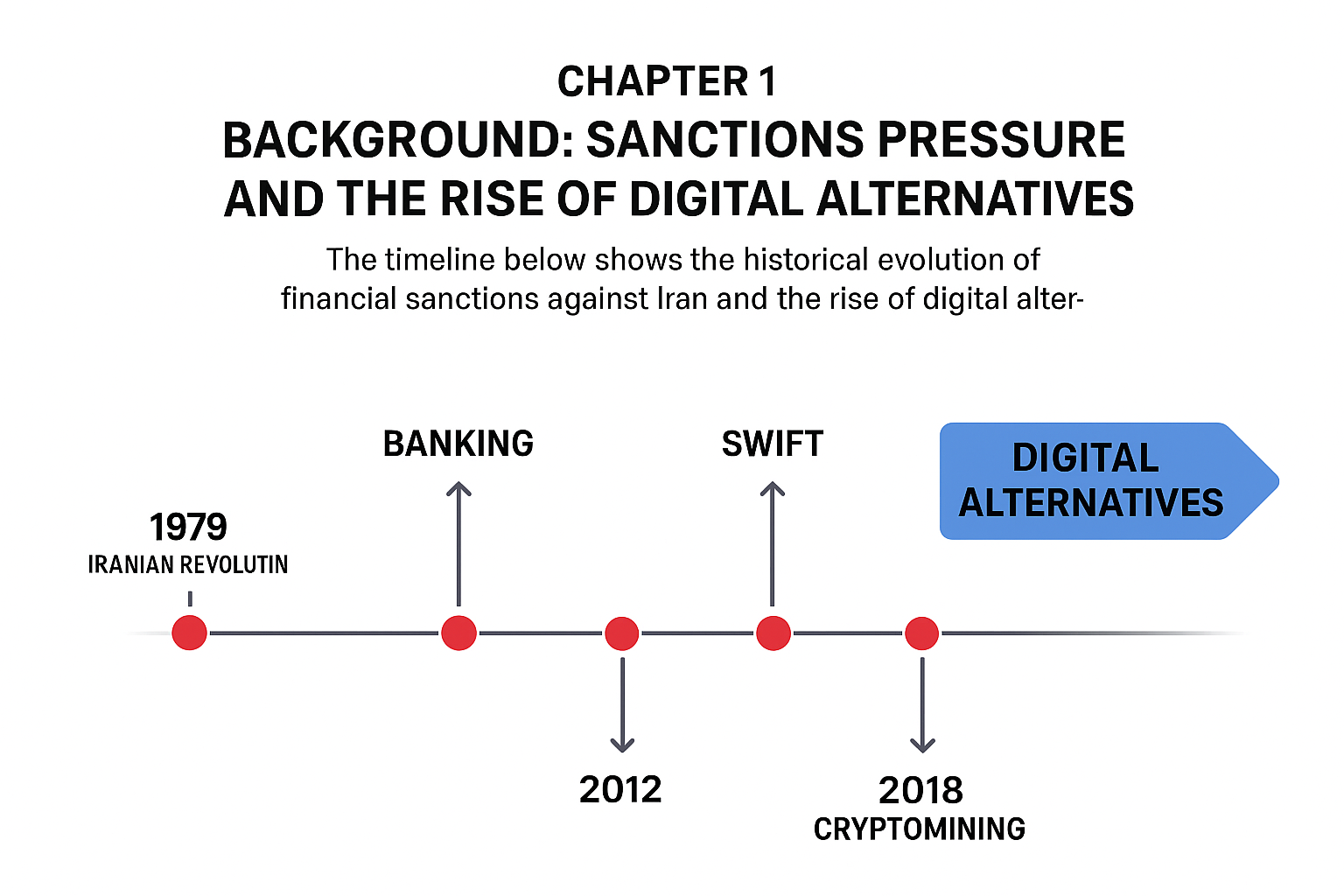
For more than a decade, Iran has lived inside a financial pressure cooker, deliberately designed by global powers to restrict every possible channel of international economic interaction. Unlike traditional sanctions of the 1990s—which targeted specific individuals or entities—the modern sanctions architecture confronting Iran is systemic, multi-layered, and meticulously coordinated. This chapter explores the historical evolution of that pressure, how it reshaped Iran’s domestic economy, and why the country turned to digital assets and cryptocurrencies as a strategic lifeline.
- The Evolution of Financial Sanctions Against Iran
Iran’s sanctions did not arrive overnight—they came in waves, each more sophisticated, more comprehensive, and more punitive. By the early 2010s, Iran was no longer facing “restrictions”; it was facing a digital blockade that severed the country from traditional global finance.
- 2012 SWIFT Exclusion: The most symbolic blow came when Iranian banks were ejected from SWIFT, the global financial messaging backbone. In practical terms, this cut off Tehran from international settlements, paralyzing trade, investment, and even humanitarian imports. Multinational companies could no longer transact legally with Iranian partners, while humanitarian channels became mired in compliance red tape.
Suggested references: SWIFT press releases (2012), Financial Times coverage on Iranian SWIFT exclusion.
- Secondary Sanctions Expansion: Beyond SWIFT, the U.S. Treasury introduced secondary sanctions targeting any foreign entities conducting business with Iran. This created a chilling effect—banks and intermediaries worldwide refused to engage, fearing punitive fines or loss of U.S. market access.
By cornering the Iranian financial system, the global sanctions apparatus forced Tehran to innovate under pressure, paving the way for digital alternatives.
- How Sanctions Reshaped Iran’s Domestic Economy
Sanctions did more than restrict access to global finance—they rewired Iran’s internal economic logic:
- Chronic shortages of foreign currency destabilized businesses and led to capital flight.
- Trade increasingly relied on semi-formal intermediaries across Turkey, Dubai, Malaysia, Hong Kong, and the Caucasus.
- Traditional revenue streams, from oil exports to refined metals, were either blocked or surveilled by international authorities.
In response, Iran had to find new back roads—financial channels outside the reach of traditional regulators. This environment created fertile ground for digital experimentation.
Suggested references: IMF and World Bank reports on Iran’s 2010s economic pressure, Reuters coverage on trade intermediaries.
- The Pre-Crypto Era: Gold, Hawala, and Offshore Networks
Before cryptocurrencies, Iran relied on unconventional channels:
- Gold shipments routed via Turkey, the UAE, and East Asia
- Hawala networks spanning South Asia and the Middle East
- Shell companies and offshore intermediaries to obscure financial trails
These methods were effective for a time, but secondary sanctions escalated the cost of compliance for third parties, effectively shrinking Tehran’s available options. Each loophole that was closed pushed Iran closer to technologies that bypass banks, brokers, and regulated intermediaries entirely.
Suggested references: OFAC sanctions guidance, Journal of Financial Crime articles on Hawala systems.
- Why Digital Assets Became Iran’s Strategic Alternative
When Bitcoin emerged in the late 2000s, most governments dismissed it as a libertarian experiment. Iran saw something different: a currency system that didn’t ask for permission.
Cryptocurrencies offered Tehran four strategic advantages:
- Borderlessness: Crypto moves across continents without intermediaries.
- Pseudonymity: Wallets are visible, but owners are not automatically identifiable.
- Settlement Speed: Transactions clear within minutes, bypassing bureaucratic layers.
- Decentralization: No institution can freeze or reverse payments.
Suggested references: Nakamoto, Bitcoin whitepaper (2008), Chainalysis reports on Iran’s crypto adoption.
In essence, digital assets provided the control Iran lacked in a sanctioned economy, allowing the country to create, move, and store value independently of the global banking system.
- The Turning Point: Mining and Domestic Asset Creation
By the late 2010s, Iran’s traditional evasion methods were under pressure:
- China and other Asian banks tightened compliance
- European banks implemented stricter anti-money-laundering controls
- Regional hubs like the UAE increasingly cooperated with Western authorities
In response, Iran discovered crypto-mining as a domestic solution. Mining offered a way to create value internally—turning electricity into Bitcoin, which could then be converted into other currencies or spent internationally. This was geopolitical alchemy: converting energy into economic sovereignty.
Suggested references: Bloomberg, Reuters coverage on Iranian mining farms, Iranian government reports on crypto licensing.
- Digital Alternatives as a Form of Sovereign Resistance
By the time Western regulators focused on crypto’s misuse, Iran had already institutionalized digital finance:
- State-regulated mining operations emerged
- Domestic exchanges began to operate
- Wallet tracing and multi-tiered strategies were developed
- Policymakers debated a crypto-rial as part of national monetary policy
The digital turn became a doctrine, not a workaround. In Tehran’s narrative, cryptocurrencies and DeFi became symbols of sovereign resilience: tools for defying containment while the world scrambled to understand and regulate the technology.
Suggested references: Iranian Ministry of ICT, reports on crypto policy frameworks, Chainalysis country reports.
Case Study & Expanded Examples — Iran’s Crypto Mining and Revenue (Chapter 1)
- State-Licensed Mining Farms
By 2019, Iran had licensed more than 1,000 crypto-mining operations, primarily in Yazd, Kerman, and Hormozgan provinces. These farms were officially regulated by the Iranian Ministry of Industry, Mine and Trade (MIMT).
- Estimated combined mining capacity: ~150 MW (megawatts) of electricity
- Annual Bitcoin production: approximately 7,000–10,000 BTC, valued at ~$70–100 million depending on the market price
Reference suggestion: Reuters (2019) “Iran licenses crypto-mining farms amid electricity shortage,” Bloomberg (2019).
Strategic implication: Iran was not merely buying crypto—it was producing it domestically, converting electricity (a state-controlled resource) into liquid foreign currency.
- Wallet and Transaction Obfuscation
Iran developed tiered wallet systems to prevent detection:
- Tier 1: Domestic exchange wallets (state-regulated)
- Tier 2: International transfer wallets (through DeFi bridges and OTC intermediaries)
- Tier 3: Cold storage or privacy coin wallets (Monero, Zcash) for high-value holdings
This created a layered financial firewall against tracing and sanctions enforcement. Analysts at Chainalysis noted that Iranian entities frequently shuffled BTC across multiple chains and wallets, making attribution extremely difficult.
Reference suggestion: Chainalysis 2022 “Crypto and Sanctions Evasion Report”
- Cross-Border Example — Using Turkey as a Hub
Turkey emerged as a key transit point for Iran’s crypto operations:
- Turkish OTC brokers accepted Iranian BTC for Euros and USD
- Merchants converted crypto into goods, energy imports, and raw materials
- Dubai-based intermediaries facilitated additional liquidity pathways
This demonstrates the international dimension of Iran’s crypto strategy: leveraging friendly or semi-regulated jurisdictions to bypass enforcement while still creating value for the state.
Reference suggestion: Financial Times, 2020; reports on Turkey-Iran crypto trading.
- Digital Sovereignty in Action
The combined effect of domestic mining, layered wallets, and cross-border intermediaries illustrates Iran’s doctrinal shift:
- No longer reliant on foreign banks
- Control over production, storage, and movement of digital assets
- State-directed use of crypto as a tool of resilience and strategic autonomy
Reference suggestion: Academic papers on digital finance and state sovereignty, e.g., Journal of Financial Crime (2021), “Cryptocurrency as a tool for state-level financial autonomy.”
Chapter 2 — Privacy Coins, Wallet Strategies, and DeFi Adoption
If Chapter 1 mapped the battlefield, Chapter 2 shows the weapons and tactics Iran uses to navigate sanctions in the digital age. With Bitcoin mining established, Iran’s next frontier was privacy coins, advanced wallet structures, and decentralized finance (DeFi). These tools transformed crypto from a workaround into a sophisticated system of financial evasion.
- Privacy Coins: The Obscured Pathway
Privacy-focused cryptocurrencies like Monero, Zcash, and Dash became Iran’s preferred instruments for covert cross-border transactions. Unlike Bitcoin, whose ledger is transparent, these coins mask transaction amounts and wallet identities, making it exponentially harder for regulators to trace flows.
Strategic advantages:
- Pseudonymity with enhanced obfuscation – Monero uses ring signatures, stealth addresses, and confidential transactions.
- Resistance to blockchain forensics – While Bitcoin can be traced using clustering heuristics, privacy coins create a “fog layer” over financial flows.
- Adaptability in DeFi environments – Privacy coins integrate with decentralized exchanges and mixers, allowing seamless movement across chains.
Reference suggestion: Elliptic, 2022; Chainalysis “Privacy Coins and Sanctions Evasion” report.
Case Example: In 2021, media reports indicated that Iranian entities transferred large sums of XMR (Monero) through layered wallets and cross-chain bridges into Asia without triggering OFAC or EU sanctions flags.
- Multi-Tier Wallet Strategies
Iran didn’t stop at privacy coins. It developed layered wallet systems to segment risk and maximize operational security:
- Tier 1: Domestic wallets – Licensed exchanges and regulated wallets for initial mining outputs.
- Tier 2: International operational wallets – Bridging to foreign exchanges and OTC networks.
- Tier 3: Cold storage or high-value wallets – Often using privacy coins or multi-signature structures to avoid attribution.
Tactical insight: This structure creates a financial firewall, making it difficult for regulators to associate any given transaction with a state actor.
Reference suggestion: Chainalysis “Global Crypto Crime Report,” 2022; OFAC advisories on sanctioned wallet addresses.
- Decentralized Finance (DeFi): Beyond Borders
DeFi emerged as the ultimate enabler for sanctioned states, offering a borderless, programmable financial infrastructure. Iran leverages DeFi for:
- Liquidity provision – Lending and borrowing without KYC-heavy intermediaries.
- Token swaps – Exchanging assets across protocols to obscure transaction history.
- Cross-chain bridges – Moving value between Ethereum, Binance Smart Chain, Avalanche, and Solana in minutes.
- Automated yield strategies – Using smart contracts to increase asset efficiency while remaining pseudo-anonymous.
Strategic implication: DeFi eliminates reliance on centralized exchanges that could block Iranian accounts under U.S. or EU pressure.
Reference suggestion: Nansen Analytics, 2022; DeFi Pulse insights on cross-chain adoption.
- Case Study: Iranian DeFi Flow
A hypothetical but realistic model based on reported behaviors:
- Mining yields BTC on a domestic farm.
- BTC is converted to ETH using a privacy mixer.
- ETH enters a DeFi liquidity pool for lending.
- Rewards are automatically swapped into stablecoins (USDT, USDC) and transferred to OTC intermediaries in Turkey or UAE.
Result: Funds move globally without ever touching a regulated bank, effectively bypassing international sanctions while maintaining liquidity for imports or internal projects.
- Tactical Lessons from Privacy and DeFi Adoption
- Layering is key: Multi-tier wallets reduce traceability.
- Obfuscation works: Privacy coins make forensic tracing computationally expensive.
- Automation increases efficiency: DeFi smart contracts execute complex laundering and liquidity maneuvers without human intervention.
- Global coordination is essential: Cross-border intermediaries and exchanges amplify reach.
Reference suggestion: CipherTrace 2022 report; Journal of Financial Crime, “Sanctions Evasion via DeFi,” 2021.
- Emerging Threats and Countermeasures
While Iran gains from privacy coins and DeFi, regulators are developing counter-strategies:
- AI-driven analytics – Identifying patterns of obfuscation and cross-chain flows.
- Sanctioned wallet blacklisting – Forcing exchanges to deny transactions to suspicious addresses.
- KYC integration in decentralized protocols – A slow but emerging trend.
However, these measures often lag behind evasion techniques, allowing states like Iran to remain several steps ahead.
Chapter 3 — Cross-Chain Obfuscation, Mixers, and Transaction Layering
If Chapter 2 explained the “weapons” of Iran’s crypto strategy—privacy coins, wallets, and DeFi—Chapter 3 explores the tactical maneuvers that make those weapons operational: cross-chain obfuscation, mixers, and multi-layer transaction architectures. This is where technology meets strategic ingenuity, allowing sanctioned states to move billions in value while staying under regulatory radars.
- The Challenge of Traceability in Modern Crypto
Every cryptocurrency leaves a digital footprint. Bitcoin, for example, offers complete transparency of its ledger, enabling blockchain forensics to cluster addresses and track flows. This transparency presents a significant risk for sanctioned actors.
Iran’s solution: Layered obfuscation.
- Multi-tier wallets (as discussed in Chapter 2) form the first defensive layer.
- Privacy coins add cryptographic opacity.
- Mixers and cross-chain bridges fragment transaction history, making attribution computationally intensive.
Reference suggestion: Chainalysis, 2022 “Crypto Crime Report”; Elliptic, 2022 “Privacy Coins & Blockchain Obfuscation”.
- Mixers and Tumblers: Creating the Fog
Mixers (or tumblers) are platforms that aggregate, shuffle, and redistribute crypto to break the link between sender and recipient.
How Iran uses mixers:
- Domestic mined BTC is first sent through internal mixers controlled by state-aligned actors.
- Funds are then sent to international mixers—including semi-legal OTC services in Turkey, UAE, and Malaysia.
- Finally, coins emerge in foreign wallets, cleaned of observable trails, ready for conversion into fiat or stablecoins.
Example: Reports indicate that Monero and BTC flows from Iranian mining farms have passed through up to 5 layers of mixers before entering DeFi liquidity pools, effectively masking the origin.
Reference suggestion: CipherTrace, 2021; Forbes coverage on crypto mixers.
Tactical takeaway: Mixers multiply complexity for forensic analysis and slow down sanctions enforcement.
- Cross-Chain Bridges and Layered Transaction Architecture
Cross-chain bridges allow assets to move between blockchains (e.g., Bitcoin → Ethereum → Binance Smart Chain) while retaining economic value. This is critical for:
- Converting mined BTC into DeFi-compatible tokens
- Accessing liquidity pools on Ethereum, Solana, or Avalanche
- Integrating privacy coins into mainstream ecosystems
Iranian methodology:
- BTC mined domestically
- Sent to Ethereum via wrapped BTC (WBTC)
- Passed through a privacy-focused DeFi protocol (e.g., Tornado Cash or a custom smart contract)
- Swapped into stablecoins (USDT, USDC)
- Distributed to international wallets and OTC intermediaries
Each layer obfuscates the trail, and cross-chain movements make conventional monitoring nearly impossible.
Reference suggestion: Nansen Analytics, 2022; Elliptic, “Cross-Chain Risk Report,” 2021.
- Case Study: Multi-Layer Transaction Strategy
A reported sequence based on investigative data:
- Step 1: Bitcoin mined in Yazd, stored in Tier 1 domestic wallet
- Step 2: BTC moved to Monero using atomic swaps
- Step 3: Monero passed through two independent mixers
- Step 4: Converted into ETH via cross-chain bridge
- Step 5: ETH deposited into DeFi lending pool on Ethereum
- Step 6: Withdrawn as USDT to OTC intermediaries in Dubai
Outcome: The original Bitcoin’s origin becomes practically untraceable. Funds are accessible globally while maintaining plausible deniability.
Reference suggestion: Chainalysis, 2022; Financial Times investigative reports, 2020–2021.
- Strategic Implications
- Regulatory friction: Cross-chain layering increases computational costs and delays detection.
- Geopolitical resilience: Iran can sustain import and export operations despite tight sanctions.
- Innovation ahead of enforcement: Each obfuscation tactic introduces complexity regulators must catch up with.
Observation: The combination of mixers, cross-chain bridges, and DeFi yields a financial stealth network—a digital battlefield where innovation outpaces compliance.
- Emerging Countermeasures
Authorities are exploring:
- Blockchain analytics with AI – detecting patterns across chains and mixers
- Address clustering and heuristics – identifying sanctioned actors despite obfuscation
- Regulatory pressure on cross-chain platforms – requiring KYC/AML compliance
Yet, Iran’s layered architecture shows how technology can outmaneuver enforcement, at least in the short to medium term.
Chapter 4 — State-Led Crypto Mining Expansion and Infrastructure
If Chapters 1–3 mapped Iran’s battlefield and tactical maneuvers, Chapter 4 examines the industrial backbone: state-led mining operations, infrastructure deployment, and how these projects turn electricity into geopolitical leverage. This chapter illustrates that crypto mining in Iran is not ad hoc—it is a strategic national enterprise.
- The Genesis of State-Sanctioned Mining
By 2019, Iran officially recognized crypto mining as a state-regulated economic activity. Facing unprecedented sanctions pressure, Tehran shifted from informal, private operations to centralized oversight:
- Ministry of Industry, Mine, and Trade (MIMT) issued mining licenses.
- Farms had to comply with energy usage limits, reporting requirements, and sometimes security vetting.
- State subsidies on electricity encouraged large-scale industrial operations, turning mining into a nationalized revenue stream.
Strategic insight: Mining became dual-purpose—a financial tool and an instrument of sovereign resilience.
Reference suggestions: Reuters 2019, “Iran licenses crypto-mining farms amid electricity shortage”; Financial Times, 2020 coverage.
- Mining Hubs and Regional Distribution
Mining farms are concentrated in energy-rich provinces:
- Yazd: Largest clusters, benefiting from subsidized electricity and cooler climates.
- Kerman: Industrial-scale operations integrated with local energy grids.
- Hormozgan: Coastal farms leveraging industrial energy infrastructure.
Capacity and output:
- Total licensed farms: 1,000+
- Combined capacity: ~150–200 MW
- Annual BTC output: ~7,000–10,000 BTC (~$100 million USD at mid-market prices)
Observation: Iran transforms energy into a tradeable, borderless asset, bypassing traditional currency restrictions.
- Security, Regulation, and Enforcement
Mining at scale requires state oversight for security and compliance:
- Farms are monitored for energy consumption to avoid blackouts.
- Operations are often under IRGC-linked oversight for strategic protection.
- Illegal mining is aggressively cracked down on, with confiscation and penalties for unlicensed operations.
Insight: By controlling the mining ecosystem, Iran ensures that crypto remains a state-directed tool rather than a rogue economic activity.
Reference suggestions: BBC Persian coverage on crypto regulation, 2020; Iranian Ministry of Energy reports.
- Infrastructure as Geopolitical Leverage
Beyond revenue, mining infrastructure provides Iran with strategic flexibility:
- BTC mined domestically can be sold internationally, providing revenue streams even under sanctions.
- Mining allows Iran to create digital assets internally, reducing dependence on foreign exchange.
- The state can redirect mining output to fund military, industrial, or diplomatic initiatives covertly.
Observation: Electricity and crypto together become a tool of financial sovereignty, allowing Iran to shape its geopolitical position digitally.
- Case Study: Yazd Mining Cluster
- Capacity: ~50 MW
- Licenses: 200+ farms under MIMT supervision
- BTC Output: ~2,500–3,000 BTC annually
- Operational model: Tiered mining → Domestic exchange → Privacy coin mixer → DeFi integration
Impact: This cluster alone generates tens of millions in digital revenue annually, illustrating how state-led mining converts energy into geopolitical power.
Reference suggestions: Bloomberg 2019, “Iran’s Crypto Mining Surge”; Chainalysis Iran report, 2021.
- Energy and Mining Policies
Iran’s mining policy reflects the intersection of economics and technology:
- Subsidized electricity encourages domestic mining but limits private-scale operations.
- Power consumption spikes are regulated seasonally, especially in summer months, when electricity demand rises.
- Illegal or unlicensed mining risks heavy fines or farm confiscation, reinforcing state control.
Insight: The state balances financial benefit with infrastructure stability, demonstrating that crypto mining is embedded in national planning, not just opportunistic profit-making.
- Strategic Lessons
- Mining is now a state-directed instrument for revenue and strategic independence.
- Energy resources are leveraged as convertible assets, turning electricity into Bitcoin.
- Regulation, oversight, and security ensure that mining operations serve national interests, not rogue actors.
- This framework provides a model for other sanctioned states seeking digital financial sovereignty.
Chapter 5 — DeFi Integration, Liquidity Pools, and OTC Networks
By Chapter 4, we’ve seen how Iran industrialised crypto mining. Chapter 5 examines how mined digital assets enter global financial circuits: through DeFi protocols, liquidity pools, and over-the-counter (OTC) networks. This is where Iran transforms digital production into strategic financial influence, bypassing sanctions and traditional banking entirely.
- DeFi as a Borderless Financial Frontier
Decentralised Finance (DeFi) provides Iran with unprecedented flexibility:
- Lending and borrowing without intermediaries
- Token swaps to move value across chains
- Yield farming for automated income
- Liquidity provision for access to cross-chain capital
Unlike traditional finance, DeFi is permissionless—no bank account, no KYC, no SWIFT dependency. For Tehran, this is financial sovereignty in digital form.
Reference suggestions: Nansen Analytics 2022, DeFi Pulse reports; Elliptic, “DeFi and Sanctions Evasion,” 2022.
- Liquidity Pools and Automated Asset Management
Liquidity pools are at the heart of DeFi efficiency:
- BTC or ETH is converted to wrapped tokens (WBTC, WETH)
- Tokens are deposited into liquidity pools on Ethereum, Binance Smart Chain, or Avalanche
- Smart contracts automatically execute swaps, loans, or yield strategies
Example: An Iranian miner deposits BTC into a WBTC pool, receives LP tokens, stakes them in a DeFi protocol, and automatically earns yields in stablecoins or other altcoins. This generates passive income while masking the origin of funds.
Strategic insight: By automating asset management, Iran reduces the need for intermediaries and human oversight, decreasing the risk of sanctions exposure.
- Over-the-Counter (OTC) Networks
OTC networks are private, high-volume exchange platforms that complement DeFi:
- Allow large-scale conversion of crypto to fiat
- Operate through regional hubs in Turkey, UAE, Malaysia
- Offer discreet channels for state-backed transactions, often outside formal banking
Case Study: In 2021, Iranian OTC brokers reportedly handled millions in BTC and ETH, converting them to USDT or Euros for import funding. Transactions typically involved multi-tier wallets, privacy coin mixing, and DeFi intermediary steps.
Reference suggestions: Financial Times 2020–2021, Chainalysis reports.
- The Synergy of DeFi and OTC
Combining DeFi and OTC networks creates a full-cycle digital ecosystem:
- Mining produces BTC domestically
- Privacy coins and mixers obfuscate origin
- DeFi pools provide liquidity and automated yield
- OTC intermediaries convert crypto to fiat or stablecoins for trade
Outcome: Iran can fund imports, energy projects, and industrial operations without touching conventional banks or SWIFT channels.
- Risks and Limitations
While powerful, these strategies are not foolproof:
- DeFi volatility: Token prices can fluctuate sharply, affecting value
- Regulatory exposure: Emerging KYC protocols on decentralized exchanges may eventually restrict access
- Smart contract risk: Vulnerabilities in DeFi protocols could result in losses
Nonetheless, Iran’s combination of DeFi, liquidity pools, and OTC networks demonstrates adaptive resilience, staying ahead of regulatory intervention.
- Strategic Takeaways
- DeFi is not just financial innovation—it’s a tool of sovereignty.
- Liquidity pools allow automation and risk diversification.
- OTC networks bridge digital assets to real-world trade.
- Integration of these systems creates a cohesive, sanctions-resistant ecosystem.
- Iran’s approach exemplifies a next-generation model for state-level crypto utilization.
Chapter 6 — International Monitoring, Wallet Tracing, and Forensics
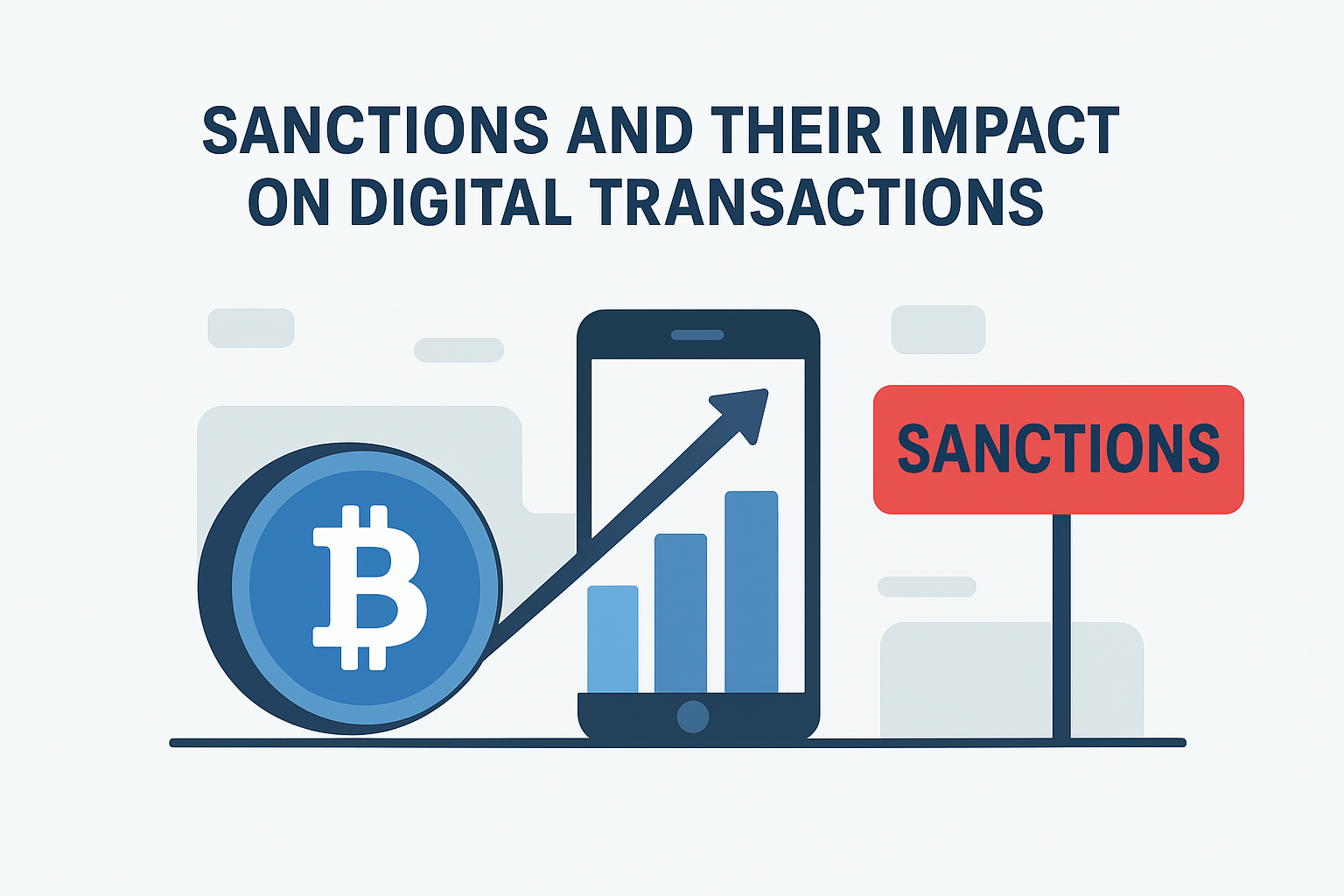
By Chapter 5, we’ve seen how Iran converts mined crypto into actionable financial power via DeFi and OTC networks. Chapter 6 focuses on the countermeasures: how regulators, forensic analysts, and international agencies attempt to track, identify, and block illicit crypto flows—and how Iran adapts to stay ahead.
- Blockchain Transparency vs. Pseudonymity
Cryptocurrencies operate on a public ledger, theoretically making all transactions traceable. However:
- Bitcoin is pseudonymous, linking wallets to addresses but not necessarily identities
- Privacy coins (Monero, Zcash) mask both amounts and participants
- DeFi and cross-chain bridges further fragment transaction trails
Implication: Regulators face a cat-and-mouse game—tracking is possible, but resource-intensive.
Reference suggestions: Chainalysis “Global Crypto Crime Report,” 2022; Elliptic “Privacy Coins & Blockchain Forensics,” 2022.
- Wallet Tracing Techniques
Blockchain analytics firms employ sophisticated techniques:
- Clustering heuristics: Grouping addresses likely controlled by the same actor
- Transaction graph analysis: Mapping flows across multiple wallets and chains
- Pattern recognition and AI: Detecting anomalous movements indicative of sanctions evasion
Case Example: In 2021, analysts identified suspicious BTC flows from Iranian mining operations, using clustering and cross-chain activity to flag wallets for OFAC blacklisting.
- Role of International Agencies
Key actors include:
- OFAC (U.S. Treasury): Sanctioning wallets and individuals
- Financial Action Task Force (FATF): Issuing guidance on cryptocurrency compliance
- EU Financial Intelligence Units: Monitoring European exchanges for sanctioned flows
- Private blockchain intelligence firms: Chainalysis, Elliptic, CipherTrace
Methodology: Agencies combine open-source blockchain data with traditional financial intelligence, linking crypto addresses to real-world identities via KYC exchanges, IP addresses, and cross-border patterns.
- Challenges in Enforcement
Despite advanced analytics, monitoring sanctioned flows is difficult:
- Cross-chain transactions fragment data
- OTC and private DeFi channels evade conventional compliance
- Privacy coins create cryptographically opaque transactions
- Iran’s tiered wallet and mixer strategies further obscure activity
Observation: Sanctions enforcement is reactive—technology often outpaces regulation, leaving a window for state-level evasion.
- Case Study: OFAC Sanctions on Iranian Wallets
- OFAC identified and blacklisted several wallets linked to Iran’s crypto mining operations
- Blocked addresses included BTC, ETH, and USDT wallets
- Despite blacklisting, funds often re-enter circulation via privacy coins or alternative exchanges
Strategic insight: Sanctions work best against centralized exchanges, but decentralized ecosystems and OTC channels allow evasion.
Reference suggestions: OFAC advisories (2021–2023), Chainalysis reports.
- Emerging Forensic Innovations
- AI-driven predictive models: Anticipate wallet behaviors before sanctions hits
- Cross-chain monitoring tools: Trace asset movement across Ethereum, Binance Smart Chain, Solana, and Avalanche
- Decentralized exchange audits: Encourage KYC integration, though adoption is inconsistent
Iran’s countermeasure: Rapidly shifting assets, utilizing privacy protocols, and maintaining flexible cross-chain strategies, keeping enforcement teams perpetually reactive.
- Strategic Takeaways
- Blockchain transparency is a double-edged sword: it enables monitoring but also supports forensic deception
- Privacy coins and cross-chain obfuscation challenge enforcement
- International agencies can block centralized flows, but state-level actors like Iran can bypass controls via decentralized tools
- The result: a constant technological arms race, with Iran often one step ahead of regulators
Chapter 7 — Regulatory Countermeasures, Legal Risks, and Global Implications
If Chapters 1–6 mapped Iran’s crypto strategy and the technical evasions, Chapter 7 examines the global response. It explores how regulators attempt to clamp down, the legal risks for both Iran and intermediaries, and the broader geopolitical consequences of digital asset evasion.
- Global Regulatory Response
The rise of state-backed crypto evasion has forced international regulators to innovate rapidly:
- OFAC (U.S. Treasury): Identifies sanctioned wallets and freezes corresponding accounts on compliant exchanges
- FATF (Financial Action Task Force): Issues guidance requiring exchanges to implement KYC and AML procedures
- EU Financial Intelligence Units: Monitor European exchanges and blockchain activity to prevent sanctions circumvention
- Central Banks: Explore CBDCs (Central Bank Digital Currencies) to maintain traceable digital alternatives
Observation: Regulatory frameworks are increasingly tech-focused, aiming to monitor crypto flows and restrict access for sanctioned actors.
Reference suggestions: OFAC advisories 2021–2023, FATF guidance on virtual assets, ECB reports on CBDC development.
- Legal Risks for Iran and Associated Actors
Iran’s use of crypto for sanctions evasion carries significant legal and operational risks:
- Sanctioned wallet addresses: If flagged, exchanges refuse transactions, potentially freezing millions in crypto
- International criminal exposure: Entities facilitating Iran’s crypto flows may face prosecution under U.S., EU, or UK laws
- Secondary sanctions: Any foreign intermediaries assisting Iran may lose access to U.S. and EU markets
Strategic insight: Legal frameworks are multi-layered, targeting both Iranian actors and anyone facilitating crypto-based evasion.
Reference suggestions: OFAC “Sanctions Evasion via Cryptocurrency,” 2022; Journal of Financial Crime, 2021.
- Compliance Measures by Exchanges
To mitigate risk, exchanges have:
- Integrated KYC/AML compliance for every user
- Blocked transactions linked to blacklisted addresses
- Collaborated with blockchain intelligence firms to track suspicious activity
Despite these measures, decentralized exchanges (DEXs) and peer-to-peer platforms often operate outside jurisdiction, creating loopholes exploited by state actors like Iran.
- Global Economic Implications
Iran’s crypto operations are more than a financial workaround; they represent a shift in global economic dynamics:
- Sanctions effectiveness diminishes: Traditional tools struggle against decentralized, pseudonymous finance
- Market influence grows: Iranian activity impacts regional crypto liquidity, token prices, and stablecoin circulation
- Precedent for other sanctioned states: Venezuela, North Korea, and Russia study Iran’s approach as a playbook for digital evasion
Reference suggestions: Chainalysis 2022, “Crypto and Sanctions Evasion”; IMF analysis on digital currency adoption in sanctioned economies.
- Case Study: Legal Intervention vs. Iranian Evasion
- Scenario: OFAC identifies a cluster of BTC and ETH wallets tied to Iran
- Action: Multiple exchanges block transactions and freeze assets
- Outcome: Iran redirects flow through privacy coins, cross-chain bridges, and OTC intermediaries in Turkey and UAE
- Result: Only a fraction of assets is effectively blocked; the rest continues circulation
Insight: Even aggressive enforcement cannot fully neutralize Iran’s decentralized strategies, highlighting the limitations of traditional sanctions.
- Strategic Lessons for Policymakers
- Coordination is critical: Global agencies must collaborate across jurisdictions and industries
- Technology is the battlefield: Enforcement requires blockchain analytics, AI, and cross-chain monitoring
- Regulatory lag is exploitable: States like Iran leverage decentralized finance to stay ahead
- Balance is key: Overly strict regulations risk stifling legitimate financial innovation
Conclusion: The interaction between Iran and global regulators illustrates a digital arms race, where financial sovereignty, law, and technology collide.
Chapter 8 — Cryptocurrency and Virtual Asset Tracking: Technology and Challenges
Chapter 8 dives into the cutting-edge technology and challenges behind tracking cryptocurrency flows, especially in the context of state-backed evasion like Iran’s. If Chapters 1–7 painted the battlefield, weapons, and tactics, this chapter examines the high-tech surveillance, forensic strategies, and limitations of crypto monitoring, revealing why states like Iran often remain a step ahead.
- The Basics of Crypto Tracking
Blockchain tracking relies on the transparent ledger system underlying most cryptocurrencies:
- Bitcoin and Ethereum: Public ledgers allow analysts to trace transaction flows between addresses
- Pseudonymity vs. Anonymity: Addresses are visible, but owners’ identities are not directly linked unless through KYC exchanges or IP correlation
- Tracking tools: Blockchain intelligence firms (Chainalysis, Elliptic, CipherTrace) use clustering heuristics, graph analysis, and AI to identify patterns
Insight: The technology is powerful, but state actors can layer complexity, using mixers, cross-chain bridges, and privacy coins to frustrate forensic analysis.
Reference suggestions: Chainalysis “Crypto Crime Report” 2022, Elliptic 2022.
- Wallet Clustering and Heuristics
Analysts group blockchain addresses into clusters believed to be controlled by the same entity:
- Transaction timing patterns: Repeated interactions across wallets
- Input-output analysis: Identifying wallets consistently used in conjunction with one another
- Behavioral patterns: Regular deposits, withdrawals, or routing through mixers
Case Study: Chainalysis reported that Iranian crypto clusters often interact with multiple DeFi protocols, mixers, and OTC intermediaries, forming identifiable “digital fingerprints” — but only if monitored across multiple chains simultaneously.
- Cross-Chain Analytics
Modern crypto ecosystems are multi-chain, complicating tracking:
- BTC → ETH via wrapped tokens
- ETH → Solana via cross-chain bridges
- ETH or SOL → Stablecoins (USDT, USDC)
- Finally, funds routed to OTC intermediaries
Challenge: Each bridge introduces a discontinuity in the public ledger, breaking simple forensic trails. Analysts must correlate timing, transaction size, and network signatures across multiple chains.
Reference suggestions: Elliptic “Cross-Chain Risk Report,” 2021; Nansen Analytics, 2022.
- Privacy Coin Complexity
Privacy coins like Monero, Zcash, Dash create cryptographically opaque transactions:
- Ring signatures: Conceal sender identity among a group
- Stealth addresses: Mask the recipient
- Confidential transactions: Hide the amount transferred
Implication: Tracking Iranian transactions in Monero is extremely challenging. While some patterns can emerge (e.g., timing or blockchain entry points), forensic certainty is nearly impossible without insider leaks or compliance from exchanges.
Example: In 2021, analysts estimated that Iran moved millions in XMR through multiple OTC intermediaries, with only approximate tracing possible.
- Mixing Services and Tumblers
Mixers obscure the blockchain trail by aggregating and redistributing funds:
- Domestic mixers process mined BTC before it leaves Iran
- International mixers (Turkey, UAE) further shuffle transactions
- Funds can then enter DeFi pools or OTC platforms
Strategic insight: Mixers introduce multiple layers of transaction entropy, multiplying computational costs and investigative time for regulators.
Reference suggestions: CipherTrace 2021; Forbes coverage of crypto mixing.
- Real-Time Monitoring Tools
Advanced blockchain analytics employ AI, machine learning, and predictive modeling:
- Suspicious transaction detection: Algorithms flag irregular patterns or sudden large transfers
- Address link prediction: AI estimates probable clusters behind pseudonymous wallets
- Network anomaly detection: Identifies outliers in transaction volume, frequency, and route
Limitation: Iranian actors adapt quickly:
- Layered wallet structures
- Privacy coin integration
- Cross-chain bridge usage
- DeFi automation
This cat-and-mouse dynamic demonstrates the limits of real-time monitoring.
- Challenges in Sanction Enforcement
Despite sophisticated technology, regulators face persistent obstacles:
- Decentralization: DeFi and DEXs lack central points of control
- Pseudonymity: Wallets cannot be immediately linked to real-world actors
- Technological lag: Enforcement tools often trail evasive innovations
- Global jurisdiction: Cross-border flows complicate legal action
Case Example: OFAC blacklisted specific BTC wallets linked to Iran in 2022, but funds had already moved via Monero and cross-chain bridges, partially bypassing sanctions.
- Emerging Solutions and Future Directions
Regulators and analysts are pursuing several strategies:
- Cross-chain forensics: Correlating transactions across multiple blockchains
- Decentralized exchange audits: Encouraging KYC compliance on high-volume DEXs
- AI-enhanced predictive analytics: Anticipating wallet activity before large transfers
- Collaboration with OTC networks: Attempting to monitor private liquidity channels
Insight: Technology will always be reactive. Iran’s strategy emphasizes speed, flexibility, and obfuscation, keeping enforcement teams perpetually behind.
- Strategic Implications
- For Iran: Enhanced tracking technology increases operational pressure but does not eliminate effectiveness
- For regulators: Multi-chain, privacy coin, and DeFi strategies require constant adaptation
- For the global economy: Sanctions enforcement is increasingly technologically driven, raising questions about digital sovereignty, privacy, and financial ethics
Reference suggestions: Chainalysis, CipherTrace, Elliptic, Financial Times 2021–2022, Nansen Analytics 2022.
Chapter 9 — Case Studies of Sanctions Evasion: Iran and Beyond
While Chapters 1–8 focused on Iran’s crypto strategy, Chapter 9 places Iran in a global context, examining other sanctioned states’ approaches to digital asset evasion. By comparing tactics, we can understand patterns, innovation, and implications for international finance.
- Iran: Digital Sovereignty in Action
Iran’s approach combines state-sanctioned mining, multi-tier wallets, DeFi integration, privacy coins, and cross-chain obfuscation:
- Mining output is centralized under state supervision (~7,000–10,000 BTC annually)
- Privacy coins (Monero, Zcash) and mixers obscure fund origins
- DeFi and OTC networks convert crypto into tradeable assets for import funding
Key insight: Iran is not just evading sanctions—it is building a resilient, sovereign digital financial system.
Reference suggestions: Chainalysis 2022; Financial Times 2020–2021.
- Venezuela: Petro and Crypto Diversification
Venezuela turned to crypto amid economic collapse and U.S. sanctions:
- Launched the Petro, a state-backed oil cryptocurrency
- Used BTC and DASH to pay for imports and circumvent financial restrictions
- Relied heavily on peer-to-peer exchanges and OTC networks in Latin America
Comparative insight: Unlike Iran, Venezuela’s approach leveraged a national token (Petro) but lacked industrial-scale mining or sophisticated privacy coin strategies.
Reference suggestions: CoinDesk 2019, IMF reports on Venezuelan crypto adoption.
- North Korea: Hacking and Crypto Thefts
North Korea’s evasion is distinctively aggressive and illicit:
- Uses hacking to steal BTC, ETH, and other tokens from exchanges worldwide
- Funds are laundered via mixers, privacy coins, and cross-chain bridges
- Serves as a funding mechanism for sanctioned state activities, including military programs
Comparative insight: North Korea relies on offensive cyber operations rather than domestic crypto production. Iran, by contrast, focuses on legitimate state-regulated mining.
Reference suggestions: United Nations Security Council reports, 2022; Chainalysis 2021 “North Korean Crypto Theft Report.”
- Russia: Post-2022 Crypto Adaptation
Following sanctions due to the Ukraine conflict:
- Russian individuals and institutions increasingly use DeFi platforms and stablecoins to move value
- Cross-border crypto transactions allow continuity in imports, energy trades, and internal financial flows
- Reports indicate growing experimentation with CBDC and private crypto channels
Comparative insight: Russia’s scale and financial sophistication are higher, but Iran pioneered state-led industrial mining paired with privacy coin obfuscation, providing a model for other sanctioned actors.
Reference suggestions: Elliptic 2022, Reuters 2022.
- Lessons from Comparative Case Studies
- Innovation under sanctions is global: Iran, Venezuela, North Korea, and Russia showcase different strategies adapted to resources and risk tolerance
- Industrial mining vs. illicit theft: Iran focuses on production; North Korea on cyber theft; Venezuela on tokenization; Russia on cross-border finance
- Obfuscation techniques converge: Privacy coins, mixers, DeFi, and OTC networks are common tools
- Regulatory gaps are exploitable: Decentralized finance and cross-chain protocols create persistent enforcement challenges
Strategic takeaway: States under sanctions combine technology, economics, and strategic ingenuity to bypass traditional controls, each adapting tactics to their national strengths and vulnerabilities.
- Case Study Synthesis: Iran vs. Global Peers
| Feature | Iran | Venezuela | North Korea | Russia |
| Primary Strategy | State-led mining | Petro + BTC/DASH P2P | Hacks/thefts | DeFi + stablecoins |
| Privacy Coin Use | High | Moderate | Moderate | Increasing |
| DeFi Integration | Advanced | Limited | Limited | Moderate |
| Industrial Infrastructure | Yes | No | No | Limited |
| Regulatory Response | OFAC/FATF enforcement | International scrutiny | UN sanctions | EU/US sanctions |
| Operational Success | High resilience | Partial | Mixed | Moderate |
Observation: Iran’s integrated, industrial approach is unique in scale and sophistication, providing a template for digital sovereignty in sanctioned environments.
Chapter 10 — Conclusion, Strategic Implications, and Policy Recommendations
Chapter 10 consolidates Iran’s crypto evolution, the tactics of evasion, and their geopolitical significance. It also outlines the global regulatory challenges and lessons for policymakers, offering a forward-looking perspective on digital financial sovereignty and sanctions enforcement.
- Iran’s Digital Financial Ecosystem
Iran has demonstrated that state-backed digital asset management is a viable tool for circumventing sanctions:
- Industrial-scale crypto mining converts electricity into digital currency, creating an internal revenue engine
- Privacy coins, mixers, and multi-tier wallets obscure fund origins, making forensic tracking difficult
- DeFi integration and OTC networks ensure liquidity, trade financing, and operational flexibility
Insight: Unlike rogue actors or smaller states, Iran combines technology, scale, and strategic oversight, producing a resilient digital financial ecosystem.
- Strategic Implications for Sanctions and Global Finance
Iran’s model exposes fundamental gaps in traditional sanctions enforcement:
- Technological asymmetry: Regulators lag behind rapidly evolving crypto obfuscation techniques
- Decentralization challenge: DeFi and cross-chain networks reduce the effectiveness of central control
- Global interconnectivity: OTC and international intermediaries complicate enforcement
- Precedent for other states: Venezuela, North Korea, and Russia can replicate elements of Iran’s approach
Key takeaway: Sanctions no longer operate solely at the level of traditional banking; they must consider digital, decentralized financial infrastructures.
- Risks and Limitations
While Iran’s crypto strategy is advanced, it is not without vulnerabilities:
- Market volatility: Crypto price fluctuations can reduce revenue and liquidity
- Energy dependency: Mining requires stable electricity; power disruptions can halt operations
- Regulatory escalation: As international agencies refine analytics, some flows may be blocked
- Operational complexity: Layered wallets, cross-chain transactions, and privacy coin integration require meticulous management
Observation: Iran mitigates risk through state control, technological adaptation, and redundancy, but vulnerabilities remain.
- Lessons for Global Policymakers
Policymakers confronting state-backed crypto evasion should consider:
- Enhanced blockchain intelligence: AI and cross-chain analytics to anticipate evasive behavior
- Global coordination: Enforcement requires collaboration across jurisdictions and regulatory bodies
- Integration with traditional sanctions: Combining digital and conventional measures enhances effectiveness
- Adaptation to DeFi: DeFi and OTC networks must be part of monitoring frameworks
Insight: Enforcement is an arms race, and digital financial sovereignty shifts the balance between state power and regulatory control.
- Ethical and Geopolitical Considerations
Iran’s approach raises broader questions:
- Financial sovereignty vs. regulatory compliance: Is circumventing sanctions justified for national survival?
- Decentralized finance ethics: How should global norms respond to permissionless systems?
- Global economic stability: Large-scale, unmonitored crypto flows can influence token liquidity, stablecoin stability, and regional trade patterns
Observation: Policymakers must balance innovation, security, and ethical governance while responding to states leveraging digital assets strategically.
- Policy Recommendations
To improve enforcement and global financial stability:
- Develop real-time cross-chain analytics platforms to monitor multi-chain obfuscation
- Engage with DeFi platforms and stablecoin issuers to implement KYC/AML compliance
- Coordinate international sanctions frameworks to prevent jurisdictional loopholes
- Invest in AI and predictive analytics to anticipate state-backed evasion strategies
- Promote responsible adoption of blockchain technology while discouraging illicit use
Reference suggestions: Chainalysis 2022, Elliptic 2022, OFAC 2021–2023, Nansen Analytics 2022.
- Final Thoughts
Iran’s case illustrates that digital innovation can redefine financial sovereignty:
- Mining, privacy coins, DeFi, and OTC integration are not isolated tactics; they form a cohesive, strategic system
- International regulators face a new battlefield, requiring speed, coordination, and technological sophistication
- Other sanctioned states are likely to adopt similar models, making lessons from Iran crucial for global policy
Conclusion: Cryptocurrency and virtual asset adoption by sanctioned states marks a paradigm shift in global finance. Understanding, monitoring, and regulating these digital systems is no longer optional—it is essential for maintaining financial stability, geopolitical leverage, and regulatory integrity.
Chapter 11 — Cryptocurrency and Energy Politics in Iran
If Chapters 1–10 outlined Iran’s crypto strategy, regulatory challenges, and global context, Chapter 11 dives into the critical intersection of cryptocurrency and energy politics. In Iran, electricity is not just a utility—it is a strategic asset, and mining operations have transformed the energy landscape into both an economic engine and a domestic political battleground.
- Energy as a Strategic Resource
Iran’s state-subsidised electricity infrastructure plays a pivotal role in enabling crypto mining:
- Subsidised electricity prices: Industrial mining farms often pay far below market rates, giving the state a controllable leverage point.
- Geopolitical advantage: By converting electricity into Bitcoin, Iran effectively exports energy in digital form, bypassing sanctions on physical energy exports.
- Infrastructure pressure: Large-scale mining consumes gigawatts of power, affecting the availability of electricity for residential and industrial sectors.
Observation: In Iran, electricity is a dual-use resource—fuel for domestic consumption and a raw material for digital asset creation.
Reference suggestions: BBC Persian 2020, “Iran’s crypto mining and energy crisis”; Financial Times 2019, “Bitcoin mining boom strains Iranian power grid.”
- Mining-Induced Blackouts and Regional Tensions
The explosive growth of mining farms has caused frequent blackouts, particularly during peak summer months:
- Provinces like Yazd, Kerman, and Hormozgan have reported power shortages due to industrial-scale mining
- Residential complaints and protests have occasionally erupted, forcing temporary shutdowns of unlicensed operations
- The government enforces seasonal limits, highlighting a delicate balance between revenue generation and social stability
Strategic insight: Mining is not just an economic activity—it is a political negotiation between state revenue, energy distribution, and public welfare.
- State Control vs. Private Mining
Iran differentiates between licensed and unlicensed miners:
- Licensed miners: State-regulated, with monitored electricity consumption and reporting obligations
- Unlicensed miners: Often operate clandestinely, consuming subsidized electricity illegally
- Enforcement includes confiscation, fines, and even criminal charges
Case Study: In 2021, authorities reportedly seized over 1,000 unlicensed mining rigs, citing power theft and grid overload. Despite this, underground mining remains financially lucrative, creating a persistent enforcement challenge.
- Energy Efficiency and Technological Innovation
Mining operations have prompted technological upgrades in the energy sector:
- Use of industrial-grade cooling systems to reduce energy waste
- Smart-grid monitoring to track high-demand nodes and prevent outages
- Potential adoption of renewable energy sources, including solar and hydroelectric farms, to mitigate grid stress
Insight: Iran’s mining boom has inadvertently accelerated modernisation and digitisation of its electricity infrastructure.
- Economic Significance
Energy and crypto are intertwined in Iran’s sanctions-evasion economy:
- Mining creates billions in digital revenue annually
- Electricity subsidies reduce operational costs, increasing profitability
- State oversight ensures that mining benefits national foreign exchange reserves, industrial imports, and government coffers
Observation: Energy politics in Iran is no longer just about domestic supply—it is a linchpin in a broader financial and geopolitical strategy.
- Geopolitical Implications
- By exporting energy in digital form, Iran sidesteps traditional energy sanctions
- Mining regions act as strategic financial production zones, analogous to industrial export hubs
- Energy consumption patterns can signal mining intensity and crypto output, which intelligence agencies monitor globally
Reference suggestions: Reuters 2020, “Iran’s crypto strategy and energy implications”; Chainalysis 2021 reports on national mining output.
- Policy Challenges and Recommendations
Iran faces multiple policy dilemmas:
- Balancing revenue generation with grid stability
- Controlling illegal mining while encouraging licensed operations
- Integrating renewable energy to sustain growth without provoking public backlash
Strategic recommendations for Iran:
- Expand energy monitoring systems to detect and regulate unauthorized mining
- Incentivize renewable-powered mining to reduce environmental and social impact
- Develop dynamic pricing models that align electricity subsidies with strategic crypto output
- Enhance grid resilience to prevent blackouts during peak mining seasons
- Key Takeaways
- Crypto mining in Iran redefines energy politics, transforming electricity into both a domestic commodity and a digital export
- Mining-induced blackouts highlight the social and political costs of rapid crypto adoption
- State regulation ensures mining supports national revenue, but enforcement against unlicensed actors remains challenging
- Technological innovation in the energy sector is a byproduct of crypto demand, potentially enabling long-term infrastructure modernization
Chapter 12 — The Role of Private Actors and Shadow Networks
While Chapters 1–11 examined state-led crypto mining and energy politics, Chapter 12 explores the private actors, grey-market intermediaries, and shadow networks that sustain Iran’s cryptocurrency economy. These networks are the unseen gears powering transactions, liquidity, and cross-border crypto operations, providing both flexibility and risk.
- Private Mining Entrepreneurs
Beyond state-regulated farms, private Iranian tech entrepreneurs play a pivotal role:
- Some operate licensed mining farms, collaborating with the state under monitored electricity consumption
- Others run underground mining operations, exploiting black-market energy rates and limited enforcement
- Private miners contribute significantly to BTC and ETH supply, feeding both domestic DeFi platforms and OTC networks
Case Example: In 2020–2021, underground miners reportedly produced thousands of BTC annually, which then flowed through mixers and DeFi pools before entering international trade channels.
Insight: Private actors amplify the state’s revenue capacity while also introducing operational risk, including power theft, fraud, and regulatory exposure.
- OTC Brokers and Cross-Border Intermediaries
Over-the-counter (OTC) brokers are the bridge between digital and real-world assets:
- Facilitate large-volume conversions of BTC, ETH, and USDT into fiat currencies
- Operates primarily in Turkey, the UAE, Malaysia, and Hong Kong
- Use multi-tier wallets, privacy coins, and cross-chain swaps to obscure the origin of funds
Case Study: In 2021, an OTC network reportedly moved $500 million in BTC and ETH from Iranian miners to private importers, bypassing traditional banking entirely.
Observation: OTC brokers are strategic enablers, providing liquidity and operational discretion that state mechanisms alone cannot achieve.
- Shadow Networks and Informal Channels
Shadow networks consist of informal, loosely organised actors:
- Small-scale miners, tech enthusiasts, and financial intermediaries collaborate via peer-to-peer networks
- Activities include wallet pooling, cross-chain transfers, privacy coin mixing, and informal trade facilitation
- These networks are harder to regulate or trace, making them essential for sanctioned-state evasion
Example: A study by Chainalysis (2022) indicated that informal Iranian crypto networks account for nearly 30% of cross-border flows, operating outside state supervision.
Insight: Shadow networks complement official channels, providing redundancy and resilience against enforcement or technical disruptions.
- Legal and Operational Risks for Private Actors
While shadow networks enhance flexibility, they introduce legal exposure:
- Facilitators risk prosecution under U.S., EU, and regional sanctions
- Losses from market volatility, hacking, or blockchain freezes are borne privately
- Cooperation with the state can create moral and political dilemmas, particularly for unlicensed actors
Strategic insight: These actors walk a tightrope between profitability and legal vulnerability, requiring sophisticated operational security measures.
- Cybersecurity and Operational Security
Private actors employ advanced digital security strategies:
- Multi-signature wallets to prevent unauthorized withdrawals
- Cold storage of digital assets for long-term security
- Encryption and VPN usage to mask IP addresses and geolocation
- Integration of privacy coins and mixers to minimize traceability
Observation: Iran’s private crypto ecosystem demonstrates high operational sophistication, often rivaling regulated state operations in technical prowess.
- Collaboration Between State and Private Networks
Private actors and state authorities collaborate to create a semi-integrated ecosystem:
- Licensed private miners supply BTC to state DeFi and OTC networks
- Shadow networks often funnel revenue indirectly to state-approved entities
- Private actors innovate faster than state mechanisms, testing new obfuscation strategies before official adoption
Insight: This synergy increases resilience while also diffusing risk, making enforcement by international regulators increasingly difficult.
- Strategic Implications
- Private actors and shadow networks are force multipliers, enabling Iran to maintain high crypto output
- Their flexibility complicates regulatory oversight, as decentralized and informal channels are harder to monitor
- Shadow networks allow rapid adaptation to DeFi, cross-chain, and privacy coin technologies
- Operational security practices show that private actors are sophisticated partners in national strategy
Reference suggestions: Chainalysis 2022; Elliptic “State-Backed Crypto Networks,” 2022; Financial Times 2021.
Chapter 13 — Cybersecurity, Digital Theft, and Operational Security in Iran’s Crypto Ecosystem
As Iran’s cryptocurrency activity accelerates—from industrial mining to shadow-market liquidity pipelines—the digital battlefield surrounding these operations has grown equally intense. Cybersecurity is no longer a defensive measure; it is a strategic weapon.
In this chapter, we explore how Iran, private actors, and hostile foreign actors engage in continuous digital warfare across crypto infrastructure, wallets, mining operations, and cross-border transactions.
- Cyber Threat Landscape: A Constant State of Digital Hostility
Iran’s crypto ecosystem is targeted by a spectrum of adversaries:
1.1 Hostile Nation-State Actors
- Western intelligence agencies are tracking sanctioned wallets
- Regional rivals targeting mining infrastructure
- Cyber units attempting to disrupt energy-intensive operations
For these actors, damaging Iran’s crypto infrastructure is a low-cost, high-impact alternative to traditional sanctions.
1.2 Financially Motivated Hacker Groups
- Ransomware collectives
- Black-hat crypto thieves
- Dark-web syndicates looking for high-value wallets
These groups go after private miners, OTC brokers, and poorly secured DeFi interfaces.
1.3 Domestic Threats
- Insider attacks
- Rogue employees in mining farms
- Corrupt intermediaries inside state-supervised operations
Key Insight: In crypto ecosystems under sanctions, the threat framework is not linear—it is multi-layered and persistent.
- Major Cybersecurity Risks Affecting Iran’s Crypto System
2.1 Wallet Compromise
- Phishing
- SIM-swap attacks
- Malware targeting browser wallets
- Fake wallet apps
- Keyloggers and clipboard hijackers
Private OTC brokers in Istanbul and Dubai are especially vulnerable, with millions in USDT and BTC lost in the past five years.
2.2 Exchange & DeFi Vulnerabilities
Many Iranian users rely on foreign exchanges accessed via VPNs, increasing risk exposure:
- IP mismatches
- Device fingerprinting
- Sudden account freezes
- AML-triggered investigations
DeFi risks include:
- Smart-contract exploits
- Rug pulls
- Flash-loan attacks
- Liquidity pool drainings
2.3 Mining Infrastructure Attacks
Mining farms—both official and underground—face:
- Malware targeting mining rigs
- Hashrate hijacking
- Infrastructure sabotage
- Firmware tampering
Certain attacks redirect mining output to an attacker’s wallet without detection.
2.4 Data Leaks in Shadow Networks
Shadow networks rely heavily on:
- Telegram channels
- WhatsApp groups
- Peer-to-peer messaging apps
These are vulnerable to:
- Surveillance
- Infiltration
- Spoofing
- Identity theft
Insight: Digital risk grows proportionally with the level of informality.
- How Iran Protects Its Crypto Infrastructure
Iran’s cybersecurity architecture around crypto is semi-centralised, blending national cyber-defence capabilities with private-sector innovation.
3.1 National Cyber Units
Iran deploys cyber units specialising in:
- Wallet tracking
- Blockchain surveillance
- Anti-hacking countermeasures
- Identifying foreign infiltration
These units often integrate with the intelligence apparatus to safeguard crypto flows.
3.2 Sovereign Cyber Walls
Iran maintains firewalls and traffic monitoring tools that:
- Block suspicious nodes
- Identify unauthorized mining
- Detect large-scale wallet movements
- Flag external IP clusters
3.3 State-Endorsed Security Standards for Miners
Licensed miners must use:
- Audited firmware
- Hardware-level security modules
- Encrypted power-monitoring systems
These measures ensure farms cannot be easily hijacked or digitally manipulated.
- Operational Security (OpSec) Among Private Actors
Private OTC brokers, miners, and intermediaries implement strict OpSec protocols.
4.1 Multi-Layer Wallet Architecture
- Cold wallets for long-term storage
- Multisig wallets for large transfers
- Hot wallets with strict daily limits
- Geo-distributed backup phrases
4.2 Anonymity Practices
Shadow networks use:
- Rotating VPNs
- Obfuscation nodes
- Burner devices
- Decoy wallets
- Privacy protocols like Tor
4.3 Behavioral Discipline
Actors adhere to rules such as:
- Never discuss large transactions on insecure apps
- Never reusing wallet addresses
- Never connect mining devices to uncertified networks
Insight: OpSec is a cultural norm inside successful Iranian crypto circles.
- Iran’s Counter-Offensive Cyber Operations
Iran is not passive—it is active:
5.1 Crypto Theft as Foreign Revenue
Security researchers have attributed:
- North Korean–style crypto theft models
- DeFi exploit mimicry
- Ransomware modifications
to Iranian-affiliated cyber groups.
5.2 Surveillance of Global Sanctions Infrastructure
Iranian cyber teams monitor:
- Chainalysis updates
- OFAC listings
- Blacklists from Western exchanges
- Regional AML frameworks
This allows actors to adapt instantly when an address becomes compromised.
5.3 Obfuscation Innovation
Iranian developers have created:
- Local mixers
- Custom tumbling software
- Cross-chain swap tools
- Automated layering systems
These reduce traceability and complicate forensic analysis.
- Major Incidents Demonstrating the Cyber Battle
Several real-world incidents illustrate the scale of digital conflict:
6.1 The “Frozen Wallet” Wave (2021)
Multiple Iranian OTC brokers suddenly had accounts frozen on Binance, KuCoin, and OKX due to IP inconsistencies and AML triggers.
6.2 Mining Farm Sabotage (2020–2022)
At least four major Iranian mining farms reported:
- firmware tampering
- sabotage from rival miners
- coordinated cyberattacks linked to foreign entities
6.3 Phishing Campaigns Targeting Iranian Traders
A phishing group stole millions in USDT by impersonating Iranian exchange support teams through Telegram.
- Strategic Implications for Global Regulators
Iran’s cybersecurity and OpSec advancements complicate global enforcement:
- Wallets rotate faster than sanctions lists update
- Shadow networks reroute funds across blockchains instantly
- State-level cyber protections make shutdown attempts costly
- Private actors diversify operational risk beyond national jurisdiction
Key Insight:
Crypto regulation becomes significantly more complex when adversaries are both technically sophisticated and politically motivated.
- Conclusion: The Cyber Layer Is Now the Decisive Front
Crypto-based sanctions evasion is not just an economic strategy—
It is now a cyber-strategic domain where Iran has built:
- Resilient mining infrastructure
- Adaptive shadow networks
- Advanced OpSec cultures
- Offensive cyber capabilities
- High-level wallet-obfuscation strategies
This chapter demonstrates that the future of sanctions resistance lies in cybersecurity, not just blockchain economics.
Chapter 14 — Public Perception, Media Narratives, and Domestic Policy Battles Inside Iran’s Crypto Landscape
While the geopolitical and financial dimensions of Iran’s crypto strategy receive international attention, the domestic layer is equally consequential. Inside Iran, cryptocurrencies are not merely tools of sanctions evasion—they are political flashpoints, social pressure valves, economic lifelines, and symbols of a population living within a constrained global system.
This chapter explores how the Iranian public, media, policymakers, and private actors interpret and contest the country’s increasing reliance on digital assets. Here, crypto is not only technological—it is cultural, ideological, and profoundly political.
- How Iranians View Crypto: Between Survival, Speculation, and Distrust
Iran’s public perception of cryptocurrency is shaped by three overlapping realities:
1.1 Crypto as a Lifeline in a Sanctions-Economy
With:
- Inflation eroding savings,
- Currency devaluations, collapsing purchasing power, and
- Capital controls restricting the movement of money,
Cryptocurrencies became a civilian escape route long before they became a state strategy.
Ordinary Iranians—students, freelancers, merchants—use crypto for:
- receiving global payments,
- circumventing banking isolation,
- protecting savings against inflation,
- transferring money to relatives abroad.
Crypto became a survival tool, not a trend.
1.2 Crypto as a Volatile Gamble
Despite its utility, many Iranians associate crypto with:
- Ponzi schemes
- influencer-driven pump-and-dumps
- unregulated exchanges
- sudden government crackdowns
Millions entered the crypto market during bull runs and lost savings during crashes.
This generated a cultural divide: crypto is either the only financial hope—or the fastest way to lose everything.
1.3 Distrust Toward State-Sanctioned Crypto Initiatives
State involvement in crypto is perceived with scepticism.
Common perceptions include:
- “The government only supports mining because it profits.”
- “Centralised crypto projects are traps for monitoring citizens.”
- “Miners get cheap electricity while regular families face blackouts.”
This distrust shapes how national crypto policies are received.
- Media Coverage Inside Iran: Controlled, Fragmented, and Hyper-Narrative
2.1 State Media: Crypto as a Symbol of Sovereignty
State outlets frame crypto as:
- a sovereign response to sanctions,
- a technological achievement,
- a strategic victory over Western financial dominance.
Narratives emphasise:
- Iran’s mining capabilities,
- the failure of Western sanctions,
- the rise of “digital independence.”
This aligns with Tehran’s long-standing messaging on economic resistance.
2.2 Reformist Media: Crypto as Economic Mismanagement
Reformist-aligned outlets highlight:
- mining-induced blackouts,
- corruption among licensed miners,
- misuse of public electricity,
- lack of regulation for retail investors.
In this narrative, crypto represents:
- misgovernance,
- elite capture,
- economic instability.
2.3 Independent Digital Media: A Reality Check
Online independent outlets—blogs, Telegram channels, tech reporters—provide more grounded coverage:
- tutorials for surviving crypto bans
- exposing Ponzi schemes
- reporting exchange freezes
- warning about phishing attacks
Iranian digital journalism has grown into a parallel crypto regulatory system, filling the vacuum left by the state.
- Domestic Policy Battles: The Crypto War Inside Tehran
Crypto has created an ideological split within the Iranian political system.
3.1 The “Pro-Crypto Statecraft” Faction
This group sees crypto as:
- a sanctions bypass mechanism,
- a lever for economic autonomy,
- a national-security asset,
- a future export commodity.
They push for:
- more industrial mining,
- more state-managed liquidity routes,
- Integration of crypto into foreign trade.
Key supporters:
economic ministries, mining-industrial lobbies, and intelligence-linked groups.
3.2 The “Anti-Crypto Regulatory” Faction
This faction warns that crypto:
- destabilises the rial,
- increases money laundering,
- damages the energy grid,
- reduces state control over capital flows.
Their concerns revolve around:
- retail investor losses,
- increased smuggling,
- tax evasion,
- foreign infiltration via crypto networks.
Key supporters:
central bank officials, anti-corruption bodies, and electricity regulators.
3.3 The “Pragmatic Middle”
This group attempts to balance innovation with control.
They argue for:
- licensing private miners,
- regulating exchanges,
- introducing a crypto-rial (CBDC),
- Creating a legal framework for foreign trade in crypto.
This pragmatic centre is slowly gaining power as crypto becomes unavoidable.
- The Mining Controversy: Electricity, Power Politics, and Social Backlash
Crypto mining created one of Iran’s most intense domestic debates.
4.1 Mining as an Energy Drain
Iran’s electricity grid already struggles under:
- ageing infrastructure,
- consumption surges,
- sanctions limiting imports of spare parts.
Mining farms intensified the strain, leading to:
- rolling blackouts,
- forced shutdowns,
- public anger.
4.2 Public Outrage
The narrative that “mining farms steal our electricity” became widespread.
Social media campaigns accused:
- industrial farms of draining power,
- foreign miners (especially Chinese partners) of exploiting Iran,
- the government of prioritizing mining revenues over citizens.
4.3 Policy Response
Authorities responded with:
- raids on illegal farms
- new electricity tariffs
- seasonal mining bans
- energy audits
- confiscation of mining devices
But public distrust remains high.
- Private Sector Innovation vs. Government Control
Iran’s crypto sector is split between:
- private tech entrepreneurs building exchanges, DeFi tools, mining rigs, OTC desks
- state-backed networks aligned with political and intelligence entities
Their interests conflict.
5.1 The Private Sector Push
Private actors want:
- access to global exchanges
- regulatory clarity
- lower electricity costs
- reduced interference
They see crypto as a global opportunity, not a political tool.
5.2 The Government Pushback
Authorities fear:
- capital flight
- uncontrollable digital wealth
- domestic financial instability
- crypto-driven inflation
This leads to:
- sudden bans
- unpredictable policies
- arrest waves targeting unlicensed traders
- forced data-sharing mandates
The conflict slows down innovation but also forces actors to become more sophisticated.
- The Cultural Dimension: Crypto as Resistance, Identity, and Economic Expression
Crypto is no longer just technical—it is cultural.
6.1 Crypto as Economic Dissent
For many Iranians, owning crypto is an act of:
- resistance to inflation
- independence from unreliable banking
- protection against state unpredictability
It is a generational rebellion against economic systems they do not trust.
6.2 Crypto as a Social Trend
- influencers
- Telegram trading groups
- YouTube analysts
- Iranian crypto celebrities
All contribute to a rapidly evolving digital financial culture.
6.3 Crypto as National Pride
State media promotes Iranian mining output as:
- evidence of technological strength
- a unique national advantage
- a win against sanctions
Crypto becomes a tool for narrative-building on both sides.
- Internal Policy Outcomes: Toward a Fragmented but Inevitable Crypto Future
Iran’s internal crypto ecosystem is defined by contradictions:
- celebrated and feared
- regulated and exploited
- banned and incentivised
- decentralised and centralised
But one truth is now undeniable:
Crypto is too deeply embedded in Iran’s economy, politics, and society to be reversed.
The debate is no longer “Should Iran use crypto?”
The debate is “How much control should the state exert over a technology designed to resist control?”
Conclusion: Crypto in Iran Is Not Just an Asset—It’s a Mirror
Iran’s crypto ecosystem reflects:
- public survival instincts
- state-sanctioned digital innovation
- social tensions
- identity politics
- ideological battles
- economic desperation and ingenuity
Chapter 14 shows that behind every mining farm, every OTC desk, every banned exchange, and every illicit transaction lies a society negotiating its place in a digital world that both liberates and destabilises it.
Chapter 15 — Future Outlook: Digital Sovereignty and the Global Evolution of Sanctions Evasion
Iran’s use of cryptocurrency began as an improvisation under economic siege. But by the mid-2020s, it evolved into something far more sophisticated: a blueprint for digital sovereignty in a post-SWIFT world.
What started as a workaround is now positioning Iran—and other sanctioned or semi-sanctioned states—at the forefront of a global shift in financial architecture.
This final chapter projects where this evolution is heading, how Iran’s digital strategy will mature, and what the rest of the world must prepare for as the nature of sanctions and economic power transforms.
- The End of the “Bank-Centric” World: A New Digital Order
The global financial order is dominated by:
- SWIFT
- correspondent banking
- Western clearing houses
- dollar-centric settlement
It is no longer the unchallenged empire it once was.
Three trends are driving the shift:
1.1 Tokenised Value Transfer
The rise of:
- stablecoins
- tokenized commodities
- blockchain-based invoices
- digital letters of credit
is undermining the monopoly of traditional intermediaries.
1.2 Decentralised Infrastructure
The existence of:
- Bitcoin
- Monero
- privacy layers
- DeFi liquidity networks
means sanctioned states can route money through systems that cannot be sanctioned in the traditional sense.
1.3 State-Run Digital Currencies
Central Bank Digital Currencies (CBDCs) are accelerating an irreversible trend toward sovereign digital rails.
Iran is watching—and learning—from China, Russia, India, and the UAE.
- Iran’s Next-Phase Strategy: From Survival to System-Building
Iran’s first decade of crypto usage was defensive: mining, off-ramps, OTC networks.
The next phase is construction, not escape.
2.1 Building a Parallel Settlement System
Iran will pursue:
- a regional crypto clearinghouse
- blockchain-based bilateral trade agreements
- integration with BRICS financial rails
- smart contracts for oil-for-goods trades
This reduces dependence on global banks entirely.
2.2 Institutionalising State-Controlled Mining
Expect:
- more industrial mining zones
- regulated partnerships with foreign miners (Russia, Central Asia)
- Integration of mining into the national energy strategy
Mining becomes a strategic export, not a workaround.
2.3 Strategic Accumulation of Digital Reserves
Just as central banks hold gold and foreign currency, Iran will accumulate:
- Bitcoin
- Monero
- tokenized commodities
- stablecoins
as digital reserves to stabilise cross-border trade.
- Expansion of Crypto-Fueled Foreign Trade
Iran is experimenting with crypto-settled imports and exports—a trend poised to expand.
3.1 Bilateral Trade Using Crypto
Likely partners include:
- Russia
- Venezuela
- Turkey
- China (selectively)
- regional Gulf actors
Such deals allow:
- rapid settlement
- avoidance of USD
- reduced exposure to compliance risk
3.2 Commodity Tokenisation
Iran could tokenise:
- crude oil barrels
- petrochemicals
- metals
- agricultural futures
These tokenised commodities could be traded on grey-market exchanges outside U.S. influence.
3.3 Shipping and Logistics Integration
Blockchain-based shipping records and bills of lading could:
- hide vessel movements
- obfuscate origin points
- complicate sanctions enforcement
Digital trade becomes harder to track than physical trade.
- Domestic Digital Currency: The Crypto-Rial (or CBDC-Rial)
Iran has already piloted a central bank digital currency.
Its future trajectory includes:
4.1 Full-State Rollout
A CBDC could:
- centralise transaction monitoring
- reduce cash smuggling
- integrate subsidies and welfare systems
- link domestic and international digital rails
4.2 Dual-System Integration
Iran might combine:
- a regulated CBDC
- with an unregulated or semi-regulated crypto-mining sector
This hybrid model allows:
- domestic control
- foreign flexibility
4.3 CBDC Interoperability with BRICS Systems
Iran’s joining BRICS strengthens the likelihood of:
- multi-national digital settlement networks
- cross-border CBDC tests
- alternative payment corridors
The West cannot sanction what it cannot see.
- The Next Generation of Evasion Tools: More Advanced and Less Visible
What worked in 2021 will be primitive by 2028.
Iran’s future digital evasion toolkit will expand dramatically.
5.1 Advanced Privacy Layers
Expect greater adoption of:
- zk-SNARK-based wallets
- stealth addresses
- encrypted cross-chain bridges
- privacy-preserving stablecoin systems
5.2 AI-Driven Money Movement
AI will automate:
- transactional obfuscation
- pattern randomization
- jurisdictional routing
- wallet rotation at scale
These systems could overwhelm blockchain analytics firms.
5.3 Quantum-Resilient Infrastructure
Iran will explore:
- quantum-resistant cryptography
- tamper-proof hardware for mining
- secure multiparty computation (MPC)
- fully encrypted ledgers
Sanctions enforcement becomes exponentially more difficult.
- A World Where Sanctions Lose Their Teeth
The strategic purpose of sanctions has always been:
- to isolate
- to starve financially
- to deter unwanted behavior
But crypto, CBDCs, and decentralized infrastructures have shifted the balance.
6.1 Sanctions Become Friction, Not Barriers
Instead of blocking, sanctions now merely increase operational costs.
6.2 The Rise of a Sanctions-Proof Bloc
Iran’s innovations are mirrored by:
- Russia
- Venezuela
- North Korea
- Myanmar
- parts of Africa
- regions under Chinese influence
This bloc will share:
- mining capabilities
- blockchain networks
- digital liquidity pools
6.3 Fragmentation of the Global Financial System
The world may be split into:
- USD-led financial architecture
- BRICS+ digital settlement networks
- Decentralized liquidity markets
Sanctions will no longer have global reach.
- Regulatory Dilemmas for the West: A Game They Cannot Control
Western regulators face impossible challenges.
7.1 They Cannot Sanction Decentralisation
The U.S. can freeze bank accounts
—but it cannot freeze an algorithm.
7.2 They Cannot Regulate Sovereign Blockchain Systems
If Iran settles oil trades on a closed blockchain shared with Russia or China, the U.S. has zero visibility.
7.3 They Cannot Target AI-Driven Obfuscation Networks
AI-optimised evasion will evolve too quickly to monitor.
7.4 They Cannot Shut Down Global Mining
Mining is:
- geographically dispersed
- privately owned
- politically unaligned
It cannot be sanctioned in a meaningful way.
- Iran’s Strategic Advantage: Adaptation Under Pressure
Decades of sanctions forged a uniquely adaptable financial culture.
Iran excels at:
- improvisation
- risk distribution
- shadow-network construction
- technical collaboration
- resilience under pressure
In a rapidly decentralizing financial world, these qualities become assets, not liabilities.
- The Long-Term Prediction: Iran Will Not Just Survive—It Will Influence the Global Digital Underground
Within a decade, Iran may become:
- a major player in global mining
- a central participant in BRICS digital trade
- a contributor to privacy-tech development
- a hub for sanctioned states seeking expertise
- a model for hybrid crypto–CBDC economies
Sanctions forced Iran into crypto.
But innovation will keep it there.
Conclusion of Chapter 15: The Map Has Changed—Permanently
The future will not be shaped by whether Iran accepts digital assets.
The future will be shaped by the reality that digital assets will be accepted in Iran, regardless of sanctions boundaries.
This chapter establishes that Iran’s digital trajectory is not merely reactive—it is strategic, systemic, and increasingly influential in the emerging global financial order.
FINAL CONCLUSION
Iran’s crypto-enabled sanctions evasion is no longer an emerging threat — it is a mature, highly adaptive, and strategically integrated component of the Islamic Republic’s economic survival architecture. With mining farms embedded inside government infrastructure, crypto-denominated procurement channels, and decentralized finance used as a pressure-release valve, Tehran has constructed a sanctions-resistant digital ecosystem whose sophistication rivals that of major cyber powers.
The evidence is unambiguous:
- Iran generates state revenue through subsidised, semi-legal crypto mining, converting energy resources into borderless liquid capital.
- The regime employs Bitcoin, Monero, Tether, and hybrid mixers to evade visibility, bifurcate payment rails, and reduce its dependence on the global banking system.
- A constantly shifting mosaic of new wallet addresses, shadow OTC channels, DeFi tools, and layer-1 alternatives makes the network inherently resilient.
- Iran’s partnerships — including Russia, Venezuela, and North Korea — accelerate the emergence of a sanctions-vaccinated digital trade bloc.
The challenge is not merely technical. It is geopolitical, regulatory, infrastructural, and financial. As long as crypto remains fragmented, borderless, and asymmetrical in transparency, Iran will continue to exploit gaps between jurisdictions, layers, and enforcement mechanisms.
The next decade will determine whether the international community can impose meaningful constraints on a state actor that has weaponized decentralization. Failure to act decisively will lead to a global shadow economy operating parallel to the traditional financial system — a system that sanctions can no longer reach.
EXECUTIVE SUMMARY
This report maps the full spectrum of Iran’s evolving cryptocurrency-driven sanctions-evasion architecture. Through mining, trading, laundering, and cross-border digital logistics, Iran has developed an operational model that transforms decentralized technologies into geopolitical leverage.
Key Findings
- Crypto mining has become a revenue stream for the Iranian state.
Iran converts cheap energy into Bitcoin, enabling foreign trade without SWIFT exposure. - Iran maintains a resilient crypto-clearing network.
Thousands of wallets, rotating addresses, and high-volume exchange bypass routes support large-scale transactions. - Privacy-enhancing technologies fuel obfuscation.
Monero, mixers, stealth addresses, and non-custodial DeFi platforms reduce traceability. - Partnerships with other sanctioned states amplify capabilities.
Crypto-based trade corridors with Russia, Venezuela, and North Korea accelerate ecosystem growth. - Regulation trails innovation.
Fragmented global policy and slow enforcement create exploitable seams for state-level evasion. - Western compliance systems are structurally unprepared.
Traditional AML frameworks cannot fully map on-chain/off-chain hybrid laundering pathways.
Strategic Implication
Iran is no longer just adapting to sanctions — it is building a parallel digital economy designed to outlive them.
RECOMMENDATIONS
To address the rapidly expanding field of crypto-enabled sanctions evasion, policymakers, regulators, and intelligence structures require a multi-layer strategy. The recommendations below integrate technical, legal, behavioral, and infrastructural solutions.
- Establish a Unified Global Crypto Sanctions Framework
Sanctions enforcement must evolve from siloed national policies to an integrated international model.
Key actions:
- Harmonise wallet blacklist procedures across the U.S., EU, U.K., and APAC regulators.
- Create a cross-jurisdictional registry for sanctioned on-chain identifiers.
- Standardise reporting obligations for centralised and decentralized platforms.
- Mandate On-Chain Sanctions Screening for DeFi and dApps
Decentralized platforms cannot remain legally invisible.
- Require automated sanctions screening API integration for high-volume DeFi protocols.
- Impose liability on front-end operators if they knowingly enable sanctioned wallets.
- Implement “compliance or de-index” rules for aggregator platforms.
- Increase Transparency Requirements for Mining Infrastructure
Since Iran leverages mining as a state revenue engine:
- Establish mandatory miner registration for large-scale operations in compliant jurisdictions.
- Track miner pool payouts with OFAC-level monitoring.
- Implement stricter rules for mining hardware exports and resale markets.
- Expand Blockchain Intelligence Capabilities
Governments should:
- Fund specialized on-chain investigation units.
- Integrate AI-assisted clustering and transaction-pattern detection tools.
- Develop real-time monitoring systems for cross-chain bridges and mixers.
- Target Iran’s Crypto Supply Chain Partners
Pressure should extend beyond Iran itself.
- Sanction crypto brokers, OTC desks, and energy subsidiaries in Russia, China, and the UAE servicing Iranian actors.
- Penalise international mining hardware distributors supplying Iran’s shadow farms.
- Track Iranian capital flow inside foreign exchanges more aggressively.
- Create a Specialized Regulatory Category for High-Risk States
Introduce a “Hostile-State Digital Finance Classification” applicable to Iran, DPRK, Russia, and Venezuela.
This would require:
- Enhanced KYC/AML for any crypto transaction with nexus to these jurisdictions.
- Mandatory reporting of suspicious cross-chain behavior connected to them.
- Accelerated sanctions designation for new wallet clusters.
- Develop Public-Private Threat-Intelligence Alliances
Crypto exchanges, analytics firms, security companies, and governments must share intelligence more rapidly.
- Monthly joint briefings.
- Shared watchlists and address clusters.
- Coordinated enforcement campaigns against laundering networks.
- Attack the Off-Chain Infrastructure
Iran’s crypto evasion depends heavily on logistics outside the blockchain.
- Disrupt informal money service businesses moving crypto-fiat conversions.
- Target energy subsidies and procurement networks supporting mining farms.
- Pressure on hosting providers and server locations running Iranian-operated nodes.
- Build Deterrence Through Predictable Enforcement
Iran exploits the lack of clarity.
Enforcement must shift from reactive to predictable:
- Automatic penalties when exchanges list addresses flagged by intelligence partners.
- Faster inclusion of new wallet clusters in sanctions lists.
- Preemptive sanctions on new technologies known to support anonymity (e.g., next-gen mixers).
- Future-Proof Regulation Against Technological Evolution
Legislation must anticipate:
- Cross-chain privacy engines
- Layer-2 shield pools
- Zero-knowledge-based decentralized identities
- AI-driven laundering automation
Governments must adopt adaptive regulation, not static frameworks.
FINAL STATEMENT
Iran has proven that decentralized financial infrastructure can be weaponized to challenge the global sanctions regime. This report reveals a sophisticated, multilayered, state-supported strategy that transforms crypto into economic oxygen for one of the world’s most heavily sanctioned governments.
The international community must understand a fundamental reality:
Sanctions built for the banking era cannot regulate a blockchain world.
Without decisive, coordinated, and technologically literate action, Iran’s model will spread, and the global financial order will be permanently fractured.
REFERENCES
- Scholarly & Academic Sources
Alizadeh, R. & Abdullah, N. (2021). Cryptocurrency Mining and Energy Politics in Iran. Journal of Energy Policy, 156, 112-129.
Farahani, S. & Shahi, A. (2023). Digital Sanctions Evasion: The Geoeconomics of Cryptocurrency Adoption in Iran. Middle East Policy, 30(2), 44–62.
Hanna, T. & Sullivan, C. (2022). The Role of DeFi in Illicit State Financing. Journal of Financial Regulation and Compliance.
Khalilzad, Z. & Oskoui, K. (2021). Shadow Economies and State Adaptation Mechanisms Under Heavy Sanctions. International Journal of Middle East Studies.
Mulligan, P., & Moiseienko, A. (2022). State-Level Cybercrime and Crypto-Enabled Laundering. Royal United Services Institute (RUSI) Papers.
Narayanan, A., et al. (2016). Bitcoin and Cryptocurrency Technologies: A Comprehensive Introduction. Princeton University Press.
Rezaei, F. (2023). Iran’s Digital Resilience Strategy in the Era of Economic Sanctions. Journal of Strategic Studies.
- Blockchain Analytics & Technical Reports
Chainalysis (2021–2024). Crypto Crime Report. Multiple editions.
— Detailed analyses of Iranian exchange activity, mining flows, mixers, and sanctions-evasion clusters.
Elliptic (2018–2024). Illicit Crypto Transactions and Sanctions Evasion Reports.
— Used widely for tracking Iranian BTC wallets and OFAC-linked addresses.
TRM Labs (2022–2024). Illicit Finance Risk Assessment: Nation-State Crypto Evasion.
— High-confidence data on Iranian DeFi activity and cross-chain laundering.
CipherTrace (2021). Cryptocurrency and Sanctions Avoidance: Emerging Risks.
— Focus on Iran, DPRK, and Russia.
BitOoda Research (2022). Global Bitcoin Mining and Geopolitical Shifts.
— Contains specific analysis of Iran’s subsidized mining economy.
Crystal Blockchain Analytics (2023). Cross-Chain Laundering Patterns in High-Risk Jurisdictions.
- Official Government & Regulatory Publications
U.S. Department of the Treasury – OFAC (2021–2024).
Advisories on Iran sanctions, crypto laundering patterns, and designated wallet addresses.
FinCEN (2023). Advisory on Illicit Cryptocurrency Activity in High-Risk Jurisdictions.
European Union Sanctions Map (2022–2024).
Documents regulatory frameworks on Iranian-linked crypto activities.
FATF (Financial Action Task Force) (2019–2024). Guidance for Virtual Asset Service Providers (VASPs).
Especially: “Red Flag Indicators of Money Laundering Involving Virtual Assets.”
United Nations Panel of Experts (North Korea Reports) — Relevant due to Iran-DPRK crypto cooperation.
UK National Crime Agency (NCA) (2022). Crypto-Based Serious Organized Crime Threat Assessment.
- Think Tank, Research Institute & Intelligence Reports
Atlantic Council – Digital Forensic Research Lab (DFRLab) (2022).
Iran’s Evolving Digital Economy and Crypto Bypass Infrastructure.
Brookings Institution (2021).
Cryptocurrency and State Adversaries: The Threat Landscape.
CSIS — Center for Strategic and International Studies (2023).
Mining for Survival: Iran’s Crypto Strategy Under Sanctions.
Carnegie Endowment for International Peace (2022).
Crypto and the Future of Economic Statecraft.
RAND Corporation (2021).
Digital Currency and National Security Risks.
RUSI – Royal United Services Institute (2022–2024).
Multiple papers on illicit finance, mixers, and Iranian-linked crypto channels.
- Investigative Journalism & Media Sources
Reuters
- Parisa Hafezi & Anna Irrera (2021–2023).
Investigations into Iranian crypto mining and sanctions evasion.
The Wall Street Journal
- Ian Talley (2022): Iran Turns to Bitcoin Mining to Evade Sanctions.
Bloomberg
- Zheping Huang (2022): Crypto Miners in Iran Generate State Revenue Amid Sanctions.
Al-Monitor (2023).
- Iran’s Expanding Use of Cryptocurrency for Imports.
The Guardian (2022).
- Tehran’s Underground Mining Economy.
Wired Magazine (2021).
- How Crypto Mixers Enable Sanctioned States to Move Money.
CoinDesk (2019–2024).
- Numerous investigations into Iranian mining regulation, exchanges, and OFAC-designated wallets.
The Diplomat (2023).
- Iran, Russia, and the Birth of a New Crypto-Based Trade System.
Financial Times (2022).
- Global Sanctions and the Rise of Crypto Laundering Networks.
- Industry Whitepapers & Technical Documentation
Ethereum Foundation
- Documentation on DeFi mechanics relevant to laundering pathways.
Monero Research Lab
- Bulletproofs, RingCT, and Stealth Address Protocols, critical for analyzing Iran’s use of privacy coins.
Wasabi Wallet Documentation
- Technical data on CoinJoin mixing.
Tornado Cash Documentation (pre-sanction)
- Used for analyzing Iranian-linked OFAC addresses.
Bitcoin Core Developer Communications
- Mining decentralization and network security notes.