Office of the Supreme Leader

Mojtaba Khamenei Supreme Leader and the architecture of power inside the Islamic Republic

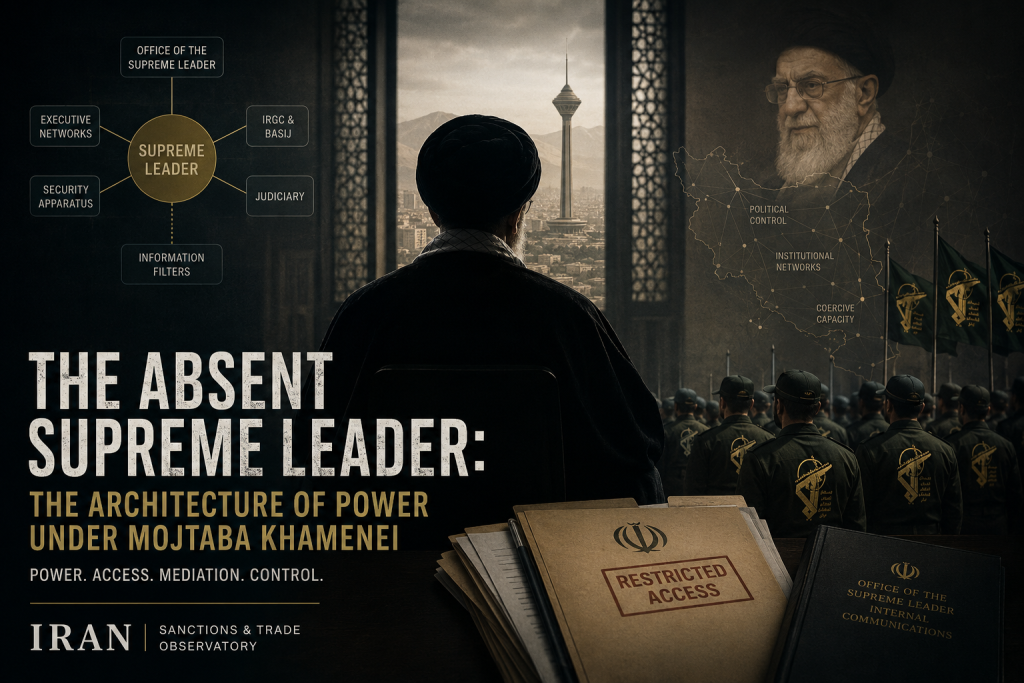
The Absent Supreme Leader: The Architecture of Power Under Mojtaba Khamenei

Introduction: The Leadership Changed. The Machinery Did Not Stop.   On 8 March 2026, Mojtaba Khamenei became Supreme Leader of the Islamic Republic, formally placing him at the apex of a political system whose constitution concentrates extraordinary military, political and institutional authority in the office of the Leader. For years, the central question surrounding Ali

The Absent Supreme Leader: The Architecture of Power Under Mojtaba Khamenei Read More »
Mojtaba Khamenei and the architecture of connective authority

Mojtaba Khamenei and the Architecture of Connective Authority

Introduction — The Authority the State Never Defined For more than two decades, Mojtaba Khamenei appeared repeatedly at the edges of the Islamic Republic’s most consequential political and security decisions. His name surfaced in accounts of electoral intervention, relations with the Islamic Revolutionary Guard Corps, the management of political crises and the increasingly restricted circle

Mojtaba Khamenei and the Architecture of Connective Authority Read More »

Vahid Haghanian and the executive architecture of the Office of the Supreme Leader

The Invisible Executive: Vahid Haghanian and the Executive Architecture of the Office of the Supreme Leader

Introduction Vahid Haghanian’s role within the executive architecture of the Office of the Supreme Leader cannot be understood through biography alone. His significance lies not in the offices he formally occupied, but in the executive functions he performed inside one of the Islamic Republic’s most opaque institutions. Every political system relies upon an institutional mechanism

The Invisible Executive: Vahid Haghanian and the Executive Architecture of the Office of the Supreme Leader Read More »